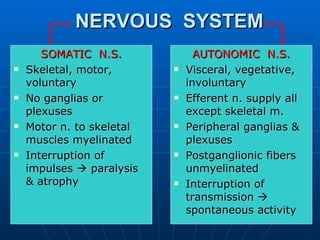
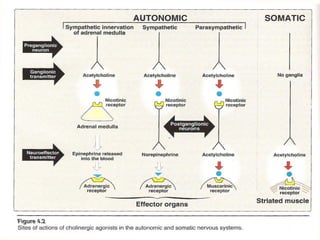
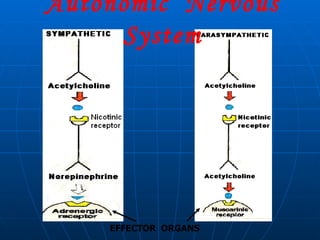
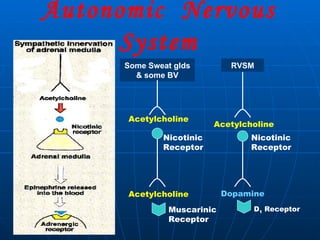
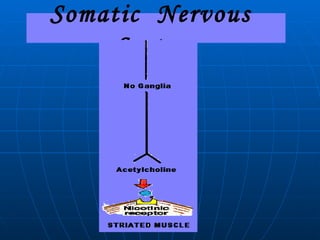
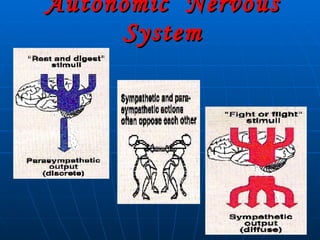
NERVOUS SYSTEMSOMATIC N.S. Skeletal, motor, voluntary No ganglias or plexuses Motor n. to skeletal muscles myelinated Interruption of impulses paralysis & atrophy AUTONOMIC N.S. Visceral, vegetative, involuntary Efferent n. supply all except skeletal m. Peripheral ganglias & plexuses Postganglionic fibers unmyelinated Interruption of transmission spontaneous activity
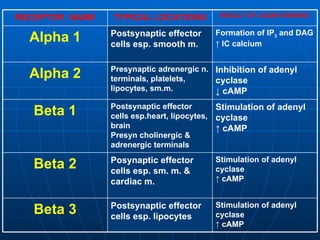
Stimulation of adenylcyclase ↑ cAMP Postsynaptic effector cells esp. lipocytes Beta 3 Stimulation of adenyl cyclase ↑ cAMP Posynaptic effector cells esp. sm. m. & cardiac m. Beta 2 Stimulation of adenyl cyclase ↑ cAMP Postsynaptic effector cells esp.heart, lipocytes, brain Presyn cholinergic & adrenergic terminals Beta 1 Inhibition of adenyl cyclase ↓ cAMP Presynaptic adrenergic n. terminals, platelets, lipocytes, sm.m. Alpha 2 Formation of IP 3 and DAG ↑ IC calcium Postsynaptic effector cells esp. smooth m. Alpha 1 RESULT OF LIGAND BINDING TYPICAL LOCATIONS RECEPTOR NAME
7.
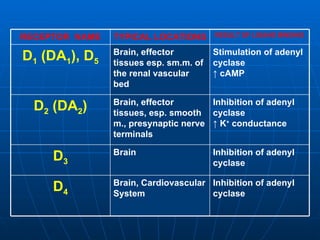
Inhibition of adenylcyclase Brain, Cardiovascular System D 4 Inhibition of adenyl cyclase Brain D 3 Inhibition of adenyl cyclase ↑ K + conductance Brain, effector tissues, esp. smooth m., presynaptic nerve terminals D 2 (DA 2 ) Stimulation of adenyl cyclase ↑ cAMP Brain, effector tissues esp. sm.m. of the renal vascular bed D 1 (DA 1 ), D 5 RESULT OF LIGAND BINDING TYPICAL LOCATIONS RECEPTOR NAME
8.
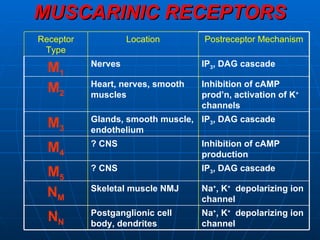
MUSCARINIC RECEPTORS Na+ , K + depolarizing ion channel Postganglionic cell body, dendrites N N Na + , K + depolarizing ion channel Skeletal muscle NMJ N M IP 3 , DAG cascade ? CNS M 5 Inhibition of cAMP production ? CNS M 4 IP 3 , DAG cascade Glands, smooth muscle, endothelium M 3 Inhibition of cAMP prod’n, activation of K + channels Heart, nerves, smooth muscles M 2 IP 3 , DAG cascade Nerves M 1 Postreceptor Mechanism Location Receptor Type
9.
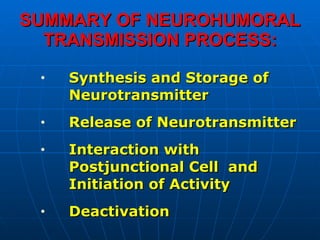
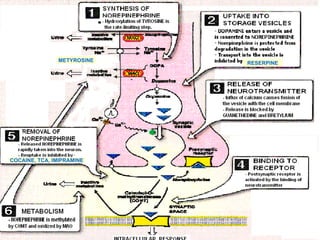
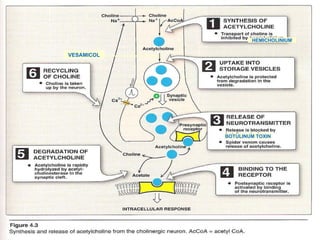
SUMMARY OF NEUROHUMORALTRANSMISSION PROCESS: Synthesis and Storage of Neurotransmitter Release of Neurotransmitter Interaction with Postjunctional Cell and Initiation of Activity Deactivation
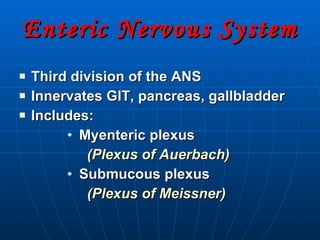
Enteric Nervous System Third division of the ANS Innervates GIT, pancreas, gallbladder Includes: Myenteric plexus (Plexus of Auerbach) Submucous plexus (Plexus of Meissner)
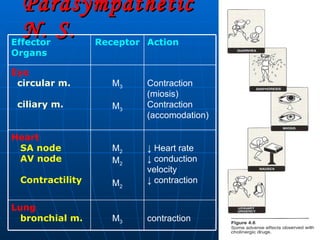
Parasympathetic N. S.contraction M 3 Lung bronchial m. ↓ Heart rate ↓ conduction velocity ↓ contraction M 2 M 2 M 2 Heart SA node AV node Contractility Contraction (miosis) Contraction (accomodation) M 3 M 3 Eye circular m. ciliary m. Action Receptor Effector Organs
22.
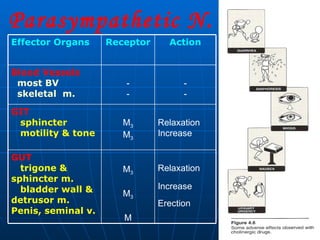
Parasympathetic N. S.Relaxation Increase Erection M 3 M 3 M GUT trigone & sphincter m. bladder wall & detrusor m. Penis, seminal v. Relaxation Increase M 3 M 3 GIT sphincter motility & tone - - - - Blood Vessels most BV skeletal m. Action Receptor Effector Organs
23.
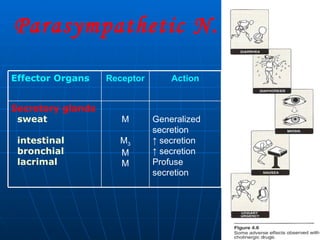
Parasympathetic N. S.Generalized secretion ↑ secretion ↑ secretion Profuse secretion M M 3 M M Secretory glands sweat intestinal bronchial lacrimal Action Receptor Effector Organs
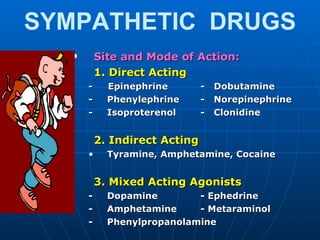
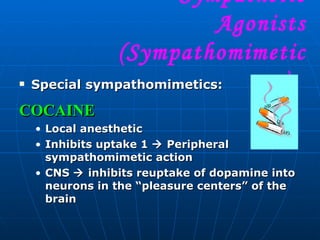
Special sympathomimetics: COCAINELocal anesthetic Inhibits uptake 1 Peripheral sympathomimetic action CNS inhibits reuptake of dopamine into neurons in the “pleasure centers” of the brain Sympathetic Agonists (Sympathomimetics)
33.
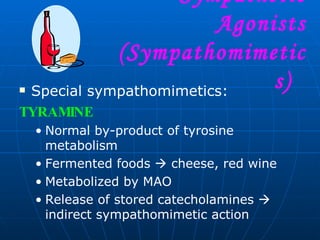
Special sympathomimetics: TYRAMINENormal by-product of tyrosine metabolism Fermented foods cheese, red wine Metabolized by MAO Release of stored catecholamines indirect sympathomimetic action Sympathetic Agonists (Sympathomimetics)
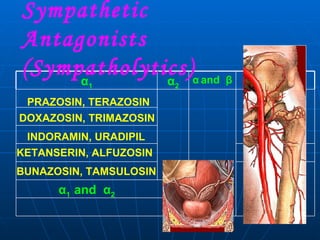
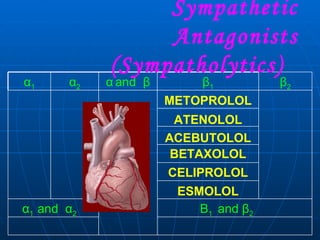
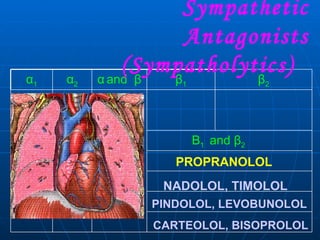
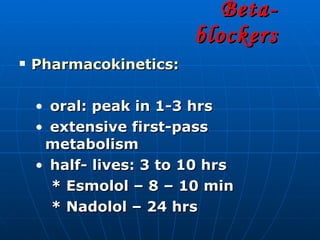
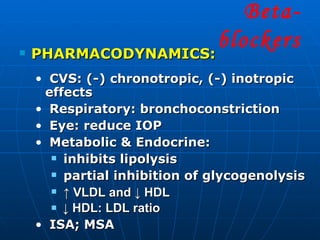
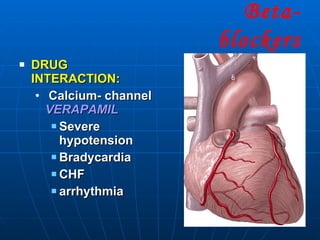
DRUG INTERACTION: Calcium-channel VERAPAMIL Severe hypotension Bradycardia CHF arrhythmia Beta- blockers
51.
“ A heartfeltapology can’t change the past, but it can brighten the future.”
52.
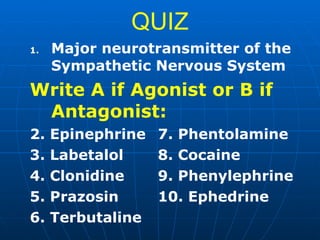
QUIZ Major neurotransmitterof the Sympathetic Nervous System Write A if Agonist or B if Antagonist: 2. Epinephrine 7. Phentolamine 3. Labetalol 8. Cocaine 4. Clonidine 9. Phenylephrine 5. Prazosin 10. Ephedrine 6. Terbutaline










![PRESENTATION FOR Sympathomimetic drugs2 [Autosaved].pptx](https://cdn.slidesharecdn.com/ss_thumbnails/presentationforqn119-122autosaved-241218042132-2fa25051-thumbnail.jpg?width=640&height=640&fit=bounds)
![drugs that affect the autonomic nervous system.ppt [autosaved] [autosaved]](https://cdn.slidesharecdn.com/ss_thumbnails/finaldrugsthataffecttheautonomicnervoussystem-181221100012-thumbnail.jpg?width=640&height=640&fit=bounds)


