Endangered Animals inthe
Philippines
AliahAgnes T. Pigao
ChristineAngela F.
Tañaquin
According to Conservation
International, the Philippines is one
of the biologically richest countries
in the world. Most of the Philippine
islands are covered with rainforests,
but cutting down trees at the
extreme level or disturbing the
natural habitats of native species
leave many species threatened or
endangered.
• PhilippineEagle
• HawksbillSeaTurtle
• PhilippineFreshwater
Crocodile
• Tamaraw
• PhilippineTarsier
• The Mindoro Bleeding-
heart
• Red-ventedCockatoo
• PhilippineForest Turtle
• Philippine Naked-backed
FruitBat
• Rufous-headed Hornbill
• Visayan Warty Pig
• Philippine mouse deer
• sea cow
• whaleshark
Philippine Eagle
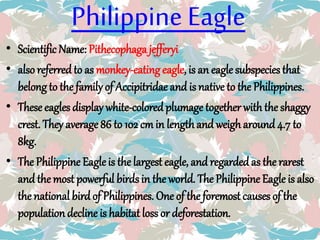
• Scientific Name: Pithecophaga jefferyi
• also referred to as monkey-eatingeagle, is an eagle subspecies that
belongto the familyof Accipitridae and is native to the Philippines.
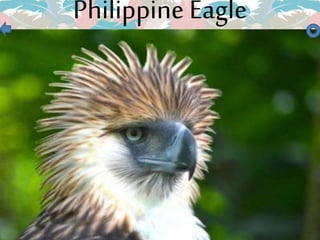
• These eagles display white-colored plumage together withthe shaggy
crest. They average 86 to 102 cmin lengthand weigharound 4.7 to
8kg.
• The Philippine Eagleis the largest eagle, and regardedas the rarest
and themost powerful birds in the world. The Philippine Eagle is also
the national birdof Philippines. One of the foremost causes of the
population decline is habitat loss or deforestation.
Philippine Eagle
Hawksbill SeaTurtle
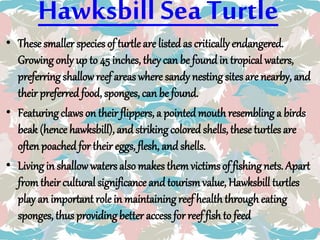
• These smaller species of turtle are listed as critically endangered.
Growing only up to 45 inches, they can be found in tropical waters,
preferring shallow reef areas where sandy nesting sites are nearby, and
their preferred food, sponges, can be found.
• Featuring claws on their flippers, a pointed mouth resembling a birds
beak (hence hawksbill), and striking colored shells, these turtles are
often poached for their eggs, flesh, and shells.
• Living in shallowwaters also makes them victims of fishing nets. Apart
from their cultural significance and tourism value, Hawksbill turtles
play an important role in maintaining reef health through eating
sponges, thus providing better access for reef fish to feed
Hawksbill SeaTurtle
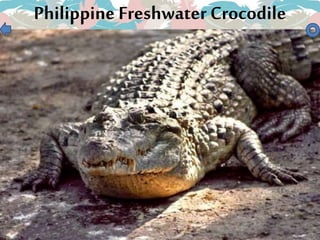
Philippine Freshwater Crocodile
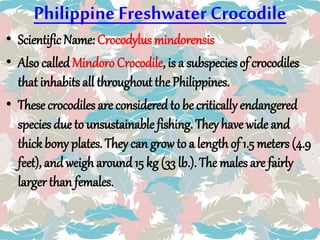
• ScientificName: Crocodylus mindorensis
• Also calledMindoro Crocodile, is a subspecies of crocodiles
that inhabits all throughout the Philippines.
• These crocodiles are consideredto be critically endangered
species due to unsustainable fishing. They have wide and
thick bony plates. They can grow to a length of 1.5 meters (4.9
feet), andweigh around15 kg (33 lb.). The males are fairly
larger than females.
Philippine Freshwater Crocodile
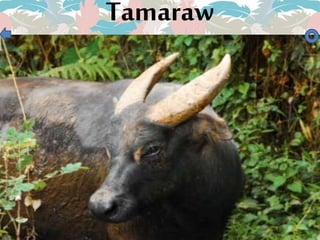
Tamaraw
• Scientific Name: Bubalus mindorensis
• also known as the Mindoro Dwarf Buffalo, is a small mammal
that belongs to the familyof Bovidae.
• These animals are native to the Mindoro Island. They are found
at a level of 2,000meters above sea level. Tamaraws are
critically endangered species as they have been subject to
extreme hunting, habitat loss, and logging. The population of
these species are now limited to few grassy plains
Tamaraw
Philippine Tarsier
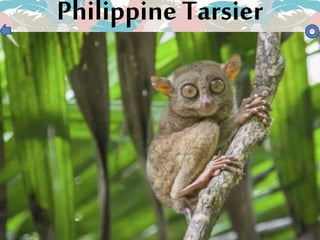
• The Philippine Tarsier (Carlito syrichta) is an
endangered species that is endemic to the
Philippines. These animals are found in the
southeastern region of archipelago, inhabiting the
islands of Leyte, Bohol,Samar, and Mindanao.
Some of these species are known to reside in
Siargao Island, Dinagat Island, and Maripipi Island.
The length of the Philippine tarsier measures
around 118 to 149 mm, with weight measuring at
113 to 142 grams.
Philippine Tarsier
THE MINDOROBLEEDING-HEART
• Scientific Name: Gallicolumbaplatenae
Common Name: Kulo-kulo
Habitat: Mt. Siburan, Mindoro
• Its heart must be bleeding saddened by its fate.
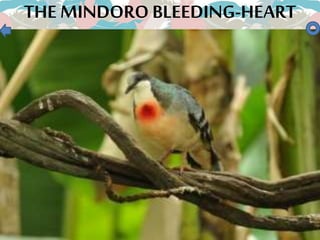
• Another species that is fighting for its very existence is the
Mindoro Bleeding-heart, a type of ground dove with the
unmistakable red markings on its chest. The sad reality is
most, of its natural habitat has been cleared as majority, if not
all, of the primary forests of Mindoro have been cleared.
THE MINDOROBLEEDING-HEART
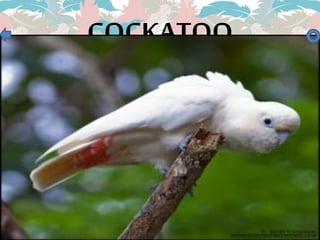
COCKATOO• Scientific Name: Cacatuahaematuropygia
Common Name: Katala, Kalangay
Habitat: Palawan, only about 180 left
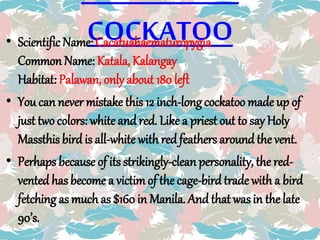
• You can never mistake this 12 inch-long cockatoo made up of
just two colors: white and red. Like a priest out to say Holy
Massthis bird is all-white with red feathers around the vent.
• Perhaps because of its strikingly-clean personality, the red-
vented has become a victimof the cage-bird trade with a bird
fetching as much as $160 in Manila. And that was in the late
90’s.
COCKATOO
PHILIPPINE FORESTTURTLE
• Scientific Name: Siebenrockiellaleytensis
Common Name: Palawan turtle
Habitat: Palawan
• This turtle may have gotten a misnomeras it is totally not endemic to the
island of Leyte but only in the Palawan island group.
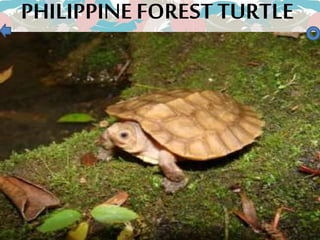
• You can easily distinguishthisland turtle by its ginkgo-shaped vertebral
scutes (at its back). Also, a line which is colored pale white to yellow
traversesacross its head behind the ears.
• They are prized as petsand ranks as one of the most commonly
confiscatedspecies in the Philippineswithoverseas buyers visitingthe
islands to collect them. However, sadly, the Philippine forest turtle do not
do well in captivity making them avery vulnerable species.
PHILIPPINE FORESTTURTLE
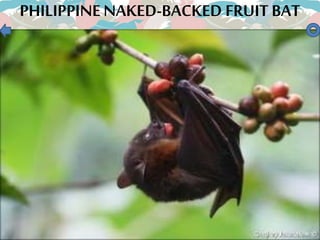
PHILIPPINENAKED-BACKED FRUIT BAT
• Scientific Name: Dobsoniachapmani
Common Name: kwaknit
Habitat: Cebu, NegrosIsland (very small numbers)
• Size is not everything. Beingthe largest cave-dwellingbat in the whole
archipelago measuring up to 220min total lengthis no protection.
Instead, the Philippine naked-backed fruit bat has attracted bad men,
beinghunted for its meat.
• However by some twist of fate, thismegabat specie known for its naked
appearance due to the wingsattachment on the midline of their back,
made an amazing recovery. Reported to be extinct in 1970’s, the night-
flier known to veryequippedat biting through hard-skinned fruits
making themextremely unpopularto farmers, were rediscovered, though
in small numbers by the 2000’s.
• Fortunately, Cebu forestswhere this bat is endemic to is protected by law.
Negros may do well to followsuit.
PHILIPPINENAKED-BACKED FRUIT BAT
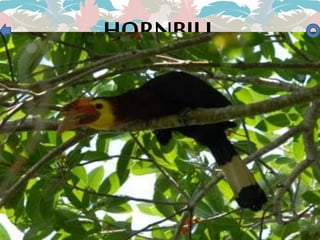
HORNBILL• Scientific Name: Aceroswaldeni
Common Name: Kalaw
Habitat: Panay, some part of Zamboanga del Norte, extinct in
Guimaras
• This bird witha lot of weight on its horn, is found only in the
Philippines. Yes, you’re right. No other country has this mighty
specie.
• That fact alone shouldmake us proud. Had it stayed that way. The
thing is the Kalawor rufous-headed is in an extremely rapid
population decline or in plainEnglish their numbers are dying. It’s a
shame that we can’t take care of sucha wonderful birdtreasure.
HORNBILL
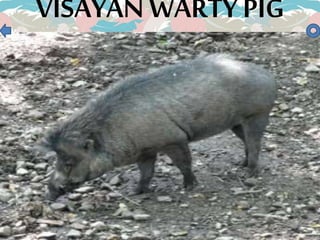
VISAYAN WARTY PIG
• Scientific Name: Suscebifrons
Common Name: Cebuwarty pig, Negros warty pig
Habitat: Cebu, Panay, Negros Island
• It’s no secret Filipino love to eat pork. One of the major reason why
this wild pig known for the 3 pairs of wart in its appearance has
become so rare.
• And to confound things up, the pig has as a subspecies the Cebu
warty pig. Seems things are looking bleak for the boaras Cebuis the
unofficial lechon capital of the Philippines.
• Luckily, breeding programs for the specie are being undertaken in
RotterdamZoo and San Diego Zoo.
VISAYAN WARTY PIG
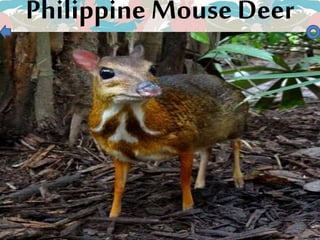
Philippine Mouse Deer
• Scientific Name: Tragulus nigricans
• Also known as Pilandok
• Classified by International Union for Conservation of Nature
(IUCN) as endangered, these are also endemic to the islands
of Palawanand Balacbac. They are usually the subject of local
folklore, but are mostly hunted for their meat.
Philippine Mouse Deer
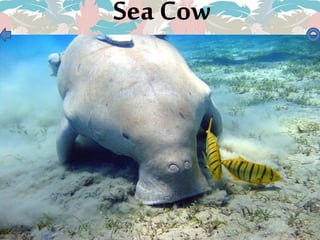
Sea Cow
• Scientific Name: Dugong dugon
• Also known as Dugong
• The dugong is commonlyfound in the tropical waters of the
Philippines, Indian Ocean, and WesternPacific Ocean. It is
classified as vulnerable by the International Union for
Conservation of Nature (IUCN).
Sea Cow
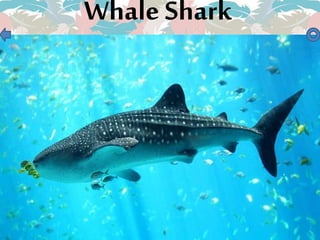
Whale Shark
• Scientific Name: Rhincodon typus
• Also known as Butanding
• The whale shark is one of the world's endangered species and
can be found in almost all tropical waters around the globe. In
the Philippines it is called butanding and is listed vulnerable
by the International Union for Conservation of Nature (IUCN).
Whale Shark
AliahAgnes T.Pigao
Christine AngelaF. Tañaquin
THE END
THANK YOU

Pigao tanaquin

  • 1.
    Endangered Animals inthe Philippines AliahAgnesT. Pigao ChristineAngela F. Tañaquin
  • 2.
    According to Conservation International,the Philippines is one of the biologically richest countries in the world. Most of the Philippine islands are covered with rainforests, but cutting down trees at the extreme level or disturbing the natural habitats of native species leave many species threatened or endangered.
  • 3.
    • PhilippineEagle • HawksbillSeaTurtle •PhilippineFreshwater Crocodile • Tamaraw • PhilippineTarsier • The Mindoro Bleeding- heart • Red-ventedCockatoo • PhilippineForest Turtle • Philippine Naked-backed FruitBat • Rufous-headed Hornbill • Visayan Warty Pig • Philippine mouse deer • sea cow • whaleshark
  • 4.
    Philippine Eagle • ScientificName: Pithecophaga jefferyi • also referred to as monkey-eatingeagle, is an eagle subspecies that belongto the familyof Accipitridae and is native to the Philippines. • These eagles display white-colored plumage together withthe shaggy crest. They average 86 to 102 cmin lengthand weigharound 4.7 to 8kg. • The Philippine Eagleis the largest eagle, and regardedas the rarest and themost powerful birds in the world. The Philippine Eagle is also the national birdof Philippines. One of the foremost causes of the population decline is habitat loss or deforestation.
  • 5.
  • 6.
    Hawksbill SeaTurtle • Thesesmaller species of turtle are listed as critically endangered. Growing only up to 45 inches, they can be found in tropical waters, preferring shallow reef areas where sandy nesting sites are nearby, and their preferred food, sponges, can be found. • Featuring claws on their flippers, a pointed mouth resembling a birds beak (hence hawksbill), and striking colored shells, these turtles are often poached for their eggs, flesh, and shells. • Living in shallowwaters also makes them victims of fishing nets. Apart from their cultural significance and tourism value, Hawksbill turtles play an important role in maintaining reef health through eating sponges, thus providing better access for reef fish to feed
  • 7.
  • 8.
    Philippine Freshwater Crocodile •ScientificName: Crocodylus mindorensis • Also calledMindoro Crocodile, is a subspecies of crocodiles that inhabits all throughout the Philippines. • These crocodiles are consideredto be critically endangered species due to unsustainable fishing. They have wide and thick bony plates. They can grow to a length of 1.5 meters (4.9 feet), andweigh around15 kg (33 lb.). The males are fairly larger than females.
  • 9.
  • 10.
    Tamaraw • Scientific Name:Bubalus mindorensis • also known as the Mindoro Dwarf Buffalo, is a small mammal that belongs to the familyof Bovidae. • These animals are native to the Mindoro Island. They are found at a level of 2,000meters above sea level. Tamaraws are critically endangered species as they have been subject to extreme hunting, habitat loss, and logging. The population of these species are now limited to few grassy plains
  • 11.
  • 12.
    Philippine Tarsier • ThePhilippine Tarsier (Carlito syrichta) is an endangered species that is endemic to the Philippines. These animals are found in the southeastern region of archipelago, inhabiting the islands of Leyte, Bohol,Samar, and Mindanao. Some of these species are known to reside in Siargao Island, Dinagat Island, and Maripipi Island. The length of the Philippine tarsier measures around 118 to 149 mm, with weight measuring at 113 to 142 grams.
  • 13.
  • 14.
    THE MINDOROBLEEDING-HEART • ScientificName: Gallicolumbaplatenae Common Name: Kulo-kulo Habitat: Mt. Siburan, Mindoro • Its heart must be bleeding saddened by its fate. • Another species that is fighting for its very existence is the Mindoro Bleeding-heart, a type of ground dove with the unmistakable red markings on its chest. The sad reality is most, of its natural habitat has been cleared as majority, if not all, of the primary forests of Mindoro have been cleared.
  • 15.
  • 16.
    COCKATOO• Scientific Name:Cacatuahaematuropygia Common Name: Katala, Kalangay Habitat: Palawan, only about 180 left • You can never mistake this 12 inch-long cockatoo made up of just two colors: white and red. Like a priest out to say Holy Massthis bird is all-white with red feathers around the vent. • Perhaps because of its strikingly-clean personality, the red- vented has become a victimof the cage-bird trade with a bird fetching as much as $160 in Manila. And that was in the late 90’s.
  • 17.
  • 18.
    PHILIPPINE FORESTTURTLE • ScientificName: Siebenrockiellaleytensis Common Name: Palawan turtle Habitat: Palawan • This turtle may have gotten a misnomeras it is totally not endemic to the island of Leyte but only in the Palawan island group. • You can easily distinguishthisland turtle by its ginkgo-shaped vertebral scutes (at its back). Also, a line which is colored pale white to yellow traversesacross its head behind the ears. • They are prized as petsand ranks as one of the most commonly confiscatedspecies in the Philippineswithoverseas buyers visitingthe islands to collect them. However, sadly, the Philippine forest turtle do not do well in captivity making them avery vulnerable species.
  • 19.
  • 20.
    PHILIPPINENAKED-BACKED FRUIT BAT •Scientific Name: Dobsoniachapmani Common Name: kwaknit Habitat: Cebu, NegrosIsland (very small numbers) • Size is not everything. Beingthe largest cave-dwellingbat in the whole archipelago measuring up to 220min total lengthis no protection. Instead, the Philippine naked-backed fruit bat has attracted bad men, beinghunted for its meat. • However by some twist of fate, thismegabat specie known for its naked appearance due to the wingsattachment on the midline of their back, made an amazing recovery. Reported to be extinct in 1970’s, the night- flier known to veryequippedat biting through hard-skinned fruits making themextremely unpopularto farmers, were rediscovered, though in small numbers by the 2000’s. • Fortunately, Cebu forestswhere this bat is endemic to is protected by law. Negros may do well to followsuit.
  • 21.
  • 22.
    HORNBILL• Scientific Name:Aceroswaldeni Common Name: Kalaw Habitat: Panay, some part of Zamboanga del Norte, extinct in Guimaras • This bird witha lot of weight on its horn, is found only in the Philippines. Yes, you’re right. No other country has this mighty specie. • That fact alone shouldmake us proud. Had it stayed that way. The thing is the Kalawor rufous-headed is in an extremely rapid population decline or in plainEnglish their numbers are dying. It’s a shame that we can’t take care of sucha wonderful birdtreasure.
  • 23.
  • 24.
    VISAYAN WARTY PIG •Scientific Name: Suscebifrons Common Name: Cebuwarty pig, Negros warty pig Habitat: Cebu, Panay, Negros Island • It’s no secret Filipino love to eat pork. One of the major reason why this wild pig known for the 3 pairs of wart in its appearance has become so rare. • And to confound things up, the pig has as a subspecies the Cebu warty pig. Seems things are looking bleak for the boaras Cebuis the unofficial lechon capital of the Philippines. • Luckily, breeding programs for the specie are being undertaken in RotterdamZoo and San Diego Zoo.
  • 25.
  • 26.
    Philippine Mouse Deer •Scientific Name: Tragulus nigricans • Also known as Pilandok • Classified by International Union for Conservation of Nature (IUCN) as endangered, these are also endemic to the islands of Palawanand Balacbac. They are usually the subject of local folklore, but are mostly hunted for their meat.
  • 27.
  • 28.
    Sea Cow • ScientificName: Dugong dugon • Also known as Dugong • The dugong is commonlyfound in the tropical waters of the Philippines, Indian Ocean, and WesternPacific Ocean. It is classified as vulnerable by the International Union for Conservation of Nature (IUCN).
  • 29.
  • 30.
    Whale Shark • ScientificName: Rhincodon typus • Also known as Butanding • The whale shark is one of the world's endangered species and can be found in almost all tropical waters around the globe. In the Philippines it is called butanding and is listed vulnerable by the International Union for Conservation of Nature (IUCN).
  • 31.
  • 32.
    AliahAgnes T.Pigao Christine AngelaF.Tañaquin THE END THANK YOU