A
Technical Seminar
on
FLOATING SOLAR
By
K.AJAY KUMAR
(15HM5A0201)
Department of Electrical And Electronics Engineering
Annamacharya Institute of Technology and
Sciences::Kadapa
INTRODUCTION:
Ever increasing power demand & depletion of fuels.
Leads to shift our focus to renewable energy sources.
Wind & hydro RE sources are area specific.
PV can be installed ay any place. Floating solar PV
results is decrease in cost.
Major issue of solar PV is requirement of land.
But floating solar can be installed on any water
bodies.
Growth of city trees
can cut
Growth of people occupies
more land
FLOATING SOLAR
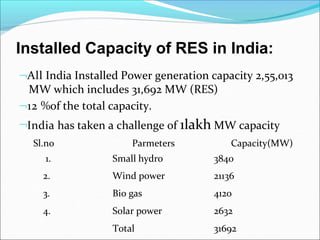
All India Installed Power generation capacity 2,55,013
MW which includes 31,692 MW (RES)
12 %of the total capacity.
India has taken a challenge of 1lakh MW capacity
Sl.no Parmeters Capacity(MW)
1. Small hydro 3840
2. Wind power 21136
3. Bio gas 4120
4. Solar power 2632
Total 31692
Installed Capacity of RES in India:
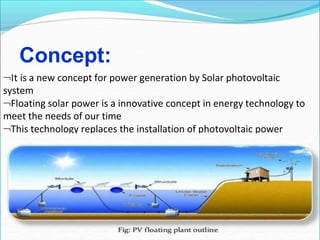
Concept:
It is a new concept for power generation by Solar photovoltaic
system
Floating solar power is a innovative concept in energy technology to
meet the needs of our time
This technology replaces the installation of photovoltaic power
plants over precious land.
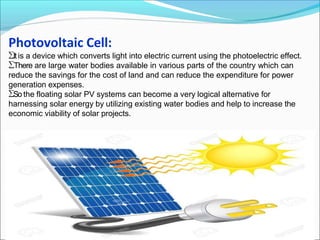
Photovoltaic Cell:
Itis a device which converts light into electric current using the photoelectric effect.
There are large water bodies available in various parts of the country which can
reduce the savings for the cost of land and can reduce the expenditure for power
generation expenses.
So the floating solar PV systems can become a very logical alternative for
harnessing solar energy by utilizing existing water bodies and help to increase the
economic viability of solar projects.
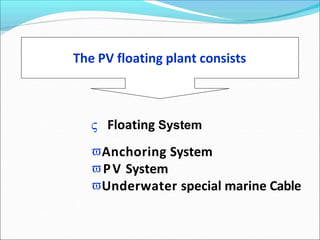
 Floating System
Anchoring System
PV System
Underwater special marine Cable
The PV floating plant consists
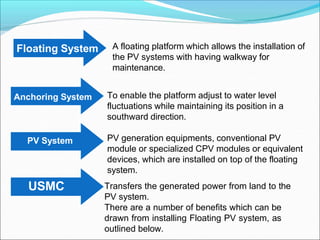
A floating platform which allows the installation of
the PV systems with having walkway for
maintenance.
Floating System
Anchoring System To enable the platform adjust to water level
fluctuations while maintaining its position in a
southward direction.
PV System
USMC
PV generation equipments, conventional PV
module or specialized CPV modules or equivalent
devices, which are installed on top of the floating
system.
Transfers the generated power from land to the
PV system.
There are a number of benefits which can be
drawn from installing Floating PV system, as
outlined below.
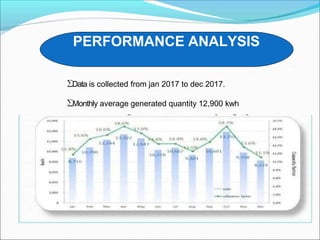
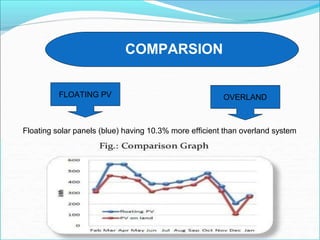
Data is collected from jan 2017 to dec 2017.
Monthly average generated quantity 12,900 kwh
PERFORMANCE ANALYSIS
COMPARSION
FLOATING PV OVERLAND
Floating solar panels (blue) having 10.3% more efficient than overland system
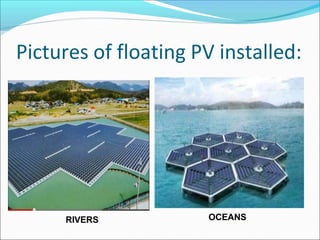
Pictures of floating PV installed:
RIVERS OCEANS
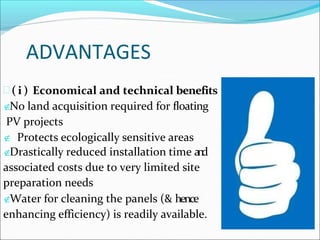
ADVANTAGES
 ( i ) Economical and technical benefits
No land acquisition required for floating
PV projects
 Protects ecologically sensitive areas
Drastically reduced installation time a
n
d
associated costs due to very limited site
preparation needs
Water for cleaning the panels (& hence
enhancing efficiency) is readily available.
DISADVANTAGES:
Folating solar plant as a problem with end-user
power demand and supply not being
synchronized.
The access to the installations is critical when
working off-shore.
Infrastructure is costly when working off-shore.
Contact:-7382778092

pptajay-180629114156.pptx

  • 1.
    A Technical Seminar on FLOATING SOLAR By K.AJAYKUMAR (15HM5A0201) Department of Electrical And Electronics Engineering Annamacharya Institute of Technology and Sciences::Kadapa
  • 2.
    INTRODUCTION: Ever increasing powerdemand & depletion of fuels. Leads to shift our focus to renewable energy sources. Wind & hydro RE sources are area specific. PV can be installed ay any place. Floating solar PV results is decrease in cost. Major issue of solar PV is requirement of land. But floating solar can be installed on any water bodies.
  • 3.
    Growth of citytrees can cut Growth of people occupies more land
  • 4.
  • 5.
    All India InstalledPower generation capacity 2,55,013 MW which includes 31,692 MW (RES) 12 %of the total capacity. India has taken a challenge of 1lakh MW capacity Sl.no Parmeters Capacity(MW) 1. Small hydro 3840 2. Wind power 21136 3. Bio gas 4120 4. Solar power 2632 Total 31692 Installed Capacity of RES in India:
  • 6.
    Concept: It is anew concept for power generation by Solar photovoltaic system Floating solar power is a innovative concept in energy technology to meet the needs of our time This technology replaces the installation of photovoltaic power plants over precious land.
  • 7.
    Photovoltaic Cell: Itis adevice which converts light into electric current using the photoelectric effect. There are large water bodies available in various parts of the country which can reduce the savings for the cost of land and can reduce the expenditure for power generation expenses. So the floating solar PV systems can become a very logical alternative for harnessing solar energy by utilizing existing water bodies and help to increase the economic viability of solar projects.
  • 8.
     Floating System AnchoringSystem PV System Underwater special marine Cable The PV floating plant consists
  • 9.
    A floating platformwhich allows the installation of the PV systems with having walkway for maintenance. Floating System Anchoring System To enable the platform adjust to water level fluctuations while maintaining its position in a southward direction. PV System USMC PV generation equipments, conventional PV module or specialized CPV modules or equivalent devices, which are installed on top of the floating system. Transfers the generated power from land to the PV system. There are a number of benefits which can be drawn from installing Floating PV system, as outlined below.
  • 10.
    Data is collectedfrom jan 2017 to dec 2017. Monthly average generated quantity 12,900 kwh PERFORMANCE ANALYSIS
  • 11.
    COMPARSION FLOATING PV OVERLAND Floatingsolar panels (blue) having 10.3% more efficient than overland system
  • 12.
    Pictures of floatingPV installed: RIVERS OCEANS
  • 13.
    ADVANTAGES  ( i) Economical and technical benefits No land acquisition required for floating PV projects  Protects ecologically sensitive areas Drastically reduced installation time a n d associated costs due to very limited site preparation needs Water for cleaning the panels (& hence enhancing efficiency) is readily available.
  • 14.
    DISADVANTAGES: Folating solar plantas a problem with end-user power demand and supply not being synchronized. The access to the installations is critical when working off-shore. Infrastructure is costly when working off-shore.
  • 15.