V/S
Valuation of online
retail Companies on
the basis of Real Value
AMAZON Vs. FLIPKART
Introduction
 We all know online shopping in India is growing at a very fast clip. At the same time, there
is an intense competition in e-commerce space, especially among the top 3 players.
Another aspect that everyone is probably aware about is, all this aggressive pricing and
discounts are being paid by Venture Capitalists’ pockets.
 Flipkart and Amazon, all of them have raised investments or have commitments of $1
Billion or more. This money is being burned to acquire new customers, offer discounts
and pump up products on offer. While we are all aware that these sites are losing money,
you will be amazed to know the quantum of loss these ecommerce players have incurred.
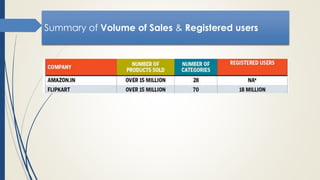
Summary of Volume of Sales & Registered users
[Data Source: Techcircle] Note: All figures are in INR Crore
GMV & Losses Comparison
179 168.9
400
321.3
0
50
100
150
200
250
300
350
400
450
Flipkart Amazon
Rs.InCrores
Company
Net Profit Losses
 Please note that the revenue figures above are not the price of products sold (GMV), as
these are all marketplaces, and their revenues come from commissions they get from sellers
or listing fees that they charge to list the products on their site.
 GMV or Gross Merchandize Value represents the price of products sold and net
revenues is just a fraction of that!
 Flipkart leads the race with net revenue of 179 crore followed by Amazon at 168.9 crore
and Snapdeal at 154.11 crore.
 However, when it comes to losses, Flipkart leads by a much bigger margin and their loss for
2013-14 stands at Rs. 400 Crore. Comparatively, Amazon losses are pegged at Rs. 321.3
crore and Snapdeal had least losses of 3 with 264.6 crore
 If an e-commerce site sells a mobile phone for Rs 5,000 through a third party and keeps a
margin of Rs 500, the GMV is on the basis of the bill and not the margin
 GMV is an annual figure of all goods sold on the site, but the value is derived from the
latest monthly figures
GMV is not the right indicator of value
always!
 So far, no e-commerce company in India is listed, though there’s talk of Flipkart planning
an Initial Public Offering in 12-18 months. Also, these companies do not give official
targets, only setting internal goals. Often, GMV turned out a key figure in assessing the
value of an e-commerce company, an official said. As such, at a GMV of $4 billion (Rs
24,000 crore), Flipkart could be valued at about $12.5 billion (Rs 75,000 crore) or higher,
while Snapdeal, with a GMV of $2 billion (Rs 12,000 crore), could be valued at about $5
billion (Rs 30,000 crore).
A source said, “The valuation shooting up because of GMV is a short-term phenomenon.”
Though GMV and revenue are the only indicators of valuation as of now, investors will
soon ask about the profitability. For 2013-14, the cumulative losses of Flipkart, Snapdeal
and Amazon India were more than Rs 1,000 crore. All these companies have maintained
they were in a growth mode, adding it was a conscious choice to not look at profitability
then.
So where are we headed to when we
say Real Value?
 The research firm Forrester estimates that e-commerce is now approaching $200 billion in
revenue in the United States alone and accounts for 9% of total retail sales. The
corresponding figure is about 3% in Asia-Pacific.
 Globally, digital retailing is probably headed toward 15% to 20% of total sales, though
the proportion will vary significantly by sector. Moreover, much digital retailing is now
highly profitable.
 What we are seeing today is only the beginning. Soon it will be hard even to define
e-commerce, let alone measure it. Is it an e-commerce sale if the customer goes to a store,
finds that the product is out of stock, and uses an in-store terminal to have another location
ship it to her home? What if the customer is shopping in one store, uses his smartphone to
find a lower price at another, and then orders it electronically for in-store pickup? How
about gifts that are ordered from a website but exchanged at a local store? Experts estimate
that digital information already influences about 50% of store sales, and that number is
growing rapidly.
Harvard Business Review 2011-12 (The future of shopping)
 As it evolves, digital retailing is quickly morphing into something so different that it
requires a new name: Omni channel retailing. The name reflects the fact that retailers will
be able to interact with customers through countless channels—websites, physical stores,
kiosks, direct mail and catalogs, call centers, social media, mobile devices, gaming
consoles, televisions, networked appliances, home services, and more. Unless
conventional merchants adopt an entirely new perspective—one that allows them to
integrate disparate channels into a single seamless Omni channel experience—they are
likely to be swept away.
Amazon’s Techniques
 It's been almost 3 years since Amazon, the $75 billion American e-tailer, launched a full-
fledged online marketplace in India.
 Amazon made a soft launch in India in February 2012. It dusted out a property it had
bought in the US way back in 1998, Junglee, and launched it in India as a price-comparison
website.
 In fact, it's taking its sister site -- the two share infrastructure - to the next level, tailoring it
to flank its main marketplace (amazon.in). Amazon has not adopted this double-play
strategy in any of its other 12 markets. It's a strategy none of its rivals in India have
adopted. "Comparison shopping sites have not worked globally," says Niren Shah,
managing director, of Norwest Venture Partners, a venture-capital fund. "But Amazon
faces tough competition from local players and is now using Junglee as a flanking
strategy - a test platform to try out categories and products before offering them on
amazon.in."
Competitive Profile Matrix
• CPM identifies the firm’s major strength and weakness in relation to
another firm’s strategic position
• Critical success factors (CSF) ensure success for an organization
Flipkart’s Techniques
• Membership cards and premium facilities.
• Extended range of academic books.
• Providing Sponsorships.
• Vernacular language option on websites.
• Better featured user interface.
• Cost cutting on packaging.
• Flipifts
• Liquor
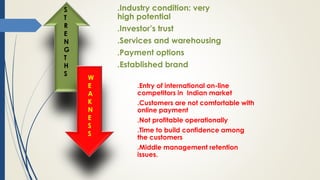
.Industry condition: very
high potential
.Investor’s trust
.Services and warehousing
.Payment options
.Established brand
.Entry of international on-line
competitors in Indian market
.Customers are not comfortable with
online payment
.Not profitable operationally
.Time to build confidence among
the customers
.Middle management retention
issues.
S
T
R
E
N
G
T
H
S
W
E
A
K
N
E
S
S
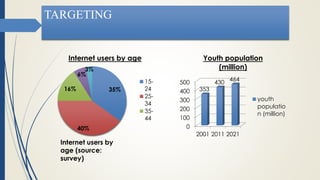
0
100
200
300
400
500
2001 2011 2021
353
430
464
Youth population
(million)
youth
populatio
n (million)
35%
40%
16%
6%
3%
Internet users by age
15-
24
25-
34
35-
44
Internet users by
age (source:
survey)
TARGETING
FLIPIFT’S COMPETITORS
Archies
Indiang
iftsport
al.com
Red
moments iFEEL Cafepres
s.com
FLIPIFT’S:-
•All consumer goods, generic gift products, customized goods.
•A different section for generic and customized products under flipift
•Presto, customized gift manufacturer and retailer-sole provider of customized goods
•Will also be supported by IP tracking systems to enhance repeatability.
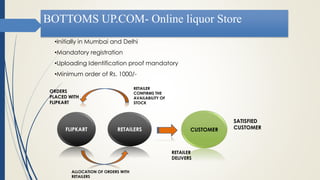
BOTTOMS UP.COM- Online liquor Store
FLIPKART RETAILERS CUSTOMER
ORDERS
PLACED WITH
FLIPKART
ALLOCATION OF ORDERS WITH
RETAILERS
RETAILER
CONFIRMS THE
AVAILABILITY OF
STOCK
RETAILER
DELIVERS
SATISFIED
CUSTOMER
•Initially in Mumbai and Delhi
•Mandatory registration
•Uploading Identification proof mandatory
•Minimum order of Rs. 1000/-
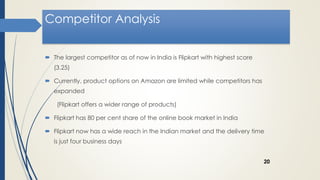
Competitor Analysis
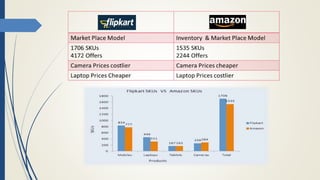
 The largest competitor as of now in India is Flipkart with highest score
(3.25)
 Currently, product options on Amazon are limited while competitors has
expanded
(Flipkart offers a wider range of products)
 Flipkart has 80 per cent share of the online book market in India
 Flipkart now has a wide reach in the Indian market and the delivery time
is just four business days
20
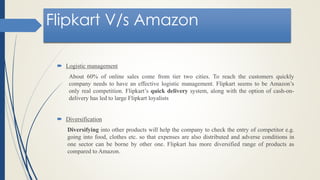
 Logistic management
About 60% of online sales come from tier two cities. To reach the customers quickly
company needs to have an effective logistic management. Flipkart seems to be Amazon’s
only real competition. Flipkart’s quick delivery system, along with the option of cash-on-
delivery has led to large Flipkart loyalists
 Diversification
Diversifying into other products will help the company to check the entry of competitor e.g.
going into food, clothes etc. so that expenses are also distributed and adverse conditions in
one sector can be borne by other one. Flipkart has more diversified range of products as
compared to Amazon.
Flipkart V/s Amazon
Comparison based on other parameters
AMAZON
 80 percent of Amazon’s product
reviews were positive. people who
received free products from
publishers, agents, authors, and
manufacturers liked them.
FLIPKART
 In India Flipkart is in operation since
2007, and from then for most of its
products in popular categories, a lot
of customer reviews giving a fair
idea of the product are available.
Glowing reviews:
Value-added differentiation
AMAZON
 Amazon.in works hard to
achieve value-added
differentiation through customer-
focused information services.
Amazon.in's site retains customer
preferences and provides
automated customization for users
FLIPKART
 Flipkart lag in value added
differentiation and should focus on
the customer preferences and
give them advantage of
customization of product.
Price Control
AMAZON
 Amazon still manage to get a hold
on its price differentiation when
compared to other physical or
online store
FLIPKART
 But with flip kart , they are still not
getting it. Customer still find a wide
gap in price between flip kart and
other online store.
Thank-You!

Flipkart,com V/s Amazon.in

  • 2.
  • 3.
    Valuation of online retailCompanies on the basis of Real Value AMAZON Vs. FLIPKART
  • 4.
    Introduction  We allknow online shopping in India is growing at a very fast clip. At the same time, there is an intense competition in e-commerce space, especially among the top 3 players. Another aspect that everyone is probably aware about is, all this aggressive pricing and discounts are being paid by Venture Capitalists’ pockets.  Flipkart and Amazon, all of them have raised investments or have commitments of $1 Billion or more. This money is being burned to acquire new customers, offer discounts and pump up products on offer. While we are all aware that these sites are losing money, you will be amazed to know the quantum of loss these ecommerce players have incurred.
  • 5.
    Summary of Volumeof Sales & Registered users
  • 6.
    [Data Source: Techcircle]Note: All figures are in INR Crore GMV & Losses Comparison 179 168.9 400 321.3 0 50 100 150 200 250 300 350 400 450 Flipkart Amazon Rs.InCrores Company Net Profit Losses
  • 7.
     Please notethat the revenue figures above are not the price of products sold (GMV), as these are all marketplaces, and their revenues come from commissions they get from sellers or listing fees that they charge to list the products on their site.  GMV or Gross Merchandize Value represents the price of products sold and net revenues is just a fraction of that!  Flipkart leads the race with net revenue of 179 crore followed by Amazon at 168.9 crore and Snapdeal at 154.11 crore.  However, when it comes to losses, Flipkart leads by a much bigger margin and their loss for 2013-14 stands at Rs. 400 Crore. Comparatively, Amazon losses are pegged at Rs. 321.3 crore and Snapdeal had least losses of 3 with 264.6 crore  If an e-commerce site sells a mobile phone for Rs 5,000 through a third party and keeps a margin of Rs 500, the GMV is on the basis of the bill and not the margin  GMV is an annual figure of all goods sold on the site, but the value is derived from the latest monthly figures
  • 8.
    GMV is notthe right indicator of value always!  So far, no e-commerce company in India is listed, though there’s talk of Flipkart planning an Initial Public Offering in 12-18 months. Also, these companies do not give official targets, only setting internal goals. Often, GMV turned out a key figure in assessing the value of an e-commerce company, an official said. As such, at a GMV of $4 billion (Rs 24,000 crore), Flipkart could be valued at about $12.5 billion (Rs 75,000 crore) or higher, while Snapdeal, with a GMV of $2 billion (Rs 12,000 crore), could be valued at about $5 billion (Rs 30,000 crore). A source said, “The valuation shooting up because of GMV is a short-term phenomenon.” Though GMV and revenue are the only indicators of valuation as of now, investors will soon ask about the profitability. For 2013-14, the cumulative losses of Flipkart, Snapdeal and Amazon India were more than Rs 1,000 crore. All these companies have maintained they were in a growth mode, adding it was a conscious choice to not look at profitability then.
  • 9.
    So where arewe headed to when we say Real Value?  The research firm Forrester estimates that e-commerce is now approaching $200 billion in revenue in the United States alone and accounts for 9% of total retail sales. The corresponding figure is about 3% in Asia-Pacific.  Globally, digital retailing is probably headed toward 15% to 20% of total sales, though the proportion will vary significantly by sector. Moreover, much digital retailing is now highly profitable.  What we are seeing today is only the beginning. Soon it will be hard even to define e-commerce, let alone measure it. Is it an e-commerce sale if the customer goes to a store, finds that the product is out of stock, and uses an in-store terminal to have another location ship it to her home? What if the customer is shopping in one store, uses his smartphone to find a lower price at another, and then orders it electronically for in-store pickup? How about gifts that are ordered from a website but exchanged at a local store? Experts estimate that digital information already influences about 50% of store sales, and that number is growing rapidly. Harvard Business Review 2011-12 (The future of shopping)
  • 10.
     As itevolves, digital retailing is quickly morphing into something so different that it requires a new name: Omni channel retailing. The name reflects the fact that retailers will be able to interact with customers through countless channels—websites, physical stores, kiosks, direct mail and catalogs, call centers, social media, mobile devices, gaming consoles, televisions, networked appliances, home services, and more. Unless conventional merchants adopt an entirely new perspective—one that allows them to integrate disparate channels into a single seamless Omni channel experience—they are likely to be swept away.
  • 11.
    Amazon’s Techniques  It'sbeen almost 3 years since Amazon, the $75 billion American e-tailer, launched a full- fledged online marketplace in India.  Amazon made a soft launch in India in February 2012. It dusted out a property it had bought in the US way back in 1998, Junglee, and launched it in India as a price-comparison website.  In fact, it's taking its sister site -- the two share infrastructure - to the next level, tailoring it to flank its main marketplace (amazon.in). Amazon has not adopted this double-play strategy in any of its other 12 markets. It's a strategy none of its rivals in India have adopted. "Comparison shopping sites have not worked globally," says Niren Shah, managing director, of Norwest Venture Partners, a venture-capital fund. "But Amazon faces tough competition from local players and is now using Junglee as a flanking strategy - a test platform to try out categories and products before offering them on amazon.in."
  • 12.
    Competitive Profile Matrix •CPM identifies the firm’s major strength and weakness in relation to another firm’s strategic position • Critical success factors (CSF) ensure success for an organization
  • 13.
    Flipkart’s Techniques • Membershipcards and premium facilities. • Extended range of academic books. • Providing Sponsorships. • Vernacular language option on websites. • Better featured user interface. • Cost cutting on packaging. • Flipifts • Liquor
  • 14.
    .Industry condition: very highpotential .Investor’s trust .Services and warehousing .Payment options .Established brand .Entry of international on-line competitors in Indian market .Customers are not comfortable with online payment .Not profitable operationally .Time to build confidence among the customers .Middle management retention issues. S T R E N G T H S W E A K N E S S
  • 15.
    0 100 200 300 400 500 2001 2011 2021 353 430 464 Youthpopulation (million) youth populatio n (million) 35% 40% 16% 6% 3% Internet users by age 15- 24 25- 34 35- 44 Internet users by age (source: survey) TARGETING
  • 16.
    FLIPIFT’S COMPETITORS Archies Indiang iftsport al.com Red moments iFEELCafepres s.com FLIPIFT’S:- •All consumer goods, generic gift products, customized goods. •A different section for generic and customized products under flipift •Presto, customized gift manufacturer and retailer-sole provider of customized goods •Will also be supported by IP tracking systems to enhance repeatability.
  • 17.
    BOTTOMS UP.COM- Onlineliquor Store FLIPKART RETAILERS CUSTOMER ORDERS PLACED WITH FLIPKART ALLOCATION OF ORDERS WITH RETAILERS RETAILER CONFIRMS THE AVAILABILITY OF STOCK RETAILER DELIVERS SATISFIED CUSTOMER •Initially in Mumbai and Delhi •Mandatory registration •Uploading Identification proof mandatory •Minimum order of Rs. 1000/-
  • 18.
    Competitor Analysis  Thelargest competitor as of now in India is Flipkart with highest score (3.25)  Currently, product options on Amazon are limited while competitors has expanded (Flipkart offers a wider range of products)  Flipkart has 80 per cent share of the online book market in India  Flipkart now has a wide reach in the Indian market and the delivery time is just four business days 20
  • 19.
     Logistic management About60% of online sales come from tier two cities. To reach the customers quickly company needs to have an effective logistic management. Flipkart seems to be Amazon’s only real competition. Flipkart’s quick delivery system, along with the option of cash-on- delivery has led to large Flipkart loyalists  Diversification Diversifying into other products will help the company to check the entry of competitor e.g. going into food, clothes etc. so that expenses are also distributed and adverse conditions in one sector can be borne by other one. Flipkart has more diversified range of products as compared to Amazon. Flipkart V/s Amazon
  • 21.
    Comparison based onother parameters AMAZON  80 percent of Amazon’s product reviews were positive. people who received free products from publishers, agents, authors, and manufacturers liked them. FLIPKART  In India Flipkart is in operation since 2007, and from then for most of its products in popular categories, a lot of customer reviews giving a fair idea of the product are available. Glowing reviews:
  • 22.
    Value-added differentiation AMAZON  Amazon.inworks hard to achieve value-added differentiation through customer- focused information services. Amazon.in's site retains customer preferences and provides automated customization for users FLIPKART  Flipkart lag in value added differentiation and should focus on the customer preferences and give them advantage of customization of product.
  • 23.
    Price Control AMAZON  Amazonstill manage to get a hold on its price differentiation when compared to other physical or online store FLIPKART  But with flip kart , they are still not getting it. Customer still find a wide gap in price between flip kart and other online store.
  • 24.