02/05/15 10:28 amFlashcards Table on IGCSE Biology All Topics
Page 1 of 34http://www.proprofs.com/flashcards/cardshowall.php?title=igcse-biology-all-topics
Home (/flashcards/) Create Flashcards (/flashcards/create-flashcards.php)
Browse (/flashcards/browse/) Tour (/flashcards/tour/) Pricing (/flashcards/signup/business/)
Text Size: S | M |
L
(855) 776-7763
IGCSE Biology All Topics
Total Flash Cards » 38
Cells
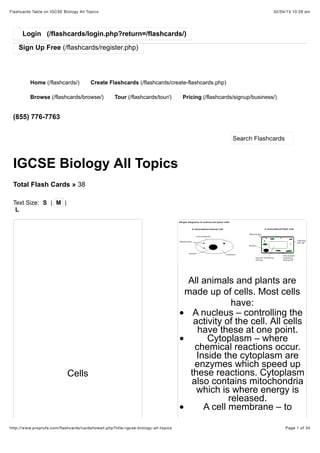
All animals and plants are
made up of cells. Most cells
have:
A nucleus – controlling the
activity of the cell. All cells
have these at one point.
Cytoplasm – where
chemical reactions occur.
Inside the cytoplasm are
enzymes which speed up
these reactions. Cytoplasm
also contains mitochondria
which is where energy is
released.
A cell membrane – to
Login (/flashcards/login.php?return=/flashcards/)
Sign Up Free (/flashcards/register.php)
Search Flashcards
02/05/15 10:28 amFlashcards Table on IGCSE Biology All Topics
Page 2 of 34http://www.proprofs.com/flashcards/cardshowall.php?title=igcse-biology-all-topics
control the passage of
substances in and out of
the cell.
Plants also have
Cell walls – to strengthen
the cell.
Chloroplasts – to absorb
sunlight energy to make
food by photosynthesis.
Vacuole –full of cell sap.
Cells, tissues and organs
Cells act together to form
tissues. For instance, the cells
on the surface of a leaf form
"pallisade tissue". A group of
cells with similar structures
and a particular function are
called a tissue. Tissues are
grouped together to form an
organ. A leaf is an organ.
Organs are grouped together
to form an organism such as a
whole plant or animal.
Cells ----> Tissue ----> Organ -
---> Organism
Tissues are usually formed
from specialised cells. The
cells in the pallisade tissue are
specialised to perform
photosynthesis and contain
many chloroplasts. Some
other specialised cells are:
Guard cells
Egg cells
Sperm cells
Red blood cells
02/05/15 10:28 amFlashcards Table on IGCSE Biology All Topics
Page 3 of 34http://www.proprofs.com/flashcards/cardshowall.php?title=igcse-biology-all-topics
Diffusion
Diffusion is the net movement
of particles from an area of
high concentration to an area
of a lower concentration. The
steeper the concentration
gradient, the more rapid the
rate of diffusion.
2 examples of diffusion are:
Oxygen (required for
respiration) passes through
cell membranes and gas
exchange surfaces (e.g.
alveoli in lungs) by diffusion
Carbon dioxide enters
leaves and leaf cells by
diffusion
Osmosis
Osmosis is the movement of
water from an area of high
water concentration (more
dilute) to an area of a low
water concentration (stronger)
through a partially permeable
membrane.
A partially permeable
membrane allows water
molecules to pass through (as
they are smaller) but not
solute molecules (they are too
big). It acts like a sieve.
Visking tubing is a partially
permeable membrane. It is
used in dialysis machines.
Diffusion and osmosis can
02/05/15 10:28 amFlashcards Table on IGCSE Biology All Topics
Page 4 of 34http://www.proprofs.com/flashcards/cardshowall.php?title=igcse-biology-all-topics
Active Transport
only work if the concentration
gradient is right. Sometimes
an organism needs to
transport something against a
concentration gradient. The
only way this can be done is
through active transport, using
energy produced by
respiration. In Active transport,
the particles move across a
cell membrane from a lower to
a higher concentration.
Examples of active transport
In plants: Plants need mineral
salts (e.g. nitrates) for making
proteins and growth. Nitrates
are at a higher concentration
inside the root cells than they
are when dissolved in the
water around the soil particles.
If the plant relied on diffusion
alone, the vital nitrate salts
would drain out of the cells
into the soil. So energy is
deployed by the cells to
actively transport nitrates
across the cell membrane into
the root cells, against the
concentration gradient. In
humans Active transport
takes place during digestion of
food in the small intestine.
After food has been absorbed
by the villi for some time, the
concentration of food
02/05/15 10:28 amFlashcards Table on IGCSE Biology All Topics
Page 5 of 34http://www.proprofs.com/flashcards/cardshowall.php?title=igcse-biology-all-topics
molecules inside the villi
increases, making it
impossible for more food to
diffuse into the villi. So simple
sugars, amino acids, minerals
and vitamins are actively
absorbed into the villi, from an
area of lower to an area of
higher concentration
Shareen Saqlain
The Cell Cycle happens in cells
Prophase
The first and longest phase of
mitosis, prophase, can take as
much as 50-60 percent of the
total time to complete mitosis.
During prophase, the
chromosomes become visible.
The centrioles, two tiny
structures located in the
cytoplasm near the nuclear
envelope, separate and take
up positions on opposite sides
of the nucleus. The centriols
lie in a region called the
centrosome that helps to
organise the spindle, a fanliek
microtubule structure that help
separate the chromosomes.
During prophase, the
condensed chromosomes
become attached to fibers in
02/05/15 10:28 amFlashcards Table on IGCSE Biology All Topics
Page 6 of 34http://www.proprofs.com/flashcards/cardshowall.php?title=igcse-biology-all-topics
the spindle at a point near the
centromere of each chromatid.
Metaphase
The second phase of mitosis,
metaphase, often only lasts a
few minutes. During
metaphase, the chromosomes
line up across the center of
the cell. Microtubules connect
the centromere of each
chromosome to the poles of
the spindle.
Anaphase
Anaphase is the third phase of
mitosis. During anaphase, the
centromeres that join the
sister chromatids separate,
allowing the sister chromatids
to separate and become
individual chromosomes. The
chromosomes continue to
move until they have
separated into two groups
near the poles of the spindle.
Anaphase ends when the
chromosomes stop moving.
Telophase
Following anaphase is
telophase, the fourth and final
phase of mitosis. In telophase,
the chromosomes, which were
distinct and condensed, begin
to disperse into a tangle of
dense material. A nuclear
envelope re-forms around
each cluster of chromosomes.
The spindle begins to break
02/05/15 10:28 amFlashcards Table on IGCSE Biology All Topics
Page 7 of 34http://www.proprofs.com/flashcards/cardshowall.php?title=igcse-biology-all-topics
apart, and a nucleolus
becomes bisible in each
daughter nucleus. Mitosis is
complete
Plant structure
Plants are divided into flowers,
stems, leaves and roots with
root hairs. A generalised plant
is shown in the illustration.
The stem provides support for
the leaves and flowers. It also
allows water and food to travel
both up and down the plant.
The leaves make the food for
the plant. Photosynthesis
takes place in the leaves.
02/05/15 10:28 amFlashcards Table on IGCSE Biology All Topics
Page 8 of 34http://www.proprofs.com/flashcards/cardshowall.php?title=igcse-biology-all-topics
The roots anchor the plant in
the soil and take up water and
salts (mineral ions) from the
soil. The root hairs provide a
large surface area for water
and salt uptake. The flowers
are reproductive organs. They
attract insects that carry pollen
from one plant to another. This
process of transferring pollen
from plant to plant is known as
pollination.
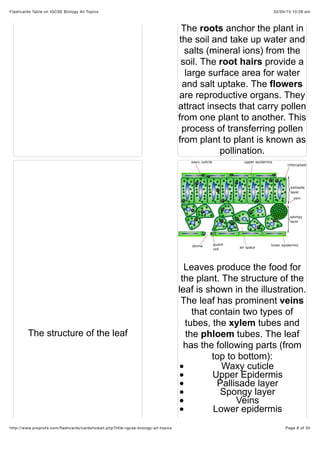
The structure of the leaf
Leaves produce the food for
the plant. The structure of the
leaf is shown in the illustration.
The leaf has prominent veins
that contain two types of
tubes, the xylem tubes and
the phloem tubes. The leaf
has the following parts (from
top to bottom):
Waxy cuticle
Upper Epidermis
Pallisade layer
Spongy layer
Veins
Lower epidermis
02/05/15 10:28 amFlashcards Table on IGCSE Biology All Topics
Page 9 of 34http://www.proprofs.com/flashcards/cardshowall.php?title=igcse-biology-all-topics
Guard cells that form
stomata
Leaves are green because
they contain the green
pigment called chlorophyll.
Chlorophyll is used in
photosynthesis.
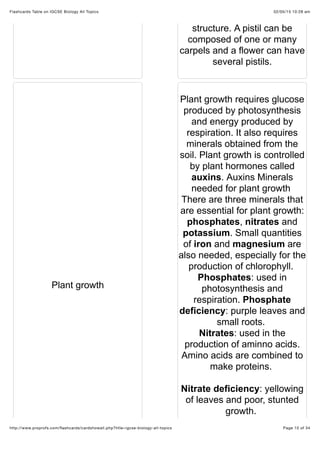
The structure of flowers
lowers are composed of:
Sepals - these are arranged
underneath the flower and
are typically green.
Petals - often brightly
coloured to attract insects.
Stamens - stalk-like
filaments that have anthers
at the top which produce
pollen. Pollen contains the
male gametes.
Pistil - contains one or
several carpels that contain
the ovaries with ovules, the
female gametes.
Sometimes the carpels are
merged. A stalk called the
style leads upwards from
each pistil and is topped by
a sticky stigma that
receives the pollen.
The pistil is the bottle shaped
02/05/15 10:28 amFlashcards Table on IGCSE Biology All Topics
Page 10 of 34http://www.proprofs.com/flashcards/cardshowall.php?title=igcse-biology-all-topics
structure. A pistil can be
composed of one or many
carpels and a flower can have
several pistils.
Plant growth
Plant growth requires glucose
produced by photosynthesis
and energy produced by
respiration. It also requires
minerals obtained from the
soil. Plant growth is controlled
by plant hormones called
auxins. Auxins Minerals
needed for plant growth
There are three minerals that
are essential for plant growth:
phosphates, nitrates and
potassium. Small quantities
of iron and magnesium are
also needed, especially for the
production of chlorophyll.
Phosphates: used in
photosynthesis and
respiration. Phosphate
deficiency: purple leaves and
small roots.
Nitrates: used in the
production of aminno acids.
Amino acids are combined to
make proteins.
Nitrate deficiency: yellowing
of leaves and poor, stunted
growth.
02/05/15 10:28 amFlashcards Table on IGCSE Biology All Topics
Page 11 of 34http://www.proprofs.com/flashcards/cardshowall.php?title=igcse-biology-all-topics
Potassium: maintains
electrical potentials and helps
enzyme action.
Potassium deficiency:
leaves become yellow with
spotty, brown, dead areas.
Photosynthesis
Like all living things, plants
need food to live. This food is
used for energy and to make
new materials when plants
grow. Plants are able to take
two inorganic chemicals,
carbon dioxide gas and water,
to make an organic chemical,
glucose. This simple food can
be used as an energy source
or converted into other useful
organic molecules.
The process requires an input
of energy. Plants have found a
way to capture the energy
from sunlight using a pigment
called chlorophyll. Once this
light energy has been
captured it can be used to
create glucose, converting the
light energy into chemical
energy. Oxygen gas is
released as a waste chemical.
As light energy is used to
create organic materials the
02/05/15 10:28 amFlashcards Table on IGCSE Biology All Topics
Page 12 of 34http://www.proprofs.com/flashcards/cardshowall.php?title=igcse-biology-all-topics
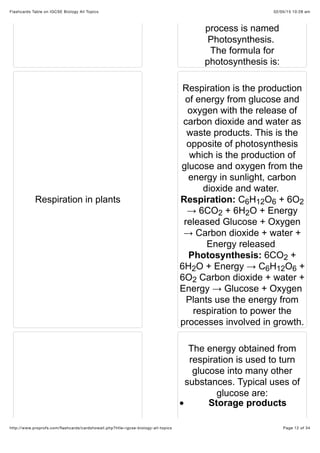
process is named
Photosynthesis.
The formula for
photosynthesis is:
Respiration in plants
Respiration is the production
of energy from glucose and
oxygen with the release of
carbon dioxide and water as
waste products. This is the
opposite of photosynthesis
which is the production of
glucose and oxygen from the
energy in sunlight, carbon
dioxide and water.
Respiration: C H O + 6O
→ 6CO + 6H O + Energy
released Glucose + Oxygen
→ Carbon dioxide + water +
Energy released
Photosynthesis: 6CO +
6H O + Energy → C H O +
6O Carbon dioxide + water +
Energy → Glucose + Oxygen
Plants use the energy from
respiration to power the
processes involved in growth.
The energy obtained from
respiration is used to turn
glucose into many other
substances. Typical uses of
glucose are:
Storage products
6 12 6 2
2 2
2
2 6 12 6
2
02/05/15 10:28 amFlashcards Table on IGCSE Biology All Topics
Page 13 of 34http://www.proprofs.com/flashcards/cardshowall.php?title=igcse-biology-all-topics
Uses of glucose
- glucose is used to make
starch which can be
converted back to glucose as
required. Potatoes and rice
are examples of parts of
plants that contain starch.-
glucose is converted into
lipids, especially in seeds.
Sunflower oil and rapeseed
oil, which are used in cooking,
come from sunflower and
oilseed rape seeds.
Structural products
- glucose is converted to
cellulose to make cell walls.
Other products
- glucose and nitrates are
used to make amino acids
which are used to make
proteins.- glucose is also a
basic raw material for making
chlorophyll.
The Human Digestive System Yummy in my TUMMY
The Mouth
Digestion begins inside the
mouth, where chewing does 2
things - makes the food easier
to swallow and increases the
surface area (this helps to
speed up digestion). Also
inside the mouth, amylase (for
digesting starch) can be
02/05/15 10:28 amFlashcards Table on IGCSE Biology All Topics
Page 14 of 34http://www.proprofs.com/flashcards/cardshowall.php?title=igcse-biology-all-topics
found, produced by the
salivary glands. The gullet
then carries food from the
mouth to the stomach by its
muscular squeezing action
called peristalsis.
Stomach
The stomach does a number
of things, including:
pummels and churns the
food
produces protease
enzymes to digest protein
produces hydrochloric acid
which kills bacteria and
gives the ideal pH for
protease to work.
Liver
The liver produces bile which
emulsifies fats i.e. breaks
them down into small droplets
for a larger surface area. This
will increase the rate at which
the fat is digested by lipase.
Bile also neutralizes the acid
produced by the stomach to
provide ideal alkaline
conditions for enzymes in the
small intestine. The gall
bladder stores the bile made
by the liver until it is needed.
The small intestine produces
amylase, lipase and protease.
The pancreas, a pistol shaped
organ, produces the enzymes
amylase, lipase and protease
02/05/15 10:28 amFlashcards Table on IGCSE Biology All Topics
Page 15 of 34http://www.proprofs.com/flashcards/cardshowall.php?title=igcse-biology-all-topics
Small Intestine
and releases them into the
small intestine when needed.
The enzymes are used to fully
digest the food molecules, so
that they are small enough to
diffuse into the bloodstream.
Food molecules diffuse in the
small intestine, which is ideal
for this purpose. The small
intestine walls are very thin so
that there is a short diffusion
pathway. It is long and folded
with villi to increase surface
area. There is a rich blood
supply to maintain a steep
concentration gradient for
diffusion.
Large Intestine & Anus
When all the useful products
have diffused into the blood,
the remaining waste reaches
the large intestine where the
majority of the remaining
water is absorbed into the
blood stream. Finally the
waste products leave the body
in the form of faeces through
the anus.
Breathing and Respiration The Basics
02/05/15 10:28 amFlashcards Table on IGCSE Biology All Topics
Page 16 of 34http://www.proprofs.com/flashcards/cardshowall.php?title=igcse-biology-all-topics
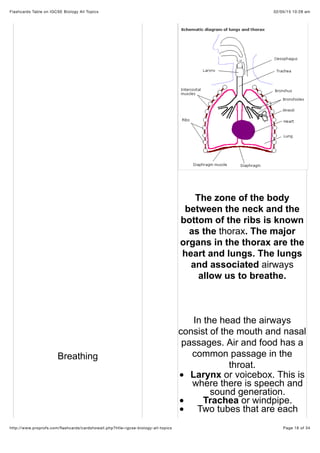
Breathing
The zone of the body
between the neck and the
bottom of the ribs is known
as the thorax. The major
organs in the thorax are the
heart and lungs. The lungs
and associated airways
allow us to breathe.
In the head the airways
consist of the mouth and nasal
passages. Air and food has a
common passage in the
throat.
Larynx or voicebox. This is
where there is speech and
sound generation.
Trachea or windpipe.
Two tubes that are each
02/05/15 10:28 amFlashcards Table on IGCSE Biology All Topics
Page 17 of 34http://www.proprofs.com/flashcards/cardshowall.php?title=igcse-biology-all-topics
known as a bronchus,
plural bronchi.
Bronchioles which are
subdivisions of each
bronchus.
Alveoli which are sacks at
the end of the airways that
allow oxygenation of the
blood.
Pleural cavity"
pleural membrane.
The key features of breathing
are that when we breathe in
the intercostal muscles
between the ribs and the
diaphragm both contract;
when we breathe out both of
these muscles relax. When we
breathe in the contraction of
the intercostals pulls the
sternum up and away from the
body and the descent of the
diaphragm increases the
volume of the thoracic cavity.
Notice that in the resting state
(breathing out) the diaphragm
bulges up under the lungs, the
lungs themselves are slightly
elastic and pull the diaphragm
back to this position
02/05/15 10:28 amFlashcards Table on IGCSE Biology All Topics
Page 18 of 34http://www.proprofs.com/flashcards/cardshowall.php?title=igcse-biology-all-topics
Oxygenation of the blood
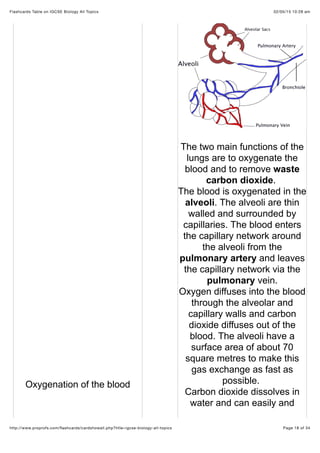
The two main functions of the
lungs are to oxygenate the
blood and to remove waste
carbon dioxide.
The blood is oxygenated in the
alveoli. The alveoli are thin
walled and surrounded by
capillaries. The blood enters
the capillary network around
the alveoli from the
pulmonary artery and leaves
the capillary network via the
pulmonary vein.
Oxygen diffuses into the blood
through the alveolar and
capillary walls and carbon
dioxide diffuses out of the
blood. The alveoli have a
surface area of about 70
square metres to make this
gas exchange as fast as
possible.
Carbon dioxide dissolves in
water and can easily and
02/05/15 10:28 amFlashcards Table on IGCSE Biology All Topics
Page 19 of 34http://www.proprofs.com/flashcards/cardshowall.php?title=igcse-biology-all-topics
reversibly form compounds
such as carbonic acid and
bicarbonates.
Oxygen does not dissolve
much in water, to overcome
this problem the oxygen in the
blood is stored in red blood
cells. These contain
haemoglobin which can
combine with oxygen to form
oxyhaemoglobin. The red
blood cells contain the oxygen
in the blood. The blood
transports oxygen from the
lungs to the rest of the body.
Oxy-haemoglobin is bright red
and haemoglobin is dark red,
this is why veins look dark and
why all the diagrams show
veins in blue and arteries in
red. The exception is the
pulmonary artery which carries
dark red, de-oxygenated blood
to the lungs and the
pulmonary vein which carries
bright red oxygenated blood
away from the lungs.The
special adaptions of the alveoli
for gas exchange are:
Thin walls
Huge surface area
Covered in capillaries to
provide blood
A wet lining to dissolve
gases
02/05/15 10:28 amFlashcards Table on IGCSE Biology All Topics
Page 20 of 34http://www.proprofs.com/flashcards/cardshowall.php?title=igcse-biology-all-topics
Aerobic respiration
Respiration is the process in
which the chemical bonds of
energy-rich molecules such as
glucose are converted into
energy usable for life
processes. Aerobic
respiration uses oxygen to
oxidise glucose and produce
energy. The equation for the
oxidation of glucose is:
C H O + 6O → 6CO +
6H O + Energy released
Glucose + Oxygen → Carbon
dioxide + water + Energy
released
In a fire there is a massive
uncontrolled release of energy
as light and heat. Respiration
is a similar process but it
occurs in gradual steps.
Most animals and plants use
aerobic respiration as a
primary source of energy.
glucose + oxygen = carbon
dioxide + water = energy
When a person is doing very
heavy exercise and the blood
cannot supply enough oxygen
another sort of respiration
occurs. This converts glucose
into energy without the need
for oxygen and is known as
anaerobic respiration. The
reaction is: Glucose → Energy
6 12 6 2 2
2
02/05/15 10:28 amFlashcards Table on IGCSE Biology All Topics
Page 21 of 34http://www.proprofs.com/flashcards/cardshowall.php?title=igcse-biology-all-topics
Anaerobic respiration
released + lactic acid
Anaerobic respiration releases
less energy than aerobic
respiration. Unfortunately the
insufficient blood supply that
leads to anaerobic respiration
also means that the lactic acid
builds up in the muscles. High
lactic acid concentrations are
painful and felt as cramp.
When exercise stops, the
blood supply is able to provide
enough oxygen to convert the
lactic acid to carbon dioxide
and water but this takes time
and the muscle pain may
continue after exercise until
the lactic acid has been
converted.
The delay in the removal of
lactic acid is known as the
oxygen debt. Carbon dioxide
and lactic acid both cause
increases in breathing rate
and heart rate to allow the
body to repay the oxygen
debt. The oxygen debt is the
reason why we continue to be
out of breath even after
exercise. If athletes are very fit
their circulation can provide
extra oxygen more rapidly and
their recovery time, the time
required to restore normal
breathing and pulse, will be
02/05/15 10:28 amFlashcards Table on IGCSE Biology All Topics
Page 22 of 34http://www.proprofs.com/flashcards/cardshowall.php?title=igcse-biology-all-topics
shorter than in people who are
not fit.
Yeasts and anaerobic
respiration
The direct conversion of
glucose to energy without the
use of oxygen occurs in many
yeasts and fungi. The ethanol
that is used in alcoholic drinks
is a result of anaerobic
respiration in yeast, the
reaction is: Glucose → Energy
released + ethanol + carbon
dioxide
Brewers use various types of
brewers yeast to produce
alcohol. In fizzy alcoholic
drinks such as champagne the
bottles are tightly stoppered to
prevent the carbon dioxide
from escaping.
The Heart a Muscle
The blood transports food,
proteins, blood cells, gases,
water, minerals and waste
products around the body.
Blood contains:
Plasma - a straw coloured
liquid in which the blood
cells are suspended and
the other components of the
blood are dissolved.
02/05/15 10:28 amFlashcards Table on IGCSE Biology All Topics
Page 23 of 34http://www.proprofs.com/flashcards/cardshowall.php?title=igcse-biology-all-topics
Blood
Red blood cells - these are
red and doughnut shaped
for a large surface area.
They carry oxygen from the
lungs to the tissues as oxy-
haemoglobin (the
oxygenated form of
haemoglobin). They do not
have a cell nucleus.
White blood cells - these
are colourless cells with a
large cell nucleus. They
defend the body against
disease by engulfing micro-
organisms (bacteria and
viruses) and producing
antitoxins and antibodies.
Platelets - these are
fragments of cells and very
small. They do not have a
cell nucleus. They form
blood clots at the site of
injuries. Clots protect the
body from further infection
and blood loss.
02/05/15 10:28 amFlashcards Table on IGCSE Biology All Topics
Page 24 of 34http://www.proprofs.com/flashcards/cardshowall.php?title=igcse-biology-all-topics
How the heart works
Due the continuous cardiac
cycle which takes an
approximate second, the heart
is the fastest and the strongest
muscle in the body. The
strongest external muscle is
the tongue, however the heart
is much stronger.
The heart works in three
stages:
1. Blood flows into the atria.
2. Both atria contract at the
same time, forcing blood
into the ventricles.
3. Both ventricles contract at
the same time, forcing
blood through the
pulmonary artery and aorta.
The heart valves ensure that
the blood goes in the correct
direction, they stop backflow.
When the atria contract the
valves between the atria and
the ventricles open passively
and the high pressure in the
arteries keeps the valves
between the ventricles and the
arteries closed. When the
ventricles contract the valves
between the ventricles and the
atria shut and the valves
between the ventricles and the
arteries open.
02/05/15 10:28 amFlashcards Table on IGCSE Biology All Topics
Page 25 of 34http://www.proprofs.com/flashcards/cardshowall.php?title=igcse-biology-all-topics
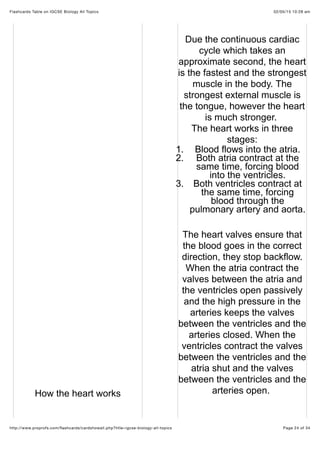
The net effect of the action of
the heart is as follows.
Deoxygenated blood from the
body enters the right atrium
and flows into the right
ventricle where it is pumped
through the lungs. In the lungs
the blood is oxygenated. It
then flows into the left atrium
and on into the left ventricle
where it is pumped out at
sufficient pressure to reach
every part of the body. The
atria have thin walls and act
as reservoirs, the ventricles
have thick, muscular walls and
act as pumps. The valves in
the heart prevent backflow.
You need to know the
following names of arteries
and veins:
Aorta - the big artery that
comes out of the left
ventricle.
Pulmonary artery - the big
artery that comes out of the
right ventricle.
Vena cava - this refers to
the big vein that connects to
the right atrium. It has two
sections the "superior" vena
cava that drains blood from
the top part of the body and
the "inferior" vena cava that
drains blood from the body
below the heart. To make
the sections clear it is often
said that there are two
02/05/15 10:28 amFlashcards Table on IGCSE Biology All Topics
Page 26 of 34http://www.proprofs.com/flashcards/cardshowall.php?title=igcse-biology-all-topics
"vena cavae", the superior
vena cava and the inferior
vena cava. Either learn the
names of the two sections
or, when you draw the heart
put the arrow to the vena
cava as close to the heart
as possible.
Pulmonary vein - the vein
that is directly attached to
the left atrium.
The menstrual cycle is a
cycle of events that occurs in
the womb (uterus) and
ovaries of female mammals. It
is associated with the
production of eggs and
preparing the uterus for the
implantation of fertilised eggs.
The menstrual cycle occurs
over a period of about 28
days. The changes during the
cycle are due to four
hormones, progesterone,
oestrogen, FSH (follicle
stimulating hormone) and LH
(luteinising hormone).
Progesterone and oestrogen
have wide ranging effects on
the body but in the context of
the menstrual cycle
progesterone is mainly
involved in maintaining the
lining of the uterus and
oestrogen is mainly concerned
with building up the lining of
02/05/15 10:28 amFlashcards Table on IGCSE Biology All Topics
Page 27 of 34http://www.proprofs.com/flashcards/cardshowall.php?title=igcse-biology-all-topics
The menstrual cycle
the uterus. FSH stimulates the
production of eggs and LH
stimulates the release of the
egg. FSH and LH are
produced by the pituitary
gland in the brain.
There are four stages in the
menstrual cycle.
Stage 1. Days 1-4.
Menstruation (bleeding)
occurs. The lining of the
uterus disintegrates and is
shed. This is due to low levels
of progesterone.
Stage 2. Days 4-14. The
uterine lining grows back. This
is due to high levels of
oestrogen.
Stage 3. Day 14. The egg
(called an ovum) is released.
This is due to LH.
Stage 4. Days 14-28. The
lining of the uterus is
maintained in case the egg
becomes fertilised and
implanted in the uterus.
Maintenance of the lining is
due to high levels of
progesterone.
The four hormones interact
with each other. FSH causes
Oestrogen release and
oestrogen inhibits FSH. LH
stimulates both oestrogen and
progesterone production.
02/05/15 10:28 amFlashcards Table on IGCSE Biology All Topics
Page 28 of 34http://www.proprofs.com/flashcards/cardshowall.php?title=igcse-biology-all-topics
Before ovulation LH release is
stimulated by oestrogen but
after ovulation it is inhibited by
both oestrogen and
progesterone.
In summary, the hormones
have the following effects:
Oestrogen: causes growth of
the uterine lining. Inhibits FSH.
Stimulates release of LH and
hence release of the egg.
Inhibits LH after ovulation.
Progesterone: maintains the
uterine lining. Inhibits LH after
ovulation. LH: Stimulates the
release of the egg (called
ovulation). Stimulates
oestrogen and progesterone
production. FSH: Stimulates
egg development and the
release of oestrogen.
Birth control tablets contain
high levels of progesterone
and oestrogen. The oestrogen
inhibits FSH production so that
eggs cease to develop.
FSH is used to treat infertility
because it stimulates the
production of eggs.
The nervous system consists
of the brain, spinal cord and
relay neurones (Central
nervous system) and
peripheral nervous system
02/05/15 10:28 amFlashcards Table on IGCSE Biology All Topics
Page 29 of 34http://www.proprofs.com/flashcards/cardshowall.php?title=igcse-biology-all-topics
The Nervous System (sensory neurones and motor
neurones). The nervous
system lets the organism react
to the environment and
surroundings and coordinate
their behaviour.
The senses
Sense organs contain
receptors that are sensitive to
stimuli. Typical stimuli are
due to changes in chemical
composition, mechanical
effects, heat, sound and light.
Stimuli are the changes that
are detected. Receptors
detect the change.
There are five sense organs
that are studied at this stage,
the nose, tongue, eyes, ears
and skin.
The nose has smell receptors
that are sensitive to a wide
range of chemical stimuli.
Much of what is called 'taste'
is actually smell; the range of
flavours in food is very limited
if the nose is blocked.
The tongue has taste
receptors that are sensitive to
chemical stimuli. There are
four basic tastes: bitter, salt,
sweet and sour.
The eyes have receptors that
are sensitive to light, the ears
have receptors that are
02/05/15 10:28 amFlashcards Table on IGCSE Biology All Topics
Page 30 of 34http://www.proprofs.com/flashcards/cardshowall.php?title=igcse-biology-all-topics
sensitive to sound and the
skin has receptors that are
sensitive to temperature,
touch, pressure and stretch.
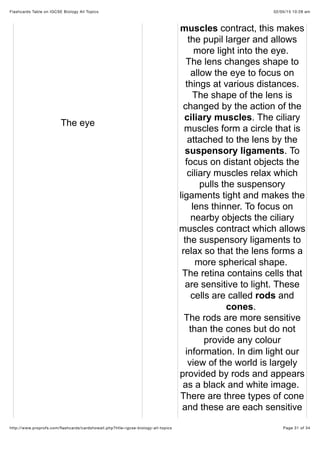
Light from the surroundings
enters the eye through the
pupil. It is focussed by the
cornea and lens so that it
forms an image on the retina.
The cornea performs crude
focussing and the lens
performs active, fine
focussing. The eye is filled
with transparent liquid (the
humours).
The iris controls the size of
the pupil and so controls how
much light gets into the eye. In
bright light the circular
muscles in the iris contract,
this makes the pupil smaller
and allows less light into the
eye. In dim light the radial
02/05/15 10:28 amFlashcards Table on IGCSE Biology All Topics
Page 31 of 34http://www.proprofs.com/flashcards/cardshowall.php?title=igcse-biology-all-topics
The eye
muscles contract, this makes
the pupil larger and allows
more light into the eye.
The lens changes shape to
allow the eye to focus on
things at various distances.
The shape of the lens is
changed by the action of the
ciliary muscles. The ciliary
muscles form a circle that is
attached to the lens by the
suspensory ligaments. To
focus on distant objects the
ciliary muscles relax which
pulls the suspensory
ligaments tight and makes the
lens thinner. To focus on
nearby objects the ciliary
muscles contract which allows
the suspensory ligaments to
relax so that the lens forms a
more spherical shape.
The retina contains cells that
are sensitive to light. These
cells are called rods and
cones.
The rods are more sensitive
than the cones but do not
provide any colour
information. In dim light our
view of the world is largely
provided by rods and appears
as a black and white image.
There are three types of cone
and these are each sensitive
02/05/15 10:28 amFlashcards Table on IGCSE Biology All Topics
Page 32 of 34http://www.proprofs.com/flashcards/cardshowall.php?title=igcse-biology-all-topics
to different colours of light.
The cones are especially
densely packed in the part of
the retina called the fovea;
this dense packing means that
the fovea is most sensitive to
fine detail in the image.
The part of the eye where the
optic nerve enters is called
the blind spot. The blind spot
does not contain any light
receptors (it has no rods or
cones).
Neurones
Neurones are cells that are
specialised to transmit
electrical impulses around
the body. They consist of three
principle components: the
dendrites, the cell body and
the axon. Each neurone has
its own nucleus. (The US
spelling of neurone is
"neuron").
There are three types of
neurone: sensory neurones,
relay neurones and motor
neurones.
Neurones connect to other
neurones by means of
synapses. Nerve impulses
travel down the axon to one
side of the synapse where the
02/05/15 10:28 amFlashcards Table on IGCSE Biology All Topics
Page 33 of 34http://www.proprofs.com/flashcards/cardshowall.php?title=igcse-biology-all-topics
electrical signal causes
chemicals to be released.
These chemicals diffuse
across the gap and generate
an electrical impulse in the
neurone on the other side of
the synapse.
Reflex arcs
The nervous system has many
reflexes. These are automatic
responses to stimuli. Very
quick responses are managed
by Reflex arcs. A reflex arc
consists of the following
components:
Stimulus
Receptor
Sensory neurone
Relay neurone
Motor neurone
Effector
Response
Pain reflex: a painful stimulus
causes a muscle to contract
automatically
02/05/15 10:28 amFlashcards Table on IGCSE Biology All Topics
Page 34 of 34http://www.proprofs.com/flashcards/cardshowall.php?title=igcse-biology-all-topics
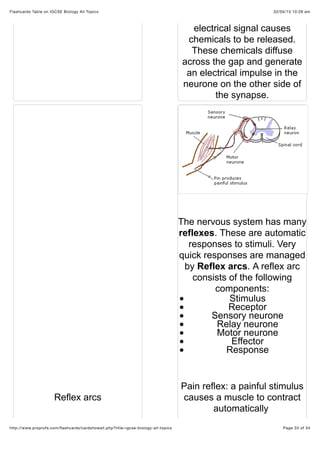
A typical reflex arc called the
"pain reflex" is illustrated.
In the pain reflex the stimulus
is mechanical damage, the
receptor is a "pain receptor",
the pain receptor generates an
electrical impulse in a sensory
neurone which creates an
electrical impulse in a relay
neurone, which in turn creates
an electrical impulse in a
motor neurone. The impulse in
the motor neurone stimulates
a muscle, which is an effector,
and this creates movement
away from the painful stimulus
as a response.
Another reflex is the "patellar"
or "knee jerk reflex" where a
blow beneath the knee-cap
makes the leg straighten. The
contraction of the pupil in
response to bright light is yet
another reflex.

Flash cards for igcse biology

  • 1.
    02/05/15 10:28 amFlashcardsTable on IGCSE Biology All Topics Page 1 of 34http://www.proprofs.com/flashcards/cardshowall.php?title=igcse-biology-all-topics Home (/flashcards/) Create Flashcards (/flashcards/create-flashcards.php) Browse (/flashcards/browse/) Tour (/flashcards/tour/) Pricing (/flashcards/signup/business/) Text Size: S | M | L (855) 776-7763 IGCSE Biology All Topics Total Flash Cards » 38 Cells All animals and plants are made up of cells. Most cells have: A nucleus – controlling the activity of the cell. All cells have these at one point. Cytoplasm – where chemical reactions occur. Inside the cytoplasm are enzymes which speed up these reactions. Cytoplasm also contains mitochondria which is where energy is released. A cell membrane – to Login (/flashcards/login.php?return=/flashcards/) Sign Up Free (/flashcards/register.php) Search Flashcards
  • 2.
    02/05/15 10:28 amFlashcardsTable on IGCSE Biology All Topics Page 2 of 34http://www.proprofs.com/flashcards/cardshowall.php?title=igcse-biology-all-topics control the passage of substances in and out of the cell. Plants also have Cell walls – to strengthen the cell. Chloroplasts – to absorb sunlight energy to make food by photosynthesis. Vacuole –full of cell sap. Cells, tissues and organs Cells act together to form tissues. For instance, the cells on the surface of a leaf form "pallisade tissue". A group of cells with similar structures and a particular function are called a tissue. Tissues are grouped together to form an organ. A leaf is an organ. Organs are grouped together to form an organism such as a whole plant or animal. Cells ----> Tissue ----> Organ - ---> Organism Tissues are usually formed from specialised cells. The cells in the pallisade tissue are specialised to perform photosynthesis and contain many chloroplasts. Some other specialised cells are: Guard cells Egg cells Sperm cells Red blood cells
  • 3.
    02/05/15 10:28 amFlashcardsTable on IGCSE Biology All Topics Page 3 of 34http://www.proprofs.com/flashcards/cardshowall.php?title=igcse-biology-all-topics Diffusion Diffusion is the net movement of particles from an area of high concentration to an area of a lower concentration. The steeper the concentration gradient, the more rapid the rate of diffusion. 2 examples of diffusion are: Oxygen (required for respiration) passes through cell membranes and gas exchange surfaces (e.g. alveoli in lungs) by diffusion Carbon dioxide enters leaves and leaf cells by diffusion Osmosis Osmosis is the movement of water from an area of high water concentration (more dilute) to an area of a low water concentration (stronger) through a partially permeable membrane. A partially permeable membrane allows water molecules to pass through (as they are smaller) but not solute molecules (they are too big). It acts like a sieve. Visking tubing is a partially permeable membrane. It is used in dialysis machines. Diffusion and osmosis can
  • 4.
    02/05/15 10:28 amFlashcardsTable on IGCSE Biology All Topics Page 4 of 34http://www.proprofs.com/flashcards/cardshowall.php?title=igcse-biology-all-topics Active Transport only work if the concentration gradient is right. Sometimes an organism needs to transport something against a concentration gradient. The only way this can be done is through active transport, using energy produced by respiration. In Active transport, the particles move across a cell membrane from a lower to a higher concentration. Examples of active transport In plants: Plants need mineral salts (e.g. nitrates) for making proteins and growth. Nitrates are at a higher concentration inside the root cells than they are when dissolved in the water around the soil particles. If the plant relied on diffusion alone, the vital nitrate salts would drain out of the cells into the soil. So energy is deployed by the cells to actively transport nitrates across the cell membrane into the root cells, against the concentration gradient. In humans Active transport takes place during digestion of food in the small intestine. After food has been absorbed by the villi for some time, the concentration of food
  • 5.
    02/05/15 10:28 amFlashcardsTable on IGCSE Biology All Topics Page 5 of 34http://www.proprofs.com/flashcards/cardshowall.php?title=igcse-biology-all-topics molecules inside the villi increases, making it impossible for more food to diffuse into the villi. So simple sugars, amino acids, minerals and vitamins are actively absorbed into the villi, from an area of lower to an area of higher concentration Shareen Saqlain The Cell Cycle happens in cells Prophase The first and longest phase of mitosis, prophase, can take as much as 50-60 percent of the total time to complete mitosis. During prophase, the chromosomes become visible. The centrioles, two tiny structures located in the cytoplasm near the nuclear envelope, separate and take up positions on opposite sides of the nucleus. The centriols lie in a region called the centrosome that helps to organise the spindle, a fanliek microtubule structure that help separate the chromosomes. During prophase, the condensed chromosomes become attached to fibers in
  • 6.
    02/05/15 10:28 amFlashcardsTable on IGCSE Biology All Topics Page 6 of 34http://www.proprofs.com/flashcards/cardshowall.php?title=igcse-biology-all-topics the spindle at a point near the centromere of each chromatid. Metaphase The second phase of mitosis, metaphase, often only lasts a few minutes. During metaphase, the chromosomes line up across the center of the cell. Microtubules connect the centromere of each chromosome to the poles of the spindle. Anaphase Anaphase is the third phase of mitosis. During anaphase, the centromeres that join the sister chromatids separate, allowing the sister chromatids to separate and become individual chromosomes. The chromosomes continue to move until they have separated into two groups near the poles of the spindle. Anaphase ends when the chromosomes stop moving. Telophase Following anaphase is telophase, the fourth and final phase of mitosis. In telophase, the chromosomes, which were distinct and condensed, begin to disperse into a tangle of dense material. A nuclear envelope re-forms around each cluster of chromosomes. The spindle begins to break
  • 7.
    02/05/15 10:28 amFlashcardsTable on IGCSE Biology All Topics Page 7 of 34http://www.proprofs.com/flashcards/cardshowall.php?title=igcse-biology-all-topics apart, and a nucleolus becomes bisible in each daughter nucleus. Mitosis is complete Plant structure Plants are divided into flowers, stems, leaves and roots with root hairs. A generalised plant is shown in the illustration. The stem provides support for the leaves and flowers. It also allows water and food to travel both up and down the plant. The leaves make the food for the plant. Photosynthesis takes place in the leaves.
  • 8.
    02/05/15 10:28 amFlashcardsTable on IGCSE Biology All Topics Page 8 of 34http://www.proprofs.com/flashcards/cardshowall.php?title=igcse-biology-all-topics The roots anchor the plant in the soil and take up water and salts (mineral ions) from the soil. The root hairs provide a large surface area for water and salt uptake. The flowers are reproductive organs. They attract insects that carry pollen from one plant to another. This process of transferring pollen from plant to plant is known as pollination. The structure of the leaf Leaves produce the food for the plant. The structure of the leaf is shown in the illustration. The leaf has prominent veins that contain two types of tubes, the xylem tubes and the phloem tubes. The leaf has the following parts (from top to bottom): Waxy cuticle Upper Epidermis Pallisade layer Spongy layer Veins Lower epidermis
  • 9.
    02/05/15 10:28 amFlashcardsTable on IGCSE Biology All Topics Page 9 of 34http://www.proprofs.com/flashcards/cardshowall.php?title=igcse-biology-all-topics Guard cells that form stomata Leaves are green because they contain the green pigment called chlorophyll. Chlorophyll is used in photosynthesis. The structure of flowers lowers are composed of: Sepals - these are arranged underneath the flower and are typically green. Petals - often brightly coloured to attract insects. Stamens - stalk-like filaments that have anthers at the top which produce pollen. Pollen contains the male gametes. Pistil - contains one or several carpels that contain the ovaries with ovules, the female gametes. Sometimes the carpels are merged. A stalk called the style leads upwards from each pistil and is topped by a sticky stigma that receives the pollen. The pistil is the bottle shaped
  • 10.
    02/05/15 10:28 amFlashcardsTable on IGCSE Biology All Topics Page 10 of 34http://www.proprofs.com/flashcards/cardshowall.php?title=igcse-biology-all-topics structure. A pistil can be composed of one or many carpels and a flower can have several pistils. Plant growth Plant growth requires glucose produced by photosynthesis and energy produced by respiration. It also requires minerals obtained from the soil. Plant growth is controlled by plant hormones called auxins. Auxins Minerals needed for plant growth There are three minerals that are essential for plant growth: phosphates, nitrates and potassium. Small quantities of iron and magnesium are also needed, especially for the production of chlorophyll. Phosphates: used in photosynthesis and respiration. Phosphate deficiency: purple leaves and small roots. Nitrates: used in the production of aminno acids. Amino acids are combined to make proteins. Nitrate deficiency: yellowing of leaves and poor, stunted growth.
  • 11.
    02/05/15 10:28 amFlashcardsTable on IGCSE Biology All Topics Page 11 of 34http://www.proprofs.com/flashcards/cardshowall.php?title=igcse-biology-all-topics Potassium: maintains electrical potentials and helps enzyme action. Potassium deficiency: leaves become yellow with spotty, brown, dead areas. Photosynthesis Like all living things, plants need food to live. This food is used for energy and to make new materials when plants grow. Plants are able to take two inorganic chemicals, carbon dioxide gas and water, to make an organic chemical, glucose. This simple food can be used as an energy source or converted into other useful organic molecules. The process requires an input of energy. Plants have found a way to capture the energy from sunlight using a pigment called chlorophyll. Once this light energy has been captured it can be used to create glucose, converting the light energy into chemical energy. Oxygen gas is released as a waste chemical. As light energy is used to create organic materials the
  • 12.
    02/05/15 10:28 amFlashcardsTable on IGCSE Biology All Topics Page 12 of 34http://www.proprofs.com/flashcards/cardshowall.php?title=igcse-biology-all-topics process is named Photosynthesis. The formula for photosynthesis is: Respiration in plants Respiration is the production of energy from glucose and oxygen with the release of carbon dioxide and water as waste products. This is the opposite of photosynthesis which is the production of glucose and oxygen from the energy in sunlight, carbon dioxide and water. Respiration: C H O + 6O → 6CO + 6H O + Energy released Glucose + Oxygen → Carbon dioxide + water + Energy released Photosynthesis: 6CO + 6H O + Energy → C H O + 6O Carbon dioxide + water + Energy → Glucose + Oxygen Plants use the energy from respiration to power the processes involved in growth. The energy obtained from respiration is used to turn glucose into many other substances. Typical uses of glucose are: Storage products 6 12 6 2 2 2 2 2 6 12 6 2
  • 13.
    02/05/15 10:28 amFlashcardsTable on IGCSE Biology All Topics Page 13 of 34http://www.proprofs.com/flashcards/cardshowall.php?title=igcse-biology-all-topics Uses of glucose - glucose is used to make starch which can be converted back to glucose as required. Potatoes and rice are examples of parts of plants that contain starch.- glucose is converted into lipids, especially in seeds. Sunflower oil and rapeseed oil, which are used in cooking, come from sunflower and oilseed rape seeds. Structural products - glucose is converted to cellulose to make cell walls. Other products - glucose and nitrates are used to make amino acids which are used to make proteins.- glucose is also a basic raw material for making chlorophyll. The Human Digestive System Yummy in my TUMMY The Mouth Digestion begins inside the mouth, where chewing does 2 things - makes the food easier to swallow and increases the surface area (this helps to speed up digestion). Also inside the mouth, amylase (for digesting starch) can be
  • 14.
    02/05/15 10:28 amFlashcardsTable on IGCSE Biology All Topics Page 14 of 34http://www.proprofs.com/flashcards/cardshowall.php?title=igcse-biology-all-topics found, produced by the salivary glands. The gullet then carries food from the mouth to the stomach by its muscular squeezing action called peristalsis. Stomach The stomach does a number of things, including: pummels and churns the food produces protease enzymes to digest protein produces hydrochloric acid which kills bacteria and gives the ideal pH for protease to work. Liver The liver produces bile which emulsifies fats i.e. breaks them down into small droplets for a larger surface area. This will increase the rate at which the fat is digested by lipase. Bile also neutralizes the acid produced by the stomach to provide ideal alkaline conditions for enzymes in the small intestine. The gall bladder stores the bile made by the liver until it is needed. The small intestine produces amylase, lipase and protease. The pancreas, a pistol shaped organ, produces the enzymes amylase, lipase and protease
  • 15.
    02/05/15 10:28 amFlashcardsTable on IGCSE Biology All Topics Page 15 of 34http://www.proprofs.com/flashcards/cardshowall.php?title=igcse-biology-all-topics Small Intestine and releases them into the small intestine when needed. The enzymes are used to fully digest the food molecules, so that they are small enough to diffuse into the bloodstream. Food molecules diffuse in the small intestine, which is ideal for this purpose. The small intestine walls are very thin so that there is a short diffusion pathway. It is long and folded with villi to increase surface area. There is a rich blood supply to maintain a steep concentration gradient for diffusion. Large Intestine & Anus When all the useful products have diffused into the blood, the remaining waste reaches the large intestine where the majority of the remaining water is absorbed into the blood stream. Finally the waste products leave the body in the form of faeces through the anus. Breathing and Respiration The Basics
  • 16.
    02/05/15 10:28 amFlashcardsTable on IGCSE Biology All Topics Page 16 of 34http://www.proprofs.com/flashcards/cardshowall.php?title=igcse-biology-all-topics Breathing The zone of the body between the neck and the bottom of the ribs is known as the thorax. The major organs in the thorax are the heart and lungs. The lungs and associated airways allow us to breathe. In the head the airways consist of the mouth and nasal passages. Air and food has a common passage in the throat. Larynx or voicebox. This is where there is speech and sound generation. Trachea or windpipe. Two tubes that are each
  • 17.
    02/05/15 10:28 amFlashcardsTable on IGCSE Biology All Topics Page 17 of 34http://www.proprofs.com/flashcards/cardshowall.php?title=igcse-biology-all-topics known as a bronchus, plural bronchi. Bronchioles which are subdivisions of each bronchus. Alveoli which are sacks at the end of the airways that allow oxygenation of the blood. Pleural cavity" pleural membrane. The key features of breathing are that when we breathe in the intercostal muscles between the ribs and the diaphragm both contract; when we breathe out both of these muscles relax. When we breathe in the contraction of the intercostals pulls the sternum up and away from the body and the descent of the diaphragm increases the volume of the thoracic cavity. Notice that in the resting state (breathing out) the diaphragm bulges up under the lungs, the lungs themselves are slightly elastic and pull the diaphragm back to this position
  • 18.
    02/05/15 10:28 amFlashcardsTable on IGCSE Biology All Topics Page 18 of 34http://www.proprofs.com/flashcards/cardshowall.php?title=igcse-biology-all-topics Oxygenation of the blood The two main functions of the lungs are to oxygenate the blood and to remove waste carbon dioxide. The blood is oxygenated in the alveoli. The alveoli are thin walled and surrounded by capillaries. The blood enters the capillary network around the alveoli from the pulmonary artery and leaves the capillary network via the pulmonary vein. Oxygen diffuses into the blood through the alveolar and capillary walls and carbon dioxide diffuses out of the blood. The alveoli have a surface area of about 70 square metres to make this gas exchange as fast as possible. Carbon dioxide dissolves in water and can easily and
  • 19.
    02/05/15 10:28 amFlashcardsTable on IGCSE Biology All Topics Page 19 of 34http://www.proprofs.com/flashcards/cardshowall.php?title=igcse-biology-all-topics reversibly form compounds such as carbonic acid and bicarbonates. Oxygen does not dissolve much in water, to overcome this problem the oxygen in the blood is stored in red blood cells. These contain haemoglobin which can combine with oxygen to form oxyhaemoglobin. The red blood cells contain the oxygen in the blood. The blood transports oxygen from the lungs to the rest of the body. Oxy-haemoglobin is bright red and haemoglobin is dark red, this is why veins look dark and why all the diagrams show veins in blue and arteries in red. The exception is the pulmonary artery which carries dark red, de-oxygenated blood to the lungs and the pulmonary vein which carries bright red oxygenated blood away from the lungs.The special adaptions of the alveoli for gas exchange are: Thin walls Huge surface area Covered in capillaries to provide blood A wet lining to dissolve gases
  • 20.
    02/05/15 10:28 amFlashcardsTable on IGCSE Biology All Topics Page 20 of 34http://www.proprofs.com/flashcards/cardshowall.php?title=igcse-biology-all-topics Aerobic respiration Respiration is the process in which the chemical bonds of energy-rich molecules such as glucose are converted into energy usable for life processes. Aerobic respiration uses oxygen to oxidise glucose and produce energy. The equation for the oxidation of glucose is: C H O + 6O → 6CO + 6H O + Energy released Glucose + Oxygen → Carbon dioxide + water + Energy released In a fire there is a massive uncontrolled release of energy as light and heat. Respiration is a similar process but it occurs in gradual steps. Most animals and plants use aerobic respiration as a primary source of energy. glucose + oxygen = carbon dioxide + water = energy When a person is doing very heavy exercise and the blood cannot supply enough oxygen another sort of respiration occurs. This converts glucose into energy without the need for oxygen and is known as anaerobic respiration. The reaction is: Glucose → Energy 6 12 6 2 2 2
  • 21.
    02/05/15 10:28 amFlashcardsTable on IGCSE Biology All Topics Page 21 of 34http://www.proprofs.com/flashcards/cardshowall.php?title=igcse-biology-all-topics Anaerobic respiration released + lactic acid Anaerobic respiration releases less energy than aerobic respiration. Unfortunately the insufficient blood supply that leads to anaerobic respiration also means that the lactic acid builds up in the muscles. High lactic acid concentrations are painful and felt as cramp. When exercise stops, the blood supply is able to provide enough oxygen to convert the lactic acid to carbon dioxide and water but this takes time and the muscle pain may continue after exercise until the lactic acid has been converted. The delay in the removal of lactic acid is known as the oxygen debt. Carbon dioxide and lactic acid both cause increases in breathing rate and heart rate to allow the body to repay the oxygen debt. The oxygen debt is the reason why we continue to be out of breath even after exercise. If athletes are very fit their circulation can provide extra oxygen more rapidly and their recovery time, the time required to restore normal breathing and pulse, will be
  • 22.
    02/05/15 10:28 amFlashcardsTable on IGCSE Biology All Topics Page 22 of 34http://www.proprofs.com/flashcards/cardshowall.php?title=igcse-biology-all-topics shorter than in people who are not fit. Yeasts and anaerobic respiration The direct conversion of glucose to energy without the use of oxygen occurs in many yeasts and fungi. The ethanol that is used in alcoholic drinks is a result of anaerobic respiration in yeast, the reaction is: Glucose → Energy released + ethanol + carbon dioxide Brewers use various types of brewers yeast to produce alcohol. In fizzy alcoholic drinks such as champagne the bottles are tightly stoppered to prevent the carbon dioxide from escaping. The Heart a Muscle The blood transports food, proteins, blood cells, gases, water, minerals and waste products around the body. Blood contains: Plasma - a straw coloured liquid in which the blood cells are suspended and the other components of the blood are dissolved.
  • 23.
    02/05/15 10:28 amFlashcardsTable on IGCSE Biology All Topics Page 23 of 34http://www.proprofs.com/flashcards/cardshowall.php?title=igcse-biology-all-topics Blood Red blood cells - these are red and doughnut shaped for a large surface area. They carry oxygen from the lungs to the tissues as oxy- haemoglobin (the oxygenated form of haemoglobin). They do not have a cell nucleus. White blood cells - these are colourless cells with a large cell nucleus. They defend the body against disease by engulfing micro- organisms (bacteria and viruses) and producing antitoxins and antibodies. Platelets - these are fragments of cells and very small. They do not have a cell nucleus. They form blood clots at the site of injuries. Clots protect the body from further infection and blood loss.
  • 24.
    02/05/15 10:28 amFlashcardsTable on IGCSE Biology All Topics Page 24 of 34http://www.proprofs.com/flashcards/cardshowall.php?title=igcse-biology-all-topics How the heart works Due the continuous cardiac cycle which takes an approximate second, the heart is the fastest and the strongest muscle in the body. The strongest external muscle is the tongue, however the heart is much stronger. The heart works in three stages: 1. Blood flows into the atria. 2. Both atria contract at the same time, forcing blood into the ventricles. 3. Both ventricles contract at the same time, forcing blood through the pulmonary artery and aorta. The heart valves ensure that the blood goes in the correct direction, they stop backflow. When the atria contract the valves between the atria and the ventricles open passively and the high pressure in the arteries keeps the valves between the ventricles and the arteries closed. When the ventricles contract the valves between the ventricles and the atria shut and the valves between the ventricles and the arteries open.
  • 25.
    02/05/15 10:28 amFlashcardsTable on IGCSE Biology All Topics Page 25 of 34http://www.proprofs.com/flashcards/cardshowall.php?title=igcse-biology-all-topics The net effect of the action of the heart is as follows. Deoxygenated blood from the body enters the right atrium and flows into the right ventricle where it is pumped through the lungs. In the lungs the blood is oxygenated. It then flows into the left atrium and on into the left ventricle where it is pumped out at sufficient pressure to reach every part of the body. The atria have thin walls and act as reservoirs, the ventricles have thick, muscular walls and act as pumps. The valves in the heart prevent backflow. You need to know the following names of arteries and veins: Aorta - the big artery that comes out of the left ventricle. Pulmonary artery - the big artery that comes out of the right ventricle. Vena cava - this refers to the big vein that connects to the right atrium. It has two sections the "superior" vena cava that drains blood from the top part of the body and the "inferior" vena cava that drains blood from the body below the heart. To make the sections clear it is often said that there are two
  • 26.
    02/05/15 10:28 amFlashcardsTable on IGCSE Biology All Topics Page 26 of 34http://www.proprofs.com/flashcards/cardshowall.php?title=igcse-biology-all-topics "vena cavae", the superior vena cava and the inferior vena cava. Either learn the names of the two sections or, when you draw the heart put the arrow to the vena cava as close to the heart as possible. Pulmonary vein - the vein that is directly attached to the left atrium. The menstrual cycle is a cycle of events that occurs in the womb (uterus) and ovaries of female mammals. It is associated with the production of eggs and preparing the uterus for the implantation of fertilised eggs. The menstrual cycle occurs over a period of about 28 days. The changes during the cycle are due to four hormones, progesterone, oestrogen, FSH (follicle stimulating hormone) and LH (luteinising hormone). Progesterone and oestrogen have wide ranging effects on the body but in the context of the menstrual cycle progesterone is mainly involved in maintaining the lining of the uterus and oestrogen is mainly concerned with building up the lining of
  • 27.
    02/05/15 10:28 amFlashcardsTable on IGCSE Biology All Topics Page 27 of 34http://www.proprofs.com/flashcards/cardshowall.php?title=igcse-biology-all-topics The menstrual cycle the uterus. FSH stimulates the production of eggs and LH stimulates the release of the egg. FSH and LH are produced by the pituitary gland in the brain. There are four stages in the menstrual cycle. Stage 1. Days 1-4. Menstruation (bleeding) occurs. The lining of the uterus disintegrates and is shed. This is due to low levels of progesterone. Stage 2. Days 4-14. The uterine lining grows back. This is due to high levels of oestrogen. Stage 3. Day 14. The egg (called an ovum) is released. This is due to LH. Stage 4. Days 14-28. The lining of the uterus is maintained in case the egg becomes fertilised and implanted in the uterus. Maintenance of the lining is due to high levels of progesterone. The four hormones interact with each other. FSH causes Oestrogen release and oestrogen inhibits FSH. LH stimulates both oestrogen and progesterone production.
  • 28.
    02/05/15 10:28 amFlashcardsTable on IGCSE Biology All Topics Page 28 of 34http://www.proprofs.com/flashcards/cardshowall.php?title=igcse-biology-all-topics Before ovulation LH release is stimulated by oestrogen but after ovulation it is inhibited by both oestrogen and progesterone. In summary, the hormones have the following effects: Oestrogen: causes growth of the uterine lining. Inhibits FSH. Stimulates release of LH and hence release of the egg. Inhibits LH after ovulation. Progesterone: maintains the uterine lining. Inhibits LH after ovulation. LH: Stimulates the release of the egg (called ovulation). Stimulates oestrogen and progesterone production. FSH: Stimulates egg development and the release of oestrogen. Birth control tablets contain high levels of progesterone and oestrogen. The oestrogen inhibits FSH production so that eggs cease to develop. FSH is used to treat infertility because it stimulates the production of eggs. The nervous system consists of the brain, spinal cord and relay neurones (Central nervous system) and peripheral nervous system
  • 29.
    02/05/15 10:28 amFlashcardsTable on IGCSE Biology All Topics Page 29 of 34http://www.proprofs.com/flashcards/cardshowall.php?title=igcse-biology-all-topics The Nervous System (sensory neurones and motor neurones). The nervous system lets the organism react to the environment and surroundings and coordinate their behaviour. The senses Sense organs contain receptors that are sensitive to stimuli. Typical stimuli are due to changes in chemical composition, mechanical effects, heat, sound and light. Stimuli are the changes that are detected. Receptors detect the change. There are five sense organs that are studied at this stage, the nose, tongue, eyes, ears and skin. The nose has smell receptors that are sensitive to a wide range of chemical stimuli. Much of what is called 'taste' is actually smell; the range of flavours in food is very limited if the nose is blocked. The tongue has taste receptors that are sensitive to chemical stimuli. There are four basic tastes: bitter, salt, sweet and sour. The eyes have receptors that are sensitive to light, the ears have receptors that are
  • 30.
    02/05/15 10:28 amFlashcardsTable on IGCSE Biology All Topics Page 30 of 34http://www.proprofs.com/flashcards/cardshowall.php?title=igcse-biology-all-topics sensitive to sound and the skin has receptors that are sensitive to temperature, touch, pressure and stretch. Light from the surroundings enters the eye through the pupil. It is focussed by the cornea and lens so that it forms an image on the retina. The cornea performs crude focussing and the lens performs active, fine focussing. The eye is filled with transparent liquid (the humours). The iris controls the size of the pupil and so controls how much light gets into the eye. In bright light the circular muscles in the iris contract, this makes the pupil smaller and allows less light into the eye. In dim light the radial
  • 31.
    02/05/15 10:28 amFlashcardsTable on IGCSE Biology All Topics Page 31 of 34http://www.proprofs.com/flashcards/cardshowall.php?title=igcse-biology-all-topics The eye muscles contract, this makes the pupil larger and allows more light into the eye. The lens changes shape to allow the eye to focus on things at various distances. The shape of the lens is changed by the action of the ciliary muscles. The ciliary muscles form a circle that is attached to the lens by the suspensory ligaments. To focus on distant objects the ciliary muscles relax which pulls the suspensory ligaments tight and makes the lens thinner. To focus on nearby objects the ciliary muscles contract which allows the suspensory ligaments to relax so that the lens forms a more spherical shape. The retina contains cells that are sensitive to light. These cells are called rods and cones. The rods are more sensitive than the cones but do not provide any colour information. In dim light our view of the world is largely provided by rods and appears as a black and white image. There are three types of cone and these are each sensitive
  • 32.
    02/05/15 10:28 amFlashcardsTable on IGCSE Biology All Topics Page 32 of 34http://www.proprofs.com/flashcards/cardshowall.php?title=igcse-biology-all-topics to different colours of light. The cones are especially densely packed in the part of the retina called the fovea; this dense packing means that the fovea is most sensitive to fine detail in the image. The part of the eye where the optic nerve enters is called the blind spot. The blind spot does not contain any light receptors (it has no rods or cones). Neurones Neurones are cells that are specialised to transmit electrical impulses around the body. They consist of three principle components: the dendrites, the cell body and the axon. Each neurone has its own nucleus. (The US spelling of neurone is "neuron"). There are three types of neurone: sensory neurones, relay neurones and motor neurones. Neurones connect to other neurones by means of synapses. Nerve impulses travel down the axon to one side of the synapse where the
  • 33.
    02/05/15 10:28 amFlashcardsTable on IGCSE Biology All Topics Page 33 of 34http://www.proprofs.com/flashcards/cardshowall.php?title=igcse-biology-all-topics electrical signal causes chemicals to be released. These chemicals diffuse across the gap and generate an electrical impulse in the neurone on the other side of the synapse. Reflex arcs The nervous system has many reflexes. These are automatic responses to stimuli. Very quick responses are managed by Reflex arcs. A reflex arc consists of the following components: Stimulus Receptor Sensory neurone Relay neurone Motor neurone Effector Response Pain reflex: a painful stimulus causes a muscle to contract automatically
  • 34.
    02/05/15 10:28 amFlashcardsTable on IGCSE Biology All Topics Page 34 of 34http://www.proprofs.com/flashcards/cardshowall.php?title=igcse-biology-all-topics A typical reflex arc called the "pain reflex" is illustrated. In the pain reflex the stimulus is mechanical damage, the receptor is a "pain receptor", the pain receptor generates an electrical impulse in a sensory neurone which creates an electrical impulse in a relay neurone, which in turn creates an electrical impulse in a motor neurone. The impulse in the motor neurone stimulates a muscle, which is an effector, and this creates movement away from the painful stimulus as a response. Another reflex is the "patellar" or "knee jerk reflex" where a blow beneath the knee-cap makes the leg straighten. The contraction of the pupil in response to bright light is yet another reflex.