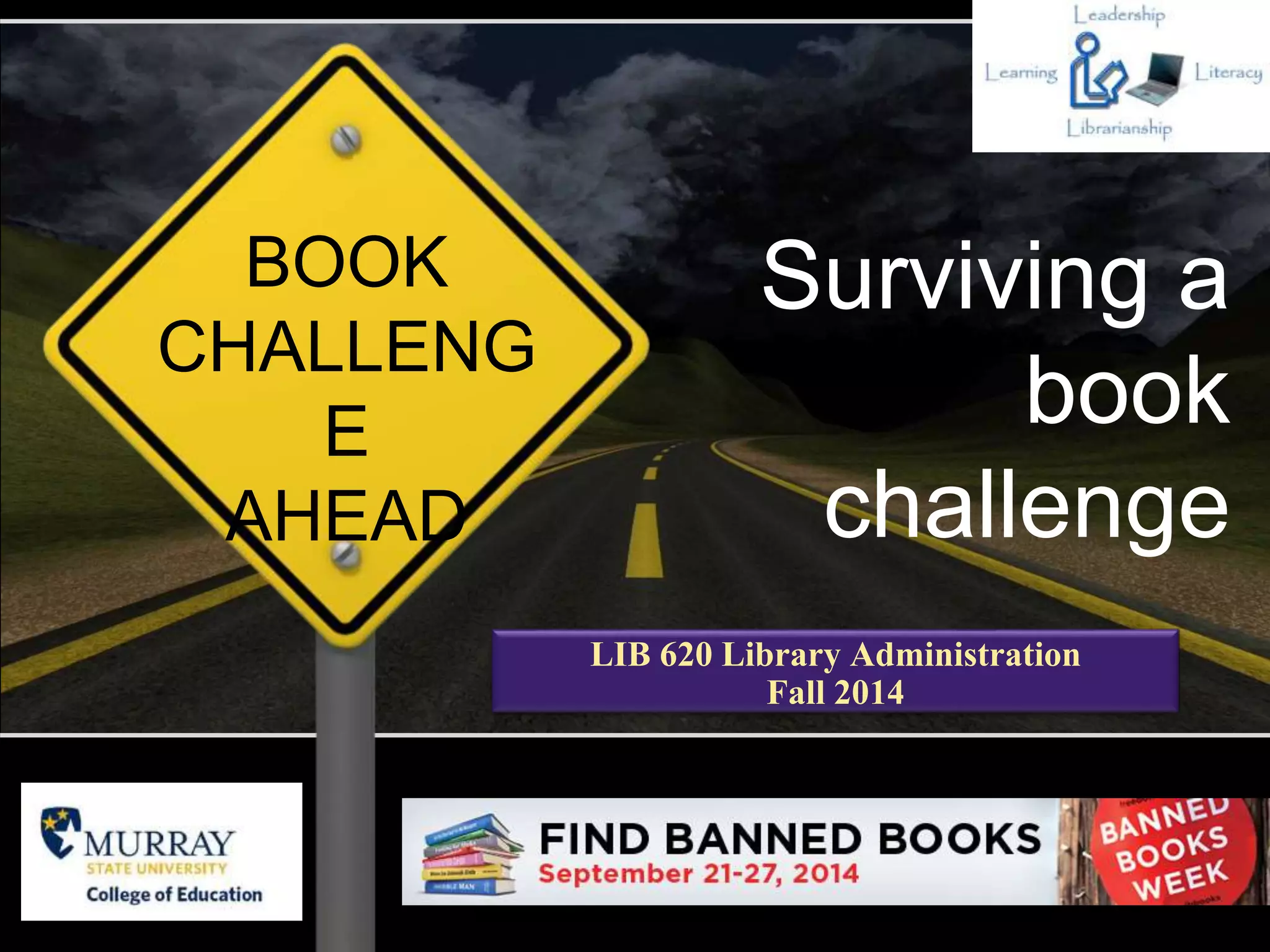
BOOK 
CHALLENG 
E 
AHEAD 
Surviving a 
LIB 620 Library Administration 
Fall 2014 
book 
challenge
2 
http://www.youtube.com/watch?v=67GDSczduTA&list=PL0 
2Yd8H4JhiBgAeoUFQ-s2zKYuS8ieaqp
3 
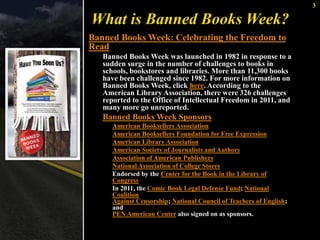
What is Banned Books Week? 
Banned Books Week: Celebrating the Freedom to 
Read 
Banned Books Week was launched in 1982 in response to a 
sudden surge in the number of challenges to books in 
schools, bookstores and libraries. More than 11,300 books 
have been challenged since 1982. For more information on 
Banned Books Week, click here. According to the 
American Library Association, there were 326 challenges 
reported to the Office of Intellectual Freedom in 2011, and 
many more go unreported. 
Banned Books Week Sponsors 
American Booksellers Association 
American Booksellers Foundation for Free Expression 
American Library Association 
American Society of Journalists and Authors 
Association of American Publishers 
National Association of College Stores 
Endorsed by the Center for the Book in the Library of 
Congress 
In 2011, the Comic Book Legal Defense Fund; National 
Coalition 
Against Censorship; National Council of Teachers of English; 
and 
PEN American Center also signed on as sponsors.
4 
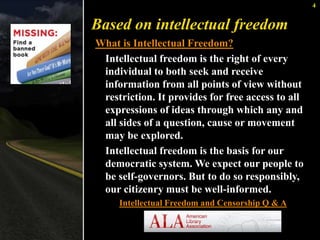
Based on intellectual freedom 
What is Intellectual Freedom? 
Intellectual freedom is the right of every 
individual to both seek and receive 
information from all points of view without 
restriction. It provides for free access to all 
expressions of ideas through which any and 
all sides of a question, cause or movement 
may be explored. 
Intellectual freedom is the basis for our 
democratic system. We expect our people to 
be self-governors. But to do so responsibly, 
our citizenry must be well-informed. 
Intellectual Freedom and Censorship Q & A
5 
Censorship 
[is] the control of the information and ideas 
circulated within a society 
The rationales for censorship have varied, with 
some censors targeting material deemed to be 
indecent or obscene; heretical or blasphemous; 
or seditious or treasonous. Thus, ideas have 
been suppressed under the guise of protecting 
three basic social institutions: the family, the 
church, and the state. 
• From the website of the Internet Censorship Project, a 
program of the Open Society Institute's Internet 
Program, part of Soros Foundations Network.
6 
Freedom of speech 
The First Amendment of the 
Constitution of the United States 
of America 
Congress shall make no law 
respecting an establishment of 
religion, or prohibiting the free 
exercise thereof; or abridging the 
freedom of speech, or of the press; or 
the right of the people peaceably to 
assemble, and to petition the 
government for a redress of 
grievances. The Bill of Rights to the U.S. 
Constitution was ratified on 
December 15, 1791
7 
What about the freedom to read? 
Not explicitly mentioned in the 
Constitution 
Does that mean to say that the First 
Amendment does not apply to reading? 
See court cases on The Right to Read 
Freely on ALA’s Notable First Amendment 
Court Cases web page
8 
What is a book challenge? 
A challenge is an attempt to remove or 
restrict materials, based upon the 
objections of a person or group. 
Challenges do not simply involve a 
person expressing a point of view; 
rather, they are an attempt to remove 
material from the curriculum or library, 
thereby restricting the access of others. 
Challenges to library materials 
ALA Office for Intellectual Freedom
9 
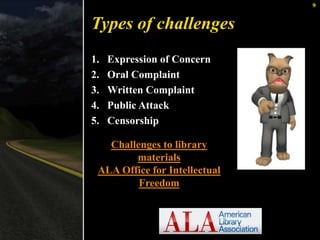
Types of challenges 
1. Expression of Concern 
2. Oral Complaint 
3. Written Complaint 
4. Public Attack 
5. Censorship 
Challenges to library 
materials 
ALA Office for Intellectual 
Freedom
10 
Why are books challenged? 
Books usually are challenged with the best intentions— 
to protect others, frequently children, from difficult 
ideas and information. See Notable First Amendment 
Cases. 
Often challenges are motivated by a desire to protect 
children from “inappropriate” sexual content or 
“offensive” language. 
Although this is a commendable motivation, Free Access 
to Libraries for Minors, an interpretation of the Library 
Bill of Rights (ALA’s basic policy concerning access to 
information) states that, “Librarians and governing 
bodies should maintain that parents—and only 
parents—have the right and the responsibility to restrict 
the access of their children—and only their children—to 
library resources.” Censorship by librarians of 
constitutionally protected speech, whether for protection 
or for any other reason, violates the First Amendment. 
About 
Banned & 
Challenged 
Books
11 
Freedom to Read Under Fire as 
Attempts to Ban Books Continue 
• 
Posted: 09/22/2013 10:40 
am 
• According to the American Library 
Association’s (ALA) Office for Intellectual 
Freedom (OIF), there were 464 reported 
attempts to remove or restrict materials 
from schools and libraries in 2012 and more 
than 17,700 attempts since 1990, when the 
ALA began to record book challenges. 
• Danger does not arise from viewpoints other 
than our own; the danger lies in allowing 
others to decide for us and our communities 
which reading materials are appropriate!
12 
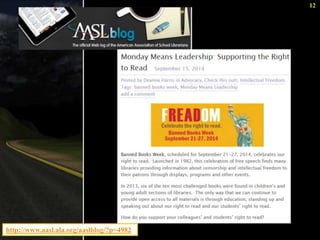
http://www.aasl.ala.org/aaslblog/?p=4982
13 
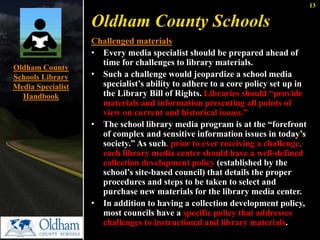
Oldham County Schools 
Challenged materials 
• Every media specialist should be prepared ahead of 
time for challenges to library materials. 
• Such a challenge would jeopardize a school media 
specialist’s ability to adhere to a core policy set up in 
the Library Bill of Rights. Libraries should “provide 
materials and information presenting all points of 
view on current and historical issues.” 
• The school library media program is at the “forefront 
of complex and sensitive information issues in today’s 
society.” As such, prior to ever receiving a challenge, 
each library media center should have a well-defined 
collection development policy (established by the 
school’s site-based council) that details the proper 
procedures and steps to be taken to select and 
purchase new materials for the library media center. 
• In addition to having a collection development policy, 
most councils have a specific policy that addresses 
challenges to instructional and library materials. 
Oldham County 
Schools Library 
Media Specialist 
Handbook
14 
Handling Challenges to Materials 
in Your Collection 
1. Keep your policies and procedures current 
2. Have a formal policy to handle complaints 
3. Have open lines of communication with 
local community leaders 
4. Communicate the library’s position on 
intellectual freedom to the public 
• Intellectual Freedom & Censorship, Collection 
Development Training for Arizona Public Libraries
15 
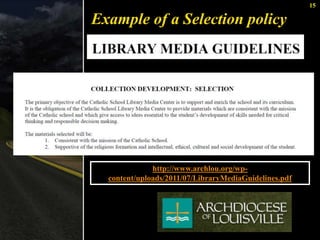
Example of a Selection policy 
http://www.archlou.org/wp-content/ 
uploads/2011/07/LibraryMediaGuidelines.pdf
16 
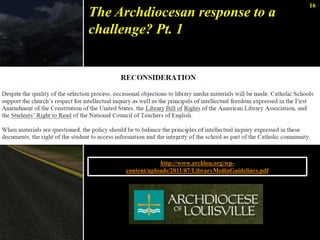
The Archdiocesan response to a 
challenge? Pt. 1 
http://www.archlou.org/wp-content/ 
uploads/2011/07/LibraryMediaGuidelines.pdf
17 
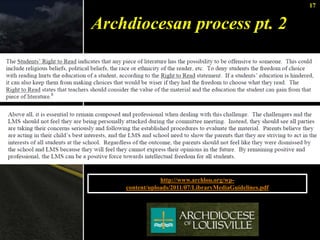
Archdiocesan process pt. 2 
http://www.archlou.org/wp-content/ 
uploads/2011/07/LibraryMediaGuidelines.pdf
18 
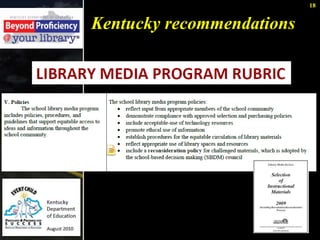
Kentucky recommendations
19 
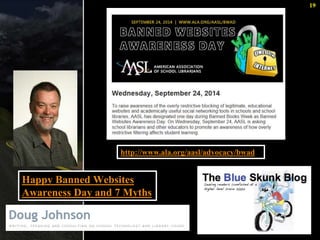
http://www.ala.org/aasl/advocacy/bwad 
Happy Banned Websites 
Awareness Day and 7 Myths
20 
Be Prepared! 
FUTURE 
CHALLENGE 
S 
AHEAD

Book challenge ahead: Surviving a book challenge

  • 1.
    BOOK CHALLENG E AHEAD Surviving a LIB 620 Library Administration Fall 2014 book challenge
  • 2.
  • 3.
    3 What isBanned Books Week? Banned Books Week: Celebrating the Freedom to Read Banned Books Week was launched in 1982 in response to a sudden surge in the number of challenges to books in schools, bookstores and libraries. More than 11,300 books have been challenged since 1982. For more information on Banned Books Week, click here. According to the American Library Association, there were 326 challenges reported to the Office of Intellectual Freedom in 2011, and many more go unreported. Banned Books Week Sponsors American Booksellers Association American Booksellers Foundation for Free Expression American Library Association American Society of Journalists and Authors Association of American Publishers National Association of College Stores Endorsed by the Center for the Book in the Library of Congress In 2011, the Comic Book Legal Defense Fund; National Coalition Against Censorship; National Council of Teachers of English; and PEN American Center also signed on as sponsors.
  • 4.
    4 Based onintellectual freedom What is Intellectual Freedom? Intellectual freedom is the right of every individual to both seek and receive information from all points of view without restriction. It provides for free access to all expressions of ideas through which any and all sides of a question, cause or movement may be explored. Intellectual freedom is the basis for our democratic system. We expect our people to be self-governors. But to do so responsibly, our citizenry must be well-informed. Intellectual Freedom and Censorship Q & A
  • 5.
    5 Censorship [is]the control of the information and ideas circulated within a society The rationales for censorship have varied, with some censors targeting material deemed to be indecent or obscene; heretical or blasphemous; or seditious or treasonous. Thus, ideas have been suppressed under the guise of protecting three basic social institutions: the family, the church, and the state. • From the website of the Internet Censorship Project, a program of the Open Society Institute's Internet Program, part of Soros Foundations Network.
  • 6.
    6 Freedom ofspeech The First Amendment of the Constitution of the United States of America Congress shall make no law respecting an establishment of religion, or prohibiting the free exercise thereof; or abridging the freedom of speech, or of the press; or the right of the people peaceably to assemble, and to petition the government for a redress of grievances. The Bill of Rights to the U.S. Constitution was ratified on December 15, 1791
  • 7.
    7 What aboutthe freedom to read? Not explicitly mentioned in the Constitution Does that mean to say that the First Amendment does not apply to reading? See court cases on The Right to Read Freely on ALA’s Notable First Amendment Court Cases web page
  • 8.
    8 What isa book challenge? A challenge is an attempt to remove or restrict materials, based upon the objections of a person or group. Challenges do not simply involve a person expressing a point of view; rather, they are an attempt to remove material from the curriculum or library, thereby restricting the access of others. Challenges to library materials ALA Office for Intellectual Freedom
  • 9.
    9 Types ofchallenges 1. Expression of Concern 2. Oral Complaint 3. Written Complaint 4. Public Attack 5. Censorship Challenges to library materials ALA Office for Intellectual Freedom
  • 10.
    10 Why arebooks challenged? Books usually are challenged with the best intentions— to protect others, frequently children, from difficult ideas and information. See Notable First Amendment Cases. Often challenges are motivated by a desire to protect children from “inappropriate” sexual content or “offensive” language. Although this is a commendable motivation, Free Access to Libraries for Minors, an interpretation of the Library Bill of Rights (ALA’s basic policy concerning access to information) states that, “Librarians and governing bodies should maintain that parents—and only parents—have the right and the responsibility to restrict the access of their children—and only their children—to library resources.” Censorship by librarians of constitutionally protected speech, whether for protection or for any other reason, violates the First Amendment. About Banned & Challenged Books
  • 11.
    11 Freedom toRead Under Fire as Attempts to Ban Books Continue • Posted: 09/22/2013 10:40 am • According to the American Library Association’s (ALA) Office for Intellectual Freedom (OIF), there were 464 reported attempts to remove or restrict materials from schools and libraries in 2012 and more than 17,700 attempts since 1990, when the ALA began to record book challenges. • Danger does not arise from viewpoints other than our own; the danger lies in allowing others to decide for us and our communities which reading materials are appropriate!
  • 12.
  • 13.
    13 Oldham CountySchools Challenged materials • Every media specialist should be prepared ahead of time for challenges to library materials. • Such a challenge would jeopardize a school media specialist’s ability to adhere to a core policy set up in the Library Bill of Rights. Libraries should “provide materials and information presenting all points of view on current and historical issues.” • The school library media program is at the “forefront of complex and sensitive information issues in today’s society.” As such, prior to ever receiving a challenge, each library media center should have a well-defined collection development policy (established by the school’s site-based council) that details the proper procedures and steps to be taken to select and purchase new materials for the library media center. • In addition to having a collection development policy, most councils have a specific policy that addresses challenges to instructional and library materials. Oldham County Schools Library Media Specialist Handbook
  • 14.
    14 Handling Challengesto Materials in Your Collection 1. Keep your policies and procedures current 2. Have a formal policy to handle complaints 3. Have open lines of communication with local community leaders 4. Communicate the library’s position on intellectual freedom to the public • Intellectual Freedom & Censorship, Collection Development Training for Arizona Public Libraries
  • 15.
    15 Example ofa Selection policy http://www.archlou.org/wp-content/ uploads/2011/07/LibraryMediaGuidelines.pdf
  • 16.
    16 The Archdiocesanresponse to a challenge? Pt. 1 http://www.archlou.org/wp-content/ uploads/2011/07/LibraryMediaGuidelines.pdf
  • 17.
    17 Archdiocesan processpt. 2 http://www.archlou.org/wp-content/ uploads/2011/07/LibraryMediaGuidelines.pdf
  • 18.
  • 19.
    19 http://www.ala.org/aasl/advocacy/bwad HappyBanned Websites Awareness Day and 7 Myths
  • 20.
    20 Be Prepared! FUTURE CHALLENGE S AHEAD