Censorship
Challenged and Banned Books
Challenged vs. Banned
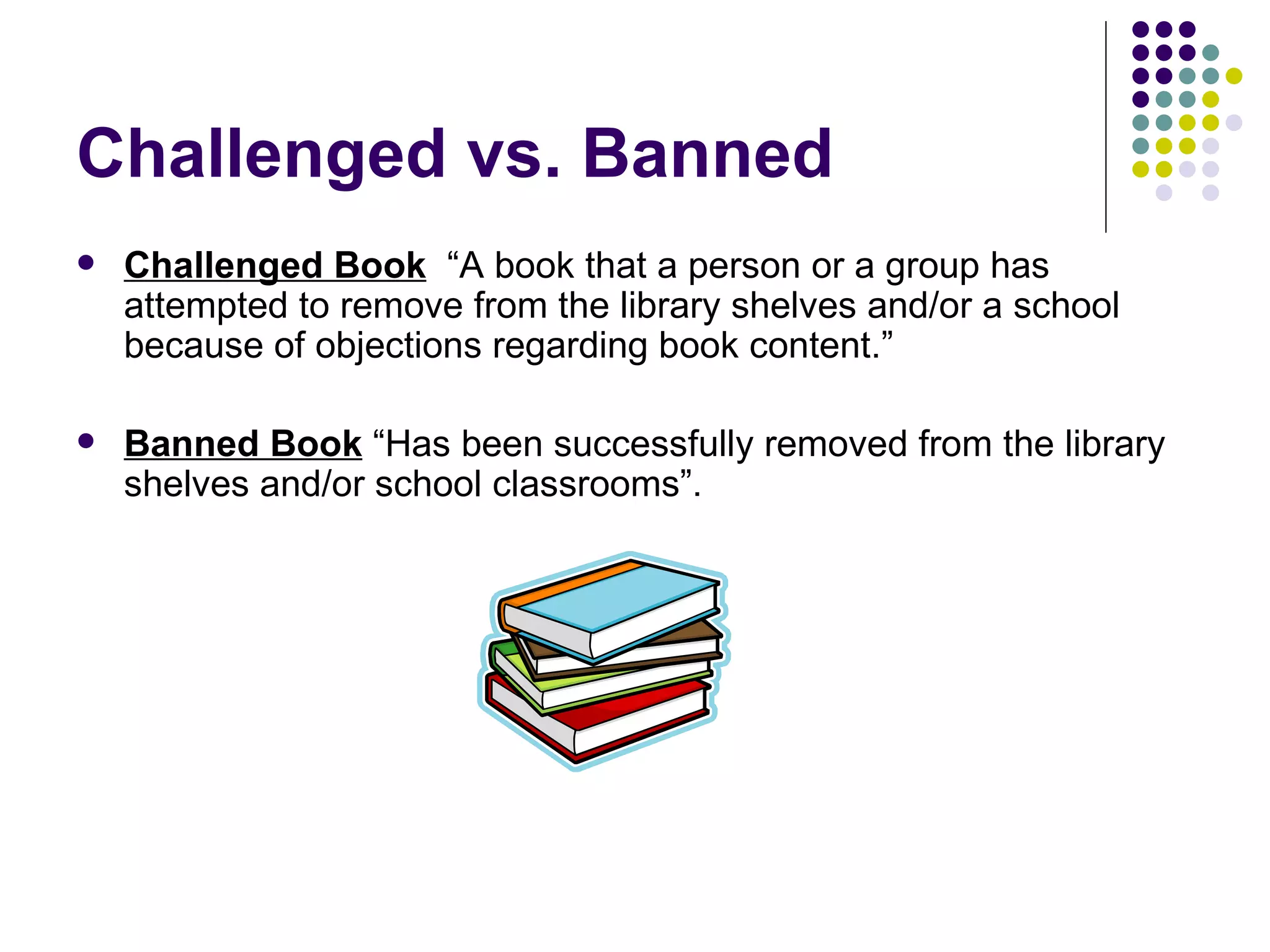
   Challenged Book “A book that a person or a group has
    attempted to remove from the library shelves and/or a school
    because of objections regarding book content.”

   Banned Book “Has been successfully removed from the library
    shelves and/or school classrooms”.
Some reasons why a book
might be challenged:
   Language
   Sexual content
   Racially discriminatory
   Violence
   Political differences
   Religious differences
Top Reasons Books are Challenged

1.   the material was considered to be "sexually
     explicit"
2.   the material contained "offensive language"
3.   the materials was "unsuited to any age
     group“


http://www.ala.org/advocacy/banned/aboutbannedbooks
American Library Association
(ALA)
   ALA's Office for Intellectual Freedom compiles a list
    of the top ten most frequently challenged books
    each year
   Collects information from two sources: newspapers
    and reports submitted by individuals
   “Research suggests that for each challenge
    reported there are as many as four or five which go
    unreported.”


http://www.ala.org/advocacy/banned/aboutbannedbooks
ALA’s The 10 most challenged books of 2010:
   And Tango Makes Three, by Peter Parnell and Justin Richardson
    Reasons: homosexuality, religious viewpoint, unsuited to age group
   The Absolutely True Diary of a Part-Time Indian, by Sherman Alexie
    Reasons: offensive language, racism, religious viewpoint, sex education, sexually explicit,
    violence, unsuited to age group
   Brave New World, by Aldous Huxley
    Reasons: insensitivity, offensive language, racism, sexually explicit
   Crank, by Ellen Hopkins
    Reasons: drugs, offensive language, racism, sexually explicit
   The Hunger Games (series), by Suzanne Collins
    Reasons: sexually explicit, violence, unsuited to age group
   Lush, by Natasha Friend
    Reasons: drugs, sexually explicit, offensive language, unsuited to age group
   What My Mother Doesn't Know, by Sonya Sones
    Reasons: sexism, sexually explicit, unsuited to age group
   Nickel and Dimed: On (Not) Getting by in America, by Barbara Ehrenreich
    Reasons: drugs, inaccurate, offensive language, political viewpoint, religious viewpoint
   Revolutionary Voices edited by Amy Sonnie
    Reasons: homosexuality, sexually explicit
   Twilight (series), by Stephenie Meyer
    Reasons: sexually explicit, religious viewpoint, violence, unsuited to age group


http://www.bannedbooksweek.org/about
Library Bill of Rights
    The American Library Association affirms that all libraries are forums for
    information and ideas, and that the following basic policies should guide their
    services.
   I. Books and other library resources should be provided for the interest, information,
    and enlightenment of all people of the community the library serves. Materials should
    not be excluded because of the origin, background, or views of those contributing to
    their creation.
   II. Libraries should provide materials and information presenting all points of view on
    current and historical issues. Materials should not be proscribed or removed because
    of partisan or doctrinal disapproval.
   III. Libraries should challenge censorship in the fulfillment of their responsibility to
    provide information and enlightenment.
   IV. Libraries should cooperate with all persons and groups concerned with resisting
    abridgment of free expression and free access to ideas.
   V. A person’s right to use a library should not be denied or abridged because of origin,
    age, background, or views.
   VI. Libraries which make exhibit spaces and meeting rooms available to the public they
    serve should make such facilities available on an equitable basis, regardless of the
    beliefs or affiliations of individuals or groups requesting their use.

Adopted June 18, 1948, by the ALA Council; amended February 2, 1961; amended June
   28, 1967; amended January 23, 1980; inclusion of “age” reaffirmed January 24, 1996.


http://www.ala.org/advocacy/intfreedom/librarybill/
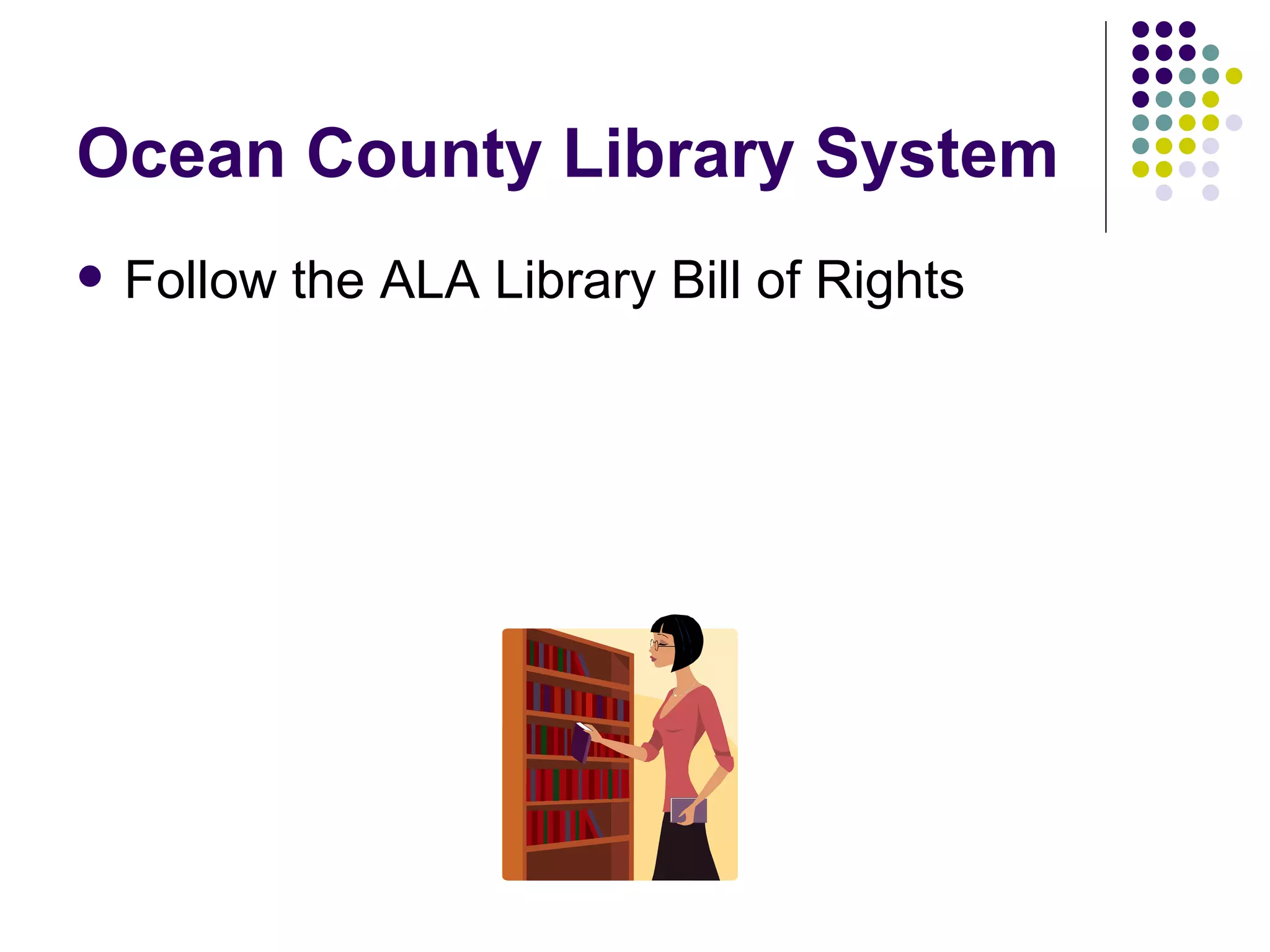
Ocean County Library System
   Follow the ALA Library Bill of Rights
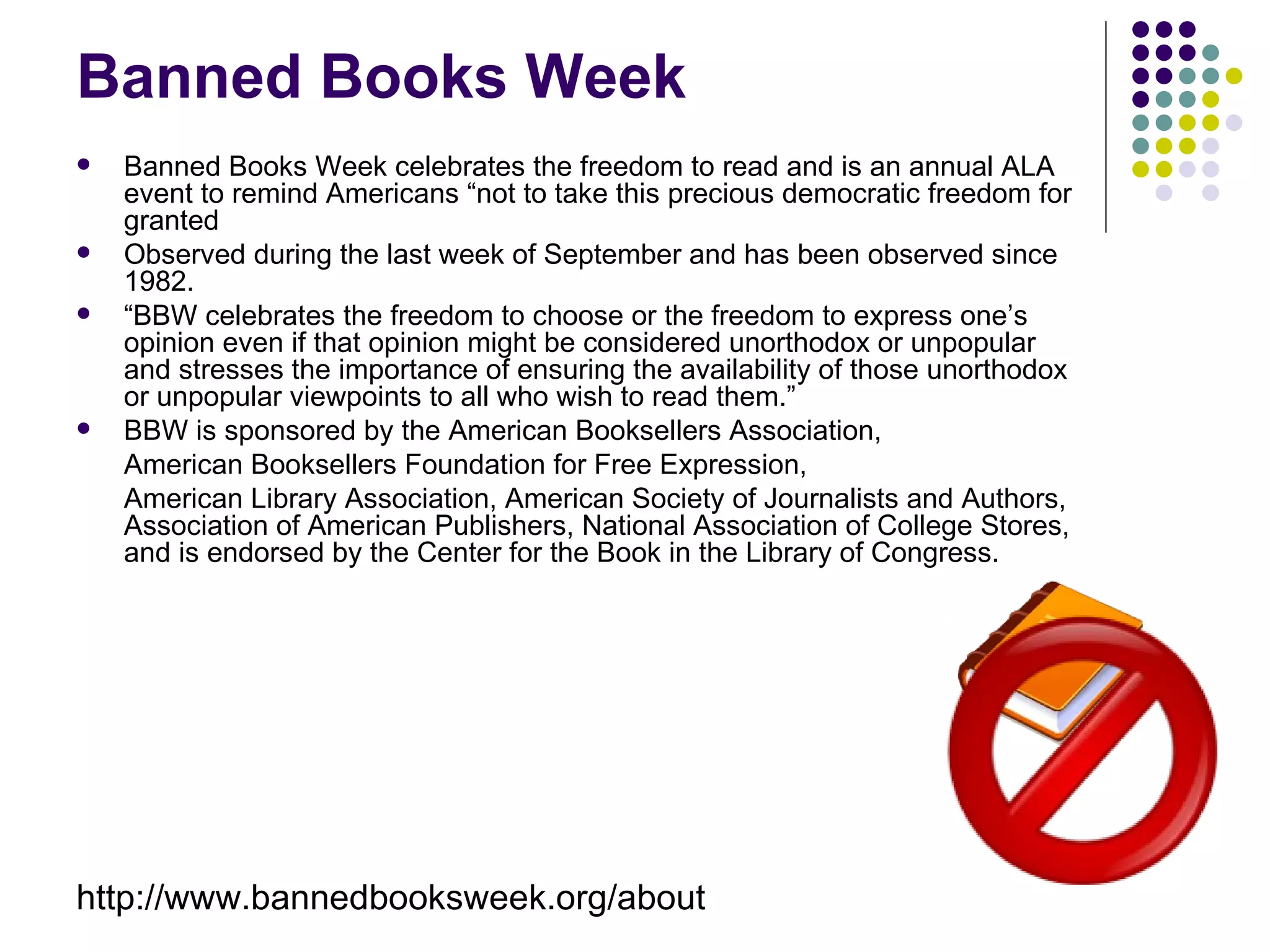
Banned Books Week
   Banned Books Week celebrates the freedom to read and is an annual ALA
    event to remind Americans “not to take this precious democratic freedom for
    granted
   Observed during the last week of September and has been observed since
    1982.
   “BBW celebrates the freedom to choose or the freedom to express one’s
    opinion even if that opinion might be considered unorthodox or unpopular
    and stresses the importance of ensuring the availability of those unorthodox
    or unpopular viewpoints to all who wish to read them.”
   BBW is sponsored by the American Booksellers Association,
    American Booksellers Foundation for Free Expression,
    American Library Association, American Society of Journalists and Authors,
    Association of American Publishers, National Association of College Stores,
    and is endorsed by the Center for the Book in the Library of Congress.


http://www.bannedbooksweek.org/about
Examples of Challenges
   Debbie Does Dallas Uncovered
   The Giver
   Islam
Sources and Links:
   http://www.ala.org/advocacy/banned/aboutbannedbooks
   http://www.bannedbooksweek.org/about
   http://www.ala.org/advocacy/intfreedom/librarybill/
   http://pabbis.org/

Banned books pp

  • 1.
  • 2.
    Challenged vs. Banned  Challenged Book “A book that a person or a group has attempted to remove from the library shelves and/or a school because of objections regarding book content.”  Banned Book “Has been successfully removed from the library shelves and/or school classrooms”.
  • 3.
    Some reasons whya book might be challenged:  Language  Sexual content  Racially discriminatory  Violence  Political differences  Religious differences
  • 4.
    Top Reasons Booksare Challenged 1. the material was considered to be "sexually explicit" 2. the material contained "offensive language" 3. the materials was "unsuited to any age group“ http://www.ala.org/advocacy/banned/aboutbannedbooks
  • 5.
    American Library Association (ALA)  ALA's Office for Intellectual Freedom compiles a list of the top ten most frequently challenged books each year  Collects information from two sources: newspapers and reports submitted by individuals  “Research suggests that for each challenge reported there are as many as four or five which go unreported.” http://www.ala.org/advocacy/banned/aboutbannedbooks
  • 6.
    ALA’s The 10most challenged books of 2010:  And Tango Makes Three, by Peter Parnell and Justin Richardson Reasons: homosexuality, religious viewpoint, unsuited to age group  The Absolutely True Diary of a Part-Time Indian, by Sherman Alexie Reasons: offensive language, racism, religious viewpoint, sex education, sexually explicit, violence, unsuited to age group  Brave New World, by Aldous Huxley Reasons: insensitivity, offensive language, racism, sexually explicit  Crank, by Ellen Hopkins Reasons: drugs, offensive language, racism, sexually explicit  The Hunger Games (series), by Suzanne Collins Reasons: sexually explicit, violence, unsuited to age group  Lush, by Natasha Friend Reasons: drugs, sexually explicit, offensive language, unsuited to age group  What My Mother Doesn't Know, by Sonya Sones Reasons: sexism, sexually explicit, unsuited to age group  Nickel and Dimed: On (Not) Getting by in America, by Barbara Ehrenreich Reasons: drugs, inaccurate, offensive language, political viewpoint, religious viewpoint  Revolutionary Voices edited by Amy Sonnie Reasons: homosexuality, sexually explicit  Twilight (series), by Stephenie Meyer Reasons: sexually explicit, religious viewpoint, violence, unsuited to age group http://www.bannedbooksweek.org/about
  • 7.
    Library Bill ofRights The American Library Association affirms that all libraries are forums for information and ideas, and that the following basic policies should guide their services.  I. Books and other library resources should be provided for the interest, information, and enlightenment of all people of the community the library serves. Materials should not be excluded because of the origin, background, or views of those contributing to their creation.  II. Libraries should provide materials and information presenting all points of view on current and historical issues. Materials should not be proscribed or removed because of partisan or doctrinal disapproval.  III. Libraries should challenge censorship in the fulfillment of their responsibility to provide information and enlightenment.  IV. Libraries should cooperate with all persons and groups concerned with resisting abridgment of free expression and free access to ideas.  V. A person’s right to use a library should not be denied or abridged because of origin, age, background, or views.  VI. Libraries which make exhibit spaces and meeting rooms available to the public they serve should make such facilities available on an equitable basis, regardless of the beliefs or affiliations of individuals or groups requesting their use. Adopted June 18, 1948, by the ALA Council; amended February 2, 1961; amended June 28, 1967; amended January 23, 1980; inclusion of “age” reaffirmed January 24, 1996. http://www.ala.org/advocacy/intfreedom/librarybill/
  • 8.
    Ocean County LibrarySystem  Follow the ALA Library Bill of Rights
  • 9.
    Banned Books Week  Banned Books Week celebrates the freedom to read and is an annual ALA event to remind Americans “not to take this precious democratic freedom for granted  Observed during the last week of September and has been observed since 1982.  “BBW celebrates the freedom to choose or the freedom to express one’s opinion even if that opinion might be considered unorthodox or unpopular and stresses the importance of ensuring the availability of those unorthodox or unpopular viewpoints to all who wish to read them.”  BBW is sponsored by the American Booksellers Association, American Booksellers Foundation for Free Expression, American Library Association, American Society of Journalists and Authors, Association of American Publishers, National Association of College Stores, and is endorsed by the Center for the Book in the Library of Congress. http://www.bannedbooksweek.org/about
  • 10.
    Examples of Challenges  Debbie Does Dallas Uncovered  The Giver  Islam
  • 11.
    Sources and Links:  http://www.ala.org/advocacy/banned/aboutbannedbooks  http://www.bannedbooksweek.org/about  http://www.ala.org/advocacy/intfreedom/librarybill/  http://pabbis.org/

Editor's Notes

  • #6 point 2- some of whom use the Challenge Database Form. All challenges are compiled into a database.