
itCoin 2.0
IS THIS THE FUTURE?
Supratika CHAKRAPANI
GUO Zongren
NG Wen Ying
WONG See Wei Nina
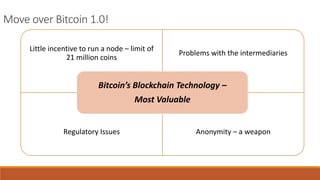
Move over Bitcoin 1.0!
Little incentive to run a node – limit of
21 million coins
Problems with the intermediaries
Regulatory Issues Anonymity – a weapon
Bitcoin’s Blockchain Technology –
Most Valuable
3
Smart Contracts
Computer protocols that facilitate, verify, or
enforce the negotiation or performance of a
contract
All sorts of property that is valuable and
controlled by digital means
 Property
 Car Rentals
 Smart Houses
 Employee HR Contracts
 Business Contracts
Provide much better observation and
verification where proactive measures must
fall short
Reduced transaction cost with contracting
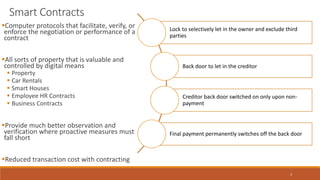
Lock to selectively let in the owner and exclude third
parties
Back door to let in the creditor
Creditor back door switched on only upon non-
payment
Final payment permanently switches off the back door
4
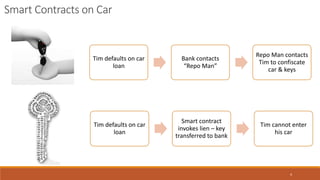
Smart Contracts on Car
Tim defaults on car
loan
Bank contacts
“Repo Man”
Repo Man contacts
Tim to confiscate
car & keys
Tim defaults on car
loan
Smart contract
invokes lien – key
transferred to bank
Tim cannot enter
his car
5
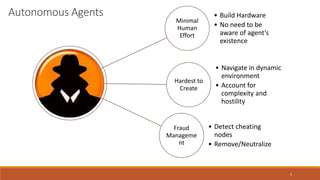
Autonomous Agents
Minimal
Human
Effort
• Build Hardware
• No need to be
aware of agent’s
existence
Hardest to
Create
• Navigate in dynamic
environment
• Account for
complexity and
hostility
Fraud
Manageme
nt
• Detect cheating
nodes
• Remove/Neutralize
6
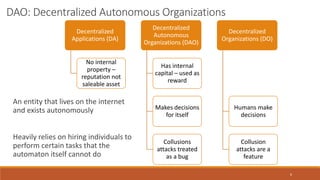
DAO: Decentralized Autonomous Organizations
An entity that lives on the internet
and exists autonomously
Heavily relies on hiring individuals to
perform certain tasks that the
automaton itself cannot do
Decentralized
Applications (DA)
No internal
property –
reputation not
saleable asset
Decentralized
Autonomous
Organizations (DAO)
Has internal
capital – used as
reward
Makes decisions
for itself
Collusions
attacks treated
as a bug
Decentralized
Organizations (DO)
Humans make
decisions
Collusion
attacks are a
feature
7
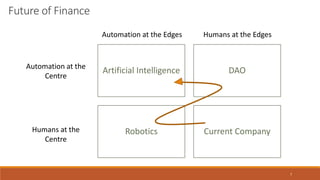
Future of Finance
Artificial Intelligence DAO
Robotics Current Company
Humans at the EdgesAutomation at the Edges
Automation at the
Centre
Humans at the
Centre
8
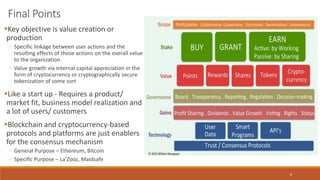
Final Points
Key objective is value creation or
production
◦ Specific linkage between user actions and the
resulting effects of those actions on the overall value
to the organization
◦ Value growth via internal capital appreciation in the
form of cryptocurrency or cryptographically secure
tokenization of some sort
Like a start up - Requires a product/
market fit, business model realization and
a lot of users/ customers
Blockchain and cryptocurrency-based
protocols and platforms are just enablers
for the consensus mechanism
◦ General Purpose – Ethereum, Bitcoin
◦ Specific Purpose – La’Zooz, Maidsafe
Block chain
What is it?
◦ A shared public ledger – A bookkeeping system that shows all confirmed
transactions
◦ Only confirmed transactions are included in the block chain
◦ Once each block chain is established, the contents cannot be deleted.
◦ Block chains are added onto existing block chains.
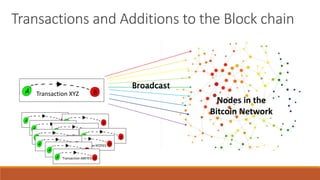
Transactions and Additions to the Block chain
Nodes in the
Bitcoin Network
Transaction XYZ
Transaction XYZYES
Broadcast
Transaction ABEYES
Existing Block chain
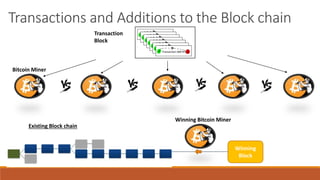
Transactions and Additions to the Block chain
Bitcoin Miner
Transaction
Block
Transaction ABEYES
Winning
Block
Winning Bitcoin Miner
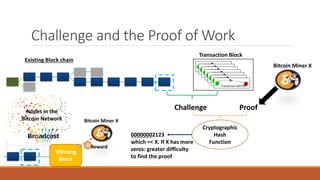
Challenge and the Proof of Work
Existing Block chain
Transaction Block
Challenge
Bitcoin Miner X
Proof
Cryptographic
Hash
Function
00000002123
which =< X. If X has more
zeros: greater difficulty
to find the proof
Winning
Block
Nodes in the
Bitcoin Network
Broadcast
Bitcoin Miner X
Reward
Transaction ABEYES
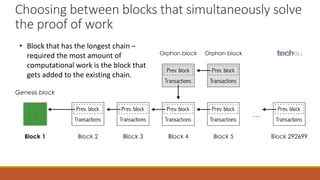
Choosing between blocks that simultaneously solve
the proof of work
• Block that has the longest chain –
required the most amount of
computational work is the block that
gets added to the existing chain.
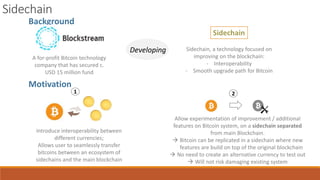
Motivation
Background
A for-profit Bitcoin technology
company that has secured c.
USD 15 million fund
Developing
Sidechain
Sidechain, a technology focused on
improving on the blockchain:
- Interoperability
- Smooth upgrade path for Bitcoin
1
Introduce interoperability between
different currencies;
Allows user to seamlessly transfer
bitcoins between an ecosystem of
sidechains and the main blockchain
2
Allow experimentation of improvement / additional
features on Bitcoin system, on a sidechain separated
from main Blockchain.
 Bitcoin can be replicated in a sidechain where new
features are build on top of the original blockchain
 No need to create an alternative currency to test out
 Will not risk damaging existing system
Sidechain
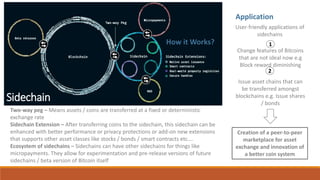
How it Works?
Sidechain
Two-way peg – Means assets / coins are transferred at a fixed or deterministic
exchange rate
Sidechain Extension – After transferring coins to the sidechain, this sidechain can be
enhanced with better performance or privacy protections or add-on new extensions
that supports other asset classes like stocks / bonds / smart contracts etc….
Ecosystem of sidechains – Sidechains can have other sidechains for things like
micropayments. They allow for experimentation and pre-release versions of future
sidechains / beta version of Bitcoin itself
Application
1
User-friendly applications of
sidechains
Change features of Bitcoins
that are not ideal now e.g
Block reward diminishing
2
Issue asset chains that can
be transferred amongst
blockchains e.g. Issue shares
/ bonds
Creation of a peer-to-peer
marketplace for asset
exchange and innovation of
a better coin system
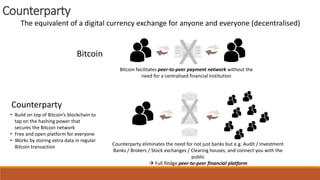
Counterparty
The equivalent of a digital currency exchange for anyone and everyone (decentralised)
Bitcoin
Counterparty
XBitcoin facilitates peer-to-peer payment network without the
need for a centralised financial institution
X
Counterparty eliminates the need for not just banks but e.g. Audit / Investment
Banks / Brokers / Stock exchanges / Clearing houses, and connect you with the
public
 Full fledge peer-to-peer financial platform
• Build on top of Bitcoin’s blockchain to
tap on the hashing power that
secures the Bitcoin network
• Free and open platform for everyone
• Works by storing extra data in regular
Bitcoin transaction
Counterparty
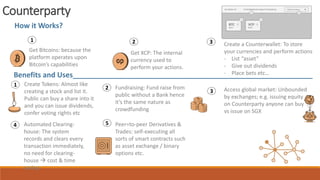
How it Works?
1
Get Bitcoins: because the
platform operates upon
Bitcoin’s capabilities
3 Create a Counterwallet: To store
your currencies and perform actions
- List “asset”
- Give out dividends
- Place bets etc…
2
Get XCP: The internal
currency used to
perform your actions.
Benefits and Uses____________________________________________________________
1 Create Tokens: Almost like
creating a stock and list it.
Public can buy a share into it
and you can issue dividends,
confer voting rights etc
2 Fundraising: Fund raise from
public without a Bank hence
it’s the same nature as
crowdfunding
3 Access global market: Unbounded
by exchanges; e.g. issuing equity
on Counterparty anyone can buy
vs issue on SGX
4 Automated Clearing-
house: The system
records and clears every
transaction immediately,
no need for clearing-
house  cost & time
saving
5 Peer=to-peer Derivatives &
Trades: self-executing all
sorts of smart contracts such
as asset exchange / binary
options etc.
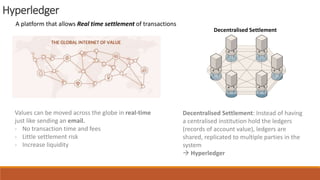
Hyperledger
A platform that allows Real time settlement of transactions
Values can be moved across the globe in real-time
just like sending an email.
- No transaction time and fees
- Little settlement risk
- Increase liquidity
Decentralised Settlement: Instead of having
a centralised institution hold the ledgers
(records of account value), ledgers are
shared, replicated to multiple parties in the
system
 Hyperledger
Decentralised Settlement
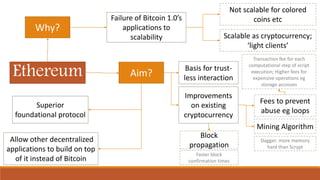
Ethereum
Why?
Aim?
Failure of Bitcoin 1.0’s
applications to
scalability Scalable as cryptocurrency;
‘light clients’
Not scalable for colored
coins etc
Superior
foundational protocol
Allow other decentralized
applications to build on top
of it instead of Bitcoin
Improvements
on existing
cryptocurrency
Fees to prevent
abuse eg loops
Transaction fee for each
computational step of script
execution; Higher fees for
expensive operations eg
storage accesses
Mining Algorithm
Dagger: more memory
hard than Scrypt
Block
propagation
Faster block
confirmation times
Basis for trust-
less interaction
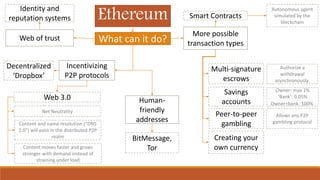
Ethereum Smart Contracts
Autonomous agent
simulated by the
blockchain
More possible
transaction types
Multi-signature
escrows
Authorize a
withdrawal
asynchronously
Savings
accounts
Peer-to-peer
gambling
Creating your
own currency
What can it do?
Owner: max 1%
‘Bank’: 0.05%
Owner+bank: 100%
Allows any P2P
gambling protocol
Incentivizing
P2P protocols
Decentralized
‘Dropbox’
Human-
friendly
addresses
BitMessage,
Tor
Web of trust
Identity and
reputation systems
Web 3.0
Content and name resolution (“DNS
2.0″) will exist in the distributed P2P
realm
Net Neutrality
Content moves faster and grows
stronger with demand instead of
straining under load
Ethereum – current status
May 2014 - Regulations:
 Digital Finance Compliance Association was created with the purpose of interfacing
with the Swiss authorities and providing guidance while also providing assistance
and advice for current and new members
Ether sale: lasted 42 days, July-Sep 2014, and collected a total of 31,531 BTC, worth $18,439,086 at
the time of the sale, in exchange for about 60,102,216 ETH.
Going forward: Web 3.0: anonymous, decentralized.
 HTML/Javascript based engine and Ehereum bindings: can tie together contracts with HTML/Javascript
based front-ends
 Nov 2014: MIST – decentralized app browser
 Feb 2015: Whisper group chat
Asked to join the World Wide Web Consortium (W3C) and participate in the Web Payments Interest
Group. The membership includes some of the largest banks, payments companies, tech companies
and telecoms in the world.
- Example of Ethereum application
Target
 Applications without servers by enlisting users to participate in the management and security of these
applications’ data
 Data-driven interactions which are both autonomous and legally compliant
Decerver: Distributed Application Server
 Developers can build distributed applications which easily interact with a diverse set of blockchain and
peer-to-peer protocols, all of which have been harmonized in an interactive layer that can be accessed
via a JavaScript runtime
Thelonious
 Customizable, smart-contract enabled, smart-contract controlled blockchain design
 Derived from the Ethereum protocol
 Gives developers the control to define their own state-of-the-art blockchain
Conclusion
Invest in technology, not the reward (coins)
 Cannot tell which coin will be more accepted in relation to fiat currency in the future
Invest in companies that are developing applications that are monetizable
 Venture capital aspect
 Need for technological specialist who is able to advise on viability of product (eg proprietary code,
demand, scalability)
Investment in supporting infrastructure
 E.g. storage, smart contracts for employees
 R&D aspect: prepare for regulations in future
 Smart-contract enabled ownership
 Eg electronic hotel doors, cutting out middleman etc
Potential for government-issued coins
 Ability of government to fix exchange rate
 Loss of centralization & anonymity
Nick Szabo -- The Idea of Smart Contracts (Nick Szabo -- The Idea of Smart Contracts) (Last
Accessed: 15th April 2015) http://szabo.best.vwh.net/smart_contracts_idea.html
What Does it Take to Succeed as a Decentralized Autonomous Organization? (Coin Desk RSS)
(Last Accessed:15th April 2015) http://www.coindesk.com/succeed-as-decentralized-
autonomous-organization/
Vitalik Buterin. (Last Accessed: 22nd March 2015, Created on 19th September 2013). Retrieved
from https://bitcoinmagazine.com/7050/bootstrapping-a-decentralized-autonomous-
corporation-part-i/
Adam Hofman (Last Accessed: 22nd March 2015, Created on 5th June 2014). Retrieved from
https://bitcoinmagazine.com/13763/swarm-redefines-crowdfunding/
25
References

Bitcoin 2.0

  • 1.
    itCoin 2.0 IS THISTHE FUTURE? Supratika CHAKRAPANI GUO Zongren NG Wen Ying WONG See Wei Nina
  • 2.
    Move over Bitcoin1.0! Little incentive to run a node – limit of 21 million coins Problems with the intermediaries Regulatory Issues Anonymity – a weapon Bitcoin’s Blockchain Technology – Most Valuable
  • 3.
    3 Smart Contracts Computer protocolsthat facilitate, verify, or enforce the negotiation or performance of a contract All sorts of property that is valuable and controlled by digital means  Property  Car Rentals  Smart Houses  Employee HR Contracts  Business Contracts Provide much better observation and verification where proactive measures must fall short Reduced transaction cost with contracting Lock to selectively let in the owner and exclude third parties Back door to let in the creditor Creditor back door switched on only upon non- payment Final payment permanently switches off the back door
  • 4.
    4 Smart Contracts onCar Tim defaults on car loan Bank contacts “Repo Man” Repo Man contacts Tim to confiscate car & keys Tim defaults on car loan Smart contract invokes lien – key transferred to bank Tim cannot enter his car
  • 5.
    5 Autonomous Agents Minimal Human Effort • BuildHardware • No need to be aware of agent’s existence Hardest to Create • Navigate in dynamic environment • Account for complexity and hostility Fraud Manageme nt • Detect cheating nodes • Remove/Neutralize
  • 6.
    6 DAO: Decentralized AutonomousOrganizations An entity that lives on the internet and exists autonomously Heavily relies on hiring individuals to perform certain tasks that the automaton itself cannot do Decentralized Applications (DA) No internal property – reputation not saleable asset Decentralized Autonomous Organizations (DAO) Has internal capital – used as reward Makes decisions for itself Collusions attacks treated as a bug Decentralized Organizations (DO) Humans make decisions Collusion attacks are a feature
  • 7.
    7 Future of Finance ArtificialIntelligence DAO Robotics Current Company Humans at the EdgesAutomation at the Edges Automation at the Centre Humans at the Centre
  • 8.
    8 Final Points Key objectiveis value creation or production ◦ Specific linkage between user actions and the resulting effects of those actions on the overall value to the organization ◦ Value growth via internal capital appreciation in the form of cryptocurrency or cryptographically secure tokenization of some sort Like a start up - Requires a product/ market fit, business model realization and a lot of users/ customers Blockchain and cryptocurrency-based protocols and platforms are just enablers for the consensus mechanism ◦ General Purpose – Ethereum, Bitcoin ◦ Specific Purpose – La’Zooz, Maidsafe
  • 9.
    Block chain What isit? ◦ A shared public ledger – A bookkeeping system that shows all confirmed transactions ◦ Only confirmed transactions are included in the block chain ◦ Once each block chain is established, the contents cannot be deleted. ◦ Block chains are added onto existing block chains.
  • 10.
    Transactions and Additionsto the Block chain Nodes in the Bitcoin Network Transaction XYZ Transaction XYZYES Broadcast Transaction ABEYES
  • 11.
    Existing Block chain Transactionsand Additions to the Block chain Bitcoin Miner Transaction Block Transaction ABEYES Winning Block Winning Bitcoin Miner
  • 12.
    Challenge and theProof of Work Existing Block chain Transaction Block Challenge Bitcoin Miner X Proof Cryptographic Hash Function 00000002123 which =< X. If X has more zeros: greater difficulty to find the proof Winning Block Nodes in the Bitcoin Network Broadcast Bitcoin Miner X Reward Transaction ABEYES
  • 13.
    Choosing between blocksthat simultaneously solve the proof of work • Block that has the longest chain – required the most amount of computational work is the block that gets added to the existing chain.
  • 14.
    Motivation Background A for-profit Bitcointechnology company that has secured c. USD 15 million fund Developing Sidechain Sidechain, a technology focused on improving on the blockchain: - Interoperability - Smooth upgrade path for Bitcoin 1 Introduce interoperability between different currencies; Allows user to seamlessly transfer bitcoins between an ecosystem of sidechains and the main blockchain 2 Allow experimentation of improvement / additional features on Bitcoin system, on a sidechain separated from main Blockchain.  Bitcoin can be replicated in a sidechain where new features are build on top of the original blockchain  No need to create an alternative currency to test out  Will not risk damaging existing system Sidechain
  • 15.
    How it Works? Sidechain Two-waypeg – Means assets / coins are transferred at a fixed or deterministic exchange rate Sidechain Extension – After transferring coins to the sidechain, this sidechain can be enhanced with better performance or privacy protections or add-on new extensions that supports other asset classes like stocks / bonds / smart contracts etc…. Ecosystem of sidechains – Sidechains can have other sidechains for things like micropayments. They allow for experimentation and pre-release versions of future sidechains / beta version of Bitcoin itself Application 1 User-friendly applications of sidechains Change features of Bitcoins that are not ideal now e.g Block reward diminishing 2 Issue asset chains that can be transferred amongst blockchains e.g. Issue shares / bonds Creation of a peer-to-peer marketplace for asset exchange and innovation of a better coin system
  • 16.
    Counterparty The equivalent ofa digital currency exchange for anyone and everyone (decentralised) Bitcoin Counterparty XBitcoin facilitates peer-to-peer payment network without the need for a centralised financial institution X Counterparty eliminates the need for not just banks but e.g. Audit / Investment Banks / Brokers / Stock exchanges / Clearing houses, and connect you with the public  Full fledge peer-to-peer financial platform • Build on top of Bitcoin’s blockchain to tap on the hashing power that secures the Bitcoin network • Free and open platform for everyone • Works by storing extra data in regular Bitcoin transaction
  • 17.
    Counterparty How it Works? 1 GetBitcoins: because the platform operates upon Bitcoin’s capabilities 3 Create a Counterwallet: To store your currencies and perform actions - List “asset” - Give out dividends - Place bets etc… 2 Get XCP: The internal currency used to perform your actions. Benefits and Uses____________________________________________________________ 1 Create Tokens: Almost like creating a stock and list it. Public can buy a share into it and you can issue dividends, confer voting rights etc 2 Fundraising: Fund raise from public without a Bank hence it’s the same nature as crowdfunding 3 Access global market: Unbounded by exchanges; e.g. issuing equity on Counterparty anyone can buy vs issue on SGX 4 Automated Clearing- house: The system records and clears every transaction immediately, no need for clearing- house  cost & time saving 5 Peer=to-peer Derivatives & Trades: self-executing all sorts of smart contracts such as asset exchange / binary options etc.
  • 18.
    Hyperledger A platform thatallows Real time settlement of transactions Values can be moved across the globe in real-time just like sending an email. - No transaction time and fees - Little settlement risk - Increase liquidity Decentralised Settlement: Instead of having a centralised institution hold the ledgers (records of account value), ledgers are shared, replicated to multiple parties in the system  Hyperledger Decentralised Settlement
  • 19.
    Ethereum Why? Aim? Failure of Bitcoin1.0’s applications to scalability Scalable as cryptocurrency; ‘light clients’ Not scalable for colored coins etc Superior foundational protocol Allow other decentralized applications to build on top of it instead of Bitcoin Improvements on existing cryptocurrency Fees to prevent abuse eg loops Transaction fee for each computational step of script execution; Higher fees for expensive operations eg storage accesses Mining Algorithm Dagger: more memory hard than Scrypt Block propagation Faster block confirmation times Basis for trust- less interaction
  • 20.
    Ethereum Smart Contracts Autonomousagent simulated by the blockchain More possible transaction types Multi-signature escrows Authorize a withdrawal asynchronously Savings accounts Peer-to-peer gambling Creating your own currency What can it do? Owner: max 1% ‘Bank’: 0.05% Owner+bank: 100% Allows any P2P gambling protocol Incentivizing P2P protocols Decentralized ‘Dropbox’ Human- friendly addresses BitMessage, Tor Web of trust Identity and reputation systems Web 3.0 Content and name resolution (“DNS 2.0″) will exist in the distributed P2P realm Net Neutrality Content moves faster and grows stronger with demand instead of straining under load
  • 21.
    Ethereum – currentstatus May 2014 - Regulations:  Digital Finance Compliance Association was created with the purpose of interfacing with the Swiss authorities and providing guidance while also providing assistance and advice for current and new members Ether sale: lasted 42 days, July-Sep 2014, and collected a total of 31,531 BTC, worth $18,439,086 at the time of the sale, in exchange for about 60,102,216 ETH. Going forward: Web 3.0: anonymous, decentralized.  HTML/Javascript based engine and Ehereum bindings: can tie together contracts with HTML/Javascript based front-ends  Nov 2014: MIST – decentralized app browser  Feb 2015: Whisper group chat Asked to join the World Wide Web Consortium (W3C) and participate in the Web Payments Interest Group. The membership includes some of the largest banks, payments companies, tech companies and telecoms in the world.
  • 22.
    - Example ofEthereum application Target  Applications without servers by enlisting users to participate in the management and security of these applications’ data  Data-driven interactions which are both autonomous and legally compliant Decerver: Distributed Application Server  Developers can build distributed applications which easily interact with a diverse set of blockchain and peer-to-peer protocols, all of which have been harmonized in an interactive layer that can be accessed via a JavaScript runtime Thelonious  Customizable, smart-contract enabled, smart-contract controlled blockchain design  Derived from the Ethereum protocol  Gives developers the control to define their own state-of-the-art blockchain
  • 23.
    Conclusion Invest in technology,not the reward (coins)  Cannot tell which coin will be more accepted in relation to fiat currency in the future Invest in companies that are developing applications that are monetizable  Venture capital aspect  Need for technological specialist who is able to advise on viability of product (eg proprietary code, demand, scalability) Investment in supporting infrastructure  E.g. storage, smart contracts for employees  R&D aspect: prepare for regulations in future  Smart-contract enabled ownership  Eg electronic hotel doors, cutting out middleman etc Potential for government-issued coins  Ability of government to fix exchange rate  Loss of centralization & anonymity
  • 25.
    Nick Szabo --The Idea of Smart Contracts (Nick Szabo -- The Idea of Smart Contracts) (Last Accessed: 15th April 2015) http://szabo.best.vwh.net/smart_contracts_idea.html What Does it Take to Succeed as a Decentralized Autonomous Organization? (Coin Desk RSS) (Last Accessed:15th April 2015) http://www.coindesk.com/succeed-as-decentralized- autonomous-organization/ Vitalik Buterin. (Last Accessed: 22nd March 2015, Created on 19th September 2013). Retrieved from https://bitcoinmagazine.com/7050/bootstrapping-a-decentralized-autonomous- corporation-part-i/ Adam Hofman (Last Accessed: 22nd March 2015, Created on 5th June 2014). Retrieved from https://bitcoinmagazine.com/13763/swarm-redefines-crowdfunding/ 25 References

Editor's Notes

  • #10 A bookkeeping system that is a Each blockchain records a number of transactions that have occurred Cannot be deleted but can only be added onto The blockchain is a shared public ledger on which the entire Bitcoin network relies. All confirmed transactions are included in the block chain. This way, Bitcoin wallets can calculate their spendable balance and new transactions can be verified to be spending bitcoins that are actually owned by the spender. The integrity and the chronological order of the block chain are enforced with cryptography.
  • #11 Compression into a single block
  • #13 Hash functions produce a digest of the inputs. Meaning the output is of a certain fixed size or fixed length. Outputs are usually random. A specific input will always produce the same output when it is input into the cryptographic hash function. (Deterministic function) Each challenge contains the hash output of the previous block making changing previous transactions difficult since its is the product of high amount of computational power. Cryptographic hash functions must be computationally efficient: inputs would produce outputs quickly. Cryptographic has functions should also have collision resistance: ie it’s hard to find two inputs that would produce the same digest or produce the same output. It should take a long time to find two distinct messages to produce the same output under the cryptographic hash function. It is possible that two different inputs can produce two same outputs since there are an infinite number of inputs yet a finite number of outputs Outputs should look random
  • #14 Orphan blocks aka stale blocks are blocks in which miners have solved but are found to have solved it with less computational effort compared to another block whose proof was solved at the same time. These blocks do not get attached to the existing block chain, and the next block would not be using any of its transactions into its block.
  • #20 https://bitcoinmagazine.com/9671/ethereum-next-generation-cryptocurrency-decentralized-application-platform/
  • #21 https://bitcoinmagazine.com/9671/ethereum-next-generation-cryptocurrency-decentralized-application-platform/
  • #23 If the commercial entities were wise about how they structured the deal, they could track all of their data-driven interactions on a smart contract-enabled blockchain without having to build twelve different systems, ensure their interoperability, and expend labour-time to appropriately categorize and file relevant transactional data. Every entity having access to the blockchain will be able to completely verify the entirety of the interactions as well as the entire history of the data set, which would be automatically maintained over the life of the deal and summarised at its conclusion. Under the current software design paradigm which would likely be deployed for such a deal, this would never happen. Each entity would keep full control over the scripts or software tracking and executing any downstream functions after a new or update record transaction. While the different commercial entities may be legally incorporated and would not be required to move to a completely trustless system of the kind described above, they would all experience significant cost savings from the increased verifiability and automation a blockchain-based smart contract system would permit.