UNION BUDGET    PRESENTED BY:-DEEPAK KHANDELWALIRFAN SHAFISAGAR KUMAR
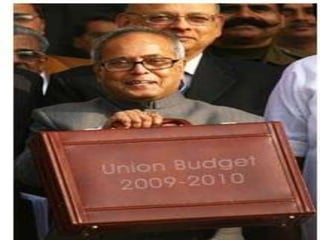
WHAT IS UNION BUDGET?The budget is the annual announcement of the government’s fiscal policy changes. It announce the tax changes proposed for the following tax year and also how the government plan to spend the revenue.
It is an instrument for fulfilling the obligations of the states
 It is a political statement of the priorities set by the government.
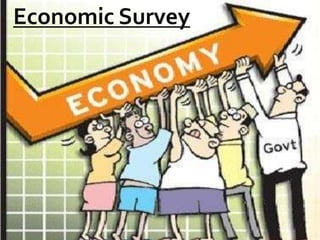
 It shows the financial transaction of the year.Economic Survey
The economic survey of India is published by central statical organization.
 Each year survey is conducted to show the status of economic scenario of the country.
The Economic Survey of India showcases the annual- economic development of the country.
It is scheduled to be presented on 2nd July, when the Budget Session of Parliament begins.
Union Budget sets goals and targets for the next one year, the Economic Survey focuses on the growth achieved the previous year and the factors that contributed to it.It talks about the state of the economy while      concentrating on selected economic indicators such as:-State of the Economy
Challenges and policy response.
Fiscal Developments and Public Finance.
Price and Monetary management.
Industrial Production.
Agriculture & Food management.
Energy, Infrastructure and Communication.
Poverty and Human development.
Financial Intermediate and Markets.STATE OF ECONOMYGDP to grow to 7.5 per cent in 2009-10.
The overall growth of GDP at factor cost at constant prices in 2008-09, as per revised estimates released by the Central Statistical Organisation (CSO) (May 29, 2009) was 6.7 per cent.
Despite the slowdown in growth, investment remained relatively buoyant, growing at a rate higher than that of GDP
The overall rate of growth of capital information at constant price was 15.6 in 07-08 is compare to 13.9 in 06-07.
The index of industrial production for the year 2008-09 points towards a sharp slowdown with growth being placed at 2.4 per cent. Challenges and policy response.During the last two years the Indian  economy faced three major challenges-Increase the capital inflow which reached to maximum in the last quarter of 2007-08.
An inflationary explosion in global commodity prices.
Global financial meltdown and collapse of international trade.FISCAL DEVELOPMENT AND PUBLIC FINANCEFiscal consolidation began in the early 1990. with fiscal deficit declining from 6.6% for GDP in 1990-91 to 4.1% of GDP in 1996-97 and it reached to 6.2% of GDP in 2001-02.
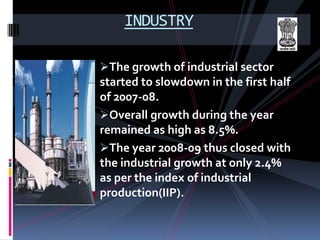
INDUSTRYThe growth of industrial sector started to slowdown in the first half of 2007-08.
Overall growth during the year remained as high as 8.5%.
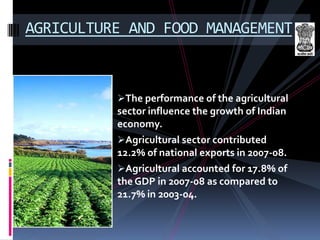
The year 2008-09 thus closed with the industrial growth at only 2.4% as per the index of industrial production(IIP).AGRICULTURE AND FOOD MANAGEMENTThe performance of the agricultural sector influence the growth of Indian economy.
Agricultural sector contributed 12.2% of national exports in 2007-08.
Agricultural accounted for 17.8% of the GDP in 2007-08 as compared to 21.7% in 2003-04. BUDGET AT A GLANCETotal estimated expenditure is Rs.10,20,838crore, 36% more than previous.
Total estimated income is Rs. 6,14,497crore.

Union Budget

  • 1.
    UNION BUDGET PRESENTED BY:-DEEPAK KHANDELWALIRFAN SHAFISAGAR KUMAR
  • 3.
    WHAT IS UNIONBUDGET?The budget is the annual announcement of the government’s fiscal policy changes. It announce the tax changes proposed for the following tax year and also how the government plan to spend the revenue.
  • 4.
    It is aninstrument for fulfilling the obligations of the states
  • 5.
    It isa political statement of the priorities set by the government.
  • 6.
    It showsthe financial transaction of the year.Economic Survey
  • 7.
    The economic surveyof India is published by central statical organization.
  • 8.
    Each yearsurvey is conducted to show the status of economic scenario of the country.
  • 9.
    The Economic Surveyof India showcases the annual- economic development of the country.
  • 10.
    It is scheduledto be presented on 2nd July, when the Budget Session of Parliament begins.
  • 11.
    Union Budget setsgoals and targets for the next one year, the Economic Survey focuses on the growth achieved the previous year and the factors that contributed to it.It talks about the state of the economy while concentrating on selected economic indicators such as:-State of the Economy
  • 12.
  • 13.
  • 14.
  • 15.
  • 16.
  • 17.
  • 18.
    Poverty and Humandevelopment.
  • 19.
    Financial Intermediate andMarkets.STATE OF ECONOMYGDP to grow to 7.5 per cent in 2009-10.
  • 20.
    The overall growthof GDP at factor cost at constant prices in 2008-09, as per revised estimates released by the Central Statistical Organisation (CSO) (May 29, 2009) was 6.7 per cent.
  • 21.
    Despite the slowdownin growth, investment remained relatively buoyant, growing at a rate higher than that of GDP
  • 22.
    The overall rateof growth of capital information at constant price was 15.6 in 07-08 is compare to 13.9 in 06-07.
  • 23.
    The index ofindustrial production for the year 2008-09 points towards a sharp slowdown with growth being placed at 2.4 per cent. Challenges and policy response.During the last two years the Indian economy faced three major challenges-Increase the capital inflow which reached to maximum in the last quarter of 2007-08.
  • 24.
    An inflationary explosionin global commodity prices.
  • 25.
    Global financial meltdownand collapse of international trade.FISCAL DEVELOPMENT AND PUBLIC FINANCEFiscal consolidation began in the early 1990. with fiscal deficit declining from 6.6% for GDP in 1990-91 to 4.1% of GDP in 1996-97 and it reached to 6.2% of GDP in 2001-02.
  • 26.
    INDUSTRYThe growth ofindustrial sector started to slowdown in the first half of 2007-08.
  • 27.
    Overall growth duringthe year remained as high as 8.5%.
  • 28.
    The year 2008-09thus closed with the industrial growth at only 2.4% as per the index of industrial production(IIP).AGRICULTURE AND FOOD MANAGEMENTThe performance of the agricultural sector influence the growth of Indian economy.
  • 29.
    Agricultural sector contributed12.2% of national exports in 2007-08.
  • 30.
    Agricultural accounted for17.8% of the GDP in 2007-08 as compared to 21.7% in 2003-04. BUDGET AT A GLANCETotal estimated expenditure is Rs.10,20,838crore, 36% more than previous.
  • 31.
    Total estimated incomeis Rs. 6,14,497crore.
  • 32.
    Sustain rate ofgrowth 9%p.a over an extended time.
  • 33.
    Non tax revenuereceipts estimated at Rs.1,40,279crore in 2009-10 compare to Rs.95,785crore in 2008-09.INFRASTRUCTURE AND INDUSTRYInadequate infrastructure is responsible for pushing back India’s GDP by about 2%.
  • 34.
    IIFCL will refinance60% of bank loan in critical sectors.
  • 35.
    Allocation of nationalhighway authority of India for the national highway development programme increased by 23%.
  • 36.
    National Ganga Projectallocation to go up to Rs 562 Crore.AGRICULTURETarget for agriculture credit are Rs.3,25,000 crore for year 2009-10.For farmers loans upto 3 lakh at 7% p.a.Agriculture sector has grown by 2.4%.Record rice production at 98.04 million tonnes. 14 national agricultural projects approved.Central assistance for storm water drainage project increase to Rs.500 crore from 200 crore.Rajeev Gandhi Krishi vikas yojana allocation up by 30%.
  • 37.
    EDUCATIONOverall plan expenditurefor education sector in budget 2009-10 is 3.25 lakh crore.
  • 38.
    This is34% up from the previous year.
  • 39.
    2,113 crore toset upto more IITs and IIMs.
  • 40.
    Interest subsidy onloans for higher education.
  • 41.
    Rs. 827 croreallocated for opening one central university in each uncovered state.
  • 42.
    Spending on highereducation raised to Rs.2010 crore.OIL AND GASBio-diesel custom duty lowered.
  • 43.
    To develop andset up national gas grid.
  • 44.
    Domestic oil pricesshould be in sync with global crude.
  • 45.
    Tax incentives willbe provided on capital expenditure on the laying and operating of cross country natural gas, crude or in pipe line networks for excise duty on naphtha reduced to 14%.RURAL DEVELOPMENTIn National Rural Health Mission(NRHM) to increase of Rs.2,057 crore.
  • 46.
    Pradhan Mantri AdarshGram Yojna has been initiated for integrated development of 1000 villages allocation Rs.100 crore.
  • 47.
    Allocation under RajivGandhi Gram Vidyutikaran yojna is up by 27% to Rs.7000 crore.
  • 48.
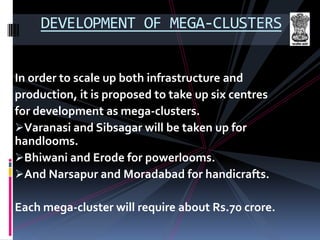
    Expenditure on IndiraAwas Yojna by 63% to Rs.8800 crore.DEVELOPMENT OF MEGA-CLUSTERSIn order to scale up both infrastructure andproduction, it is proposed to take up six centresfor development as mega-clusters.Varanasi and Sibsagar will be taken up for handlooms.
  • 49.
    Bhiwani and Erodefor powerlooms.
  • 50.
    And Narsapur andMoradabad for handicrafts.Each mega-cluster will require about Rs.70 crore.
  • 51.
    TAXSurcharge of 10%on personal income tax removed.
  • 52.
    Custom duty reducedfrom 10% to5% on 10 specific life saving drugs.
  • 53.
    Excise duty onbranded articles of jewellery to be reduced from 2% to nil.
  • 54.
    Excise duty onspecial boiling point spirit to be reduced to 14%.HEALTHAll BPL families to be covered under Rashtriya Swasthya Bima Yojana(RSBY). Allocation under RSBY increased by 40% over previous allocation to Rs.350 crore in 2009-10.
  • 55.
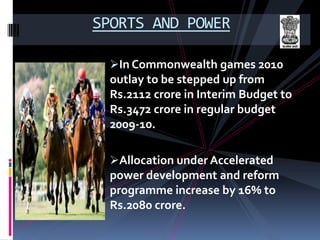
    Allocation under NationalRural Health Mission increase by Rs.2057 crore.SPORTS AND POWERIn Commonwealth games 2010 outlay to be stepped up from Rs.2112 crore in Interim Budget to Rs.3472 crore in regular budget 2009-10.
  • 56.
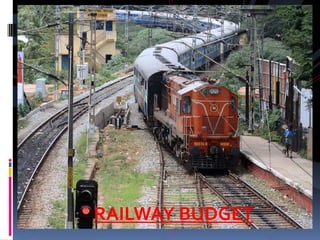
    Allocation under Acceleratedpower development and reform programme increase by 16% to Rs.2080 crore.RAILWAY BUDGET
  • 57.
    HIGHLIGHTS OF RAILWAYBUDGETRailways has generated the revenue of 90,000 crore in last 5 years.
  • 58.
    The India Railwayhas expenditure 81685 crore.
  • 59.
    Development of Railfacility in Jammu and Kashmir.REDUCED TARRIFS:For ordinary passenger trains there is reduction in passenger fares by Rupee 1 for fares costing up to Rs 50 per passenger for journey above 10 km.
  • 60.
    For all mail/expressand ordinary passenger trains, second class and sleeper class fares are to be reduced by 2 per cent for tickets costing Rs 50 and more per passenger.
  • 61.
    Also there isto be a fare Reduction of 2 per cent for AC First Class, AC II tier, AC III tier and AC Chair Car. NEW PASSENGER SERVICES:43 new train services to be started in 2009-10.
  • 62.
    Extension of 14trains envisaged.
  • 63.
    Frequency of 14trains is to be increased. INFRASTRUCTURE:New lines to be introduced
  • 64.
    Gauge conversion atChhindwara, Ahmedpur and Naghbir
  • 65.
    Doubling at Tala,Secunderabad, Sahibganj, Ara, Ghumani, Hissar, Dankuni, Bibinagar, Krishnanagar, Rajkot, Bandel and Jhansi.DEVELOPMENT:Seven nursing college to be set up on railway land in places including Delhi, Kolkata & Mumbai.
  • 66.
    50 stations tobe upgrade to world class standards.
  • 67.
    49 stations tobe developed at pilgrim centers.
  • 68.
    Multi-functional complexes withshopping malls, food stalls, medicines and variety stores in different parts of the country.
  • 69.
    Mega logistics hubsin Eastern and Western corridors Colleges on Rail land on Public-Private Partnership.
  • 70.
    To set up1000 MW power plant.
  • 71.
    309 outof 375 stations will be developed with modern facilities .
  • 72.
    Cold storage facilitiesfor farmers to store products CONCLUSIONThere have been muted references to disinvestment and banking reforms. The FDI scenario has been left largely unchanged while reforms in the education and insurance sector have not been mentioned extensively.On the positive side this budget has been very good to the rural sector and this is the single biggest impact of this budget. The National Rural Employment Guarantee Scheme has been allotted more funds to make it a bigger success.
  • 73.
    There have beenextra funds allotted towards rural housing as well.The farm loan waiver has been extended till the end of the year which is going to be helpful for farmers unable to pay back their loans even this year due to the weak monsoon. Global economics have played a large part in this budget. It has been the single biggest determinant of revenue economics for this fiscal. The FM has pretty much decided that reforms cannot be pushed until and unless the global economic crisis is over.
  • 74.
    The rural reformsare excellent but at the cost of urban reforms is disappointing.Important areas like banking and insurance have been ignored.But this budget has emerged as part of the presentgovernment’s long term roadmap for the economy.