OHA Annual Conference 2012


DAVID ANDRICK
DIRECTOR PHYSICIAN             ADRIAN R. BYRNE
RECRUITMENT                    PRESIDENT
                               LUND-BYRNE ASSOCIATES
   Every organization requires the right people to make it work. Ensuring
    the right-fit with physicians is an essential task of the physician
    services department that is best accomplished with a formal “due
    diligence” process.
   Building an employed physician group practice that meets the needs
    of the community while supporting hospital business objectives is
    sensitive work.

   Some local physicians are feeling the reimbursement and cost pinch
    and are intent on hedging their situation.
       They will leverage past relationships with the local hospital.
       This includes exploring direct employment or some form of joint management arrangement.
James Thurber, an American cartoonist and writer best
   known for Walter Mitty, wrote:


   "Let us not look back in anger or
     forward in fear, but around in
              awareness."
 Healthcare delivery models are changing (again)
 New players are entering the market to provide
  care (Insurers/Pharmacy’s)
 New choices exist for physicians and allied
  health providers (Walmart, CVS, Corporate
  Health)
 National Physician contract groups (Team)
 Follow the money………………..
Independent Physicians look at:
   “Obama Care” confusion
       Perception v Reality
       Belief that things are changing anyway

   Independent practice is more complicated
   Real erosion of practice revenues
       Operating costs continue to increase
       Cost of technology (purchase and implementation)

   Look for expert help with new reimbursement models
   Do not want to be left out of new provider networks
   Consumer expectations are changing
Hospitals are moving to gain economies of scale:
 Increasing M&A activity
 Better control of costs and quality
 Hospitals need greater control over service area
  referrals and.. larger service areas
 Hospital performance criteria requires active physician
  support and input
 Harder to recruit physicians into independent practice
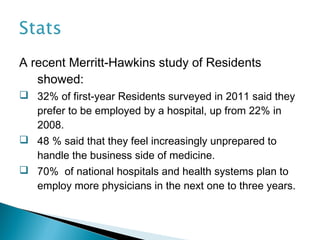
A recent Merritt-Hawkins study of Residents
   showed:
 32% of first-year Residents surveyed in 2011 said they
  prefer to be employed by a hospital, up from 22% in
  2008.
 48 % said that they feel increasingly unprepared to
  handle the business side of medicine.
 70% of national hospitals and health systems plan to
  employ more physicians in the next one to three years.
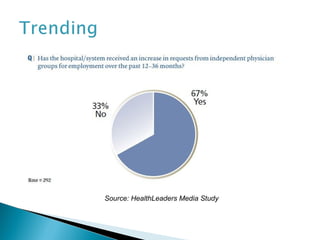
Source: HealthLeaders Media Study
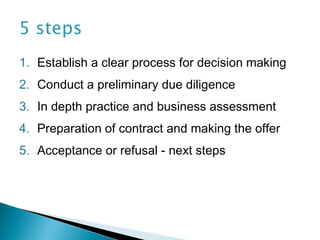
1. Establish a clear process for decision making
2. Conduct a preliminary due diligence
3. In depth practice and business assessment
4. Preparation of contract and making the offer
5. Acceptance or refusal - next steps
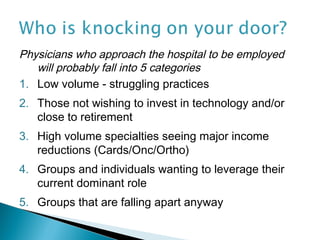
Physicians who approach the hospital to be employed
   will probably fall into 5 categories
1. Low volume - struggling practices
2. Those not wishing to invest in technology and/or
   close to retirement
3. High volume specialties seeing major income
   reductions (Cards/Onc/Ortho)
4. Groups and individuals wanting to leverage their
   current dominant role
5. Groups that are falling apart anyway
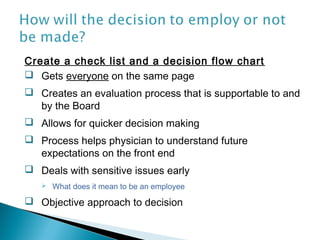
Create a check list and a decision flow chart
 Gets everyone on the same page
 Creates an evaluation process that is supportable to and
  by the Board
 Allows for quicker decision making
 Process helps physician to understand future
  expectations on the front end
 Deals with sensitive issues early
      What does it mean to be an employee
 Objective approach to decision
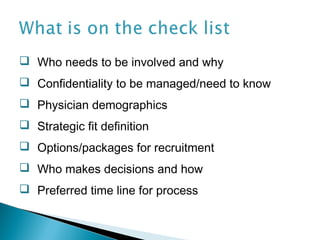
 Who needs to be involved and why
 Confidentiality to be managed/need to know
 Physician demographics
 Strategic fit definition
 Options/packages for recruitment
 Who makes decisions and how
 Preferred time line for process
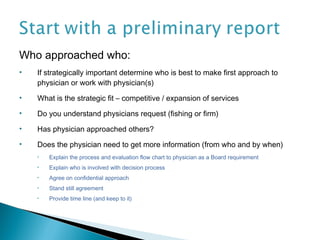
Who approached who:
•   If strategically important determine who is best to make first approach to
    physician or work with physician(s)
•   What is the strategic fit – competitive / expansion of services
•   Do you understand physicians request (fishing or firm)
•   Has physician approached others?
•   Does the physician need to get more information (from who and by when)
    •   Explain the process and evaluation flow chart to physician as a Board requirement
    •   Explain who is involved with decision process
    •   Agree on confidential approach
    •   Stand still agreement
    •   Provide time line (and keep to it)
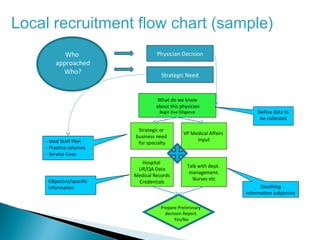
Local recruitment flow chart (sample)
           Who                     Physician Decision
        approached
          Who?                       Strategic Need


                                    What do we know
                                   about this physician
                                    Begin Due Diligence                   Define data to
                                                                           be collected

                           Strategic or
                                                VP Medical Affairs
                          business need
    - Med Staff Plan                                 Input
                           for specialty
    - Practice volumes
    - Service Lines
                            Hospital
                                                  Talk with dept.
                           UR/QA Data
                                                   management.
                          Medical Records
     Objective/specific                             Nurses etc
                           Credentials
     information                                                           Sleuthing
                                                                     Information subjective

                                     Prepare Preliminary
                                       decision Report.
                                           Yes/No
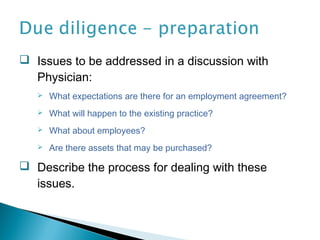
 Issues to be addressed in a discussion with
  Physician:
      What expectations are there for an employment agreement?
      What will happen to the existing practice?
      What about employees?
      Are there assets that may be purchased?

 Describe the process for dealing with these
  issues.
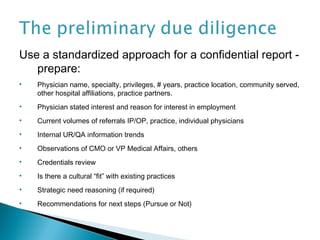
Use a standardized approach for a confidential report -
   prepare:
•   Physician name, specialty, privileges, # years, practice location, community served,
    other hospital affiliations, practice partners.
•   Physician stated interest and reason for interest in employment
•   Current volumes of referrals IP/OP, practice, individual physicians
•   Internal UR/QA information trends
•   Observations of CMO or VP Medical Affairs, others
•   Credentials review
•   Is there a cultural “fit” with existing practices
•   Strategic need reasoning (if required)
•   Recommendations for next steps (Pursue or Not)
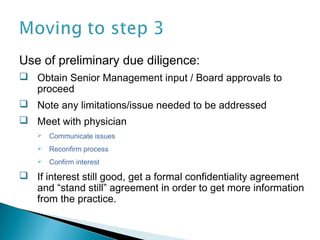
Use of preliminary due diligence:
 Obtain Senior Management input / Board approvals to
  proceed
 Note any limitations/issue needed to be addressed
 Meet with physician
       Communicate issues
       Reconfirm process
       Confirm interest

 If interest still good, get a formal confidentiality agreement
  and “stand still” agreement in order to get more information
  from the practice.
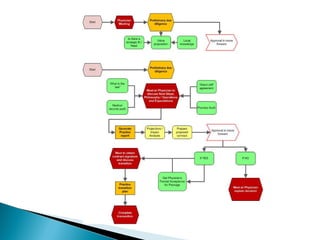
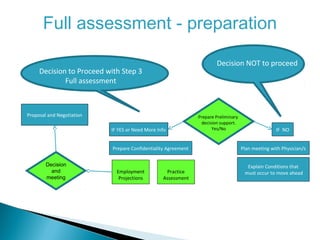
Full assessment - preparation

                                                                       Decision NOT to proceed
     Decision to Proceed with Step 3
             Full assessment


Proposal and Negotiation                                       Prepare Preliminary
                                                                decision support.
                           IF YES or Need More Info                  Yes/No                         IF NO


                           Prepare Confidentiality Agreement                         Plan meeting with Physician/s


        Decision                                                                       Explain Conditions that
          and                Employment           Practice                            must occur to move ahead
        meeting               Projections        Assessment
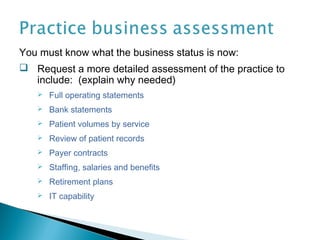
You must know what the business status is now:
 Request a more detailed assessment of the practice to
   include: (explain why needed)
      Full operating statements
      Bank statements
      Patient volumes by service
      Review of patient records
      Payer contracts
      Staffing, salaries and benefits
      Retirement plans
      IT capability
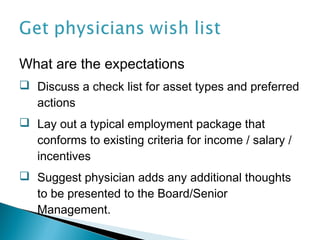
What are the expectations
 Discuss a check list for asset types and preferred
  actions
 Lay out a typical employment package that
  conforms to existing criteria for income / salary /
  incentives
 Suggest physician adds any additional thoughts
  to be presented to the Board/Senior
  Management.
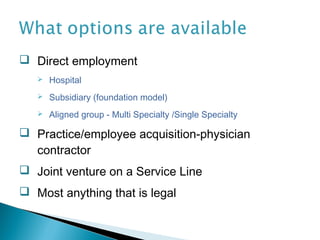
 Direct employment
      Hospital
      Subsidiary (foundation model)
      Aligned group - Multi Specialty /Single Specialty

 Practice/employee acquisition-physician
  contractor
 Joint venture on a Service Line
 Most anything that is legal
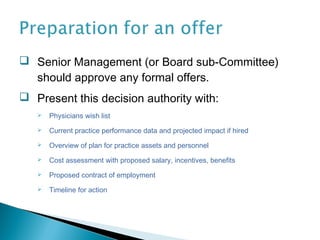
 Senior Management (or Board sub-Committee)
  should approve any formal offers.
 Present this decision authority with:
      Physicians wish list
      Current practice performance data and projected impact if hired
      Overview of plan for practice assets and personnel
      Cost assessment with proposed salary, incentives, benefits
      Proposed contract of employment
      Timeline for action
Plan for the Normal

Manage the Exceptions
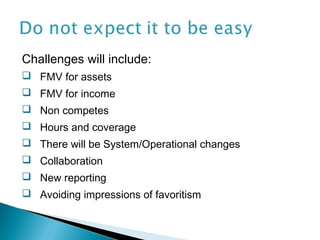
Challenges will include:
 FMV for assets
 FMV for income
 Non competes
 Hours and coverage
 There will be System/Operational changes
 Collaboration
 New reporting
 Avoiding impressions of favoritism
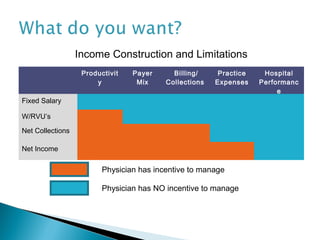
Income Construction and Limitations
                   Productivit   Payer      Billing/     Practice    Hospital
                       y          Mix     Collections   Expenses    Performanc
                                                                         e
Fixed Salary

W/RVU’s

Net Collections

Net Income

                         Physician has incentive to manage

                         Physician has NO incentive to manage
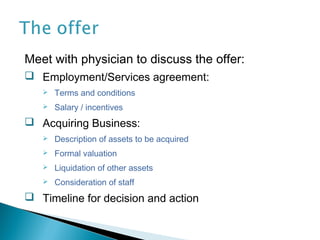
Meet with physician to discuss the offer:
 Employment/Services agreement:
      Terms and conditions
      Salary / incentives
 Acquiring Business:
      Description of assets to be acquired
      Formal valuation
      Liquidation of other assets
      Consideration of staff
 Timeline for decision and action
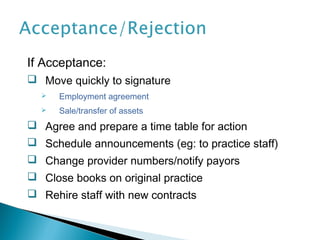
If Acceptance:
 Move quickly to signature
     Employment agreement
     Sale/transfer of assets
 Agree and prepare a time table for action
 Schedule announcements (eg: to practice staff)
 Change provider numbers/notify payors
 Close books on original practice
 Rehire staff with new contracts
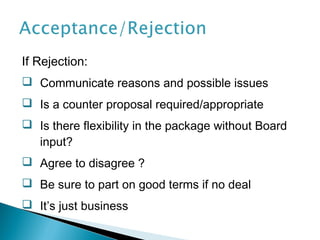
If Rejection:
 Communicate reasons and possible issues
 Is a counter proposal required/appropriate
 Is there flexibility in the package without Board
  input?
 Agree to disagree ?
 Be sure to part on good terms if no deal
 It’s just business
   Be open but confidential (emotions may come into play)
   Explain how decisions are made
   Use an objective and supportable approach
   Understand the physicians reasoning
   Collect both objective quantifiable data and subjective
    (confidential) peer commentary
   When agreement is reached move quickly to get contracts and
    make the changes
   If no agreement there must be clarity and part friends.
Five steps in phys recruitment 2011

Five steps in phys recruitment 2011

  • 1.
    OHA Annual Conference2012 DAVID ANDRICK DIRECTOR PHYSICIAN ADRIAN R. BYRNE RECRUITMENT PRESIDENT LUND-BYRNE ASSOCIATES
  • 2.
    Every organization requires the right people to make it work. Ensuring the right-fit with physicians is an essential task of the physician services department that is best accomplished with a formal “due diligence” process.  Building an employed physician group practice that meets the needs of the community while supporting hospital business objectives is sensitive work.  Some local physicians are feeling the reimbursement and cost pinch and are intent on hedging their situation.  They will leverage past relationships with the local hospital.  This includes exploring direct employment or some form of joint management arrangement.
  • 3.
    James Thurber, anAmerican cartoonist and writer best known for Walter Mitty, wrote: "Let us not look back in anger or forward in fear, but around in awareness."
  • 4.
     Healthcare deliverymodels are changing (again)  New players are entering the market to provide care (Insurers/Pharmacy’s)  New choices exist for physicians and allied health providers (Walmart, CVS, Corporate Health)  National Physician contract groups (Team)  Follow the money………………..
  • 5.
    Independent Physicians lookat:  “Obama Care” confusion  Perception v Reality  Belief that things are changing anyway  Independent practice is more complicated  Real erosion of practice revenues  Operating costs continue to increase  Cost of technology (purchase and implementation)  Look for expert help with new reimbursement models  Do not want to be left out of new provider networks  Consumer expectations are changing
  • 6.
    Hospitals are movingto gain economies of scale:  Increasing M&A activity  Better control of costs and quality  Hospitals need greater control over service area referrals and.. larger service areas  Hospital performance criteria requires active physician support and input  Harder to recruit physicians into independent practice
  • 7.
    A recent Merritt-Hawkinsstudy of Residents showed:  32% of first-year Residents surveyed in 2011 said they prefer to be employed by a hospital, up from 22% in 2008.  48 % said that they feel increasingly unprepared to handle the business side of medicine.  70% of national hospitals and health systems plan to employ more physicians in the next one to three years.
  • 8.
  • 10.
    1. Establish aclear process for decision making 2. Conduct a preliminary due diligence 3. In depth practice and business assessment 4. Preparation of contract and making the offer 5. Acceptance or refusal - next steps
  • 11.
    Physicians who approachthe hospital to be employed will probably fall into 5 categories 1. Low volume - struggling practices 2. Those not wishing to invest in technology and/or close to retirement 3. High volume specialties seeing major income reductions (Cards/Onc/Ortho) 4. Groups and individuals wanting to leverage their current dominant role 5. Groups that are falling apart anyway
  • 13.
    Create a checklist and a decision flow chart  Gets everyone on the same page  Creates an evaluation process that is supportable to and by the Board  Allows for quicker decision making  Process helps physician to understand future expectations on the front end  Deals with sensitive issues early  What does it mean to be an employee  Objective approach to decision
  • 15.
     Who needsto be involved and why  Confidentiality to be managed/need to know  Physician demographics  Strategic fit definition  Options/packages for recruitment  Who makes decisions and how  Preferred time line for process
  • 17.
    Who approached who: • If strategically important determine who is best to make first approach to physician or work with physician(s) • What is the strategic fit – competitive / expansion of services • Do you understand physicians request (fishing or firm) • Has physician approached others? • Does the physician need to get more information (from who and by when) • Explain the process and evaluation flow chart to physician as a Board requirement • Explain who is involved with decision process • Agree on confidential approach • Stand still agreement • Provide time line (and keep to it)
  • 18.
    Local recruitment flowchart (sample) Who Physician Decision approached Who? Strategic Need What do we know about this physician Begin Due Diligence Define data to be collected Strategic or VP Medical Affairs business need - Med Staff Plan Input for specialty - Practice volumes - Service Lines Hospital Talk with dept. UR/QA Data management. Medical Records Objective/specific Nurses etc Credentials information Sleuthing Information subjective Prepare Preliminary decision Report. Yes/No
  • 20.
     Issues tobe addressed in a discussion with Physician:  What expectations are there for an employment agreement?  What will happen to the existing practice?  What about employees?  Are there assets that may be purchased?  Describe the process for dealing with these issues.
  • 21.
    Use a standardizedapproach for a confidential report - prepare: • Physician name, specialty, privileges, # years, practice location, community served, other hospital affiliations, practice partners. • Physician stated interest and reason for interest in employment • Current volumes of referrals IP/OP, practice, individual physicians • Internal UR/QA information trends • Observations of CMO or VP Medical Affairs, others • Credentials review • Is there a cultural “fit” with existing practices • Strategic need reasoning (if required) • Recommendations for next steps (Pursue or Not)
  • 22.
    Use of preliminarydue diligence:  Obtain Senior Management input / Board approvals to proceed  Note any limitations/issue needed to be addressed  Meet with physician  Communicate issues  Reconfirm process  Confirm interest  If interest still good, get a formal confidentiality agreement and “stand still” agreement in order to get more information from the practice.
  • 24.
    Full assessment -preparation Decision NOT to proceed Decision to Proceed with Step 3 Full assessment Proposal and Negotiation Prepare Preliminary decision support. IF YES or Need More Info Yes/No IF NO Prepare Confidentiality Agreement Plan meeting with Physician/s Decision Explain Conditions that and Employment Practice must occur to move ahead meeting Projections Assessment
  • 25.
    You must knowwhat the business status is now:  Request a more detailed assessment of the practice to include: (explain why needed)  Full operating statements  Bank statements  Patient volumes by service  Review of patient records  Payer contracts  Staffing, salaries and benefits  Retirement plans  IT capability
  • 26.
    What are theexpectations  Discuss a check list for asset types and preferred actions  Lay out a typical employment package that conforms to existing criteria for income / salary / incentives  Suggest physician adds any additional thoughts to be presented to the Board/Senior Management.
  • 27.
     Direct employment  Hospital  Subsidiary (foundation model)  Aligned group - Multi Specialty /Single Specialty  Practice/employee acquisition-physician contractor  Joint venture on a Service Line  Most anything that is legal
  • 28.
     Senior Management(or Board sub-Committee) should approve any formal offers.  Present this decision authority with:  Physicians wish list  Current practice performance data and projected impact if hired  Overview of plan for practice assets and personnel  Cost assessment with proposed salary, incentives, benefits  Proposed contract of employment  Timeline for action
  • 30.
    Plan for theNormal Manage the Exceptions
  • 31.
    Challenges will include: FMV for assets  FMV for income  Non competes  Hours and coverage  There will be System/Operational changes  Collaboration  New reporting  Avoiding impressions of favoritism
  • 32.
    Income Construction andLimitations Productivit Payer Billing/ Practice Hospital y Mix Collections Expenses Performanc e Fixed Salary W/RVU’s Net Collections Net Income Physician has incentive to manage Physician has NO incentive to manage
  • 33.
    Meet with physicianto discuss the offer:  Employment/Services agreement:  Terms and conditions  Salary / incentives  Acquiring Business:  Description of assets to be acquired  Formal valuation  Liquidation of other assets  Consideration of staff  Timeline for decision and action
  • 36.
    If Acceptance:  Movequickly to signature  Employment agreement  Sale/transfer of assets  Agree and prepare a time table for action  Schedule announcements (eg: to practice staff)  Change provider numbers/notify payors  Close books on original practice  Rehire staff with new contracts
  • 37.
    If Rejection:  Communicatereasons and possible issues  Is a counter proposal required/appropriate  Is there flexibility in the package without Board input?  Agree to disagree ?  Be sure to part on good terms if no deal  It’s just business
  • 38.
    Be open but confidential (emotions may come into play)  Explain how decisions are made  Use an objective and supportable approach  Understand the physicians reasoning  Collect both objective quantifiable data and subjective (confidential) peer commentary  When agreement is reached move quickly to get contracts and make the changes  If no agreement there must be clarity and part friends.

Editor's Notes

  • #7 Thoughts of managing population health and capitated payments processes is supporting Hospitals move toward integration by getting the physicians as part of the team. Allows for the collection of data and the ability to modify behaviors to meet expected standards of care. All clinical issues within the hospital are to great extent governed by the physicians.
  • #8 Physician employment is more than a trend it’s a tidal wave.
  • #9 A recent Healthleaders Study revealed that 67% of those surveyed said they had received more requests from local physicians to discuss employment. Making such decisions on who locally you want to employ has the potential to be trouble unless you handle it right.
  • #10 There is a lot to be done to ensure the process goes smoothly. So if you want the right outcome don’t wait for the autopsy.
  • #11 The 5 Step Approach When exploring physician employment options, managers should consider the following questions: What is the mission-related purpose of the physician employment or practice acquisition, such as serving a medically underserved area, addressing the absence of specialists or practitioners in the hospital, or raising the hospital's profile? What steps have been taken to assess whether the employment or acquisition will fulfill that purpose, such as assessment of the physician's services, capabilities and qualifications? What type of compensation package is necessary? Has a third-party made a fair-market value assessment and is the compensation in the range of that assessment? Is there a cash-in/cash-out problem or will the professional service fees a hospital collects cover the proposed compensation package? If not, what is the justification for going ahead at a loss? What assessments and projections have been performed on the impact to the hospital or health system in connection with the employment or acquisition? Has that assessment been performed and considered separately from the setting of the compensation package? Has management reviewed the compensation package through, for example, a compensation committee, verified compliance with the hospital's guidelines, and affirmed its reasonableness? Will there be restrictions on the physician's practice at other institutions during and after employment? Does the arrangement include incentives to ensure the physician's productivity during employment? If so, have those incentives been structured in a way that is compliant with regulatory requirements; that is, they do not take into account value or volume of referrals? Is there a process for monitoring the progress or success of the employment/acquisition in relation to the stated mission? Is there a path for making necessary adjustments to the relationship if needed to achieve the stated goal? What is the exit strategy for the hospital if the relationship with the physician is not viable?
  • #12 How many of you are in the midst of dealing with employment interest from local physicians? Many of you will be intuitively conscious of these issues but it pays to cover them….. Some docs are looking for a way out of difficult situations with the hospital being the insurance policy. While their motivation for employment may not match that of the future ideal employee it is up to you to know why you are being approached and plan with that in mind.
  • #14 You will not want to just wing it. The consequences of missteps can be career limiting especially if you are dealing with high volume physicians. By preparing a formal approach, in which other decision makers have input, will allow you to get decisions faster and be responsive to the physicians. Suggest you look at creating a process flow chart to be sure you get all the steps and consider contingencies. Also others know what you are up to as you begin the process. Be sure to share the process with the physician and arrange an informal discussion on what it means to be an employed physician. If not already done arrange for the physician to talk with other employed physicians. Better now than later in the process.
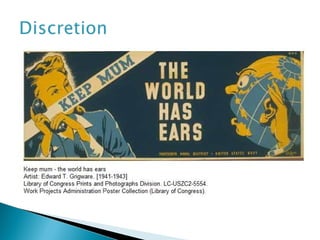
  • #15 A word to the wise Lose lips sink ships. But keep those who need to know…. informed
  • #16 What kind of things do you need to know to create your check list and what variables are you likely to consider.
  • #18 Some will approach you and there will be some that you will want to approach to explore what they are thinking. What is the reason you will contemplate a recruitment. Strategic growth, better manage a service line, build a primary care referral base? What do you know about the physicians intent…. This is crucial. Fishing, desperate or a real desire to focus on being a clinician. How will you initially advise the physician? Ask how much time have they invested in exploring their options and particularly employment. Supply some resources…… make no attempt to hide information… it will come back to haunt you and spread mistrust to other physicians If desire to proceed need to set some ground rules. Your preliminary report will want to have covered the first conversation with the physician to verify he/she is serious and has carefully considered the process. It will also cover what is generally known about the physician. This quick assessment saves time and money if there are obvious reasons why this transaction will not take place.
  • #19 Build a picture of the physician and how his/her practice will fit into your system
  • #21 Preliminary discussion Describe the process that you are required to follow with all local physician recruitment and how the decision will be made.
  • #22 Use your check list and limit who is involved in gathering the information Put the description together to get approvals to go to the next step. Who will be your best resources…. Confidentiality remains key
  • #28 Step Back…. Do you have in place an existing group practice? Will the hospital directly employ. Is the Hospital an investor in an aligned group? Will the employed physician be an employee in a solo practice. Some hospitals acquire the practice and the physician becomes a 1099 employee. Practice can be leased from the physician and operated by hospital.
  • #29 Be sure you have answered the questions before they are asked. CYA You may be presenting more than one physician to the Board so follow the same process for each. Simplifies the presentation. Put each physicians information in a separate packet. Present. Who are you talking about What is known What does the doctor request If approved what is the plan for acquisition and employment Costs and projections Proposed contracts w/ salary structure
  • #31 By standardizing your approach you can simplify your life There will be exceptions
  • #32 Points of Pain will include money, control and ego
  • #33 The whole process of paying physicians is undergoing a Change. Initially salaries were the norm and production fell, then the switch to practice expenses and the care of the uninsured/Medicaid was ignored. Followed by Work RVU’s and production of any kind ramped up. Now seeing more combinations that include quality and hospital goals …with production. You need to run the numbers What is the best use of the physicians expertise and time.