Five Great
Practices For
Attracting
Media Coverage
How to reach and cultivate radio, TV,
newspaper and magazine outlets for an
event
- Jerry Seinfeld, American
Comedian
“It's amazing that the amount of
news that happens in the world
everyday always just exactly fits
the newspaper.”
Event planning involves significant preparation. You have to
consider the technical arrangement of lights and sound, the
functional needs of hosting guests, and the kinds of promotion
that surround and integrate with the audience. Moreover, there
are aspects of scheduling to be considered, the safety of
attendees, and the generation of story material. You may all
these bases covered, but still face the challenge of attracting the
conventional media to attend and tell your story. There is
grassroots coverage one can employ by simply posting pictures
and videos on social platforms which has some value.
Nonetheless, how do you attract established media sources such
as radio, TV, newspaper and magazine outlets? The presentation
here captures a number of practices one can employ.
#1 Speak the Language
of News Reporters
• Speak the language of the
journalist. Use the
nomenclature that reporters and
commentators use in gathering
and dispensing news. Share
why the story is "timely and
relevant." Explain why the
story has "legs" beyond a news
cycle. Note if you have a
journalism degree or have
worked in the past as a reporter
then let your contact know that
you belong to the same tribe—
the storytellers of real events—
and build rapport.
#2 Know What
Motivates a Media
Reporter
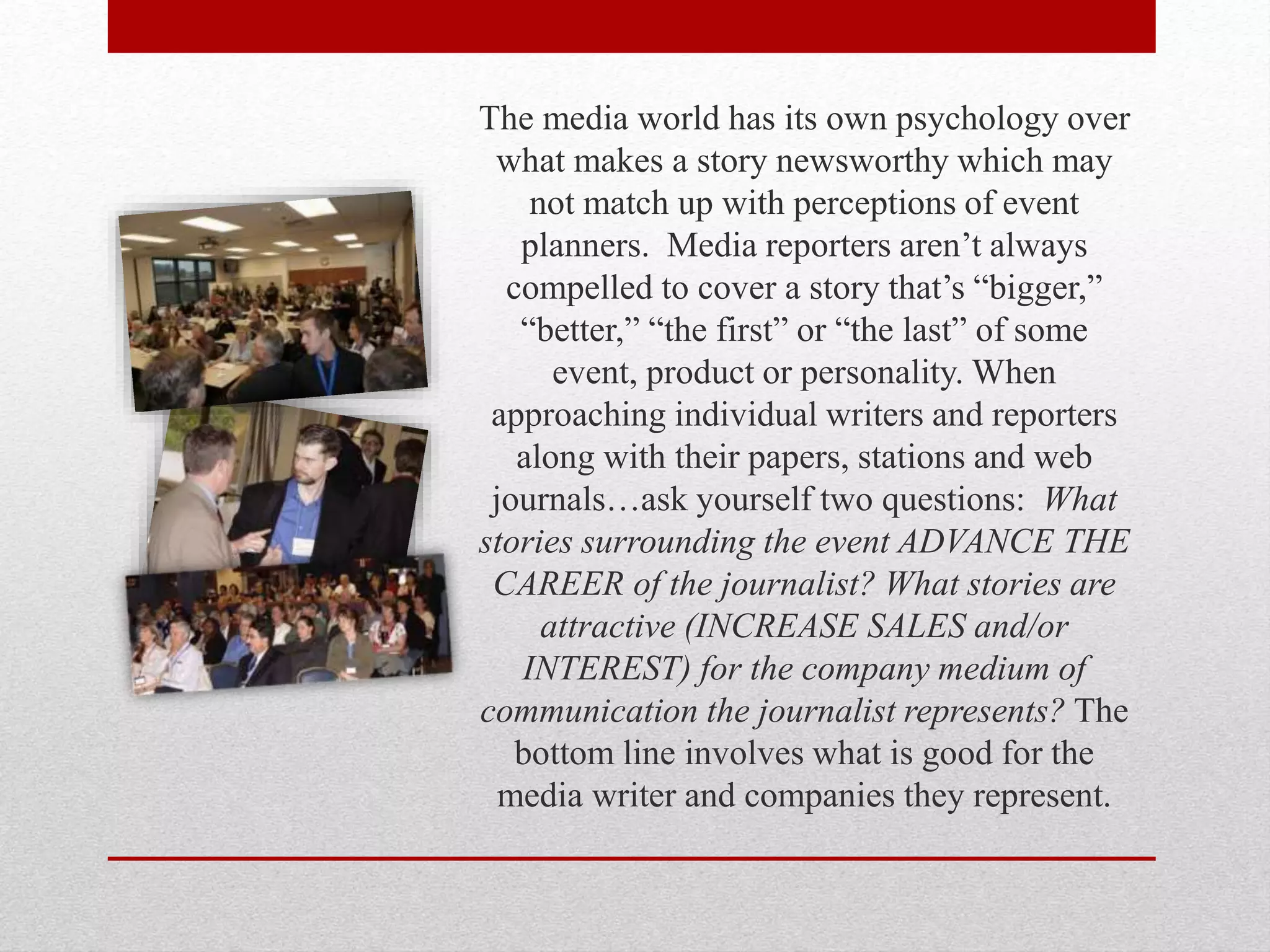
The media world has its own psychology over
what makes a story newsworthy which may
not match up with perceptions of event
planners. Media reporters aren’t always
compelled to cover a story that’s “bigger,”
“better,” “the first” or “the last” of some
event, product or personality. When
approaching individual writers and reporters
along with their papers, stations and web
journals…ask yourself two questions: What
stories surrounding the event ADVANCE THE
CAREER of the journalist? What stories are
attractive (INCREASE SALES and/or
INTEREST) for the company medium of
communication the journalist represents? The
bottom line involves what is good for the
media writer and companies they represent.
#3 Cultivate Stringers
and Independent
Media Sources
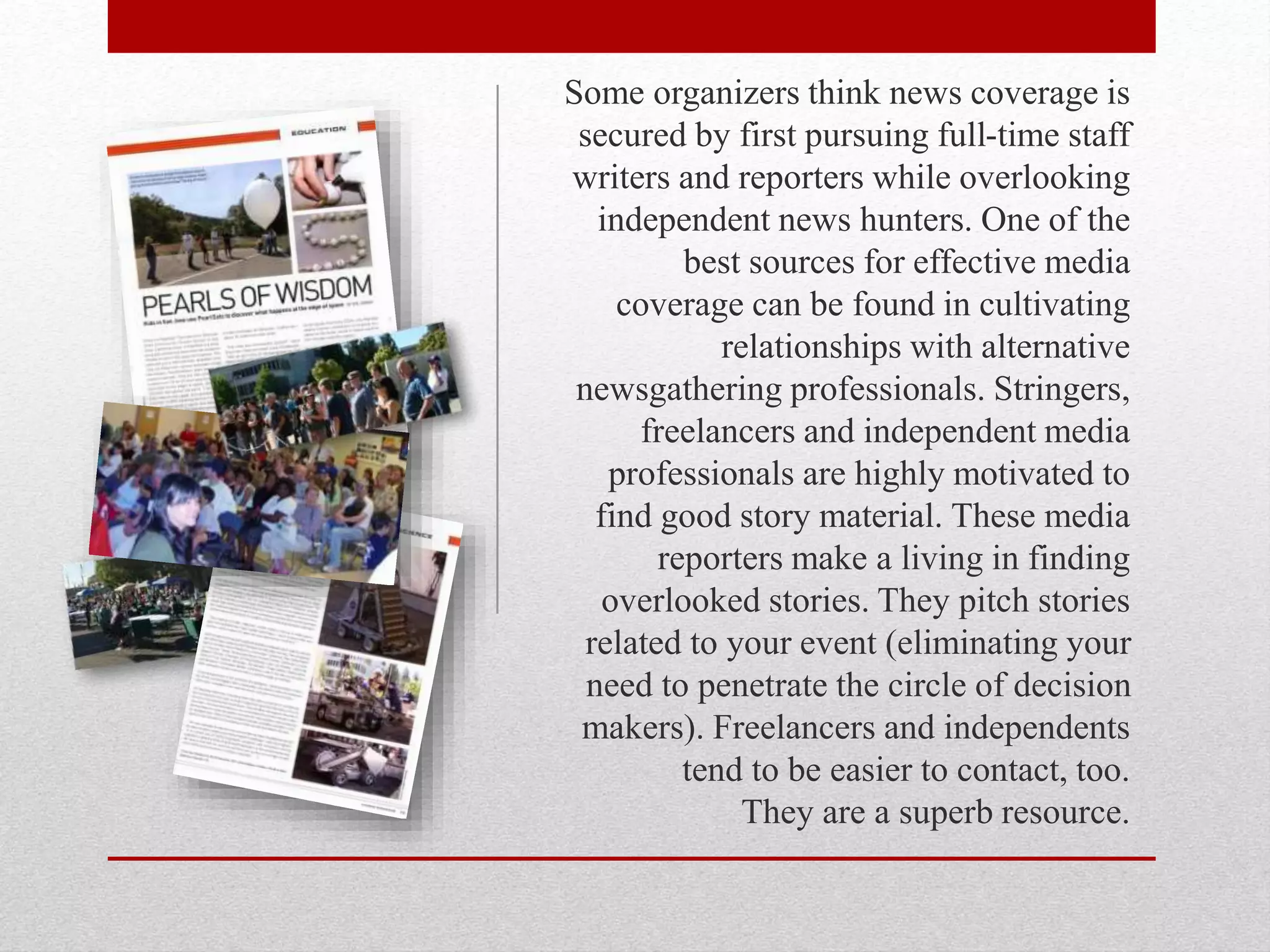
Some organizers think news coverage is
secured by first pursuing full-time staff
writers and reporters while overlooking
independent news hunters. One of the
best sources for effective media
coverage can be found in cultivating
relationships with alternative
newsgathering professionals. Stringers,
freelancers and independent media
professionals are highly motivated to
find good story material. These media
reporters make a living in finding
overlooked stories. They pitch stories
related to your event (eliminating your
need to penetrate the circle of decision
makers). Freelancers and independents
tend to be easier to contact, too.
They are a superb resource.
#4 The Response to
Media Queries is one
of Top Priority
Most people understand that responding to a
journalist's call or question as soon as possible is
important. However, when juggling a dozen
other issues related to event management, it's
easy to delay a quick response. Nonetheless, it's
imperative to respond to the query of a reporter
in a timely fashion. Media reporters live in the
world of DEADLINES. Your quick response
builds CREDIBILITY with that media reporter
that you have made her or him a top
priority. You will be seen as a reliable and
responsive source for quotes and information
under DEADLINE pressures. It cannot be
understated as to how the consistent integration
of this practice produces significant results in
media circles.
#5 Give Media Reporters
Pithy, Pungent and
Powerful Lines
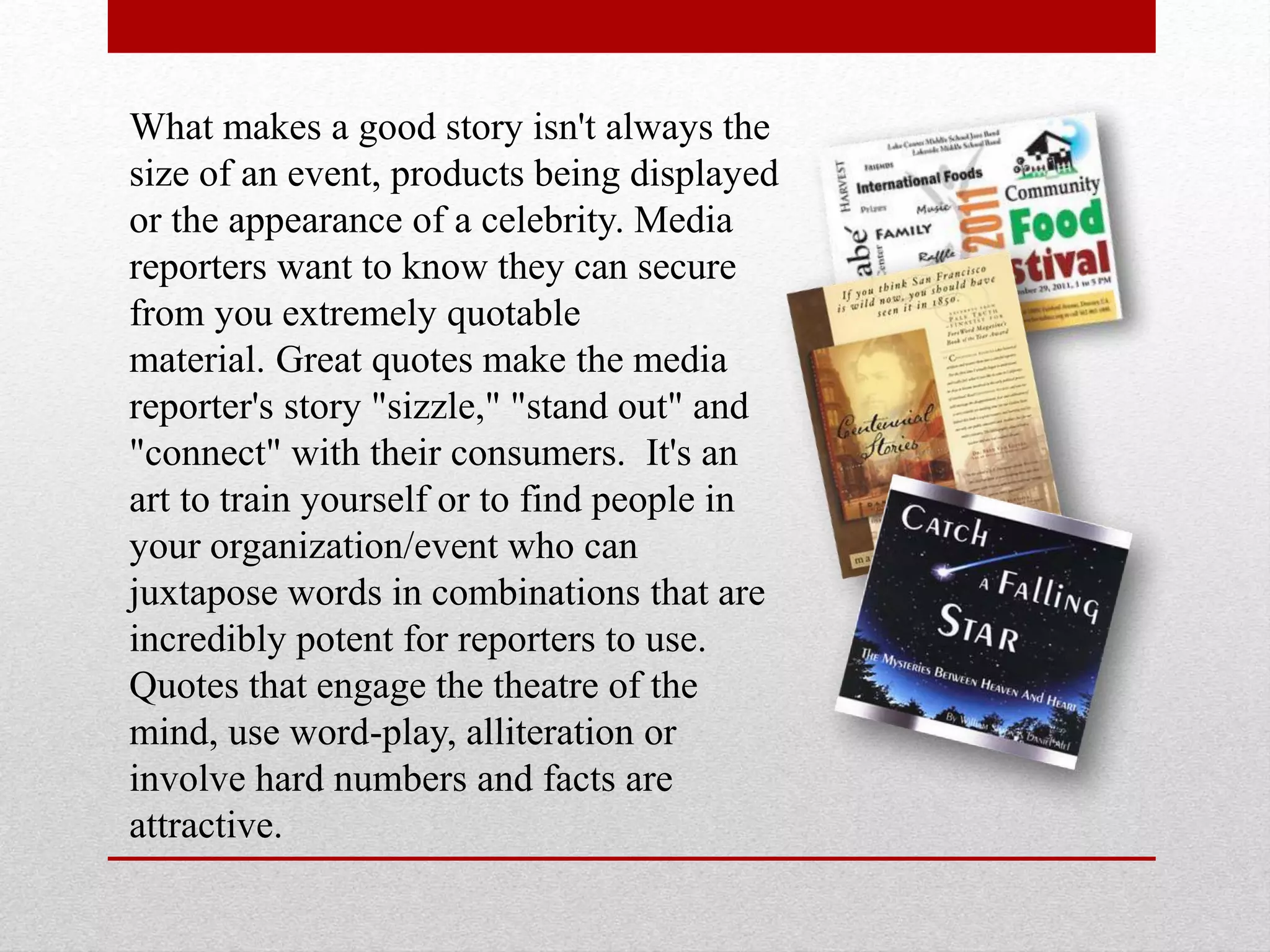
What makes a good story isn't always the
size of an event, products being displayed
or the appearance of a celebrity. Media
reporters want to know they can secure
from you extremely quotable
material. Great quotes make the media
reporter's story "sizzle," "stand out" and
"connect" with their consumers. It's an
art to train yourself or to find people in
your organization/event who can
juxtapose words in combinations that are
incredibly potent for reporters to use.
Quotes that engage the theatre of the
mind, use word-play, alliteration or
involve hard numbers and facts are
attractive.
By being quotable (Practice #5),
responsive to queries (Practice #4),
resourceful in using independent
reporters (Practice #3), knowing the
psychology of what drives media
reporters (Practice #2), and using the
language of the reporter to connect with
him/her (practice #1)...
you raise the probability of obtaining
media coverage for your event.
And...
...you will create great PARTNERSHIPS
with those who report news.
For PR professionals, MEDIA
RELATIONS is the art of ethically
managing the needs of reporters and the
quality of the stories being told.
These five practices in how to attract media
coverage set the stage for garnering an
enthusiastic response from reporters that
exceed the standard contact methods of
leaving a phone message, emails, media
alerts and press releases.
Final Word
My intent with this short slide series is
to provide additional insights and tools
in securing media coverage for event
planners. The five practices listed in
here are part of a larger presentation.
Assistant Professor Bill Simon
Journalism and Public Relations
BIOLA University, Los Angeles

Five Great Practices For Attracting Media Coverage

  • 1.
    Five Great Practices For Attracting MediaCoverage How to reach and cultivate radio, TV, newspaper and magazine outlets for an event
  • 2.
    - Jerry Seinfeld,American Comedian “It's amazing that the amount of news that happens in the world everyday always just exactly fits the newspaper.”
  • 3.
    Event planning involvessignificant preparation. You have to consider the technical arrangement of lights and sound, the functional needs of hosting guests, and the kinds of promotion that surround and integrate with the audience. Moreover, there are aspects of scheduling to be considered, the safety of attendees, and the generation of story material. You may all these bases covered, but still face the challenge of attracting the conventional media to attend and tell your story. There is grassroots coverage one can employ by simply posting pictures and videos on social platforms which has some value. Nonetheless, how do you attract established media sources such as radio, TV, newspaper and magazine outlets? The presentation here captures a number of practices one can employ.
  • 4.
    #1 Speak theLanguage of News Reporters
  • 5.
    • Speak thelanguage of the journalist. Use the nomenclature that reporters and commentators use in gathering and dispensing news. Share why the story is "timely and relevant." Explain why the story has "legs" beyond a news cycle. Note if you have a journalism degree or have worked in the past as a reporter then let your contact know that you belong to the same tribe— the storytellers of real events— and build rapport.
  • 6.
    #2 Know What Motivatesa Media Reporter
  • 7.
    The media worldhas its own psychology over what makes a story newsworthy which may not match up with perceptions of event planners. Media reporters aren’t always compelled to cover a story that’s “bigger,” “better,” “the first” or “the last” of some event, product or personality. When approaching individual writers and reporters along with their papers, stations and web journals…ask yourself two questions: What stories surrounding the event ADVANCE THE CAREER of the journalist? What stories are attractive (INCREASE SALES and/or INTEREST) for the company medium of communication the journalist represents? The bottom line involves what is good for the media writer and companies they represent.
  • 8.
    #3 Cultivate Stringers andIndependent Media Sources
  • 9.
    Some organizers thinknews coverage is secured by first pursuing full-time staff writers and reporters while overlooking independent news hunters. One of the best sources for effective media coverage can be found in cultivating relationships with alternative newsgathering professionals. Stringers, freelancers and independent media professionals are highly motivated to find good story material. These media reporters make a living in finding overlooked stories. They pitch stories related to your event (eliminating your need to penetrate the circle of decision makers). Freelancers and independents tend to be easier to contact, too. They are a superb resource.
  • 10.
    #4 The Responseto Media Queries is one of Top Priority
  • 11.
    Most people understandthat responding to a journalist's call or question as soon as possible is important. However, when juggling a dozen other issues related to event management, it's easy to delay a quick response. Nonetheless, it's imperative to respond to the query of a reporter in a timely fashion. Media reporters live in the world of DEADLINES. Your quick response builds CREDIBILITY with that media reporter that you have made her or him a top priority. You will be seen as a reliable and responsive source for quotes and information under DEADLINE pressures. It cannot be understated as to how the consistent integration of this practice produces significant results in media circles.
  • 12.
    #5 Give MediaReporters Pithy, Pungent and Powerful Lines
  • 13.
    What makes agood story isn't always the size of an event, products being displayed or the appearance of a celebrity. Media reporters want to know they can secure from you extremely quotable material. Great quotes make the media reporter's story "sizzle," "stand out" and "connect" with their consumers. It's an art to train yourself or to find people in your organization/event who can juxtapose words in combinations that are incredibly potent for reporters to use. Quotes that engage the theatre of the mind, use word-play, alliteration or involve hard numbers and facts are attractive.
  • 14.
    By being quotable(Practice #5), responsive to queries (Practice #4), resourceful in using independent reporters (Practice #3), knowing the psychology of what drives media reporters (Practice #2), and using the language of the reporter to connect with him/her (practice #1)... you raise the probability of obtaining media coverage for your event. And...
  • 15.
    ...you will creategreat PARTNERSHIPS with those who report news. For PR professionals, MEDIA RELATIONS is the art of ethically managing the needs of reporters and the quality of the stories being told. These five practices in how to attract media coverage set the stage for garnering an enthusiastic response from reporters that exceed the standard contact methods of leaving a phone message, emails, media alerts and press releases.
  • 16.
    Final Word My intentwith this short slide series is to provide additional insights and tools in securing media coverage for event planners. The five practices listed in here are part of a larger presentation. Assistant Professor Bill Simon Journalism and Public Relations BIOLA University, Los Angeles