The Presentation
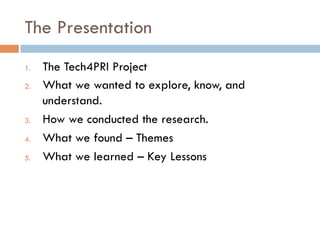
1.  The Tech4PRI Project
2.  What we wanted to explore, know, and
understand.
3.  How we conducted the research.
4.  What we found – Themes
5.  What we learned – Key Lessons
The Tech4PRI Project
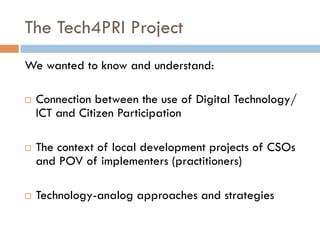
We wanted to know and understand:
¨  Connection between the use of Digital Technology/
ICT and Citizen Participation
¨  The context of local development projects of CSOs
and POV of implementers (practitioners)
¨  Technology-analog approaches and strategies
Areas to be Explored
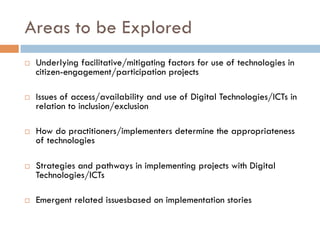
¨  Underlying facilitative/mitigating factors for use of technologies in
citizen-engagement/participation projects
¨  Issues of access/availability and use of Digital Technologies/ICTs in
relation to inclusion/exclusion
¨  How do practitioners/implementers determine the appropriateness
of technologies
¨  Strategies and pathways in implementing projects with Digital
Technologies/ICTs
¨  Emergent related issuesbased on implementation stories
Method
¨  11 case projects
¨  Key Informant Interviews – Implementers and Users
¨  FGDs with users
¨  Secondary Data – Documents/Reports
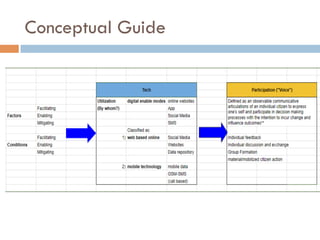
Conceptual Guide
Observable Themes from the Research
¨  Planners and Implementers
¨  Design and Implementation Processes
¨  Hardware, Software, and Peopleware
¨  Audience and Users
Planners and Implementers
 
¨  Face the challenge of Making sense of tools while in the
context of implementation
¨  There are occasions when implementers encounter a
piece of tech and "make these relevant or useful" in
their projects, sometimes to a fault.
¨  There is a bandwagon effect or tendency to use the
“new” and “latest”, or adapt innovative designs
Design and Implementation Processes
¨  The blended approach of online-offline needs to be
further explored and unpacked.
¨  Projects should include a strategy/plan concerning
tech/ICT use -- to operationalize digital technology and
“offline” approaches
¨  Training sessions are seen as means to prepare citizens
to be “tech ready”.
Hardware, Software, and Peopleware
¨  Technology improves the capacity of CSOs to operate
and achieve objectives, e.g. projects on transparency
¨  An emphasis on Peopleware -- implementers, users, and
the performance of technology
¨  There is a menu of technologies but the human factor is
key. e.g. use of infomediaries, face-to-face interaction
approaches, etc.
Audience and Users
¨  Who is the audience? Who are the users?
¨  Planners prospect users and audience
¨  Implementers adjust once immersed in
implementation
KEY LESSONS
Key Lessons
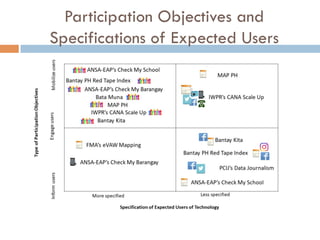
¨  Deciding on a “participatory objective” (e.g.
inform, engage, mobilize users)
¤  This has direct implications on the technologies that will
be employed in a project.
Key Lessons
¨  Ecology and Context of Technology Use for
Participation
¤  the lack of design thinking and the turnover processes
for the design and management of platforms mitigates
technology use
¤  Sustained interest and “endurance” of implementers
and growth of interested parties enable technology
use.
¤  Technology over people – overzealous about
technology resulting to a disconnect between the design
and advocacy.
Key Lessons
¨  Technology and Modes of Participation: Blended,
“Shotgun”, and Targeted Approaches
¤  Digital technologies are seen to perform specific
functions that complement offline activities.
¤  Some use digital technologies as optional mode or
platform, other initiatives integrate multiple modes or
platforms as part of their interventions called multi-
modal (‘shotgun’) approach.
¤  Redundancy(+/-) to increase the chances of the user to
be informed, engage, be mobilized, and to participate.
Key Lessons
¨  Ambiguity of “users” and “public” makes
targeting-for-appropriateness very difficult
¤  Practitioners select technology tools based on their
assumptions about the function of each technology
based on past experiences, or based on their ‘feel’ of
a particular too.
¤  Implementers would refer to a variety of “publics”,
apart from the what for them is the “general public”
¤  While all citizen participation initiatives identify ‘the
public’ as their main beneficiary, not many coherently
specify their target users.
Key Lessons
¨  Digital Divide in the Technology use and the
Sustainability of the projects
¤  For implementers, issues and problems mainly deal with
costs and expenses attached with the use of technology.
¤  Costs and expenses are mainly infrastructural in nature.
¤  Ease of use of technology, functionality of the
platforms, and its capacity for wider reach recur in the
discussions.
¨ 
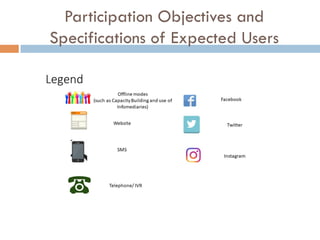
Participation Objectives and
Specifications of Expected Users
Participation Objectives and
Specifications of Expected Users

Session 2b ANSA EAP Tech4PRI

  • 2.
    The Presentation 1.  TheTech4PRI Project 2.  What we wanted to explore, know, and understand. 3.  How we conducted the research. 4.  What we found – Themes 5.  What we learned – Key Lessons
  • 3.
    The Tech4PRI Project Wewanted to know and understand: ¨  Connection between the use of Digital Technology/ ICT and Citizen Participation ¨  The context of local development projects of CSOs and POV of implementers (practitioners) ¨  Technology-analog approaches and strategies
  • 4.
    Areas to beExplored ¨  Underlying facilitative/mitigating factors for use of technologies in citizen-engagement/participation projects ¨  Issues of access/availability and use of Digital Technologies/ICTs in relation to inclusion/exclusion ¨  How do practitioners/implementers determine the appropriateness of technologies ¨  Strategies and pathways in implementing projects with Digital Technologies/ICTs ¨  Emergent related issuesbased on implementation stories
  • 5.
    Method ¨  11 caseprojects ¨  Key Informant Interviews – Implementers and Users ¨  FGDs with users ¨  Secondary Data – Documents/Reports
  • 6.
  • 7.
    Observable Themes fromthe Research ¨  Planners and Implementers ¨  Design and Implementation Processes ¨  Hardware, Software, and Peopleware ¨  Audience and Users
  • 8.
    Planners and Implementers   ¨ Face the challenge of Making sense of tools while in the context of implementation ¨  There are occasions when implementers encounter a piece of tech and "make these relevant or useful" in their projects, sometimes to a fault. ¨  There is a bandwagon effect or tendency to use the “new” and “latest”, or adapt innovative designs
  • 9.
    Design and ImplementationProcesses ¨  The blended approach of online-offline needs to be further explored and unpacked. ¨  Projects should include a strategy/plan concerning tech/ICT use -- to operationalize digital technology and “offline” approaches ¨  Training sessions are seen as means to prepare citizens to be “tech ready”.
  • 10.
    Hardware, Software, andPeopleware ¨  Technology improves the capacity of CSOs to operate and achieve objectives, e.g. projects on transparency ¨  An emphasis on Peopleware -- implementers, users, and the performance of technology ¨  There is a menu of technologies but the human factor is key. e.g. use of infomediaries, face-to-face interaction approaches, etc.
  • 11.
    Audience and Users ¨ Who is the audience? Who are the users? ¨  Planners prospect users and audience ¨  Implementers adjust once immersed in implementation
  • 12.
  • 13.
    Key Lessons ¨  Decidingon a “participatory objective” (e.g. inform, engage, mobilize users) ¤  This has direct implications on the technologies that will be employed in a project.
  • 14.
    Key Lessons ¨  Ecologyand Context of Technology Use for Participation ¤  the lack of design thinking and the turnover processes for the design and management of platforms mitigates technology use ¤  Sustained interest and “endurance” of implementers and growth of interested parties enable technology use. ¤  Technology over people – overzealous about technology resulting to a disconnect between the design and advocacy.
  • 15.
    Key Lessons ¨  Technologyand Modes of Participation: Blended, “Shotgun”, and Targeted Approaches ¤  Digital technologies are seen to perform specific functions that complement offline activities. ¤  Some use digital technologies as optional mode or platform, other initiatives integrate multiple modes or platforms as part of their interventions called multi- modal (‘shotgun’) approach. ¤  Redundancy(+/-) to increase the chances of the user to be informed, engage, be mobilized, and to participate.
  • 16.
    Key Lessons ¨  Ambiguityof “users” and “public” makes targeting-for-appropriateness very difficult ¤  Practitioners select technology tools based on their assumptions about the function of each technology based on past experiences, or based on their ‘feel’ of a particular too. ¤  Implementers would refer to a variety of “publics”, apart from the what for them is the “general public” ¤  While all citizen participation initiatives identify ‘the public’ as their main beneficiary, not many coherently specify their target users.
  • 17.
    Key Lessons ¨  DigitalDivide in the Technology use and the Sustainability of the projects ¤  For implementers, issues and problems mainly deal with costs and expenses attached with the use of technology. ¤  Costs and expenses are mainly infrastructural in nature. ¤  Ease of use of technology, functionality of the platforms, and its capacity for wider reach recur in the discussions. ¨ 
  • 18.
  • 19.