PHYSICAL FITNESS
ASSESSMENT
Deepali Jain
M.P.T. Sports
Fitness and Health
 The word health is often associated only with physical
fitness, but there are other components of health.
 FITNESS means “readiness”. Fit people are better equipped
than non-fit people.
 The level of fitness includes all aspects of health and life.
 It affects physical, mental, and social health.
What is Physical Fitness?
 Physical Fitness is the ability
of your body systems to
work efficiently.
 A fit person is able to carry
out the typical activities of
living, such as work, and still
have enough energy and
vigor to respond to
emergency situations and to
enjoy leisure time activities.
Physical Activity and Exercise
 Physical activity is a
general term that includes
sports, dance, and activities
done at work or at home,
such as walking, climbing
stairs, or mowing the lawn.
 When people do physical
activity especially for the
purpose of getting fit, we
say they are doing exercise.
Physical Fitness is the body’s ability to
function efficiently and effectively. It
consists of Health Related Fitness and
Skill Related Fitness, which have
different components, each of which
contributes to total quality of life
What is a Fitness Assessment?
• A fitness assessment is a series of
measurements that help determine physical
fitness
• It is a comprehensive assessment of health
related fitness administered by
professional, trained staff.
A fitness assessment provides a baseline
measurement of
• 1-cardiovascular endurance,
• 2- body composition,
• 3- muscular endurance,
• 4-muscular strength
• 5- flexibility.
Fitness assessment provide an accurate measure
of the current fitness and health level of an
individual.
• Assessments are recommended prior to
beginning an exercise program
• These tests are often the starting point for
designing an appropriate exercise program.
• To determine the health status and physical
fitness of an individual through the assessment
of the 5 components of fitness
• To help develop and establish an effective
fitness program
• To establish goals and motivation
• To evaluate progress
• To identify the strengths and weaknesses in
relation to the physical fitness
Objectives of fitness assessments
The Parts of Physical Fitness
 Health - Related
Physical Fitness
 Skill - Related Physical
Fitness
• It helps you stay
healthy
• It helps you perform well
in sports and activities that
require certain skills
Cardiorespiratory fitness
(CRF)
 Cardiorespiratory fitness (CRF) reflects the functional
capabilities of the heart, blood vessels, lungs, and skeletal
muscles to perform work.
 There are many different terms that have been used to describe
this measure of physical fitness, including:
• Maximal aerobic capacity
• Functional capacity
• Physical work capacity (PWC)
• Cardiovascular endurance, fitness, or capacity
• Cardiorespiratory endurance, fitness, or capacity
• Cardiopulmonary endurance, fitness, or capacity
1.Cardiovascular endurance
assessment
• 1-Cardio-respiratory Endurance or Resting Heart
Rate: Indicator of aerobic fitness and cardiac
efficiency
• Cardio-respiratory endurance: the ability to
perform large-muscle, dynamic exercise of
moderate to high intensity for prolonged periods
• Cardiovascular endurance is the ability of;
the heart, the blood,
the blood vessels
the respiratory system
to provide the required oxygen and fuel to the
muscles for carrying on a particular exercise
for specific period of time at a steady rate
Cardiovascular Endurance
 Factors to consider
 VO2 max – volume of O2 (ml O2 kg-1
min-1)
 Heart rate
 Blood pressure
 Measures efficiency, work load and force
of the heart
VO2 max Test
 GOLD STANDARD
 Treadmill
 Tube
 HR monitor
 Cables
 Stop when O2 levels
plateau
 Impractical
Maximal Oxygen Consumption test
(VO2 Max)
According to the American College of Sports
Medicine (ACSM), cardio-respiratory fitness is
determined by oxygen consumption, technically
called VO2. This is measured by how much
oxygen (in milliliters) your body can use per
kilogram of body weight per minute.
Cardiovascular endurance assessment
VO2max The formulas:
Male:
108.844 - [lbs./2.2 (0.1636)] – [time (1.438)] – [HR (0.1928)]
Female:
100.5 - [lbs./2.2 (0.1636)] – [time (1.438)] – [HR (0.1928)]
Calculating
• Determining appropriate maximum
heart rate in a fitness assessment
should also take into account blood
pressure
• A person with high blood pressure
should be evaluated by a physician
prior to proceeding with an exercise
program.
Cardiovascular endurance assessment
• Another common test in a fitness assessment is
aerobic fitness. the main goal of any aerobic
exercise is to provide an increased amount of
oxygen to the body.
• Aerobic exercise involved three specific types
of exercise including; cycling, swimming, and
running.
• Aerobic exercise can also include skiing,
jogging, running on a treadmill using an
elliptical trainer,
Cardiovascular endurance assessment
Treadmill Elliptical trainer
CV testing: Field Test
 Beep Test
 20m distance
 Job/run/sprint
according to the beep
 Miss 1x its ok, but
beat the next beep
2- Muscular endurance
• Muscular endurance is the ability of a muscle
or group of muscles to contract without
becoming exhausted
• is very important for people playing sports and
who have to sustain an activity for long
periods of time.
Muscular endurance is assessed by counting the
maximum number of repetitions of a muscular
contraction a person can perform to fatigue
(Repetition Maximum Testing 1 RM)
The term used to describe the maximal amount of
weight that can be lifted with one contraction is called
the repetition maximum (RM).
The 1-RM is typically considered the gold standard
measure of muscular strength
Muscular endurance
Muscular Endurance
 Push-up test
 Max of push-ups
 Sit-up test
 1min for Max
 Wall Sit
 Max squat along wall
YMCA Submaximal Bench
Press Test
 This test provides a
standardized method
to quantify muscular
endurance using the
bench press exercise.
Muscular endurance
 Requires Max testing
 Squats and bench press
 Very unsafe for
inexperienced
individuals
 Typical Tests:
 Vertical jump
 Leg press
 Handgrip
dynamometers
3: Flexibility
3- Flexibility test
The capacity of the joints to move
through a full range of motion;
• the ability to bend and recover
without injury
• Flexibility is an important
component of fitness
and physical performance
• Evaluates flexibility of lower back
and posterior leg muscles
 Similar to the HRPF assessment of muscular
endurance, there is no one single measurement
that provides an overall measurement of
flexibility.
 Fortunately, goniometer assessments are quite
feasible
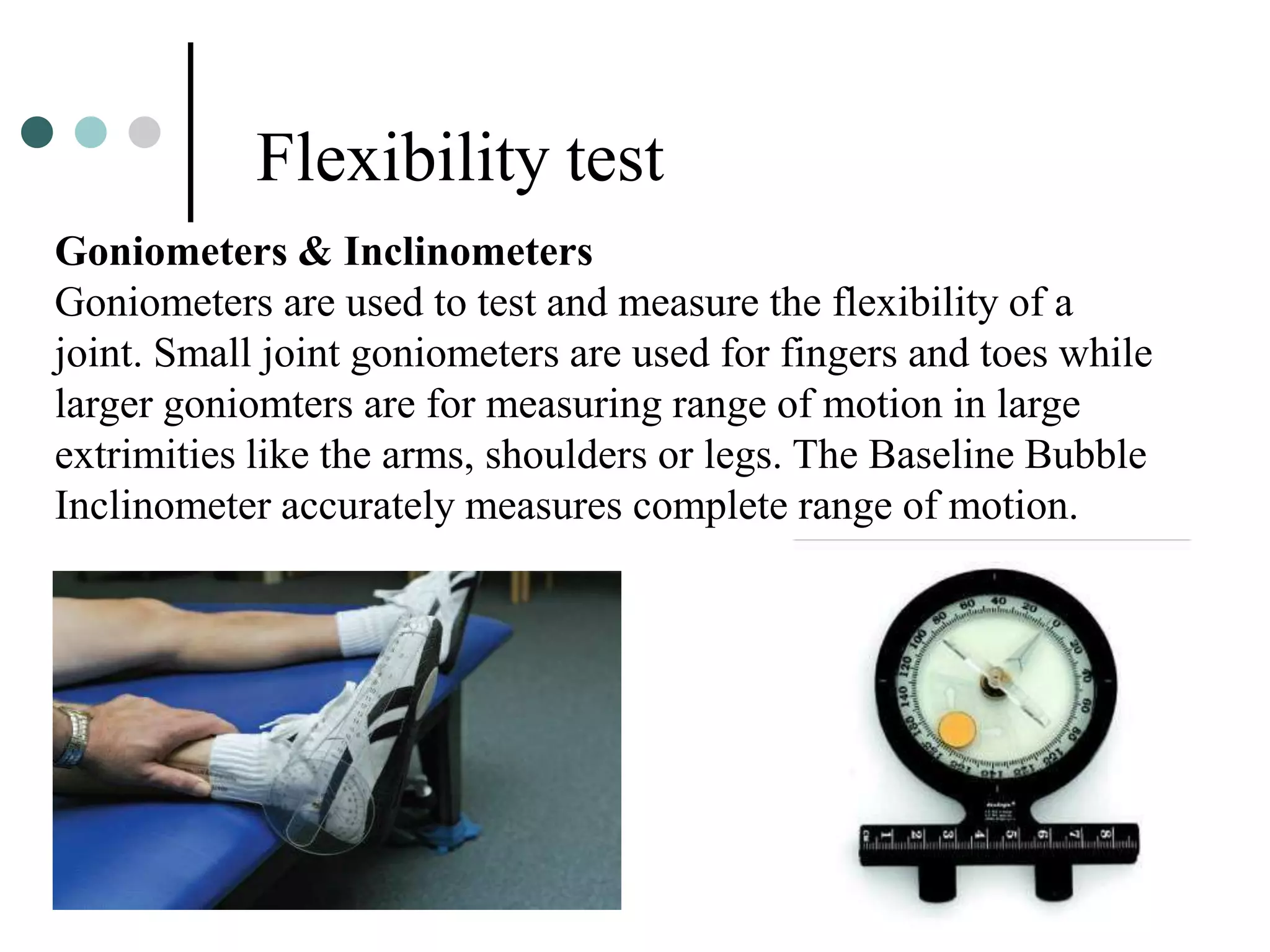
Goniometers & Inclinometers
Goniometers are used to test and measure the flexibility of a
joint. Small joint goniometers are used for fingers and toes while
larger goniomters are for measuring range of motion in large
extrimities like the arms, shoulders or legs. The Baseline Bubble
Inclinometer accurately measures complete range of motion.
Flexibility test
DISTANCE TESTS FOR
ASSESSMENT OF FLEXIBILITY
 Sit and reach (hamstrings)
 Measures hamstring
flexibility
 Legs out straight
 Reach as far as you can
 Zipper test (shoulders)
 One hand over head
 One hand around back
4-Body Composition Assessment
Body composition is the study of the components of
the body and their relative proportions.
From a health-related physical fitness (HRPF)
assessment point of view, body composition is defined
as the relative proportions of fat and fat-free tissue in
the body, typically expressed as a total body fat
percentage.
4-Body Composition Assessment
The evaluation of body composition can be done
through measure of the two-component (fat and fat-
free mass) assess by;-
• Height & Weight (Body Mass Index)
• Skin folds,
• Bioelectrical impedance analysis (BIA),
• Hydrostatic weighing
• Circumference Measurements
• Waist Girth & Waist-to-Hip Ratio
Body Composition
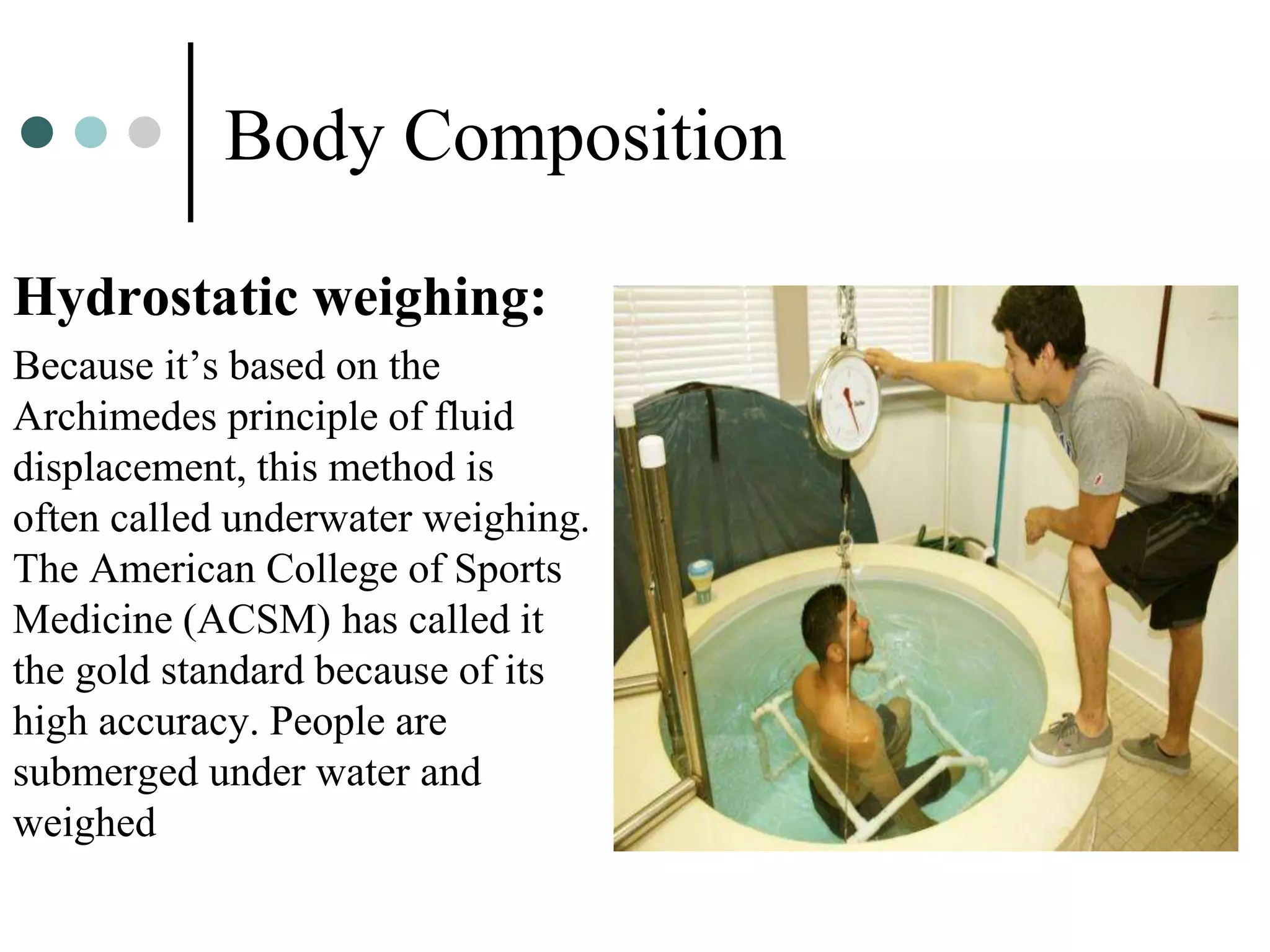
Hydrostatic weighing:
Because it’s based on the
Archimedes principle of fluid
displacement, this method is
often called underwater weighing.
The American College of Sports
Medicine (ACSM) has called it
the gold standard because of its
high accuracy. People are
submerged under water and
weighed
Body Composition: DEXA Scan
The dual-energy X-ray absorptiometry (DEXA) is a body
composition test. It’s a fast, relatively noninvasive technique that can
measure bone density for the diagnosis of osteoporosis, whole-body
composition and regional composition.
 Body Mass Index (BMI) •
 Distribution of mass based
on your height
 Waist to hip ratio
 Circumference of waist
versus the hips
 Shows the distribution of fat
 Sum of skin folds
 Shows where fat is stored
around the body
Body Mass Index
 Body Mass Index (BMI = kg/m2)
 Compares your mass to your height
 Not accurate for “athletic” individuals
Skin-fold test
• Skinfold measurements can be used to estimate body
fat percentage based on the assumption that the
amount of subcutaneous fat in a particular skinfold is
proportional to the total amount of overall body fat.
• At first glance, pinching a fold of skin and applying a
set of calipers to measure the distance appears to be a
simple skill. However, consistently obtaining
accurate skinfold measurements requires a good-
quality skinfold caliper, specific training, and a
significant amount of practice.
5-Muscular Strength test
• Muscle strength: the ability of muscles to
work against resistance
• Muscular Strength; tests muscular strength of
the upper body, (Push Up Strength Test)
Skill - Related Physical Fitness
 Different sports require different parts of
skill -related fitness.
 Many sports require several parts. For
example, a skater might have good agility,
but may not posses good power.
 Some people have more natural ability in
skill areas than others.
 Good health does not come from being
good in skill-related fitness.
Agility
• Agility is the ability to change the position of your body
quickly and to control body’s movements. People with
good agility are most likely to be good at activities such
as: diving, soccer, ice skating, wrestling, etc.
Balance
• Balance is the ability to keep an upright posture while
standing still or moving. People with good balance are
most likely to be good in activities such as
gymnastics, ice skating, rhythmic gymnastics, ski-
jumping, surfing, etc.
Power
• Power is the ability to
use strength and speed.
People with good power
might have the ability to
put the shot, throw the
discus, high jump, play
football, speed swim,
speed skate, etc.
Coordination
 Coordination is the integration of hand
and/or foot movements with the input of
the senses
 Examples of activities that require
coordination include: • CrossFit • Group
fitness classes (i.e., Zumba, Body Pump,
Body Attack, Bootcamp) • Baseball •
Basketball • Golf • Jumping rope •
Martial arts (i.e., karate, judo,
taekwondo) • Skiing/Snowboarding
Reaction Time
• Reaction time is the amount of time it takes to move
once you realize the need to act. People with good
reaction time are able to make fast starts in track or
swimming, or to dodge a fast attack in fencing or
karate.
Speed
Speed is the ability to perform a movement or cover a
distance in a short period of time. People with leg
speed can run fast, while people with good arm speed
can throw fast or hit a ball that is thrown fast.
THANKYOU

fitness.pdf

  • 1.
  • 2.
    Fitness and Health The word health is often associated only with physical fitness, but there are other components of health.  FITNESS means “readiness”. Fit people are better equipped than non-fit people.  The level of fitness includes all aspects of health and life.  It affects physical, mental, and social health.
  • 3.
    What is PhysicalFitness?  Physical Fitness is the ability of your body systems to work efficiently.  A fit person is able to carry out the typical activities of living, such as work, and still have enough energy and vigor to respond to emergency situations and to enjoy leisure time activities.
  • 4.
    Physical Activity andExercise  Physical activity is a general term that includes sports, dance, and activities done at work or at home, such as walking, climbing stairs, or mowing the lawn.  When people do physical activity especially for the purpose of getting fit, we say they are doing exercise. Physical Fitness is the body’s ability to function efficiently and effectively. It consists of Health Related Fitness and Skill Related Fitness, which have different components, each of which contributes to total quality of life
  • 5.
    What is aFitness Assessment? • A fitness assessment is a series of measurements that help determine physical fitness • It is a comprehensive assessment of health related fitness administered by professional, trained staff.
  • 6.
    A fitness assessmentprovides a baseline measurement of • 1-cardiovascular endurance, • 2- body composition, • 3- muscular endurance, • 4-muscular strength • 5- flexibility. Fitness assessment provide an accurate measure of the current fitness and health level of an individual.
  • 7.
    • Assessments arerecommended prior to beginning an exercise program • These tests are often the starting point for designing an appropriate exercise program.
  • 8.
    • To determinethe health status and physical fitness of an individual through the assessment of the 5 components of fitness • To help develop and establish an effective fitness program • To establish goals and motivation • To evaluate progress • To identify the strengths and weaknesses in relation to the physical fitness Objectives of fitness assessments
  • 10.
    The Parts ofPhysical Fitness  Health - Related Physical Fitness  Skill - Related Physical Fitness • It helps you stay healthy • It helps you perform well in sports and activities that require certain skills
  • 11.
    Cardiorespiratory fitness (CRF)  Cardiorespiratoryfitness (CRF) reflects the functional capabilities of the heart, blood vessels, lungs, and skeletal muscles to perform work.  There are many different terms that have been used to describe this measure of physical fitness, including: • Maximal aerobic capacity • Functional capacity • Physical work capacity (PWC) • Cardiovascular endurance, fitness, or capacity • Cardiorespiratory endurance, fitness, or capacity • Cardiopulmonary endurance, fitness, or capacity
  • 12.
    1.Cardiovascular endurance assessment • 1-Cardio-respiratoryEndurance or Resting Heart Rate: Indicator of aerobic fitness and cardiac efficiency • Cardio-respiratory endurance: the ability to perform large-muscle, dynamic exercise of moderate to high intensity for prolonged periods
  • 13.
    • Cardiovascular enduranceis the ability of; the heart, the blood, the blood vessels the respiratory system to provide the required oxygen and fuel to the muscles for carrying on a particular exercise for specific period of time at a steady rate Cardiovascular Endurance
  • 14.
    Cardiovascular Endurance  Factorsto consider  VO2 max – volume of O2 (ml O2 kg-1 min-1)  Heart rate  Blood pressure  Measures efficiency, work load and force of the heart
  • 15.
    VO2 max Test GOLD STANDARD  Treadmill  Tube  HR monitor  Cables  Stop when O2 levels plateau  Impractical
  • 16.
    Maximal Oxygen Consumptiontest (VO2 Max) According to the American College of Sports Medicine (ACSM), cardio-respiratory fitness is determined by oxygen consumption, technically called VO2. This is measured by how much oxygen (in milliliters) your body can use per kilogram of body weight per minute. Cardiovascular endurance assessment
  • 19.
    VO2max The formulas: Male: 108.844- [lbs./2.2 (0.1636)] – [time (1.438)] – [HR (0.1928)] Female: 100.5 - [lbs./2.2 (0.1636)] – [time (1.438)] – [HR (0.1928)] Calculating
  • 21.
    • Determining appropriatemaximum heart rate in a fitness assessment should also take into account blood pressure • A person with high blood pressure should be evaluated by a physician prior to proceeding with an exercise program. Cardiovascular endurance assessment
  • 22.
    • Another commontest in a fitness assessment is aerobic fitness. the main goal of any aerobic exercise is to provide an increased amount of oxygen to the body. • Aerobic exercise involved three specific types of exercise including; cycling, swimming, and running. • Aerobic exercise can also include skiing, jogging, running on a treadmill using an elliptical trainer, Cardiovascular endurance assessment
  • 23.
  • 24.
    CV testing: FieldTest  Beep Test  20m distance  Job/run/sprint according to the beep  Miss 1x its ok, but beat the next beep
  • 26.
    2- Muscular endurance •Muscular endurance is the ability of a muscle or group of muscles to contract without becoming exhausted • is very important for people playing sports and who have to sustain an activity for long periods of time.
  • 27.
    Muscular endurance isassessed by counting the maximum number of repetitions of a muscular contraction a person can perform to fatigue (Repetition Maximum Testing 1 RM) The term used to describe the maximal amount of weight that can be lifted with one contraction is called the repetition maximum (RM). The 1-RM is typically considered the gold standard measure of muscular strength Muscular endurance
  • 28.
    Muscular Endurance  Push-uptest  Max of push-ups  Sit-up test  1min for Max  Wall Sit  Max squat along wall
  • 29.
    YMCA Submaximal Bench PressTest  This test provides a standardized method to quantify muscular endurance using the bench press exercise.
  • 30.
    Muscular endurance  RequiresMax testing  Squats and bench press  Very unsafe for inexperienced individuals  Typical Tests:  Vertical jump  Leg press  Handgrip dynamometers
  • 31.
  • 32.
    3- Flexibility test Thecapacity of the joints to move through a full range of motion; • the ability to bend and recover without injury • Flexibility is an important component of fitness and physical performance • Evaluates flexibility of lower back and posterior leg muscles
  • 33.
     Similar tothe HRPF assessment of muscular endurance, there is no one single measurement that provides an overall measurement of flexibility.  Fortunately, goniometer assessments are quite feasible
  • 34.
    Goniometers & Inclinometers Goniometersare used to test and measure the flexibility of a joint. Small joint goniometers are used for fingers and toes while larger goniomters are for measuring range of motion in large extrimities like the arms, shoulders or legs. The Baseline Bubble Inclinometer accurately measures complete range of motion. Flexibility test
  • 35.
    DISTANCE TESTS FOR ASSESSMENTOF FLEXIBILITY  Sit and reach (hamstrings)  Measures hamstring flexibility  Legs out straight  Reach as far as you can  Zipper test (shoulders)  One hand over head  One hand around back
  • 36.
    4-Body Composition Assessment Bodycomposition is the study of the components of the body and their relative proportions. From a health-related physical fitness (HRPF) assessment point of view, body composition is defined as the relative proportions of fat and fat-free tissue in the body, typically expressed as a total body fat percentage.
  • 37.
    4-Body Composition Assessment Theevaluation of body composition can be done through measure of the two-component (fat and fat- free mass) assess by;- • Height & Weight (Body Mass Index) • Skin folds, • Bioelectrical impedance analysis (BIA), • Hydrostatic weighing • Circumference Measurements • Waist Girth & Waist-to-Hip Ratio
  • 38.
    Body Composition Hydrostatic weighing: Becauseit’s based on the Archimedes principle of fluid displacement, this method is often called underwater weighing. The American College of Sports Medicine (ACSM) has called it the gold standard because of its high accuracy. People are submerged under water and weighed
  • 39.
    Body Composition: DEXAScan The dual-energy X-ray absorptiometry (DEXA) is a body composition test. It’s a fast, relatively noninvasive technique that can measure bone density for the diagnosis of osteoporosis, whole-body composition and regional composition.
  • 40.
     Body MassIndex (BMI) •  Distribution of mass based on your height  Waist to hip ratio  Circumference of waist versus the hips  Shows the distribution of fat  Sum of skin folds  Shows where fat is stored around the body
  • 41.
    Body Mass Index Body Mass Index (BMI = kg/m2)  Compares your mass to your height  Not accurate for “athletic” individuals
  • 42.
    Skin-fold test • Skinfoldmeasurements can be used to estimate body fat percentage based on the assumption that the amount of subcutaneous fat in a particular skinfold is proportional to the total amount of overall body fat. • At first glance, pinching a fold of skin and applying a set of calipers to measure the distance appears to be a simple skill. However, consistently obtaining accurate skinfold measurements requires a good- quality skinfold caliper, specific training, and a significant amount of practice.
  • 45.
    5-Muscular Strength test •Muscle strength: the ability of muscles to work against resistance • Muscular Strength; tests muscular strength of the upper body, (Push Up Strength Test)
  • 46.
    Skill - RelatedPhysical Fitness  Different sports require different parts of skill -related fitness.  Many sports require several parts. For example, a skater might have good agility, but may not posses good power.  Some people have more natural ability in skill areas than others.  Good health does not come from being good in skill-related fitness.
  • 47.
    Agility • Agility isthe ability to change the position of your body quickly and to control body’s movements. People with good agility are most likely to be good at activities such as: diving, soccer, ice skating, wrestling, etc.
  • 48.
    Balance • Balance isthe ability to keep an upright posture while standing still or moving. People with good balance are most likely to be good in activities such as gymnastics, ice skating, rhythmic gymnastics, ski- jumping, surfing, etc.
  • 49.
    Power • Power isthe ability to use strength and speed. People with good power might have the ability to put the shot, throw the discus, high jump, play football, speed swim, speed skate, etc.
  • 50.
    Coordination  Coordination isthe integration of hand and/or foot movements with the input of the senses  Examples of activities that require coordination include: • CrossFit • Group fitness classes (i.e., Zumba, Body Pump, Body Attack, Bootcamp) • Baseball • Basketball • Golf • Jumping rope • Martial arts (i.e., karate, judo, taekwondo) • Skiing/Snowboarding
  • 51.
    Reaction Time • Reactiontime is the amount of time it takes to move once you realize the need to act. People with good reaction time are able to make fast starts in track or swimming, or to dodge a fast attack in fencing or karate.
  • 52.
    Speed Speed is theability to perform a movement or cover a distance in a short period of time. People with leg speed can run fast, while people with good arm speed can throw fast or hit a ball that is thrown fast.
  • 53.