Fit for Work? 
Prevention & management of workforce illness, 
disability and absence from MSDs – the role of 
engagement & ‘good work’ 
Stephen Bevan 
Director, Centre for Workforce Effectiveness, The Work Foundation (UK) 
Honorary Professor, Lancaster University, UK 
Founding President, Fit for Work Europe Coalition
Themes 
• The Global ‘Burden’ of MSDs 
• The EU & Asia Pacific & NZ picture 
• Ageing, retirement, work & health in 2030 
• Areas for action: 
• Earlier diagnosis & intervention 
• ‘Good Work’ is good for health 
• Engagement & Wellbeing 
• Some examples
Global Burden of MSDs 
©The Work Foundation
Global Burden of MSDs 
©The Work Foundation 
2nd greatest 
cause of 
disability in all 
regions of the 
world 
Disability due to 
MSDs increased 
by 45% from 
1990 to 2010 
1.7bn Affected: 
Back pain 632m 
Neck pain 332m 
OA knee 251m 
Other MSD 561m
MSDs and Disability 
• Ranking of major causes of death and 
disability (% DALYs) 
• Cardiovascular and circulatory diseases 11.8% 
• All neoplasms 7.6% 
• Mental and behavioural disorders 7.4% 
• Musculoskeletal disorders 6.8% 
• Yet MSDs not considered a priority non-communicable 
disease…. 
• …high on morbidity but low on mortality
Musculoskeletal Disorders in the EU Workforce
Core Findings: New Zealand 
MSDs are the 
leading cause of 
disability in NZ 
affecting 1 in 4 
In 2009 MSDs 
accounted for 21% of 
all sickness & invalid 
benefit payments 
MSDs cost the 
economy 
NZ$5.57 billion 
each year 
15% of all citizens 
visit their GP with 
an MSD each year 
Income tax 
foregone due to 
Arthritis 
NZ$254m 
Lost productivity 
is the largest cost 
of Arthritis (47%) 
Indirect costs of 
Arthritis outweigh 
direct costs by 
3.6:1 
54% of people 
with Arthritis are 
of working age 
Earlier diagnosis & treatment of MSDs could improve workability, job retention 
and return to work – reducing their clinical, economic & social impact
Musculoskeletal Disorders in Asia Pacific
Ageing, retirement, work & health in 2030 
©The Work Foundation
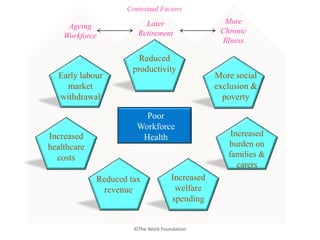
Labour Market Dynamics 
• Ageing workforces in most developed 
economies 
• Pension/superannuation challenges mean 
many will retire later 
• Growing proportion of the workforce will have 
one or more chronic and work-limiting health 
condition
Reduced 
productivity 
Poor 
Workforce 
Health 
©The Work Foundation 
More social 
exclusion & 
poverty 
Early labour 
market 
withdrawal 
Increased 
healthcare 
costs 
Reduced tax 
revenue 
Increased 
welfare 
spending 
Increased 
burden on 
families & 
carers 
Ageing 
Workforce 
Later 
Retirement 
More 
Chronic 
Illness 
Contextual Factors
LTCs in the UK Working Age Population - 2030 
©The Work Foundation 
N=21.6m Source: Vaughan-Jones & Barham, 2009 
Mental Health 
CHD 
Stroke 
COPD 
Asthma 
MSDs 
Cancer 
Diabetes 
Asthma 
2.6m 
Diabetes 
1.3m 
Stroke 
367k 
Mental 
Health 7m 
MSDs 
7m 
COPD 
1.6m 
Cancer 
800k 
CHD 
1m 
Comorbidity 
– limitations of the 
Biomedical model?
Action Areas 
• Early intervention 
• Health benefits of Work 
• Health & Wellbeing ‘strategy’ 
• Engagement & Wellbeing 
• Examples 
©The Work Foundation
Early Intervention 
• Better treatment. The quicker an individual receives a diagnosis, the more 
rapidly they can get access to appropriate treatment which can stabilise or 
control their symptoms; 
• Reducing the risk of developing co-morbid conditions. For many people 
with chronic conditions issues like pain, fatigue, depression or anxiety can 
become a significant issue which can increase healthcare costs and 
reduces functional capacity; 
• Aiding a return to activities of daily living. Early intervention can ensure 
people with chronic conditions can become more self-reliant and rely less 
on health and social care services; 
• Staying in or returning to work. People whose health conditions are being 
well-managed are more likely to remain economically active, continue to 
pay taxes and be less reliant on welfare payments 
©The Work Foundation
Madrid: Early Intervention for MSDs 
15 
 Early Intervention Clinic1 in Madrid – after 5 days 
1Abasolo, L et al, (2005) A Health System Program To Reduce Work Disability Related to Musculoskeletal Disorders, Annals of Internal Medicine, 143:404-414. 
 Reduce the duration of temporary disability by 39% 
 Reduce the incidence of permanent disability by 50% 
 Reduce the utilization of health care resources by 40% 
 The analysis showed that $1 invested in the early 
intervention program yielded $11 of benefit 
If replicated across the EU this intervention would allow 
1m additional workers to attend work each day
Health Benefits of Work 
• Good Work is Good for Health 
• Focus on ‘Capacity’ not ‘Incapacity’ [Fit Note?] 
• Early intervention is cost effective: Primary care, 
workplaces, secondary care all play a part 
• Work should be regarded as a clinical outcome of care 
• Up to 30% of workers with MSDs also have mental 
health problems – interventions need to take this into 
account 
• Work has therapeutic benefits – especially ‘good work’ 
– but what does this mean in practice?
Components of ‘Good Work’
Waddell & Burton, 
2006 
‘Is work good for your 
health & wellbeing?’ 
Marmot 
2005 
‘Status Syndrome: How 
Social Standing Affects 
our Health & Longevity’
Parker & Bevan 
2011 
‘Good Work & Our Times’
Part of the difficulty with the ‘Work is good for you’ 
statement is that it is too simple. What work? For 
whom? When? In what way? The statement has been 
amended – ‘Good work is good for your health’…
Is this a Health & Wellbeing ‘Strategy’? 
©The Work Foundation
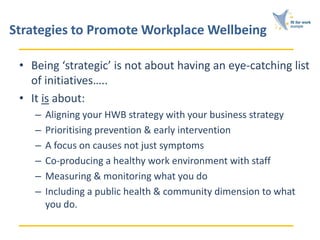
Strategies to Promote Workplace Wellbeing 
• Being ‘strategic’ is not about having an eye-catching list 
of initiatives….. 
• It is about: 
– Aligning your HWB strategy with your business strategy 
– Prioritising prevention & early intervention 
– A focus on causes not just symptoms 
– Co-producing a healthy work environment with staff 
– Measuring & monitoring what you do 
– Including a public health & community dimension to what 
you do.
Early 
Referral 
©The Work Foundation 
Job 
Design 
Line 
Management 
Workplace 
Accommodations 
Vocational 
Rehabilitation 
Examples 
“The best 
workplace 
accommodation 
is a great 
manager”
Resilience – two perspectives 
‘both the capacity to be bent without 
breaking and the capacity, once bent, 
©The Work Foundation 
to spring back’ 
‘something which helps inoculate our 
employees against work pressure, 
ambiguity, poor management and 
bullying’ 
Or…
Challenges 
• HWB – cost or investment? 
• Line manager health 
• Employee engagement & wellbeing vs 
‘Vitality Curve’ performance management 
• Disclosure, stigma & psychological health 
• HWB as ‘benefit’ or ‘intervention’? 
• Good Work: Tackling symptoms or causes? 
©The Work Foundation
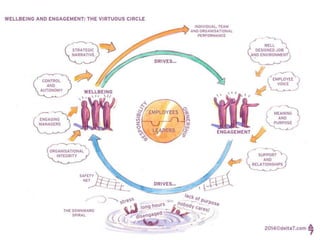
Engagement & Wellbeing 
• Strong links between both psychological and physical 
health and engagement 
• Engagement at work significantly affects people’s 
perceptions of whether they consider they are thriving 
in their wider lives 
• Organisations that have introduced initiatives aimed at 
improving physical health also see benefits from 
improved teamwork 
• Committed and healthy employees have a significant 
influence on customer service, lower staff turnover and 
reduced absence
©The Work Foundation 
Recent study of Bank 
workers on work/non-work 
‘boundary’ and 
wellbeing 
Non-work factors 
had a negative 
compounding effect 
on those already 
suffering work 
stress, reducing 
productivity by a 
further 6 per cent
Some Examples 
©The Work Foundation
BT – Line Manager MH Education 
©The Work Foundation
Unilever – HRA Approach 
• Started with a top-down approach 
• HRA with top 14 executives – modifyable 
health risks 
• Intensive lifestyle coaching (hydration, sleep, 
exercise, alcohol etc) 
• High impact results made a wider business 
case for extension of HRA 
• £3.8:£1 ROI achieved globally 
©The Work Foundation
BP – Early Onset Dementia 
• Retention of skills & know-how is business-critical 
• Early onset dementia & cognitive decline seen as a 
risk 
• Pilot work by OHS to redesign jobs and provide 
support for employees showing early signs 
• TWF/LU planning to evaluate these interventions 
©The Work Foundation
EDF Energy - Resilience 
• OH & HR initiative to shift the emphasis of MH 
from ‘Stress’ to ‘Resilience’ 
• Focus on coping, self-management & control 
• Strong link to Business ‘resilience’, H&S & 
agility 
• Training & support for line managers & staff 
• ‘Resilience’ not embraced by French ‘parent’ 
©The Work Foundation
Conclusions 
• Most adults spend a high proportion of their lives 
at work 
• As well as income, the workplace is where many 
of us find friendship, fulfilment and the 
emotional interactions that enrich our lives 
• People living with chronic illness or disability 
have the right to expect access to high quality, 
flexible and rewarding work 
• We know how to secure this and the pressure for 
all stakeholders to act is becoming irresistible
Thank You! 
Stay in Touch 
www.fitforworkeurope.eu 
www.theworkfoundation.com 
sbevan@theworkfoundation.com 
@StephenBevan

Fit for Work?

  • 1.
    Fit for Work? Prevention & management of workforce illness, disability and absence from MSDs – the role of engagement & ‘good work’ Stephen Bevan Director, Centre for Workforce Effectiveness, The Work Foundation (UK) Honorary Professor, Lancaster University, UK Founding President, Fit for Work Europe Coalition
  • 2.
    Themes • TheGlobal ‘Burden’ of MSDs • The EU & Asia Pacific & NZ picture • Ageing, retirement, work & health in 2030 • Areas for action: • Earlier diagnosis & intervention • ‘Good Work’ is good for health • Engagement & Wellbeing • Some examples
  • 3.
    Global Burden ofMSDs ©The Work Foundation
  • 4.
    Global Burden ofMSDs ©The Work Foundation 2nd greatest cause of disability in all regions of the world Disability due to MSDs increased by 45% from 1990 to 2010 1.7bn Affected: Back pain 632m Neck pain 332m OA knee 251m Other MSD 561m
  • 5.
    MSDs and Disability • Ranking of major causes of death and disability (% DALYs) • Cardiovascular and circulatory diseases 11.8% • All neoplasms 7.6% • Mental and behavioural disorders 7.4% • Musculoskeletal disorders 6.8% • Yet MSDs not considered a priority non-communicable disease…. • …high on morbidity but low on mortality
  • 6.
  • 7.
    Core Findings: NewZealand MSDs are the leading cause of disability in NZ affecting 1 in 4 In 2009 MSDs accounted for 21% of all sickness & invalid benefit payments MSDs cost the economy NZ$5.57 billion each year 15% of all citizens visit their GP with an MSD each year Income tax foregone due to Arthritis NZ$254m Lost productivity is the largest cost of Arthritis (47%) Indirect costs of Arthritis outweigh direct costs by 3.6:1 54% of people with Arthritis are of working age Earlier diagnosis & treatment of MSDs could improve workability, job retention and return to work – reducing their clinical, economic & social impact
  • 8.
  • 9.
    Ageing, retirement, work& health in 2030 ©The Work Foundation
  • 10.
    Labour Market Dynamics • Ageing workforces in most developed economies • Pension/superannuation challenges mean many will retire later • Growing proportion of the workforce will have one or more chronic and work-limiting health condition
  • 11.
    Reduced productivity Poor Workforce Health ©The Work Foundation More social exclusion & poverty Early labour market withdrawal Increased healthcare costs Reduced tax revenue Increased welfare spending Increased burden on families & carers Ageing Workforce Later Retirement More Chronic Illness Contextual Factors
  • 12.
    LTCs in theUK Working Age Population - 2030 ©The Work Foundation N=21.6m Source: Vaughan-Jones & Barham, 2009 Mental Health CHD Stroke COPD Asthma MSDs Cancer Diabetes Asthma 2.6m Diabetes 1.3m Stroke 367k Mental Health 7m MSDs 7m COPD 1.6m Cancer 800k CHD 1m Comorbidity – limitations of the Biomedical model?
  • 13.
    Action Areas •Early intervention • Health benefits of Work • Health & Wellbeing ‘strategy’ • Engagement & Wellbeing • Examples ©The Work Foundation
  • 14.
    Early Intervention •Better treatment. The quicker an individual receives a diagnosis, the more rapidly they can get access to appropriate treatment which can stabilise or control their symptoms; • Reducing the risk of developing co-morbid conditions. For many people with chronic conditions issues like pain, fatigue, depression or anxiety can become a significant issue which can increase healthcare costs and reduces functional capacity; • Aiding a return to activities of daily living. Early intervention can ensure people with chronic conditions can become more self-reliant and rely less on health and social care services; • Staying in or returning to work. People whose health conditions are being well-managed are more likely to remain economically active, continue to pay taxes and be less reliant on welfare payments ©The Work Foundation
  • 15.
    Madrid: Early Interventionfor MSDs 15  Early Intervention Clinic1 in Madrid – after 5 days 1Abasolo, L et al, (2005) A Health System Program To Reduce Work Disability Related to Musculoskeletal Disorders, Annals of Internal Medicine, 143:404-414.  Reduce the duration of temporary disability by 39%  Reduce the incidence of permanent disability by 50%  Reduce the utilization of health care resources by 40%  The analysis showed that $1 invested in the early intervention program yielded $11 of benefit If replicated across the EU this intervention would allow 1m additional workers to attend work each day
  • 16.
    Health Benefits ofWork • Good Work is Good for Health • Focus on ‘Capacity’ not ‘Incapacity’ [Fit Note?] • Early intervention is cost effective: Primary care, workplaces, secondary care all play a part • Work should be regarded as a clinical outcome of care • Up to 30% of workers with MSDs also have mental health problems – interventions need to take this into account • Work has therapeutic benefits – especially ‘good work’ – but what does this mean in practice?
  • 17.
  • 18.
    Waddell & Burton, 2006 ‘Is work good for your health & wellbeing?’ Marmot 2005 ‘Status Syndrome: How Social Standing Affects our Health & Longevity’
  • 19.
    Parker & Bevan 2011 ‘Good Work & Our Times’
  • 20.
    Part of thedifficulty with the ‘Work is good for you’ statement is that it is too simple. What work? For whom? When? In what way? The statement has been amended – ‘Good work is good for your health’…
  • 21.
    Is this aHealth & Wellbeing ‘Strategy’? ©The Work Foundation
  • 22.
    Strategies to PromoteWorkplace Wellbeing • Being ‘strategic’ is not about having an eye-catching list of initiatives….. • It is about: – Aligning your HWB strategy with your business strategy – Prioritising prevention & early intervention – A focus on causes not just symptoms – Co-producing a healthy work environment with staff – Measuring & monitoring what you do – Including a public health & community dimension to what you do.
  • 23.
    Early Referral ©TheWork Foundation Job Design Line Management Workplace Accommodations Vocational Rehabilitation Examples “The best workplace accommodation is a great manager”
  • 24.
    Resilience – twoperspectives ‘both the capacity to be bent without breaking and the capacity, once bent, ©The Work Foundation to spring back’ ‘something which helps inoculate our employees against work pressure, ambiguity, poor management and bullying’ Or…
  • 25.
    Challenges • HWB– cost or investment? • Line manager health • Employee engagement & wellbeing vs ‘Vitality Curve’ performance management • Disclosure, stigma & psychological health • HWB as ‘benefit’ or ‘intervention’? • Good Work: Tackling symptoms or causes? ©The Work Foundation
  • 26.
    Engagement & Wellbeing • Strong links between both psychological and physical health and engagement • Engagement at work significantly affects people’s perceptions of whether they consider they are thriving in their wider lives • Organisations that have introduced initiatives aimed at improving physical health also see benefits from improved teamwork • Committed and healthy employees have a significant influence on customer service, lower staff turnover and reduced absence
  • 29.
    ©The Work Foundation Recent study of Bank workers on work/non-work ‘boundary’ and wellbeing Non-work factors had a negative compounding effect on those already suffering work stress, reducing productivity by a further 6 per cent
  • 31.
    Some Examples ©TheWork Foundation
  • 32.
    BT – LineManager MH Education ©The Work Foundation
  • 33.
    Unilever – HRAApproach • Started with a top-down approach • HRA with top 14 executives – modifyable health risks • Intensive lifestyle coaching (hydration, sleep, exercise, alcohol etc) • High impact results made a wider business case for extension of HRA • £3.8:£1 ROI achieved globally ©The Work Foundation
  • 34.
    BP – EarlyOnset Dementia • Retention of skills & know-how is business-critical • Early onset dementia & cognitive decline seen as a risk • Pilot work by OHS to redesign jobs and provide support for employees showing early signs • TWF/LU planning to evaluate these interventions ©The Work Foundation
  • 35.
    EDF Energy -Resilience • OH & HR initiative to shift the emphasis of MH from ‘Stress’ to ‘Resilience’ • Focus on coping, self-management & control • Strong link to Business ‘resilience’, H&S & agility • Training & support for line managers & staff • ‘Resilience’ not embraced by French ‘parent’ ©The Work Foundation
  • 36.
    Conclusions • Mostadults spend a high proportion of their lives at work • As well as income, the workplace is where many of us find friendship, fulfilment and the emotional interactions that enrich our lives • People living with chronic illness or disability have the right to expect access to high quality, flexible and rewarding work • We know how to secure this and the pressure for all stakeholders to act is becoming irresistible
  • 37.
    Thank You! Stayin Touch www.fitforworkeurope.eu www.theworkfoundation.com sbevan@theworkfoundation.com @StephenBevan