WHAT CAN BUSINESSES DO TO HELP EMPLOYEES 
MAINTAIN AND IMPROVE THEIR HEALTH? 
December 10, 2014 
Leadership Duluth 
Kim Nichols Dauner, MPH, PhD 
UMD Health Care Management Program 
Asst. Professor, Dept. of Economics 
kdauner@d.umn.edu; 218-726-7279
WORKSITE WELLNESS TRENDS
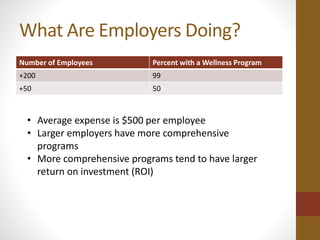
What Are Employers Doing? 
Number of Employees Percent with a Wellness Program 
+200 99 
+50 50 
• Average expense is $500 per employee 
• Larger employers have more comprehensive 
programs 
• More comprehensive programs tend to have larger 
return on investment (ROI)
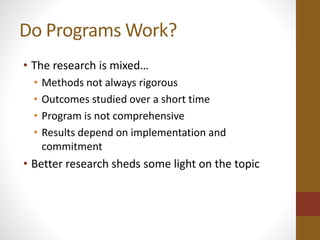
Do Programs Work? 
• The research is mixed… 
• Methods not always rigorous 
• Outcomes studied over a short time 
• Program is not comprehensive 
• Results depend on implementation and 
commitment 
• Better research sheds some light on the topic
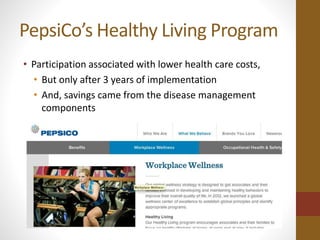
PepsiCo’s Healthy Living Program 
• Participation associated with lower health care costs, 
• But only after 3 years of implementation 
• And, savings came from the disease management 
components
ROI Studies 
• $3 ROI for every $1 spent (Goetzel) 
• When an employer spends $100-$150 per 
employee 
• Takes 2-3 year to realize savings 
• Among 9 randomized controlled trials of 
traditional workplace wellness programs, the 
mean ROI was 1.79 to 1.00 (Baxter)
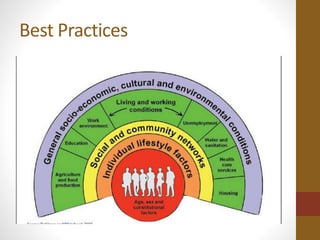
Best Practices
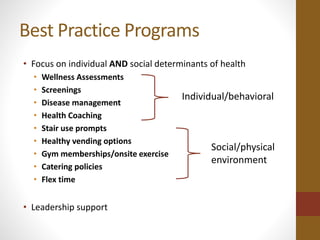
Best Practice Programs 
• Focus on individual AND social determinants of health 
• Wellness Assessments 
• Screenings 
• Disease management 
• Health Coaching 
• Stair use prompts 
• Healthy vending options 
• Gym memberships/onsite exercise 
• Catering policies 
• Flex time 
• Leadership support 
Individual/behavioral 
Social/physical 
environment
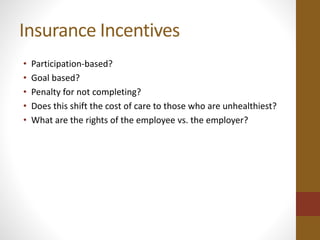
Insurance Incentives 
• Participation-based? 
• Goal based? 
• Penalty for not completing? 
• Does this shift the cost of care to those who are unhealthiest? 
• What are the rights of the employee vs. the employer?
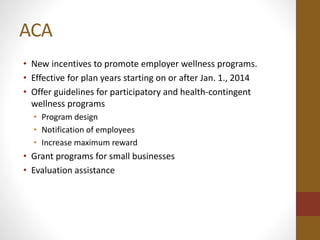
ACA 
• New incentives to promote employer wellness programs. 
• Effective for plan years starting on or after Jan. 1., 2014 
• Offer guidelines for participatory and health-contingent 
wellness programs 
• Program design 
• Notification of employees 
• Increase maximum reward 
• Grant programs for small businesses 
• Evaluation assistance
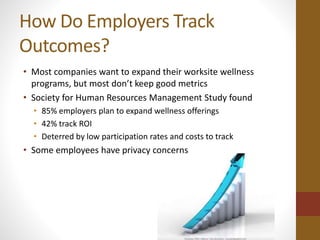
How Do Employers Track 
Outcomes? 
• Most companies want to expand their worksite wellness 
programs, but most don’t keep good metrics 
• Society for Human Resources Management Study found 
• 85% employers plan to expand wellness offerings 
• 42% track ROI 
• Deterred by low participation rates and costs to track 
• Some employees have privacy concerns
Holistic Approaches 
• Engagement and productivity 
• Stress is a risk factor 
• ~60% UMD employees taking the wellness assessment had moderate 
to high risk from stress (roughly equal to those at risk from being 
overweight) 
• Employees wants (anecdotal) work-life balance, turning off the 
ability to always be connected, jobs where you are the only one who 
does it. 
• Low engagement reported in US – 30% 
• Companies with employees citing higher engagement 
• Lower absenteeism 
• Lower turnover 
• Increased productivity 
• Increased profitability
Holistic Approaches 
• Wellness Council of America (WELCOA) 
• Increase engagement 
• Boost productivity 
• Employee retention
EMPLOYERS WITH <50 EMPLOYEES
Worksites with <50 Employees 
• National Small Business Association Study found: 
• 93% of small businesses studied reported that health was 
important to their bottom line 
• High confidence in ability to help their employees 
• Stress level was most cited employee concern 
• Culture may already be more family-like, easier to 
shape. 
• Studied even less 
• Often don't self-insure but also have smaller budget to 
work with 
• Sensitive to one adverse health event 
• Privacy concerns 
• Many small environmental changes can help

UMD Presentation

  • 1.
    WHAT CAN BUSINESSESDO TO HELP EMPLOYEES MAINTAIN AND IMPROVE THEIR HEALTH? December 10, 2014 Leadership Duluth Kim Nichols Dauner, MPH, PhD UMD Health Care Management Program Asst. Professor, Dept. of Economics kdauner@d.umn.edu; 218-726-7279
  • 2.
  • 3.
    What Are EmployersDoing? Number of Employees Percent with a Wellness Program +200 99 +50 50 • Average expense is $500 per employee • Larger employers have more comprehensive programs • More comprehensive programs tend to have larger return on investment (ROI)
  • 4.
    Do Programs Work? • The research is mixed… • Methods not always rigorous • Outcomes studied over a short time • Program is not comprehensive • Results depend on implementation and commitment • Better research sheds some light on the topic
  • 5.
    PepsiCo’s Healthy LivingProgram • Participation associated with lower health care costs, • But only after 3 years of implementation • And, savings came from the disease management components
  • 6.
    ROI Studies •$3 ROI for every $1 spent (Goetzel) • When an employer spends $100-$150 per employee • Takes 2-3 year to realize savings • Among 9 randomized controlled trials of traditional workplace wellness programs, the mean ROI was 1.79 to 1.00 (Baxter)
  • 7.
  • 9.
    Best Practice Programs • Focus on individual AND social determinants of health • Wellness Assessments • Screenings • Disease management • Health Coaching • Stair use prompts • Healthy vending options • Gym memberships/onsite exercise • Catering policies • Flex time • Leadership support Individual/behavioral Social/physical environment
  • 10.
    Insurance Incentives •Participation-based? • Goal based? • Penalty for not completing? • Does this shift the cost of care to those who are unhealthiest? • What are the rights of the employee vs. the employer?
  • 11.
    ACA • Newincentives to promote employer wellness programs. • Effective for plan years starting on or after Jan. 1., 2014 • Offer guidelines for participatory and health-contingent wellness programs • Program design • Notification of employees • Increase maximum reward • Grant programs for small businesses • Evaluation assistance
  • 12.
    How Do EmployersTrack Outcomes? • Most companies want to expand their worksite wellness programs, but most don’t keep good metrics • Society for Human Resources Management Study found • 85% employers plan to expand wellness offerings • 42% track ROI • Deterred by low participation rates and costs to track • Some employees have privacy concerns
  • 13.
    Holistic Approaches •Engagement and productivity • Stress is a risk factor • ~60% UMD employees taking the wellness assessment had moderate to high risk from stress (roughly equal to those at risk from being overweight) • Employees wants (anecdotal) work-life balance, turning off the ability to always be connected, jobs where you are the only one who does it. • Low engagement reported in US – 30% • Companies with employees citing higher engagement • Lower absenteeism • Lower turnover • Increased productivity • Increased profitability
  • 14.
    Holistic Approaches •Wellness Council of America (WELCOA) • Increase engagement • Boost productivity • Employee retention
  • 15.
  • 16.
    Worksites with <50Employees • National Small Business Association Study found: • 93% of small businesses studied reported that health was important to their bottom line • High confidence in ability to help their employees • Stress level was most cited employee concern • Culture may already be more family-like, easier to shape. • Studied even less • Often don't self-insure but also have smaller budget to work with • Sensitive to one adverse health event • Privacy concerns • Many small environmental changes can help

Editor's Notes

  • #2 Introduction Background in evaluating policy, community level, and worksite interventions that are aimed at improving health and healthy behaviors When I first moved to Duluth worked consulting employers of all sizes on creating healthy worksites. I’ve also worked with St. Luke’s Hospital on a worksite wellness intervention and am currently working with UMD’s HR to assess participation in campus wellness programs and productivity.
  • #4 Society of Human Resources Management data. Overview of what companies are doing. Investment dependent on size.
  • #5 Even though ROI tends to be higher for doing more, the research in general is mixed. Many studies occur at just one worksite, don’t employ rigorous research methods such as comparison groups, tend to focus on health savings over the short term (whereas we know that early prevention and exercise may prevent health costs many years down the road). Or, there are issues with the program itself being minimal or the research does not talk about the people (some call them the health champions) that make the program happen. At the same time, we have some better studies that shed some light on the topic.
  • #6 One if from PepsiCo’s Healthy Living Program. Study done by John Caloyeras and colleagues and reported on in the January 2014 journal Health Affairs. They evaluated the cost impact of the lifestyle and disease management components of PepsiCo’s wellness program, Healthy Living. They found that seven years of continuous participation in one or both components was associated with an average reduction of $30 in health care cost per member per month. And when they looked at each component individually, found that the disease management component was associated with lower costs and that the lifestyle management component was not. We estimate disease management to reduce health care costs by $136 per member per month, driven by a 29 percent reduction in hospital admissions. Workplace wellness programs may reduce health risks, delay or avoid the onset of chronic diseases, and lower health care costs for employees with manifest chronic disease. And even 7 years could be a small time horizon. Also suggests a need to focus on people with chronic conditions to reduce more immediate risk. Also, and I will discuss this in a minute, what about more intermediary results like employee productivity and engagement. These results echoed by a recent observational study by the Univ of Pittsburgh Medical Center. Disease management was key.
  • #7 Study by Ron Goetzel who works with the Centers for Disease Control and Prevention estimates a $3 ROI for every $1 spent by the employer, when an employer makes at $100-$150 per employee investment (generally suggesting a bit more than just educational programming). More recent analysis of many other studies (Baxter in a 2014 Am. J Health Promotion) found more modest cost-savings. Caveats with how savings and costs measured. More cost savings with programs that do beyond “the superficial” passing along of knowledge or education. Which brings me to the next point of – what should a wellness program look like?
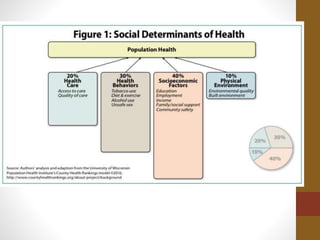
  • #8 First, let’s talk about what determines health? It’s a combination of individual, behavioral, community, social, economic, cultural, and environmental factors. Included in here, and often discussed separately, is access to health care. However, when we break it down to which factors actually contribute THE MOST to health, the answers are often surprising.
  • #9 It’s really the health behaviors and social/economic forces that have the most influence on our health. Worksite included in here. Meaning from here is that it’s imperative that we take these forces into account.
  • #10 Here’s what it looks like in terms of WW program components. Michael O’Donnell in a recent Health Affairs blog post uses language I like. The best programs include core components of programs that engage employees, improve health and save money are 1) improve awareness, 2) enhance motivation, 3) build skills, and 4) create opportunities that make the healthiest choice the easiest choice.
  • #11 Other aspects of WW programs are under hot debate. First one is the use of incentives. Different companies structure these differently. Some center around participation. This is how UMD has done it. Employee or employee/spouse – you complete a certain number of points in year one and in year two, your annual premiums will be reduced by $300 (individual) $400 family. Others take the approach of giving an incentive if certain health goals are met. Interestingly, Kaiser Health News published an article last week entitled: EEOC Takes Aim At Wellness Programs Increasingly Offered By Employers. Cited At Honeywell, employees are subject to stiff penalties for refusing health screenings. Some saw this as “policing” employees. Others argue that we already “police” health behavior by not allowing smoking at worksites. Going to be an interesting debate.
  • #12 The Affordable Care Act creates new incentives and builds on existing wellness program policies to promote employer wellness programs and encourage opportunities to support healthier workplaces. The Departments of Health and Human Services (HHS), Labor and the Treasury are jointly releasing proposed rules on wellness programs to reflect the changes to existing wellness provisions made by the Affordable Care Act and to encourage appropriately designed, consumer-protective wellness programs in group health coverage. These proposed rules would be effective for plan years starting on or after January 1, 2014. The proposed rules continue to support workplace wellness programs, including "participatory wellness programs" which generally are available without regard to an individual's health status. These include, for example, programs that reimburse for the cost of membership in a fitness center; that provide a reward to employees for attending a monthly, no-cost health education seminar; or that provides a reward to employees who complete a health risk assessment without requiring them to take further action. The rules also outline amended standards for nondiscriminatory "health-contingent wellness programs," which generally require individuals to meet a specific standard related to their health to obtain a reward. Examples of health-contingent wellness programs include programs that provide a reward to those who do not use, or decrease their use of, tobacco, or programs that provide a reward to those who achieve a specified cholesterol level or weight as well as to those who fail to meet that biometric target but take certain additional required actions. Protecting Consumers In order to protect consumers from unfair practices, the proposed regulations would require health-contingent wellness programs to follow certain rules, including: Programs must be reasonably designed to promote health or prevent disease. To be considered reasonably designed to promote health or prevent disease, a program would have to offer a different, reasonable means of qualifying for the reward to any individual who does not meet the standard based on the measurement, test or screening. Programs must have a reasonable chance of improving health or preventing disease and not be overly burdensome for individuals. Programs must be reasonably designed to be available to all similarly situated individuals. Reasonable alternative means of qualifying for the reward would have to be offered to individuals whose medical conditions make it unreasonably difficult, or for whom it is medically inadvisable, to meet the specified health-related standard. Individuals must be given notice of the opportunity to qualify for the same reward through other means. These proposed rules provide new sample language intended to be simpler for individuals to understand and to increase the likelihood that those who qualify for a different means of obtaining a reward will contact the plan or issuer to request it. Ensuring Flexibility for Employers The proposed rules also implement changes in the Affordable Care Act that increase the maximum permissible reward under a health-contingent wellness program from 20 percent to 30 percent of the cost of health coverage, and that further increase the maximum reward to as much as 50 percent for programs designed to prevent or reduce tobacco use. Evidence shows that workplace health programs have the potential to promote healthy behaviors; improve employees' health knowledge and skills; help employees get necessary health screenings, immunizations, and follow-up care; and reduce workplace exposure to substances and hazards that can cause diseases and injury. The proposed rules would not specify the types of wellness programs employers can offer, and invite comments on additional standards for wellness programs to protect consumers. See Dept. of Labor for more information. Some state grants too – Susan will discuss.
  • #13 SHRM data indicate. Buck HR consultants recently reported up to 35% increase in those wanting metrics tracked. Employers are going to need to implement programs that work (based on health determinants), track own metrics on costs, productivity, behaviors. More creativity.
  • #14 Quiz – what to US companies cite? Costs. For most outside the US employers engagement and productivity are #1. Stress a huge risk factor. UMD example. We also tend to report low engagement. Research suggests improving engagement can reduce absenteeism and turnover and increase productivity and even profitability. Brett sent me an article about how the addition of face-to-face coaching increased participation and engagement. Getting people off the phone and into the clinic was helpful.
  • #15 WELCOA also on board with this.
  • #17 General things about smaller employers pursuing wellness programs. Latter from my experiences working with small businesses in Duluth and NE MN.