PFM REFORMS ARE NECESSARY TO SUSTAIN FISCAL RULES: A SUB‐NATIONAL PERSPECTIVE FROM INDIA 
ICGFM 2014 Winter Training Conference 
PFM, Foundation for Public Governance 
Pratap Ranjan Jena 
National Institute of Public Finance and Policy 
New Delhi
THE CONTEXT AND RATIONALE 
 
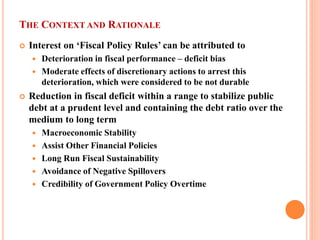
Interest on ‘Fiscal Policy Rules’ can be attributed to 
 
Deterioration in fiscal performance – deficit bias 
 
Moderate effects of discretionary actions to arrest this deterioration, which were considered to be not durable 
 
Reduction in fiscal deficit within a range to stabilize public debt at a prudent level and containing the debt ratio over the medium to long term 
 
Macroeconomic Stability 
 
Assist Other Financial Policies 
 
Long Run Fiscal Sustainability 
 
Avoidance of Negative Spillovers 
 
Credibility of Government Policy Overtime
GLOBAL CRISIS AND FISCAL RULES 
 
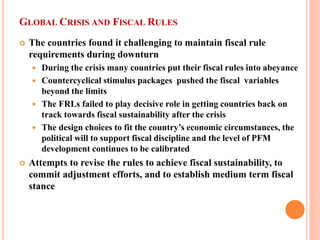
The countries found it challenging to maintain fiscal rule requirements during downturn 
 
During the crisis many countries put their fiscal rules into abeyance 
 
Countercyclical stimulus packages pushed the fiscal variables beyond the limits 
 
The FRLs failed to play decisive role in getting countries back on track towards fiscal sustainability after the crisis 
 
The design choices to fit the country’s economic circumstances, the political will to support fiscal discipline and the level of PFM development continues to be calibrated 
 
Attempts to revise the rules to achieve fiscal sustainability, to commit adjustment efforts, and to establish medium term fiscal stance
NEXT GENERATION FISCAL RULES 
 
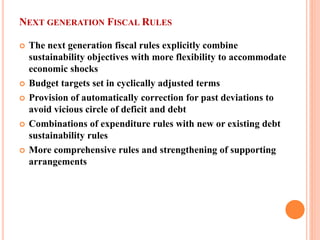
The next generation fiscal rules explicitly combine sustainability objectives with more flexibility to accommodate economic shocks 
 
Budget targets set in cyclically adjusted terms 
 
Provision of automatically correction for past deviations to avoid vicious circle of deficit and debt 
 
Combinations of expenditure rules with new or existing debt sustainability rules 
 
More comprehensive rules and strengthening of supporting arrangements
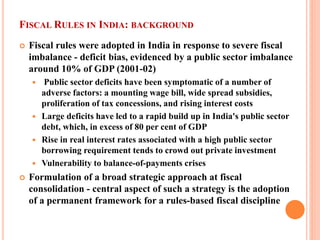
FISCAL RULES IN INDIA: BACKGROUND 
 
Fiscal rules were adopted in India in response to severe fiscal imbalance - deficit bias, evidenced by a public sector imbalance around 10% of GDP (2001-02) 
 
Public sector deficits have been symptomatic of a number of adverse factors: a mounting wage bill, wide spread subsidies, proliferation of tax concessions, and rising interest costs 
 
Large deficits have led to a rapid build up in India's public sector debt, which, in excess of 80 per cent of GDP 
 
Rise in real interest rates associated with a high public sector borrowing requirement tends to crowd out private investment 
 
Vulnerability to balance-of-payments crises 
 
Formulation of a broad strategic approach at fiscal consolidation - central aspect of such a strategy is the adoption of a permanent framework for a rules-based fiscal discipline
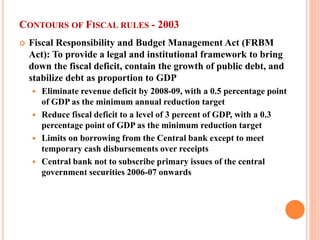
CONTOURS OF FISCAL RULES - 2003 
 
Fiscal Responsibility and Budget Management Act (FRBM Act): To provide a legal and institutional framework to bring down the fiscal deficit, contain the growth of public debt, and stabilize debt as proportion to GDP 
 
Eliminate revenue deficit by 2008-09, with a 0.5 percentage point of GDP as the minimum annual reduction target 
 
Reduce fiscal deficit to a level of 3 percent of GDP, with a 0.3 percentage point of GDP as the minimum reduction target 
 
Limits on borrowing from the Central bank except to meet temporary cash disbursements over receipts 
 
Central bank not to subscribe primary issues of the central government securities 2006-07 onwards
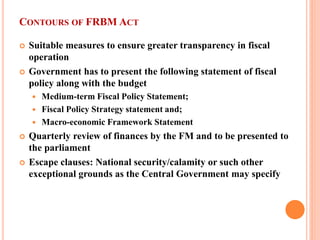
CONTOURS OF FRBM ACT 
 
Suitable measures to ensure greater transparency in fiscal operation 
 
Government has to present the following statement of fiscal policy along with the budget 
 
Medium-term Fiscal Policy Statement; 
 
Fiscal Policy Strategy statement and; 
 
Macro-economic Framework Statement 
 
Quarterly review of finances by the FM and to be presented to the parliament 
 
Escape clauses: National security/calamity or such other exceptional grounds as the Central Government may specify
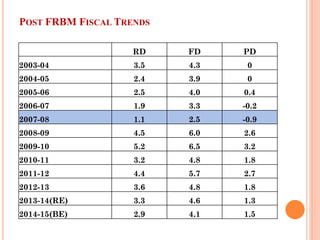
POST FRBM FISCAL TRENDS 
RD 
FD 
PD 
2003-04 
3.5 
4.3 
0 
2004-05 
2.4 
3.9 
0 
2005-06 
2.5 
4.0 
0.4 
2006-07 
1.9 
3.3 
-0.2 
2007-08 
1.1 
2.5 
-0.9 
2008-09 
4.5 
6.0 
2.6 
2009-10 
5.2 
6.5 
3.2 
2010-11 
3.2 
4.8 
1.8 
2011-12 
4.4 
5.7 
2.7 
2012-13 
3.6 
4.8 
1.8 
2013-14(RE) 
3.3 
4.6 
1.3 
2014-15(BE) 
2.9 
4.1 
1.5
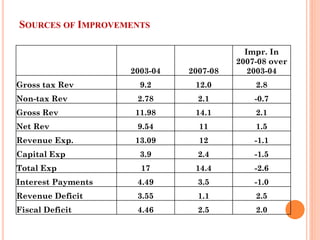
SOURCES OF IMPROVEMENTS 
2003-04 
2007-08 
Impr. In 2007-08 over 2003-04 
Gross tax Rev 
9.2 
12.0 
2.8 
Non-tax Rev 
2.78 
2.1 
-0.7 
Gross Rev 
11.98 
14.1 
2.1 
Net Rev 
9.54 
11 
1.5 
Revenue Exp. 
13.09 
12 
-1.1 
Capital Exp 
3.9 
2.4 
-1.5 
Total Exp 
17 
14.4 
-2.6 
Interest Payments 
4.49 
3.5 
-1.0 
Revenue Deficit 
3.55 
1.1 
2.5 
Fiscal Deficit 
4.46 
2.5 
2.0
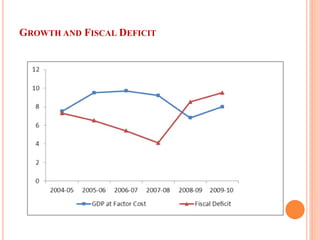
GROWTH AND FISCAL DEFICIT
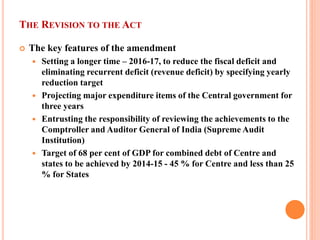
THE REVISION TO THE ACT 
 
The key features of the amendment 
 
Setting a longer time – 2016-17, to reduce the fiscal deficit and eliminating recurrent deficit (revenue deficit) by specifying yearly reduction target 
 
Projecting major expenditure items of the Central government for three years 
 
Entrusting the responsibility of reviewing the achievements to the Comptroller and Auditor General of India (Supreme Audit Institution) 
 
Target of 68 per cent of GDP for combined debt of Centre and states to be achieved by 2014-15 - 45 % for Centre and less than 25 % for States
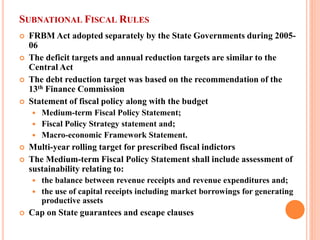
SUBNATIONAL FISCAL RULES 
 
FRBM Act adopted separately by the State Governments during 2005- 06 
 
The deficit targets and annual reduction targets are similar to the Central Act 
 
The debt reduction target was based on the recommendation of the 13th Finance Commission 
 
Statement of fiscal policy along with the budget 
 
Medium-term Fiscal Policy Statement; 
 
Fiscal Policy Strategy statement and; 
 
Macro-economic Framework Statement. 
 
Multi-year rolling target for prescribed fiscal indictors 
 
The Medium-term Fiscal Policy Statement shall include assessment of sustainability relating to: 
 
the balance between revenue receipts and revenue expenditures and; 
 
the use of capital receipts including market borrowings for generating productive assets 
 
Cap on State guarantees and escape clauses
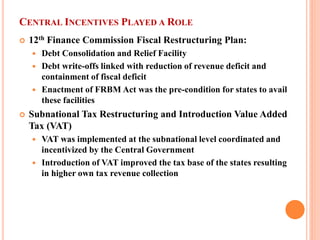
CENTRAL INCENTIVES PLAYED A ROLE 
 
12th Finance Commission Fiscal Restructuring Plan: 
 
Debt Consolidation and Relief Facility 
 
Debt write-offs linked with reduction of revenue deficit and containment of fiscal deficit 
 
Enactment of FRBM Act was the pre-condition for states to avail these facilities 
 
Subnational Tax Restructuring and Introduction Value Added Tax (VAT) 
 
VAT was implemented at the subnational level coordinated and incentivized by the Central Government 
 
Introduction of VAT improved the tax base of the states resulting in higher own tax revenue collection
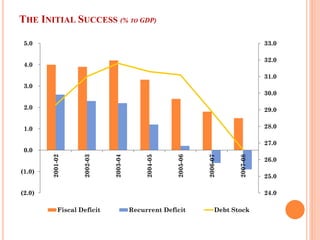
THE INITIAL SUCCESS (% TO GDP) 
24.0 
25.0 
26.0 
27.0 
28.0 
29.0 
30.0 
31.0 
32.0 
33.0 
(2.0) 
(1.0) 
0.0 
1.0 
2.0 
3.0 
4.0 
5.0 
2001-02 
2002-03 
2003-04 
2004-05 
2005-06 
2006-07 
2007-08 
Fiscal Deficit 
Recurrent Deficit 
Debt Stock
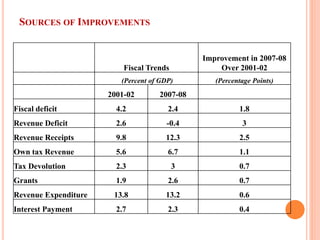
SOURCES OF IMPROVEMENTS 
Fiscal Trends 
Improvement in 2007-08 Over 2001-02 
(Percent of GDP) 
(Percentage Points) 
2001-02 
2007-08 
Fiscal deficit 
4.2 
2.4 
1.8 
Revenue Deficit 
2.6 
-0.4 
3 
Revenue Receipts 
9.8 
12.3 
2.5 
Own tax Revenue 
5.6 
6.7 
1.1 
Tax Devolution 
2.3 
3 
0.7 
Grants 
1.9 
2.6 
0.7 
Revenue Expenditure 
13.8 
13.2 
0.6 
Interest Payment 
2.7 
2.3 
0.4
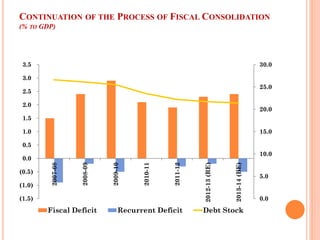
CONTINUATION OF THE PROCESS OF FISCAL CONSOLIDATION (% TO GDP) 
0.0 
5.0 
10.0 
15.0 
20.0 
25.0 
30.0 
(1.5) 
(1.0) 
(0.5) 
0.0 
0.5 
1.0 
1.5 
2.0 
2.5 
3.0 
3.5 
2007-08 
2008-09 
2009-10 
2010-11 
2011-12 
2012-13 (RE) 
2013-14 (BE) 
Fiscal Deficit 
Recurrent Deficit 
Debt Stock
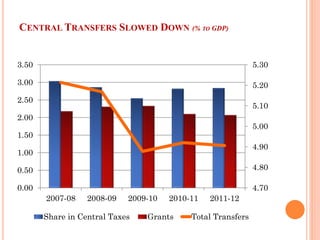
CENTRAL TRANSFERS SLOWED DOWN (% TO GDP) 
4.70 
4.80 
4.90 
5.00 
5.10 
5.20 
5.30 
0.00 
0.50 
1.00 
1.50 
2.00 
2.50 
3.00 
3.50 
2007-08 
2008-09 
2009-10 
2010-11 
2011-12 
Share in Central Taxes 
Grants 
Total Transfers
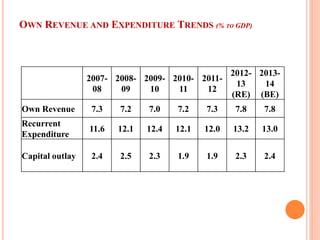
OWN REVENUE AND EXPENDITURE TRENDS (% TO GDP) 
2007- 08 
2008- 09 
2009- 10 
2010- 11 
2011- 12 
2012- 13 (RE) 
2013- 14 (BE) 
Own Revenue 
7.3 
7.2 
7.0 
7.2 
7.3 
7.8 
7.8 
Recurrent Expenditure 
11.6 
12.1 
12.4 
12.1 
12.0 
13.2 
13.0 
Capital outlay 
2.4 
2.5 
2.3 
1.9 
1.9 
2.3 
2.4
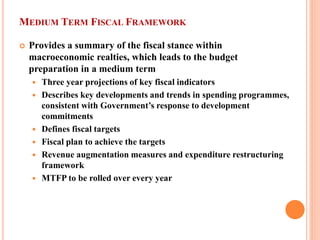
MEDIUM TERM FISCAL FRAMEWORK 
 
Provides a summary of the fiscal stance within macroeconomic realties, which leads to the budget preparation in a medium term 
 
Three year projections of key fiscal indicators 
 
Describes key developments and trends in spending programmes, consistent with Government’s response to development commitments 
 
Defines fiscal targets 
 
Fiscal plan to achieve the targets 
 
Revenue augmentation measures and expenditure restructuring framework 
 
MTFP to be rolled over every year
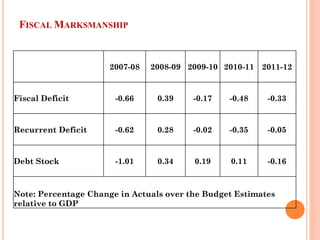
FISCAL MARKSMANSHIP 
2007-08 
2008-09 
2009-10 
2010-11 
2011-12 
Fiscal Deficit 
-0.66 
0.39 
-0.17 
-0.48 
-0.33 
Recurrent Deficit 
-0.62 
0.28 
-0.02 
-0.35 
-0.05 
Debt Stock 
-1.01 
0.34 
0.19 
0.11 
-0.16 
Note: Percentage Change in Actuals over the Budget Estimates relative to GDP
CASH MANAGEMENT SYSTEM 
 
Many State Governments revamped their cash management system to remove year-end rushes of expenditure and maintain an even pace throughout the year 
 
This has helped in drawing up reliable borrowing calendar 
 
Expenditure ceilings have been fixed for each quarter that limits the expenditure to 40 % in last quarter and 15 % in last month 
 
The departments keep these limits in their budget proposals 
 
Introduction of cash management system is expected to improve utilization of the budgetary allocation 
 
Treasury computerization has helped streamlining spending based on voted amount
FISCAL MANAGEMENT PRINCIPLES 
 
Maintain debt at a prudent level, manage guarantees and other contingent liabilities prudently 
 
Use borrowed funds for productive purposes and create capital assists. 
 
Maintaining stability and predictability in the level of tax burden, avoiding incentives, concessions and exemptions 
 
Pursuing tax policies with due regard to economic efficiency and compliance cost 
 
Raising non-tax revenue with due regard to cost recovery and equity 
 
Improving processes and institutional aspects keeping quality of public expenditure and value for money in consideration 
 
Some States have been attempting to develop sector MTEFs
FEATURES OF SUBNATIONAL FISCAL RULES 
 
Realistic fiscal objectives: reducing deficit and stabilizing debt burden 
 
Improving fiscal transparency: disclosures on fiscal variables and policies to achieve the targets 
 
Reporting to the legislature on fiscal and budgetary outcomes 
 
Defining medium term fiscal process (3 year targets) 
 
Fiscal policy decisions guiding budgetary process 
 
Independent review of progress in achieving the FRBM Act provisions 
 
Coordination with Central Government 
 
Central incentives for fiscal reforms
SOME OTHER INSTITUTIONAL FEATURES 
 
Monitoring and Reporting Fiscal Data: The Comptroller and Auditor General of India (Supreme Audit Institution) maintains fiscal data and prepares the Finance Account 
 
Fiscal Forecasting: This has been improving over the years 
 
Fiscal policy making: Although States are independent in drawing out their own fiscal policy, the fiscal restructuring path prepared by the Central Finance commission are generally adhered to 
 
Department of Finance in the States take lead in framing fiscal policy and monitors fiscal consolidation process 
 
Political agreement on need for rule based fiscal management
ISSUES IN RESOURCE ALLOCATION 
 
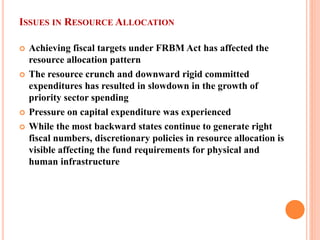
Achieving fiscal targets under FRBM Act has affected the resource allocation pattern 
 
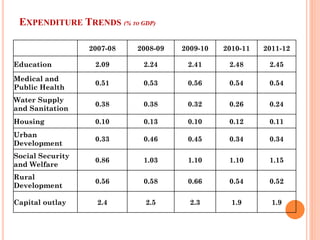
The resource crunch and downward rigid committed expenditures has resulted in slowdown in the growth of priority sector spending 
 
Pressure on capital expenditure was experienced 
 
While the most backward states continue to generate right fiscal numbers, discretionary policies in resource allocation is visible affecting the fund requirements for physical and human infrastructure
EXPENDITURE TRENDS (% TO GDP) 
2007-08 
2008-09 
2009-10 
2010-11 
2011-12 
Education 
2.09 
2.24 
2.41 
2.48 
2.45 
Medical and Public Health 
0.51 
0.53 
0.56 
0.54 
0.54 
Water Supply and Sanitation 
0.38 
0.38 
0.32 
0.26 
0.24 
Housing 
0.10 
0.13 
0.10 
0.12 
0.11 
Urban Development 
0.33 
0.46 
0.45 
0.34 
0.34 
Social Security and Welfare 
0.86 
1.03 
1.10 
1.10 
1.15 
Rural Development 
0.56 
0.58 
0.66 
0.54 
0.52 
Capital outlay 
2.4 
2.5 
2.3 
1.9 
1.9
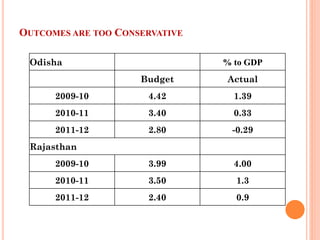
OUTCOMES ARE TOO CONSERVATIVE 
Odisha 
% to GDP 
Budget 
Actual 
2009-10 
4.42 
1.39 
2010-11 
3.40 
0.33 
2011-12 
2.80 
-0.29 
Rajasthan 
2009-10 
3.99 
4.00 
2010-11 
3.50 
1.3 
2011-12 
2.40 
0.9
FISCAL CAPACITY AND DEVELOPMENT CONCERNS 
 
The fiscal capacity across the Sates vary 
 
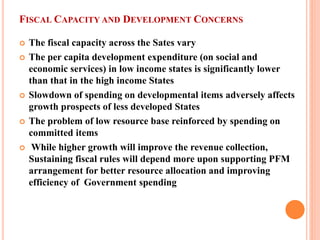
The per capita development expenditure (on social and economic services) in low income states is significantly lower than that in the high income States 
 
Slowdown of spending on developmental items adversely affects growth prospects of less developed States 
 
The problem of low resource base reinforced by spending on committed items 
 
While higher growth will improve the revenue collection, Sustaining fiscal rules will depend more upon supporting PFM arrangement for better resource allocation and improving efficiency of Government spending
SUPPORTING PFM ARRANGEMENTS 
 
While MTFP has helped the subnational Governments to limit their deficit and debt level levels, this process needs to be strengthened further 
 
Medium-term budget frameworks 
 
Top-down budgeting process 
 
Medium term sector vision and prioritization by the spending departments 
 
Reliable data availability and technical forecasting capacity 
 
Improving ability to cost new and existing policy measures in the medium term 
 
Independent review mechanism should be modified to establish institutional set up to help the Government in implementing and monitoring the provisions of the fiscal rules 
 
Appropriate expenditure restructuring is required focusing on capital expenditure and priority sectors
SUPPORTING PFM ARRANGEMENTS 
 
Appropriate expenditure restructuring focusing on capital expenditure and priority sectors within the available revenue is required 
 
Fiscal rules should not encourage governments to tax less and spend more in good times 
 
Improving the capacity in the area of project appraisal and project execution 
 
The Government also should pay attention to facilitate land acquisition, improve co-ordination among departments at policy and implementation level, and speed up the environment clearances for better implementation of projects and utilization of the approved budget

Fiscal rules india pratapjena_en

  • 1.
    PFM REFORMS ARENECESSARY TO SUSTAIN FISCAL RULES: A SUB‐NATIONAL PERSPECTIVE FROM INDIA ICGFM 2014 Winter Training Conference PFM, Foundation for Public Governance Pratap Ranjan Jena National Institute of Public Finance and Policy New Delhi
  • 2.
    THE CONTEXT ANDRATIONALE  Interest on ‘Fiscal Policy Rules’ can be attributed to  Deterioration in fiscal performance – deficit bias  Moderate effects of discretionary actions to arrest this deterioration, which were considered to be not durable  Reduction in fiscal deficit within a range to stabilize public debt at a prudent level and containing the debt ratio over the medium to long term  Macroeconomic Stability  Assist Other Financial Policies  Long Run Fiscal Sustainability  Avoidance of Negative Spillovers  Credibility of Government Policy Overtime
  • 3.
    GLOBAL CRISIS ANDFISCAL RULES  The countries found it challenging to maintain fiscal rule requirements during downturn  During the crisis many countries put their fiscal rules into abeyance  Countercyclical stimulus packages pushed the fiscal variables beyond the limits  The FRLs failed to play decisive role in getting countries back on track towards fiscal sustainability after the crisis  The design choices to fit the country’s economic circumstances, the political will to support fiscal discipline and the level of PFM development continues to be calibrated  Attempts to revise the rules to achieve fiscal sustainability, to commit adjustment efforts, and to establish medium term fiscal stance
  • 4.
    NEXT GENERATION FISCALRULES  The next generation fiscal rules explicitly combine sustainability objectives with more flexibility to accommodate economic shocks  Budget targets set in cyclically adjusted terms  Provision of automatically correction for past deviations to avoid vicious circle of deficit and debt  Combinations of expenditure rules with new or existing debt sustainability rules  More comprehensive rules and strengthening of supporting arrangements
  • 5.
    FISCAL RULES ININDIA: BACKGROUND  Fiscal rules were adopted in India in response to severe fiscal imbalance - deficit bias, evidenced by a public sector imbalance around 10% of GDP (2001-02)  Public sector deficits have been symptomatic of a number of adverse factors: a mounting wage bill, wide spread subsidies, proliferation of tax concessions, and rising interest costs  Large deficits have led to a rapid build up in India's public sector debt, which, in excess of 80 per cent of GDP  Rise in real interest rates associated with a high public sector borrowing requirement tends to crowd out private investment  Vulnerability to balance-of-payments crises  Formulation of a broad strategic approach at fiscal consolidation - central aspect of such a strategy is the adoption of a permanent framework for a rules-based fiscal discipline
  • 6.
    CONTOURS OF FISCALRULES - 2003  Fiscal Responsibility and Budget Management Act (FRBM Act): To provide a legal and institutional framework to bring down the fiscal deficit, contain the growth of public debt, and stabilize debt as proportion to GDP  Eliminate revenue deficit by 2008-09, with a 0.5 percentage point of GDP as the minimum annual reduction target  Reduce fiscal deficit to a level of 3 percent of GDP, with a 0.3 percentage point of GDP as the minimum reduction target  Limits on borrowing from the Central bank except to meet temporary cash disbursements over receipts  Central bank not to subscribe primary issues of the central government securities 2006-07 onwards
  • 7.
    CONTOURS OF FRBMACT  Suitable measures to ensure greater transparency in fiscal operation  Government has to present the following statement of fiscal policy along with the budget  Medium-term Fiscal Policy Statement;  Fiscal Policy Strategy statement and;  Macro-economic Framework Statement  Quarterly review of finances by the FM and to be presented to the parliament  Escape clauses: National security/calamity or such other exceptional grounds as the Central Government may specify
  • 8.
    POST FRBM FISCALTRENDS RD FD PD 2003-04 3.5 4.3 0 2004-05 2.4 3.9 0 2005-06 2.5 4.0 0.4 2006-07 1.9 3.3 -0.2 2007-08 1.1 2.5 -0.9 2008-09 4.5 6.0 2.6 2009-10 5.2 6.5 3.2 2010-11 3.2 4.8 1.8 2011-12 4.4 5.7 2.7 2012-13 3.6 4.8 1.8 2013-14(RE) 3.3 4.6 1.3 2014-15(BE) 2.9 4.1 1.5
  • 9.
    SOURCES OF IMPROVEMENTS 2003-04 2007-08 Impr. In 2007-08 over 2003-04 Gross tax Rev 9.2 12.0 2.8 Non-tax Rev 2.78 2.1 -0.7 Gross Rev 11.98 14.1 2.1 Net Rev 9.54 11 1.5 Revenue Exp. 13.09 12 -1.1 Capital Exp 3.9 2.4 -1.5 Total Exp 17 14.4 -2.6 Interest Payments 4.49 3.5 -1.0 Revenue Deficit 3.55 1.1 2.5 Fiscal Deficit 4.46 2.5 2.0
  • 10.
  • 11.
    THE REVISION TOTHE ACT  The key features of the amendment  Setting a longer time – 2016-17, to reduce the fiscal deficit and eliminating recurrent deficit (revenue deficit) by specifying yearly reduction target  Projecting major expenditure items of the Central government for three years  Entrusting the responsibility of reviewing the achievements to the Comptroller and Auditor General of India (Supreme Audit Institution)  Target of 68 per cent of GDP for combined debt of Centre and states to be achieved by 2014-15 - 45 % for Centre and less than 25 % for States
  • 12.
    SUBNATIONAL FISCAL RULES  FRBM Act adopted separately by the State Governments during 2005- 06  The deficit targets and annual reduction targets are similar to the Central Act  The debt reduction target was based on the recommendation of the 13th Finance Commission  Statement of fiscal policy along with the budget  Medium-term Fiscal Policy Statement;  Fiscal Policy Strategy statement and;  Macro-economic Framework Statement.  Multi-year rolling target for prescribed fiscal indictors  The Medium-term Fiscal Policy Statement shall include assessment of sustainability relating to:  the balance between revenue receipts and revenue expenditures and;  the use of capital receipts including market borrowings for generating productive assets  Cap on State guarantees and escape clauses
  • 13.
    CENTRAL INCENTIVES PLAYEDA ROLE  12th Finance Commission Fiscal Restructuring Plan:  Debt Consolidation and Relief Facility  Debt write-offs linked with reduction of revenue deficit and containment of fiscal deficit  Enactment of FRBM Act was the pre-condition for states to avail these facilities  Subnational Tax Restructuring and Introduction Value Added Tax (VAT)  VAT was implemented at the subnational level coordinated and incentivized by the Central Government  Introduction of VAT improved the tax base of the states resulting in higher own tax revenue collection
  • 14.
    THE INITIAL SUCCESS(% TO GDP) 24.0 25.0 26.0 27.0 28.0 29.0 30.0 31.0 32.0 33.0 (2.0) (1.0) 0.0 1.0 2.0 3.0 4.0 5.0 2001-02 2002-03 2003-04 2004-05 2005-06 2006-07 2007-08 Fiscal Deficit Recurrent Deficit Debt Stock
  • 15.
    SOURCES OF IMPROVEMENTS Fiscal Trends Improvement in 2007-08 Over 2001-02 (Percent of GDP) (Percentage Points) 2001-02 2007-08 Fiscal deficit 4.2 2.4 1.8 Revenue Deficit 2.6 -0.4 3 Revenue Receipts 9.8 12.3 2.5 Own tax Revenue 5.6 6.7 1.1 Tax Devolution 2.3 3 0.7 Grants 1.9 2.6 0.7 Revenue Expenditure 13.8 13.2 0.6 Interest Payment 2.7 2.3 0.4
  • 16.
    CONTINUATION OF THEPROCESS OF FISCAL CONSOLIDATION (% TO GDP) 0.0 5.0 10.0 15.0 20.0 25.0 30.0 (1.5) (1.0) (0.5) 0.0 0.5 1.0 1.5 2.0 2.5 3.0 3.5 2007-08 2008-09 2009-10 2010-11 2011-12 2012-13 (RE) 2013-14 (BE) Fiscal Deficit Recurrent Deficit Debt Stock
  • 17.
    CENTRAL TRANSFERS SLOWEDDOWN (% TO GDP) 4.70 4.80 4.90 5.00 5.10 5.20 5.30 0.00 0.50 1.00 1.50 2.00 2.50 3.00 3.50 2007-08 2008-09 2009-10 2010-11 2011-12 Share in Central Taxes Grants Total Transfers
  • 18.
    OWN REVENUE ANDEXPENDITURE TRENDS (% TO GDP) 2007- 08 2008- 09 2009- 10 2010- 11 2011- 12 2012- 13 (RE) 2013- 14 (BE) Own Revenue 7.3 7.2 7.0 7.2 7.3 7.8 7.8 Recurrent Expenditure 11.6 12.1 12.4 12.1 12.0 13.2 13.0 Capital outlay 2.4 2.5 2.3 1.9 1.9 2.3 2.4
  • 19.
    MEDIUM TERM FISCALFRAMEWORK  Provides a summary of the fiscal stance within macroeconomic realties, which leads to the budget preparation in a medium term  Three year projections of key fiscal indicators  Describes key developments and trends in spending programmes, consistent with Government’s response to development commitments  Defines fiscal targets  Fiscal plan to achieve the targets  Revenue augmentation measures and expenditure restructuring framework  MTFP to be rolled over every year
  • 20.
    FISCAL MARKSMANSHIP 2007-08 2008-09 2009-10 2010-11 2011-12 Fiscal Deficit -0.66 0.39 -0.17 -0.48 -0.33 Recurrent Deficit -0.62 0.28 -0.02 -0.35 -0.05 Debt Stock -1.01 0.34 0.19 0.11 -0.16 Note: Percentage Change in Actuals over the Budget Estimates relative to GDP
  • 21.
    CASH MANAGEMENT SYSTEM  Many State Governments revamped their cash management system to remove year-end rushes of expenditure and maintain an even pace throughout the year  This has helped in drawing up reliable borrowing calendar  Expenditure ceilings have been fixed for each quarter that limits the expenditure to 40 % in last quarter and 15 % in last month  The departments keep these limits in their budget proposals  Introduction of cash management system is expected to improve utilization of the budgetary allocation  Treasury computerization has helped streamlining spending based on voted amount
  • 22.
    FISCAL MANAGEMENT PRINCIPLES  Maintain debt at a prudent level, manage guarantees and other contingent liabilities prudently  Use borrowed funds for productive purposes and create capital assists.  Maintaining stability and predictability in the level of tax burden, avoiding incentives, concessions and exemptions  Pursuing tax policies with due regard to economic efficiency and compliance cost  Raising non-tax revenue with due regard to cost recovery and equity  Improving processes and institutional aspects keeping quality of public expenditure and value for money in consideration  Some States have been attempting to develop sector MTEFs
  • 23.
    FEATURES OF SUBNATIONALFISCAL RULES  Realistic fiscal objectives: reducing deficit and stabilizing debt burden  Improving fiscal transparency: disclosures on fiscal variables and policies to achieve the targets  Reporting to the legislature on fiscal and budgetary outcomes  Defining medium term fiscal process (3 year targets)  Fiscal policy decisions guiding budgetary process  Independent review of progress in achieving the FRBM Act provisions  Coordination with Central Government  Central incentives for fiscal reforms
  • 24.
    SOME OTHER INSTITUTIONALFEATURES  Monitoring and Reporting Fiscal Data: The Comptroller and Auditor General of India (Supreme Audit Institution) maintains fiscal data and prepares the Finance Account  Fiscal Forecasting: This has been improving over the years  Fiscal policy making: Although States are independent in drawing out their own fiscal policy, the fiscal restructuring path prepared by the Central Finance commission are generally adhered to  Department of Finance in the States take lead in framing fiscal policy and monitors fiscal consolidation process  Political agreement on need for rule based fiscal management
  • 25.
    ISSUES IN RESOURCEALLOCATION  Achieving fiscal targets under FRBM Act has affected the resource allocation pattern  The resource crunch and downward rigid committed expenditures has resulted in slowdown in the growth of priority sector spending  Pressure on capital expenditure was experienced  While the most backward states continue to generate right fiscal numbers, discretionary policies in resource allocation is visible affecting the fund requirements for physical and human infrastructure
  • 26.
    EXPENDITURE TRENDS (%TO GDP) 2007-08 2008-09 2009-10 2010-11 2011-12 Education 2.09 2.24 2.41 2.48 2.45 Medical and Public Health 0.51 0.53 0.56 0.54 0.54 Water Supply and Sanitation 0.38 0.38 0.32 0.26 0.24 Housing 0.10 0.13 0.10 0.12 0.11 Urban Development 0.33 0.46 0.45 0.34 0.34 Social Security and Welfare 0.86 1.03 1.10 1.10 1.15 Rural Development 0.56 0.58 0.66 0.54 0.52 Capital outlay 2.4 2.5 2.3 1.9 1.9
  • 27.
    OUTCOMES ARE TOOCONSERVATIVE Odisha % to GDP Budget Actual 2009-10 4.42 1.39 2010-11 3.40 0.33 2011-12 2.80 -0.29 Rajasthan 2009-10 3.99 4.00 2010-11 3.50 1.3 2011-12 2.40 0.9
  • 28.
    FISCAL CAPACITY ANDDEVELOPMENT CONCERNS  The fiscal capacity across the Sates vary  The per capita development expenditure (on social and economic services) in low income states is significantly lower than that in the high income States  Slowdown of spending on developmental items adversely affects growth prospects of less developed States  The problem of low resource base reinforced by spending on committed items  While higher growth will improve the revenue collection, Sustaining fiscal rules will depend more upon supporting PFM arrangement for better resource allocation and improving efficiency of Government spending
  • 29.
    SUPPORTING PFM ARRANGEMENTS  While MTFP has helped the subnational Governments to limit their deficit and debt level levels, this process needs to be strengthened further  Medium-term budget frameworks  Top-down budgeting process  Medium term sector vision and prioritization by the spending departments  Reliable data availability and technical forecasting capacity  Improving ability to cost new and existing policy measures in the medium term  Independent review mechanism should be modified to establish institutional set up to help the Government in implementing and monitoring the provisions of the fiscal rules  Appropriate expenditure restructuring is required focusing on capital expenditure and priority sectors
  • 30.
    SUPPORTING PFM ARRANGEMENTS  Appropriate expenditure restructuring focusing on capital expenditure and priority sectors within the available revenue is required  Fiscal rules should not encourage governments to tax less and spend more in good times  Improving the capacity in the area of project appraisal and project execution  The Government also should pay attention to facilitate land acquisition, improve co-ordination among departments at policy and implementation level, and speed up the environment clearances for better implementation of projects and utilization of the approved budget