G O V E R N M E N T – D E V E L O P M E N T P A R T N E R S R O U N D T A B L E
S A N A ’ A , D E C E M B E R 1 8 T H 2 0 1 3
J E A N - M A R C L E P A I N
E U P F M S P E C I A L I S T
J L E P A I N @ Y A H O O . F R
W W W . S L I D E S H A R E . N E T / J E A N M A R C L E P A I N /
Action Plan for Public Finance
Management Reforms
Part 1
Objectives and Content of the Action Plan
Why the Action Plan is strategically Important
 The political stability of the country requires new economic
policies which cannot be implemented without efficient
PFM mechanisms.
 Restoration of macroeconomic stability requires sound
fiscal policy that cannot be put in place without
strengthening revenue collection and an adequate
expenditure planning.
 Resolution of the liquidity crisis cannot be achieved only
through external budget assistance. It requires important
structural PFM reforms and improvement in budget
execution procedures.
Methodology
This Action Plan is made of the compilation of several
plans:
 MOF sector plans + Revenue Authority, Custom
Authority and Finance Institute
 COCA Action Plan
 High Tender Board Action Plan
 Harmonization Plan (joint plan MOF-MOPIC)
 MOLA Fiscal Decentralisation Plan
 Matrix of existing projects financed by development
partners
Key Objectives of the Action Plan
 Accelerate implementation of the Transitional
Programme for Stabilisation and Development
 Restore fiscal sustainability and budget credibility
 Prepare for fiscal decentralisation
 Strengthen controls and enhance accountability
Characteristics of the Action Plan
 Two year interim strategy (2014-2015)
 Focus on ‘quick-wins’ and efficiency issues
 New planning phase starting in 2015 to deal with
more structural issues such as revision of the legal
framework after PFM assessment (PER , PEFA or
other);
 Attention given to reform sequencing
Structure of the Action Plan
A. Restoring fiscal sustainability and strengthening the budget
formulation process
B. Strengthening revenue mobilization and revenue management
C. Enhancing Control and Accountability
D. Developing capacity and expanding role of the Finance
Institute
E. Strengthening risk management, public debt management and
development of the financial sector
F. Implementing fiscal decentralisation
G. Institutional reforms and medium term planning
Part 2
Fiscal Policy and Budget Credibility
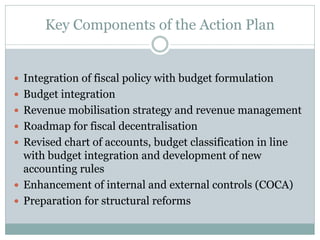
Key Components of the Action Plan
 Integration of fiscal policy with budget formulation
 Budget integration
 Revenue mobilisation strategy and revenue management
 Roadmap for fiscal decentralisation
 Revised chart of accounts, budget classification in line
with budget integration and development of new
accounting rules
 Enhancement of internal and external controls (COCA)
 Preparation for structural reforms
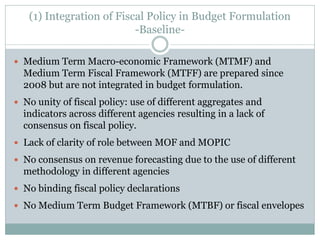
(1) Integration of Fiscal Policy in Budget Formulation
-Baseline-
 Medium Term Macro-economic Framework (MTMF) and
Medium Term Fiscal Framework (MTFF) are prepared since
2008 but are not integrated in budget formulation.
 No unity of fiscal policy: use of different aggregates and
indicators across different agencies resulting in a lack of
consensus on fiscal policy.
 Lack of clarity of role between MOF and MOPIC
 No consensus on revenue forecasting due to the use of different
methodology in different agencies
 No binding fiscal policy declarations
 No Medium Term Budget Framework (MTBF) or fiscal envelopes
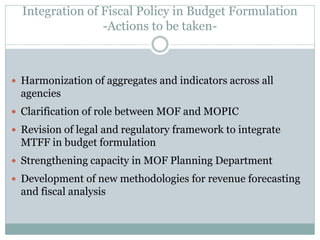
Integration of Fiscal Policy in Budget Formulation
-Actions to be taken-
 Harmonization of aggregates and indicators across all
agencies
 Clarification of role between MOF and MOPIC
 Revision of legal and regulatory framework to integrate
MTFF in budget formulation
 Strengthening capacity in MOF Planning Department
 Development of new methodologies for revenue forecasting
and fiscal analysis
Reaching Fiscal Sustainability
 Potential decline in oil revenues (need a consensus)
 Assessing revenue mobilisation potential
 Dealing with tax holidays
 Phasing out energy subsidies
 Rationalizing state-owned enterprise management
 Facing new fiscal challenges (fiscal decentralisation, poverty
reduction strategy, employment development, etc.)
→ Defining medium term path toward fiscal
sustainability based on a Medium Term Fiscal
Sustainability Study
(2) Budget Integration
1. Operational budget
2. Investment Budget
3. Subsidy Budget
4. Economic Unit Budget
5. Other off-budget fiscal activities
Integration Between Operational and Investment
Budgets
Harmonisation Plan:
 Aligning Public Investment Plans (PIP) on the Transitional
Programme for Stabilisation and Development;
 Defining a realistic fiscal envelope for investment based on the
MTFF;
 Aligning budget on PIP;
 Introducing Public Investment Management (PIM) methodology to
monitor the complete investment life cycle;
 Improve investment projects’ documentation;
 Define strict criteria for investment projects’ budget financing;
 Remove from budget non-performing projects;
 Integrate systematically maintenance cost in operational budget
through specific commitments.
Integration of subsidies in the General Budget
 Subsidies should be treated as a budget-line item,
not as a sub-budget;
 Volume of subsidies should be determined through
the MTFF in direct relation to fiscal capacity;
 A plan should be developed to phase out gradually
energy subsidies while deploying a social safety net.
Integration of the Economic Unit Budget
-Baseline-
 Economic Unit Budget nearly as big as the General
Budget;
 Definition of “economic unit” is vague. It includes
potential direct budget users such as hospitals, and
non-budget users such as state-owned-enterprises,
as well as other parastatal entities.
 Some economic units (E.U.) should be considered as
part of the private sector but have staff on the State
payroll;
 The Economic Unit Budget does not trace flows from
other budgets (operational expenditure, investments
and subsidies).
Consequence of the lack of integration
 General budget does not encompass all state fiscal
activities (lack of comprehensiveness).
 Status of a number of parastatal funds not included in
the Economic Unit Budget is unclear
 The State is bearing fiscal risk on state-owned
enterprises through implicit and explicit guarantees. The
resulting volume of contingent liabilities is not known
but is high enough to threaten the fiscal stability of the
country.
 Profit from SOEs is not treated as direct revenue for the
State as it transits through the Economic Unit Budget;
 State control on economic units is weak.
Action considered
 Assessment of E.U. to define typology and determine which unit
should be integrated in the general budget and which unit should
be excluded.
 Revision of budget classification and chart of accounts according
to the new typology.
 Transformation of the Economic Unit Department into a State-
Owned Enterprise Department (after 2015)
 Drafting of new legislation and regulation for the management of
SOEs, parastatal funds and other parastatal entities not included
in the general budget;
 Development of a risk management system to assess and track
fiscal risks resulting from E.U. Activities + risk mitigation
strategy.
Part 3
Revenue Mobilisation Strategy
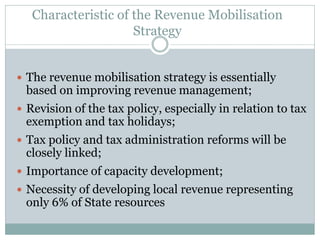
Characteristic of the Revenue Mobilisation
Strategy
 The revenue mobilisation strategy is essentially
based on improving revenue management;
 Revision of the tax policy, especially in relation to tax
exemption and tax holidays;
 Tax policy and tax administration reforms will be
closely linked;
 Importance of capacity development;
 Necessity of developing local revenue representing
only 6% of State resources
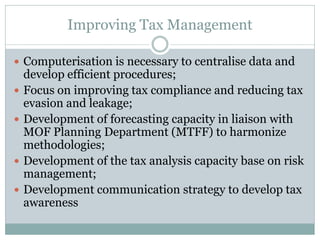
Improving Tax Management
 Computerisation is necessary to centralise data and
develop efficient procedures;
 Focus on improving tax compliance and reducing tax
evasion and leakage;
 Development of forecasting capacity in liaison with
MOF Planning Department (MTFF) to harmonize
methodologies;
 Development of the tax analysis capacity base on risk
management;
 Development communication strategy to develop tax
awareness
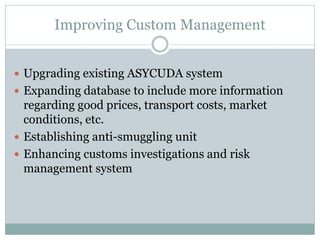
Improving Custom Management
 Upgrading existing ASYCUDA system
 Expanding database to include more information
regarding good prices, transport costs, market
conditions, etc.
 Establishing anti-smuggling unit
 Enhancing customs investigations and risk
management system
Part 4
Fiscal Decentralisation
General Principles
 Fiscal decentralisation policy should be prepared
ahead of Constitution in order to ensure that
principal of fiscal decentralisation are fiscally
sustainable.
 Whatever is the form of the new Constitution, a
substantial amount of fiscal decentralisation will be
introduced.
 Fiscal decentralisation is relatively independent from
political and administrative decentralization.
Planned Actions
1. Linking fiscal decentralization to budget policy, planning,
and budget through a Fiscal Decentralization Strategy
Paper
2. Preparing concept note on different options for a system of
intergovernmental transfers
3. Reengineering the budget execution process in line with
fiscal decentralization
4. Developing new legal and regulatory framework for fiscal
decentralization
5. Developing revenue and expenditure management capacity
at the sub-national level
Fiscal Decentralisation Study
 Assess existing imbalance in existing transfers at the sub-
national level to measure additional fiscal needs for
correcting measures
 Assess tax base and existing tax resource in each
province;
 Measure existing gap between responsibility and
expenditure assignment and existing fiscal resources and
transfers at the sub-national level.
 Identify potential changes that can be made in the
revenue and expenditure assignment.
 Prepare recommendations based on different options for
a formula-based intergovernmental transfer system.
Part 5
The Way Forward beyond 2015
PFM Reforms after 2015
 Planning for the period 2016-2020 should start in 2015.
 It should be based on a PFM Assessment facilitated by
development partners (PER, PEFA or other)
 It will require a more substantial effort than the 2014-
2015 Action Plan and more technical assistance will be
needed to ensure support to the different sectors.
 Putting reforms of the PFM system on tract requires
developing a vision of the future system with a time
horizon of 10 to 15 years, and being ready for structural
reforms such as the introduction of a new PFM Law,
Revision of the tax code, introduction of a system of
intergovernmental transfers, etc.
THANKS

Yemen: Action plan for public finance management reforms

  • 1.
    G O VE R N M E N T – D E V E L O P M E N T P A R T N E R S R O U N D T A B L E S A N A ’ A , D E C E M B E R 1 8 T H 2 0 1 3 J E A N - M A R C L E P A I N E U P F M S P E C I A L I S T J L E P A I N @ Y A H O O . F R W W W . S L I D E S H A R E . N E T / J E A N M A R C L E P A I N / Action Plan for Public Finance Management Reforms
  • 2.
    Part 1 Objectives andContent of the Action Plan
  • 3.
    Why the ActionPlan is strategically Important  The political stability of the country requires new economic policies which cannot be implemented without efficient PFM mechanisms.  Restoration of macroeconomic stability requires sound fiscal policy that cannot be put in place without strengthening revenue collection and an adequate expenditure planning.  Resolution of the liquidity crisis cannot be achieved only through external budget assistance. It requires important structural PFM reforms and improvement in budget execution procedures.
  • 4.
    Methodology This Action Planis made of the compilation of several plans:  MOF sector plans + Revenue Authority, Custom Authority and Finance Institute  COCA Action Plan  High Tender Board Action Plan  Harmonization Plan (joint plan MOF-MOPIC)  MOLA Fiscal Decentralisation Plan  Matrix of existing projects financed by development partners
  • 5.
    Key Objectives ofthe Action Plan  Accelerate implementation of the Transitional Programme for Stabilisation and Development  Restore fiscal sustainability and budget credibility  Prepare for fiscal decentralisation  Strengthen controls and enhance accountability
  • 6.
    Characteristics of theAction Plan  Two year interim strategy (2014-2015)  Focus on ‘quick-wins’ and efficiency issues  New planning phase starting in 2015 to deal with more structural issues such as revision of the legal framework after PFM assessment (PER , PEFA or other);  Attention given to reform sequencing
  • 7.
    Structure of theAction Plan A. Restoring fiscal sustainability and strengthening the budget formulation process B. Strengthening revenue mobilization and revenue management C. Enhancing Control and Accountability D. Developing capacity and expanding role of the Finance Institute E. Strengthening risk management, public debt management and development of the financial sector F. Implementing fiscal decentralisation G. Institutional reforms and medium term planning
  • 8.
    Part 2 Fiscal Policyand Budget Credibility
  • 9.
    Key Components ofthe Action Plan  Integration of fiscal policy with budget formulation  Budget integration  Revenue mobilisation strategy and revenue management  Roadmap for fiscal decentralisation  Revised chart of accounts, budget classification in line with budget integration and development of new accounting rules  Enhancement of internal and external controls (COCA)  Preparation for structural reforms
  • 10.
    (1) Integration ofFiscal Policy in Budget Formulation -Baseline-  Medium Term Macro-economic Framework (MTMF) and Medium Term Fiscal Framework (MTFF) are prepared since 2008 but are not integrated in budget formulation.  No unity of fiscal policy: use of different aggregates and indicators across different agencies resulting in a lack of consensus on fiscal policy.  Lack of clarity of role between MOF and MOPIC  No consensus on revenue forecasting due to the use of different methodology in different agencies  No binding fiscal policy declarations  No Medium Term Budget Framework (MTBF) or fiscal envelopes
  • 11.
    Integration of FiscalPolicy in Budget Formulation -Actions to be taken-  Harmonization of aggregates and indicators across all agencies  Clarification of role between MOF and MOPIC  Revision of legal and regulatory framework to integrate MTFF in budget formulation  Strengthening capacity in MOF Planning Department  Development of new methodologies for revenue forecasting and fiscal analysis
  • 12.
    Reaching Fiscal Sustainability Potential decline in oil revenues (need a consensus)  Assessing revenue mobilisation potential  Dealing with tax holidays  Phasing out energy subsidies  Rationalizing state-owned enterprise management  Facing new fiscal challenges (fiscal decentralisation, poverty reduction strategy, employment development, etc.) → Defining medium term path toward fiscal sustainability based on a Medium Term Fiscal Sustainability Study
  • 13.
    (2) Budget Integration 1.Operational budget 2. Investment Budget 3. Subsidy Budget 4. Economic Unit Budget 5. Other off-budget fiscal activities
  • 14.
    Integration Between Operationaland Investment Budgets Harmonisation Plan:  Aligning Public Investment Plans (PIP) on the Transitional Programme for Stabilisation and Development;  Defining a realistic fiscal envelope for investment based on the MTFF;  Aligning budget on PIP;  Introducing Public Investment Management (PIM) methodology to monitor the complete investment life cycle;  Improve investment projects’ documentation;  Define strict criteria for investment projects’ budget financing;  Remove from budget non-performing projects;  Integrate systematically maintenance cost in operational budget through specific commitments.
  • 15.
    Integration of subsidiesin the General Budget  Subsidies should be treated as a budget-line item, not as a sub-budget;  Volume of subsidies should be determined through the MTFF in direct relation to fiscal capacity;  A plan should be developed to phase out gradually energy subsidies while deploying a social safety net.
  • 16.
    Integration of theEconomic Unit Budget -Baseline-  Economic Unit Budget nearly as big as the General Budget;  Definition of “economic unit” is vague. It includes potential direct budget users such as hospitals, and non-budget users such as state-owned-enterprises, as well as other parastatal entities.  Some economic units (E.U.) should be considered as part of the private sector but have staff on the State payroll;  The Economic Unit Budget does not trace flows from other budgets (operational expenditure, investments and subsidies).
  • 17.
    Consequence of thelack of integration  General budget does not encompass all state fiscal activities (lack of comprehensiveness).  Status of a number of parastatal funds not included in the Economic Unit Budget is unclear  The State is bearing fiscal risk on state-owned enterprises through implicit and explicit guarantees. The resulting volume of contingent liabilities is not known but is high enough to threaten the fiscal stability of the country.  Profit from SOEs is not treated as direct revenue for the State as it transits through the Economic Unit Budget;  State control on economic units is weak.
  • 18.
    Action considered  Assessmentof E.U. to define typology and determine which unit should be integrated in the general budget and which unit should be excluded.  Revision of budget classification and chart of accounts according to the new typology.  Transformation of the Economic Unit Department into a State- Owned Enterprise Department (after 2015)  Drafting of new legislation and regulation for the management of SOEs, parastatal funds and other parastatal entities not included in the general budget;  Development of a risk management system to assess and track fiscal risks resulting from E.U. Activities + risk mitigation strategy.
  • 19.
  • 20.
    Characteristic of theRevenue Mobilisation Strategy  The revenue mobilisation strategy is essentially based on improving revenue management;  Revision of the tax policy, especially in relation to tax exemption and tax holidays;  Tax policy and tax administration reforms will be closely linked;  Importance of capacity development;  Necessity of developing local revenue representing only 6% of State resources
  • 21.
    Improving Tax Management Computerisation is necessary to centralise data and develop efficient procedures;  Focus on improving tax compliance and reducing tax evasion and leakage;  Development of forecasting capacity in liaison with MOF Planning Department (MTFF) to harmonize methodologies;  Development of the tax analysis capacity base on risk management;  Development communication strategy to develop tax awareness
  • 22.
    Improving Custom Management Upgrading existing ASYCUDA system  Expanding database to include more information regarding good prices, transport costs, market conditions, etc.  Establishing anti-smuggling unit  Enhancing customs investigations and risk management system
  • 23.
  • 24.
    General Principles  Fiscaldecentralisation policy should be prepared ahead of Constitution in order to ensure that principal of fiscal decentralisation are fiscally sustainable.  Whatever is the form of the new Constitution, a substantial amount of fiscal decentralisation will be introduced.  Fiscal decentralisation is relatively independent from political and administrative decentralization.
  • 25.
    Planned Actions 1. Linkingfiscal decentralization to budget policy, planning, and budget through a Fiscal Decentralization Strategy Paper 2. Preparing concept note on different options for a system of intergovernmental transfers 3. Reengineering the budget execution process in line with fiscal decentralization 4. Developing new legal and regulatory framework for fiscal decentralization 5. Developing revenue and expenditure management capacity at the sub-national level
  • 26.
    Fiscal Decentralisation Study Assess existing imbalance in existing transfers at the sub- national level to measure additional fiscal needs for correcting measures  Assess tax base and existing tax resource in each province;  Measure existing gap between responsibility and expenditure assignment and existing fiscal resources and transfers at the sub-national level.  Identify potential changes that can be made in the revenue and expenditure assignment.  Prepare recommendations based on different options for a formula-based intergovernmental transfer system.
  • 27.
    Part 5 The WayForward beyond 2015
  • 28.
    PFM Reforms after2015  Planning for the period 2016-2020 should start in 2015.  It should be based on a PFM Assessment facilitated by development partners (PER, PEFA or other)  It will require a more substantial effort than the 2014- 2015 Action Plan and more technical assistance will be needed to ensure support to the different sectors.  Putting reforms of the PFM system on tract requires developing a vision of the future system with a time horizon of 10 to 15 years, and being ready for structural reforms such as the introduction of a new PFM Law, Revision of the tax code, introduction of a system of intergovernmental transfers, etc.
  • 29.