FRANCIS Y. CAPISTRANO
Acting Director IV
Knowledge Management and Fiscal Transparency Service
Department of Budget and Management
1
The National Budget
2
Mandate
The DBM, created under Executive
Order No. 25 dated April 25, 1936, is
mandated under this Order and by
subsequent issuances to promote the
sound, efficient and effective
management and utilization of
government resources (i.e.,
technological, manpower, physical and
financial) as instrument in the
achievement of national
socioeconomic & political
development goals.
The National Budget:
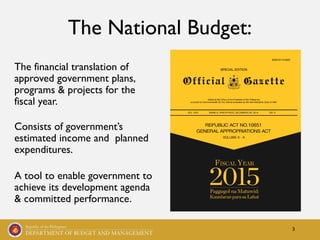
The financial translation of
approved government plans,
programs & projects for the
fiscal year.
Consists of government’s
estimated income and planned
expenditures.
A tool to enable government to
achieve its development agenda
& committed performance.
3
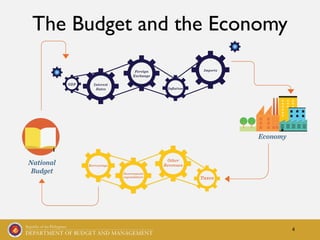
The Budget and the Economy
4
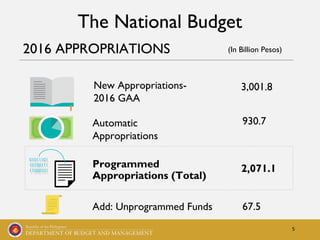
The National Budget
5
2016 APPROPRIATIONS (In Billion Pesos)
New Appropriations-
2016 GAA
Automatic
Appropriations
Programmed
Appropriations (Total)
Add: Unprogrammed Funds
3,001.8
930.7
2,071.1
67.5
6
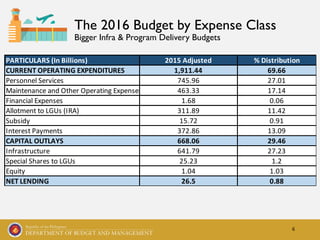
The 2016 Budget by Expense Class
Bigger Infra & Program Delivery Budgets
PARTICULARS (In Billions) 2015 Adjusted % Distribution
CURRENT OPERATING EXPENDITURES 1,911.44 69.66
Personnel Services 745.96 27.01
Maintenance and Other Operating Expenses 463.33 17.14
Financial Expenses 1.68 0.06
Allotment to LGUs (IRA) 311.89 11.42
Subsidy 15.72 0.91
Interest Payments 372.86 13.09
CAPITAL OUTLAYS 668.06 29.46
Infrastructure 641.79 27.23
Special Shares to LGUs 25.23 1.2
Equity 1.04 1.03
NET LENDING 26.5 0.88
7
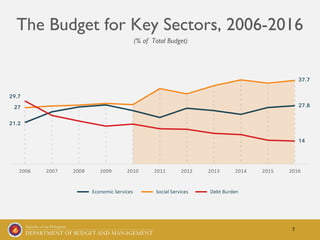
The Budget for Key Sectors, 2006-2016
(% of Total Budget)
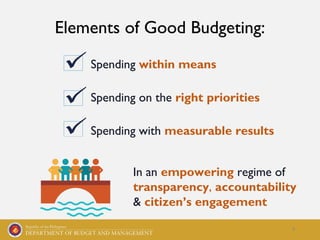
Elements of Good Budgeting:
Spending within means
Spending on the right priorities
Spending with measurable results
In an empowering regime of
transparency, accountability
& citizen’s engagement
9
10
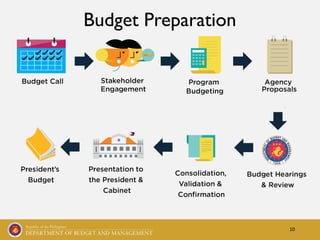
Budget Preparation
11
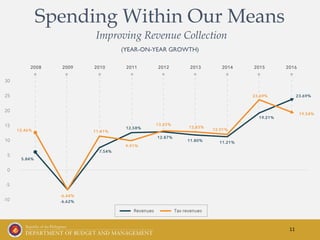
Improving Revenue Collection
Spending Within Our Means
(YEAR-ON-YEAR GROWTH)
12
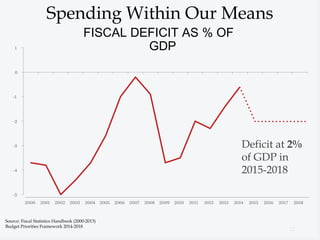
Spending Within Our Means
FISCAL DEFICIT AS % OF
GDP
Source: Fiscal Statistics Handbook (2000-2013)
Budget Priorities Framework 2014-2018
Deficit at 2%
of GDP in
2015-2018
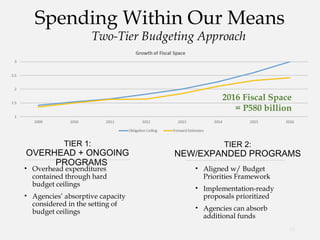
• Overhead expenditures
contained through hard
budget ceilings
• Agencies’ absorptive capacity
considered in the setting of
budget ceilings
• Aligned w/ Budget
Priorities Framework
• Implementation-ready
proposals prioritized
• Agencies can absorb
additional funds
13
Spending Within Our Means
Two-Tier Budgeting Approach
TIER 1:
OVERHEAD + ONGOING
PROGRAMS
TIER 2:
NEW/EXPANDED PROGRAMS
2016 Fiscal Space
= P580 billion
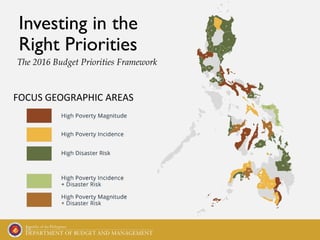
Investing in the
Right Priorities
FOCUS GEOGRAPHIC AREAS
14
The 2016 Budget Priorities Framework
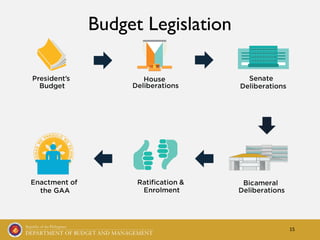
Budget Legislation
15
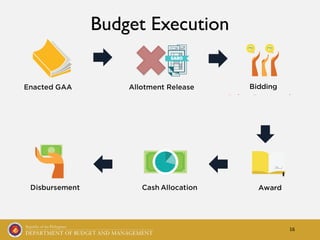
Budget Execution
16
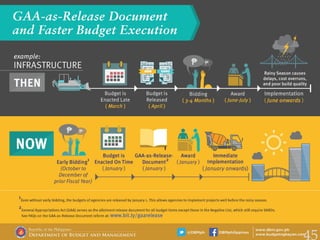
17
45
18
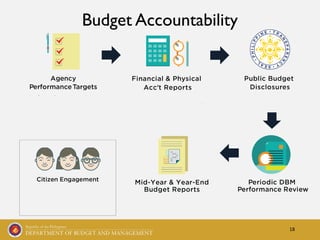
Budget Accountability
19
20
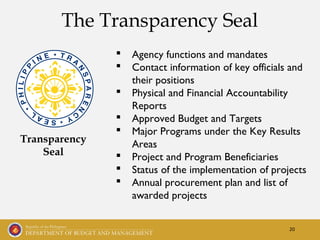
The Transparency Seal
Transparency
Seal
 Agency functions and mandates
 Contact information of key officials and
their positions
 Physical and Financial Accountability
Reports
 Approved Budget and Targets
 Major Programs under the Key Results
Areas
 Project and Program Beneficiaries
 Status of the implementation of projects
 Annual procurement plan and list of
awarded projects
FRANCIS Y. CAPISTRANO
Acting Director IV
Knowledge Management and Fiscal Transparency Service
Department of Budget and Management
21
The National Budget

The National Budget

  • 1.
    FRANCIS Y. CAPISTRANO ActingDirector IV Knowledge Management and Fiscal Transparency Service Department of Budget and Management 1 The National Budget
  • 2.
    2 Mandate The DBM, createdunder Executive Order No. 25 dated April 25, 1936, is mandated under this Order and by subsequent issuances to promote the sound, efficient and effective management and utilization of government resources (i.e., technological, manpower, physical and financial) as instrument in the achievement of national socioeconomic & political development goals.
  • 3.
    The National Budget: Thefinancial translation of approved government plans, programs & projects for the fiscal year. Consists of government’s estimated income and planned expenditures. A tool to enable government to achieve its development agenda & committed performance. 3
  • 4.
    The Budget andthe Economy 4
  • 5.
    The National Budget 5 2016APPROPRIATIONS (In Billion Pesos) New Appropriations- 2016 GAA Automatic Appropriations Programmed Appropriations (Total) Add: Unprogrammed Funds 3,001.8 930.7 2,071.1 67.5
  • 6.
    6 The 2016 Budgetby Expense Class Bigger Infra & Program Delivery Budgets PARTICULARS (In Billions) 2015 Adjusted % Distribution CURRENT OPERATING EXPENDITURES 1,911.44 69.66 Personnel Services 745.96 27.01 Maintenance and Other Operating Expenses 463.33 17.14 Financial Expenses 1.68 0.06 Allotment to LGUs (IRA) 311.89 11.42 Subsidy 15.72 0.91 Interest Payments 372.86 13.09 CAPITAL OUTLAYS 668.06 29.46 Infrastructure 641.79 27.23 Special Shares to LGUs 25.23 1.2 Equity 1.04 1.03 NET LENDING 26.5 0.88
  • 7.
    7 The Budget forKey Sectors, 2006-2016 (% of Total Budget)
  • 9.
    Elements of GoodBudgeting: Spending within means Spending on the right priorities Spending with measurable results In an empowering regime of transparency, accountability & citizen’s engagement 9
  • 10.
  • 11.
    11 Improving Revenue Collection SpendingWithin Our Means (YEAR-ON-YEAR GROWTH)
  • 12.
    12 Spending Within OurMeans FISCAL DEFICIT AS % OF GDP Source: Fiscal Statistics Handbook (2000-2013) Budget Priorities Framework 2014-2018 Deficit at 2% of GDP in 2015-2018
  • 13.
    • Overhead expenditures containedthrough hard budget ceilings • Agencies’ absorptive capacity considered in the setting of budget ceilings • Aligned w/ Budget Priorities Framework • Implementation-ready proposals prioritized • Agencies can absorb additional funds 13 Spending Within Our Means Two-Tier Budgeting Approach TIER 1: OVERHEAD + ONGOING PROGRAMS TIER 2: NEW/EXPANDED PROGRAMS 2016 Fiscal Space = P580 billion
  • 14.
    Investing in the RightPriorities FOCUS GEOGRAPHIC AREAS 14 The 2016 Budget Priorities Framework
  • 15.
  • 16.
  • 17.
  • 18.
  • 19.
  • 20.
    20 The Transparency Seal Transparency Seal Agency functions and mandates  Contact information of key officials and their positions  Physical and Financial Accountability Reports  Approved Budget and Targets  Major Programs under the Key Results Areas  Project and Program Beneficiaries  Status of the implementation of projects  Annual procurement plan and list of awarded projects
  • 21.
    FRANCIS Y. CAPISTRANO ActingDirector IV Knowledge Management and Fiscal Transparency Service Department of Budget and Management 21 The National Budget