

Chemical Responder – Awareness
Level Training
Your Role in Emergency Response
Who Am I?
• Michael Hampton, CSP, ARM
• 35+ years in Safety & Health
Management
• Mining, Manufacturing,
Hazardous Waste, Hazardous
Materials
• Rocky Mountain Center for
Occupational & Environmental
Health - University of Utah
What do we want to achieve?
• At the conclusion of this training, you should be
able to:
– Describe the role of the First Responder at the Awareness Level
– Understand the different levels of training under the Hazwoper
standard
– Describe the 4 Awareness Level Goals for the First Responder
– Utilize the North American Emergency Response Guidebook to
assist in accomplishing the goals of a First Responder
Let’s Get Started
• Quick Reviews
• Audience Response
Devices
• Check your learning
• “So many buttons!”
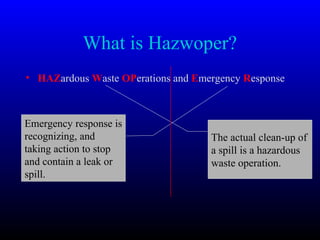
What is Hazwoper?
• HAZardous Waste OPerations and Emergency Response
Emergency response is
recognizing, and
taking action to stop
and contain a leak or
spill.
The actual clean-up of
a spill is a hazardous
waste operation.
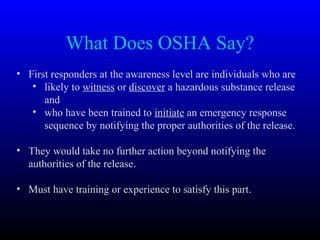
What Does OSHA Say?
• First responders at the awareness level are individuals who are
• likely to witness or discover a hazardous substance release
and
• who have been trained to initiate an emergency response
sequence by notifying the proper authorities of the release.
• They would take no further action beyond notifying the
authorities of the release.
• Must have training or experience to satisfy this part.
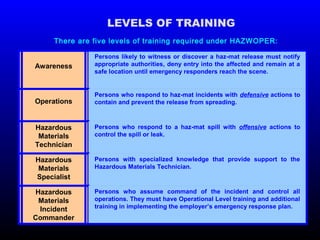
Awareness
Persons likely to witness or discover a haz-mat release must notify
appropriate authorities, deny entry into the affected and remain at a
safe location until emergency responders reach the scene.
Operations
Persons who respond to haz-mat incidents with defensive actions to
contain and prevent the release from spreading.
Hazardous
Materials
Technician
Persons who respond to a haz-mat spill with offensive actions to
control the spill or leak.
Hazardous
Materials
Specialist
Persons with specialized knowledge that provide support to the
Hazardous Materials Technician.
Hazardous
Materials
Incident
Commander
Persons who assume command of the incident and control all
operations. They must have Operational Level training and additional
training in implementing the employer’s emergency response plan.
There are five levels of training required under HAZWOPER:
LEVELS OF TRAINING
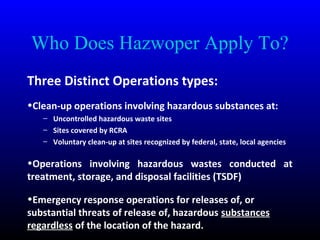
Who Does Hazwoper Apply To?
Three Distinct Operations types:
•Clean-up operations involving hazardous substances at:
– Uncontrolled hazardous waste sites
– Sites covered by RCRA
– Voluntary clean-up at sites recognized by federal, state, local agencies
•Operations involving hazardous wastes conducted at
treatment, storage, and disposal facilities (TSDF)
•Emergency response operations for releases of, or
substantial threats of release of, hazardous substances
regardless of the location of the hazard.
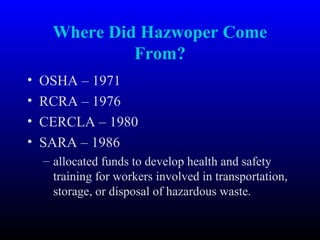
Where Did Hazwoper Come
From?
• OSHA – 1971
• RCRA – 1976
• CERCLA – 1980
• SARA – 1986
– allocated funds to develop health and safety
training for workers involved in transportation,
storage, or disposal of hazardous waste.
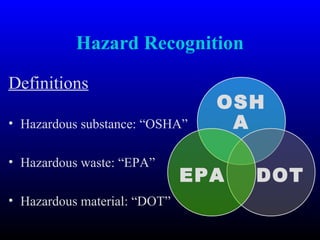
Hazard Recognition
Definitions
• Hazardous substance: “OSHA”
• Hazardous waste: “EPA”
• Hazardous material: “DOT”
OSH
A
DOTEPA
Hazardous Substance - OSHA
• A substance which may result in adverse
affects on the health and safety of
employees
• A substance included as a hazardous
material by DOT and as a hazardous waste
by EPA
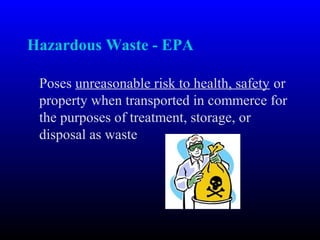
Hazardous Waste - EPA
Poses unreasonable risk to health, safety or
property when transported in commerce for
the purposes of treatment, storage, or
disposal as waste
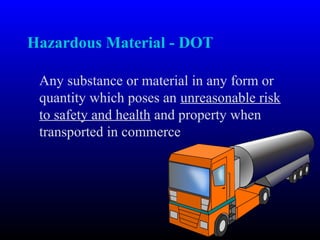
Hazardous Material - DOT
Any substance or material in any form or
quantity which poses an unreasonable risk
to safety and health and property when
transported in commerce
“Incidental” Spill
• A spill which does not pose a significant safety or
health hazard to employees in the immediate
vicinity or to the employee cleaning it up
• No potential to become an emergency within a
short time frame.
• Safely cleaned up by employees who are familiar
with the hazards of the chemicals with which they
are working.
Chemical Hazards in the
Workplace
• Flammable
• Corrosive
• Reactive
• Toxic
• Sudden Release of Pressure (explosion)
– detonation and deflagration
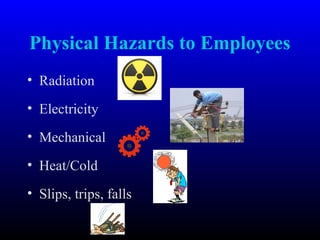
Physical Hazards to Employees
• Radiation
• Electricity
• Mechanical
• Heat/Cold
• Slips, trips, falls
Biological Hazards
• Infectious Hospital Waste
• Research Materials
• Raw sewage (hepatitis A, E-coli)
• Bites from vectors (ticks, rats, wild dogs)
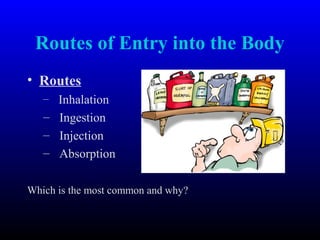
Routes of Entry into the Body
• Routes
– Inhalation
– Ingestion
– Injection
– Absorption
Which is the most common and why?
Chewing gum in a contaminated area is a
form of which route of exposure?
A. Inhalation
B. Injection
C. Ingestion
D. Absorption
Inhalation
Injection
Ingestion
Absorption
0% 0%0%0%
Which of the items below is not
true about an “incidental spill”?
A. There is no potential to
become an emergency.
B. PPE is not required to clean
up the spill.
C. Safely cleaned up by
employees who are familiar
with the hazards.
D. Does not pose a significant
safety or health hazard.
There
isno
potentialto
b...
PPE
isnotrequired
to
clean...
Safelycleaned
up
byem
pl...
Doesnotpose
asignificant...
0% 0%0%0%
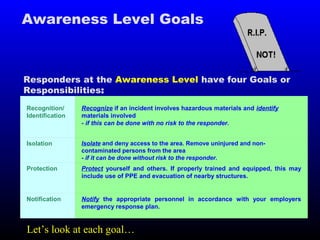
Awareness Level Goals
 
 
Recognition/
Identification
 
Recognize if an incident involves hazardous materials and identify
materials involved
- if this can be done with no risk to the responder.
Isolation Isolate and deny access to the area. Remove uninjured and non-
contaminated persons from the area
- if it can be done without risk to the responder.
Protection Protect yourself and others. If properly trained and equipped, this may
include use of PPE and evacuation of nearby structures.
Notification Notify the appropriate personnel in accordance with your employers
emergency response plan.
 
Let’s look at each goal…
Responders at the Awareness Level have four Goals or
Responsibilities:
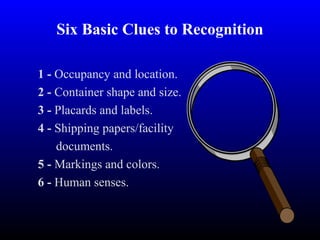
Six Basic Clues to Recognition
1 - Occupancy and location.
2 - Container shape and size.
3 - Placards and labels.
4 - Shipping papers/facility
documents.
5 - Markings and colors.
6 - Human senses.
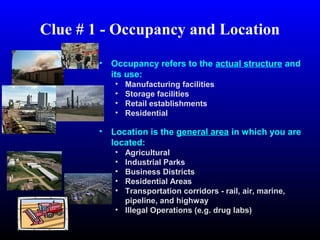
Clue # 1 - Occupancy and Location
• Occupancy refers to the actual structure and
its use:
• Manufacturing facilities
• Storage facilities
• Retail establishments
• Residential
 
• Location is the general area in which you are
located:
• Agricultural
• Industrial Parks
• Business Districts
• Residential Areas
• Transportation corridors - rail, air, marine,
pipeline, and highway
• Illegal Operations (e.g. drug labs)
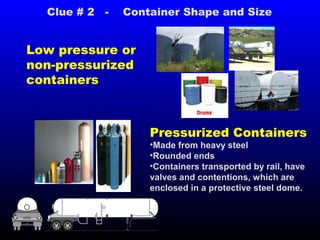
Low pressure or
non-pressurized
containers
Pressurized Containers
•Made from heavy steel
•Rounded ends
•Containers transported by rail, have
valves and contentions, which are
enclosed in a protective steel dome.
Clue # 2 - Container Shape and Size
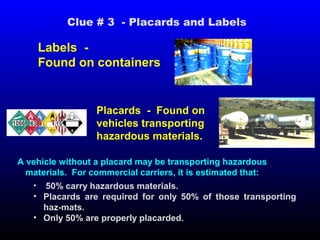
Clue # 3 - Placards and Labels
A vehicle without a placard may be transporting hazardous
materials. For commercial carriers, it is estimated that:
• 50% carry hazardous materials.
• Placards are required for only 50% of those transporting
haz-mats.
• Only 50% are properly placarded.
Labels -
Found on containers
Placards - Found on
vehicles transporting
hazardous materials.
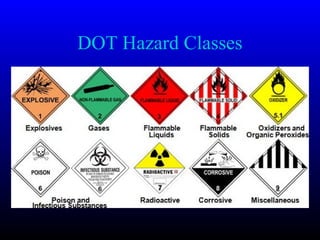
DOT Hazard Classes
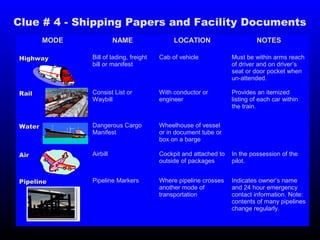
Clue # 4 - Shipping Papers and Facility Documents   
MODEMODE NAMENAME LOCATIONLOCATION NOTESNOTES
HighwayHighway Bill of lading, freight
bill or manifest
Cab of vehicle Must be within arms reach
of driver and on driver’s
seat or door pocket when
un-attended.
RailRail Consist List or
Waybill
With conductor or
engineer
Provides an itemized
listing of each car within
the train.
WaterWater Dangerous Cargo
Manifest
Wheelhouse of vessel
or in document tube or
box on a barge
AirAir Airbill Cockpit and attached to
outside of packages
In the possession of the
pilot.
PipelinePipeline Pipeline Markers Where pipeline crosses
another mode of
transportation
Indicates owner’s name
and 24 hour emergency
contact information. Note:
contents of many pipelines
change regularly.
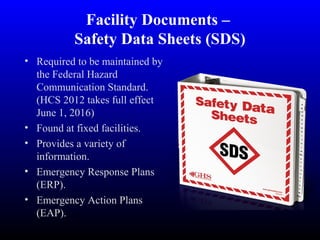
Facility Documents –
Safety Data Sheets (SDS)
• Required to be maintained by
the Federal Hazard
Communication Standard.
(HCS 2012 takes full effect
June 1, 2016)
• Found at fixed facilities.
• Provides a variety of
information.
• Emergency Response Plans
(ERP).
• Emergency Action Plans
(EAP).
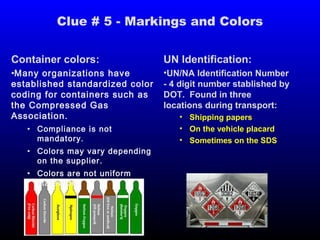
Clue # 5 - Markings and Colors
Container colors:
•Many organizations have
established standardized color
coding for containers such as
the Compressed Gas
Association.
• Compliance is not
mandatory.
• Colors may vary depending
on the supplier.
• Colors are not uniform
statewide.
UN Identification:
•UN/NA Identification Number
- 4 digit number stablished by
DOT. Found in three
locations during transport:
• Shipping papers
• On the vehicle placard
• Sometimes on the SDS
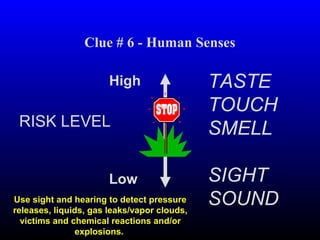
Clue # 6 - Human Senses
RISK LEVEL
High
Low
TASTE
TOUCH
SMELL
SIGHT
SOUNDUse sight and hearing to detect pressure
releases, liquids, gas leaks/vapor clouds,
victims and chemical reactions and/or
explosions.
Summary of Recognition
• Goals of recognition and identification
– Recognize, Classify, Identify
• Six clues to the presence of hazardous materials
– Occupancy and location, container shape and
size, placards and labels, shipping papers and
facility documents, markings and colors, the
human senses.
• There are nine general classes of hazardous
materials (DOT).
How many clues are there to assist in
recognizing the chemical hazards?
A. 4
B. 2
C. 8
D. 6
4
2
8
6
0% 0%0%0%
OSHA requires these documents to be
available for employees to review when
working with chemicals.
A. DOT shipping
papers
B. Safety Data Sheets
C. Packing slips for
chemicals
D. Christmas cards
from customers DOT
shipping
papersSafetyDataSheets
Packing
slipsforchem
icals
Christm
ascardsfrom
cust...
0% 0%0%0%
Which of the items below is not a good
indicator of the hazards associated with a
material?
A. Placards & labels
B. Shape and size of
containers
C. Markings and color
of containers
D. The color of the
container lid Placards&
labels
Shape
and
sizeofcontainers
M
arkingsand
colorofcont...
The
colorofthe
containerlid
0% 0%0%0%
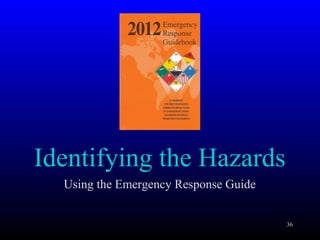
Identifying the Hazards
Using the Emergency Response Guide
36
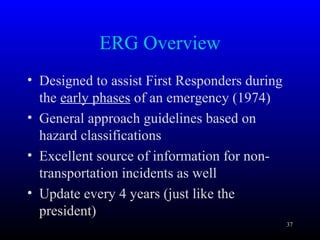
ERG Overview
• Designed to assist First Responders during
the early phases of an emergency (1974)
• General approach guidelines based on
hazard classifications
• Excellent source of information for non-
transportation incidents as well
• Update every 4 years (just like the
president)
37
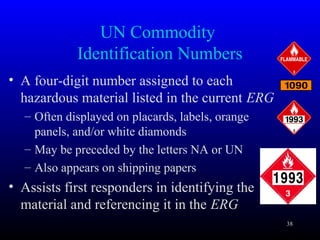
UN Commodity
Identification Numbers
• A four-digit number assigned to each
hazardous material listed in the current ERG
– Often displayed on placards, labels, orange
panels, and/or white diamonds
– May be preceded by the letters NA or UN
– Also appears on shipping papers
• Assists first responders in identifying the
material and referencing it in the ERG
38
How To Use The Guide
• Identify the material
– UN 4 digit identification number
– Labeling
• Identify the 3 digit guide number
– Based on above information
• Turn to the numbered guide
– Read carefully
– Take necessary actions
39
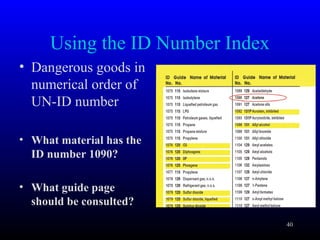
Using the ID Number Index
• Dangerous goods in
numerical order of
UN-ID number
• What material has the
ID number 1090?
• What guide page
should be consulted?
40
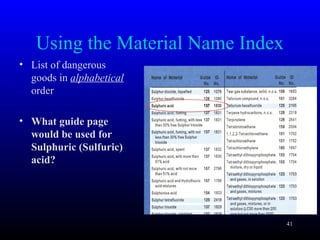
Using the Material Name Index
• List of dangerous
goods in alphabetical
order
• What guide page
would be used for
Sulphuric (Sulfuric)
acid?
41
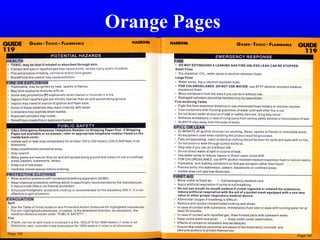
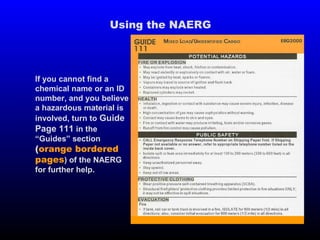
Orange Pages
If you cannot find a
chemical name or an ID
number, and you believe
a hazardous material is
involved, turn to Guide
Page 111 in the
“Guides” section
(orange bordered
pages) of the NAERG
for further help.
Using the NAERG
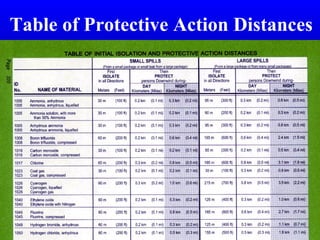
Table of Protective Action Distances
Isolate
• Close doors and windows
– Post warning signs or personnel
• Barricade with caution tape or other
physical structure
• Minimize the opening on a lab hood
• Can you close a valve?
Protective Action Options
• Shelter in-place
– Short duration incidents
– Greater hazard to attempt
to move
– Impractical to evacuate
• Evacuation
– Potential for massive fire or
explosion
– Long duration incidents
Notify
• Report to the proper
authorities
– Facility EAP
– Public Safety Officials
• Debrief to on-scene
response personnel
• Stay available until released
Summary
• Spills and releases of hazardous
substances can occur anywhere
& anytime
• Take the proper steps to:
– Recognize/Identify, Isolate, Protect
& Notify
• Use the tools available to provide
for safety during the initial
response.
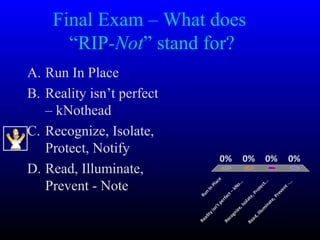
Final Exam – What does
“RIP-Not” stand for?
A. Run In Place
B. Reality isn’t perfect
– kNothead
C. Recognize, Isolate,
Protect, Notify
D. Read, Illuminate,
Prevent - Note
Run
In
Place
Realityisn’tperfect–
kNo...
Recognize,Isolate,Protect...
Read,Illum
inate,Prevent-...
0% 0%0%0%
Any Final Questions?

First responder awareness level presentation

  • 1.
    Chemical Responder –Awareness Level Training Your Role in Emergency Response
  • 2.
    Who Am I? •Michael Hampton, CSP, ARM • 35+ years in Safety & Health Management • Mining, Manufacturing, Hazardous Waste, Hazardous Materials • Rocky Mountain Center for Occupational & Environmental Health - University of Utah
  • 3.
    What do wewant to achieve? • At the conclusion of this training, you should be able to: – Describe the role of the First Responder at the Awareness Level – Understand the different levels of training under the Hazwoper standard – Describe the 4 Awareness Level Goals for the First Responder – Utilize the North American Emergency Response Guidebook to assist in accomplishing the goals of a First Responder
  • 4.
    Let’s Get Started •Quick Reviews • Audience Response Devices • Check your learning • “So many buttons!”
  • 5.
    What is Hazwoper? •HAZardous Waste OPerations and Emergency Response Emergency response is recognizing, and taking action to stop and contain a leak or spill. The actual clean-up of a spill is a hazardous waste operation.
  • 6.
    What Does OSHASay? • First responders at the awareness level are individuals who are • likely to witness or discover a hazardous substance release and • who have been trained to initiate an emergency response sequence by notifying the proper authorities of the release. • They would take no further action beyond notifying the authorities of the release. • Must have training or experience to satisfy this part.
  • 7.
    Awareness Persons likely towitness or discover a haz-mat release must notify appropriate authorities, deny entry into the affected and remain at a safe location until emergency responders reach the scene. Operations Persons who respond to haz-mat incidents with defensive actions to contain and prevent the release from spreading. Hazardous Materials Technician Persons who respond to a haz-mat spill with offensive actions to control the spill or leak. Hazardous Materials Specialist Persons with specialized knowledge that provide support to the Hazardous Materials Technician. Hazardous Materials Incident Commander Persons who assume command of the incident and control all operations. They must have Operational Level training and additional training in implementing the employer’s emergency response plan. There are five levels of training required under HAZWOPER: LEVELS OF TRAINING
  • 8.
    Who Does HazwoperApply To? Three Distinct Operations types: •Clean-up operations involving hazardous substances at: – Uncontrolled hazardous waste sites – Sites covered by RCRA – Voluntary clean-up at sites recognized by federal, state, local agencies •Operations involving hazardous wastes conducted at treatment, storage, and disposal facilities (TSDF) •Emergency response operations for releases of, or substantial threats of release of, hazardous substances regardless of the location of the hazard.
  • 9.
    Where Did HazwoperCome From? • OSHA – 1971 • RCRA – 1976 • CERCLA – 1980 • SARA – 1986 – allocated funds to develop health and safety training for workers involved in transportation, storage, or disposal of hazardous waste.
  • 10.
    Hazard Recognition Definitions • Hazardoussubstance: “OSHA” • Hazardous waste: “EPA” • Hazardous material: “DOT” OSH A DOTEPA
  • 11.
    Hazardous Substance -OSHA • A substance which may result in adverse affects on the health and safety of employees • A substance included as a hazardous material by DOT and as a hazardous waste by EPA
  • 12.
    Hazardous Waste -EPA Poses unreasonable risk to health, safety or property when transported in commerce for the purposes of treatment, storage, or disposal as waste
  • 13.
    Hazardous Material -DOT Any substance or material in any form or quantity which poses an unreasonable risk to safety and health and property when transported in commerce
  • 14.
    “Incidental” Spill • Aspill which does not pose a significant safety or health hazard to employees in the immediate vicinity or to the employee cleaning it up • No potential to become an emergency within a short time frame. • Safely cleaned up by employees who are familiar with the hazards of the chemicals with which they are working.
  • 15.
    Chemical Hazards inthe Workplace • Flammable • Corrosive • Reactive • Toxic • Sudden Release of Pressure (explosion) – detonation and deflagration
  • 16.
    Physical Hazards toEmployees • Radiation • Electricity • Mechanical • Heat/Cold • Slips, trips, falls
  • 17.
    Biological Hazards • InfectiousHospital Waste • Research Materials • Raw sewage (hepatitis A, E-coli) • Bites from vectors (ticks, rats, wild dogs)
  • 18.
    Routes of Entryinto the Body • Routes – Inhalation – Ingestion – Injection – Absorption Which is the most common and why?
  • 19.
    Chewing gum ina contaminated area is a form of which route of exposure? A. Inhalation B. Injection C. Ingestion D. Absorption Inhalation Injection Ingestion Absorption 0% 0%0%0%
  • 20.
    Which of theitems below is not true about an “incidental spill”? A. There is no potential to become an emergency. B. PPE is not required to clean up the spill. C. Safely cleaned up by employees who are familiar with the hazards. D. Does not pose a significant safety or health hazard. There isno potentialto b... PPE isnotrequired to clean... Safelycleaned up byem pl... Doesnotpose asignificant... 0% 0%0%0%
  • 21.
    Awareness Level Goals     Recognition/ Identification   Recognizeif an incident involves hazardous materials and identify materials involved - if this can be done with no risk to the responder. Isolation Isolate and deny access to the area. Remove uninjured and non- contaminated persons from the area - if it can be done without risk to the responder. Protection Protect yourself and others. If properly trained and equipped, this may include use of PPE and evacuation of nearby structures. Notification Notify the appropriate personnel in accordance with your employers emergency response plan.   Let’s look at each goal… Responders at the Awareness Level have four Goals or Responsibilities:
  • 22.
    Six Basic Cluesto Recognition 1 - Occupancy and location. 2 - Container shape and size. 3 - Placards and labels. 4 - Shipping papers/facility documents. 5 - Markings and colors. 6 - Human senses.
  • 23.
    Clue # 1- Occupancy and Location • Occupancy refers to the actual structure and its use: • Manufacturing facilities • Storage facilities • Retail establishments • Residential   • Location is the general area in which you are located: • Agricultural • Industrial Parks • Business Districts • Residential Areas • Transportation corridors - rail, air, marine, pipeline, and highway • Illegal Operations (e.g. drug labs)
  • 24.
    Low pressure or non-pressurized containers PressurizedContainers •Made from heavy steel •Rounded ends •Containers transported by rail, have valves and contentions, which are enclosed in a protective steel dome. Clue # 2 - Container Shape and Size
  • 25.
    Clue # 3- Placards and Labels A vehicle without a placard may be transporting hazardous materials. For commercial carriers, it is estimated that: • 50% carry hazardous materials. • Placards are required for only 50% of those transporting haz-mats. • Only 50% are properly placarded. Labels - Found on containers Placards - Found on vehicles transporting hazardous materials.
  • 26.
  • 27.
    Clue # 4- Shipping Papers and Facility Documents    MODEMODE NAMENAME LOCATIONLOCATION NOTESNOTES HighwayHighway Bill of lading, freight bill or manifest Cab of vehicle Must be within arms reach of driver and on driver’s seat or door pocket when un-attended. RailRail Consist List or Waybill With conductor or engineer Provides an itemized listing of each car within the train. WaterWater Dangerous Cargo Manifest Wheelhouse of vessel or in document tube or box on a barge AirAir Airbill Cockpit and attached to outside of packages In the possession of the pilot. PipelinePipeline Pipeline Markers Where pipeline crosses another mode of transportation Indicates owner’s name and 24 hour emergency contact information. Note: contents of many pipelines change regularly.
  • 28.
    Facility Documents – SafetyData Sheets (SDS) • Required to be maintained by the Federal Hazard Communication Standard. (HCS 2012 takes full effect June 1, 2016) • Found at fixed facilities. • Provides a variety of information. • Emergency Response Plans (ERP). • Emergency Action Plans (EAP).
  • 29.
    Clue # 5- Markings and Colors Container colors: •Many organizations have established standardized color coding for containers such as the Compressed Gas Association. • Compliance is not mandatory. • Colors may vary depending on the supplier. • Colors are not uniform statewide. UN Identification: •UN/NA Identification Number - 4 digit number stablished by DOT. Found in three locations during transport: • Shipping papers • On the vehicle placard • Sometimes on the SDS
  • 31.
    Clue # 6- Human Senses RISK LEVEL High Low TASTE TOUCH SMELL SIGHT SOUNDUse sight and hearing to detect pressure releases, liquids, gas leaks/vapor clouds, victims and chemical reactions and/or explosions.
  • 32.
    Summary of Recognition •Goals of recognition and identification – Recognize, Classify, Identify • Six clues to the presence of hazardous materials – Occupancy and location, container shape and size, placards and labels, shipping papers and facility documents, markings and colors, the human senses. • There are nine general classes of hazardous materials (DOT).
  • 33.
    How many cluesare there to assist in recognizing the chemical hazards? A. 4 B. 2 C. 8 D. 6 4 2 8 6 0% 0%0%0%
  • 34.
    OSHA requires thesedocuments to be available for employees to review when working with chemicals. A. DOT shipping papers B. Safety Data Sheets C. Packing slips for chemicals D. Christmas cards from customers DOT shipping papersSafetyDataSheets Packing slipsforchem icals Christm ascardsfrom cust... 0% 0%0%0%
  • 35.
    Which of theitems below is not a good indicator of the hazards associated with a material? A. Placards & labels B. Shape and size of containers C. Markings and color of containers D. The color of the container lid Placards& labels Shape and sizeofcontainers M arkingsand colorofcont... The colorofthe containerlid 0% 0%0%0%
  • 36.
    Identifying the Hazards Usingthe Emergency Response Guide 36
  • 37.
    ERG Overview • Designedto assist First Responders during the early phases of an emergency (1974) • General approach guidelines based on hazard classifications • Excellent source of information for non- transportation incidents as well • Update every 4 years (just like the president) 37
  • 38.
    UN Commodity Identification Numbers •A four-digit number assigned to each hazardous material listed in the current ERG – Often displayed on placards, labels, orange panels, and/or white diamonds – May be preceded by the letters NA or UN – Also appears on shipping papers • Assists first responders in identifying the material and referencing it in the ERG 38
  • 39.
    How To UseThe Guide • Identify the material – UN 4 digit identification number – Labeling • Identify the 3 digit guide number – Based on above information • Turn to the numbered guide – Read carefully – Take necessary actions 39
  • 40.
    Using the IDNumber Index • Dangerous goods in numerical order of UN-ID number • What material has the ID number 1090? • What guide page should be consulted? 40
  • 41.
    Using the MaterialName Index • List of dangerous goods in alphabetical order • What guide page would be used for Sulphuric (Sulfuric) acid? 41
  • 42.
  • 43.
    If you cannotfind a chemical name or an ID number, and you believe a hazardous material is involved, turn to Guide Page 111 in the “Guides” section (orange bordered pages) of the NAERG for further help. Using the NAERG
  • 44.
    Table of ProtectiveAction Distances
  • 45.
    Isolate • Close doorsand windows – Post warning signs or personnel • Barricade with caution tape or other physical structure • Minimize the opening on a lab hood • Can you close a valve?
  • 46.
    Protective Action Options •Shelter in-place – Short duration incidents – Greater hazard to attempt to move – Impractical to evacuate • Evacuation – Potential for massive fire or explosion – Long duration incidents
  • 47.
    Notify • Report tothe proper authorities – Facility EAP – Public Safety Officials • Debrief to on-scene response personnel • Stay available until released
  • 48.
    Summary • Spills andreleases of hazardous substances can occur anywhere & anytime • Take the proper steps to: – Recognize/Identify, Isolate, Protect & Notify • Use the tools available to provide for safety during the initial response.
  • 49.
    Final Exam –What does “RIP-Not” stand for? A. Run In Place B. Reality isn’t perfect – kNothead C. Recognize, Isolate, Protect, Notify D. Read, Illuminate, Prevent - Note Run In Place Realityisn’tperfect– kNo... Recognize,Isolate,Protect... Read,Illum inate,Prevent-... 0% 0%0%0%
  • 50.

Editor's Notes

  • #25 Three are three major classifications of containers – portable, fixed and transportation. The concept of vapor pressure is critical to understanding the construction and hazards of non-pressurized and pressurized containers. Vapor pressure is the absolute pressure exerted by a liquid. All liquids evaporate. The evaporation rate is dependent upon the vapor pressure. As temperature increases, so does vapor pressure.
  • #26 The US DOT requires the use of labels and placards. Labels are found on containers and placards may be required on vehicles transporting hazardous materials. The absence of a placard does not always indicate that the vehicle is not transporting hazardous materials.
  • #28 Shipping papers must itemize all hazardous materials present during any mode of transport. As explained in the following table, location and names of the shipping papers depends upon the mode of transportation:
  • #30 Container Colors - Many organizations have established standardized, voluntary color-coding for containers. An example is the Compressed Gas Association. Container colors vary depending upon the supplier. Other Markings - Company names and other unique markings may provide clues to the presence of hazardous materials. Familiarize yourself with your community and your local hazardous materials suppliers and users. Many UN/NA numbers have numerous materials listed. For example, “Combustible Liquids” not otherwise specified is listed for 1993.