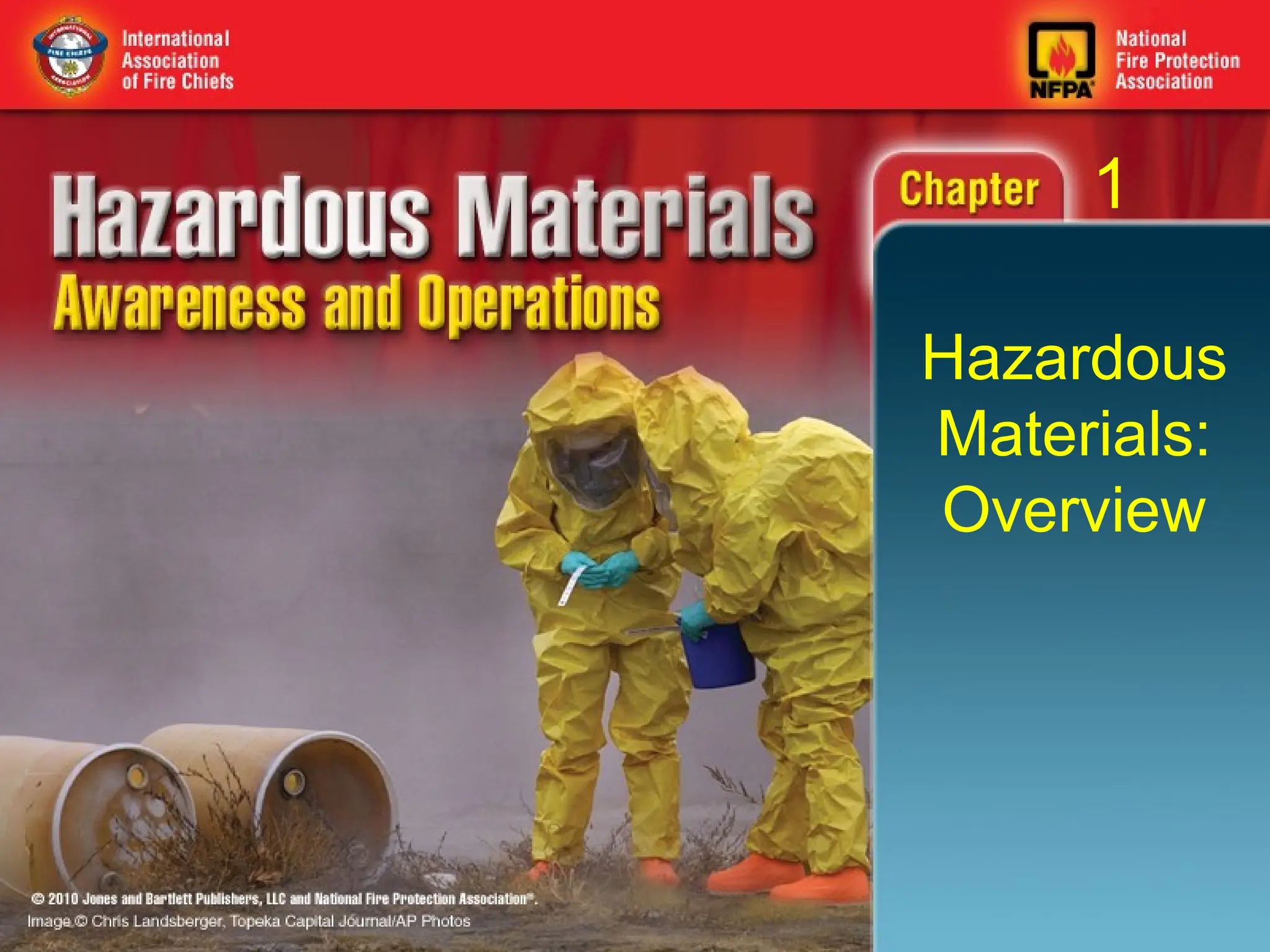
Hazardous
Materials:
Overview
1
Objectives (1 of 2)
• Define a hazardous material.
• Define weapons of mass destruction
(WMD).
• Describe the levels of hazardous materials
training: Awareness, operations,
technician, specialist, and incident
commander.
1
Objectives (2 of 2)
• Understand standards vs. federal
regulations that govern hazardous
materials response activities.
• Explain why hazardous materials incidents
differ from other emergencies.
• Explain the need for a planned response
to a hazardous materials incident.
1
The Responders (1 of 2)
• Fire fighters
• Law enforcement personnel
• Emergency medical services personnel
1
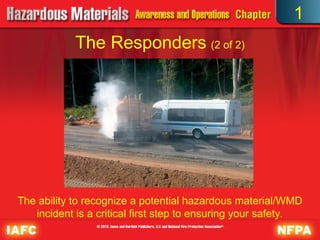
The Responders (2 of 2)
The ability to recognize a potential hazardous material/WMD
incident is a critical first step to ensuring your safety.
1
Hazardous Materials or WMD
Involvement
• Changes the nature of the incident
• Changes the responder’s mentality
1
Course Goals
• Recognize hazardous material/WMD
incidents
• Take initial actions (e.g., establish scene
control zones)
• Implement the Incident Command System
• Use basic reference sources (e.g., ERG)
• Perform appropriate decontamination
• Understand the roles in full-scale response
1
Authority Having Jurisdiction (AHJ)
• Sets operational policy
• Sets procedures
• For jurisdiction in which you operate
1
Governmental Entities
• Occupational Safety and Health
Administration (OSHA)
• Environmental Protection Agency (EPA)
• Issue regulations concerning hazardous
materials emergencies
• Enforce these regulations
1
OSHA Regulations
• Mandatory, government-issued, enforced
• Each U.S. state may choose to
adopt/supersede OSHA workplace health
and safety regulations
– State-plan states: Adopt OSHA regulations
– Non-plan states: Follow Title 40, CFR
1
• EPA regulates/governs issues related to
hazardous materials in the environment
• CFR Title 40, Protection of the
Environment, Part 311, Worker Protection
(EPA’s version of OSHA HAZWOPER)
EPA Regulations
1
NFPA Standards
• Voluntary
• Consensus-based (public can comment on
standards before they are adopted)
• Technical committee meets regularly to
revise/update/change the standards
• Agencies adopt entirely or in part
1
Hazardous Materials (1 of 2)
• Hazardous materials pose a risk to
– Health
– Safety
– The environment
1
Hazardous Materials (2 of 2)
• Hazardous materials pose a risk when
– Transported in commerce
– Used incorrectly
– Not properly contained or stored
1
Weapons of Mass Destruction
(WMD)
• Criminal use of hazardous materials,
including:
– Illicit laboratories
– Environmental crimes
– Industrial sabotage
1
Where are Hazardous Materials?
(1 of 2)
• They can be found anywhere
– e.g., 5000-gallon leak of milk into water body
poses unreasonable threat to environment
– Commonly sold industrial chemicals,
household cleaners, lawn care products
– Manufacturing also creates harmful waste
1
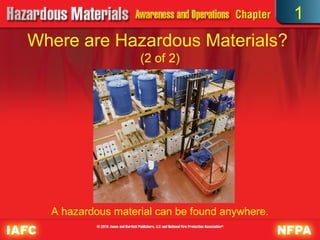
Where are Hazardous Materials?
(2 of 2)
A hazardous material can be found anywhere.
1
Questions to Ask in Chemical
Release
• Answers to these questions will inform
response to hazardous materials incident
– What is the chemical?
– How was it released?
– What will it do next?
1
NFPA Hazardous Materials/WMD
Response Standards
• NFPA 472, Standard for Competence of
Responders to Hazardous
Materials/Weapons of Mass Destruction
Incidents
• NFPA 473, Standard for Competencies for
EMS Personnel Responding to Hazardous
Materials/Weapons of Mass Destruction
Incidents
1
OSHA Hazardous Materials/WMD
Response Regulations
• HAZWOPER (HAZardous Waste
OPerations and Emergency Response)
– Found in CFR 29 1910.120
– Training levels: Awareness, operations,
technician, specialist, incident commander
– Revised less frequently than NFPA 472
1
Awareness Level Personnel (1 of 3)
• Could encounter hazardous materials/
WMD emergency
• Recognize presence of hazardous
materials/WMD
• Secure the area and protect themselves
• Call for trained personnel
1
• Not “responders”; function in support roles
– Detect presence of hazardous materials/WMD
– Identify substance involved
– Use ERG to research the hazard at hand
Awareness Level Personnel (2 of 3)
1
• Not “responders”; function in support roles
– Initiate and implement protective actions
consistent with plan, procedures, and ERG
– Initiate notification process
Awareness Level Personnel (3 of 3)
1
• HAZWOPER considers awareness level to
be “responders”
– Have knowledge of hazardous substances
and associated risks
– Understand potential outcomes of incident
– Recognize presence of hazardous material
HAZWOPER Regulations for
Awareness Level Personnel (1 of 2)
1
• HAZWOPER considers awareness level to
be “responders”
– Understand role of awareness level individual
in emergency response plan
– Can assess need for additional resources and
notify the communication center
– Annual refresher training required
HAZWOPER Regulations for
Awareness Level Personnel (2 of 2)
1
Operations Level Responders
• Respond to hazardous materials/WMD
emergencies
• Protect persons, environment, or property
• May have competencies specific to
mission, expected tasks, equipment, and
training (determined by AHJ)
1
Core Competencies of Operations
Level Responders (1 of 2)
• Analyze incident scene, determine scope
of emergency
• Identify containers and materials involved
• Use reference sources (e.g., ERG)
• Predict behavior of hazardous material
• Estimate potential incident outcomes
1
• Plan response to substance release,
select correct level of PPE
• Perform decontamination
• Preserve evidence
• Evaluate status and effectiveness of the
response
Core Competencies of Operations
Level Responders (2 of 2)
1
Mission-Specific Responsibilities of
Operations Level Responders
• Personal protective equipment (PPE)
• Technical and mass decontamination
• Evidence preservation and sampling
• Product control
• Air monitoring and sampling
• Victim rescue and recovery operations
1
HAZWOPER Regulations for
Operations Level Responders (1 of 3)
• Must be trained to respond in a defensive
fashion
– Do not stop the release directly
– Keep a safe distance from substance
– Prevent spread of hazardous material
– Prevent/reduce potential human exposures
1
• Must be trained to respond in a defensive
fashion
– Conduct hazard/risk assessment
– Select proper PPE
– Know basic hazardous materials terms
HAZWOPER Regulations for
Operations Level Responders (2 of 3)
1
• Must be trained to respond in a defensive
fashion
– Control, contain/confine using available
resources
– Perform decontamination
– Understand relevant standard operating and
termination procedures
HAZWOPER Regulations for
Operations Level Responders (3 of 3)
1
Hazardous Materials Technicians
(1 of 3)
• Direct operations level responders during
hazardous materials/WMD response
– Assess performance, provide feedback
• Approach point of release
• Plug, patch, or otherwise mitigate
emergency
1
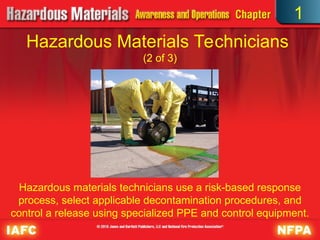
Hazardous Materials Technicians
(2 of 3)
Hazardous materials technicians use a risk-based response
process, select applicable decontamination procedures, and
control a release using specialized PPE and control equipment.
1
Hazardous Materials Technicians
(3 of 3)
• Analyze a problem involving hazardous
materials/WMD
• Select appropriate decontamination
procedures
• Control a release using specialized PPE
and control equipment
1
• Implement employer’s emergency
response plan
• Classify, identify, and verify materials
• Function within ICS-given role
HAZWOPER Regulations for
Technician Level Responders (1 of 3)
1
• Select and use proper PPE
• Use hazard/risk assessment techniques
• Advance control and containment/
confinement
HAZWOPER Regulations for
Technician Level Responders (2 of 3)
1
• Understand and implement
decontamination procedures
• Understand termination procedures
• Understand basic chemical and
toxicological terminology and behavior
• Annual refresher training required
HAZWOPER Regulations for
Technician Level Responders (3 of 3)
1
Specialist Level Responders
• Identified only in HAZWOPER
• Receive more specialized training than
hazardous materials technician
1
Hazardous Materials Incident
Commander
• Responsible for all incident activities
• Develops strategies and tactics
• Orders and releases resources
1
HAZWOPER Regulations for
Incident Commander (1 of 2)
• Know and implement employer’s ICS
• Know how to implement employer’s
emergency response plan
• Know and understand hazards/risks of
chemical protective clothing
1
• Know how to implement local emergency
response plan and the Federal Regional
Response Team
• Know and understand importance of
decontamination procedures
• Annual refresher training required
HAZWOPER Regulations for
Incident Commander (2 of 2)
1
Superfund Amendments and
Reauthorization Act of 1986
• Created method and standard practice for
a local community to understand chemical
hazards in the community
• Title III: Emergency Planning and
Community Right to Know Act (EPCRA)
– Businesses must report storage type,
quantity, and methods to fire dept. and local
emergency planning committee
1
• Department of Transportation (DOT)
– Promulgates/publishes laws and regulations
governing transportation of goods by highway,
rail, pipeline, air, and sometimes marine
transport
Other Governmental Agencies (1 of 3)
1
• Local Emergency Planning Committee
(LEPC)
– Gathers and disseminates information about
hazardous materials to public
– Composed of volunteers from industry,
transportation, media, fire, police, public
– Collect Material Safety Data Sheet (MSDS)
Other Governmental Agencies (2 of 3)
1
• State Emergency Response Commission
(SERC)
– Acts as liaison between local and state levels
of authority
– Fire and police service, elected officials
– Collects and disseminates information relating
to hazardous materials emergencies
Other Governmental Agencies (3 of 3)
1
Material Safety Data Sheet (1 of 2)
• Important resource for responders
• Detailed profile of chemical/mixture
• Provided by manufacturer/supplier
• Describes physical and chemical
properties
• Gives toxicology data
1
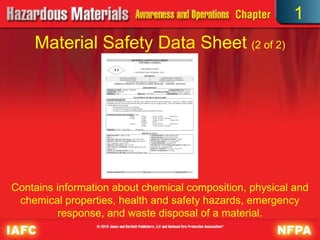
Material Safety Data Sheet (2 of 2)
Contains information about chemical composition, physical and
chemical properties, health and safety hazards, emergency
response, and waste disposal of a material.
1
Response to Hazardous
Materials/WMD Emergency
• Requires a different mindset
• Generally takes more time
• Bear in mind role of law enforcement,
presence of on-scene evidence
• Begins with training before incident
1
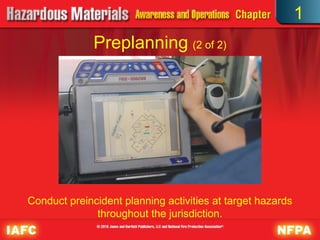
Preplanning (1 of 2)
• Focus on target hazards in community
• Discuss/share information with LEPC
• Determine cohesive emergency response
plan, before a large-scale incident occurs
1
Preplanning (2 of 2)
Conduct preincident planning activities at target hazards
throughout the jurisdiction.
1
Summary (1 of 4)
• Hazardous materials pose risk to health,
safety, or environment
• OSHA and EPA: Issue and enforce
hazardous materials regulations
• NFPA: Issue and enforce consensus-
based hazardous materials/WMD
standards
1
• Response actions are dictated by behavior
of chemical released
• NFPA 472 and 473: Relate to hazardous
materials/WMD incident response
• OSHA HAZWOPER: CFR 29 1910.120
– EPA’s version: CFR 40
Summary (2 of 4)
1
• Awareness level personnel
– Recognize hazard, isolate area, call for
assistance
• Operations level responders
– Core competencies: Defensive actions
– Mission-specific: PPE, decontamination,
evidence preservation, air monitoring, etc.
Summary (3 of 4)
1
• Hazardous materials technicians
– Mitigate emergency
• Incident commander
– Responsible for all incident activities
Summary (4 of 4)
1

lecture about hazmat abording cbrne terrorism

  • 1.
  • 2.
    Objectives (1 of2) • Define a hazardous material. • Define weapons of mass destruction (WMD). • Describe the levels of hazardous materials training: Awareness, operations, technician, specialist, and incident commander. 1
  • 3.
    Objectives (2 of2) • Understand standards vs. federal regulations that govern hazardous materials response activities. • Explain why hazardous materials incidents differ from other emergencies. • Explain the need for a planned response to a hazardous materials incident. 1
  • 4.
    The Responders (1of 2) • Fire fighters • Law enforcement personnel • Emergency medical services personnel 1
  • 5.
    The Responders (2of 2) The ability to recognize a potential hazardous material/WMD incident is a critical first step to ensuring your safety. 1
  • 6.
    Hazardous Materials orWMD Involvement • Changes the nature of the incident • Changes the responder’s mentality 1
  • 7.
    Course Goals • Recognizehazardous material/WMD incidents • Take initial actions (e.g., establish scene control zones) • Implement the Incident Command System • Use basic reference sources (e.g., ERG) • Perform appropriate decontamination • Understand the roles in full-scale response 1
  • 8.
    Authority Having Jurisdiction(AHJ) • Sets operational policy • Sets procedures • For jurisdiction in which you operate 1
  • 9.
    Governmental Entities • OccupationalSafety and Health Administration (OSHA) • Environmental Protection Agency (EPA) • Issue regulations concerning hazardous materials emergencies • Enforce these regulations 1
  • 10.
    OSHA Regulations • Mandatory,government-issued, enforced • Each U.S. state may choose to adopt/supersede OSHA workplace health and safety regulations – State-plan states: Adopt OSHA regulations – Non-plan states: Follow Title 40, CFR 1
  • 11.
    • EPA regulates/governsissues related to hazardous materials in the environment • CFR Title 40, Protection of the Environment, Part 311, Worker Protection (EPA’s version of OSHA HAZWOPER) EPA Regulations 1
  • 12.
    NFPA Standards • Voluntary •Consensus-based (public can comment on standards before they are adopted) • Technical committee meets regularly to revise/update/change the standards • Agencies adopt entirely or in part 1
  • 13.
    Hazardous Materials (1of 2) • Hazardous materials pose a risk to – Health – Safety – The environment 1
  • 14.
    Hazardous Materials (2of 2) • Hazardous materials pose a risk when – Transported in commerce – Used incorrectly – Not properly contained or stored 1
  • 15.
    Weapons of MassDestruction (WMD) • Criminal use of hazardous materials, including: – Illicit laboratories – Environmental crimes – Industrial sabotage 1
  • 16.
    Where are HazardousMaterials? (1 of 2) • They can be found anywhere – e.g., 5000-gallon leak of milk into water body poses unreasonable threat to environment – Commonly sold industrial chemicals, household cleaners, lawn care products – Manufacturing also creates harmful waste 1
  • 17.
    Where are HazardousMaterials? (2 of 2) A hazardous material can be found anywhere. 1
  • 18.
    Questions to Askin Chemical Release • Answers to these questions will inform response to hazardous materials incident – What is the chemical? – How was it released? – What will it do next? 1
  • 19.
    NFPA Hazardous Materials/WMD ResponseStandards • NFPA 472, Standard for Competence of Responders to Hazardous Materials/Weapons of Mass Destruction Incidents • NFPA 473, Standard for Competencies for EMS Personnel Responding to Hazardous Materials/Weapons of Mass Destruction Incidents 1
  • 20.
    OSHA Hazardous Materials/WMD ResponseRegulations • HAZWOPER (HAZardous Waste OPerations and Emergency Response) – Found in CFR 29 1910.120 – Training levels: Awareness, operations, technician, specialist, incident commander – Revised less frequently than NFPA 472 1
  • 21.
    Awareness Level Personnel(1 of 3) • Could encounter hazardous materials/ WMD emergency • Recognize presence of hazardous materials/WMD • Secure the area and protect themselves • Call for trained personnel 1
  • 22.
    • Not “responders”;function in support roles – Detect presence of hazardous materials/WMD – Identify substance involved – Use ERG to research the hazard at hand Awareness Level Personnel (2 of 3) 1
  • 23.
    • Not “responders”;function in support roles – Initiate and implement protective actions consistent with plan, procedures, and ERG – Initiate notification process Awareness Level Personnel (3 of 3) 1
  • 24.
    • HAZWOPER considersawareness level to be “responders” – Have knowledge of hazardous substances and associated risks – Understand potential outcomes of incident – Recognize presence of hazardous material HAZWOPER Regulations for Awareness Level Personnel (1 of 2) 1
  • 25.
    • HAZWOPER considersawareness level to be “responders” – Understand role of awareness level individual in emergency response plan – Can assess need for additional resources and notify the communication center – Annual refresher training required HAZWOPER Regulations for Awareness Level Personnel (2 of 2) 1
  • 26.
    Operations Level Responders •Respond to hazardous materials/WMD emergencies • Protect persons, environment, or property • May have competencies specific to mission, expected tasks, equipment, and training (determined by AHJ) 1
  • 27.
    Core Competencies ofOperations Level Responders (1 of 2) • Analyze incident scene, determine scope of emergency • Identify containers and materials involved • Use reference sources (e.g., ERG) • Predict behavior of hazardous material • Estimate potential incident outcomes 1
  • 28.
    • Plan responseto substance release, select correct level of PPE • Perform decontamination • Preserve evidence • Evaluate status and effectiveness of the response Core Competencies of Operations Level Responders (2 of 2) 1
  • 29.
    Mission-Specific Responsibilities of OperationsLevel Responders • Personal protective equipment (PPE) • Technical and mass decontamination • Evidence preservation and sampling • Product control • Air monitoring and sampling • Victim rescue and recovery operations 1
  • 30.
    HAZWOPER Regulations for OperationsLevel Responders (1 of 3) • Must be trained to respond in a defensive fashion – Do not stop the release directly – Keep a safe distance from substance – Prevent spread of hazardous material – Prevent/reduce potential human exposures 1
  • 31.
    • Must betrained to respond in a defensive fashion – Conduct hazard/risk assessment – Select proper PPE – Know basic hazardous materials terms HAZWOPER Regulations for Operations Level Responders (2 of 3) 1
  • 32.
    • Must betrained to respond in a defensive fashion – Control, contain/confine using available resources – Perform decontamination – Understand relevant standard operating and termination procedures HAZWOPER Regulations for Operations Level Responders (3 of 3) 1
  • 33.
    Hazardous Materials Technicians (1of 3) • Direct operations level responders during hazardous materials/WMD response – Assess performance, provide feedback • Approach point of release • Plug, patch, or otherwise mitigate emergency 1
  • 34.
    Hazardous Materials Technicians (2of 3) Hazardous materials technicians use a risk-based response process, select applicable decontamination procedures, and control a release using specialized PPE and control equipment. 1
  • 35.
    Hazardous Materials Technicians (3of 3) • Analyze a problem involving hazardous materials/WMD • Select appropriate decontamination procedures • Control a release using specialized PPE and control equipment 1
  • 36.
    • Implement employer’semergency response plan • Classify, identify, and verify materials • Function within ICS-given role HAZWOPER Regulations for Technician Level Responders (1 of 3) 1
  • 37.
    • Select anduse proper PPE • Use hazard/risk assessment techniques • Advance control and containment/ confinement HAZWOPER Regulations for Technician Level Responders (2 of 3) 1
  • 38.
    • Understand andimplement decontamination procedures • Understand termination procedures • Understand basic chemical and toxicological terminology and behavior • Annual refresher training required HAZWOPER Regulations for Technician Level Responders (3 of 3) 1
  • 39.
    Specialist Level Responders •Identified only in HAZWOPER • Receive more specialized training than hazardous materials technician 1
  • 40.
    Hazardous Materials Incident Commander •Responsible for all incident activities • Develops strategies and tactics • Orders and releases resources 1
  • 41.
    HAZWOPER Regulations for IncidentCommander (1 of 2) • Know and implement employer’s ICS • Know how to implement employer’s emergency response plan • Know and understand hazards/risks of chemical protective clothing 1
  • 42.
    • Know howto implement local emergency response plan and the Federal Regional Response Team • Know and understand importance of decontamination procedures • Annual refresher training required HAZWOPER Regulations for Incident Commander (2 of 2) 1
  • 43.
    Superfund Amendments and ReauthorizationAct of 1986 • Created method and standard practice for a local community to understand chemical hazards in the community • Title III: Emergency Planning and Community Right to Know Act (EPCRA) – Businesses must report storage type, quantity, and methods to fire dept. and local emergency planning committee 1
  • 44.
    • Department ofTransportation (DOT) – Promulgates/publishes laws and regulations governing transportation of goods by highway, rail, pipeline, air, and sometimes marine transport Other Governmental Agencies (1 of 3) 1
  • 45.
    • Local EmergencyPlanning Committee (LEPC) – Gathers and disseminates information about hazardous materials to public – Composed of volunteers from industry, transportation, media, fire, police, public – Collect Material Safety Data Sheet (MSDS) Other Governmental Agencies (2 of 3) 1
  • 46.
    • State EmergencyResponse Commission (SERC) – Acts as liaison between local and state levels of authority – Fire and police service, elected officials – Collects and disseminates information relating to hazardous materials emergencies Other Governmental Agencies (3 of 3) 1
  • 47.
    Material Safety DataSheet (1 of 2) • Important resource for responders • Detailed profile of chemical/mixture • Provided by manufacturer/supplier • Describes physical and chemical properties • Gives toxicology data 1
  • 48.
    Material Safety DataSheet (2 of 2) Contains information about chemical composition, physical and chemical properties, health and safety hazards, emergency response, and waste disposal of a material. 1
  • 49.
    Response to Hazardous Materials/WMDEmergency • Requires a different mindset • Generally takes more time • Bear in mind role of law enforcement, presence of on-scene evidence • Begins with training before incident 1
  • 50.
    Preplanning (1 of2) • Focus on target hazards in community • Discuss/share information with LEPC • Determine cohesive emergency response plan, before a large-scale incident occurs 1
  • 51.
    Preplanning (2 of2) Conduct preincident planning activities at target hazards throughout the jurisdiction. 1
  • 52.
    Summary (1 of4) • Hazardous materials pose risk to health, safety, or environment • OSHA and EPA: Issue and enforce hazardous materials regulations • NFPA: Issue and enforce consensus- based hazardous materials/WMD standards 1
  • 53.
    • Response actionsare dictated by behavior of chemical released • NFPA 472 and 473: Relate to hazardous materials/WMD incident response • OSHA HAZWOPER: CFR 29 1910.120 – EPA’s version: CFR 40 Summary (2 of 4) 1
  • 54.
    • Awareness levelpersonnel – Recognize hazard, isolate area, call for assistance • Operations level responders – Core competencies: Defensive actions – Mission-specific: PPE, decontamination, evidence preservation, air monitoring, etc. Summary (3 of 4) 1
  • 55.
    • Hazardous materialstechnicians – Mitigate emergency • Incident commander – Responsible for all incident activities Summary (4 of 4) 1

Editor's Notes

  • #5 Image: Courtesy of George Roarty/VDEM
  • #17 Image: © Steve Allen/Brand X Pictures/Alamy Images
  • #34 Image: Courtesy of Staff Sgt. Brandie Session/U.S. Air Force
  • #48 Image: Courtesy of Tanner Industries, Inc., Southhampton, PA