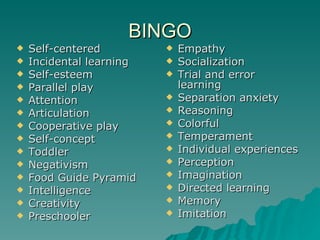
BINGO Self-centered Incidental learning Self-esteem Parallel play Attention Articulation Cooperative play Self-concept Toddler Negativism Food Guide Pyramid Intelligence Creativity Preschooler Empathy Socialization Trial and error learning Separation anxiety Reasoning Colorful Temperament Individual experiences Perception Imagination Directed learning Memory  Imitation
Ability to interpret or understand everyday situations and to use that experience when faced with new situations or problems
An important component in meal planning for toddlers
When a toddler thinks of his/her own needs or wants, not those of others
How highly you value yourself
Children playing individually near other children
Ability to use clear distinct sounds
Children from ages 1 ½ through 3 years old, who are unsteady on their feet
Doing the opposite of what others want you to do
Unplanned learning
Guidelines suggesting how much of each food group to consume
Intellectual ability to use imagination to create something
Children ages 3-5
Ability to put one’s self in another’s place
Process when young children gradually learn to get along with others in their family and then in groups
Type of learning when a child tries several solutions before finding one that works
Fear of being away from parents
Intellectual ability to solve problems
Two things that cause changes among children in emotional development
Type of intellectual activity when children are able to focus on something
Children playing WITH one another
Information received through the senses
Intellectual ability to pretend
Learning that results from being taught
How a child sees his/her self
Intellectual activity in which children are able to remember things
Learning by watching and copying others

First Impressions 1