Presented by:
Dr. Ali Soffar
Under supervision of :
Mr. Ahmed Rasheed
First aid refers to the emergency or immediate
care you should provide when a person is injured or ill
until full medical treatment is available.
Topics of first aid are widely different based on the
type of work, number of workers and definitely how far
the medical facility is.
Main topics that would be of higher importance are
how to deal with these topics: loss of consciousness,
unresponsiveness, bleeding, multiple trauma, localized
injury, burns, seizures, choking and insect bites.
Basic First Aid for Bleeding
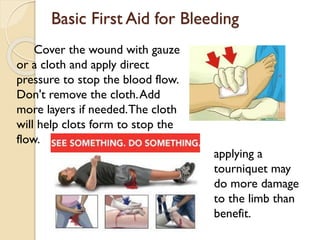
Cover the wound with gauze
or a cloth and apply direct
pressure to stop the blood flow.
Don't remove the cloth.Add
more layers if needed.The cloth
will help clots form to stop the
flow.
applying a
tourniquet may
do more damage
to the limb than
benefit.
Basic First Aid for Nose bleeding
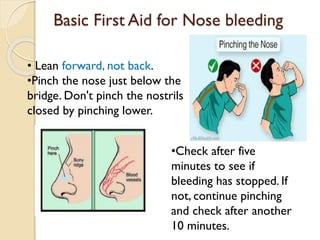
• Lean forward, not back.
•Pinch the nose just below the
bridge. Don't pinch the nostrils
closed by pinching lower.
•Check after five
minutes to see if
bleeding has stopped. If
not, continue pinching
and check after another
10 minutes.
Basic First Aid for Burns
The first step to treating a burn is to stop the burning
process.
Chemicals need to be cleaned off.
Electricity needs to be turned off. Heat
needs to be cooled down with running
water. Sunburn victims need to be
covered up or go inside.
No matter what caused the burns or
how bad they are, stopping the burn
comes before treating the burn.
Basic First Aid for Burns
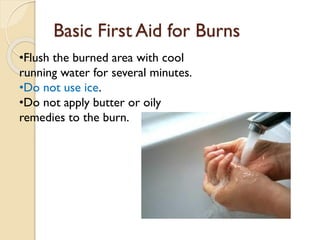
•Flush the burned area with cool
running water for several minutes.
•Do not use ice.
•Do not apply butter or oily
remedies to the burn.
Basic First Aid for Blisters
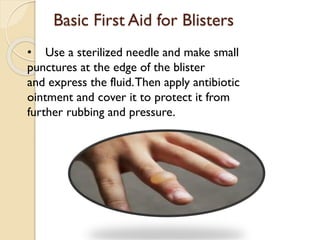
• Use a sterilized needle and make small
punctures at the edge of the blister
and express the fluid.Then apply antibiotic
ointment and cover it to protect it from
further rubbing and pressure.
Basic First Aid for Fractures, Sprains
•Stabilize the limb using a splint and padding to keep
it immobile.
•Put a cold pack on the injury.
Basic First Aid for Insect Bites
Basic First Aid for Foreign Body
•Use a cold pack to reduce swelling at the site.
•Monitor the person who was stung by signs
of anaphylaxis, including redness or itching in
other areas of the body, and shortness of
breath.
•Seek medical advice in same day if it is available.
•Remove the foreign body, if it can be removed
totally without remnants.
Basic First Aid for Fever
•Uncontrolled fever has so many impacts
on health.
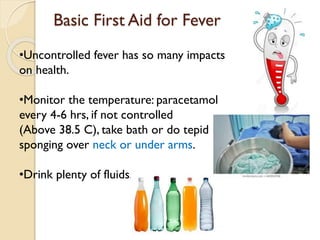
•Monitor the temperature: paracetamol
every 4-6 hrs, if not controlled
(Above 38.5 C), take bath or do tepid
sponging over neck or under arms.
•Drink plenty of fluids.
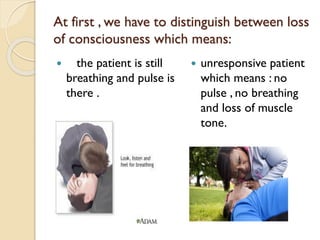
At first , we have to distinguish between loss
of consciousness which means:
 the patient is still
breathing and pulse is
there .
 unresponsive patient
which means : no
pulse , no breathing
and loss of muscle
tone.
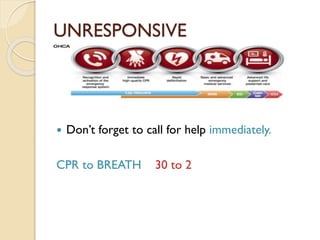
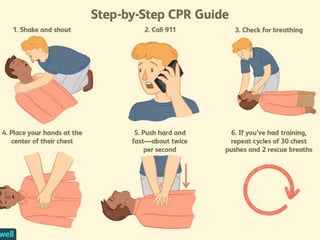
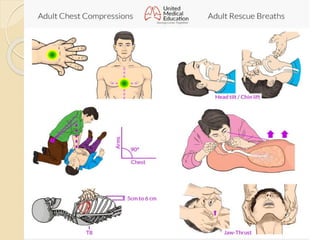
UNRESPONSIVE
 Don’t forget to call for help immediately.
CPR to BREATH 30 to 2
first aid .pdf
first aid .pdf
first aid .pdf

first aid .pdf

  • 2.
    Presented by: Dr. AliSoffar Under supervision of : Mr. Ahmed Rasheed
  • 3.
    First aid refersto the emergency or immediate care you should provide when a person is injured or ill until full medical treatment is available. Topics of first aid are widely different based on the type of work, number of workers and definitely how far the medical facility is. Main topics that would be of higher importance are how to deal with these topics: loss of consciousness, unresponsiveness, bleeding, multiple trauma, localized injury, burns, seizures, choking and insect bites.
  • 4.
    Basic First Aidfor Bleeding
  • 5.
    Basic First Aidfor Bleeding Cover the wound with gauze or a cloth and apply direct pressure to stop the blood flow. Don't remove the cloth.Add more layers if needed.The cloth will help clots form to stop the flow. applying a tourniquet may do more damage to the limb than benefit.
  • 6.
    Basic First Aidfor Nose bleeding • Lean forward, not back. •Pinch the nose just below the bridge. Don't pinch the nostrils closed by pinching lower. •Check after five minutes to see if bleeding has stopped. If not, continue pinching and check after another 10 minutes.
  • 7.
    Basic First Aidfor Burns
  • 8.
    Basic First Aidfor Burns The first step to treating a burn is to stop the burning process. Chemicals need to be cleaned off. Electricity needs to be turned off. Heat needs to be cooled down with running water. Sunburn victims need to be covered up or go inside. No matter what caused the burns or how bad they are, stopping the burn comes before treating the burn.
  • 9.
    Basic First Aidfor Burns •Flush the burned area with cool running water for several minutes. •Do not use ice. •Do not apply butter or oily remedies to the burn.
  • 10.
    Basic First Aidfor Blisters • Use a sterilized needle and make small punctures at the edge of the blister and express the fluid.Then apply antibiotic ointment and cover it to protect it from further rubbing and pressure.
  • 11.
    Basic First Aidfor Fractures, Sprains •Stabilize the limb using a splint and padding to keep it immobile. •Put a cold pack on the injury.
  • 12.
    Basic First Aidfor Insect Bites Basic First Aid for Foreign Body •Use a cold pack to reduce swelling at the site. •Monitor the person who was stung by signs of anaphylaxis, including redness or itching in other areas of the body, and shortness of breath. •Seek medical advice in same day if it is available. •Remove the foreign body, if it can be removed totally without remnants.
  • 13.
    Basic First Aidfor Fever •Uncontrolled fever has so many impacts on health. •Monitor the temperature: paracetamol every 4-6 hrs, if not controlled (Above 38.5 C), take bath or do tepid sponging over neck or under arms. •Drink plenty of fluids.
  • 14.
    At first ,we have to distinguish between loss of consciousness which means:  the patient is still breathing and pulse is there .  unresponsive patient which means : no pulse , no breathing and loss of muscle tone.
  • 15.
    UNRESPONSIVE  Don’t forgetto call for help immediately. CPR to BREATH 30 to 2