FIRE SAFETY HANDBOOK
This Fire Safety Handbook
was written by the
NYU Medical Center
Environmental Services Department
Address: 550 First Avenue
New York, NY 10016
Tel. Number: (212) 263-5159
Fax: (212) 263-7855
This handbook has been approved by the Division of Fire Prevention
of the New York City Fire Department
NYU MEDICAL CENTER
FIRE SAFETY HANDBOOK
TABLE OF CONTENTS
Foreword ..............................................................................................1
Introducción ........................................................................................1
Fire Alarm Policy ................................................................................2
Norma sobre Alarmes de Incendio .....................................................2
General Fire Emergency Instructions
How To Pull The Alarm ..................................................................3
How To Call Communications ........................................................3
Fire Protocol To Be Implemented ..................................................3
Evacuation Instructions .................................................................3
All Clear Notification ......................................................................4
Instrucciónes generales para emergencias de incendio
Cómo accionar la alarma ................................................................5
Cómo llamar a Communicaciones ..................................................5
Normas de Incendio que deben aplicarse ......................................5
Instrucciónes sobre evacuación ......................................................5
Notificación de fin de alarma .........................................................6
Specific Assignments
Communications .............................................................................7
Fire Marshal ..................................................................................11
Fire Brigade Chief ........................................................................11
Fire Brigade ..................................................................................11
Engineer ........................................................................................11
Security Officers ...........................................................................12
Specific Fire Emergency Instructions
Patient Floors ................................................................................13
Clinical Areas ................................................................................14
Laboratories ..................................................................................15
Animal Areas .................................................................................16
Office Areas ...................................................................................16
Classrooms ....................................................................................16
Public Areas ..................................................................................16
Hall of Residence ................................................................................17
NYU MEDICAL CENTER
FIRE SAFETY HANDBOOK
Additional Fire Safety Information
Types of Fire Extinguishers and How to Use Them .......................19
Elevator Operation During a Fire Emergency ................................23
Fire Safety Awareness ........................................................................24
Smoking Policy and No Smoking Areas ...........................................26
Patient Evacuation Procedure ...........................................................28
*Emergency Patient Removal Carries .............................................30
Side by Side Assist .........................................................................30
Swing Carry ...................................................................................32
Packstrap Carry .............................................................................34
Four-Rescuer or Blanket Carry ....................................................36
Fire Alarm Codes.................................................................................38
Maps of Medical Center .....................................................................39
Otras Informaciones sobre seguridad contra el fuego
Clases de extintores y cómo usarlos .................................................21
Utilización de ascensores en emergencias de incendio .................. 23
Normas de seguridad contra incendios ............................................25
Normas sobre el derecho de fumar y zonas de prohibición
de fumar ............................................................................................27
Procedimiento para la evacuación de pacientes ..............................29
Codigos de alarma de incendio ......................................................... 38
Mapas del Cientro Medico . ................................................................39
*Emergency Patient Removal Carries courtesy of Abbott Laboratories.
NYU MEDICAL CENTER
FIRE SAFETY HANDBOOK
FOREWORD
The Fire Safety Handbook has been developed to provide NYU Medical
Center Personnel with a plan of action in the event of a fire emergency.
The procedures outlined in this handbook have been formulated to protect
life and minimize property loss. However, an action plan is only as effec-
tive as the people who carry out the procedures. The actions taken during
the first few minutes of a fire are crucial in averting serious disaster.
Therefore, all Medical Center employees are encouraged to review the
manual and to become familiar with the fire plan appropriate to their
work area. In addition, employees are asked to actively participate in fire
drills, recognize fire hazards, remove such hazards whenever possible and
report them to their supervisors when necessary.
INTRODUCCION
El Fire Safety Handbook se ha elaborado para proporcionar al personal
del NYU Medical Center un plan de acción para los casos de emergencia
de incendio. Los procedimientos que se esbozan en este folleto se han for-
mulado para proteger las vidas y reducir al mínimo las perdidas materi-
ales. Sin embargo, ningún plan de acción puede ser más eficaz que las per-
sonas que hayan aplicarlo. Las medidas tomadas durante los primeros
minutos de un incendio son vitales para evitar un desastre grave. Por lo
tanto, se exhorta a todos los empleados del Medical Center a examinar el
manual y familiarizarse con el plan correspondiente a su zona. Además, se
solicita que los empleados participen activamente en las prácticas de lucha
contra incendios, aprendan a reconocer los peligros de incendio, los elimi-
nen siempre que sea posible y los anuncien a sus supervisores cuando sea
necesario.
1
NYU MEDICAL CENTER
FIRE SAFETY HANDBOOK
FIRE ALARM POLICY
It is the policy of the Medical Center that upon discovery of smoke or fire,
the fire alarm is to be pulled. Because of the potential for underestimat-
ing the seriousness of a fire condition, there are no exceptions to this pol-
icy.
When the fire alarm sounds, every employee is expected to implement fire
protocol appropriate to his or her work area. There is no code to indicate
if an alarm signifies a drill or real fire. Therefore, every alarm should be
treated as a potentially serious fire.
NORMA SOBRE ALARMAS DE INCENDIO
Es la norma del Medical Center que, cada vez que se descubra humo
fuego, se accióne la alarma de incendio. Como existe el peligro de que se
subestime la gravedad de una situación, no se admiten exceptiones a esta
norma.
Cuando suene la alarma de incendio, todos los empleados deben aplica las
normas de incendio adecuadas según su zona de trabajo. No exist ningún
código para anunciar si la alarma se refiere a una práctica o a un incen-
dio real, por lo cual todas las alarmas deben tomarse como si fuesen incen-
dios graves.
2
NYU MEDICAL CENTER
FIRE SAFETY HANDBOOK
GENERAL FIRE EMERGENCY INSTRUCTIONS
If you suspect or discover a fire—
PULL THE NEAREST FIRE ALARM
To pull the alarm
• Open door of alarm box.
• Pull lever down completely.
• Release lever.
CALL COMMUNICATIONS
To call communications
• Dial 33911.
• Tell operator location of fire or smoke condition, including the building,
floor and room number.
• State your name and extension.
IMPLEMENT FIRE PROTOCOL
• Shout out the code phrase “Code Red.” Never call out the word "Fire"
during a fire emergency.
• Remove all person(s) in immediate danger to a safe area away from the
fire.
• Close all windows and doors in the area to prevent the spread of fire
and smoke.
• Turn off all electrical equipment, i.e., typewriters, duplicating machi-
nery and non-essential clinical apparatus. LEAVE LIGHTS ON.
• Remove gas cylinders and flammable liquids from the immediate fire
vicinity.
• Use the appropriate type portable fire extinguisher to put out the fire.
(See pages 19-22 for discussion of extinguisher use.)
• NOTE: Extinguishers are only effective on small fires, i.e., waste bas-
ket fire, that can be extinguished quickly.
• DO NOT FIGHT A FIRE ALONE.
EVACUATION
Patient Floors
• Patients will be evacuated only when deemed necessary by the NYC
Fire Department, Fire Marshall, Administrator on duty or Nurse in
charge. Otherwise, patients and visitors are to remain in the patient
rooms with the door closed until the "All Clear" is sounded.
3
NYU MEDICAL CENTER
FIRE SAFETY HANDBOOK
Clinical Areas (Operating Room, Diagnostic and Therapeutic Areas)
• Patients undergoing an operation or treatment who are in immediate
danger are to be moved under the direction of the operating physician,
nurse, therapist or technician in attendance. If the patients are not in
immediate danger, they are to remain in the operating or treatment
rooms until the "All Clear" is sounded or until instructed to do other-
wise by the NYC Fire Department, Fire Marshal or Brigade Chief.
Laboratories, Office Areas, Classrooms, Public Areas
• All occupants on the floor where the fire condition exists must evacuate
using the nearest exit or exit stairway to at least two (2) floors below
the fire location or to a safe place out of the building. DO NOT USE
ELEVATORS.
• Occupants on all other floors are to remain inside their office classroom
or laboratory with the door closed until the "All Clear" is sounded or
until instructed to do otherwise by the NYC Fire Department, Fire
Marshal, or Brigade Chief.
Hall of Residence
• All occupants must evacuate from the building using the nearest exit
or exit stairway when the fire condition is located within the building.
Occupants must evacuate to a safe place out of the building. DO NOT
USE ELEVATORS.
• Skirball, Greenberg Hall and 660 First Avenue occupants must follow
directions of the floor wardens (see Fire Safety Handbooks for these
buildings).
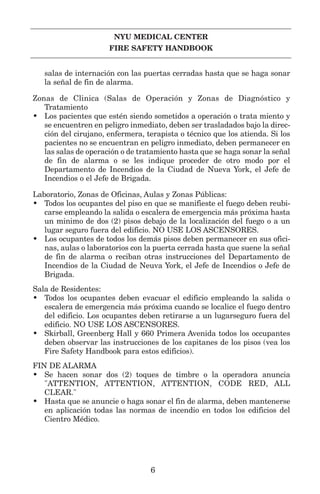
ALL CLEAR
• Two (2) bells are sounded or the operator announces, "ATTENTION,
ATTENTION, ATTENTION, CODE RED, ALL CLEAR.”
• Until the "All Clear" is announced or sounded, all fire emergency pro-
tocols must remain in effect throughout the Medical Center complex.
4
NYU MEDICAL CENTER
FIRE SAFETY HANDBOOK
INSTRUCCIONES GENERALES PARA EMERGENCIAS
DE INCENDIO
Al descrubrir o sospechar un incendio:
ACCIONE LA ARMA DE INCENDIO MAS CERCANA
Para accionar la alarma:
• Abra la puerta de la caja de alarma.
• Tire de la palanca completamente.
• Suelte la palanca.
LLAME A COMUNICACIONES
Para llamar a comunicaciones:
• Marque el 33911.
• Indique a la operadora el lugar del fuego o del humo; incluya la infor-
mación sobre el edificio, el piso y el número de habitación.
• Indique su propio nombre y extensión.
APLIQUE LAS NORMAS DE INCENDIOS
• Diga las frase en codigo, “Code Rojo” la cual significa "Fuego"; en caso
de emergencia. Nunca diga fuego o incendio durante una emergencia.
• Retire a todas las personas que estén en peligro inmediato a una zona
segura lejos del fuego.
• Cierre todas las puertas y ventanas de la zona para evitar la difusión
del fuego y del humo.
• Apague todos los equipos eléctricos, como máquinas de escribir, copi-
adoras y aparatos clínicos que no sean esenciales.
DEJE ENCENDIDAS LAS LUCES.
• Retire los tanques de gas y los liquidos inflamables de la proximidad
inmediata del fuego.
• Emplee los extintores de tipo adecuado para combatir el fuego. (Vea
páginas 20-23 para descripción de uso apropiado de extintores.)
• NOTA: Los extintores sólo son eficaces contra fuegos pequeños, como
los de una papelera, que pueden extinguirse rápidamente. NO COM-
BATA EL FUEGO USTED SOLO.
EVACUACION
Pisos de pacientes:
• Los pacientes serán reubicados únicamente cuando lo considere nece-
sario el Departamento de Incendios de la Ciudad de Nueva York, el Jefe
de Incendios, el Administrador de servicio o la Enfermera responsable.
De lo contrario, los pacientes y visitantes deben permanecer en las
5
NYU MEDICAL CENTER
FIRE SAFETY HANDBOOK
salas de internación con las puertas cerradas hasta que se haga sonar
la señal de fin de alarma.
Zonas de Clinica (Salas de Operación y Zonas de Diagnóstico y
Tratamiento
• Los pacientes que estén siendo sometidos a operación o trata miento y
se encuentren en peligro inmediato, deben ser trasladados bajo la direc-
ción del cirujano, enfermera, terapista o técnico que los atienda. Si los
pacientes no se encuentran en peligro inmediato, deben permanecer en
las salas de operación o de tratamiento hasta que se haga sonar la señal
de fin de alarma o se les indique proceder de otro modo por el
Departamento de Incendios de la Ciudad de Nueva York, el Jefe de
Incendios o el Jefe de Brigada.
Laboratorio, Zonas de Oficinas, Aulas y Zonas Públicas:
• Todos los ocupantes del piso en que se manifieste el fuego deben reubi-
carse empleando la salida o escalera de emergencia más próxima hasta
un minimo de dos (2) pisos debajo de la localización del fuego o a un
lugar seguro fuera del edificio. NO USE LOS ASCENSORES.
• Los ocupantes de todos los demás pisos deben permanecer en sus ofici-
nas, aulas o laboratorios con la puerta cerrada hasta que suene la señal
de fin de alarma o reciban otras instrucciones del Departamento de
Incendios de la Ciudad de Neuva York, el Jefe de Incendios o Jefe de
Brigada.
Sala de Residentes:
• Todos los ocupantes deben evacuar el edificio empleando la salida o
escalera de emergencia más próxima cuando se localice el fuego dentro
del edificio. Los ocupantes deben retirarse a un lugarseguro fuera del
edificio. NO USE LOS ASCENSORES.
• Skirball, Greenberg Hall y 660 Primera Avenida todos los occupantes
deben observar las instrucciones de los capitanes de los pisos (vea los
Fire Safety Handbook para estos edificios).
FIN DE ALARMA
• Se hacen sonar dos (2) toques de timbre o la operadora anuncia
"ATTENTION, ATTENTION, ATTENTION, CODE RED, ALL
CLEAR."
• Hasta que se anuncie o haga sonar el fin de alarma, deben mantenerse
en aplicación todas las normas de incendio en todos los edificios del
Cientro Médico.
6
NYU MEDICAL CENTER
FIRE SAFETY HANDBOOK
SPECIFIC ASSIGNMENTS
COMMUNICATIONS
Upon notification of a fire within the Medical Center or other property
located within New York City, the following actions should be taken:
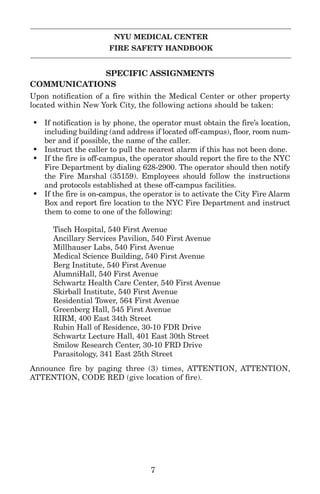
• If notification is by phone, the operator must obtain the fire’s location,
including building (and address if located off-campus), floor, room num-
ber and if possible, the name of the caller.
• Instruct the caller to pull the nearest alarm if this has not been done.
• If the fire is off-campus, the operator should report the fire to the NYC
Fire Department by dialing 628-2900. The operator should then notify
the Fire Marshal (35159). Employees should follow the instructions
and protocols established at these off-campus facilities.
• If the fire is on-campus, the operator is to activate the City Fire Alarm
Box and report fire location to the NYC Fire Department and instruct
them to come to one of the following:
Tisch Hospital, 540 First Avenue
Ancillary Services Pavilion, 540 First Avenue
Millhauser Labs, 540 First Avenue
Medical Science Building, 540 First Avenue
Berg Institute, 540 First Avenue
AlumniHall, 540 First Avenue
Schwartz Health Care Center, 540 First Avenue
Skirball Institute, 540 First Avenue
Residential Tower, 564 First Avenue
Greenberg Hall, 545 First Avenue
RIRM, 400 East 34th Street
Rubin Hall of Residence, 30-10 FDR Drive
Schwartz Lecture Hall, 401 East 30th Street
Smilow Research Center, 30-10 FRD Drive
Parasitology, 341 East 25th Street
Announce fire by paging three (3) times, ATTENTION, ATTENTION,
ATTENTION, CODE RED (give location of fire).
7
NYU MEDICAL CENTER
FIRE SAFETY HANDBOOK
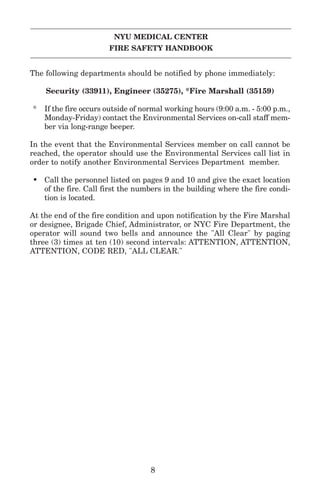
The following departments should be notified by phone immediately:
Security (33911), Engineer (35275), *Fire Marshall (35159)
* If the fire occurs outside of normal working hours (9:00 a.m. - 5:00 p.m.,
Monday-Friday) contact the Environmental Services on-call staff mem-
ber via long-range beeper.
In the event that the Environmental Services member on call cannot be
reached, the operator should use the Environmental Services call list in
order to notify another Environmental Services Department member.
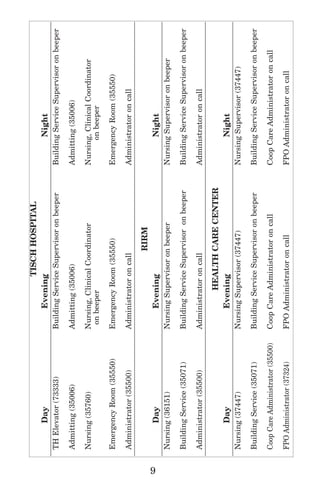
• Call the personnel listed on pages 9 and 10 and give the exact location
of the fire. Call first the numbers in the building where the fire condi-
tion is located.
At the end of the fire condition and upon notification by the Fire Marshal
or designee, Brigade Chief, Administrator, or NYC Fire Department, the
operator will sound two bells and announce the "All Clear" by paging
three (3) times at ten (10) second intervals: ATTENTION, ATTENTION,
ATTENTION, CODE RED, "ALL CLEAR."
8
9
TISCHHOSPITAL
DayEveningNight
THElevator(73333)BuildingServiceSupervisoronbeeperBuildingServiceSupervisoronbeeper
Admitting(35006)Admitting(35006)Admitting(35006)
Nursing(35760)Nursing,ClinicalCoordinatorNursing,ClinicalCoordinator
onbeeperonbeeper
EmergencyRoom(35550)EmergencyRoom(35550)EmergencyRoom(35550)
Administrator(35500)AdministratoroncallAdministratoroncall
RIRM
DayEveningNight
Nursing(36151)NursingSupervisoronbeeperNursingSupervisoronbeeper
BuildingService(35071)BuildingServiceSupervisoronbeeperBuildingServiceSupervisoronbeeper
Administrator(35500)AdministratoroncallAdministratoroncall
HEALTHCARECENTER
DayEveningNight
Nursing(37447)NursingSupervisor(37447)NursingSupervisor(37447)
BuildingService(35071)BuildingServiceSupervisoronbeeperBuildingServiceSupervisoronbeeper
CoopCareAdministrator(35500)CoopCareAdministratoroncallCoopCareAdministratoroncall
FPOAdministrator(37324)FPOAdministratoroncallFPOAdministratoroncall
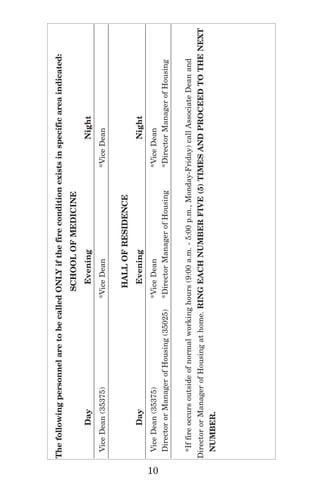
10
ThefollowingpersonnelaretobecalledONLYifthefireconditionexistsinspecificareaindicated:
SCHOOLOFMEDICINE
DayEveningNight
ViceDean(35375)*ViceDean*ViceDean
HALLOFRESIDENCE
DayEveningNight
ViceDean(35375)*ViceDean*ViceDean
DirectororManagerofHousing(35025)*DirectorManagerofHousing*DirectorManagerofHousing
*Iffireoccursoutsideofnormalworkinghours(9:00a.m.-5:00p.m.,Monday-Friday)callAssociateDeanand
DirectororManagerofHousingathome.RINGEACHNUMBERFIVE(5)TIMESANDPROCEEDTOTHENEXT
NUMBER.
NYU MEDICAL CENTER
FIRE SAFETY HANDBOOK
SPECIFIC ASSIGNMENTS
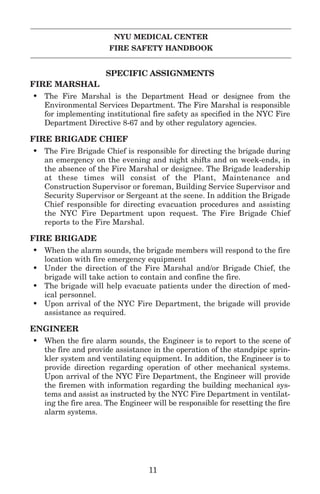
FIRE MARSHAL
• The Fire Marshal is the Department Head or designee from the
Environmental Services Department. The Fire Marshal is responsible
for implementing institutional fire safety as specified in the NYC Fire
Department Directive 8-67 and by other regulatory agencies.
FIRE BRIGADE CHIEF
• The Fire Brigade Chief is responsible for directing the brigade during
an emergency on the evening and night shifts and on week-ends, in
the absence of the Fire Marshal or designee. The Brigade leadership
at these times will consist of the Plant, Maintenance and
Construction Supervisor or foreman, Building Service Supervisor and
Security Supervisor or Sergeant at the scene. In addition the Brigade
Chief responsible for directing evacuation procedures and assisting
the NYC Fire Department upon request. The Fire Brigade Chief
reports to the Fire Marshal.
FIRE BRIGADE
• When the alarm sounds, the brigade members will respond to the fire
location with fire emergency equipment
• Under the direction of the Fire Marshal and/or Brigade Chief, the
brigade will take action to contain and confine the fire.
• The brigade will help evacuate patients under the direction of med-
ical personnel.
• Upon arrival of the NYC Fire Department, the brigade will provide
assistance as required.
ENGINEER
• When the fire alarm sounds, the Engineer is to report to the scene of
the fire and provide assistance in the operation of the standpipc sprin-
kler system and ventilating equipment. In addition, the Engineer is to
provide direction regarding operation of other mechanical systems.
Upon arrival of the NYC Fire Department, the Engineer will provide
the firemen with information regarding the building mechanical sys-
tems and assist as instructed by the NYC Fire Department in ventilat-
ing the fire area. The Engineer will be responsible for resetting the fire
alarm systems.
11
NYU MEDICAL CENTER
FIRE SAFETY HANDBOOK
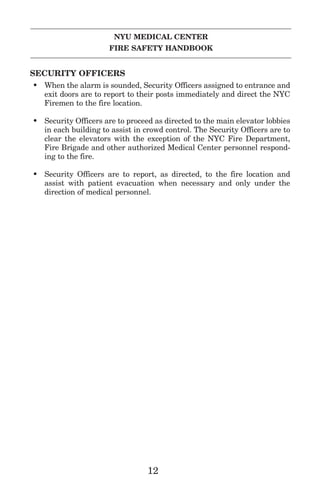
SECURITY OFFICERS
• When the alarm is sounded, Security Officers assigned to entrance and
exit doors are to report to their posts immediately and direct the NYC
Firemen to the fire location.
• Security Officers are to proceed as directed to the main elevator lobbies
in each building to assist in crowd control. The Security Officers are to
clear the elevators with the exception of the NYC Fire Department,
Fire Brigade and other authorized Medical Center personnel respond-
ing to the fire.
• Security Officers are to report, as directed, to the fire location and
assist with patient evacuation when necessary and only under the
direction of medical personnel.
12
NYU MEDICAL CENTER
FIRE SAFETY HANDBOOK
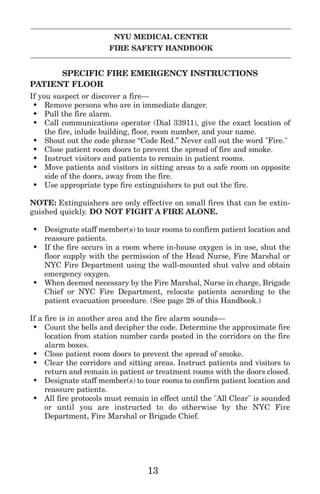
SPECIFIC FIRE EMERGENCY INSTRUCTIONS
PATIENT FLOOR
If you suspect or discover a fire—
• Remove persons who are in immediate danger.
• Pull the fire alarm.
• Call communications operator (Dial 33911), give the exact location of
the fire, inlude building, floor, room number, and your name.
• Shout out the code phrase “Code Red.” Never call out the word "Fire."
• Close patient room doors to prevent the spread of fire and smoke.
• Instruct visitors and patients to remain in patient rooms.
• Move patients and visitors in sitting areas to a safe room on opposite
side of the doors, away from the fire.
• Use appropriate type fire extinguishers to put out the fire.
NOTE: Extinguishers are only effective on small fires that can be extin-
guished quickly. DO NOT FIGHT A FIRE ALONE.
• Designate staff member(s) to tour rooms to confirm patient location and
reassure patients.
• If the fire occurs in a room where in-house oxygen is in use, shut the
floor supply with the permission of the Head Nurse, Fire Marshal or
NYC Fire Department using the wall-mounted shut valve and obtain
emergency oxygen.
• When deemed necessary by the Fire Marshal, Nurse in charge, Brigade
Chief or NYC Fire Department, relocate patients according to the
patient evacuation procedure. (See page 28 of this Handbook.)
If a fire is in another area and the fire alarm sounds—
• Count the bells and decipher the code. Determine the approximate fire
location from station number cards posted in the corridors on the fire
alarm boxes.
• Close patient room doors to prevent the spread of smoke.
• Clear the corridors and sitting areas. Instruct patients and visitors to
return and remain in patient or treatment rooms with the doors closed.
• Designate staff member(s) to tour rooms to confirm patient location and
reassure patients.
• All fire protocols must remain in effect until the "All Clear" is sounded
or until you are instructed to do otherwise by the NYC Fire
Department, Fire Marshal or Brigade Chief.
13
NYU MEDICAL CENTER
FIRE SAFETY HANDBOOK
SPECIFIC FIRE EMERGENCY INSTRUCTIONS
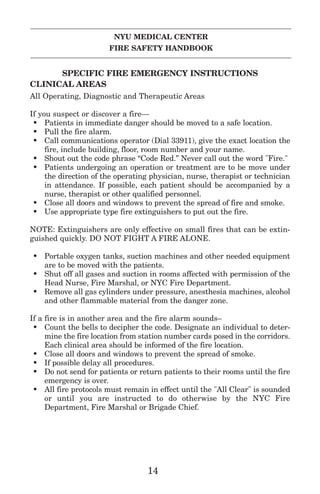
CLINICAL AREAS
All Operating, Diagnostic and Therapeutic Areas
If you suspect or discover a fire—
• Patients in immediate danger should be moved to a safe location.
• Pull the fire alarm.
• Call communications operator (Dial 33911), give the exact location the
fire, include building, floor, room number and your name.
• Shout out the code phrase “Code Red.” Never call out the word "Fire."
• Patients undergoing an operation or treatment are to be move under
the direction of the operating physician, nurse, therapist or technician
in attendance. If possible, each patient should be accompanied by a
nurse, therapist or other qualified personnel.
• Close all doors and windows to prevent the spread of fire and smoke.
• Use appropriate type fire extinguishers to put out the fire.
NOTE: Extinguishers are only effective on small fires that can be extin-
guished quickly. DO NOT FIGHT A FIRE ALONE.
• Portable oxygen tanks, suction machines and other needed equipment
are to be moved with the patients.
• Shut off all gases and suction in rooms affected with permission of the
Head Nurse, Fire Marshal, or NYC Fire Department.
• Remove all gas cylinders under pressure, anesthesia machines, alcohol
and other flammable material from the danger zone.
If a fire is in another area and the fire alarm sounds–
• Count the bells to decipher the code. Designate an individual to deter-
mine the fire location from station number cards posed in the corridors.
Each clinical area should be informed of the fire location.
• Close all doors and windows to prevent the spread of smoke.
• If possible delay all procedures.
• Do not send for patients or return patients to their rooms until the fire
emergency is over.
• All fire protocols must remain in effect until the "All Clear" is sounded
or until you are instructed to do otherwise by the NYC Fire
Department, Fire Marshal or Brigade Chief.
14
NYU MEDICAL CENTER
FIRE SAFETY HANDBOOK
SPECIFIC FIRE EMERGENCY INSTRUCTIONS
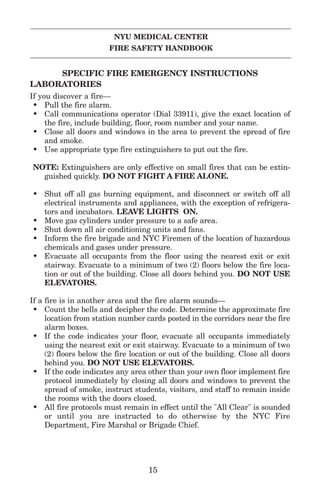
LABORATORIES
If you discover a fire—
• Pull the fire alarm.
• Call communications operator (Dial 33911), give the exact location of
the fire, include building, floor, room number and your name.
• Close all doors and windows in the area to prevent the spread of fire
and smoke.
• Use appropriate type fire extinguishers to put out the fire.
NOTE: Extinguishers are only effective on small fires that can be extin-
guished quickly. DO NOT FIGHT A FIRE ALONE.
• Shut off all gas burning equipment, and disconnect or switch off all
electrical instruments and appliances, with the exception of refrigera-
tors and incubators. LEAVE LIGHTS ON.
• Move gas cylinders under pressure to a safe area.
• Shut down all air conditioning units and fans.
• Inform the fire brigade and NYC Firemen of the location of hazardous
chemicals and gases under pressure.
• Evacuate all occupants from the floor using the nearest exit or exit
stairway. Evacuate to a minimum of two (2) floors below the fire loca-
tion or out of the building. Close all doors behind you. DO NOT USE
ELEVATORS.
If a fire is in another area and the fire alarm sounds—
• Count the bells and decipher the code. Determine the approximate fire
location from station number cards posted in the corridors near the fire
alarm boxes.
• If the code indicates your floor, evacuate all occupants immediately
using the nearest exit or exit stairway. Evacuate to a minimum of two
(2) floors below the fire location or out of the building. Close all doors
behind you. DO NOT USE ELEVATORS.
• If the code indicates any area other than your own floor implement fire
protocol immediately by closing all doors and windows to prevent the
spread of smoke, instruct students, visitors, and staff to remain inside
the rooms with the doors closed.
• All fire protocols must remain in effect until the "All Clear" is sounded
or until you are instructed to do otherwise by the NYC Fire
Department, Fire Marshal or Brigade Chief.
15
NYU MEDICAL CENTER
FIRE SAFETY HANDBOOK
SPECIFIC FIRE EMERGENCY INSTRUCTIONS
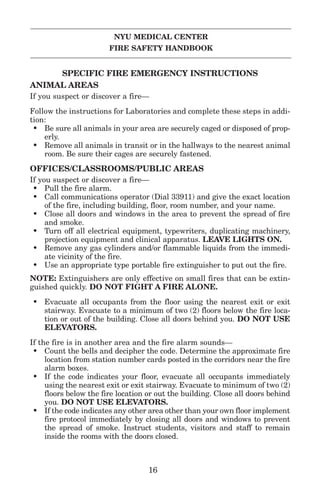
ANIMAL AREAS
If you suspect or discover a fire—
Follow the instructions for Laboratories and complete these steps in addi-
tion:
• Be sure all animals in your area are securely caged or disposed of prop-
erly.
• Remove all animals in transit or in the hallways to the nearest animal
room. Be sure their cages are securely fastened.
OFFICES/CLASSROOMS/PUBLIC AREAS
If you suspect or discover a fire—
• Pull the fire alarm.
• Call communications operator (Dial 33911) and give the exact location
of the fire, including building, floor, room number, and your name.
• Close all doors and windows in the area to prevent the spread of fire
and smoke.
• Turn off all electrical equipment, typewriters, duplicating machinery,
projection equipment and clinical apparatus. LEAVE LIGHTS ON.
• Remove any gas cylinders and/or flammable liquids from the immedi-
ate vicinity of the fire.
• Use an appropriate type portable fire extinguisher to put out the fire.
NOTE: Extinguishers are only effective on small fires that can be extin-
guished quickly. DO NOT FIGHT A FIRE ALONE.
• Evacuate all occupants from the floor using the nearest exit or exit
stairway. Evacuate to a minimum of two (2) floors below the fire loca-
tion or out of the building. Close all doors behind you. DO NOT USE
ELEVATORS.
If the fire is in another area and the fire alarm sounds—
• Count the bells and decipher the code. Determine the approximate fire
location from station number cards posted in the corridors near the fire
alarm boxes.
• If the code indicates your floor, evacuate all occupants immediately
using the nearest exit or exit stairway. Evacuate to minimum of two (2)
floors below the fire location or out the building. Close all doors behind
you. DO NOT USE ELEVATORS.
• If the code indicates any other area other than your own floor implement
fire protocol immediately by closing all doors and windows to prevent
the spread of smoke. Instruct students, visitors and staff to remain
inside the rooms with the doors closed.
16
NYU MEDICAL CENTER
FIRE SAFETY HANDBOOK
SPECIFIC FIRE EMERGENCY INSTRUCTIONS
• All fire protocols must remain in effect until the "All Clear" is sounded
or until you are instructed to do otherwise by the NYC Fire
Department, Fire Marshal or Brigade Chief.
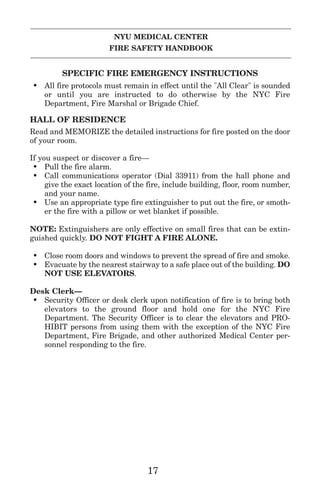
HALL OF RESIDENCE
Read and MEMORIZE the detailed instructions for fire posted on the door
of your room.
If you suspect or discover a fire—
• Pull the fire alarm.
• Call communications operator (Dial 33911) from the hall phone and
give the exact location of the fire, include building, floor, room number,
and your name.
• Use an appropriate type fire extinguisher to put out the fire, or smoth-
er the fire with a pillow or wet blanket if possible.
NOTE: Extinguishers are only effective on small fires that can be extin-
guished quickly. DO NOT FIGHT A FIRE ALONE.
• Close room doors and windows to prevent the spread of fire and smoke.
• Evacuate by the nearest stairway to a safe place out of the building. DO
NOT USE ELEVATORS.
Desk Clerk—
• Security Officer or desk clerk upon notification of fire is to bring both
elevators to the ground floor and hold one for the NYC Fire
Department. The Security Officer is to clear the elevators and PRO-
HIBIT persons from using them with the exception of the NYC Fire
Department, Fire Brigade, and other authorized Medical Center per-
sonnel responding to the fire.
17
NYU MEDICAL CENTER
FIRE SAFETY HANDBOOK
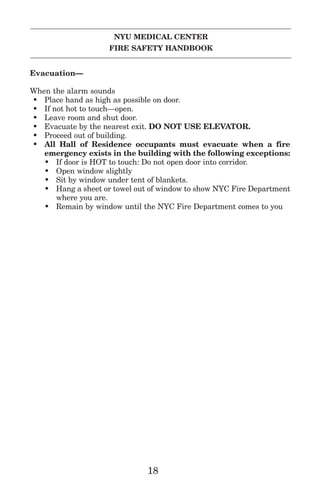
Evacuation—
When the alarm sounds
• Place hand as high as possible on door.
• If not hot to touch—open.
• Leave room and shut door.
• Evacuate by the nearest exit. DO NOT USE ELEVATOR.
• Proceed out of building.
• All Hall of Residence occupants must evacuate when a fire
emergency exists in the building with the following exceptions:
• If door is HOT to touch: Do not open door into corridor.
• Open window slightly
• Sit by window under tent of blankets.
• Hang a sheet or towel out of window to show NYC Fire Department
where you are.
• Remain by window until the NYC Fire Department comes to you
18
NYU MEDICAL CENTER
FIRE SAFETY HANDBOOK
ADDITIONAL FIRE SAFETY INFORMATION
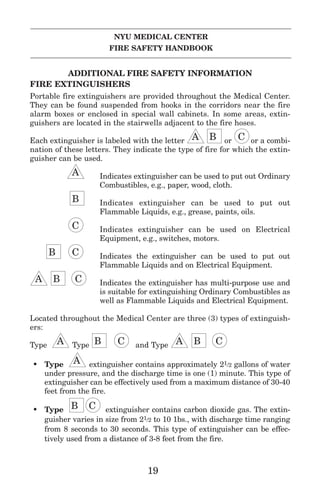
FIRE EXTINGUISHERS
Portable fire extinguishers are provided throughout the Medical Center.
They can be found suspended from hooks in the corridors near the fire
alarm boxes or enclosed in special wall cabinets. In some areas, extin-
guishers are located in the stairwells adjacent to the fire hoses.
Each extinguisher is labeled with the letter LLA IIB or GGC or a combi-
nation of these letters. They indicate the type of fire for which the extin-
guisher can be used.
LLA Indicates extinguisher can be used to put out Ordinary
Combustibles, e.g., paper, wood, cloth.
IIB Indicates extinguisher can be used to put out
Flammable Liquids, e.g., grease, paints, oils.
GGC Indicates extinguisher can be used on Electrical
Equipment, e.g., switches, motors.
IIB GGC Indicates the extinguisher can be used to put out
Flammable Liquids and on Electrical Equipment.
LLA IIB GGC Indicates the extinguisher has multi-purpose use and
is suitable for extinguishing Ordinary Combustibles as
well as Flammable Liquids and Electrical Equipment.
Located throughout the Medical Center are three (3) types of extinguish-
ers:
Type LLA Type IIB GGC and Type LLA IIB GGC
• Type LLA extinguisher contains approximately 21/2 gallons of water
under pressure, and the discharge time is one (1) minute. This type of
extinguisher can be effectively used from a maximum distance of 30-40
feet from the fire.
• Type IIB GGC extinguisher contains carbon dioxide gas. The extin-
guisher varies in size from 21/2 to 10 1bs., with discharge time ranging
from 8 seconds to 30 seconds. This type of extinguisher can be effec-
tively used from a distance of 3-8 feet from the fire.
19
NYU MEDICAL CENTER
FIRE SAFETY HANDBOOK
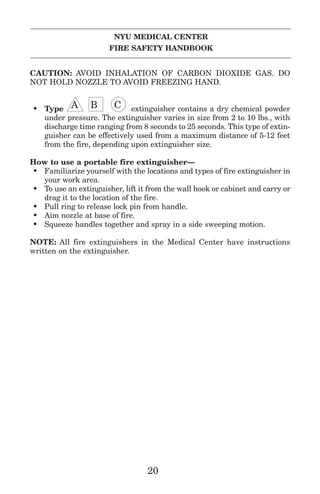
CAUTION: AVOID INHALATION OF CARBON DIOXIDE GAS. DO
NOT HOLD NOZZLE TO AVOID FREEZING HAND.
• Type LLA IIB GGC extinguisher contains a dry chemical powder
under pressure. The extinguisher varies in size from 2 to 10 lbs., with
discharge time ranging from 8 seconds to 25 seconds. This type of extin-
guisher can be effectively used from a maximum distance of 5-12 feet
from the fire, depending upon extinguisher size.
How to use a portable fire extinguisher—
• Familiarize yourself with the locations and types of fire extinguisher in
your work area.
• To use an extinguisher, lift it from the wall hook or cabinet and carry or
drag it to the location of the fire.
• Pull ring to release lock pin from handle.
• Aim nozzle at base of fire.
• Squeeze handles together and spray in a side sweeping motion.
NOTE: All fire extinguishers in the Medical Center have instructions
written on the extinguisher.
20
NYU MEDICAL CENTER
FIRE SAFETY HANDBOOK
INFORMACION COMPLEMENTARIA SOBRE
LA SEGURIDAD CONTRA INCENDIOS
EXTINTORES
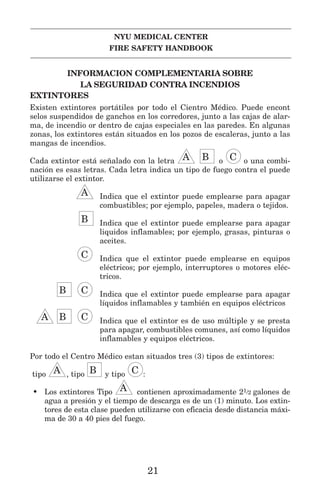
Existen extintores portátiles por todo el Cientro Médico. Puede encont
selos suspendidos de ganchos en los corredores, junto a las cajas de alar-
ma, de incendio or dentro de cajas especiales en las paredes. En algunas
zonas, los extintores están situados en los pozos de escaleras, junto a las
mangas de incendios.
Cada extintor está señalado con la letra LLA IIB o GGC o una combi-
nación es esas letras. Cada letra indica un tipo de fuego contra el puede
utilizarse el extintor.
LLA Indica que el extintor puede emplearse para apagar
combustibles; por ejemplo, papeles, madera o tejidos.
IIB Indica que el extintor puede emplearse para apagar
liquidos inflamables; por ejemplo, grasas, pinturas o
aceites.
GGC Indica que el extintor puede emplearse en equipos
eléctricos; por ejemplo, interruptores o motores eléc-
tricos.
IIB GGC Indica que el extintor puede emplearse para apagar
líquidos inflamables y también en equipos eléctricos
LLA IIB GGC Indica que el extintor es de uso múltiple y se presta
para apagar, combustibles comunes, así como líquidos
inflamables y equipos eléctricos.
Por todo el Centro Médico estan situados tres (3) tipos de extintores:
tipo LLA , tipo IIB y tipo GGC :
• Los extintores Tipo LLA contienen aproximadamente 21/2 galones de
agua a presión y el tiempo de descarga es de un (1) minuto. Los extin-
tores de esta clase pueden utilizarse con eficacia desde distancia máxi-
ma de 30 a 40 pies del fuego.
21
NYU MEDICAL CENTER
FIRE SAFETY HANDBOOK
• Los extintores Tipo IIB GGC contienen gas de dioxido de ( bon. Los
extintor varián de tamaño entre las 21/2 y las 10 1ibras, con tiempo de
descarga de entre 8 segundos a 30 segundos. Este tipo extintor puede
utilizarse con eficacia desde una distancia de 3 pies del fuego.
ADVERTENCIA: Evítese la inhalación de gas dióxido de carbón. NO
TOME EN SUS MANOS LA BOQUILLA, PARA EVITAR CONGELA-
CION.
• Los extintores Tipo LLA IIB GGC contienen una substancia química
en polvo, bajo presión. El tamano de los extintores varia entre 2 a 10
Libras, con un tiempo de descarga de entre 8 a segundos. Esta clase de
extintor puede utilizarse con eficacia de una distancia máxima de entre
5 a 12 pies del fuego, según volumen del extintor.
Como emplear un extintor portátil
• Familiarícese con los locales y las clases de extintores que encuentran
en su zona de trabajo.
• Para utilizar un extintor, retirelo del gancho de pared o de la caja
llévelo o arrástrelo hasta el lugar del fuego.
• Tire del aro para soltar la traba del asa.
• Dirija la boquilla hacia la base del fuego.
• Sostenga las dos asas apretándo las juntas y lance el chorro con un
movimiento lateral de barrido.
NOTA: Todos los extintores en el Cientro Médico llevan instrucciones
escritas.
22
NYU MEDICAL CENTER
FIRE SAFETY HANDBOOK
ELEVATOR USE DURING A FIRE EMERGENCY
• Elevator use during a fire emergency is PROHIBITED with the excep-
tion of the NYC Fire Department, Fire Brigade, Fire Marshal and
authorized Medical Center personnel responding to the fire.
• When possible use the stairs to reach the fire location.
• If elevator use is necessary for responding to a fire emergency, DO
NOT ride the elevator to the fire location. Stop at least two (2) floors
below, and walk up the stairs to gain access to the fire floor. DO NOT
use the elevator unless it is being operated manually with a key.
USO DE ASCENSORES EN EMERGENCIAS DE INCENDIO
• El uso de ascensores durante las emergencias de incendio está PRO-
HIBIDO, con la excepción del Departamento de Incendios de la Ciudad
de Nueva York, la Brigada de Incendios, el Jefe de Incendios y el per-
sonal autorizado del Cientro Médico que acuda para combatir el fuego.
• Si el uso de los ascensores es necesario para responder a una emergen-
cia de incendio, NO VA YA en ascensor hasta el lugar del fuego.
Deténgalo por lo menos dos (2) pisos debajo del lugar del fuego y camine
por las escaleras para llegar al piso del incendio. NO USE ascensores a
menos que estén accionados manualmente con llave.
23
NYU MEDICAL CENTER
FIRE SAFETY HANDBOOK
FIRE SAFETY AWARENESS
Follow and enforce these rules:
• Smoking is not permitted in any Medical Center building.
• Do not store oxygen with any flammable gas.
• Never lock or obstruct an exit or fire door.
• Do not keep doors open with makeshift wedges.
• Do not block corridors with equipment.
• Check fire doors frequently to make sure they open easily.
• Store all chemicals in air-tight containers.
• Flammable or explosive material requiring refrigeration must be
stored in an approved explosion-proof type refrigerator.
• Do not discard pressurized containers, empty containers used to store
flammable substances or like material with burnable rubbish.
• Do not use multiple plugs in electrical outlets.
• Do not overload electrical circuits with portable appliances, such as
radios, heaters, fans, laboratory equipment and air conditioners.
• Disconnect and report at once all faulty electrical appliances, frayed
electrical cords, defective switches, plugs and electrical outlets.
• Have all new electrical appliances checked by the Facilities
Maintenance Department or Clinical Engineering Department before
using.
24
NYU MEDICAL CENTER
FIRE SAFETY HANDBOOK
NORMAS DE SEGURIDAD CONTRA INCENDIOS
Siga la siguientes reglas y hágalas aplicar:
• Fume únicamente en los lugares oficialmente indicados para ello.
• No guarde oxígeno junto con ningún gas inflammable.
• Nunca cierre bajo llave ni obstruya puertas de salida o de incendio.
• No utilice cuñas para mantener abiertas las puertas.
• No bloquee los corredores con equipos.
• Verifique con frecuencia que las puertas de incendio se abran fácil-
mente.
• Guarde todos los productos químicos en recipientes herméticos.
• Los materiales inflamables o explosivos que requieran refrigeración
deben guardarse en refrigeradores a prueba de explosiones.
• No tire envases bajo presión, latas de aceite vacias ni materiales simi-
lares, con desechos combustibles.
• No utilice enchufes múltiples en los tomaccorientes.
• No sobrecargue los circuitos eléctricos con aparatos portátiles como
radios, calentadores, ventiladores, equipos de laboratorio y acondi-
cionadores de aire.
• Desconecte y denuncie de inmediato cualquier aparato eléctrico que
tenga desperfectos, cables eléctricos mal aislados, e interruptores,
enchufes o tomacorrientes defectuosos.
• Haga comprobar todos los apartos eléctricos por el Departamento de
Planta y Mantenimiento o por el Departamento de Ingeniería Clinica
antes de utilizarlos.
25
NYU MEDICAL CENTER
FIRE SAFETY HANDBOOK
SMOKING
The Medical Center Administration expects compliance from all staff,
patients and visitors regarding its rules and regulations governing smok-
ing. Persons violating this policy are subject to a fine by New York City
and disciplinary action by NYU Medical Center.
Smoking is prohibited in all indoor and outdoor areas of the Medical
Center. Any exceptions to the prohibition are to be authorized for a
patient by a physician's written order based on medical criteria.
26
NYU MEDICAL CENTER
FIRE SAFETY HANDBOOK
CONDICIONES PARA FUMAR
LAS NORMAS
La Administración de Cientro Médico espera que todo el personal, todos
los pacientes y visitantes acaten sus normas y reglamentaciones sobre
condiciones para fumar. Las personas que violen estas normas seran pasi-
bles de multa por la Ciudad de Nueva York y medidas disciplinarias del
Cientro Médico de la NYU.
Esta prohibido fumar adentro de todas las zonas del Cientro Médico, y
alguna excepción a esta prohibición necesita estar autorizadas en escrito
por el doctor dando ordena sobre criteria médico para el pasiente.
Las siguientes zonas estan designadas como LIBRES DE FUMAR. No se
permitira fumar en esos lugares en ninguna circumstancia.
27
NYU MEDICAL CENTER
FIRE SAFETY HANDBOOK
PATIENT EVACUATION PROCEDURE
Patient evacuation in a hospital is determined by the proximity and
severity of the fire or smoke condition. The following steps provide basic
guidelines for relocating patients. However, the fire condition will ulti-
mately determine the extent of the patient relocation.
• Step 1
Patients in immediate danger should be moved first.
• Step 2
Horizontal movement—move patients laterally on the floor to the other
side of the fire doors.
• Step 3
Vertical movement—ambulatory patients should be led down the stairs
and relocated to a safe area at least two (2) floors below the fire loca-
tion when possible. Non-ambulatory patients should be transported by
elevator only on the orders of the NYC Fire Department. Patients
should be relocated to two (2) floors below the fire location when possi-
ble. Elevators being used for relocation purposes should not travel past
the fire location if at all possible.
• Step 4
If necessary Tisch Hospital cafeteria or Alumni Hall can be utilized as
patient holding areas. Evacuation out of the building should be a last
resort. Follow the instruction in the NYUMC Emergency Evacuation
Plan.
28
NYU MEDICAL CENTER
FIRE SAFETY HANDBOOK
PROCEDIMIENTO PARA LA EVACUACION DE PACIENTES
La evacuación de los pacientes de un hospital se determina según la prox-
imidad y gravedad del fuego o del humo. Las etapas siguientes ofrecen
directivas para la reubicación de pacientes. Sin embargo, el alcance de la
reubicación de los pacientes se determinará en última instancia por las
características del fuego.
• Etapa 1
Los pacientes en peligro inminente deben ser reubicados primero.
• Etapa 2
Movimiento horizontal; desplácese a los pacientes lateralmente en piso
al otro lado de las puertas de incendio.
• Etapa 3
Movimiento vertical: Los pacientes en condiciones de caminar deben
ser conducidos hacia abajo por las escaleras y reubicados a una zona
segura que esté por lo menos dos (2) pisos por debajo del lugar del fuego,
siempre que sea posible. Los pacientes que no estén en condiciones de
caminar deben ser transportados en ascensor únicamente si ascensor
no se encuentra en peligro inmediato de fuego y está accionado con
llave. Los pacientes deben ser reubicados a por lo menos dos (2) pisos
por debajo del lugar del fuego siempre que sea posible. Los ascensores
que se utilicen para fines de reubicación no deben pasar por el nivel en
que se produce el fuego siempre que sea posible evitarlo.
• Etapa 4
En caso de necesidad, pueden utilizarse como zonas de concentración de
pacientes la cafetería del Hospital Universitario y la Sala de Graduados
(Alumni Hall). Debe efectuarse la evacuación fuera del edificio como
último recurso.
29
NYU MEDICAL CENTER
FIRE SAFETY HANDBOOK
EMERGENCY PATIENT REMOVAL CARRIES
Patients in immediate danger of fire or smoke must be moved to a safe
area as quickly as possible. Removal of patients by bed or mattress is a
time consuming and cumbersome process and often impossible.
Therefore, it is recommended that patient removal carries be implement-
ed as a time-saving and thus life-saving technique to evacuate patients.
The following carries have been selected on the basis of their lifting and
carrying advantages.
When utilizing the carries remember patients should be hugged firmly to
the carrier’s body. The carrier should use his or her own body and the
patient’s body to support the latter’s weight. These emergency patient
removal carries, if executed properly, distribute a patient’s weight over all
the carrier’s body, rather than concentrating it on his or her hands and
arms alone.
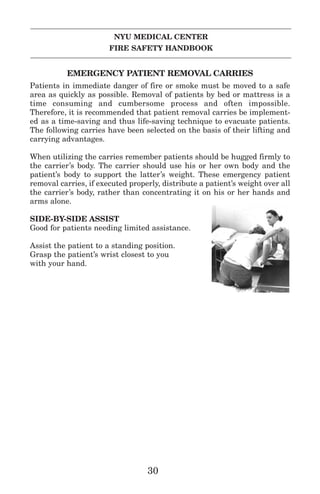
SIDE-BY-SIDE ASSIST
Good for patients needing limited assistance.
Assist the patient to a standing position.
Grasp the patient’s wrist closest to you
with your hand.
30
NYU MEDICAL CENTER
FIRE SAFETY HANDBOOK
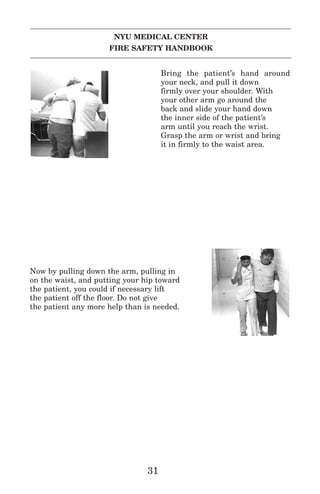
Bring the patient’s hand around
your neck, and pull it down
firmly over your shoulder. With
your other arm go around the
back and slide your hand down
the inner side of the patient’s
arm until you reach the wrist.
Grasp the arm or wrist and bring
it in firmly to the waist area.
Now by pulling down the arm, pulling in
on the waist, and putting your hip toward
the patient, you could if necessary lift
the patient off the floor. Do not give
the patient any more help than is needed.
31
NYU MEDICAL CENTER
FIRE SAFETY HANDBOOK
SWING CARRY
The swing carry is good for evacuating any weight patient, and moving a
patient down a stairway. The swing carry utilizes a cradle of interlocked
arms and wrists and is useful for moving heavy patients long distances.
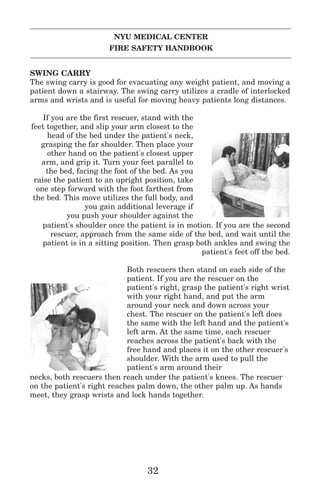
If you are the first rescuer, stand with the
feet together, and slip your arm closest to the
head of the bed under the patient's neck,
grasping the far shoulder. Then place your
other hand on the patient's closest upper
arm, and grip it. Turn your feet parallel to
the bed, facing the foot of the bed. As you
raise the patient to an upright position, take
one step forward with the foot farthest from
the bed. This move utilizes the full body, and
you gain additional leverage if
you push your shoulder against the
patient's shoulder once the patient is in motion. If you are the second
rescuer, approach from the same side of the bed, and wait until the
patient is in a sitting position. Then grasp both ankles and swing the
patient's feet off the bed.
Both rescuers then stand on each side of the
patient. If you are the rescuer on the
patient's right, grasp the patient's right wrist
with your right hand, and put the arm
around your neck and down across your
chest. The rescuer on the patient's left does
the same with the left hand and the patient's
left arm. At the same time, each rescuer
reaches across the patient's back with the
free hand and places it on the other rescuer's
shoulder. With the arm used to pull the
patient's arm around their
necks, both rescuers then reach under the patient's knees. The rescuer
on the patient's right reaches palm down, the other palm up. As hands
meet, they grasp wrists and lock hands together.
32
NYU MEDICAL CENTER
FIRE SAFETY HANDBOOK
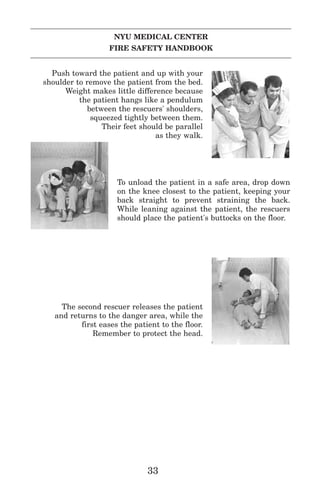
Push toward the patient and up with your
shoulder to remove the patient from the bed.
Weight makes little difference because
the patient hangs like a pendulum
between the rescuers' shoulders,
squeezed tightly between them.
Their feet should be parallel
as they walk.
To unload the patient in a safe area, drop down
on the knee closest to the patient, keeping your
back straight to prevent straining the back.
While leaning against the patient, the rescuers
should place the patient's buttocks on the floor.
The second rescuer releases the patient
and returns to the danger area, while the
first eases the patient to the floor.
Remember to protect the head.
33
NYU MEDICAL CENTER
FIRE SAFETY HANDBOOK
PACKSTRAP CARRY
Good for broken legs, cerebrovascular injuries, narrow or burning door-
ways and obstructed areas.
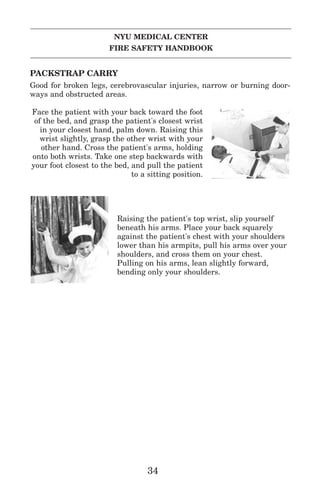
Face the patient with your back toward the foot
of the bed, and grasp the patient's closest wrist
in your closest hand, palm down. Raising this
wrist slightly, grasp the other wrist with your
other hand. Cross the patient's arms, holding
onto both wrists. Take one step backwards with
your foot closest to the bed, and pull the patient
to a sitting position.
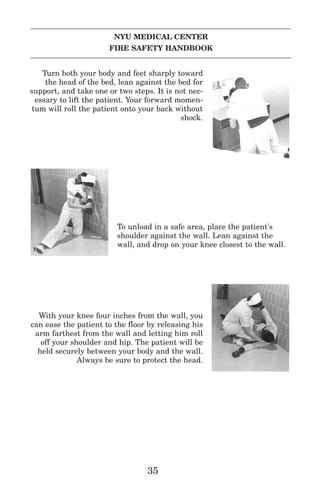
Raising the patient's top wrist, slip yourself
beneath his arms. Place your back squarely
against the patient's chest with your shoulders
lower than his armpits, pull his arms over your
shoulders, and cross them on your chest.
Pulling on his arms, lean slightly forward,
bending only your shoulders.
34
NYU MEDICAL CENTER
FIRE SAFETY HANDBOOK
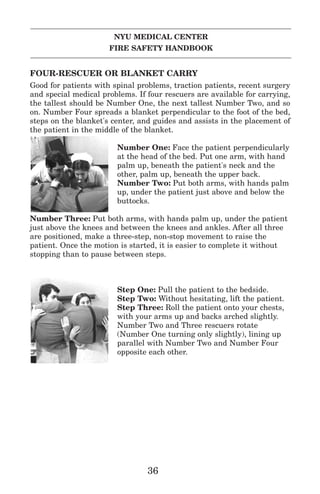
Turn both your body and feet sharply toward
the head of the bed, lean against the bed for
support, and take one or two steps. It is not nec-
essary to lift the patient. Your forward momen-
tum will roll the patient onto your back without
shock.
To unload in a safe area, place the patient's
shoulder against the wall. Lean against the
wall, and drop on your knee closest to the wall.
With your knee four inches from the wall, you
can ease the patient to the floor by releasing his
arm farthest from the wall and letting him roll
off your shoulder and hip. The patient will be
held securely between your body and the wall.
Always be sure to protect the head.
35
NYU MEDICAL CENTER
FIRE SAFETY HANDBOOK
FOUR-RESCUER OR BLANKET CARRY
Good for patients with spinal problems, traction patients, recent surgery
and special medical problems. If four rescuers are available for carrying,
the tallest should be Number One, the next tallest Number Two, and so
on. Number Four spreads a blanket perpendicular to the foot of the bed,
steps on the blanket's center, and guides and assists in the placement of
the patient in the middle of the blanket.
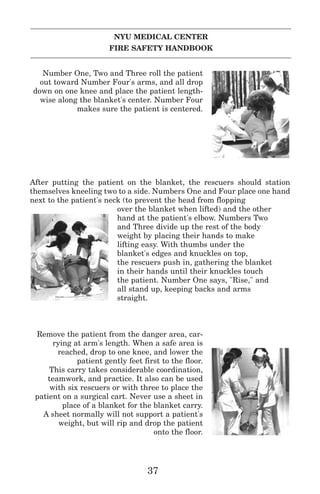
Number One: Face the patient perpendicularly
at the head of the bed. Put one arm, with hand
palm up, beneath the patient's neck and the
other, palm up, beneath the upper back.
Number Two: Put both arms, with hands palm
up, under the patient just above and below the
buttocks.
Number Three: Put both arms, with hands palm up, under the patient
just above the knees and between the knees and ankles. After all three
are positioned, make a three-step, non-stop movement to raise the
patient. Once the motion is started, it is easier to complete it without
stopping than to pause between steps.
Step One: Pull the patient to the bedside.
Step Two: Without hesitating, lift the patient.
Step Three: Roll the patient onto your chests,
with your arms up and backs arched slightly.
Number Two and Three rescuers rotate
(Number One turning only slightly), lining up
parallel with Number Two and Number Four
opposite each other.
36
NYU MEDICAL CENTER
FIRE SAFETY HANDBOOK
Number One, Two and Three roll the patient
out toward Number Four's arms, and all drop
down on one knee and place the patient length-
wise along the blanket's center. Number Four
makes sure the patient is centered.
After putting the patient on the blanket, the rescuers should station
themselves kneeling two to a side. Numbers One and Four place one hand
next to the patient's neck (to prevent the head from flopping
over the blanket when lifted) and the other
hand at the patient's elbow. Numbers Two
and Three divide up the rest of the body
weight by placing their hands to make
lifting easy. With thumbs under the
blanket's edges and knuckles on top,
the rescuers push in, gathering the blanket
in their hands until their knuckles touch
the patient. Number One says, "Rise," and
all stand up, keeping backs and arms
straight.
Remove the patient from the danger area, car-
rying at arm's length. When a safe area is
reached, drop to one knee, and lower the
patient gently feet first to the floor.
This carry takes considerable coordination,
teamwork, and practice. It also can be used
with six rescuers or with three to place the
patient on a surgical cart. Never use a sheet in
place of a blanket for the blanket carry.
A sheet normally will not support a patient's
weight, but will rip and drop the patient
onto the floor.
37
NYU MEDICAL CENTER
FIRE SAFETY HANDBOOK
FIRE ALARM CODES
The fire alarm bells ring in a sequence of three (3) or four (4) sets of bells
with the sequence sounding three (3) times. To decipher the signal, count
the number of bells in each set. Next, check a station number card posted
in the corridor to determine the location of the alarm.
The bells are only an indicator of the approximate fire location and not
necessarily the exact location of the fire. The location announced by the
operator is the location of the fire alarm sounded and not necessarily the
exact location of the fire.
CODIGO DE ALARMA DE INCENDIO
El timbre de alarma de incendio suena en una secuencia de tres (3) series
de toques, efectuándose la secuencia tres (3) veces. Para descifrar la señal,
cuente el número de toques en cada serie. Luego, consulte inmediata-
mente a una tarjeta de número de estación colocada en el corredor para
determinar el local de la alarma.
Los toques de timbre son sólo un indicador del lugar cerca del fuego, y no
dan necesariamente su lugar preciso. El lugar anunciado por la operado-
ra corresponde a la alarma que se ha accionado, y no necesariamente al
lugar exacto del fuego.
38
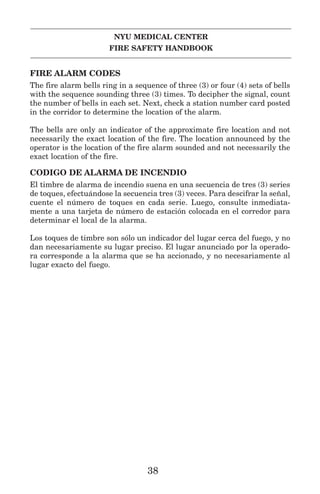
39
EVACUATION MAP
Rusk Institute of Rehabilitation
Medicine
Floor 1
In case of fire, use stairs to
evacuate. Do not use elevators.
NYU MEDICAL CENTER
FIRE SAFETY HANDBOOK
NYU MEDICAL CENTER
FIRE SAFETY HANDBOOK
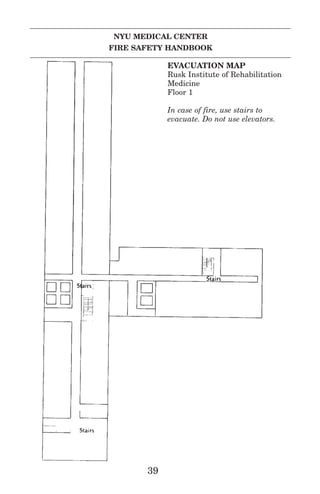
40
EVACUATION MAP
Rusk Institute of Rehabilitation
Medicine
Floors 4 and 5
In case of fire, use stairs to
evacuate. Do not use elevators.
NYU MEDICAL CENTER
FIRE SAFETY HANDBOOK
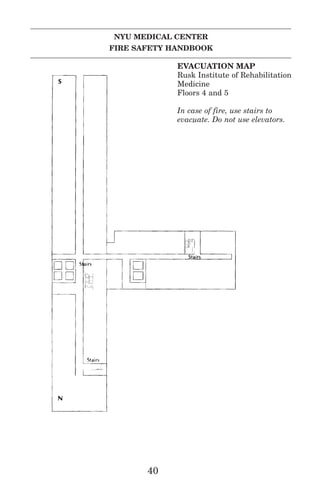
41
EVACUATION MAP
Medical Science Building
Floors: Cellar - 1
In case of fire, use stairs to
evacuate. Do not use elevators.
NYU MEDICAL CENTER
FIRE SAFETY HANDBOOK
42
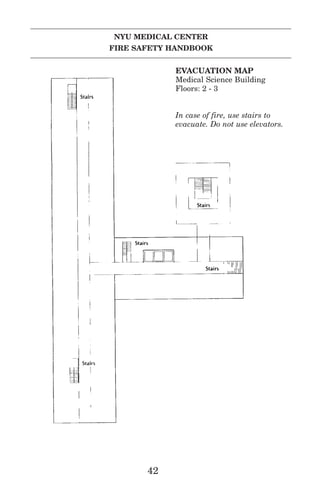
EVACUATION MAP
Medical Science Building
Floors: 2 - 3
In case of fire, use stairs to
evacuate. Do not use elevators.
NYU MEDICAL CENTER
FIRE SAFETY HANDBOOK
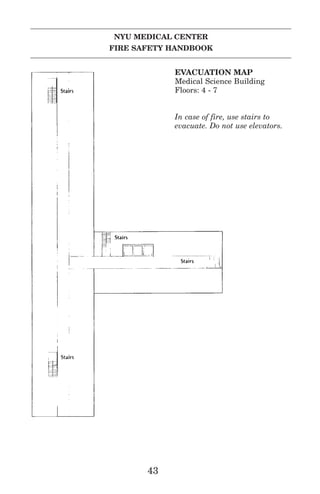
43
EVACUATION MAP
Medical Science Building
Floors: 4 - 7
In case of fire, use stairs to
evacuate. Do not use elevators.
NYU MEDICAL CENTER
FIRE SAFETY HANDBOOK
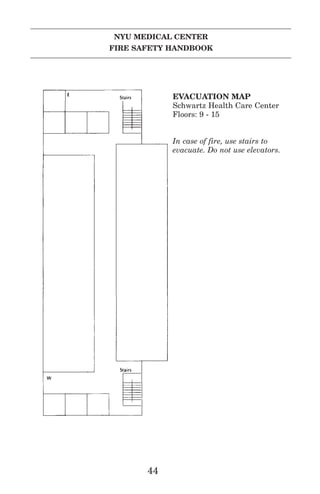
44
EVACUATION MAP
Schwartz Health Care Center
Floors: 9 - 15
In case of fire, use stairs to
evacuate. Do not use elevators.
NYU MEDICAL CENTER
FIRE SAFETY HANDBOOK
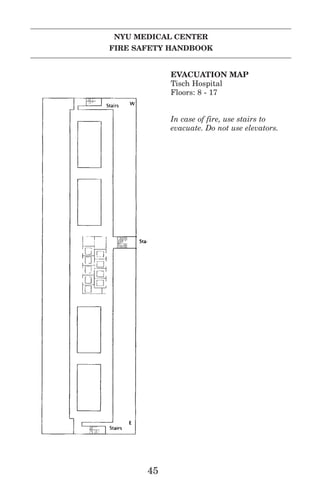
45
EVACUATION MAP
Tisch Hospital
Floors: 8 - 17
In case of fire, use stairs to
evacuate. Do not use elevators.
G
NYU MEDICAL CENTER
FIRE SAFETY HANDBOOK
46
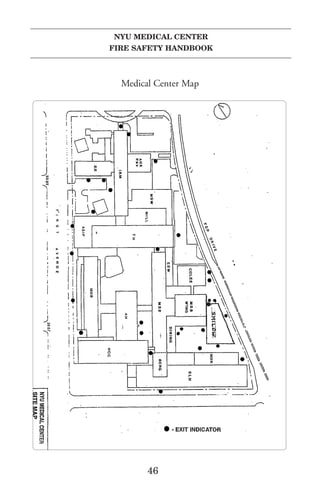
Medical Center Map

Fire handbook

  • 1.
    FIRE SAFETY HANDBOOK ThisFire Safety Handbook was written by the NYU Medical Center Environmental Services Department Address: 550 First Avenue New York, NY 10016 Tel. Number: (212) 263-5159 Fax: (212) 263-7855 This handbook has been approved by the Division of Fire Prevention of the New York City Fire Department
  • 2.
    NYU MEDICAL CENTER FIRESAFETY HANDBOOK TABLE OF CONTENTS Foreword ..............................................................................................1 Introducción ........................................................................................1 Fire Alarm Policy ................................................................................2 Norma sobre Alarmes de Incendio .....................................................2 General Fire Emergency Instructions How To Pull The Alarm ..................................................................3 How To Call Communications ........................................................3 Fire Protocol To Be Implemented ..................................................3 Evacuation Instructions .................................................................3 All Clear Notification ......................................................................4 Instrucciónes generales para emergencias de incendio Cómo accionar la alarma ................................................................5 Cómo llamar a Communicaciones ..................................................5 Normas de Incendio que deben aplicarse ......................................5 Instrucciónes sobre evacuación ......................................................5 Notificación de fin de alarma .........................................................6 Specific Assignments Communications .............................................................................7 Fire Marshal ..................................................................................11 Fire Brigade Chief ........................................................................11 Fire Brigade ..................................................................................11 Engineer ........................................................................................11 Security Officers ...........................................................................12 Specific Fire Emergency Instructions Patient Floors ................................................................................13 Clinical Areas ................................................................................14 Laboratories ..................................................................................15 Animal Areas .................................................................................16 Office Areas ...................................................................................16 Classrooms ....................................................................................16 Public Areas ..................................................................................16 Hall of Residence ................................................................................17
  • 3.
    NYU MEDICAL CENTER FIRESAFETY HANDBOOK Additional Fire Safety Information Types of Fire Extinguishers and How to Use Them .......................19 Elevator Operation During a Fire Emergency ................................23 Fire Safety Awareness ........................................................................24 Smoking Policy and No Smoking Areas ...........................................26 Patient Evacuation Procedure ...........................................................28 *Emergency Patient Removal Carries .............................................30 Side by Side Assist .........................................................................30 Swing Carry ...................................................................................32 Packstrap Carry .............................................................................34 Four-Rescuer or Blanket Carry ....................................................36 Fire Alarm Codes.................................................................................38 Maps of Medical Center .....................................................................39 Otras Informaciones sobre seguridad contra el fuego Clases de extintores y cómo usarlos .................................................21 Utilización de ascensores en emergencias de incendio .................. 23 Normas de seguridad contra incendios ............................................25 Normas sobre el derecho de fumar y zonas de prohibición de fumar ............................................................................................27 Procedimiento para la evacuación de pacientes ..............................29 Codigos de alarma de incendio ......................................................... 38 Mapas del Cientro Medico . ................................................................39 *Emergency Patient Removal Carries courtesy of Abbott Laboratories.
  • 4.
    NYU MEDICAL CENTER FIRESAFETY HANDBOOK FOREWORD The Fire Safety Handbook has been developed to provide NYU Medical Center Personnel with a plan of action in the event of a fire emergency. The procedures outlined in this handbook have been formulated to protect life and minimize property loss. However, an action plan is only as effec- tive as the people who carry out the procedures. The actions taken during the first few minutes of a fire are crucial in averting serious disaster. Therefore, all Medical Center employees are encouraged to review the manual and to become familiar with the fire plan appropriate to their work area. In addition, employees are asked to actively participate in fire drills, recognize fire hazards, remove such hazards whenever possible and report them to their supervisors when necessary. INTRODUCCION El Fire Safety Handbook se ha elaborado para proporcionar al personal del NYU Medical Center un plan de acción para los casos de emergencia de incendio. Los procedimientos que se esbozan en este folleto se han for- mulado para proteger las vidas y reducir al mínimo las perdidas materi- ales. Sin embargo, ningún plan de acción puede ser más eficaz que las per- sonas que hayan aplicarlo. Las medidas tomadas durante los primeros minutos de un incendio son vitales para evitar un desastre grave. Por lo tanto, se exhorta a todos los empleados del Medical Center a examinar el manual y familiarizarse con el plan correspondiente a su zona. Además, se solicita que los empleados participen activamente en las prácticas de lucha contra incendios, aprendan a reconocer los peligros de incendio, los elimi- nen siempre que sea posible y los anuncien a sus supervisores cuando sea necesario. 1
  • 5.
    NYU MEDICAL CENTER FIRESAFETY HANDBOOK FIRE ALARM POLICY It is the policy of the Medical Center that upon discovery of smoke or fire, the fire alarm is to be pulled. Because of the potential for underestimat- ing the seriousness of a fire condition, there are no exceptions to this pol- icy. When the fire alarm sounds, every employee is expected to implement fire protocol appropriate to his or her work area. There is no code to indicate if an alarm signifies a drill or real fire. Therefore, every alarm should be treated as a potentially serious fire. NORMA SOBRE ALARMAS DE INCENDIO Es la norma del Medical Center que, cada vez que se descubra humo fuego, se accióne la alarma de incendio. Como existe el peligro de que se subestime la gravedad de una situación, no se admiten exceptiones a esta norma. Cuando suene la alarma de incendio, todos los empleados deben aplica las normas de incendio adecuadas según su zona de trabajo. No exist ningún código para anunciar si la alarma se refiere a una práctica o a un incen- dio real, por lo cual todas las alarmas deben tomarse como si fuesen incen- dios graves. 2
  • 6.
    NYU MEDICAL CENTER FIRESAFETY HANDBOOK GENERAL FIRE EMERGENCY INSTRUCTIONS If you suspect or discover a fire— PULL THE NEAREST FIRE ALARM To pull the alarm • Open door of alarm box. • Pull lever down completely. • Release lever. CALL COMMUNICATIONS To call communications • Dial 33911. • Tell operator location of fire or smoke condition, including the building, floor and room number. • State your name and extension. IMPLEMENT FIRE PROTOCOL • Shout out the code phrase “Code Red.” Never call out the word "Fire" during a fire emergency. • Remove all person(s) in immediate danger to a safe area away from the fire. • Close all windows and doors in the area to prevent the spread of fire and smoke. • Turn off all electrical equipment, i.e., typewriters, duplicating machi- nery and non-essential clinical apparatus. LEAVE LIGHTS ON. • Remove gas cylinders and flammable liquids from the immediate fire vicinity. • Use the appropriate type portable fire extinguisher to put out the fire. (See pages 19-22 for discussion of extinguisher use.) • NOTE: Extinguishers are only effective on small fires, i.e., waste bas- ket fire, that can be extinguished quickly. • DO NOT FIGHT A FIRE ALONE. EVACUATION Patient Floors • Patients will be evacuated only when deemed necessary by the NYC Fire Department, Fire Marshall, Administrator on duty or Nurse in charge. Otherwise, patients and visitors are to remain in the patient rooms with the door closed until the "All Clear" is sounded. 3
  • 7.
    NYU MEDICAL CENTER FIRESAFETY HANDBOOK Clinical Areas (Operating Room, Diagnostic and Therapeutic Areas) • Patients undergoing an operation or treatment who are in immediate danger are to be moved under the direction of the operating physician, nurse, therapist or technician in attendance. If the patients are not in immediate danger, they are to remain in the operating or treatment rooms until the "All Clear" is sounded or until instructed to do other- wise by the NYC Fire Department, Fire Marshal or Brigade Chief. Laboratories, Office Areas, Classrooms, Public Areas • All occupants on the floor where the fire condition exists must evacuate using the nearest exit or exit stairway to at least two (2) floors below the fire location or to a safe place out of the building. DO NOT USE ELEVATORS. • Occupants on all other floors are to remain inside their office classroom or laboratory with the door closed until the "All Clear" is sounded or until instructed to do otherwise by the NYC Fire Department, Fire Marshal, or Brigade Chief. Hall of Residence • All occupants must evacuate from the building using the nearest exit or exit stairway when the fire condition is located within the building. Occupants must evacuate to a safe place out of the building. DO NOT USE ELEVATORS. • Skirball, Greenberg Hall and 660 First Avenue occupants must follow directions of the floor wardens (see Fire Safety Handbooks for these buildings). ALL CLEAR • Two (2) bells are sounded or the operator announces, "ATTENTION, ATTENTION, ATTENTION, CODE RED, ALL CLEAR.” • Until the "All Clear" is announced or sounded, all fire emergency pro- tocols must remain in effect throughout the Medical Center complex. 4
  • 8.
    NYU MEDICAL CENTER FIRESAFETY HANDBOOK INSTRUCCIONES GENERALES PARA EMERGENCIAS DE INCENDIO Al descrubrir o sospechar un incendio: ACCIONE LA ARMA DE INCENDIO MAS CERCANA Para accionar la alarma: • Abra la puerta de la caja de alarma. • Tire de la palanca completamente. • Suelte la palanca. LLAME A COMUNICACIONES Para llamar a comunicaciones: • Marque el 33911. • Indique a la operadora el lugar del fuego o del humo; incluya la infor- mación sobre el edificio, el piso y el número de habitación. • Indique su propio nombre y extensión. APLIQUE LAS NORMAS DE INCENDIOS • Diga las frase en codigo, “Code Rojo” la cual significa "Fuego"; en caso de emergencia. Nunca diga fuego o incendio durante una emergencia. • Retire a todas las personas que estén en peligro inmediato a una zona segura lejos del fuego. • Cierre todas las puertas y ventanas de la zona para evitar la difusión del fuego y del humo. • Apague todos los equipos eléctricos, como máquinas de escribir, copi- adoras y aparatos clínicos que no sean esenciales. DEJE ENCENDIDAS LAS LUCES. • Retire los tanques de gas y los liquidos inflamables de la proximidad inmediata del fuego. • Emplee los extintores de tipo adecuado para combatir el fuego. (Vea páginas 20-23 para descripción de uso apropiado de extintores.) • NOTA: Los extintores sólo son eficaces contra fuegos pequeños, como los de una papelera, que pueden extinguirse rápidamente. NO COM- BATA EL FUEGO USTED SOLO. EVACUACION Pisos de pacientes: • Los pacientes serán reubicados únicamente cuando lo considere nece- sario el Departamento de Incendios de la Ciudad de Nueva York, el Jefe de Incendios, el Administrador de servicio o la Enfermera responsable. De lo contrario, los pacientes y visitantes deben permanecer en las 5
  • 9.
    NYU MEDICAL CENTER FIRESAFETY HANDBOOK salas de internación con las puertas cerradas hasta que se haga sonar la señal de fin de alarma. Zonas de Clinica (Salas de Operación y Zonas de Diagnóstico y Tratamiento • Los pacientes que estén siendo sometidos a operación o trata miento y se encuentren en peligro inmediato, deben ser trasladados bajo la direc- ción del cirujano, enfermera, terapista o técnico que los atienda. Si los pacientes no se encuentran en peligro inmediato, deben permanecer en las salas de operación o de tratamiento hasta que se haga sonar la señal de fin de alarma o se les indique proceder de otro modo por el Departamento de Incendios de la Ciudad de Nueva York, el Jefe de Incendios o el Jefe de Brigada. Laboratorio, Zonas de Oficinas, Aulas y Zonas Públicas: • Todos los ocupantes del piso en que se manifieste el fuego deben reubi- carse empleando la salida o escalera de emergencia más próxima hasta un minimo de dos (2) pisos debajo de la localización del fuego o a un lugar seguro fuera del edificio. NO USE LOS ASCENSORES. • Los ocupantes de todos los demás pisos deben permanecer en sus ofici- nas, aulas o laboratorios con la puerta cerrada hasta que suene la señal de fin de alarma o reciban otras instrucciones del Departamento de Incendios de la Ciudad de Neuva York, el Jefe de Incendios o Jefe de Brigada. Sala de Residentes: • Todos los ocupantes deben evacuar el edificio empleando la salida o escalera de emergencia más próxima cuando se localice el fuego dentro del edificio. Los ocupantes deben retirarse a un lugarseguro fuera del edificio. NO USE LOS ASCENSORES. • Skirball, Greenberg Hall y 660 Primera Avenida todos los occupantes deben observar las instrucciones de los capitanes de los pisos (vea los Fire Safety Handbook para estos edificios). FIN DE ALARMA • Se hacen sonar dos (2) toques de timbre o la operadora anuncia "ATTENTION, ATTENTION, ATTENTION, CODE RED, ALL CLEAR." • Hasta que se anuncie o haga sonar el fin de alarma, deben mantenerse en aplicación todas las normas de incendio en todos los edificios del Cientro Médico. 6
  • 10.
    NYU MEDICAL CENTER FIRESAFETY HANDBOOK SPECIFIC ASSIGNMENTS COMMUNICATIONS Upon notification of a fire within the Medical Center or other property located within New York City, the following actions should be taken: • If notification is by phone, the operator must obtain the fire’s location, including building (and address if located off-campus), floor, room num- ber and if possible, the name of the caller. • Instruct the caller to pull the nearest alarm if this has not been done. • If the fire is off-campus, the operator should report the fire to the NYC Fire Department by dialing 628-2900. The operator should then notify the Fire Marshal (35159). Employees should follow the instructions and protocols established at these off-campus facilities. • If the fire is on-campus, the operator is to activate the City Fire Alarm Box and report fire location to the NYC Fire Department and instruct them to come to one of the following: Tisch Hospital, 540 First Avenue Ancillary Services Pavilion, 540 First Avenue Millhauser Labs, 540 First Avenue Medical Science Building, 540 First Avenue Berg Institute, 540 First Avenue AlumniHall, 540 First Avenue Schwartz Health Care Center, 540 First Avenue Skirball Institute, 540 First Avenue Residential Tower, 564 First Avenue Greenberg Hall, 545 First Avenue RIRM, 400 East 34th Street Rubin Hall of Residence, 30-10 FDR Drive Schwartz Lecture Hall, 401 East 30th Street Smilow Research Center, 30-10 FRD Drive Parasitology, 341 East 25th Street Announce fire by paging three (3) times, ATTENTION, ATTENTION, ATTENTION, CODE RED (give location of fire). 7
  • 11.
    NYU MEDICAL CENTER FIRESAFETY HANDBOOK The following departments should be notified by phone immediately: Security (33911), Engineer (35275), *Fire Marshall (35159) * If the fire occurs outside of normal working hours (9:00 a.m. - 5:00 p.m., Monday-Friday) contact the Environmental Services on-call staff mem- ber via long-range beeper. In the event that the Environmental Services member on call cannot be reached, the operator should use the Environmental Services call list in order to notify another Environmental Services Department member. • Call the personnel listed on pages 9 and 10 and give the exact location of the fire. Call first the numbers in the building where the fire condi- tion is located. At the end of the fire condition and upon notification by the Fire Marshal or designee, Brigade Chief, Administrator, or NYC Fire Department, the operator will sound two bells and announce the "All Clear" by paging three (3) times at ten (10) second intervals: ATTENTION, ATTENTION, ATTENTION, CODE RED, "ALL CLEAR." 8
  • 12.
    9 TISCHHOSPITAL DayEveningNight THElevator(73333)BuildingServiceSupervisoronbeeperBuildingServiceSupervisoronbeeper Admitting(35006)Admitting(35006)Admitting(35006) Nursing(35760)Nursing,ClinicalCoordinatorNursing,ClinicalCoordinator onbeeperonbeeper EmergencyRoom(35550)EmergencyRoom(35550)EmergencyRoom(35550) Administrator(35500)AdministratoroncallAdministratoroncall RIRM DayEveningNight Nursing(36151)NursingSupervisoronbeeperNursingSupervisoronbeeper BuildingService(35071)BuildingServiceSupervisoronbeeperBuildingServiceSupervisoronbeeper Administrator(35500)AdministratoroncallAdministratoroncall HEALTHCARECENTER DayEveningNight Nursing(37447)NursingSupervisor(37447)NursingSupervisor(37447) BuildingService(35071)BuildingServiceSupervisoronbeeperBuildingServiceSupervisoronbeeper CoopCareAdministrator(35500)CoopCareAdministratoroncallCoopCareAdministratoroncall FPOAdministrator(37324)FPOAdministratoroncallFPOAdministratoroncall
  • 13.
  • 14.
    NYU MEDICAL CENTER FIRESAFETY HANDBOOK SPECIFIC ASSIGNMENTS FIRE MARSHAL • The Fire Marshal is the Department Head or designee from the Environmental Services Department. The Fire Marshal is responsible for implementing institutional fire safety as specified in the NYC Fire Department Directive 8-67 and by other regulatory agencies. FIRE BRIGADE CHIEF • The Fire Brigade Chief is responsible for directing the brigade during an emergency on the evening and night shifts and on week-ends, in the absence of the Fire Marshal or designee. The Brigade leadership at these times will consist of the Plant, Maintenance and Construction Supervisor or foreman, Building Service Supervisor and Security Supervisor or Sergeant at the scene. In addition the Brigade Chief responsible for directing evacuation procedures and assisting the NYC Fire Department upon request. The Fire Brigade Chief reports to the Fire Marshal. FIRE BRIGADE • When the alarm sounds, the brigade members will respond to the fire location with fire emergency equipment • Under the direction of the Fire Marshal and/or Brigade Chief, the brigade will take action to contain and confine the fire. • The brigade will help evacuate patients under the direction of med- ical personnel. • Upon arrival of the NYC Fire Department, the brigade will provide assistance as required. ENGINEER • When the fire alarm sounds, the Engineer is to report to the scene of the fire and provide assistance in the operation of the standpipc sprin- kler system and ventilating equipment. In addition, the Engineer is to provide direction regarding operation of other mechanical systems. Upon arrival of the NYC Fire Department, the Engineer will provide the firemen with information regarding the building mechanical sys- tems and assist as instructed by the NYC Fire Department in ventilat- ing the fire area. The Engineer will be responsible for resetting the fire alarm systems. 11
  • 15.
    NYU MEDICAL CENTER FIRESAFETY HANDBOOK SECURITY OFFICERS • When the alarm is sounded, Security Officers assigned to entrance and exit doors are to report to their posts immediately and direct the NYC Firemen to the fire location. • Security Officers are to proceed as directed to the main elevator lobbies in each building to assist in crowd control. The Security Officers are to clear the elevators with the exception of the NYC Fire Department, Fire Brigade and other authorized Medical Center personnel respond- ing to the fire. • Security Officers are to report, as directed, to the fire location and assist with patient evacuation when necessary and only under the direction of medical personnel. 12
  • 16.
    NYU MEDICAL CENTER FIRESAFETY HANDBOOK SPECIFIC FIRE EMERGENCY INSTRUCTIONS PATIENT FLOOR If you suspect or discover a fire— • Remove persons who are in immediate danger. • Pull the fire alarm. • Call communications operator (Dial 33911), give the exact location of the fire, inlude building, floor, room number, and your name. • Shout out the code phrase “Code Red.” Never call out the word "Fire." • Close patient room doors to prevent the spread of fire and smoke. • Instruct visitors and patients to remain in patient rooms. • Move patients and visitors in sitting areas to a safe room on opposite side of the doors, away from the fire. • Use appropriate type fire extinguishers to put out the fire. NOTE: Extinguishers are only effective on small fires that can be extin- guished quickly. DO NOT FIGHT A FIRE ALONE. • Designate staff member(s) to tour rooms to confirm patient location and reassure patients. • If the fire occurs in a room where in-house oxygen is in use, shut the floor supply with the permission of the Head Nurse, Fire Marshal or NYC Fire Department using the wall-mounted shut valve and obtain emergency oxygen. • When deemed necessary by the Fire Marshal, Nurse in charge, Brigade Chief or NYC Fire Department, relocate patients according to the patient evacuation procedure. (See page 28 of this Handbook.) If a fire is in another area and the fire alarm sounds— • Count the bells and decipher the code. Determine the approximate fire location from station number cards posted in the corridors on the fire alarm boxes. • Close patient room doors to prevent the spread of smoke. • Clear the corridors and sitting areas. Instruct patients and visitors to return and remain in patient or treatment rooms with the doors closed. • Designate staff member(s) to tour rooms to confirm patient location and reassure patients. • All fire protocols must remain in effect until the "All Clear" is sounded or until you are instructed to do otherwise by the NYC Fire Department, Fire Marshal or Brigade Chief. 13
  • 17.
    NYU MEDICAL CENTER FIRESAFETY HANDBOOK SPECIFIC FIRE EMERGENCY INSTRUCTIONS CLINICAL AREAS All Operating, Diagnostic and Therapeutic Areas If you suspect or discover a fire— • Patients in immediate danger should be moved to a safe location. • Pull the fire alarm. • Call communications operator (Dial 33911), give the exact location the fire, include building, floor, room number and your name. • Shout out the code phrase “Code Red.” Never call out the word "Fire." • Patients undergoing an operation or treatment are to be move under the direction of the operating physician, nurse, therapist or technician in attendance. If possible, each patient should be accompanied by a nurse, therapist or other qualified personnel. • Close all doors and windows to prevent the spread of fire and smoke. • Use appropriate type fire extinguishers to put out the fire. NOTE: Extinguishers are only effective on small fires that can be extin- guished quickly. DO NOT FIGHT A FIRE ALONE. • Portable oxygen tanks, suction machines and other needed equipment are to be moved with the patients. • Shut off all gases and suction in rooms affected with permission of the Head Nurse, Fire Marshal, or NYC Fire Department. • Remove all gas cylinders under pressure, anesthesia machines, alcohol and other flammable material from the danger zone. If a fire is in another area and the fire alarm sounds– • Count the bells to decipher the code. Designate an individual to deter- mine the fire location from station number cards posed in the corridors. Each clinical area should be informed of the fire location. • Close all doors and windows to prevent the spread of smoke. • If possible delay all procedures. • Do not send for patients or return patients to their rooms until the fire emergency is over. • All fire protocols must remain in effect until the "All Clear" is sounded or until you are instructed to do otherwise by the NYC Fire Department, Fire Marshal or Brigade Chief. 14
  • 18.
    NYU MEDICAL CENTER FIRESAFETY HANDBOOK SPECIFIC FIRE EMERGENCY INSTRUCTIONS LABORATORIES If you discover a fire— • Pull the fire alarm. • Call communications operator (Dial 33911), give the exact location of the fire, include building, floor, room number and your name. • Close all doors and windows in the area to prevent the spread of fire and smoke. • Use appropriate type fire extinguishers to put out the fire. NOTE: Extinguishers are only effective on small fires that can be extin- guished quickly. DO NOT FIGHT A FIRE ALONE. • Shut off all gas burning equipment, and disconnect or switch off all electrical instruments and appliances, with the exception of refrigera- tors and incubators. LEAVE LIGHTS ON. • Move gas cylinders under pressure to a safe area. • Shut down all air conditioning units and fans. • Inform the fire brigade and NYC Firemen of the location of hazardous chemicals and gases under pressure. • Evacuate all occupants from the floor using the nearest exit or exit stairway. Evacuate to a minimum of two (2) floors below the fire loca- tion or out of the building. Close all doors behind you. DO NOT USE ELEVATORS. If a fire is in another area and the fire alarm sounds— • Count the bells and decipher the code. Determine the approximate fire location from station number cards posted in the corridors near the fire alarm boxes. • If the code indicates your floor, evacuate all occupants immediately using the nearest exit or exit stairway. Evacuate to a minimum of two (2) floors below the fire location or out of the building. Close all doors behind you. DO NOT USE ELEVATORS. • If the code indicates any area other than your own floor implement fire protocol immediately by closing all doors and windows to prevent the spread of smoke, instruct students, visitors, and staff to remain inside the rooms with the doors closed. • All fire protocols must remain in effect until the "All Clear" is sounded or until you are instructed to do otherwise by the NYC Fire Department, Fire Marshal or Brigade Chief. 15
  • 19.
    NYU MEDICAL CENTER FIRESAFETY HANDBOOK SPECIFIC FIRE EMERGENCY INSTRUCTIONS ANIMAL AREAS If you suspect or discover a fire— Follow the instructions for Laboratories and complete these steps in addi- tion: • Be sure all animals in your area are securely caged or disposed of prop- erly. • Remove all animals in transit or in the hallways to the nearest animal room. Be sure their cages are securely fastened. OFFICES/CLASSROOMS/PUBLIC AREAS If you suspect or discover a fire— • Pull the fire alarm. • Call communications operator (Dial 33911) and give the exact location of the fire, including building, floor, room number, and your name. • Close all doors and windows in the area to prevent the spread of fire and smoke. • Turn off all electrical equipment, typewriters, duplicating machinery, projection equipment and clinical apparatus. LEAVE LIGHTS ON. • Remove any gas cylinders and/or flammable liquids from the immedi- ate vicinity of the fire. • Use an appropriate type portable fire extinguisher to put out the fire. NOTE: Extinguishers are only effective on small fires that can be extin- guished quickly. DO NOT FIGHT A FIRE ALONE. • Evacuate all occupants from the floor using the nearest exit or exit stairway. Evacuate to a minimum of two (2) floors below the fire loca- tion or out of the building. Close all doors behind you. DO NOT USE ELEVATORS. If the fire is in another area and the fire alarm sounds— • Count the bells and decipher the code. Determine the approximate fire location from station number cards posted in the corridors near the fire alarm boxes. • If the code indicates your floor, evacuate all occupants immediately using the nearest exit or exit stairway. Evacuate to minimum of two (2) floors below the fire location or out the building. Close all doors behind you. DO NOT USE ELEVATORS. • If the code indicates any other area other than your own floor implement fire protocol immediately by closing all doors and windows to prevent the spread of smoke. Instruct students, visitors and staff to remain inside the rooms with the doors closed. 16
  • 20.
    NYU MEDICAL CENTER FIRESAFETY HANDBOOK SPECIFIC FIRE EMERGENCY INSTRUCTIONS • All fire protocols must remain in effect until the "All Clear" is sounded or until you are instructed to do otherwise by the NYC Fire Department, Fire Marshal or Brigade Chief. HALL OF RESIDENCE Read and MEMORIZE the detailed instructions for fire posted on the door of your room. If you suspect or discover a fire— • Pull the fire alarm. • Call communications operator (Dial 33911) from the hall phone and give the exact location of the fire, include building, floor, room number, and your name. • Use an appropriate type fire extinguisher to put out the fire, or smoth- er the fire with a pillow or wet blanket if possible. NOTE: Extinguishers are only effective on small fires that can be extin- guished quickly. DO NOT FIGHT A FIRE ALONE. • Close room doors and windows to prevent the spread of fire and smoke. • Evacuate by the nearest stairway to a safe place out of the building. DO NOT USE ELEVATORS. Desk Clerk— • Security Officer or desk clerk upon notification of fire is to bring both elevators to the ground floor and hold one for the NYC Fire Department. The Security Officer is to clear the elevators and PRO- HIBIT persons from using them with the exception of the NYC Fire Department, Fire Brigade, and other authorized Medical Center per- sonnel responding to the fire. 17
  • 21.
    NYU MEDICAL CENTER FIRESAFETY HANDBOOK Evacuation— When the alarm sounds • Place hand as high as possible on door. • If not hot to touch—open. • Leave room and shut door. • Evacuate by the nearest exit. DO NOT USE ELEVATOR. • Proceed out of building. • All Hall of Residence occupants must evacuate when a fire emergency exists in the building with the following exceptions: • If door is HOT to touch: Do not open door into corridor. • Open window slightly • Sit by window under tent of blankets. • Hang a sheet or towel out of window to show NYC Fire Department where you are. • Remain by window until the NYC Fire Department comes to you 18
  • 22.
    NYU MEDICAL CENTER FIRESAFETY HANDBOOK ADDITIONAL FIRE SAFETY INFORMATION FIRE EXTINGUISHERS Portable fire extinguishers are provided throughout the Medical Center. They can be found suspended from hooks in the corridors near the fire alarm boxes or enclosed in special wall cabinets. In some areas, extin- guishers are located in the stairwells adjacent to the fire hoses. Each extinguisher is labeled with the letter LLA IIB or GGC or a combi- nation of these letters. They indicate the type of fire for which the extin- guisher can be used. LLA Indicates extinguisher can be used to put out Ordinary Combustibles, e.g., paper, wood, cloth. IIB Indicates extinguisher can be used to put out Flammable Liquids, e.g., grease, paints, oils. GGC Indicates extinguisher can be used on Electrical Equipment, e.g., switches, motors. IIB GGC Indicates the extinguisher can be used to put out Flammable Liquids and on Electrical Equipment. LLA IIB GGC Indicates the extinguisher has multi-purpose use and is suitable for extinguishing Ordinary Combustibles as well as Flammable Liquids and Electrical Equipment. Located throughout the Medical Center are three (3) types of extinguish- ers: Type LLA Type IIB GGC and Type LLA IIB GGC • Type LLA extinguisher contains approximately 21/2 gallons of water under pressure, and the discharge time is one (1) minute. This type of extinguisher can be effectively used from a maximum distance of 30-40 feet from the fire. • Type IIB GGC extinguisher contains carbon dioxide gas. The extin- guisher varies in size from 21/2 to 10 1bs., with discharge time ranging from 8 seconds to 30 seconds. This type of extinguisher can be effec- tively used from a distance of 3-8 feet from the fire. 19
  • 23.
    NYU MEDICAL CENTER FIRESAFETY HANDBOOK CAUTION: AVOID INHALATION OF CARBON DIOXIDE GAS. DO NOT HOLD NOZZLE TO AVOID FREEZING HAND. • Type LLA IIB GGC extinguisher contains a dry chemical powder under pressure. The extinguisher varies in size from 2 to 10 lbs., with discharge time ranging from 8 seconds to 25 seconds. This type of extin- guisher can be effectively used from a maximum distance of 5-12 feet from the fire, depending upon extinguisher size. How to use a portable fire extinguisher— • Familiarize yourself with the locations and types of fire extinguisher in your work area. • To use an extinguisher, lift it from the wall hook or cabinet and carry or drag it to the location of the fire. • Pull ring to release lock pin from handle. • Aim nozzle at base of fire. • Squeeze handles together and spray in a side sweeping motion. NOTE: All fire extinguishers in the Medical Center have instructions written on the extinguisher. 20
  • 24.
    NYU MEDICAL CENTER FIRESAFETY HANDBOOK INFORMACION COMPLEMENTARIA SOBRE LA SEGURIDAD CONTRA INCENDIOS EXTINTORES Existen extintores portátiles por todo el Cientro Médico. Puede encont selos suspendidos de ganchos en los corredores, junto a las cajas de alar- ma, de incendio or dentro de cajas especiales en las paredes. En algunas zonas, los extintores están situados en los pozos de escaleras, junto a las mangas de incendios. Cada extintor está señalado con la letra LLA IIB o GGC o una combi- nación es esas letras. Cada letra indica un tipo de fuego contra el puede utilizarse el extintor. LLA Indica que el extintor puede emplearse para apagar combustibles; por ejemplo, papeles, madera o tejidos. IIB Indica que el extintor puede emplearse para apagar liquidos inflamables; por ejemplo, grasas, pinturas o aceites. GGC Indica que el extintor puede emplearse en equipos eléctricos; por ejemplo, interruptores o motores eléc- tricos. IIB GGC Indica que el extintor puede emplearse para apagar líquidos inflamables y también en equipos eléctricos LLA IIB GGC Indica que el extintor es de uso múltiple y se presta para apagar, combustibles comunes, así como líquidos inflamables y equipos eléctricos. Por todo el Centro Médico estan situados tres (3) tipos de extintores: tipo LLA , tipo IIB y tipo GGC : • Los extintores Tipo LLA contienen aproximadamente 21/2 galones de agua a presión y el tiempo de descarga es de un (1) minuto. Los extin- tores de esta clase pueden utilizarse con eficacia desde distancia máxi- ma de 30 a 40 pies del fuego. 21
  • 25.
    NYU MEDICAL CENTER FIRESAFETY HANDBOOK • Los extintores Tipo IIB GGC contienen gas de dioxido de ( bon. Los extintor varián de tamaño entre las 21/2 y las 10 1ibras, con tiempo de descarga de entre 8 segundos a 30 segundos. Este tipo extintor puede utilizarse con eficacia desde una distancia de 3 pies del fuego. ADVERTENCIA: Evítese la inhalación de gas dióxido de carbón. NO TOME EN SUS MANOS LA BOQUILLA, PARA EVITAR CONGELA- CION. • Los extintores Tipo LLA IIB GGC contienen una substancia química en polvo, bajo presión. El tamano de los extintores varia entre 2 a 10 Libras, con un tiempo de descarga de entre 8 a segundos. Esta clase de extintor puede utilizarse con eficacia de una distancia máxima de entre 5 a 12 pies del fuego, según volumen del extintor. Como emplear un extintor portátil • Familiarícese con los locales y las clases de extintores que encuentran en su zona de trabajo. • Para utilizar un extintor, retirelo del gancho de pared o de la caja llévelo o arrástrelo hasta el lugar del fuego. • Tire del aro para soltar la traba del asa. • Dirija la boquilla hacia la base del fuego. • Sostenga las dos asas apretándo las juntas y lance el chorro con un movimiento lateral de barrido. NOTA: Todos los extintores en el Cientro Médico llevan instrucciones escritas. 22
  • 26.
    NYU MEDICAL CENTER FIRESAFETY HANDBOOK ELEVATOR USE DURING A FIRE EMERGENCY • Elevator use during a fire emergency is PROHIBITED with the excep- tion of the NYC Fire Department, Fire Brigade, Fire Marshal and authorized Medical Center personnel responding to the fire. • When possible use the stairs to reach the fire location. • If elevator use is necessary for responding to a fire emergency, DO NOT ride the elevator to the fire location. Stop at least two (2) floors below, and walk up the stairs to gain access to the fire floor. DO NOT use the elevator unless it is being operated manually with a key. USO DE ASCENSORES EN EMERGENCIAS DE INCENDIO • El uso de ascensores durante las emergencias de incendio está PRO- HIBIDO, con la excepción del Departamento de Incendios de la Ciudad de Nueva York, la Brigada de Incendios, el Jefe de Incendios y el per- sonal autorizado del Cientro Médico que acuda para combatir el fuego. • Si el uso de los ascensores es necesario para responder a una emergen- cia de incendio, NO VA YA en ascensor hasta el lugar del fuego. Deténgalo por lo menos dos (2) pisos debajo del lugar del fuego y camine por las escaleras para llegar al piso del incendio. NO USE ascensores a menos que estén accionados manualmente con llave. 23
  • 27.
    NYU MEDICAL CENTER FIRESAFETY HANDBOOK FIRE SAFETY AWARENESS Follow and enforce these rules: • Smoking is not permitted in any Medical Center building. • Do not store oxygen with any flammable gas. • Never lock or obstruct an exit or fire door. • Do not keep doors open with makeshift wedges. • Do not block corridors with equipment. • Check fire doors frequently to make sure they open easily. • Store all chemicals in air-tight containers. • Flammable or explosive material requiring refrigeration must be stored in an approved explosion-proof type refrigerator. • Do not discard pressurized containers, empty containers used to store flammable substances or like material with burnable rubbish. • Do not use multiple plugs in electrical outlets. • Do not overload electrical circuits with portable appliances, such as radios, heaters, fans, laboratory equipment and air conditioners. • Disconnect and report at once all faulty electrical appliances, frayed electrical cords, defective switches, plugs and electrical outlets. • Have all new electrical appliances checked by the Facilities Maintenance Department or Clinical Engineering Department before using. 24
  • 28.
    NYU MEDICAL CENTER FIRESAFETY HANDBOOK NORMAS DE SEGURIDAD CONTRA INCENDIOS Siga la siguientes reglas y hágalas aplicar: • Fume únicamente en los lugares oficialmente indicados para ello. • No guarde oxígeno junto con ningún gas inflammable. • Nunca cierre bajo llave ni obstruya puertas de salida o de incendio. • No utilice cuñas para mantener abiertas las puertas. • No bloquee los corredores con equipos. • Verifique con frecuencia que las puertas de incendio se abran fácil- mente. • Guarde todos los productos químicos en recipientes herméticos. • Los materiales inflamables o explosivos que requieran refrigeración deben guardarse en refrigeradores a prueba de explosiones. • No tire envases bajo presión, latas de aceite vacias ni materiales simi- lares, con desechos combustibles. • No utilice enchufes múltiples en los tomaccorientes. • No sobrecargue los circuitos eléctricos con aparatos portátiles como radios, calentadores, ventiladores, equipos de laboratorio y acondi- cionadores de aire. • Desconecte y denuncie de inmediato cualquier aparato eléctrico que tenga desperfectos, cables eléctricos mal aislados, e interruptores, enchufes o tomacorrientes defectuosos. • Haga comprobar todos los apartos eléctricos por el Departamento de Planta y Mantenimiento o por el Departamento de Ingeniería Clinica antes de utilizarlos. 25
  • 29.
    NYU MEDICAL CENTER FIRESAFETY HANDBOOK SMOKING The Medical Center Administration expects compliance from all staff, patients and visitors regarding its rules and regulations governing smok- ing. Persons violating this policy are subject to a fine by New York City and disciplinary action by NYU Medical Center. Smoking is prohibited in all indoor and outdoor areas of the Medical Center. Any exceptions to the prohibition are to be authorized for a patient by a physician's written order based on medical criteria. 26
  • 30.
    NYU MEDICAL CENTER FIRESAFETY HANDBOOK CONDICIONES PARA FUMAR LAS NORMAS La Administración de Cientro Médico espera que todo el personal, todos los pacientes y visitantes acaten sus normas y reglamentaciones sobre condiciones para fumar. Las personas que violen estas normas seran pasi- bles de multa por la Ciudad de Nueva York y medidas disciplinarias del Cientro Médico de la NYU. Esta prohibido fumar adentro de todas las zonas del Cientro Médico, y alguna excepción a esta prohibición necesita estar autorizadas en escrito por el doctor dando ordena sobre criteria médico para el pasiente. Las siguientes zonas estan designadas como LIBRES DE FUMAR. No se permitira fumar en esos lugares en ninguna circumstancia. 27
  • 31.
    NYU MEDICAL CENTER FIRESAFETY HANDBOOK PATIENT EVACUATION PROCEDURE Patient evacuation in a hospital is determined by the proximity and severity of the fire or smoke condition. The following steps provide basic guidelines for relocating patients. However, the fire condition will ulti- mately determine the extent of the patient relocation. • Step 1 Patients in immediate danger should be moved first. • Step 2 Horizontal movement—move patients laterally on the floor to the other side of the fire doors. • Step 3 Vertical movement—ambulatory patients should be led down the stairs and relocated to a safe area at least two (2) floors below the fire loca- tion when possible. Non-ambulatory patients should be transported by elevator only on the orders of the NYC Fire Department. Patients should be relocated to two (2) floors below the fire location when possi- ble. Elevators being used for relocation purposes should not travel past the fire location if at all possible. • Step 4 If necessary Tisch Hospital cafeteria or Alumni Hall can be utilized as patient holding areas. Evacuation out of the building should be a last resort. Follow the instruction in the NYUMC Emergency Evacuation Plan. 28
  • 32.
    NYU MEDICAL CENTER FIRESAFETY HANDBOOK PROCEDIMIENTO PARA LA EVACUACION DE PACIENTES La evacuación de los pacientes de un hospital se determina según la prox- imidad y gravedad del fuego o del humo. Las etapas siguientes ofrecen directivas para la reubicación de pacientes. Sin embargo, el alcance de la reubicación de los pacientes se determinará en última instancia por las características del fuego. • Etapa 1 Los pacientes en peligro inminente deben ser reubicados primero. • Etapa 2 Movimiento horizontal; desplácese a los pacientes lateralmente en piso al otro lado de las puertas de incendio. • Etapa 3 Movimiento vertical: Los pacientes en condiciones de caminar deben ser conducidos hacia abajo por las escaleras y reubicados a una zona segura que esté por lo menos dos (2) pisos por debajo del lugar del fuego, siempre que sea posible. Los pacientes que no estén en condiciones de caminar deben ser transportados en ascensor únicamente si ascensor no se encuentra en peligro inmediato de fuego y está accionado con llave. Los pacientes deben ser reubicados a por lo menos dos (2) pisos por debajo del lugar del fuego siempre que sea posible. Los ascensores que se utilicen para fines de reubicación no deben pasar por el nivel en que se produce el fuego siempre que sea posible evitarlo. • Etapa 4 En caso de necesidad, pueden utilizarse como zonas de concentración de pacientes la cafetería del Hospital Universitario y la Sala de Graduados (Alumni Hall). Debe efectuarse la evacuación fuera del edificio como último recurso. 29
  • 33.
    NYU MEDICAL CENTER FIRESAFETY HANDBOOK EMERGENCY PATIENT REMOVAL CARRIES Patients in immediate danger of fire or smoke must be moved to a safe area as quickly as possible. Removal of patients by bed or mattress is a time consuming and cumbersome process and often impossible. Therefore, it is recommended that patient removal carries be implement- ed as a time-saving and thus life-saving technique to evacuate patients. The following carries have been selected on the basis of their lifting and carrying advantages. When utilizing the carries remember patients should be hugged firmly to the carrier’s body. The carrier should use his or her own body and the patient’s body to support the latter’s weight. These emergency patient removal carries, if executed properly, distribute a patient’s weight over all the carrier’s body, rather than concentrating it on his or her hands and arms alone. SIDE-BY-SIDE ASSIST Good for patients needing limited assistance. Assist the patient to a standing position. Grasp the patient’s wrist closest to you with your hand. 30
  • 34.
    NYU MEDICAL CENTER FIRESAFETY HANDBOOK Bring the patient’s hand around your neck, and pull it down firmly over your shoulder. With your other arm go around the back and slide your hand down the inner side of the patient’s arm until you reach the wrist. Grasp the arm or wrist and bring it in firmly to the waist area. Now by pulling down the arm, pulling in on the waist, and putting your hip toward the patient, you could if necessary lift the patient off the floor. Do not give the patient any more help than is needed. 31
  • 35.
    NYU MEDICAL CENTER FIRESAFETY HANDBOOK SWING CARRY The swing carry is good for evacuating any weight patient, and moving a patient down a stairway. The swing carry utilizes a cradle of interlocked arms and wrists and is useful for moving heavy patients long distances. If you are the first rescuer, stand with the feet together, and slip your arm closest to the head of the bed under the patient's neck, grasping the far shoulder. Then place your other hand on the patient's closest upper arm, and grip it. Turn your feet parallel to the bed, facing the foot of the bed. As you raise the patient to an upright position, take one step forward with the foot farthest from the bed. This move utilizes the full body, and you gain additional leverage if you push your shoulder against the patient's shoulder once the patient is in motion. If you are the second rescuer, approach from the same side of the bed, and wait until the patient is in a sitting position. Then grasp both ankles and swing the patient's feet off the bed. Both rescuers then stand on each side of the patient. If you are the rescuer on the patient's right, grasp the patient's right wrist with your right hand, and put the arm around your neck and down across your chest. The rescuer on the patient's left does the same with the left hand and the patient's left arm. At the same time, each rescuer reaches across the patient's back with the free hand and places it on the other rescuer's shoulder. With the arm used to pull the patient's arm around their necks, both rescuers then reach under the patient's knees. The rescuer on the patient's right reaches palm down, the other palm up. As hands meet, they grasp wrists and lock hands together. 32
  • 36.
    NYU MEDICAL CENTER FIRESAFETY HANDBOOK Push toward the patient and up with your shoulder to remove the patient from the bed. Weight makes little difference because the patient hangs like a pendulum between the rescuers' shoulders, squeezed tightly between them. Their feet should be parallel as they walk. To unload the patient in a safe area, drop down on the knee closest to the patient, keeping your back straight to prevent straining the back. While leaning against the patient, the rescuers should place the patient's buttocks on the floor. The second rescuer releases the patient and returns to the danger area, while the first eases the patient to the floor. Remember to protect the head. 33
  • 37.
    NYU MEDICAL CENTER FIRESAFETY HANDBOOK PACKSTRAP CARRY Good for broken legs, cerebrovascular injuries, narrow or burning door- ways and obstructed areas. Face the patient with your back toward the foot of the bed, and grasp the patient's closest wrist in your closest hand, palm down. Raising this wrist slightly, grasp the other wrist with your other hand. Cross the patient's arms, holding onto both wrists. Take one step backwards with your foot closest to the bed, and pull the patient to a sitting position. Raising the patient's top wrist, slip yourself beneath his arms. Place your back squarely against the patient's chest with your shoulders lower than his armpits, pull his arms over your shoulders, and cross them on your chest. Pulling on his arms, lean slightly forward, bending only your shoulders. 34
  • 38.
    NYU MEDICAL CENTER FIRESAFETY HANDBOOK Turn both your body and feet sharply toward the head of the bed, lean against the bed for support, and take one or two steps. It is not nec- essary to lift the patient. Your forward momen- tum will roll the patient onto your back without shock. To unload in a safe area, place the patient's shoulder against the wall. Lean against the wall, and drop on your knee closest to the wall. With your knee four inches from the wall, you can ease the patient to the floor by releasing his arm farthest from the wall and letting him roll off your shoulder and hip. The patient will be held securely between your body and the wall. Always be sure to protect the head. 35
  • 39.
    NYU MEDICAL CENTER FIRESAFETY HANDBOOK FOUR-RESCUER OR BLANKET CARRY Good for patients with spinal problems, traction patients, recent surgery and special medical problems. If four rescuers are available for carrying, the tallest should be Number One, the next tallest Number Two, and so on. Number Four spreads a blanket perpendicular to the foot of the bed, steps on the blanket's center, and guides and assists in the placement of the patient in the middle of the blanket. Number One: Face the patient perpendicularly at the head of the bed. Put one arm, with hand palm up, beneath the patient's neck and the other, palm up, beneath the upper back. Number Two: Put both arms, with hands palm up, under the patient just above and below the buttocks. Number Three: Put both arms, with hands palm up, under the patient just above the knees and between the knees and ankles. After all three are positioned, make a three-step, non-stop movement to raise the patient. Once the motion is started, it is easier to complete it without stopping than to pause between steps. Step One: Pull the patient to the bedside. Step Two: Without hesitating, lift the patient. Step Three: Roll the patient onto your chests, with your arms up and backs arched slightly. Number Two and Three rescuers rotate (Number One turning only slightly), lining up parallel with Number Two and Number Four opposite each other. 36
  • 40.
    NYU MEDICAL CENTER FIRESAFETY HANDBOOK Number One, Two and Three roll the patient out toward Number Four's arms, and all drop down on one knee and place the patient length- wise along the blanket's center. Number Four makes sure the patient is centered. After putting the patient on the blanket, the rescuers should station themselves kneeling two to a side. Numbers One and Four place one hand next to the patient's neck (to prevent the head from flopping over the blanket when lifted) and the other hand at the patient's elbow. Numbers Two and Three divide up the rest of the body weight by placing their hands to make lifting easy. With thumbs under the blanket's edges and knuckles on top, the rescuers push in, gathering the blanket in their hands until their knuckles touch the patient. Number One says, "Rise," and all stand up, keeping backs and arms straight. Remove the patient from the danger area, car- rying at arm's length. When a safe area is reached, drop to one knee, and lower the patient gently feet first to the floor. This carry takes considerable coordination, teamwork, and practice. It also can be used with six rescuers or with three to place the patient on a surgical cart. Never use a sheet in place of a blanket for the blanket carry. A sheet normally will not support a patient's weight, but will rip and drop the patient onto the floor. 37
  • 41.
    NYU MEDICAL CENTER FIRESAFETY HANDBOOK FIRE ALARM CODES The fire alarm bells ring in a sequence of three (3) or four (4) sets of bells with the sequence sounding three (3) times. To decipher the signal, count the number of bells in each set. Next, check a station number card posted in the corridor to determine the location of the alarm. The bells are only an indicator of the approximate fire location and not necessarily the exact location of the fire. The location announced by the operator is the location of the fire alarm sounded and not necessarily the exact location of the fire. CODIGO DE ALARMA DE INCENDIO El timbre de alarma de incendio suena en una secuencia de tres (3) series de toques, efectuándose la secuencia tres (3) veces. Para descifrar la señal, cuente el número de toques en cada serie. Luego, consulte inmediata- mente a una tarjeta de número de estación colocada en el corredor para determinar el local de la alarma. Los toques de timbre son sólo un indicador del lugar cerca del fuego, y no dan necesariamente su lugar preciso. El lugar anunciado por la operado- ra corresponde a la alarma que se ha accionado, y no necesariamente al lugar exacto del fuego. 38
  • 42.
    39 EVACUATION MAP Rusk Instituteof Rehabilitation Medicine Floor 1 In case of fire, use stairs to evacuate. Do not use elevators. NYU MEDICAL CENTER FIRE SAFETY HANDBOOK
  • 43.
    NYU MEDICAL CENTER FIRESAFETY HANDBOOK 40 EVACUATION MAP Rusk Institute of Rehabilitation Medicine Floors 4 and 5 In case of fire, use stairs to evacuate. Do not use elevators.
  • 44.
    NYU MEDICAL CENTER FIRESAFETY HANDBOOK 41 EVACUATION MAP Medical Science Building Floors: Cellar - 1 In case of fire, use stairs to evacuate. Do not use elevators.
  • 45.
    NYU MEDICAL CENTER FIRESAFETY HANDBOOK 42 EVACUATION MAP Medical Science Building Floors: 2 - 3 In case of fire, use stairs to evacuate. Do not use elevators.
  • 46.
    NYU MEDICAL CENTER FIRESAFETY HANDBOOK 43 EVACUATION MAP Medical Science Building Floors: 4 - 7 In case of fire, use stairs to evacuate. Do not use elevators.
  • 47.
    NYU MEDICAL CENTER FIRESAFETY HANDBOOK 44 EVACUATION MAP Schwartz Health Care Center Floors: 9 - 15 In case of fire, use stairs to evacuate. Do not use elevators.
  • 48.
    NYU MEDICAL CENTER FIRESAFETY HANDBOOK 45 EVACUATION MAP Tisch Hospital Floors: 8 - 17 In case of fire, use stairs to evacuate. Do not use elevators.
  • 49.
    G NYU MEDICAL CENTER FIRESAFETY HANDBOOK 46 Medical Center Map