- 1 -
Seattle Fire Department Fire Safety Handbook for Apartment Managers
Seattle Fire Department Fire Prevention Division
Public Education Section
www.seattle.gov/fire
FIRE SAFETY
HANDBOOK
For Apartment Managers
- 2 -
Seattle Fire Department Fire Safety Handbook for Apartment Managers
Contents
Introduction..................................................2
Common Fire Hazards.................................3
Fire Emergency Guides...............................7
Fire Safety Planning ....................................9
Fire Safety Inspections..............................13
Resources...................................................15
- 2 -
Seattle Fire Department Fire Safety Handbook for Apartment Managers
Fire Safety Handbook
for Apartment Managers
Introduction
Fire in an apartment building often involves more than one unit. Many building
occupants may be affected. The dense nature of apartment living allows for the
spread of smoke, heat, and fire.
Fire is always unexpected. Preparing for it shouldn’t be. Responding to a
fire requires quick decisions and fast actions in a setting that can be loud, smoky,
dark, and hot. Lives and property can be saved by being prepared before fire
strikes. The Seattle Fire Code and Washington State Law establish fire safety
regulations for multi-residential housing. These rules require property owners to
develop a fire emergency guide for tenants. They also require that tenants be
informed about the fire protection equipment in the building.
This publication was developed to assist property managers in their fire
safety efforts. This handbook will provide:
111... information to inform staff and tenants about home fire prevention and safety,
222... guidelines for developing a Code-required Fire Emergency Guide,
333... recommendations for developing fire emergency procedures and
444... an overview of what to expect from the Fire Department inspection process.
- 3 -
Seattle Fire Department Fire Safety Handbook for Apartment Managers
CHAPTER 1
Common Home Fire Hazards
In a typical year, the Seattle Fire Department responds to around 150 fires in
multi-residential buildings. Understanding where and how residential fires begin
and following a few basic rules will help reduce the risk. The following information
is intended to inform building managers and owners about the potential fire
hazards common to apartment buildings. This information should be shared with
tenants on a regular basis.
Cooking Safety for Residents
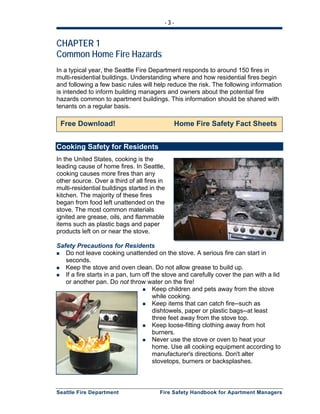
In the United States, cooking is the
leading cause of home fires. In Seattle,
cooking causes more fires than any
other source. Over a third of all fires in
multi-residential buildings started in the
kitchen. The majority of these fires
began from food left unattended on the
stove. The most common materials
ignited are grease, oils, and flammable
items such as plastic bags and paper
products left on or near the stove.
Safety Precautions for Residents
Do not leave cooking unattended on the stove. A serious fire can start in
seconds.
Keep the stove and oven clean. Do not allow grease to build up.
If a fire starts in a pan, turn off the stove and carefully cover the pan with a lid
or another pan. Do not throw water on the fire!
Keep children and pets away from the stove
while cooking.
Keep items that can catch fire--such as
dishtowels, paper or plastic bags--at least
three feet away from the stove top.
Keep loose-fitting clothing away from hot
burners.
Never use the stove or oven to heat your
home. Use all cooking equipment according to
manufacturer's directions. Don't alter
stovetops, burners or backsplashes.
Free Download! Home Fire Safety Fact Sheets
- 4 -
Seattle Fire Department Fire Safety Handbook for Apartment Managers
Heating Safety for Residents
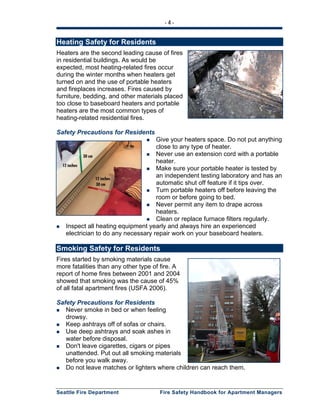
Heaters are the second leading cause of fires
in residential buildings. As would be
expected, most heating-related fires occur
during the winter months when heaters get
turned on and the use of portable heaters
and fireplaces increases. Fires caused by
furniture, bedding, and other materials placed
too close to baseboard heaters and portable
heaters are the most common types of
heating-related residential fires.
Safety Precautions for Residents
Give your heaters space. Do not put anything
close to any type of heater.
Never use an extension cord with a portable
heater.
Make sure your portable heater is tested by
an independent testing laboratory and has an
automatic shut off feature if it tips over.
Turn portable heaters off before leaving the
room or before going to bed.
Never permit any item to drape across
heaters.
Clean or replace furnace filters regularly.
Inspect all heating equipment yearly and always hire an experienced
electrician to do any necessary repair work on your baseboard heaters.
Smoking Safety for Residents
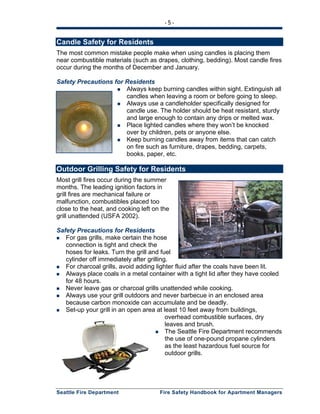
Fires started by smoking materials cause
more fatalities than any other type of fire. A
report of home fires between 2001 and 2004
showed that smoking was the cause of 45%
of all fatal apartment fires (USFA 2006).
Safety Precautions for Residents
Never smoke in bed or when feeling
drowsy.
Keep ashtrays off of sofas or chairs.
Use deep ashtrays and soak ashes in
water before disposal.
Don't leave cigarettes, cigars or pipes
unattended. Put out all smoking materials
before you walk away.
Do not leave matches or lighters where children can reach them.
- 5 -
Seattle Fire Department Fire Safety Handbook for Apartment Managers
Candle Safety for Residents
The most common mistake people make when using candles is placing them
near combustible materials (such as drapes, clothing, bedding). Most candle fires
occur during the months of December and January.
Safety Precautions for Residents
Always keep burning candles within sight. Extinguish all
candles when leaving a room or before going to sleep.
Always use a candleholder specifically designed for
candle use. The holder should be heat resistant, sturdy
and large enough to contain any drips or melted wax.
Place lighted candles where they won’t be knocked
over by children, pets or anyone else.
Keep burning candles away from items that can catch
on fire such as furniture, drapes, bedding, carpets,
books, paper, etc.
Outdoor Grilling Safety for Residents
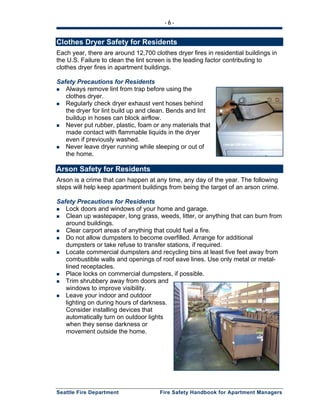
Most grill fires occur during the summer
months. The leading ignition factors in
grill fires are mechanical failure or
malfunction, combustibles placed too
close to the heat, and cooking left on the
grill unattended (USFA 2002).
Safety Precautions for Residents
For gas grills, make certain the hose
connection is tight and check the
hoses for leaks. Turn the grill and fuel
cylinder off immediately after grilling.
For charcoal grills, avoid adding lighter fluid after the coals have been lit.
Always place coals in a metal container with a tight lid after they have cooled
for 48 hours.
Never leave gas or charcoal grills unattended while cooking.
Always use your grill outdoors and never barbecue in an enclosed area
because carbon monoxide can accumulate and be deadly.
Set-up your grill in an open area at least 10 feet away from buildings,
overhead combustible surfaces, dry
leaves and brush.
The Seattle Fire Department recommends
the use of one-pound propane cylinders
as the least hazardous fuel source for
outdoor grills.
- 6 -
Seattle Fire Department Fire Safety Handbook for Apartment Managers
Clothes Dryer Safety for Residents
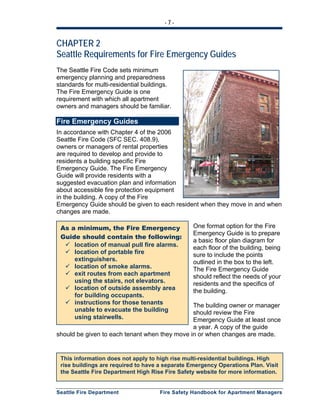
Each year, there are around 12,700 clothes dryer fires in residential buildings in
the U.S. Failure to clean the lint screen is the leading factor contributing to
clothes dryer fires in apartment buildings.
Safety Precautions for Residents
Always remove lint from trap before using the
clothes dryer.
Regularly check dryer exhaust vent hoses behind
the dryer for lint build up and clean. Bends and lint
buildup in hoses can block airflow.
Never put rubber, plastic, foam or any materials that
made contact with flammable liquids in the dryer
even if previously washed.
Never leave dryer running while sleeping or out of
the home.
Arson Safety for Residents
Arson is a crime that can happen at any time, any day of the year. The following
steps will help keep apartment buildings from being the target of an arson crime.
Safety Precautions for Residents
Lock doors and windows of your home and garage.
Clean up wastepaper, long grass, weeds, litter, or anything that can burn from
around buildings.
Clear carport areas of anything that could fuel a fire.
Do not allow dumpsters to become overfilled. Arrange for additional
dumpsters or take refuse to transfer stations, if required.
Locate commercial dumpsters and recycling bins at least five feet away from
combustible walls and openings of roof eave lines. Use only metal or metal-
lined receptacles.
Place locks on commercial dumpsters, if possible.
Trim shrubbery away from doors and
windows to improve visibility.
Leave your indoor and outdoor
lighting on during hours of darkness.
Consider installing devices that
automatically turn on outdoor lights
when they sense darkness or
movement outside the home.
- 7 -
Seattle Fire Department Fire Safety Handbook for Apartment Managers
This information does not apply to high rise multi-residential buildings. High
rise buildings are required to have a separate Emergency Operations Plan. Visit
the Seattle Fire Department High Rise Fire Safety website for more information.
CHAPTER 2
Seattle Requirements for Fire Emergency Guides
The Seattle Fire Code sets minimum
emergency planning and preparedness
standards for multi-residential buildings.
The Fire Emergency Guide is one
requirement with which all apartment
owners and managers should be familiar.
Fire Emergency Guides
In accordance with Chapter 4 of the 2006
Seattle Fire Code (SFC SEC. 408.9),
owners or managers of rental properties
are required to develop and provide to
residents a building specific Fire
Emergency Guide. The Fire Emergency
Guide will provide residents with a
suggested evacuation plan and information
about accessible fire protection equipment
in the building. A copy of the Fire
Emergency Guide should be given to each resident when they move in and when
changes are made.
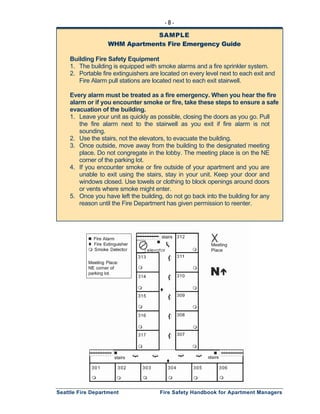
One format option for the Fire
Emergency Guide is to prepare
a basic floor plan diagram for
each floor of the building, being
sure to include the points
outlined in the box to the left.
The Fire Emergency Guide
should reflect the needs of your
residents and the specifics of
the building.
The building owner or manager
should review the Fire
Emergency Guide at least once
a year. A copy of the guide
should be given to each tenant when they move in or when changes are made.
As a minimum, the Fire Emergency
Guide should contain the following:
location of manual pull fire alarms.
location of portable fire
extinguishers.
location of smoke alarms.
exit routes from each apartment
using the stairs, not elevators.
location of outside assembly area
for building occupants.
instructions for those tenants
unable to evacuate the building
using stairwells.
- 8 -
Seattle Fire Department Fire Safety Handbook for Apartment Managers
SAMPLE
WHM Apartments Fire Emergency Guide
Building Fire Safety Equipment
1. The building is equipped with smoke alarms and a fire sprinkler system.
2. Portable fire extinguishers are located on every level next to each exit and
Fire Alarm pull stations are located next to each exit stairwell.
Every alarm must be treated as a fire emergency. When you hear the fire
alarm or if you encounter smoke or fire, take these steps to ensure a safe
evacuation of the building.
1. Leave your unit as quickly as possible, closing the doors as you go. Pull
the fire alarm next to the stairwell as you exit if fire alarm is not
sounding.
2. Use the stairs, not the elevators, to evacuate the building.
3. Once outside, move away from the building to the designated meeting
place. Do not congregate in the lobby. The meeting place is on the NE
corner of the parking lot.
4. If you encounter smoke or fire outside of your apartment and you are
unable to exit using the stairs, stay in your unit. Keep your door and
windows closed. Use towels or clothing to block openings around doors
or vents where smoke might enter.
5. Once you have left the building, do not go back into the building for any
reason until the Fire Department has given permission to reenter.
- 9 -
Seattle Fire Department Fire Safety Handbook for Apartment Managers
CHAPTER 3
Fire Safety Planning
Staff Training
If your building has regular staff
members, it is important that
they have an understanding of
their role in a fire emergency.
Training should be provided for
any tasks they may need to
perform during a fire
emergency. Particular attention
should be paid to the following
areas.
Prevention
Educate all employees as to the
specific hazards in their working
environment and how to
prevent fires while conducting
their assigned duties. Employee
awareness can prevent fires
and protect residents.
Evacuation
Staff members may be
expected to manage the
evacuation of the building
during a fire emergency.
Employees who are asked to
fulfill this task must understand
the building’s evacuation plan for both ambulatory and non-ambulatory residents.
Once residents are outside it is important to keep them informed in order to
combat any fears or rumors.
Reporting
Any fire alarm must be treated as a real emergency and
needs to be reported to the Fire Department, even if a
central station monitoring company provides service to the
building. One staff member should be assigned the
responsibility of calling 9-1-1 from a safe telephone
whenever the building alarm activates or a fire is reported.
The caller should be prepared to provide information as it
is requested by the dispatcher and should be able to stay
on the telephone until instructed to hang up.
What is Real Fire Like?
• Real fire is fast. Once a fire begins
to flame it can double in size every
30 seconds. At this rate, a room can
become fully involved in minutes.
• Real fire is dark. Fires produce large
amounts of thick, black smoke that
obscures vision, causes nausea and
may even lead to unconsciousness
or death. Three out of four people
who die in residential fires die from
smoke inhalation.
• Real fire is hot. A fire can cause the
temperature at ceiling level to reach
excesses of 1200 degrees
Fahrenheit, at just 5 feet it can be
800 degrees. At this temperature, the
superheated air will burn your lungs.
• Real fire is unpredictable. Each fire
is unique. Some may smolder for
hours filling a room with smoke.
Others will burn at exceedingly high
temperatures, consuming everything
with flames.
- 10 -
Seattle Fire Department Fire Safety Handbook for Apartment Managers
Need Help Training Staff?
The Seattle Fire Department loans out
Self-Teaching Kits to be used for training
staff on fire safety.
Click here to learn more about Seattle
Fire Department’s Self-Teaching Kits.
Investigation
If the building’s fire alarm panel provides information as to where the alarm is
initiated, building staff may be able to investigate the source. Investigation does
not eliminate the need to report the alarm to the Fire Department. Anyone
assigned to investigate a fire alarm must understand the danger of fire and know
how to operate a portable fire extinguisher. Any information regarding the source
of the fire alarm should be reported in a call to 9-1-1 as soon as possible.
If building staff determine that a
fire alarm is false prior to the
Fire Department's arrival, they
should call 9-1-1 and relay the
information to the dispatcher.
The dispatcher will notify the
responding fire companies that
a false alarm has been
reported. One fire company will
arrive to verify that the alarm is
false. The Seattle Fire Department will investigate all fire alarms. The building
alarm may not be silenced without permission of the Fire Department or
dispatcher.
Conducting Fire Drills
Staff fire drills are intended to test staff readiness and
response to a fire emergency situation. It is important
that staff fully understands their role in case of a fire
alarm. Fire drills should replicate as closely as possible
the activity expected in an actual emergency. In
addition, fire drills should include a review of the plan
and execution of assigned staff duties.
The following suggestions are provided to assist with
the planning of staff fire drills:
Prior to any drill, staff should be familiar with the
building emergency plan and the details of their
responsibilities. Encourage staff to discuss their
concerns regarding the evacuation procedures.
The drill for your building should include sounding
the fire alarm. If your building fire alarm is
monitored, notify the monitoring company of the drill
immediately prior to its occurrence. Remember to contact the monitoring
company again when the drill is completed. There is no need to notify the
Fire Department.
Keep a fire drill logbook to record fire drill activity. Records should include
the date and time of each drill, the name of the person conducting the drill
and other information pertinent to the drill.
- 11 -
Seattle Fire Department Fire Safety Handbook for Apartment Managers
It is also recommended that you notify residents that the audible alarms
will be sounded for the staff fire drill and invite them to participate.
Another recommendation is to keep records of fire drills and include the following
information:
1. Identity of the person conducting the drill.
2. Date and time of the drill.
3. Notification method used.
4. Staff members on duty and participating.
5. Number of occupants evacuated.
6. Special conditions simulated.
7. Problems encountered.
8. Time required to accomplish the evacuation.
Alternate Fire Evacuation
For those residents unable to
use stairs to evacuate, the
safest response to a fire
emergency may be to remain in
their apartments. As long as the
fire is not in the individual
apartment, that unit is an area
of refuge. An area of refuge
provides protection from smoke
and flames. Residents must be
instructed that if they choose to
stay in their units, their doors
and windows must remain shut.
Residents should also
understand that it is safer for
them to remain inside the
apartment rather than await
further evacuation assistance
from their balconies. If they feel
they are in jeopardy, residents
should use their telephone to
call 9-1-1 to report their location
and request immediate help.
Residents who choose to stay
in their units should be identified to the responding firefighters immediately upon
their arrival. One way this can be done is by maintaining a roster at the fire alarm
panel of residents who plan to stay in their rooms. This roster is then provided to
the firefighters upon their arrival.
Free Download! Alternative Evacuation Handout
Survival Rules for Residents
• Keep the door to the room closed.
A closed door is a barrier to smoke.
• Use towels or clothing to block
openings around doors or vents
where smoke might enter.
• Place a signal in the window. The
signal can be anything that will call
attention to your location.
• If smoke or fire enters your unit,
call 9-1-1 to report your location.
Stay low to the floor to breathe the
best air. Put a wet cloth over your
mouth or nose.
• It is advisable to keep windows
and balcony sliders closed. Smoke
from the outside of the building can
enter through open windows.
Breaking windows may put you at
greater risk of smoke entering from
the outside, and will hamper rescue
efforts below.
- 12 -
Seattle Fire Department Fire Safety Handbook for Apartment Managers
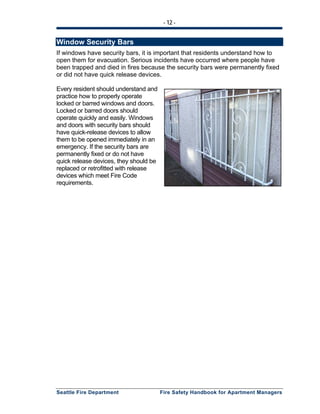
Window Security Bars
If windows have security bars, it is important that residents understand how to
open them for evacuation. Serious incidents have occurred where people have
been trapped and died in fires because the security bars were permanently fixed
or did not have quick release devices.
Every resident should understand and
practice how to properly operate
locked or barred windows and doors.
Locked or barred doors should
operate quickly and easily. Windows
and doors with security bars should
have quick-release devices to allow
them to be opened immediately in an
emergency. If the security bars are
permanently fixed or do not have
quick release devices, they should be
replaced or retrofitted with release
devices which meet Fire Code
requirements.
- 13 -
Seattle Fire Department Fire Safety Handbook for Apartment Managers
CHAPTER 4
Fire Safety Inspections
Emphasis Areas for Apartment Inspections
Seattle Fire Department firefighters inspect
buildings at least every other year to help
ensure certain fire and life safety
requirements are being met. The primary
goal of the inspection program is to identify
and remove potential fire safety hazards in a
building’s public areas.
To prepare for inspections, apartment
managers should be aware of the following
fire safety items.
Emergency Access
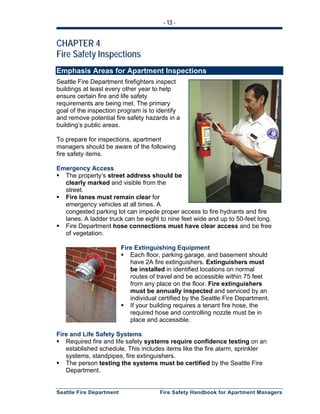
The property’s street address should be
clearly marked and visible from the
street.
Fire lanes must remain clear for
emergency vehicles at all times. A
congested parking lot can impede proper access to fire hydrants and fire
lanes. A ladder truck can be eight to nine feet wide and up to 50-feet long.
Fire Department hose connections must have clear access and be free
of vegetation.
Fire Extinguishing Equipment
Each floor, parking garage, and basement should
have 2A fire extinguishers. Extinguishers must
be installed in identified locations on normal
routes of travel and be accessible within 75 feet
from any place on the floor. Fire extinguishers
must be annually inspected and serviced by an
individual certified by the Seattle Fire Department.
If your building requires a tenant fire hose, the
required hose and controlling nozzle must be in
place and accessible.
Fire and Life Safety Systems
Required fire and life safety systems require confidence testing on an
established schedule. This includes items like the fire alarm, sprinkler
systems, standpipes, fire extinguishers.
The person testing the systems must be certified by the Seattle Fire
Department.
- 14 -
Seattle Fire Department Fire Safety Handbook for Apartment Managers
Exits
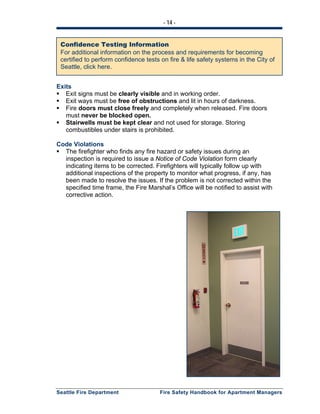
Exit signs must be clearly visible and in working order.
Exit ways must be free of obstructions and lit in hours of darkness.
Fire doors must close freely and completely when released. Fire doors
must never be blocked open.
Stairwells must be kept clear and not used for storage. Storing
combustibles under stairs is prohibited.
Code Violations
The firefighter who finds any fire hazard or safety issues during an
inspection is required to issue a Notice of Code Violation form clearly
indicating items to be corrected. Firefighters will typically follow up with
additional inspections of the property to monitor what progress, if any, has
been made to resolve the issues. If the problem is not corrected within the
specified time frame, the Fire Marshal’s Office will be notified to assist with
corrective action.
Confidence Testing Information
For additional information on the process and requirements for becoming
certified to perform confidence tests on fire & life safety systems in the City of
Seattle, click here.
- 15 -
Seattle Fire Department Fire Safety Handbook for Apartment Managers
CHAPTER 5
Resources
Further Resources for Apartment Managers
Seattle Fire Department Fire Prevention Division, Public Education Section
http://www.seattle.gov/fire/pubEd/
Seattle Fire Dept. Apartment Fire Safety Website
http://www.seattle.gov/fire/pubEd/apt/aptFireSafety.htm
Fire Emergency Guides for Multi-Residential Occupancies
http://www.seattle.gov/fire/FMO/firecode/infobulletins/2007-1.pdf#2007-1
Smoke Alarms in Rental Properties
http://www.seattle.gov/fire/pubEd/brochures/smoke%20alarms%20rental.pdf
King County Fire Marshal, Dept. of Development & Environmental Services
http://www.metrokc.gov/permits/FireMarshal.aspx
Washington State Fire Marshal’s Office
http://www.wsp.wa.gov/fire/education.htm
Washington State RCW 59.18.060—Landlord Duties
http://www.wsp.wa.gov/fire/regional.htm
Seattle Dept. of Planning & Development, Landlord-Tenant Information
http://www.seattle.gov/dpd/Publications/Landlord_Tenant/
Rental Housing Association of Puget Sound
http://www.rha-ps.com
Resources for Educating Tenants
Apartment Fire Safety Fact Sheet
http://www.seattle.gov/fire/pubEd/brochures/apartment.pdf
Home Fire Safety Checklist (including languages other than English)
http://www.seattle.gov/fire/pubEd/brochures/fire%20safety%20checklist.pdf
Fire Safety for Seniors
http://www.seattle.gov/fire/pubEd/homeSafety/seniorSafetyTips.htm
Fire Stoppers Program (for kids who misuse fire)
http://www.seattle.gov/fire/pubEd/firestoppers/fireStoppers.htm
- 16 -
Seattle Fire Department Fire Safety Handbook for Apartment Managers
Candle Safety
http://www.seattle.gov/fire/pubEd/brochures/candles.pdf
Carbon Monoxide Alarms
http://www.seattle.gov/fire/pubEd/brochures/carbon%20monoxide.pdf
Fire Extinguishers
http://www.seattle.gov/fire/pubEd/brochures/extinguishers.pdf
Heating Safety
http://www.seattle.gov/fire/pubEd/brochures/homeHeatingSafety.pdf
Outdoor Cooking
http://www.seattle.gov/fire/pubEd/brochures/Outdoor%20Grilling.pdf

Fire Safety managers handbook

  • 1.
    - 1 - SeattleFire Department Fire Safety Handbook for Apartment Managers Seattle Fire Department Fire Prevention Division Public Education Section www.seattle.gov/fire FIRE SAFETY HANDBOOK For Apartment Managers
  • 2.
    - 2 - SeattleFire Department Fire Safety Handbook for Apartment Managers Contents Introduction..................................................2 Common Fire Hazards.................................3 Fire Emergency Guides...............................7 Fire Safety Planning ....................................9 Fire Safety Inspections..............................13 Resources...................................................15
  • 3.
    - 2 - SeattleFire Department Fire Safety Handbook for Apartment Managers Fire Safety Handbook for Apartment Managers Introduction Fire in an apartment building often involves more than one unit. Many building occupants may be affected. The dense nature of apartment living allows for the spread of smoke, heat, and fire. Fire is always unexpected. Preparing for it shouldn’t be. Responding to a fire requires quick decisions and fast actions in a setting that can be loud, smoky, dark, and hot. Lives and property can be saved by being prepared before fire strikes. The Seattle Fire Code and Washington State Law establish fire safety regulations for multi-residential housing. These rules require property owners to develop a fire emergency guide for tenants. They also require that tenants be informed about the fire protection equipment in the building. This publication was developed to assist property managers in their fire safety efforts. This handbook will provide: 111... information to inform staff and tenants about home fire prevention and safety, 222... guidelines for developing a Code-required Fire Emergency Guide, 333... recommendations for developing fire emergency procedures and 444... an overview of what to expect from the Fire Department inspection process.
  • 4.
    - 3 - SeattleFire Department Fire Safety Handbook for Apartment Managers CHAPTER 1 Common Home Fire Hazards In a typical year, the Seattle Fire Department responds to around 150 fires in multi-residential buildings. Understanding where and how residential fires begin and following a few basic rules will help reduce the risk. The following information is intended to inform building managers and owners about the potential fire hazards common to apartment buildings. This information should be shared with tenants on a regular basis. Cooking Safety for Residents In the United States, cooking is the leading cause of home fires. In Seattle, cooking causes more fires than any other source. Over a third of all fires in multi-residential buildings started in the kitchen. The majority of these fires began from food left unattended on the stove. The most common materials ignited are grease, oils, and flammable items such as plastic bags and paper products left on or near the stove. Safety Precautions for Residents Do not leave cooking unattended on the stove. A serious fire can start in seconds. Keep the stove and oven clean. Do not allow grease to build up. If a fire starts in a pan, turn off the stove and carefully cover the pan with a lid or another pan. Do not throw water on the fire! Keep children and pets away from the stove while cooking. Keep items that can catch fire--such as dishtowels, paper or plastic bags--at least three feet away from the stove top. Keep loose-fitting clothing away from hot burners. Never use the stove or oven to heat your home. Use all cooking equipment according to manufacturer's directions. Don't alter stovetops, burners or backsplashes. Free Download! Home Fire Safety Fact Sheets
  • 5.
    - 4 - SeattleFire Department Fire Safety Handbook for Apartment Managers Heating Safety for Residents Heaters are the second leading cause of fires in residential buildings. As would be expected, most heating-related fires occur during the winter months when heaters get turned on and the use of portable heaters and fireplaces increases. Fires caused by furniture, bedding, and other materials placed too close to baseboard heaters and portable heaters are the most common types of heating-related residential fires. Safety Precautions for Residents Give your heaters space. Do not put anything close to any type of heater. Never use an extension cord with a portable heater. Make sure your portable heater is tested by an independent testing laboratory and has an automatic shut off feature if it tips over. Turn portable heaters off before leaving the room or before going to bed. Never permit any item to drape across heaters. Clean or replace furnace filters regularly. Inspect all heating equipment yearly and always hire an experienced electrician to do any necessary repair work on your baseboard heaters. Smoking Safety for Residents Fires started by smoking materials cause more fatalities than any other type of fire. A report of home fires between 2001 and 2004 showed that smoking was the cause of 45% of all fatal apartment fires (USFA 2006). Safety Precautions for Residents Never smoke in bed or when feeling drowsy. Keep ashtrays off of sofas or chairs. Use deep ashtrays and soak ashes in water before disposal. Don't leave cigarettes, cigars or pipes unattended. Put out all smoking materials before you walk away. Do not leave matches or lighters where children can reach them.
  • 6.
    - 5 - SeattleFire Department Fire Safety Handbook for Apartment Managers Candle Safety for Residents The most common mistake people make when using candles is placing them near combustible materials (such as drapes, clothing, bedding). Most candle fires occur during the months of December and January. Safety Precautions for Residents Always keep burning candles within sight. Extinguish all candles when leaving a room or before going to sleep. Always use a candleholder specifically designed for candle use. The holder should be heat resistant, sturdy and large enough to contain any drips or melted wax. Place lighted candles where they won’t be knocked over by children, pets or anyone else. Keep burning candles away from items that can catch on fire such as furniture, drapes, bedding, carpets, books, paper, etc. Outdoor Grilling Safety for Residents Most grill fires occur during the summer months. The leading ignition factors in grill fires are mechanical failure or malfunction, combustibles placed too close to the heat, and cooking left on the grill unattended (USFA 2002). Safety Precautions for Residents For gas grills, make certain the hose connection is tight and check the hoses for leaks. Turn the grill and fuel cylinder off immediately after grilling. For charcoal grills, avoid adding lighter fluid after the coals have been lit. Always place coals in a metal container with a tight lid after they have cooled for 48 hours. Never leave gas or charcoal grills unattended while cooking. Always use your grill outdoors and never barbecue in an enclosed area because carbon monoxide can accumulate and be deadly. Set-up your grill in an open area at least 10 feet away from buildings, overhead combustible surfaces, dry leaves and brush. The Seattle Fire Department recommends the use of one-pound propane cylinders as the least hazardous fuel source for outdoor grills.
  • 7.
    - 6 - SeattleFire Department Fire Safety Handbook for Apartment Managers Clothes Dryer Safety for Residents Each year, there are around 12,700 clothes dryer fires in residential buildings in the U.S. Failure to clean the lint screen is the leading factor contributing to clothes dryer fires in apartment buildings. Safety Precautions for Residents Always remove lint from trap before using the clothes dryer. Regularly check dryer exhaust vent hoses behind the dryer for lint build up and clean. Bends and lint buildup in hoses can block airflow. Never put rubber, plastic, foam or any materials that made contact with flammable liquids in the dryer even if previously washed. Never leave dryer running while sleeping or out of the home. Arson Safety for Residents Arson is a crime that can happen at any time, any day of the year. The following steps will help keep apartment buildings from being the target of an arson crime. Safety Precautions for Residents Lock doors and windows of your home and garage. Clean up wastepaper, long grass, weeds, litter, or anything that can burn from around buildings. Clear carport areas of anything that could fuel a fire. Do not allow dumpsters to become overfilled. Arrange for additional dumpsters or take refuse to transfer stations, if required. Locate commercial dumpsters and recycling bins at least five feet away from combustible walls and openings of roof eave lines. Use only metal or metal- lined receptacles. Place locks on commercial dumpsters, if possible. Trim shrubbery away from doors and windows to improve visibility. Leave your indoor and outdoor lighting on during hours of darkness. Consider installing devices that automatically turn on outdoor lights when they sense darkness or movement outside the home.
  • 8.
    - 7 - SeattleFire Department Fire Safety Handbook for Apartment Managers This information does not apply to high rise multi-residential buildings. High rise buildings are required to have a separate Emergency Operations Plan. Visit the Seattle Fire Department High Rise Fire Safety website for more information. CHAPTER 2 Seattle Requirements for Fire Emergency Guides The Seattle Fire Code sets minimum emergency planning and preparedness standards for multi-residential buildings. The Fire Emergency Guide is one requirement with which all apartment owners and managers should be familiar. Fire Emergency Guides In accordance with Chapter 4 of the 2006 Seattle Fire Code (SFC SEC. 408.9), owners or managers of rental properties are required to develop and provide to residents a building specific Fire Emergency Guide. The Fire Emergency Guide will provide residents with a suggested evacuation plan and information about accessible fire protection equipment in the building. A copy of the Fire Emergency Guide should be given to each resident when they move in and when changes are made. One format option for the Fire Emergency Guide is to prepare a basic floor plan diagram for each floor of the building, being sure to include the points outlined in the box to the left. The Fire Emergency Guide should reflect the needs of your residents and the specifics of the building. The building owner or manager should review the Fire Emergency Guide at least once a year. A copy of the guide should be given to each tenant when they move in or when changes are made. As a minimum, the Fire Emergency Guide should contain the following: location of manual pull fire alarms. location of portable fire extinguishers. location of smoke alarms. exit routes from each apartment using the stairs, not elevators. location of outside assembly area for building occupants. instructions for those tenants unable to evacuate the building using stairwells.
  • 9.
    - 8 - SeattleFire Department Fire Safety Handbook for Apartment Managers SAMPLE WHM Apartments Fire Emergency Guide Building Fire Safety Equipment 1. The building is equipped with smoke alarms and a fire sprinkler system. 2. Portable fire extinguishers are located on every level next to each exit and Fire Alarm pull stations are located next to each exit stairwell. Every alarm must be treated as a fire emergency. When you hear the fire alarm or if you encounter smoke or fire, take these steps to ensure a safe evacuation of the building. 1. Leave your unit as quickly as possible, closing the doors as you go. Pull the fire alarm next to the stairwell as you exit if fire alarm is not sounding. 2. Use the stairs, not the elevators, to evacuate the building. 3. Once outside, move away from the building to the designated meeting place. Do not congregate in the lobby. The meeting place is on the NE corner of the parking lot. 4. If you encounter smoke or fire outside of your apartment and you are unable to exit using the stairs, stay in your unit. Keep your door and windows closed. Use towels or clothing to block openings around doors or vents where smoke might enter. 5. Once you have left the building, do not go back into the building for any reason until the Fire Department has given permission to reenter.
  • 10.
    - 9 - SeattleFire Department Fire Safety Handbook for Apartment Managers CHAPTER 3 Fire Safety Planning Staff Training If your building has regular staff members, it is important that they have an understanding of their role in a fire emergency. Training should be provided for any tasks they may need to perform during a fire emergency. Particular attention should be paid to the following areas. Prevention Educate all employees as to the specific hazards in their working environment and how to prevent fires while conducting their assigned duties. Employee awareness can prevent fires and protect residents. Evacuation Staff members may be expected to manage the evacuation of the building during a fire emergency. Employees who are asked to fulfill this task must understand the building’s evacuation plan for both ambulatory and non-ambulatory residents. Once residents are outside it is important to keep them informed in order to combat any fears or rumors. Reporting Any fire alarm must be treated as a real emergency and needs to be reported to the Fire Department, even if a central station monitoring company provides service to the building. One staff member should be assigned the responsibility of calling 9-1-1 from a safe telephone whenever the building alarm activates or a fire is reported. The caller should be prepared to provide information as it is requested by the dispatcher and should be able to stay on the telephone until instructed to hang up. What is Real Fire Like? • Real fire is fast. Once a fire begins to flame it can double in size every 30 seconds. At this rate, a room can become fully involved in minutes. • Real fire is dark. Fires produce large amounts of thick, black smoke that obscures vision, causes nausea and may even lead to unconsciousness or death. Three out of four people who die in residential fires die from smoke inhalation. • Real fire is hot. A fire can cause the temperature at ceiling level to reach excesses of 1200 degrees Fahrenheit, at just 5 feet it can be 800 degrees. At this temperature, the superheated air will burn your lungs. • Real fire is unpredictable. Each fire is unique. Some may smolder for hours filling a room with smoke. Others will burn at exceedingly high temperatures, consuming everything with flames.
  • 11.
    - 10 - SeattleFire Department Fire Safety Handbook for Apartment Managers Need Help Training Staff? The Seattle Fire Department loans out Self-Teaching Kits to be used for training staff on fire safety. Click here to learn more about Seattle Fire Department’s Self-Teaching Kits. Investigation If the building’s fire alarm panel provides information as to where the alarm is initiated, building staff may be able to investigate the source. Investigation does not eliminate the need to report the alarm to the Fire Department. Anyone assigned to investigate a fire alarm must understand the danger of fire and know how to operate a portable fire extinguisher. Any information regarding the source of the fire alarm should be reported in a call to 9-1-1 as soon as possible. If building staff determine that a fire alarm is false prior to the Fire Department's arrival, they should call 9-1-1 and relay the information to the dispatcher. The dispatcher will notify the responding fire companies that a false alarm has been reported. One fire company will arrive to verify that the alarm is false. The Seattle Fire Department will investigate all fire alarms. The building alarm may not be silenced without permission of the Fire Department or dispatcher. Conducting Fire Drills Staff fire drills are intended to test staff readiness and response to a fire emergency situation. It is important that staff fully understands their role in case of a fire alarm. Fire drills should replicate as closely as possible the activity expected in an actual emergency. In addition, fire drills should include a review of the plan and execution of assigned staff duties. The following suggestions are provided to assist with the planning of staff fire drills: Prior to any drill, staff should be familiar with the building emergency plan and the details of their responsibilities. Encourage staff to discuss their concerns regarding the evacuation procedures. The drill for your building should include sounding the fire alarm. If your building fire alarm is monitored, notify the monitoring company of the drill immediately prior to its occurrence. Remember to contact the monitoring company again when the drill is completed. There is no need to notify the Fire Department. Keep a fire drill logbook to record fire drill activity. Records should include the date and time of each drill, the name of the person conducting the drill and other information pertinent to the drill.
  • 12.
    - 11 - SeattleFire Department Fire Safety Handbook for Apartment Managers It is also recommended that you notify residents that the audible alarms will be sounded for the staff fire drill and invite them to participate. Another recommendation is to keep records of fire drills and include the following information: 1. Identity of the person conducting the drill. 2. Date and time of the drill. 3. Notification method used. 4. Staff members on duty and participating. 5. Number of occupants evacuated. 6. Special conditions simulated. 7. Problems encountered. 8. Time required to accomplish the evacuation. Alternate Fire Evacuation For those residents unable to use stairs to evacuate, the safest response to a fire emergency may be to remain in their apartments. As long as the fire is not in the individual apartment, that unit is an area of refuge. An area of refuge provides protection from smoke and flames. Residents must be instructed that if they choose to stay in their units, their doors and windows must remain shut. Residents should also understand that it is safer for them to remain inside the apartment rather than await further evacuation assistance from their balconies. If they feel they are in jeopardy, residents should use their telephone to call 9-1-1 to report their location and request immediate help. Residents who choose to stay in their units should be identified to the responding firefighters immediately upon their arrival. One way this can be done is by maintaining a roster at the fire alarm panel of residents who plan to stay in their rooms. This roster is then provided to the firefighters upon their arrival. Free Download! Alternative Evacuation Handout Survival Rules for Residents • Keep the door to the room closed. A closed door is a barrier to smoke. • Use towels or clothing to block openings around doors or vents where smoke might enter. • Place a signal in the window. The signal can be anything that will call attention to your location. • If smoke or fire enters your unit, call 9-1-1 to report your location. Stay low to the floor to breathe the best air. Put a wet cloth over your mouth or nose. • It is advisable to keep windows and balcony sliders closed. Smoke from the outside of the building can enter through open windows. Breaking windows may put you at greater risk of smoke entering from the outside, and will hamper rescue efforts below.
  • 13.
    - 12 - SeattleFire Department Fire Safety Handbook for Apartment Managers Window Security Bars If windows have security bars, it is important that residents understand how to open them for evacuation. Serious incidents have occurred where people have been trapped and died in fires because the security bars were permanently fixed or did not have quick release devices. Every resident should understand and practice how to properly operate locked or barred windows and doors. Locked or barred doors should operate quickly and easily. Windows and doors with security bars should have quick-release devices to allow them to be opened immediately in an emergency. If the security bars are permanently fixed or do not have quick release devices, they should be replaced or retrofitted with release devices which meet Fire Code requirements.
  • 14.
    - 13 - SeattleFire Department Fire Safety Handbook for Apartment Managers CHAPTER 4 Fire Safety Inspections Emphasis Areas for Apartment Inspections Seattle Fire Department firefighters inspect buildings at least every other year to help ensure certain fire and life safety requirements are being met. The primary goal of the inspection program is to identify and remove potential fire safety hazards in a building’s public areas. To prepare for inspections, apartment managers should be aware of the following fire safety items. Emergency Access The property’s street address should be clearly marked and visible from the street. Fire lanes must remain clear for emergency vehicles at all times. A congested parking lot can impede proper access to fire hydrants and fire lanes. A ladder truck can be eight to nine feet wide and up to 50-feet long. Fire Department hose connections must have clear access and be free of vegetation. Fire Extinguishing Equipment Each floor, parking garage, and basement should have 2A fire extinguishers. Extinguishers must be installed in identified locations on normal routes of travel and be accessible within 75 feet from any place on the floor. Fire extinguishers must be annually inspected and serviced by an individual certified by the Seattle Fire Department. If your building requires a tenant fire hose, the required hose and controlling nozzle must be in place and accessible. Fire and Life Safety Systems Required fire and life safety systems require confidence testing on an established schedule. This includes items like the fire alarm, sprinkler systems, standpipes, fire extinguishers. The person testing the systems must be certified by the Seattle Fire Department.
  • 15.
    - 14 - SeattleFire Department Fire Safety Handbook for Apartment Managers Exits Exit signs must be clearly visible and in working order. Exit ways must be free of obstructions and lit in hours of darkness. Fire doors must close freely and completely when released. Fire doors must never be blocked open. Stairwells must be kept clear and not used for storage. Storing combustibles under stairs is prohibited. Code Violations The firefighter who finds any fire hazard or safety issues during an inspection is required to issue a Notice of Code Violation form clearly indicating items to be corrected. Firefighters will typically follow up with additional inspections of the property to monitor what progress, if any, has been made to resolve the issues. If the problem is not corrected within the specified time frame, the Fire Marshal’s Office will be notified to assist with corrective action. Confidence Testing Information For additional information on the process and requirements for becoming certified to perform confidence tests on fire & life safety systems in the City of Seattle, click here.
  • 16.
    - 15 - SeattleFire Department Fire Safety Handbook for Apartment Managers CHAPTER 5 Resources Further Resources for Apartment Managers Seattle Fire Department Fire Prevention Division, Public Education Section http://www.seattle.gov/fire/pubEd/ Seattle Fire Dept. Apartment Fire Safety Website http://www.seattle.gov/fire/pubEd/apt/aptFireSafety.htm Fire Emergency Guides for Multi-Residential Occupancies http://www.seattle.gov/fire/FMO/firecode/infobulletins/2007-1.pdf#2007-1 Smoke Alarms in Rental Properties http://www.seattle.gov/fire/pubEd/brochures/smoke%20alarms%20rental.pdf King County Fire Marshal, Dept. of Development & Environmental Services http://www.metrokc.gov/permits/FireMarshal.aspx Washington State Fire Marshal’s Office http://www.wsp.wa.gov/fire/education.htm Washington State RCW 59.18.060—Landlord Duties http://www.wsp.wa.gov/fire/regional.htm Seattle Dept. of Planning & Development, Landlord-Tenant Information http://www.seattle.gov/dpd/Publications/Landlord_Tenant/ Rental Housing Association of Puget Sound http://www.rha-ps.com Resources for Educating Tenants Apartment Fire Safety Fact Sheet http://www.seattle.gov/fire/pubEd/brochures/apartment.pdf Home Fire Safety Checklist (including languages other than English) http://www.seattle.gov/fire/pubEd/brochures/fire%20safety%20checklist.pdf Fire Safety for Seniors http://www.seattle.gov/fire/pubEd/homeSafety/seniorSafetyTips.htm Fire Stoppers Program (for kids who misuse fire) http://www.seattle.gov/fire/pubEd/firestoppers/fireStoppers.htm
  • 17.
    - 16 - SeattleFire Department Fire Safety Handbook for Apartment Managers Candle Safety http://www.seattle.gov/fire/pubEd/brochures/candles.pdf Carbon Monoxide Alarms http://www.seattle.gov/fire/pubEd/brochures/carbon%20monoxide.pdf Fire Extinguishers http://www.seattle.gov/fire/pubEd/brochures/extinguishers.pdf Heating Safety http://www.seattle.gov/fire/pubEd/brochures/homeHeatingSafety.pdf Outdoor Cooking http://www.seattle.gov/fire/pubEd/brochures/Outdoor%20Grilling.pdf