The document outlines the design and implementation of a fire-fighting robot developed by students at North Western University, highlighting its motivation, components, and operational flow. The robot utilizes a flame sensor, microcontroller, and motor systems to detect and extinguish fires autonomously. Future improvements include enhancing the power source and sensor accuracy, as well as integrating a GSM module for connectivity.

This slide introduces the project on designing a fire fighting robot presented by Md. Al Imran Tarafder and supervised by Farin Rahman Deepa.
The slide outlines key components of the project, including motivation, apparatus, flowchart, circuit diagrams, results, limitations, future work, and conclusion.
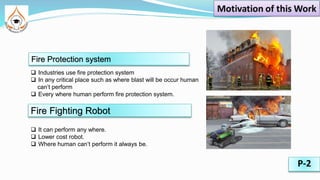
This slide discusses the importance of fire protection systems and highlights the advantages of using robots in hazardous environments.
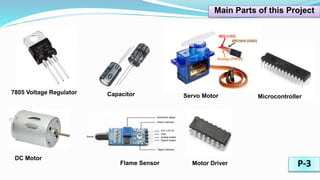
Highlights essential parts of the project such as capacitor, voltage regulator, motors, flame sensor, and microcontroller.
A flowchart illustrating the operational sequence of the fire fighting robot including the flame detection and action processes.
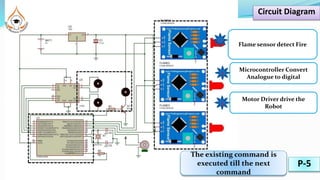
Details on how the circuit functions, including flame sensor detection, conversion processes, and execution of commands by the robot.
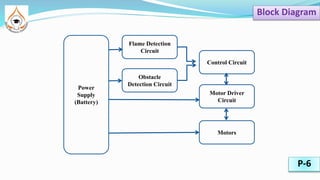
Block diagram showing the connections and components like power supply, flame detection, and motor driver circuits.
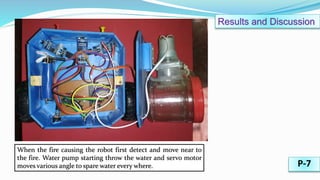
Describes how the robot detects fire and performs actions like moving and dispensing water to extinguish flames.
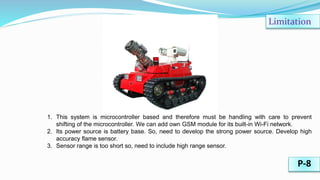
Identifies limitations such as microcontroller sensitivity, battery reliance, and short sensor range, suggesting areas for improvement.
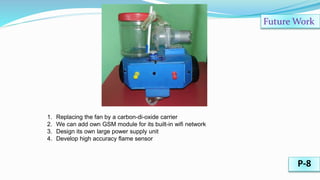
Proposed future improvements including replacing components, enhancing power supply, and developing more effective sensors.
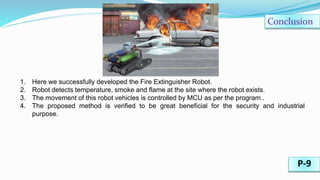
Summarizes the project's success in developing an effective fire extinguishing robot and its potential applications.
Final thank-you note, concluding the presentation.
NORTH WESTERN UNIVERSITY
Design& Implementation of
A Fire Fighting Robot
Presented By
Md. Al Imran Tarafder
Supervised By
Farin Rahman Deepa
Lecturer, Dept. of Electrical and Electronics Engineering (EEE)
North Western University
Khulna-9100, Bangladesh
2.
Motivation ofthis Fire Fighting Project
Apparatus used in this project
Flowchart
Circuit diagram
Block diagram
Result and Discussion
Limitation
Future Work
Conclusion
Outline
P-1
3.
Fire Protection system
Industries use fire protection system
In any critical place such as where blast will be occur human
can’t perform
Every where human perform fire protection system.
Fire Fighting Robot
It can perform any where.
Lower cost robot.
Where human can’t perform it always be.
P-2
4.
Main Parts ofthis Project
Capacitor7805 Voltage Regulator
Motor Driver
Servo Motor
DC Motor
Flame Sensor P-3
Microcontroller
Circuit Diagram
Flame sensordetect Fire
1
Microcontroller Convert
Analogue to digital
2
Motor Driver drive the
Robot
3
The existing command is
executed till the next
command
P-5
Results and Discussion
P-7
Whenthe fire causing the robot first detect and move near to
the fire. Water pump starting throw the water and servo motor
moves various angle to spare water every where.
9.
Limitation
P-8
1. This systemis microcontroller based and therefore must be handling with care to prevent
shifting of the microcontroller. We can add own GSM module for its built-in Wi-Fi network.
2. Its power source is battery base. So, need to develop the strong power source. Develop high
accuracy flame sensor.
3. Sensor range is too short so, need to include high range sensor.
10.
Future Work
P-8
1. Replacingthe fan by a carbon-di-oxide carrier
2. We can add own GSM module for its built-in wifi network
3. Design its own large power supply unit
4. Develop high accuracy flame sensor
11.
Conclusion
1. Here wesuccessfully developed the Fire Extinguisher Robot.
2. Robot detects temperature, smoke and flame at the site where the robot exists.
3. The movement of this robot vehicles is controlled by MCU as per the program..
4. The proposed method is verified to be great beneficial for the security and industrial
purpose.
P-9