Fire Protection Systems
Third Edition
Chapter 4 — Types of Fire Alarm and Detection Systems
Objectives
‣List and discuss the different fire alarm system classifications.
‣List and discuss the interface capabilities between fire alarm
systems and other building fire protection and life safety
systems.
Objectives
‣List and discuss the different conditions, situations, and
circumstances used to determine manual fire alarm and
automatic detection system installation requirements.
‣Describe the different acceptance and periodic inspections,
tests, and maintenance activities required for fire alarm and
detection systems.
Introduction
‣The type of fire alarm system installed in a particular building
depends on many factors established by the model codes.
‣Systems are classified according to the certain operational
events that take place when the system activates.
‣The party responsible for the activities associated with the alarm
is determined by the type of system installed.
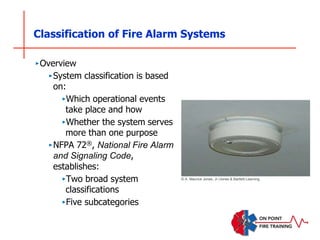
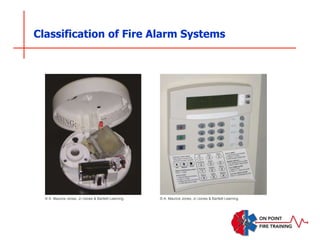
Classification of Fire Alarm Systems
‣Overview
‣System classification is based
on:
‣Which operational events
take place and how
‣Whether the system serves
more than one purpose
‣NFPA 72®, National Fire Alarm
and Signaling Code,
establishes:
‣Two broad system
classifications
‣Five subcategories
© A. Maurice Jones, Jr./Jones & Bartlett Learning.
Classification of Fire Alarm Systems
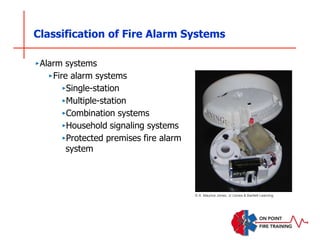
‣Alarm systems
‣Fire alarm systems
‣Single-station
‣Multiple-station
‣Combination systems
‣Household signaling systems
‣Protected premises fire alarm
system
© A. Maurice Jones, Jr./Jones & Bartlett Learning.
Classification of Fire Alarm Systems
‣Alarm systems
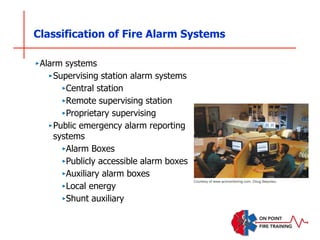
‣Supervising station alarm systems
‣Central station
‣Remote supervising station
‣Proprietary supervising
‣Public emergency alarm reporting
systems
‣Alarm Boxes
‣Publicly accessible alarm boxes
‣Auxiliary alarm boxes
‣Local energy
‣Shunt auxiliary
Courtesy of www.acimonitoring.com, Doug Beaulieu.
Classification of Fire Alarm Systems
© A. Maurice Jones, Jr./Jones & Bartlett Learning. © A. Maurice Jones, Jr./Jones & Bartlett Learning.
Classification of Fire Alarm Systems
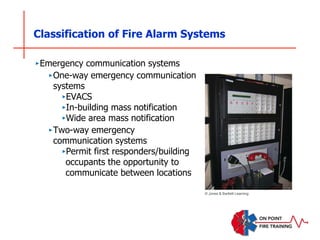
‣Emergency communication systems
‣One-way emergency communication
systems
‣EVACS
‣In-building mass notification
‣Wide area mass notification
‣Two-way emergency
communication systems
‣Permit first responders/building
occupants the opportunity to
communicate between locations
© Jones & Bartlett Learning
Interface with Other Systems
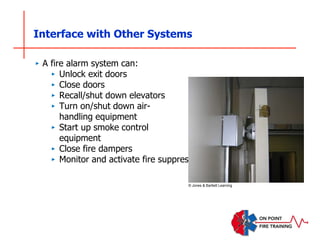
‣ A fire alarm system can:
‣ Unlock exit doors
‣ Close doors
‣ Recall/shut down elevators
‣ Turn on/shut down air-
handling equipment
‣ Start up smoke control
equipment
‣ Close fire dampers
‣ Monitor and activate fire suppression systems
© Jones & Bartlett Learning
Required Installations
‣Overview
‣NFPA or ICC model codes
‣Use and occupancy
‣Number of occupants
‣Levels above or below exit discharge
‣Types of products used or manufactured
‣Whether other fire protection systems will be installed
Required Installations
‣Use-group and occupancy
‣Installing a fire system can be especially important when a
building is large or has a large number of occupants.
‣Factors and considerations specific to the use or occupancy
‣Occupant load
‣Occupant capability
‣Building height
‣Number of levels above or below exit discharge
Required Installations
‣Number of occupants
‣The number of individuals and their location in the structure
are important factors.
‣There are differences in the occupant threshold limit
between the NFPA model codes and the ICC’s IBC® for
businesses.
‣The occupancy load does not factor into requirements for
automatic smoke detection in assembly or business
occupancies.
Required Installations
‣Building height
‣Dependent on the number of levels above or below exit
discharge
‣Neither of the model codes determines requirements for
smoke detection based on building height.
Required Installations
‣Level of exit discharge
‣The number of occupants who are above or below the
discharge level will determine if a manual fire alarm is
required.
‣Neither of the model codes requires automatic smoke
detection installation purely based on the level of exit
discharge.
Required Installations
‣Manufacturing and use products
‣Both model codes require manual fire alarm systems in
semiconductor manufacturing facilities.
‣Requirements for automatic detection systems
‣Highly toxic gases
‣Organic peroxides
‣Oxidizers stored or used exceeding the maximum
permitted amount
Required Installations
‣Special use and occupancy conditions
‣IBC® requires a manual fire alarm system in deep
underground buildings.
‣IBC® requires automatic fire detection in certain areas of any
building classified as a high-rise building.
‣Office building
‣Hotel
‣Apartment
‣Condominium
‣Telephone-switching center
Required Installations
‣Installation of other fire protection systems
‣In some occupancies, automatic sprinkler systems permit the
exclusion of manual fire alarm boxes.
‣Automatic system installations permit omission of smoke
detectors in a few situations.
Design and Installation Standards
‣NFPA 72®
‣Provides application, design, installation, inspection, testing,
and maintenance requirements.
‣Has information concerning components, hardware, system
types, power requirements, etc.
‣Establishes minimum requirements for installation.
‣References other standards to deal with specific issues
relating to the installation of fire alarm and detection
systems.
Fire Alarm System Inspection and Testing
‣Overview
‣Operational integrity
‣Initial acceptance test
‣Lifetime of periodic inspections and tests
Fire Alarm System Inspection and Testing
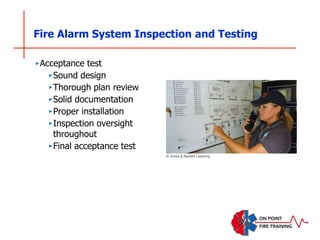
‣Acceptance test
‣Sound design
‣Thorough plan review
‣Solid documentation
‣Proper installation
‣Inspection oversight
throughout
‣Final acceptance test
© Jones & Bartlett Learning
Fire Alarm System Inspection and Testing
‣Periodic inspection, testing, service, and maintenance
‣False alarms
‣Lack of or improper inspection, testing, service, and
maintenance
‣NFPA 72®
‣Detailed inspection
‣Test intervals

1540 Ch 4 PowerPoint.pptx

  • 1.
    Fire Protection Systems ThirdEdition Chapter 4 — Types of Fire Alarm and Detection Systems
  • 2.
    Objectives ‣List and discussthe different fire alarm system classifications. ‣List and discuss the interface capabilities between fire alarm systems and other building fire protection and life safety systems.
  • 3.
    Objectives ‣List and discussthe different conditions, situations, and circumstances used to determine manual fire alarm and automatic detection system installation requirements. ‣Describe the different acceptance and periodic inspections, tests, and maintenance activities required for fire alarm and detection systems.
  • 4.
    Introduction ‣The type offire alarm system installed in a particular building depends on many factors established by the model codes. ‣Systems are classified according to the certain operational events that take place when the system activates. ‣The party responsible for the activities associated with the alarm is determined by the type of system installed.
  • 5.
    Classification of FireAlarm Systems ‣Overview ‣System classification is based on: ‣Which operational events take place and how ‣Whether the system serves more than one purpose ‣NFPA 72®, National Fire Alarm and Signaling Code, establishes: ‣Two broad system classifications ‣Five subcategories © A. Maurice Jones, Jr./Jones & Bartlett Learning.
  • 6.
    Classification of FireAlarm Systems ‣Alarm systems ‣Fire alarm systems ‣Single-station ‣Multiple-station ‣Combination systems ‣Household signaling systems ‣Protected premises fire alarm system © A. Maurice Jones, Jr./Jones & Bartlett Learning.
  • 7.
    Classification of FireAlarm Systems ‣Alarm systems ‣Supervising station alarm systems ‣Central station ‣Remote supervising station ‣Proprietary supervising ‣Public emergency alarm reporting systems ‣Alarm Boxes ‣Publicly accessible alarm boxes ‣Auxiliary alarm boxes ‣Local energy ‣Shunt auxiliary Courtesy of www.acimonitoring.com, Doug Beaulieu.
  • 8.
    Classification of FireAlarm Systems © A. Maurice Jones, Jr./Jones & Bartlett Learning. © A. Maurice Jones, Jr./Jones & Bartlett Learning.
  • 9.
    Classification of FireAlarm Systems ‣Emergency communication systems ‣One-way emergency communication systems ‣EVACS ‣In-building mass notification ‣Wide area mass notification ‣Two-way emergency communication systems ‣Permit first responders/building occupants the opportunity to communicate between locations © Jones & Bartlett Learning
  • 10.
    Interface with OtherSystems ‣ A fire alarm system can: ‣ Unlock exit doors ‣ Close doors ‣ Recall/shut down elevators ‣ Turn on/shut down air- handling equipment ‣ Start up smoke control equipment ‣ Close fire dampers ‣ Monitor and activate fire suppression systems © Jones & Bartlett Learning
  • 11.
    Required Installations ‣Overview ‣NFPA orICC model codes ‣Use and occupancy ‣Number of occupants ‣Levels above or below exit discharge ‣Types of products used or manufactured ‣Whether other fire protection systems will be installed
  • 12.
    Required Installations ‣Use-group andoccupancy ‣Installing a fire system can be especially important when a building is large or has a large number of occupants. ‣Factors and considerations specific to the use or occupancy ‣Occupant load ‣Occupant capability ‣Building height ‣Number of levels above or below exit discharge
  • 13.
    Required Installations ‣Number ofoccupants ‣The number of individuals and their location in the structure are important factors. ‣There are differences in the occupant threshold limit between the NFPA model codes and the ICC’s IBC® for businesses. ‣The occupancy load does not factor into requirements for automatic smoke detection in assembly or business occupancies.
  • 14.
    Required Installations ‣Building height ‣Dependenton the number of levels above or below exit discharge ‣Neither of the model codes determines requirements for smoke detection based on building height.
  • 15.
    Required Installations ‣Level ofexit discharge ‣The number of occupants who are above or below the discharge level will determine if a manual fire alarm is required. ‣Neither of the model codes requires automatic smoke detection installation purely based on the level of exit discharge.
  • 16.
    Required Installations ‣Manufacturing anduse products ‣Both model codes require manual fire alarm systems in semiconductor manufacturing facilities. ‣Requirements for automatic detection systems ‣Highly toxic gases ‣Organic peroxides ‣Oxidizers stored or used exceeding the maximum permitted amount
  • 17.
    Required Installations ‣Special useand occupancy conditions ‣IBC® requires a manual fire alarm system in deep underground buildings. ‣IBC® requires automatic fire detection in certain areas of any building classified as a high-rise building. ‣Office building ‣Hotel ‣Apartment ‣Condominium ‣Telephone-switching center
  • 18.
    Required Installations ‣Installation ofother fire protection systems ‣In some occupancies, automatic sprinkler systems permit the exclusion of manual fire alarm boxes. ‣Automatic system installations permit omission of smoke detectors in a few situations.
  • 19.
    Design and InstallationStandards ‣NFPA 72® ‣Provides application, design, installation, inspection, testing, and maintenance requirements. ‣Has information concerning components, hardware, system types, power requirements, etc. ‣Establishes minimum requirements for installation. ‣References other standards to deal with specific issues relating to the installation of fire alarm and detection systems.
  • 20.
    Fire Alarm SystemInspection and Testing ‣Overview ‣Operational integrity ‣Initial acceptance test ‣Lifetime of periodic inspections and tests
  • 21.
    Fire Alarm SystemInspection and Testing ‣Acceptance test ‣Sound design ‣Thorough plan review ‣Solid documentation ‣Proper installation ‣Inspection oversight throughout ‣Final acceptance test © Jones & Bartlett Learning
  • 22.
    Fire Alarm SystemInspection and Testing ‣Periodic inspection, testing, service, and maintenance ‣False alarms ‣Lack of or improper inspection, testing, service, and maintenance ‣NFPA 72® ‣Detailed inspection ‣Test intervals