Finding sources using searchable databasesHow to use resources available to Truman students to find peer-reviewed scholarly articles in clinical and interpretive disciplines
Your student fees include access to:Pickler library web site Subscription-only research databasesNumerous subscription-only e-journalsHard copies of hundreds of scholarly journalsEasy to use if you’re in town
To begin researching a topic,Go to the library web site and click the “Articles & Research Databases” linkScroll to the bottom of the screen to view Help Guides coveringConnecting to databases from homeExplaining types of articles (scholarly, popular, trade)Keyword searching basics (use of AND, NOT, OR, etc.)Citation tools
Under “Starting points for research in most subjects”You’ll find a link to the EBSCOHost family of databases under the “Background Information” headingEBSCOHost is a good resource when you need access to peer-reviewed articles from multiple disciplinesSubscription-only, but available to you using the VPN and your Truman username/password
Click “EBSCOHost”The next screen asks you to choose databasesIf you’re doing a wide-open search and just need to get a sense of what’s out there, click “Select all” then “Continue”If you’ve chosen a discipline or two and want to search within it/them, click the box next to a database appropriate to the discipline then click “Continue”
Databases often used for JINS 376:For clinical information, Academic Search Elite and CINAHL are very usefulAcademic Search Elite is a multidisciplinary database and will bring up interpretive as well as clinical sourcesCINAHL is the Cumulative Index to Nursing and Allied Health Literature; very clinical and includes multiple health sciences sub-disciplines like nursing, medicine, epidemiology, etc.
Interpretive databases varyDepends on what kind of interpretive discipline you’ve selectedAcademic Search Elite is multidisciplinary; includes lots of humanities and social sciences journals
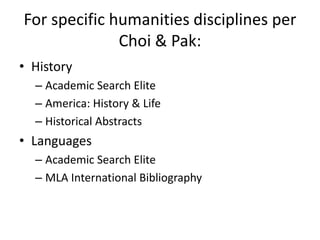
For specific humanities disciplines per Choi & Pak:HistoryAcademic Search EliteAmerica: History & LifeHistorical AbstractsLanguagesAcademic Search EliteMLA International Bibliography
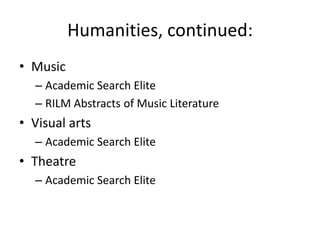
Humanities, continued:MusicAcademic Search EliteRILM Abstracts of Music LiteratureVisual artsAcademic Search EliteTheatreAcademic Search Elite
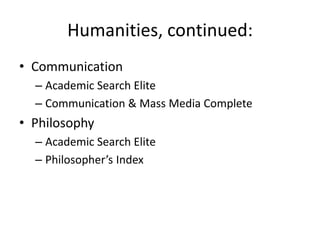
Humanities, continued:CommunicationAcademic Search EliteCommunication & Mass Media CompletePhilosophyAcademic Search ElitePhilosopher’s Index
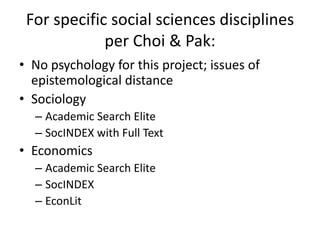
For specific social sciences disciplines per Choi & Pak:No psychology for this project; issues of epistemological distanceSociologyAcademic Search EliteSocINDEX with Full TextEconomicsAcademic Search EliteSocINDEXEconLit
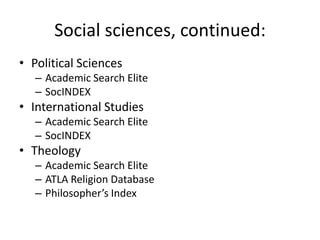
Social sciences, continued:Political SciencesAcademic Search EliteSocINDEXInternational StudiesAcademic Search EliteSocINDEXTheologyAcademic Search EliteATLA Religion DatabasePhilosopher’s Index
Once you’ve selected databases, it’s time to search.Two things to consider:LimitersKeywords
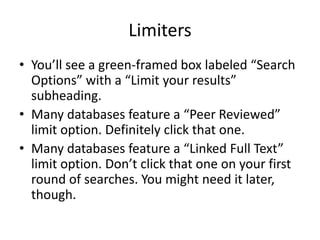
LimitersYou’ll see a green-framed box labeled “Search Options” with a “Limit your results” subheading.Many databases feature a “Peer Reviewed” limit option. Definitely click that one.Many databases feature a “Linked Full Text” limit option. Don’t click that one on your first round of searches. You might need it later, though.
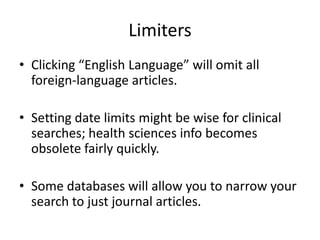
LimitersClicking “English Language” will omit all foreign-language articles.Setting date limits might be wise for clinical searches; health sciences info becomes obsolete fairly quickly.Some databases will allow you to narrow your search to just journal articles.
KeywordsChoosing keywords is an amazingly important part of doing research.Start with whatever seems obvious or intuitive to you.Skim citations and abstracts for new terms that might make better keywords.
KeywordsPlay around with different keywords. If one term fails to bring up good citations for you, try something else (even if it seems far-fetched).Once you’ve started finding articles, try combining terms to narrow the focus of your search to fit your project.
For example--Say I had decided to use nursing (falls within the “clinical medicine” branch of health sciences per Choi & Pak) and sociology (social sciences) for my paper.I’m interested in disparities in maternal mortality rates broken down by socioeconomic status and racial/ethnic identity in the U.S.
I go to EBSCOHost and select databases:CINAHL and SocINDEXI click the “Peer Reviewed” limiterI click “English language” and select “Journal article” as publication type for CINAHLI select “Periodical” as publication type for SocINDEX
Now I know that all the results of this search will be peer-reviewed and will have been published in periodicals/journals (as opposed to being dissertations)
Where to start with keywords?I start by using fairly broad terms.I type “maternal mortality and disparities” in the search term box (without using quotation marks).This brings up 46 results.
I want to make sure I stick within my selected disciplines.I check the names of journals in my results list for the words “nursing” or “sociology.”The third result was published in the Journal of Obstetric, Gynecologic, and Neonatal Nursing. Sounds good.The title of the article is, “Identifying health disparities and social inequities affecting childbearing women and infants.”
This looks promising.I click on the article title for the full citation.The abstract and subject headings suggest this is exactly the kind of thing I could use.It’s not full-text in CINAHL or SocINDEX.I click “Check for full text in Pickler Memorial Library.”
There are several possible outcomes to checking for other full-text options.The item might not be available full-text unless I request it through Inter-Library Loan (ILL) which costs a bit and may take too much time.The item may be available full-text in the bound periodicals in Pickler, which is great if I can get to campus to make a photocopy.The item may be available through Pickler’s subscription to an electronic version of the journal or the article’s inclusion in another database, like JSTOR.
The link opens a new tab in my web browser.There’s a “360 Link” logo in the upper left-hand corner.I see an image of the journal cover, the abstract again, and links to download the article in either HTML or PDF format.I click “PDF” and get a full-text pdf of the article.
Now I double-check the article:Does it work with my topic?Yes; the interplay of social and physical factors in determining disparities in maternal mortality rates is exactly what I’m interested in.Does it work with my disciplines?Yes; the journal has “nursing” in the name and the first author has “RN” listed among her credentials.Is it from a peer-reviewed scholarly source?Yes; because of the way I set my limiters, I know all my results should be peer-reviewed journal articles.
I need two more like that from nursing and three related articles from sociology.I find two more relevant-looking articles published in nursing journals, one of which I can get by going to Pickler and one I’ll have to request through ILL.I look for articles from SocINDEX and see one full-text from the Journal of Women’s Health, which I recognize as an interdisciplinary journal.
Does this one meet my needs?Journal of Women’s Health is an interdisciplinary journal, so I can’t tell what discipline is represented by the journal title.I check the authors’ credentials and affiliations, according to the article: Of eleven authors, five have “MD” behind their name and those who don’t are affiliated with health agencies.
Unless I want to re-define what clinical discipline I’m using, this article won’t work.The authors are neither nurses nor sociologists.The fact that the article discusses social factors is insufficient; I need work that has been reviewed and accepted as sociology by scholars acknowledged as experts in sociology.
I find an article that looks great.The title is “Political History and Disparities in Safe Motherhood Between Guatemala and Honduras.”It was published in the journal Population & Development Review, which seems like it might include some sociological work.It’s available full-text.
No credentials or affiliations given for the authors, though.I skim the content of the article– it seems useful, even if I’m more interested in disparities within the U.S.  It’s about how structural issues and health interventions interact.I google the authors’ names to determine what their disciplinary affiliations are.
Two authors: Jeremy Shiffman is an associate professor of public administration at Syracuse University. His PhD is in political science.Ana Lucia Garces del Valle appears to have authored materials about public health policy in Guatemala, but nothing about her academic affiliations appears in English.I have to either do without this article or switch to political science instead of sociology.
Another article from the journal Society looks promising.No author given; appears to be an article by the editors.Wikipedia defines Society as a sociological journal, but the journal’s own website describes it as an interdisciplinary journal for the social sciences.I’m dissatisfied; I try searching SocINDEX using different keywords. Maybe “maternal mortality and disparities” is too clinical.
New keywords, same database:I try using “maternal health and disparities” (again, no quotation marks) searching just SocINDEX using peer-reviewed/journal article limiters.36 results; the third one on the list is “Pregnant and Poor in the Suburb: The Experiences of Economically Disadvantaged Women of Color with Prenatal Services in a Wealthy Suburban County.”
Works for topic and peer-reviewed; does it work for discipline?Published in a journal called Journal of Sociology & Social WelfareThe first author is affiliated with a school of medicine, but the other four authors are affiliated with schools of social work or social welfareAvailable full-text and has a lengthy list of references I can mine for more sources
Other options besides EBSCOHostIf there is an academic library near you, check with a librarian there to find out what resources you can access locally.Google Scholar may provide appropriate material, but you will be responsible for ensuring that your articles are genuinely peer-reviewed.
Finding sources using searchable databases

  • 1.
    Finding sources usingsearchable databasesHow to use resources available to Truman students to find peer-reviewed scholarly articles in clinical and interpretive disciplines
  • 2.
    Your student feesinclude access to:Pickler library web site Subscription-only research databasesNumerous subscription-only e-journalsHard copies of hundreds of scholarly journalsEasy to use if you’re in town
  • 3.
    To begin researchinga topic,Go to the library web site and click the “Articles & Research Databases” linkScroll to the bottom of the screen to view Help Guides coveringConnecting to databases from homeExplaining types of articles (scholarly, popular, trade)Keyword searching basics (use of AND, NOT, OR, etc.)Citation tools
  • 4.
    Under “Starting pointsfor research in most subjects”You’ll find a link to the EBSCOHost family of databases under the “Background Information” headingEBSCOHost is a good resource when you need access to peer-reviewed articles from multiple disciplinesSubscription-only, but available to you using the VPN and your Truman username/password
  • 5.
    Click “EBSCOHost”The nextscreen asks you to choose databasesIf you’re doing a wide-open search and just need to get a sense of what’s out there, click “Select all” then “Continue”If you’ve chosen a discipline or two and want to search within it/them, click the box next to a database appropriate to the discipline then click “Continue”
  • 6.
    Databases often usedfor JINS 376:For clinical information, Academic Search Elite and CINAHL are very usefulAcademic Search Elite is a multidisciplinary database and will bring up interpretive as well as clinical sourcesCINAHL is the Cumulative Index to Nursing and Allied Health Literature; very clinical and includes multiple health sciences sub-disciplines like nursing, medicine, epidemiology, etc.
  • 7.
    Interpretive databases varyDependson what kind of interpretive discipline you’ve selectedAcademic Search Elite is multidisciplinary; includes lots of humanities and social sciences journals
  • 8.
    For specific humanitiesdisciplines per Choi & Pak:HistoryAcademic Search EliteAmerica: History & LifeHistorical AbstractsLanguagesAcademic Search EliteMLA International Bibliography
  • 9.
    Humanities, continued:MusicAcademic SearchEliteRILM Abstracts of Music LiteratureVisual artsAcademic Search EliteTheatreAcademic Search Elite
  • 10.
    Humanities, continued:CommunicationAcademic SearchEliteCommunication & Mass Media CompletePhilosophyAcademic Search ElitePhilosopher’s Index
  • 11.
    For specific socialsciences disciplines per Choi & Pak:No psychology for this project; issues of epistemological distanceSociologyAcademic Search EliteSocINDEX with Full TextEconomicsAcademic Search EliteSocINDEXEconLit
  • 12.
    Social sciences, continued:PoliticalSciencesAcademic Search EliteSocINDEXInternational StudiesAcademic Search EliteSocINDEXTheologyAcademic Search EliteATLA Religion DatabasePhilosopher’s Index
  • 13.
    Once you’ve selecteddatabases, it’s time to search.Two things to consider:LimitersKeywords
  • 14.
    LimitersYou’ll see agreen-framed box labeled “Search Options” with a “Limit your results” subheading.Many databases feature a “Peer Reviewed” limit option. Definitely click that one.Many databases feature a “Linked Full Text” limit option. Don’t click that one on your first round of searches. You might need it later, though.
  • 15.
    LimitersClicking “English Language”will omit all foreign-language articles.Setting date limits might be wise for clinical searches; health sciences info becomes obsolete fairly quickly.Some databases will allow you to narrow your search to just journal articles.
  • 16.
    KeywordsChoosing keywords isan amazingly important part of doing research.Start with whatever seems obvious or intuitive to you.Skim citations and abstracts for new terms that might make better keywords.
  • 17.
    KeywordsPlay around withdifferent keywords. If one term fails to bring up good citations for you, try something else (even if it seems far-fetched).Once you’ve started finding articles, try combining terms to narrow the focus of your search to fit your project.
  • 18.
    For example--Say Ihad decided to use nursing (falls within the “clinical medicine” branch of health sciences per Choi & Pak) and sociology (social sciences) for my paper.I’m interested in disparities in maternal mortality rates broken down by socioeconomic status and racial/ethnic identity in the U.S.
  • 19.
    I go toEBSCOHost and select databases:CINAHL and SocINDEXI click the “Peer Reviewed” limiterI click “English language” and select “Journal article” as publication type for CINAHLI select “Periodical” as publication type for SocINDEX
  • 20.
    Now I knowthat all the results of this search will be peer-reviewed and will have been published in periodicals/journals (as opposed to being dissertations)
  • 21.
    Where to startwith keywords?I start by using fairly broad terms.I type “maternal mortality and disparities” in the search term box (without using quotation marks).This brings up 46 results.
  • 22.
    I want tomake sure I stick within my selected disciplines.I check the names of journals in my results list for the words “nursing” or “sociology.”The third result was published in the Journal of Obstetric, Gynecologic, and Neonatal Nursing. Sounds good.The title of the article is, “Identifying health disparities and social inequities affecting childbearing women and infants.”
  • 23.
    This looks promising.Iclick on the article title for the full citation.The abstract and subject headings suggest this is exactly the kind of thing I could use.It’s not full-text in CINAHL or SocINDEX.I click “Check for full text in Pickler Memorial Library.”
  • 24.
    There are severalpossible outcomes to checking for other full-text options.The item might not be available full-text unless I request it through Inter-Library Loan (ILL) which costs a bit and may take too much time.The item may be available full-text in the bound periodicals in Pickler, which is great if I can get to campus to make a photocopy.The item may be available through Pickler’s subscription to an electronic version of the journal or the article’s inclusion in another database, like JSTOR.
  • 25.
    The link opensa new tab in my web browser.There’s a “360 Link” logo in the upper left-hand corner.I see an image of the journal cover, the abstract again, and links to download the article in either HTML or PDF format.I click “PDF” and get a full-text pdf of the article.
  • 26.
    Now I double-checkthe article:Does it work with my topic?Yes; the interplay of social and physical factors in determining disparities in maternal mortality rates is exactly what I’m interested in.Does it work with my disciplines?Yes; the journal has “nursing” in the name and the first author has “RN” listed among her credentials.Is it from a peer-reviewed scholarly source?Yes; because of the way I set my limiters, I know all my results should be peer-reviewed journal articles.
  • 27.
    I need twomore like that from nursing and three related articles from sociology.I find two more relevant-looking articles published in nursing journals, one of which I can get by going to Pickler and one I’ll have to request through ILL.I look for articles from SocINDEX and see one full-text from the Journal of Women’s Health, which I recognize as an interdisciplinary journal.
  • 28.
    Does this onemeet my needs?Journal of Women’s Health is an interdisciplinary journal, so I can’t tell what discipline is represented by the journal title.I check the authors’ credentials and affiliations, according to the article: Of eleven authors, five have “MD” behind their name and those who don’t are affiliated with health agencies.
  • 29.
    Unless I wantto re-define what clinical discipline I’m using, this article won’t work.The authors are neither nurses nor sociologists.The fact that the article discusses social factors is insufficient; I need work that has been reviewed and accepted as sociology by scholars acknowledged as experts in sociology.
  • 30.
    I find anarticle that looks great.The title is “Political History and Disparities in Safe Motherhood Between Guatemala and Honduras.”It was published in the journal Population & Development Review, which seems like it might include some sociological work.It’s available full-text.
  • 31.
    No credentials oraffiliations given for the authors, though.I skim the content of the article– it seems useful, even if I’m more interested in disparities within the U.S. It’s about how structural issues and health interventions interact.I google the authors’ names to determine what their disciplinary affiliations are.
  • 32.
    Two authors: JeremyShiffman is an associate professor of public administration at Syracuse University. His PhD is in political science.Ana Lucia Garces del Valle appears to have authored materials about public health policy in Guatemala, but nothing about her academic affiliations appears in English.I have to either do without this article or switch to political science instead of sociology.
  • 33.
    Another article fromthe journal Society looks promising.No author given; appears to be an article by the editors.Wikipedia defines Society as a sociological journal, but the journal’s own website describes it as an interdisciplinary journal for the social sciences.I’m dissatisfied; I try searching SocINDEX using different keywords. Maybe “maternal mortality and disparities” is too clinical.
  • 34.
    New keywords, samedatabase:I try using “maternal health and disparities” (again, no quotation marks) searching just SocINDEX using peer-reviewed/journal article limiters.36 results; the third one on the list is “Pregnant and Poor in the Suburb: The Experiences of Economically Disadvantaged Women of Color with Prenatal Services in a Wealthy Suburban County.”
  • 35.
    Works for topicand peer-reviewed; does it work for discipline?Published in a journal called Journal of Sociology & Social WelfareThe first author is affiliated with a school of medicine, but the other four authors are affiliated with schools of social work or social welfareAvailable full-text and has a lengthy list of references I can mine for more sources
  • 36.
    Other options besidesEBSCOHostIf there is an academic library near you, check with a librarian there to find out what resources you can access locally.Google Scholar may provide appropriate material, but you will be responsible for ensuring that your articles are genuinely peer-reviewed.