1
WHERE DO ENTREPRENEURS GET THEIR MONEY?
1. Their own money (owners equity or loans to the business.)
2. Debt: cash now for repayment (with interest) later.
3. Equity: cash from others for a piece of the business.
4. Bootstrapping: piecing it together on your own.
1. PERSONAL CONTRIBUTION
Either in the form of either:
- Owners equity – to be drawn out at a later time.
- As a loan to the business – to be repaid at a later
time.
3
2. DEBT
Debt: cash now for repayment (with interest) later
ď‚§ Loans
ď‚§ Lines of credit
ď‚§ Mortgages
ď‚§ Credit cards
ď‚§ Etc.
4
CHARACTERISTICS
- Money lent to you with expectation of it being
returned with interest.
- Terms are determined in advance.
- Different banks have different products – but they
are all pretty similar.
5
BANKS CONSIDER THE FOLLOWING
1. Repayment Ability
What evidence exists to convince me I'm going to get paid back? Personal
financial situation.
2. Management
What evidence exists that indicates that this person can manage his/her affairs
well enough to allow the opportunity for payback? Credit history?
3. Personal Investment
What evidence exists that this person has enough of a commitment to the
business so that I'll be sure he/she wants to work hard to protect it? (If they protect
theirs, they will be protecting mine!) Most lending institutions will require at least 25
percent cash/equity contributed to the total capital cost of the project.
4. Security
If all else (above) fails, what protection do I have to get my money back? What will
it be worth when the business fails?
Q. What is missing from this list?
6
Canada Small Business Financing:
http://www.canadabusiness.ca/eng/
Business Development Bank:
http://www.bdc.ca/en/Pages/home.aspx
Banks:
ď‚§ http://www.royalbank.ca/busindex.html
ď‚§ http://www.tdcanadatrust.com/products-services/banking/index-banking.jsp
ď‚§ https://www.cibc.com/ca/small-business.html
Summer Company:
http://www.ontariocanada.com/ontcan/1medt/smallbiz/en/sb_ye_summerco_en.jsp
Futurpreneur: http://www.futurpreneur.ca/
Sources
7
3. EQUITY
Equity: cash for a piece of the business
ď‚§ Investment
ď‚§ Angel Investment
ď‚§ Venture Capital
ď‚§ Share purchase (IPO)
 Friends and Family (“love money”) – may also be considered a
loan or charity!
8
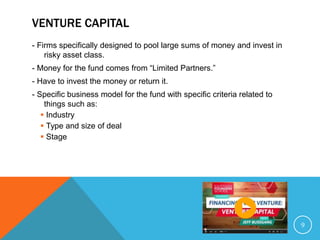
VENTURE CAPITAL
- Firms specifically designed to pool large sums of money and invest in
risky asset class.
- Money for the fund comes from “Limited Partners.”
- Have to invest the money or return it.
- Specific business model for the fund with specific criteria related to
things such as:
ď‚§ Industry
ď‚§ Type and size of deal
ď‚§ Stage
9
VENTURE CAPITAL
Key Issues
ď‚§ Process
ď‚§ Due Diligence
ď‚§ Valuation
ď‚§ Term Sheet
ď‚§ Exit
ď‚§ Entrepreneur Considerations
ď‚§ Ownership %
ď‚§ Long term ownership (exit)
ď‚§ Control
10
ANGEL INVESTORS
- Typically invest between $25,000 - $100,000.
- Very hands-on and usually have a passion for their projects.
- Deal requirements are not as cut and dry as Venture
Capitalists.
- Think of what they do as a hobby – they do not need to invest in
a company, they choose to.
- Investments are often limited to their geographic reach.
- Tend to invest earlier but also looking for investment where
business is close to launch or release.
11
ANGEL INVESTORS UPPING THEIR ANTE IN CANADA,
SAY NACO AND BDC VENTURE CAPITAL
The survey, released in September, looked at investment activity in 2012 by 20
angel groups—around two-thirds of identifiable angel groups in Canada.
Those groups made a combined 139 investments last year, a 96% increase
over the 71 reported investments in 2011. Of those deals, 102 were new.
Despite the steep increase in deal volume, however, the total dollar value of
these was only up 13%. According to the survey, that’s due to a decline in the
average investment: from $506,679 in 2012 to $313,935.
http://www.techvibes.com/blog/angel-investors-upping-their-ante-in-
canada-2013-11-09
12
DECISION CRITERIA FOR INVESTORS
13
Rank by
Angels
Rank
by VC
Enthusiasm of entrepreneur 1 1
Trustworthiness of entrepreneur 2 2
Sales potential of product 3 6
Expertise of entrepreneur 4 5
Liked entrepreneur upon meeting 5 7
Growth potential of market 6 3
Quality of product 7 10
Perceived investor financial
rewards 8 4
Niche market 9 16
Track record of entrepreneur 10 11
* Angel Investing, Osnabrugge & Robinson
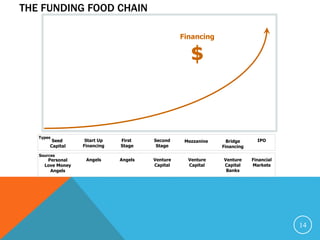
THE FUNDING FOOD CHAIN
14
Seed
Capital
Financing
$
Start Up
Financing
First
Stage
Second
Stage
Mezzanine Bridge
Financing
Types
Sources
Personal
Love Money
Angels
Angels Angels Venture
Capital
Venture
Capital
Venture
Capital
Banks
IPO
Financial
Markets
15
MORE INFORMATION
Canadian Venture Capital Association (www.cvca.ca)
National Venture Capital Association (www.nvca.org)
BDC Venture
http://www.angelinvestor.ca/
What I learned, pitch deck: http://www.techvibes.com/blog/investor-deck-
transparency-and-lessons-learned-2014-01-
16?goback=%2Egde_5037848_member_5829679035365490689#%21
16
4. BOOTSTRAPPING
o Piecing it together on your own!
o A means of financing a company through the
creative acquisition and use of resources without
raising cash from independent investors.
17
Q: What were some strategies you used during the Cash
Flow exercise that helped you preserve your “cash” and
bank account balance?
18
ADVANTAGES
• It forces you to concentrate on selling to bring cash into the
business.
• Minimizes expenses, lessens the need for cash.
• Founders retain greater authority, control and flexibility.
• Equity is expensive especially at startup.
• Better positions the company for external financing in the
future if necessary.
19
DISADVANTAGES
• May not generate enough cash to grow at the
desired rate.
• Limits potential sales, market share and overall
competitive position.
• Provides insufficient support for high growth and
capital intensive businesses.
20
STRATEGIES FOR SUCCESS
21
LEVERAGE GOVERNMENT PROGRAMS
- IRAP (Industrial Research Assistance Program)
- SR&ED Tax Credits (Scientific Research and Experimental Development)
- Other Federal and Provincial Programs
- Ontario Centres of Excellence
- Investment Accelerator Fund
22
- http://www.nrc-cnrc.gc.ca/eng/irap/index.html
- http://www.cra-arc.gc.ca/txcrdt/sred-rsde/menu-eng.html
- http://www.feddevontario.gc.ca/eic/site/723.nsf/eng/h_00122.html
- http://www.oce-ontario.org/
- http://www.marsdd.com/funding/investment-accelerator-fund/
GET OPERATIONAL QUICKLY
• Get up and running rather than waiting for the
home run.
• Look for cash generating products or services, i.e.
consulting by day.
• Take on opportunities that might not be part of the
strategic plan.
• A business that is making money builds credibility.
23
GO FIND A CUSTOMER
• Reach out to customers from day one.
• Get out and sell (perhaps before the product is
ready.)
• Use personal passion and salesmanship to
substitute for big marketing budgets.
• Offer products with tangible advantages over
competitors.
24
FOCUS ON CASH
• Cash is king – not profits, market share or other
metrics.
• Create healthy margins from day one.
• Say “no” to loss making strategies to build market
share or a customer base.
• Understand your cash flow – cash position, monthly
burn, timelines.
25
FORM ALLIANCES FOR
• Market penetration
• Sales/marketing channels
• Product credibility
• Joint bidding on projects
• Accelerate time to market
• Geographic expansion
• Business experience
• Enhance company status
26
WORK WITH CUSTOMERS
ď‚§ Ask customers to prepay fees or provide advances.
ď‚§ Get customers to fund customization work (and let you own the
IP).
ď‚§ Deliver invoices with the goods, pay attention to collections.
 Don’t do business with dead beats and dreamers.
 Market with no money – website, biz cards, tradeshows, cold
calls.
27
WORK WITH SUPPLIERS
ď‚§Ask for credit.
ď‚§Deal with service providers for low rates.
ď‚§Make use of below market rent space.
ď‚§Barter your products or services.
Don’t abuse them.
28
YOUR TEAM
ď‚§Forgo, reduce or delay compensation (sweat equity).
ď‚§Employ relatives and friends at below market
salaries.
ď‚§Look for volunteers, work term and co-op students.
ď‚§Pay with stock or stock options.
ď‚§Work from home.
29
YOU
ď‚§Use personal savings, credit cards and loans.
ď‚§Forgo, reduce or delay compensation (sweat equity).
ď‚§Work from home.
ď‚§Develop product at night and weekends while
working elsewhere.
ď‚§Wear lots of hats.
30
OTHER
ď‚§Buy used equipment (auctions).
ď‚§Borrow equipment from other businesses.
ď‚§Share business premises with others.
ď‚§Know where to save and when to spend.
ď‚§Eliminate unnecessary expenditures.
31
WHERE DO ENTREPRENEURS GET THEIR MONEY?
1. Their own money.
2. Debt from banks: cash now for repayment (with interest)
later.
3. Equity: cash from others for a piece of the business.
4. Bootstrapping: piecing it together on your own.
PARTING THOUGHTS?

Financing your new venture

  • 1.
  • 2.
    WHERE DO ENTREPRENEURSGET THEIR MONEY? 1. Their own money (owners equity or loans to the business.) 2. Debt: cash now for repayment (with interest) later. 3. Equity: cash from others for a piece of the business. 4. Bootstrapping: piecing it together on your own.
  • 3.
    1. PERSONAL CONTRIBUTION Eitherin the form of either: - Owners equity – to be drawn out at a later time. - As a loan to the business – to be repaid at a later time. 3
  • 4.
    2. DEBT Debt: cashnow for repayment (with interest) later ď‚§ Loans ď‚§ Lines of credit ď‚§ Mortgages ď‚§ Credit cards ď‚§ Etc. 4
  • 5.
    CHARACTERISTICS - Money lentto you with expectation of it being returned with interest. - Terms are determined in advance. - Different banks have different products – but they are all pretty similar. 5
  • 6.
    BANKS CONSIDER THEFOLLOWING 1. Repayment Ability What evidence exists to convince me I'm going to get paid back? Personal financial situation. 2. Management What evidence exists that indicates that this person can manage his/her affairs well enough to allow the opportunity for payback? Credit history? 3. Personal Investment What evidence exists that this person has enough of a commitment to the business so that I'll be sure he/she wants to work hard to protect it? (If they protect theirs, they will be protecting mine!) Most lending institutions will require at least 25 percent cash/equity contributed to the total capital cost of the project. 4. Security If all else (above) fails, what protection do I have to get my money back? What will it be worth when the business fails? Q. What is missing from this list? 6
  • 7.
    Canada Small BusinessFinancing: http://www.canadabusiness.ca/eng/ Business Development Bank: http://www.bdc.ca/en/Pages/home.aspx Banks: ď‚§ http://www.royalbank.ca/busindex.html ď‚§ http://www.tdcanadatrust.com/products-services/banking/index-banking.jsp ď‚§ https://www.cibc.com/ca/small-business.html Summer Company: http://www.ontariocanada.com/ontcan/1medt/smallbiz/en/sb_ye_summerco_en.jsp Futurpreneur: http://www.futurpreneur.ca/ Sources 7
  • 8.
    3. EQUITY Equity: cashfor a piece of the business  Investment  Angel Investment  Venture Capital  Share purchase (IPO)  Friends and Family (“love money”) – may also be considered a loan or charity! 8
  • 9.
    VENTURE CAPITAL - Firmsspecifically designed to pool large sums of money and invest in risky asset class. - Money for the fund comes from “Limited Partners.” - Have to invest the money or return it. - Specific business model for the fund with specific criteria related to things such as:  Industry  Type and size of deal  Stage 9
  • 10.
    VENTURE CAPITAL Key Issues ď‚§Process ď‚§ Due Diligence ď‚§ Valuation ď‚§ Term Sheet ď‚§ Exit ď‚§ Entrepreneur Considerations ď‚§ Ownership % ď‚§ Long term ownership (exit) ď‚§ Control 10
  • 11.
    ANGEL INVESTORS - Typicallyinvest between $25,000 - $100,000. - Very hands-on and usually have a passion for their projects. - Deal requirements are not as cut and dry as Venture Capitalists. - Think of what they do as a hobby – they do not need to invest in a company, they choose to. - Investments are often limited to their geographic reach. - Tend to invest earlier but also looking for investment where business is close to launch or release. 11
  • 12.
    ANGEL INVESTORS UPPINGTHEIR ANTE IN CANADA, SAY NACO AND BDC VENTURE CAPITAL The survey, released in September, looked at investment activity in 2012 by 20 angel groups—around two-thirds of identifiable angel groups in Canada. Those groups made a combined 139 investments last year, a 96% increase over the 71 reported investments in 2011. Of those deals, 102 were new. Despite the steep increase in deal volume, however, the total dollar value of these was only up 13%. According to the survey, that’s due to a decline in the average investment: from $506,679 in 2012 to $313,935. http://www.techvibes.com/blog/angel-investors-upping-their-ante-in- canada-2013-11-09 12
  • 13.
    DECISION CRITERIA FORINVESTORS 13 Rank by Angels Rank by VC Enthusiasm of entrepreneur 1 1 Trustworthiness of entrepreneur 2 2 Sales potential of product 3 6 Expertise of entrepreneur 4 5 Liked entrepreneur upon meeting 5 7 Growth potential of market 6 3 Quality of product 7 10 Perceived investor financial rewards 8 4 Niche market 9 16 Track record of entrepreneur 10 11 * Angel Investing, Osnabrugge & Robinson
  • 14.
    THE FUNDING FOODCHAIN 14 Seed Capital Financing $ Start Up Financing First Stage Second Stage Mezzanine Bridge Financing Types Sources Personal Love Money Angels Angels Angels Venture Capital Venture Capital Venture Capital Banks IPO Financial Markets
  • 15.
  • 16.
    MORE INFORMATION Canadian VentureCapital Association (www.cvca.ca) National Venture Capital Association (www.nvca.org) BDC Venture http://www.angelinvestor.ca/ What I learned, pitch deck: http://www.techvibes.com/blog/investor-deck- transparency-and-lessons-learned-2014-01- 16?goback=%2Egde_5037848_member_5829679035365490689#%21 16
  • 17.
    4. BOOTSTRAPPING o Piecingit together on your own! o A means of financing a company through the creative acquisition and use of resources without raising cash from independent investors. 17
  • 18.
    Q: What weresome strategies you used during the Cash Flow exercise that helped you preserve your “cash” and bank account balance? 18
  • 19.
    ADVANTAGES • It forcesyou to concentrate on selling to bring cash into the business. • Minimizes expenses, lessens the need for cash. • Founders retain greater authority, control and flexibility. • Equity is expensive especially at startup. • Better positions the company for external financing in the future if necessary. 19
  • 20.
    DISADVANTAGES • May notgenerate enough cash to grow at the desired rate. • Limits potential sales, market share and overall competitive position. • Provides insufficient support for high growth and capital intensive businesses. 20
  • 21.
  • 22.
    LEVERAGE GOVERNMENT PROGRAMS -IRAP (Industrial Research Assistance Program) - SR&ED Tax Credits (Scientific Research and Experimental Development) - Other Federal and Provincial Programs - Ontario Centres of Excellence - Investment Accelerator Fund 22 - http://www.nrc-cnrc.gc.ca/eng/irap/index.html - http://www.cra-arc.gc.ca/txcrdt/sred-rsde/menu-eng.html - http://www.feddevontario.gc.ca/eic/site/723.nsf/eng/h_00122.html - http://www.oce-ontario.org/ - http://www.marsdd.com/funding/investment-accelerator-fund/
  • 23.
    GET OPERATIONAL QUICKLY •Get up and running rather than waiting for the home run. • Look for cash generating products or services, i.e. consulting by day. • Take on opportunities that might not be part of the strategic plan. • A business that is making money builds credibility. 23
  • 24.
    GO FIND ACUSTOMER • Reach out to customers from day one. • Get out and sell (perhaps before the product is ready.) • Use personal passion and salesmanship to substitute for big marketing budgets. • Offer products with tangible advantages over competitors. 24
  • 25.
    FOCUS ON CASH •Cash is king – not profits, market share or other metrics. • Create healthy margins from day one. • Say “no” to loss making strategies to build market share or a customer base. • Understand your cash flow – cash position, monthly burn, timelines. 25
  • 26.
    FORM ALLIANCES FOR •Market penetration • Sales/marketing channels • Product credibility • Joint bidding on projects • Accelerate time to market • Geographic expansion • Business experience • Enhance company status 26
  • 27.
    WORK WITH CUSTOMERS Ask customers to prepay fees or provide advances.  Get customers to fund customization work (and let you own the IP).  Deliver invoices with the goods, pay attention to collections.  Don’t do business with dead beats and dreamers.  Market with no money – website, biz cards, tradeshows, cold calls. 27
  • 28.
    WORK WITH SUPPLIERS Askfor credit. Deal with service providers for low rates. Make use of below market rent space. Barter your products or services. Don’t abuse them. 28
  • 29.
    YOUR TEAM ď‚§Forgo, reduceor delay compensation (sweat equity). ď‚§Employ relatives and friends at below market salaries. ď‚§Look for volunteers, work term and co-op students. ď‚§Pay with stock or stock options. ď‚§Work from home. 29
  • 30.
    YOU ď‚§Use personal savings,credit cards and loans. ď‚§Forgo, reduce or delay compensation (sweat equity). ď‚§Work from home. ď‚§Develop product at night and weekends while working elsewhere. ď‚§Wear lots of hats. 30
  • 31.
    OTHER ď‚§Buy used equipment(auctions). ď‚§Borrow equipment from other businesses. ď‚§Share business premises with others. ď‚§Know where to save and when to spend. ď‚§Eliminate unnecessary expenditures. 31
  • 32.
    WHERE DO ENTREPRENEURSGET THEIR MONEY? 1. Their own money. 2. Debt from banks: cash now for repayment (with interest) later. 3. Equity: cash from others for a piece of the business. 4. Bootstrapping: piecing it together on your own.
  • 33.