+
Financing Post-disaster Recovery
and Reconstruction
Sudhir Kumar
Recovery and Disaster Risk Reduction Specialist
sudhir.ise@gmail.com
+
Objective
An overview of mechanism to finance post-disaster recovery and
reconstruction
+ Understanding recovery
IFRC
- Recovery: Process that results in people’s lives returning to normal
in a way that they will be more resilient to future disasters.
- Early recovery: Process of people’s lives returning to normal in the
immediate aftermath of a disaster. Include assistance in the earliest
stages of response in conjunction with relief, ... providing the basis
for longer-term recovery.
 UNISDR
Restoration, and improvement where appropriate, of facilities,
livelihoods, and living conditions of disaster-affected communities,
including efforts to reduce disaster risk factors.
+
Recovery Financing
+
5
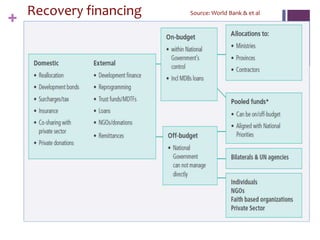
Recovery financing Source: World Bank & et al
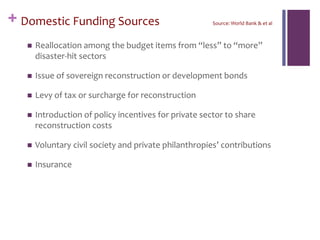
+ Domestic Funding Sources Source: World Bank & et al
 Reallocation among the budget items from “less” to “more”
disaster-hit sectors
 Issue of sovereign reconstruction or development bonds
 Levy of tax or surcharge for reconstruction
 Introduction of policy incentives for private sector to share
reconstruction costs
 Voluntary civil society and private philanthropies’ contributions
 Insurance
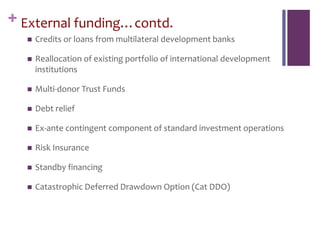
+ External funding…contd.
 Credits or loans from multilateral development banks
 Reallocation of existing portfolio of international development
institutions
 Multi-donor Trust Funds
 Debt relief
 Ex-ante contingent component of standard investment operations
 Risk Insurance
 Standby financing
 Catastrophic Deferred Drawdown Option (Cat DDO)
+
Disbursement options
On budget on treasury
On budget off treasury
Off budget off treasury
+
Case:
IFRC’s recovery financing
+ IFRC’s Key Financial instruments
Disaster Relief Emergency Fund (DREF)
 Provide immediate financial support to Red Cross Red Crescent National
Societies, enabling them to carry out their unique role as first responders
after a disaster.
 Available to all 187 National Societies, now has two main purposes:
Start-up funding to respond to large scale disasters – the “loan facility”
Funding for National Society responses to small- and medium-scale
disasters and health emergencies for which no international appeal will
be launched or when support from other actors is not foreseen – the
“grant facility”.
 Both the loan and the grant facilities are also used to help National Societies
pre- pare for imminent crises.
+ IFRC’s Key Financial instruments
Appeal : Annual appeals and Emergency appeals
 The plan is launched at the beginning of each year to fund programmes that
meet an identified need that year. Programme updates and annual reports
report on these activities.
 Emergency appeals are issued during the year in response to disasters that
arise - their timeline is flexible. Operations updates, interim narratives &
financial reports and final reports report on these activities..

Financing Post-disaster recovery and reconstruction

  • 1.
    + Financing Post-disaster Recovery andReconstruction Sudhir Kumar Recovery and Disaster Risk Reduction Specialist sudhir.ise@gmail.com
  • 2.
    + Objective An overview ofmechanism to finance post-disaster recovery and reconstruction
  • 3.
    + Understanding recovery IFRC -Recovery: Process that results in people’s lives returning to normal in a way that they will be more resilient to future disasters. - Early recovery: Process of people’s lives returning to normal in the immediate aftermath of a disaster. Include assistance in the earliest stages of response in conjunction with relief, ... providing the basis for longer-term recovery.  UNISDR Restoration, and improvement where appropriate, of facilities, livelihoods, and living conditions of disaster-affected communities, including efforts to reduce disaster risk factors.
  • 4.
  • 5.
  • 6.
    + Domestic FundingSources Source: World Bank & et al  Reallocation among the budget items from “less” to “more” disaster-hit sectors  Issue of sovereign reconstruction or development bonds  Levy of tax or surcharge for reconstruction  Introduction of policy incentives for private sector to share reconstruction costs  Voluntary civil society and private philanthropies’ contributions  Insurance
  • 7.
    + External funding…contd. Credits or loans from multilateral development banks  Reallocation of existing portfolio of international development institutions  Multi-donor Trust Funds  Debt relief  Ex-ante contingent component of standard investment operations  Risk Insurance  Standby financing  Catastrophic Deferred Drawdown Option (Cat DDO)
  • 8.
    + Disbursement options On budgeton treasury On budget off treasury Off budget off treasury
  • 9.
  • 10.
    + IFRC’s KeyFinancial instruments Disaster Relief Emergency Fund (DREF)  Provide immediate financial support to Red Cross Red Crescent National Societies, enabling them to carry out their unique role as first responders after a disaster.  Available to all 187 National Societies, now has two main purposes: Start-up funding to respond to large scale disasters – the “loan facility” Funding for National Society responses to small- and medium-scale disasters and health emergencies for which no international appeal will be launched or when support from other actors is not foreseen – the “grant facility”.  Both the loan and the grant facilities are also used to help National Societies pre- pare for imminent crises.
  • 11.
    + IFRC’s KeyFinancial instruments Appeal : Annual appeals and Emergency appeals  The plan is launched at the beginning of each year to fund programmes that meet an identified need that year. Programme updates and annual reports report on these activities.  Emergency appeals are issued during the year in response to disasters that arise - their timeline is flexible. Operations updates, interim narratives & financial reports and final reports report on these activities..