




ADVANCE FINANCIAL
  MANAGEMENT


FINANCING OPTIONS
     Presented by:-

  Manoj Yadav (41)
                      1
2
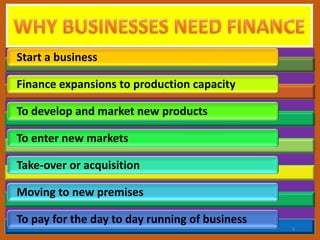
Start a business

Finance expansions to production capacity

To develop and market new products

To enter new markets

Take-over or acquisition

Moving to new premises

To pay for the day to day running of business
                                                3
4
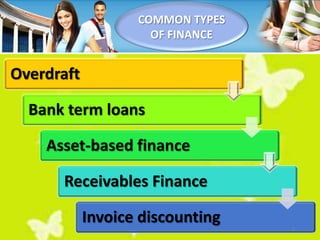
COMMON TYPES
                     OF FINANCE


Overdraft

  Bank term loans

    Asset-based finance

      Receivables Finance

            Invoice discounting   5
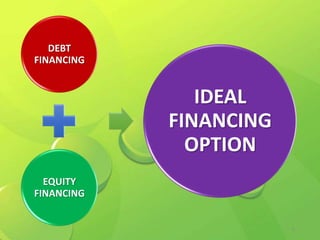
DEBT
FINANCING


               IDEAL
            FINANCING
              OPTION
  EQUITY
FINANCING


                        6
“One of the funny things about the stock market
is that every time one person buys, another sells,
and both think they are astute.”
                                 William Feather     7
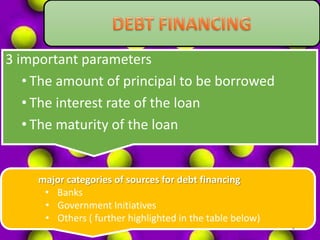
3 important parameters
   • The amount of principal to be borrowed
   • The interest rate of the loan
   • The maturity of the loan


     major categories of sources for debt financing
      • Banks
      • Government Initiatives
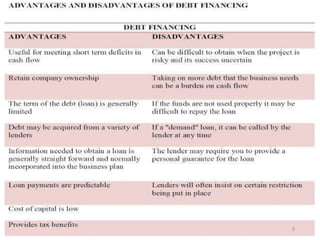
      • Others ( further highlighted in the table below)
                                                           8
9
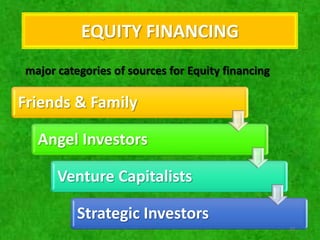
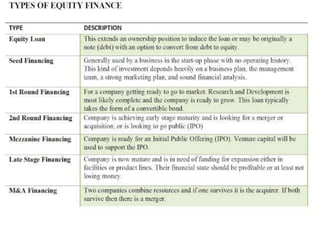
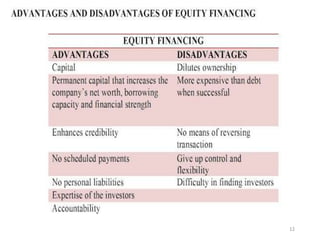
EQUITY FINANCING
major categories of sources for Equity financing

Friends & Family

  Angel Investors

      Venture Capitalists

          Strategic Investors
                                                   10
12
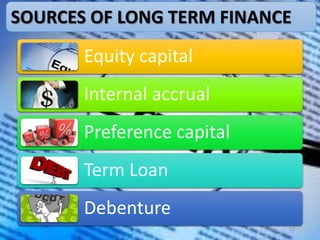
SOURCES OF LONG TERM FINANCE
       Equity capital
       Internal accrual
       Preference capital
       Term Loan
       Debenture
                            13
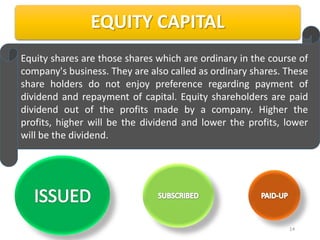
EQUITY CAPITAL
Equity shares are those shares which are ordinary in the course of
company's business. They are also called as ordinary shares. These
share holders do not enjoy preference regarding payment of
dividend and repayment of capital. Equity shareholders are paid
dividend out of the profits made by a company. Higher the
profits, higher will be the dividend and lower the profits, lower
will be the dividend.


                                                             14
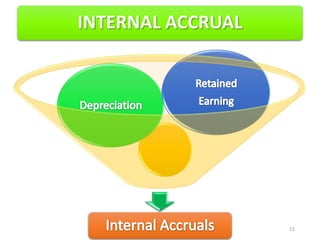
INTERNAL ACCRUAL


                   15
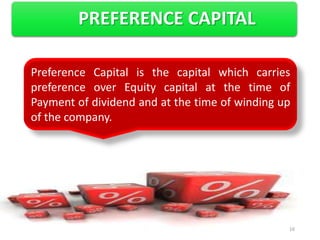
PREFERENCE CAPITAL

Preference Capital is the capital which carries
preference over Equity capital at the time of
Payment of dividend and at the time of winding up
of the company.


                                                16
TERM LOAN
Monetary loan that is repaid in regular payments over a
set period of time.
Last between one and ten years.
May last as long as 30 years in some cases.
Unfixed interest rate that will add additional balance to
be repaid.

Some new companies may use a term loan to buy
company vehicles or rent more space for their
operations.

                                                     17
DEBENTURE
Debentures have no collateral. Bond buyers generally purchase
debentures based on the belief that the bond issuer is unlikely
to default on the repayment. An example of a
government debenture would be any government-
issued Treasury bond (T-bond) or Treasury bill (T-bill). T-bonds
and T-bills are generally considered risk free because
governments, at worst, can print off more money or raise taxes
to pay these type of debts.


                                                            18
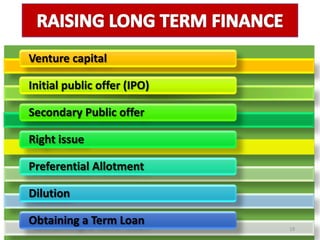
Venture capital

Initial public offer (IPO)

Secondary Public offer

Right issue

Preferential Allotment

Dilution

Obtaining a Term Loan
                             19
20
21
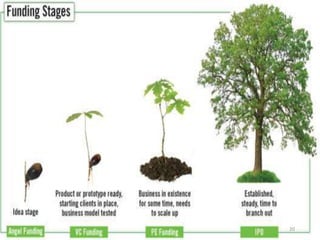
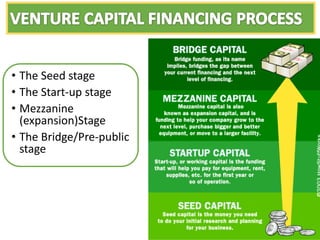
• The Seed stage
• The Start-up stage
• Mezzanine
  (expansion)Stage
• The Bridge/Pre-public
  stage


                          22
The Best Way to Raise Money That
 No One Talks About

• When it comes to raising money for your business, you
  may not be taking advantage of all your options.
• Business owners shouldn't waste their time chasing
  venture capital and about how securing a bank loan is
  all about empathy.
• There's a third way you can raise capital for your
  growing business that's easier and more effective than
  both of those methods.


                                                     23
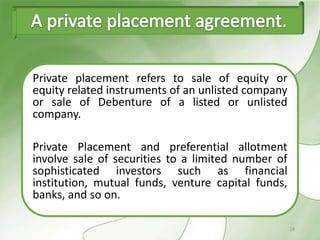
Private placement refers to sale of equity or
equity related instruments of an unlisted company
or sale of Debenture of a listed or unlisted
company.

Private Placement and preferential allotment
involve sale of securities to a limited number of
sophisticated investors such as financial
institution, mutual funds, venture capital funds,
banks, and so on.

                                                    24
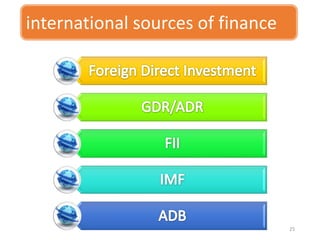
international sources of finance


                                   25
Foreign direct investment (FDI) is direct investment into
production in a country by a company located in another
country, either by buying a company in the target country or by
expanding operations of an existing business in that country.


                                                            26
ADR is method of trading non-U.S. stocks on U.S. exchanges
Suppose, Indian Co. wants to raise money from America, by issuing shares in
American stock exchange.
But then Indian co. will have to maintain accounts according to American standards.
To prevent this problem, Indian company gives its shares to American bank.
American bank gives that Indian company receipts (called ADR) in return of those
shares. Then Indian Co. can trade those ADR receipts in American share market, to
raise money.


Global Depository Receipts (GDR)
Serve as same function like ADR, but on Global scale, it helps the countries from
third world, to raise money from the stock exchanges in developed countries.
Several international banks issue GDRs, such as JPMorgan, Citigroup, Deutsche
Bank, Bank of New York.
Normally 1 GDR = 10 Shares, but not always.
                                                                            27
The term is used most commonly in India to refer to
outside companies investing in the financial markets
of India. International institutional investors must
register with the Securities and Exchange Board of
India to participate in the market. One of the major
market regulations pertaining to FIIs involves placing
limits on FII ownership in Indian companies.


                                                     28
29
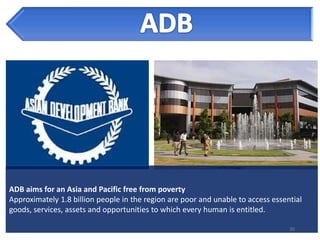
ADB aims for an Asia and Pacific free from poverty
Approximately 1.8 billion people in the region are poor and unable to access essential
goods, services, assets and opportunities to which every human is entitled.

                                                                                  30
Any Question?
                            ???


11/4/2012                     31
financing options

financing options

  • 1.
    ADVANCE FINANCIAL MANAGEMENT FINANCING OPTIONS Presented by:- Manoj Yadav (41) 1
  • 2.
  • 3.
    Start a business Financeexpansions to production capacity To develop and market new products To enter new markets Take-over or acquisition Moving to new premises To pay for the day to day running of business 3
  • 4.
  • 5.
    COMMON TYPES OF FINANCE Overdraft Bank term loans Asset-based finance Receivables Finance Invoice discounting 5
  • 6.
    DEBT FINANCING IDEAL FINANCING OPTION EQUITY FINANCING 6
  • 7.
    “One of thefunny things about the stock market is that every time one person buys, another sells, and both think they are astute.” William Feather 7
  • 8.
    3 important parameters • The amount of principal to be borrowed • The interest rate of the loan • The maturity of the loan major categories of sources for debt financing • Banks • Government Initiatives • Others ( further highlighted in the table below) 8
  • 9.
  • 10.
    EQUITY FINANCING major categoriesof sources for Equity financing Friends & Family Angel Investors Venture Capitalists Strategic Investors 10
  • 12.
  • 13.
    SOURCES OF LONGTERM FINANCE Equity capital Internal accrual Preference capital Term Loan Debenture 13
  • 14.
    EQUITY CAPITAL Equity sharesare those shares which are ordinary in the course of company's business. They are also called as ordinary shares. These share holders do not enjoy preference regarding payment of dividend and repayment of capital. Equity shareholders are paid dividend out of the profits made by a company. Higher the profits, higher will be the dividend and lower the profits, lower will be the dividend. 14
  • 15.
  • 16.
    PREFERENCE CAPITAL Preference Capitalis the capital which carries preference over Equity capital at the time of Payment of dividend and at the time of winding up of the company. 16
  • 17.
    TERM LOAN Monetary loanthat is repaid in regular payments over a set period of time. Last between one and ten years. May last as long as 30 years in some cases. Unfixed interest rate that will add additional balance to be repaid. Some new companies may use a term loan to buy company vehicles or rent more space for their operations. 17
  • 18.
    DEBENTURE Debentures have nocollateral. Bond buyers generally purchase debentures based on the belief that the bond issuer is unlikely to default on the repayment. An example of a government debenture would be any government- issued Treasury bond (T-bond) or Treasury bill (T-bill). T-bonds and T-bills are generally considered risk free because governments, at worst, can print off more money or raise taxes to pay these type of debts. 18
  • 19.
    Venture capital Initial publicoffer (IPO) Secondary Public offer Right issue Preferential Allotment Dilution Obtaining a Term Loan 19
  • 20.
  • 21.
  • 22.
    • The Seedstage • The Start-up stage • Mezzanine (expansion)Stage • The Bridge/Pre-public stage 22
  • 23.
    The Best Wayto Raise Money That No One Talks About • When it comes to raising money for your business, you may not be taking advantage of all your options. • Business owners shouldn't waste their time chasing venture capital and about how securing a bank loan is all about empathy. • There's a third way you can raise capital for your growing business that's easier and more effective than both of those methods. 23
  • 24.
    Private placement refersto sale of equity or equity related instruments of an unlisted company or sale of Debenture of a listed or unlisted company. Private Placement and preferential allotment involve sale of securities to a limited number of sophisticated investors such as financial institution, mutual funds, venture capital funds, banks, and so on. 24
  • 25.
  • 26.
    Foreign direct investment(FDI) is direct investment into production in a country by a company located in another country, either by buying a company in the target country or by expanding operations of an existing business in that country. 26
  • 27.
    ADR is methodof trading non-U.S. stocks on U.S. exchanges Suppose, Indian Co. wants to raise money from America, by issuing shares in American stock exchange. But then Indian co. will have to maintain accounts according to American standards. To prevent this problem, Indian company gives its shares to American bank. American bank gives that Indian company receipts (called ADR) in return of those shares. Then Indian Co. can trade those ADR receipts in American share market, to raise money. Global Depository Receipts (GDR) Serve as same function like ADR, but on Global scale, it helps the countries from third world, to raise money from the stock exchanges in developed countries. Several international banks issue GDRs, such as JPMorgan, Citigroup, Deutsche Bank, Bank of New York. Normally 1 GDR = 10 Shares, but not always. 27
  • 28.
    The term isused most commonly in India to refer to outside companies investing in the financial markets of India. International institutional investors must register with the Securities and Exchange Board of India to participate in the market. One of the major market regulations pertaining to FIIs involves placing limits on FII ownership in Indian companies. 28
  • 29.
  • 30.
    ADB aims foran Asia and Pacific free from poverty Approximately 1.8 billion people in the region are poor and unable to access essential goods, services, assets and opportunities to which every human is entitled. 30
  • 31.
    Any Question? ??? 11/4/2012 31

Editor's Notes

  • #2 As an entrepreneur myself, the decision on making use of debt financing and equity financing is faced on a regular basis and without a deep understanding of both options it would be very difficult to make a choice or very easy to make the wrong choice.This series has taken a look at both options highlighting the pros and cons of each and arriving at the conclusion that one is not necessarily better than the other but depends in part to the entrepreneur’s personal preferences with regards to potential profitability, financial risk and degree of control and his or her understanding of debt and equity financing.This series has also shown that the safest option is a combination of both debt and equity financing, maximizing profitability, reducing financial risk and retaining a reasonable amount of control over the company.   Utilizing both at the start of the business or separately in different stages of the business keeping in mind the difficulties of securing debt financing or if found the ability to negotiate a satisfactory interest rate. As such though the ideal option is to utilize a mix of both equity and debt financing, providing a definite formula or ratio is more subjective than objective.
  • #8 DEBTEQUITYIDEAL DEBT TO EQUITY RATIO = 2:1
  • #14 Equity capitalInternal accrual Preference capitalTerm Loan Debenture
  • #15 Issued Subscribed Paid-up
  • #17 Preference Capital is the capital which carries preference over Equity capital at the time of Payment of dividend and at the time of winding up of the company.
  • #18 A term loan is a monetary loan that is repaid in regular payments over a set period of time. Term loans usually last between one and ten years, but may last as long as 30 years in some cases. A term loan usually involves an unfixed interest rate that will add additional balance to be repaid.Term loans can be given on an individual basis but are often used for small business loans. The ability to repay over a long period of time is attractive for new or expanding enterprises, as the assumption is that they will increase their profit over time. Term loans are a good way of quickly increasing capital in order to raise a business’ supply capabilities or range. For instance, some new companies may use a term loan to buy company vehicles or rent more space for their operations.
  • #19 Debentures have no collateral. Bond buyers generally purchase debentures based on the belief that the bond issuer is unlikely to default on the repayment. An example of a government debenture would be any government-issued Treasury bond (T-bond) or Treasury bill (T-bill). T-bonds and T-bills are generally considered risk free because governments, at worst, can print off more money or raise taxes to pay these type of debts. 
  • #27 Foreign direct investment (FDI) is direct investment into production in a country by a company located in another country, either by buying a company in the target country or by expanding operations of an existing business in that country. 
  • #28 ADR is method of trading non-U.S. stocks on U.S. exchangesSuppose, Indian Co. wants to raise money from America, by issuing shares in American stock exchange.But then Indian co. will have to maintain accounts according to American standards.To prevent this problem, Indian company gives its shares to American bank.American bank gives that Indian company receipts (called ADR) in return of those shares. Then Indian Co. can trade those ADR receipts in American share market, to raise money.Global Depository Receipts (GDR)Serve as same function like ADR, but on Global scale, it helps the countries from third world, to raise money from the stock exchanges in developed countries.Several international banks issue GDRs, such as JPMorgan, Citigroup, Deutsche Bank, Bank of New York.Normally 1 GDR = 10 Shares, but not always.
  • #29 The term is used most commonly in India to refer to outside companies investing in the financial markets of India. International institutional investors must register with the Securities and Exchange Board of India to participate in the market. One of the major market regulations pertaining to FIIs involves placing limits on FII ownership in Indian companies.