Financial Statement Analysis I Session 2: Balance Sheet Instructor Paul Beretz, CICE
Objectives of Session 2 Understand what a balance sheet looks like. Identify attributes of a balance sheet. Recognize the major components of a balance sheet. Determine key characteristics in the evaluation of inventory. Receive an overview of depreciation.
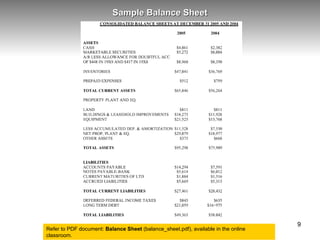
Introduction to Balance Sheet The Balance Sheet presents information about a company's assets, liabilities, and equity at a point in time.  A “picture” of the assets, liabilities and net worth of a company as of a certain date.  Normally subdivide assets and liabilities into current and non-current categories.
Assets Assets are things of value that a business owns or controls.  A tangible asset has physical form, such as inventory, building, and equipment.  Assets can be intangible – not physical in nature. Examples include the value of a patent or a trademark, a copyright, and goodwill of a company that has been built up over the years.
Liabilities Liabilities are obligations owed by the company.  An example of a liability would be a company’s accounts payable or trade debt.  Current Liabilities are debts due within one year of the date of the Balance Sheet.  Long-term liabilities are due in more than one year.
Equity Equity, sometimes called net worth, is the difference between the value of assets and that of liabilities.  Equity is the obligation of the corporation to its owners after all other creditors have been paid.
A Balance Sheet should balance Assets equal total liabilities plus equity (if it does not, there is a problem).  Equity equals assets minus liabilities. Equity can be either positive or negative. When the value of assets exceeds liabilities, equity is positive. When liabilities exceed assets, equity is negative.
Positive and Deficit Net Worth Most companies have a positive net worth, and creditors are concerned about how much equity the company has in relation to its total liabilities.  A company in which liabilities exceed assets has a deficit net worth.  From the perspective of an unsecured creditor, any customer reporting a deficit net worth represents an unusually high risk of either late payment or nonpayment.
Sample Balance Sheet Refer to PDF document:  Balance Sheet  (balance_sheet.pdf), available in the online classroom.
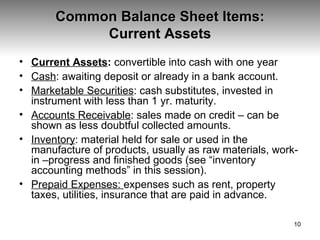
Common Balance Sheet Items: Current Assets Current Assets :  convertible into cash with one year Cash : awaiting deposit or already in a bank account. Marketable Securities : cash substitutes, invested in instrument with less than 1 yr. maturity. Accounts Receivable : sales made on credit – can be shown as less doubtful collected amounts. Inventory : material held for sale or used in the manufacture of products, usually as raw materials, work-in –progress and finished goods (see “inventory accounting methods” in this session). Prepaid Expenses:  expenses such as rent, property taxes, utilities, insurance that are paid in advance.
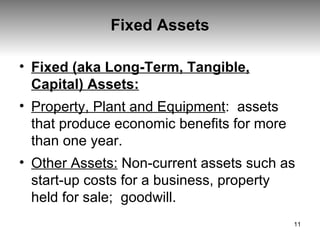
Fixed Assets Fixed (aka Long-Term, Tangible, Capital) Assets: Property, Plant and Equipment :  assets that produce economic benefits for more than one year. Other Assets:   Non-current assets such as start-up costs for a business, property held for sale;  goodwill.
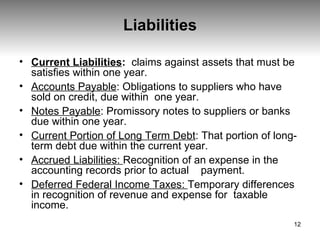
Liabilities Current Liabilities :   claims against assets that must be satisfies within one year. Accounts Payable : Obligations to suppliers who have sold on credit, due within  one year. Notes Payable : Promissory notes to suppliers or banks due within one year. Current Portion of Long Term Debt : That portion of long-term debt due within the current year. Accrued Liabilities:  Recognition of an expense in the accounting records prior to actual  payment. Deferred Federal Income Taxes:  Temporary differences in recognition of revenue and expense for  taxable income.
Other Liabilities Long Term Debt :  Obligations with maturities over one year (mortgages, long-term notes). Other Liabilities :  Pensions; lease obligations.
Owners Equity Stockholders Equity   (aka Shareholders Equity, Net Worth): Common Stock : shares held by owners who hope for appreciation in value. Additional Paid in Capital : Reflects the amount by which the original sales price of the stock exceeded par value. Retained Earnings : All money earned by the company since its inception, less payment made to shareholders in dividends; also the measurement of all undistributed earnings of the company. Other Equity Accounts : Refers to preferred stock, foreign currency translation effects, treasury stock
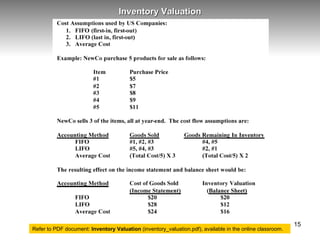
Inventory Valuation Refer to PDF document:  Inventory Valuation  (inventory_valuation.pdf), available in the online classroom.
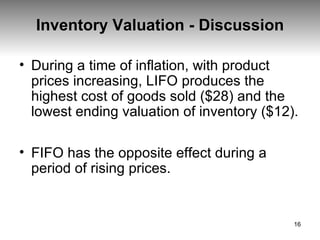
Inventory Valuation - Discussion During a time of inflation, with product prices increasing, LIFO produces the highest cost of goods sold ($28) and the lowest ending valuation of inventory ($12). FIFO has the opposite effect during a period of rising prices.
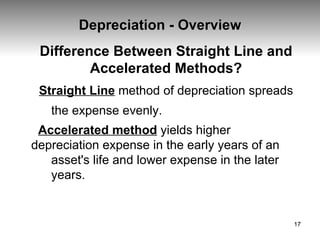
Depreciation - Overview Difference Between Straight Line and Accelerated Methods? Straight Line  method of depreciation spreads   the expense evenly.   Accelerated method  yields higher  depreciation expense in the early years of an  asset's life and lower expense in the later  years.
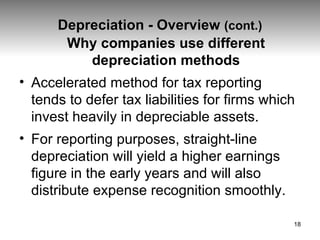
Depreciation - Overview  (cont.) Why companies use different depreciation methods Accelerated method for tax reporting  tends to defer tax liabilities for firms which invest heavily in depreciable assets. For reporting purposes, straight-line depreciation will yield a higher earnings figure in the early years and will also distribute expense recognition smoothly.
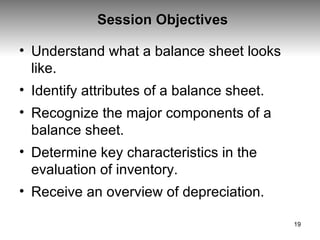
Session Objectives Understand what a balance sheet looks like. Identify attributes of a balance sheet. Recognize the major components of a balance sheet. Determine key characteristics in the evaluation of inventory. Receive an overview of depreciation.

Financial Statement Analysis I Session 2

  • 1.
    Financial Statement AnalysisI Session 2: Balance Sheet Instructor Paul Beretz, CICE
  • 2.
    Objectives of Session2 Understand what a balance sheet looks like. Identify attributes of a balance sheet. Recognize the major components of a balance sheet. Determine key characteristics in the evaluation of inventory. Receive an overview of depreciation.
  • 3.
    Introduction to BalanceSheet The Balance Sheet presents information about a company's assets, liabilities, and equity at a point in time. A “picture” of the assets, liabilities and net worth of a company as of a certain date. Normally subdivide assets and liabilities into current and non-current categories.
  • 4.
    Assets Assets arethings of value that a business owns or controls. A tangible asset has physical form, such as inventory, building, and equipment. Assets can be intangible – not physical in nature. Examples include the value of a patent or a trademark, a copyright, and goodwill of a company that has been built up over the years.
  • 5.
    Liabilities Liabilities areobligations owed by the company. An example of a liability would be a company’s accounts payable or trade debt. Current Liabilities are debts due within one year of the date of the Balance Sheet. Long-term liabilities are due in more than one year.
  • 6.
    Equity Equity, sometimescalled net worth, is the difference between the value of assets and that of liabilities. Equity is the obligation of the corporation to its owners after all other creditors have been paid.
  • 7.
    A Balance Sheetshould balance Assets equal total liabilities plus equity (if it does not, there is a problem). Equity equals assets minus liabilities. Equity can be either positive or negative. When the value of assets exceeds liabilities, equity is positive. When liabilities exceed assets, equity is negative.
  • 8.
    Positive and DeficitNet Worth Most companies have a positive net worth, and creditors are concerned about how much equity the company has in relation to its total liabilities. A company in which liabilities exceed assets has a deficit net worth. From the perspective of an unsecured creditor, any customer reporting a deficit net worth represents an unusually high risk of either late payment or nonpayment.
  • 9.
    Sample Balance SheetRefer to PDF document: Balance Sheet (balance_sheet.pdf), available in the online classroom.
  • 10.
    Common Balance SheetItems: Current Assets Current Assets : convertible into cash with one year Cash : awaiting deposit or already in a bank account. Marketable Securities : cash substitutes, invested in instrument with less than 1 yr. maturity. Accounts Receivable : sales made on credit – can be shown as less doubtful collected amounts. Inventory : material held for sale or used in the manufacture of products, usually as raw materials, work-in –progress and finished goods (see “inventory accounting methods” in this session). Prepaid Expenses: expenses such as rent, property taxes, utilities, insurance that are paid in advance.
  • 11.
    Fixed Assets Fixed(aka Long-Term, Tangible, Capital) Assets: Property, Plant and Equipment : assets that produce economic benefits for more than one year. Other Assets: Non-current assets such as start-up costs for a business, property held for sale; goodwill.
  • 12.
    Liabilities Current Liabilities: claims against assets that must be satisfies within one year. Accounts Payable : Obligations to suppliers who have sold on credit, due within one year. Notes Payable : Promissory notes to suppliers or banks due within one year. Current Portion of Long Term Debt : That portion of long-term debt due within the current year. Accrued Liabilities: Recognition of an expense in the accounting records prior to actual payment. Deferred Federal Income Taxes: Temporary differences in recognition of revenue and expense for taxable income.
  • 13.
    Other Liabilities LongTerm Debt : Obligations with maturities over one year (mortgages, long-term notes). Other Liabilities : Pensions; lease obligations.
  • 14.
    Owners Equity StockholdersEquity (aka Shareholders Equity, Net Worth): Common Stock : shares held by owners who hope for appreciation in value. Additional Paid in Capital : Reflects the amount by which the original sales price of the stock exceeded par value. Retained Earnings : All money earned by the company since its inception, less payment made to shareholders in dividends; also the measurement of all undistributed earnings of the company. Other Equity Accounts : Refers to preferred stock, foreign currency translation effects, treasury stock
  • 15.
    Inventory Valuation Referto PDF document: Inventory Valuation (inventory_valuation.pdf), available in the online classroom.
  • 16.
    Inventory Valuation -Discussion During a time of inflation, with product prices increasing, LIFO produces the highest cost of goods sold ($28) and the lowest ending valuation of inventory ($12). FIFO has the opposite effect during a period of rising prices.
  • 17.
    Depreciation - OverviewDifference Between Straight Line and Accelerated Methods? Straight Line method of depreciation spreads the expense evenly. Accelerated method yields higher depreciation expense in the early years of an asset's life and lower expense in the later years.
  • 18.
    Depreciation - Overview (cont.) Why companies use different depreciation methods Accelerated method for tax reporting tends to defer tax liabilities for firms which invest heavily in depreciable assets. For reporting purposes, straight-line depreciation will yield a higher earnings figure in the early years and will also distribute expense recognition smoothly.
  • 19.
    Session Objectives Understandwhat a balance sheet looks like. Identify attributes of a balance sheet. Recognize the major components of a balance sheet. Determine key characteristics in the evaluation of inventory. Receive an overview of depreciation.