Corporate Governance for
    Exemption Certificates
     Presentation by ISSI
        October, 2012
ISSI provides industry-leading, Sarbanes
  Oxley and SAS 70 Type II Compliant
  Electronic Certificate (ECM) solutions that
  give you control over your document
  management governance and processes
  cost-effectively.

                                                 1


           Confidential and Proprietary - ISSI
Agenda for Presentation
 The Regulatory Challenge for Governance
 What is Exemption Certificate Governance
    Policy?
   Assembling the best ”Governance Team”
   ECM Governance Metrics
   Setting the Mission and Strategy
   Best Practice Data Policies
   What are my Integration Points?
   Technology Enablement Success
   Conclusions and Q/A

                                                   2


             Confidential and Proprietary - ISSI
The Governance Challenge
 Increasing Regulatory Scrutiny.
 Transaction Taxability Encompasses:
   Today: Sales and Use
   Tomorrow: VAT
   National and International
 Expand Compliance Efforts.
 Reduce compliance cost and effort.
                                                     3


               Confidential and Proprietary - ISSI
Exemption Certificate Governance
            Policy
    Cost Reduction
    Risk Reduction
    Effort Reduction
    Compliance Improvement
    Short Term Impact
    Long Term Results

                                                  4


            Confidential and Proprietary - ISSI
Inhibitors - Certificate Governance
    Diffused compliance responsibility
    No central authority
    Many departments play a part
    The framework is crucial to success
    Lack of visibility
    Limited understanding of true risk

                                                   5


             Confidential and Proprietary - ISSI
ECM Governance Metrics
 Reduction in
   Assessments, interest and penalties.
   Accruals.
 Resources spent
   Preparing for and defending audits.
   Acquiring and reviewing certificates.
   Researching and correcting errors.

                                                  6


            Confidential and Proprietary - ISSI
Percentage of Revenue

 A Measure of Relative Impact.
 A Means for Audit Assessment.
 Statistical Sampling that can hurt
 or help.
 Used as a means to proportionally
 determine compliance.


                                              7


        Confidential and Proprietary - ISSI
More ECM Governance Metrics
   Number of valid exemption certificates
   as a percentage of the total number of
   exempt customers and as a percentage
   of revenue.

   Number missing, incomplete or invalid
   exemption certificates as a percentage
   of the total number of exempt customers
   and as a percentage of revenue.

                                                 8


           Confidential and Proprietary - ISSI
Even More ECM Metrics
 Response time on certificate acquisition
  campaigns.

 Response levels on certificate
  acquisition campaigns.

 Tax accrual accuracy.
 Time spent preparing Tax accrual
  calculations.

                                                9


          Confidential and Proprietary - ISSI
Data Policies
 Standardization
 Quality Control
 Compliance Rules
 Data Ownership
 Flow of Data
 Synchronization Rules
                                               10


         Confidential and Proprietary - ISSI
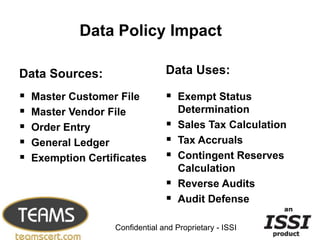
Data Policy Impact

Data Sources:                     Data Uses:

   Master Customer File           Exempt Status
   Master Vendor File                Determination
   Order Entry                      Sales Tax Calculation
   General Ledger                   Tax Accruals
   Exemption Certificates           Contingent Reserves
                                      Calculation
                                     Reverse Audits
                                     Audit Defense
                                                              11


                    Confidential and Proprietary - ISSI
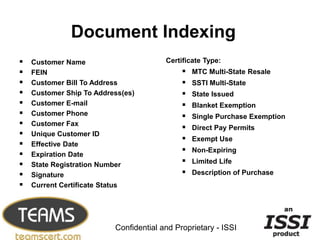
Document Indexing
   Customer Name                       Certificate Type:
   FEIN                                        MTC Multi-State Resale
   Customer Bill To Address                    SSTI Multi-State
   Customer Ship To Address(es)                State Issued
   Customer E-mail                             Blanket Exemption
   Customer Phone                              Single Purchase Exemption
   Customer Fax
                                                Direct Pay Permits
   Unique Customer ID
                                                Exempt Use
   Effective Date
                                                Non-Expiring
   Expiration Date
   State Registration Number                   Limited Life
   Signature                                   Description of Purchase
   Current Certificate Status


                                                                             12


                          Confidential and Proprietary - ISSI
Data Synchronization
 Which system’s data takes priority?
 How, when and at what interval data is
  exchanged?
 How are data conflicts resolved?
 Where and when is new customer or
  vendor data entered?
 What happens when customer or vendor
  records are deleted?

                                               13


         Confidential and Proprietary - ISSI
The Sales Tax Process
 Determine tax-exempt status of the
    customer placing an order.
   Calculate sales tax owed.
   Collect exemption certificate.
   Review certificate for sufficiency.
   Reverse audit to determine overall level
    of compliance and determine specific
    gaps and audit exposure.
   Respond to state audit documentation
    requests and defend the audit.
                                                 14


           Confidential and Proprietary - ISSI
The Use Tax Process
 Request determination that a purchase is use
    tax exempt.
   Determine the taxability of said transaction.
   Prepare and deliver an exemption certificate to
    the specific vendor.
   Document use tax-exempt transaction for
    future reference.
   Perform periodic Use Tax accrual calculations.
   Reverse audit to determine overall level of
    compliance and determine specific gaps and
    audit exposure.
   Respond to state audit documentation requests
    and defend the audit.

                                                   15


             Confidential and Proprietary - ISSI
“Gotchas” for Additional Complexity

  Drop Shipments

  Streamlined Sales Tax Project

  Direct Pay Agreements

  What is and is not taxable?


                                                 16


           Confidential and Proprietary - ISSI
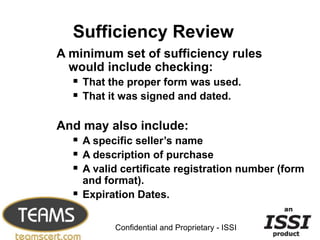
Sufficiency Review
A minimum set of sufficiency rules
  would include checking:
   That the proper form was used.
   That it was signed and dated.

And may also include:
   A specific seller’s name
   A description of purchase
   A valid certificate registration number (form
       and format).
      Expiration Dates.
                                                    17


             Confidential and Proprietary - ISSI
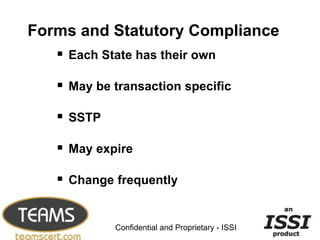
Forms and Statutory Compliance
    Each State has their own

    May be transaction specific

    SSTP

    May expire

    Change frequently

                                                  18


            Confidential and Proprietary - ISSI
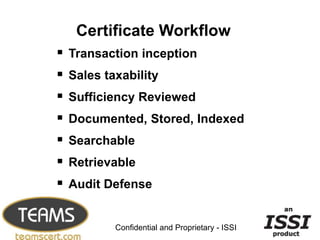
Certificate Workflow
   Transaction inception
   Sales taxability
   Sufficiency Reviewed
   Documented, Stored, Indexed
   Searchable
   Retrievable
   Audit Defense

                                                  19


            Confidential and Proprietary - ISSI
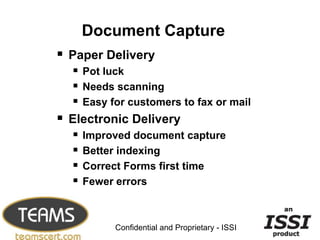
Document Capture
 Paper Delivery
   Pot luck
   Needs scanning
   Easy for customers to fax or mail
 Electronic Delivery
   Improved document capture
   Better indexing
   Correct Forms first time
   Fewer errors

                                                 20


           Confidential and Proprietary - ISSI
Technology Enablement
 Platform
      SaaS
      Traditional Self-hosted Delivery
      Hybrid Models
   Reliability
   Transparency
   Who has the staff?
   Who has the expertise?
   When do we need help?
                                                   21


             Confidential and Proprietary - ISSI
Security
 At a minimum, SAS 70 Level II Certified
 Multi-tenant versus Single-tenant
 Commingling Data:
    Instances
    Customer Files
    Certificates
 Single Sign-on
 Offshore versus Onshore
    Hosting
    Services
                                                 22


           Confidential and Proprietary - ISSI
Benefits of ECM Governance
  Reduce the cost to acquire and handle
  exemption certificates.

  Eliminate errors and confusion.
  Increase ECM compliance.
  Minimize audit risk and exposure.
  Satisfy Customers and Staff.

                                                23


          Confidential and Proprietary - ISSI
Thank you for your time!

          Larry Powers
Chief Strategy Officer, ISSI/TEAMS
    http://www.teamscert.com
          330.342.7760


                                                24


          Confidential and Proprietary - ISSI

Corp govissiwrcc2010

  • 1.
    Corporate Governance for Exemption Certificates Presentation by ISSI October, 2012 ISSI provides industry-leading, Sarbanes Oxley and SAS 70 Type II Compliant Electronic Certificate (ECM) solutions that give you control over your document management governance and processes cost-effectively. 1 Confidential and Proprietary - ISSI
  • 2.
    Agenda for Presentation The Regulatory Challenge for Governance  What is Exemption Certificate Governance Policy?  Assembling the best ”Governance Team”  ECM Governance Metrics  Setting the Mission and Strategy  Best Practice Data Policies  What are my Integration Points?  Technology Enablement Success  Conclusions and Q/A 2 Confidential and Proprietary - ISSI
  • 3.
    The Governance Challenge Increasing Regulatory Scrutiny.  Transaction Taxability Encompasses:  Today: Sales and Use  Tomorrow: VAT  National and International  Expand Compliance Efforts.  Reduce compliance cost and effort. 3 Confidential and Proprietary - ISSI
  • 4.
    Exemption Certificate Governance Policy  Cost Reduction  Risk Reduction  Effort Reduction  Compliance Improvement  Short Term Impact  Long Term Results 4 Confidential and Proprietary - ISSI
  • 5.
    Inhibitors - CertificateGovernance  Diffused compliance responsibility  No central authority  Many departments play a part  The framework is crucial to success  Lack of visibility  Limited understanding of true risk 5 Confidential and Proprietary - ISSI
  • 6.
    ECM Governance Metrics Reduction in  Assessments, interest and penalties.  Accruals.  Resources spent  Preparing for and defending audits.  Acquiring and reviewing certificates.  Researching and correcting errors. 6 Confidential and Proprietary - ISSI
  • 7.
    Percentage of Revenue A Measure of Relative Impact.  A Means for Audit Assessment.  Statistical Sampling that can hurt or help.  Used as a means to proportionally determine compliance. 7 Confidential and Proprietary - ISSI
  • 8.
    More ECM GovernanceMetrics  Number of valid exemption certificates as a percentage of the total number of exempt customers and as a percentage of revenue.  Number missing, incomplete or invalid exemption certificates as a percentage of the total number of exempt customers and as a percentage of revenue. 8 Confidential and Proprietary - ISSI
  • 9.
    Even More ECMMetrics  Response time on certificate acquisition campaigns.  Response levels on certificate acquisition campaigns.  Tax accrual accuracy.  Time spent preparing Tax accrual calculations. 9 Confidential and Proprietary - ISSI
  • 10.
    Data Policies  Standardization Quality Control  Compliance Rules  Data Ownership  Flow of Data  Synchronization Rules 10 Confidential and Proprietary - ISSI
  • 11.
    Data Policy Impact DataSources: Data Uses:  Master Customer File  Exempt Status  Master Vendor File Determination  Order Entry  Sales Tax Calculation  General Ledger  Tax Accruals  Exemption Certificates  Contingent Reserves Calculation  Reverse Audits  Audit Defense 11 Confidential and Proprietary - ISSI
  • 12.
    Document Indexing  Customer Name Certificate Type:  FEIN  MTC Multi-State Resale  Customer Bill To Address  SSTI Multi-State  Customer Ship To Address(es)  State Issued  Customer E-mail  Blanket Exemption  Customer Phone  Single Purchase Exemption  Customer Fax  Direct Pay Permits  Unique Customer ID  Exempt Use  Effective Date  Non-Expiring  Expiration Date  State Registration Number  Limited Life  Signature  Description of Purchase  Current Certificate Status 12 Confidential and Proprietary - ISSI
  • 13.
    Data Synchronization  Whichsystem’s data takes priority?  How, when and at what interval data is exchanged?  How are data conflicts resolved?  Where and when is new customer or vendor data entered?  What happens when customer or vendor records are deleted? 13 Confidential and Proprietary - ISSI
  • 14.
    The Sales TaxProcess  Determine tax-exempt status of the customer placing an order.  Calculate sales tax owed.  Collect exemption certificate.  Review certificate for sufficiency.  Reverse audit to determine overall level of compliance and determine specific gaps and audit exposure.  Respond to state audit documentation requests and defend the audit. 14 Confidential and Proprietary - ISSI
  • 15.
    The Use TaxProcess  Request determination that a purchase is use tax exempt.  Determine the taxability of said transaction.  Prepare and deliver an exemption certificate to the specific vendor.  Document use tax-exempt transaction for future reference.  Perform periodic Use Tax accrual calculations.  Reverse audit to determine overall level of compliance and determine specific gaps and audit exposure.  Respond to state audit documentation requests and defend the audit. 15 Confidential and Proprietary - ISSI
  • 16.
    “Gotchas” for AdditionalComplexity  Drop Shipments  Streamlined Sales Tax Project  Direct Pay Agreements  What is and is not taxable? 16 Confidential and Proprietary - ISSI
  • 17.
    Sufficiency Review A minimumset of sufficiency rules would include checking:  That the proper form was used.  That it was signed and dated. And may also include:  A specific seller’s name  A description of purchase  A valid certificate registration number (form and format).  Expiration Dates. 17 Confidential and Proprietary - ISSI
  • 18.
    Forms and StatutoryCompliance  Each State has their own  May be transaction specific  SSTP  May expire  Change frequently 18 Confidential and Proprietary - ISSI
  • 19.
    Certificate Workflow  Transaction inception  Sales taxability  Sufficiency Reviewed  Documented, Stored, Indexed  Searchable  Retrievable  Audit Defense 19 Confidential and Proprietary - ISSI
  • 20.
    Document Capture  PaperDelivery  Pot luck  Needs scanning  Easy for customers to fax or mail  Electronic Delivery  Improved document capture  Better indexing  Correct Forms first time  Fewer errors 20 Confidential and Proprietary - ISSI
  • 21.
    Technology Enablement  Platform  SaaS  Traditional Self-hosted Delivery  Hybrid Models  Reliability  Transparency  Who has the staff?  Who has the expertise?  When do we need help? 21 Confidential and Proprietary - ISSI
  • 22.
    Security  At aminimum, SAS 70 Level II Certified  Multi-tenant versus Single-tenant  Commingling Data:  Instances  Customer Files  Certificates  Single Sign-on  Offshore versus Onshore  Hosting  Services 22 Confidential and Proprietary - ISSI
  • 23.
    Benefits of ECMGovernance  Reduce the cost to acquire and handle exemption certificates.  Eliminate errors and confusion.  Increase ECM compliance.  Minimize audit risk and exposure.  Satisfy Customers and Staff. 23 Confidential and Proprietary - ISSI
  • 24.
    Thank you foryour time! Larry Powers Chief Strategy Officer, ISSI/TEAMS http://www.teamscert.com 330.342.7760 24 Confidential and Proprietary - ISSI

Editor's Notes

  • #6 Where does responsibility for exemption certificates fall in your organization?
  • #8 Percentage of Revenue Why does percentage of revenue matter when looking at an exemption certificate? When an auditor requests a sampling of exempt transactions for an audit, they are looking tmeasure your overall level of exemption compliance based on the small percentage sample of transactions they select for their review. Your level of compliance contained within this statistical sample is then applied tyour entire revenue stream for the period in question. If you are unlucky enough thave the one or twtransactions where your exemption certificate is invalid AND the dollar value of those transactions happens tbe high, the resulting assessment, interest and penalties will be disproportionately higher as a result. When reviewing your exempt exposure, it is wise tmeasure the relative impact as a percentage of revenue. Quite simply, the lower the percentage of revenue out of exemption compliance, the overall lower exposure tsubsequent assessment. Literally, one piece of paper could cost you millions of dollars.
  • #10 Select what makes sense.Select what truly mitigates your risk.