Copyright © 2012 Pearson Education
Chapter 3
Financial
Statements
and Ratio
Analysis
© 2012 Pearson Education 3-2
The Stockholders’ Report
• Generally accepted accounting principles (GAAP) are
the practice and procedure guidelines used to prepare and
maintain financial records and reports; authorized by the
Financial Accounting Standards Board (FASB).
© 2012 Pearson Education 3-3
The Four Key Financial Statements:
The Income Statement
• The income statement provides a financial summary of a
company’s operating results during a specified period.
• The balance sheet presents a summary of a firm’s
financial position at a given point in time.
• The statement balances the firm’s assets (what it owns)
against its financing, which can be either debt (what it
owes) or equity (what was provided by owners).
© 2012 Pearson Education 3-4
The Four Key Financial Statements:
Statement of Retained Earnings
•The statement of retained earnings reconciles the net
income earned during a given year, and any cash dividends
paid, with the change in retained earnings between the start
and the end of that year.
•The statement of cash flows provides a summary of the
firm’s operating, investment, and financing cash flows and
reconciles them with changes in its cash and marketable
securities during the period.
•Also ties together the income statement and previous and
current balance sheets.
© 2012 Pearson Education 3-5
Using Financial Ratios:
Interested Parties
• Ratio analysis involves methods of calculating and interpreting
financial ratios to analyze and monitor the firm’s performance.
• Current and prospective shareholders are interested in the firm’s
current and future level of risk and return, which directly affect
share price.
• Creditors are interested in the short-term liquidity of the company
and its ability to make interest and principal payments.
• Management is concerned with all aspects of the firm’s financial
situation, and it attempts to produce financial ratios that will be
considered favorable by both owners and creditors.
© 2012 Pearson Education 3-6
Using Financial Ratios:
Types of Ratio Comparisons
• Cross-sectional analysis is the comparison of different firms’
financial ratios at the same point in time; involves comparing the
firm’s ratios to those of other firms in its industry or to industry
averages
• Benchmarking is a type of cross-sectional analysis in which the
firm’s ratio values are compared to those of a key competitor or
group of competitors that it wishes to emulate.
© 2012 Pearson Education 3-7
Using Financial Ratios: Types
of Ratio Comparisons (cont.)
• Time-series analysis is the evaluation of the firm’s
financial performance over time using financial ratio
analysis
• Comparison of current to past performance, using ratios,
enables analysts to assess the firm’s progress.
© 2012 Pearson Education 3-8
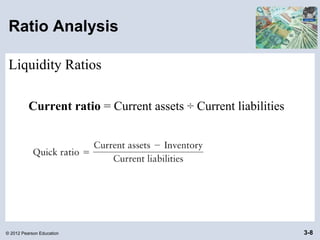
Ratio Analysis
Liquidity Ratios
Current ratio = Current assets ÷ Current liabilities
© 2012 Pearson Education 3-9
Ratio Analysis (cont.)
Activity Ratios
Inventory turnover = Cost of goods sold ÷ Inventory
Average Age of Inventory = 365 ÷ Inventory turnover
Total asset turnover = Sales ÷ Total assets
© 2012 Pearson Education 3-10
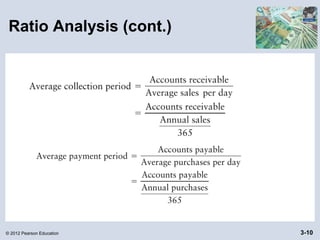
Ratio Analysis (cont.)
© 2012 Pearson Education 3-11
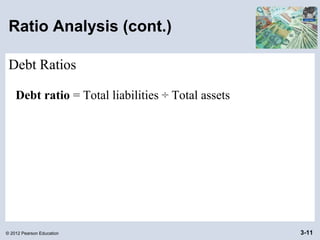
Ratio Analysis (cont.)
Debt Ratios
Debt ratio = Total liabilities ÷ Total assets
© 2012 Pearson Education 3-12
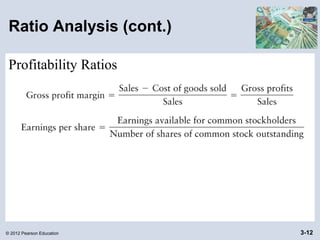
Ratio Analysis (cont.)
Profitability Ratios
© 2012 Pearson Education 3-13
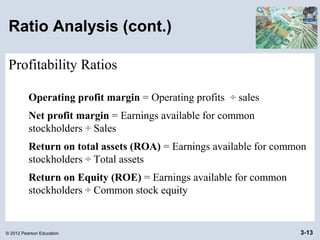
Ratio Analysis (cont.)
Profitability Ratios
Operating profit margin = Operating profits ÷ sales
Net profit margin = Earnings available for common
stockholders ÷ Sales
Return on total assets (ROA) = Earnings available for common
stockholders ÷ Total assets
Return on Equity (ROE) = Earnings available for common
stockholders ÷ Common stock equity

Chapter 3 financial statements and ratio analysis

  • 1.
    Copyright © 2012Pearson Education Chapter 3 Financial Statements and Ratio Analysis
  • 2.
    © 2012 PearsonEducation 3-2 The Stockholders’ Report • Generally accepted accounting principles (GAAP) are the practice and procedure guidelines used to prepare and maintain financial records and reports; authorized by the Financial Accounting Standards Board (FASB).
  • 3.
    © 2012 PearsonEducation 3-3 The Four Key Financial Statements: The Income Statement • The income statement provides a financial summary of a company’s operating results during a specified period. • The balance sheet presents a summary of a firm’s financial position at a given point in time. • The statement balances the firm’s assets (what it owns) against its financing, which can be either debt (what it owes) or equity (what was provided by owners).
  • 4.
    © 2012 PearsonEducation 3-4 The Four Key Financial Statements: Statement of Retained Earnings •The statement of retained earnings reconciles the net income earned during a given year, and any cash dividends paid, with the change in retained earnings between the start and the end of that year. •The statement of cash flows provides a summary of the firm’s operating, investment, and financing cash flows and reconciles them with changes in its cash and marketable securities during the period. •Also ties together the income statement and previous and current balance sheets.
  • 5.
    © 2012 PearsonEducation 3-5 Using Financial Ratios: Interested Parties • Ratio analysis involves methods of calculating and interpreting financial ratios to analyze and monitor the firm’s performance. • Current and prospective shareholders are interested in the firm’s current and future level of risk and return, which directly affect share price. • Creditors are interested in the short-term liquidity of the company and its ability to make interest and principal payments. • Management is concerned with all aspects of the firm’s financial situation, and it attempts to produce financial ratios that will be considered favorable by both owners and creditors.
  • 6.
    © 2012 PearsonEducation 3-6 Using Financial Ratios: Types of Ratio Comparisons • Cross-sectional analysis is the comparison of different firms’ financial ratios at the same point in time; involves comparing the firm’s ratios to those of other firms in its industry or to industry averages • Benchmarking is a type of cross-sectional analysis in which the firm’s ratio values are compared to those of a key competitor or group of competitors that it wishes to emulate.
  • 7.
    © 2012 PearsonEducation 3-7 Using Financial Ratios: Types of Ratio Comparisons (cont.) • Time-series analysis is the evaluation of the firm’s financial performance over time using financial ratio analysis • Comparison of current to past performance, using ratios, enables analysts to assess the firm’s progress.
  • 8.
    © 2012 PearsonEducation 3-8 Ratio Analysis Liquidity Ratios Current ratio = Current assets ÷ Current liabilities
  • 9.
    © 2012 PearsonEducation 3-9 Ratio Analysis (cont.) Activity Ratios Inventory turnover = Cost of goods sold ÷ Inventory Average Age of Inventory = 365 ÷ Inventory turnover Total asset turnover = Sales ÷ Total assets
  • 10.
    © 2012 PearsonEducation 3-10 Ratio Analysis (cont.)
  • 11.
    © 2012 PearsonEducation 3-11 Ratio Analysis (cont.) Debt Ratios Debt ratio = Total liabilities ÷ Total assets
  • 12.
    © 2012 PearsonEducation 3-12 Ratio Analysis (cont.) Profitability Ratios
  • 13.
    © 2012 PearsonEducation 3-13 Ratio Analysis (cont.) Profitability Ratios Operating profit margin = Operating profits ÷ sales Net profit margin = Earnings available for common stockholders ÷ Sales Return on total assets (ROA) = Earnings available for common stockholders ÷ Total assets Return on Equity (ROE) = Earnings available for common stockholders ÷ Common stock equity