1-1
Prepared by
Coby Harmon
University of California, Santa Barbara
Westmont College
1-2
1. Describe the growing
importance of global financial
markets and its relation to
financial reporting.
2. Explain the objective of financial
reporting.
3. Identify the major policy-
setting bodies and their role
in the standard-setting
process.
4. Discuss the challenges
facing financial reporting.
After studying this chapter, you should be able to:
Financial Reporting
and Accounting Standards
CHAPTER 1
LEARNING OBJECTIVES
1-3
PREVIEW OF CHAPTER 1
Intermediate Accounting
IFRS 3rd Edition
Kieso ● Weygandt ● Warfield
1-4
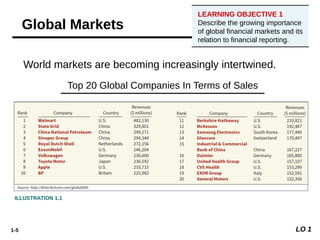
LEARNING OBJECTIVE 1
Describe the growing importance
of global financial markets and its
relation to financial reporting.
Global Markets
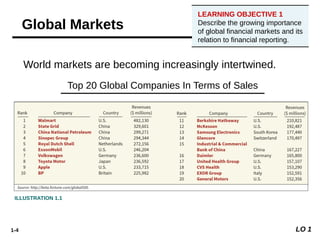
World markets are becoming increasingly intertwined.
Top 20 Global Companies In Terms of Sales
LO 1
ILLUSTRATION 1.1
1-5
LEARNING OBJECTIVE 1
Describe the growing importance
of global financial markets and its
relation to financial reporting.
Global Markets
World markets are becoming increasingly intertwined.
Top 20 Global Companies In Terms of Sales
LO 1
ILLUSTRATION 1.1
1-6
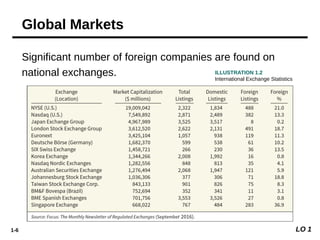
Significant number of foreign companies are found on
national exchanges. ILLUSTRATION 1.2
International Exchange Statistics
LO 1
Global Markets
1-7
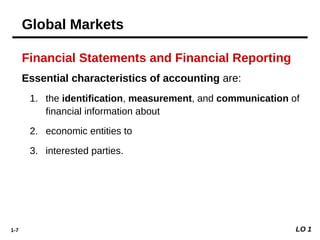
Financial Statements and Financial Reporting
Essential characteristics of accounting are:
1. the identification, measurement, and communication of
financial information about
2. economic entities to
3. interested parties.
LO 1
Global Markets
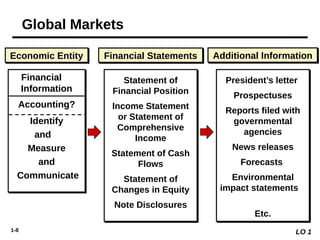
1-8
Financial
Information
Accounting?
Identify
and
Measure
and
Communicate
Statement of
Financial Position
Income Statement
or Statement of
Comprehensive
Income
Statement of Cash
Flows
Statement of
Changes in Equity
Note Disclosures
President’s letter
Prospectuses
Reports filed with
governmental
agencies
News releases
Forecasts
Environmental
impact statements
Etc.
Financial Statements Additional Information
Economic Entity
LO 1
Global Markets
1-9
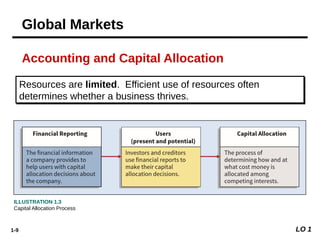
Resources are limited. Efficient use of resources often
determines whether a business thrives.
ILLUSTRATION 1.3
Capital Allocation Process
Accounting and Capital Allocation
LO 1
Global Markets
1-10
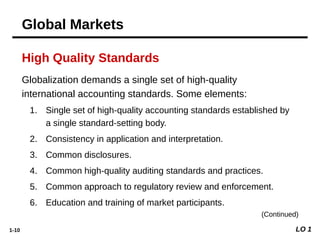
High Quality Standards
Globalization demands a single set of high-quality
international accounting standards. Some elements:
1. Single set of high-quality accounting standards established by
a single standard-setting body.
2. Consistency in application and interpretation.
3. Common disclosures.
4. Common high-quality auditing standards and practices.
5. Common approach to regulatory review and enforcement.
6. Education and training of market participants.
(Continued)
LO 1
Global Markets
1-11
High Quality Standards
LO 1
Global Markets
Globalization demands a single set of high-quality
international accounting standards. Some elements:
7. Common delivery systems (e.g., eXtensible Business
Reporting Language—XBRL).
8. Common approach to corporate governance and legal
frameworks around the world.
1-12
Objective: Provide financial information about the
reporting entity that is useful to
► present and potential equity investors,
► lenders, and
► other creditors
in making decisions about providing resources to the entity.
LO 2
Objective of
Financial
Reporting
LEARNING OBJECTIVE 2
Explain the objective of
financial reporting.
1-13
Equity Investors and Creditors
► Investors and creditors are the primary user group.
General-Purpose Financial Statements
► Provide financial reporting information to a wide variety
of users.
► Provide the most useful information possible at the
least cost.
LO 2
Objective of Financial Reporting
1-14
Decision-Usefulness
► Investors are interested in assessing
1. the company’s ability to generate net cash inflows and
2. management’s ability to protect and enhance the
capital providers’ investments.
Entity Perspective
► Companies viewed as separate and distinct from their
owners (shareholders).
LO 2
Objective of Financial Reporting
1-15
The objective of financial reporting places most emphasis on:
a. reporting to capital providers.
b. reporting on stewardship.
c. providing specific guidance related to specific needs.
d. providing information to individuals who are experts in
the field.
Question
LO 2
Objective of Financial Reporting
1-16
General-purpose financial statements are prepared primarily
for:
a. internal users.
b. external users.
c. auditors.
d. government regulators.
Question
LO 2
Objective of Financial Reporting
1-17
LEARNING OBJECTIVE 3
Identify the major policy-setting
bodies and their role in the
standard-setting process.
Main international standard-setting organization:
► International Accounting Standards Board (IASB)
● Issues International Financial Reporting Standards
(IFRS).
● Standards used on most foreign exchanges.
● IFRS used in over 149 countries.
● Two organizations that have a role in international
standard-setting are the International Organization of
Securities Commissions (IOSCO) and the IASB.
Standard-Setting
Organizations
LO 3
1-18
International Organization of Securities
Commissions (IOSCO)
► Does not set accounting standards.
► Dedicated to ensuring that global markets can operate
in an efficient and effective basis.
► Supports the use of IFRS as the single set of
international standards in cross-border offerings and
listings.
http://www.iosco.org/
LO 3
Standard-Setting Organizations
1-19
International Accounting Standards Board
(IASB)
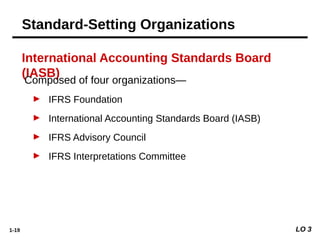
Composed of four organizations—
► IFRS Foundation
► International Accounting Standards Board (IASB)
► IFRS Advisory Council
► IFRS Interpretations Committee
LO 3
Standard-Setting Organizations
1-20
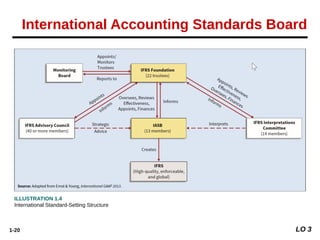
ILLUSTRATION 1.4
International Standard-Setting Structure
International Accounting Standards Board
LO 3
1-21
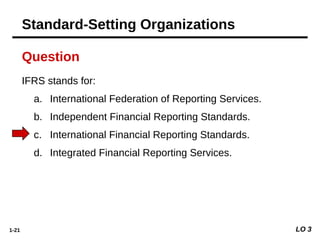
IFRS stands for:
a. International Federation of Reporting Services.
b. Independent Financial Reporting Standards.
c. International Financial Reporting Standards.
d. Integrated Financial Reporting Services.
Question
LO 3
Standard-Setting Organizations
1-22
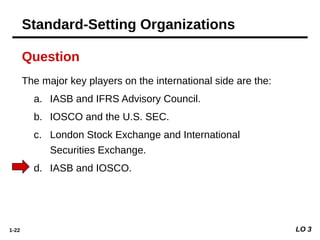
The major key players on the international side are the:
a. IASB and IFRS Advisory Council.
b. IOSCO and the U.S. SEC.
c. London Stock Exchange and International
Securities Exchange.
d. IASB and IOSCO.
Question
LO 3
Standard-Setting Organizations
1-23
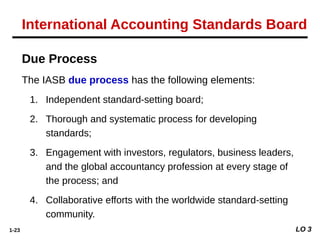
Due Process
The IASB due process has the following elements:
1. Independent standard-setting board;
2. Thorough and systematic process for developing
standards;
3. Engagement with investors, regulators, business leaders,
and the global accountancy profession at every stage of
the process; and
4. Collaborative efforts with the worldwide standard-setting
community.
LO 3
International Accounting Standards Board
1-24
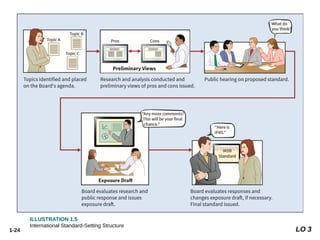
ILLUSTRATION 1.5
International Standard-Setting Structure
LO 3
1-25
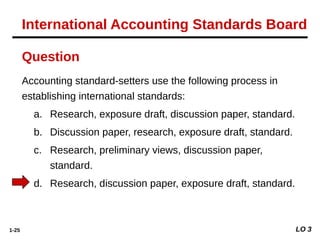
Accounting standard-setters use the following process in
establishing international standards:
a. Research, exposure draft, discussion paper, standard.
b. Discussion paper, research, exposure draft, standard.
c. Research, preliminary views, discussion paper,
standard.
d. Research, discussion paper, exposure draft, standard.
Question
LO 3
International Accounting Standards Board
1-26
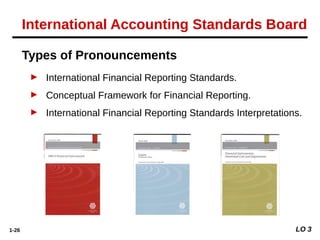
Types of Pronouncements
► International Financial Reporting Standards.
► Conceptual Framework for Financial Reporting.
► International Financial Reporting Standards Interpretations.
LO 3
International Accounting Standards Board
1-27
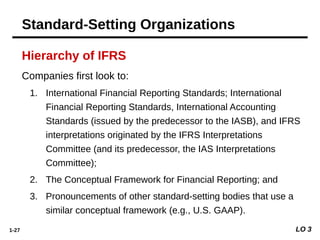
Companies first look to:
1. International Financial Reporting Standards; International
Financial Reporting Standards, International Accounting
Standards (issued by the predecessor to the IASB), and IFRS
interpretations originated by the IFRS Interpretations
Committee (and its predecessor, the IAS Interpretations
Committee);
2. The Conceptual Framework for Financial Reporting; and
3. Pronouncements of other standard-setting bodies that use a
similar conceptual framework (e.g., U.S. GAAP).
Hierarchy of IFRS
LO 3
Standard-Setting Organizations
1-28
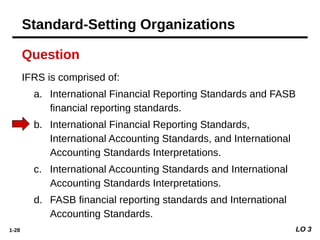
IFRS is comprised of:
a. International Financial Reporting Standards and FASB
financial reporting standards.
b. International Financial Reporting Standards,
International Accounting Standards, and International
Accounting Standards Interpretations.
c. International Accounting Standards and International
Accounting Standards Interpretations.
d. FASB financial reporting standards and International
Accounting Standards.
Question
LO 3
Standard-Setting Organizations
1-29
Financial Reporting
Challenges
IFRS in a Political Environment
LO 4
LEARNING OBJECTIVE 4
Discuss the challenges
facing financial reporting.
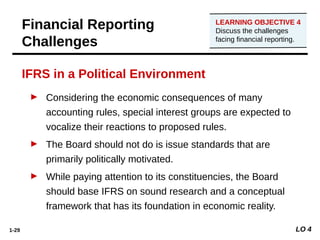
► Considering the economic consequences of many
accounting rules, special interest groups are expected to
vocalize their reactions to proposed rules.
► The Board should not do is issue standards that are
primarily politically motivated.
► While paying attention to its constituencies, the Board
should base IFRS on sound research and a conceptual
framework that has its foundation in economic reality.
1-30
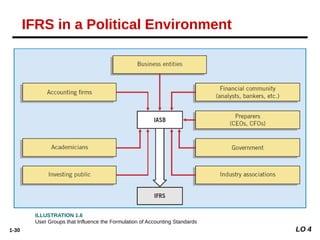
IFRS in a Political Environment
ILLUSTRATION 1.6
User Groups that Influence the Formulation of Accounting Standards
LO 4
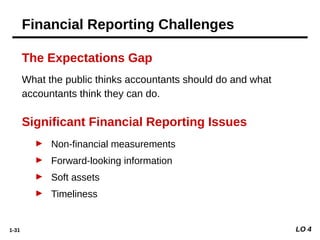
1-31
What the public thinks accountants should do and what
accountants think they can do.
The Expectations Gap
Significant Financial Reporting Issues
► Non-financial measurements
► Forward-looking information
► Soft assets
► Timeliness
LO 4
Financial Reporting Challenges
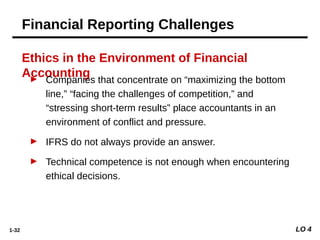
1-32
Ethics in the Environment of Financial
Accounting
► Companies that concentrate on “maximizing the bottom
line,” “facing the challenges of competition,” and
“stressing short-term results” place accountants in an
environment of conflict and pressure.
► IFRS do not always provide an answer.
► Technical competence is not enough when encountering
ethical decisions.
LO 4
Financial Reporting Challenges
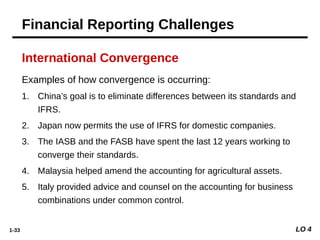
1-33
International Convergence
Examples of how convergence is occurring:
1. China’s goal is to eliminate differences between its standards and
IFRS.
2. Japan now permits the use of IFRS for domestic companies.
3. The IASB and the FASB have spent the last 12 years working to
converge their standards.
4. Malaysia helped amend the accounting for agricultural assets.
5. Italy provided advice and counsel on the accounting for business
combinations under common control.
LO 4
Financial Reporting Challenges
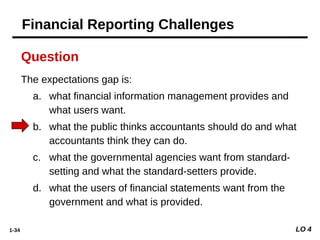
1-34
The expectations gap is:
a. what financial information management provides and
what users want.
b. what the public thinks accountants should do and what
accountants think they can do.
c. what the governmental agencies want from standard-
setting and what the standard-setters provide.
d. what the users of financial statements want from the
government and what is provided.
LO 4
Question
Financial Reporting Challenges
1-35
GLOBAL ACCOUNTING INSIGHTS
LEARNING OBJECTIVE 5
Compare IFRS and U.S. GAAP and their standard-setting processes.
Most agree that there is a need for one set of international accounting
standards. Here is why:
• Multinational corporations
• Mergers and acquisitions
• Information technology
• Financial markets
LO 5
1-36
Relevant Facts
Following are the key similarities and differences between U.S. GAAP and
IFRS related to the financial reporting environment.
Similarities
• Generally accepted accounting principles (GAAP) for U.S. companies are
developed by the Financial Accounting Standards Board (FASB). The FASB
is a private organization. The U.S. Securities and Exchange Commission
(SEC) exercises oversight over the actions of the FASB. The IASB is also a
private organization. Oversight over the actions of the IASB is regulated by
IOSCO.
GLOBAL ACCOUNTING INSIGHTS
LO 5
1-37
Relevant Facts
Similarities
• Both the IASB and the FASB have essentially the same governance
structure, that is, a Foundation that provides oversight, a Board, an Advisory
Council, and an Interpretations Committee. In addition, a general body that
involves the public interest is part of the governance structure.
• The FASB relies on the U.S. SEC for regulation and enforcement of its
standards. The IASB relies primarily on IOSCO for regulation and
enforcement of its standards.
• Both the IASB and the FASB are working together to find common ground
wherever possible.
GLOBAL ACCOUNTING INSIGHTS
LO 5
1-38
Relevant Facts
Differences
• U.S. GAAP is more detailed or rules-based. IFRS tends to simpler and more
flexible in the accounting and disclosure requirements. The difference in
approach has resulted in a debate about the merits of principles-based
versus rules-based standards.
• Differences between U.S. GAAP and IFRS should not be surprising
because standard-setters have developed standards in response to
different user needs. In some countries, the primary users of financial
statements are private investors. In others, the primary users are tax
authorities or central government planners. In the United States, investors
and creditors have driven accounting-standard formulation.
GLOBAL ACCOUNTING INSIGHTS
LO 5
1-39
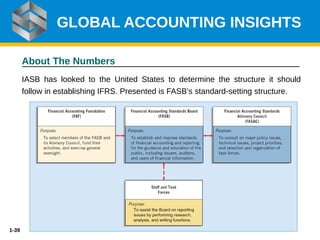
About The Numbers
IASB has looked to the United States to determine the structure it should
follow in establishing IFRS. Presented is FASB’s standard-setting structure.
GLOBAL ACCOUNTING INSIGHTS
1-40
On the Horizon
Both the IASB and the FASB are hard at work developing standards that will
lead to the elimination of major di erences in the way certain transactions are
ff
accounted for and reported. In fact, beginning in 2010, the IASB (and the
FASB on its joint projects with the IASB) started its policy of phasing in
adoption of new major standards over several years. The major reason for this
policy is to provide companies time to translate and implement international
standards into practice.
GLOBAL ACCOUNTING INSIGHTS
LO 5
1-41
Copyright © 2018 John Wiley & Sons, Inc. All rights reserved.
Reproduction or translation of this work beyond that permitted in
Section 117 of the 1976 United States Copyright Act without the
express written permission of the copyright owner is unlawful.
Request for further information should be addressed to the
Permissions Department, John Wiley & Sons, Inc. The purchaser
may make back-up copies for his/her own use only and not for
distribution or resale. The Publisher assumes no responsibility for
errors, omissions, or damages, caused by the use of these
programs or from the use of the information contained herein.
Copyright

Financial Reporting and Accounting Standards

  • 1.
    1-1 Prepared by Coby Harmon Universityof California, Santa Barbara Westmont College
  • 2.
    1-2 1. Describe thegrowing importance of global financial markets and its relation to financial reporting. 2. Explain the objective of financial reporting. 3. Identify the major policy- setting bodies and their role in the standard-setting process. 4. Discuss the challenges facing financial reporting. After studying this chapter, you should be able to: Financial Reporting and Accounting Standards CHAPTER 1 LEARNING OBJECTIVES
  • 3.
    1-3 PREVIEW OF CHAPTER1 Intermediate Accounting IFRS 3rd Edition Kieso ● Weygandt ● Warfield
  • 4.
    1-4 LEARNING OBJECTIVE 1 Describethe growing importance of global financial markets and its relation to financial reporting. Global Markets World markets are becoming increasingly intertwined. Top 20 Global Companies In Terms of Sales LO 1 ILLUSTRATION 1.1
  • 5.
    1-5 LEARNING OBJECTIVE 1 Describethe growing importance of global financial markets and its relation to financial reporting. Global Markets World markets are becoming increasingly intertwined. Top 20 Global Companies In Terms of Sales LO 1 ILLUSTRATION 1.1
  • 6.
    1-6 Significant number offoreign companies are found on national exchanges. ILLUSTRATION 1.2 International Exchange Statistics LO 1 Global Markets
  • 7.
    1-7 Financial Statements andFinancial Reporting Essential characteristics of accounting are: 1. the identification, measurement, and communication of financial information about 2. economic entities to 3. interested parties. LO 1 Global Markets
  • 8.
    1-8 Financial Information Accounting? Identify and Measure and Communicate Statement of Financial Position IncomeStatement or Statement of Comprehensive Income Statement of Cash Flows Statement of Changes in Equity Note Disclosures President’s letter Prospectuses Reports filed with governmental agencies News releases Forecasts Environmental impact statements Etc. Financial Statements Additional Information Economic Entity LO 1 Global Markets
  • 9.
    1-9 Resources are limited.Efficient use of resources often determines whether a business thrives. ILLUSTRATION 1.3 Capital Allocation Process Accounting and Capital Allocation LO 1 Global Markets
  • 10.
    1-10 High Quality Standards Globalizationdemands a single set of high-quality international accounting standards. Some elements: 1. Single set of high-quality accounting standards established by a single standard-setting body. 2. Consistency in application and interpretation. 3. Common disclosures. 4. Common high-quality auditing standards and practices. 5. Common approach to regulatory review and enforcement. 6. Education and training of market participants. (Continued) LO 1 Global Markets
  • 11.
    1-11 High Quality Standards LO1 Global Markets Globalization demands a single set of high-quality international accounting standards. Some elements: 7. Common delivery systems (e.g., eXtensible Business Reporting Language—XBRL). 8. Common approach to corporate governance and legal frameworks around the world.
  • 12.
    1-12 Objective: Provide financialinformation about the reporting entity that is useful to ► present and potential equity investors, ► lenders, and ► other creditors in making decisions about providing resources to the entity. LO 2 Objective of Financial Reporting LEARNING OBJECTIVE 2 Explain the objective of financial reporting.
  • 13.
    1-13 Equity Investors andCreditors ► Investors and creditors are the primary user group. General-Purpose Financial Statements ► Provide financial reporting information to a wide variety of users. ► Provide the most useful information possible at the least cost. LO 2 Objective of Financial Reporting
  • 14.
    1-14 Decision-Usefulness ► Investors areinterested in assessing 1. the company’s ability to generate net cash inflows and 2. management’s ability to protect and enhance the capital providers’ investments. Entity Perspective ► Companies viewed as separate and distinct from their owners (shareholders). LO 2 Objective of Financial Reporting
  • 15.
    1-15 The objective offinancial reporting places most emphasis on: a. reporting to capital providers. b. reporting on stewardship. c. providing specific guidance related to specific needs. d. providing information to individuals who are experts in the field. Question LO 2 Objective of Financial Reporting
  • 16.
    1-16 General-purpose financial statementsare prepared primarily for: a. internal users. b. external users. c. auditors. d. government regulators. Question LO 2 Objective of Financial Reporting
  • 17.
    1-17 LEARNING OBJECTIVE 3 Identifythe major policy-setting bodies and their role in the standard-setting process. Main international standard-setting organization: ► International Accounting Standards Board (IASB) ● Issues International Financial Reporting Standards (IFRS). ● Standards used on most foreign exchanges. ● IFRS used in over 149 countries. ● Two organizations that have a role in international standard-setting are the International Organization of Securities Commissions (IOSCO) and the IASB. Standard-Setting Organizations LO 3
  • 18.
    1-18 International Organization ofSecurities Commissions (IOSCO) ► Does not set accounting standards. ► Dedicated to ensuring that global markets can operate in an efficient and effective basis. ► Supports the use of IFRS as the single set of international standards in cross-border offerings and listings. http://www.iosco.org/ LO 3 Standard-Setting Organizations
  • 19.
    1-19 International Accounting StandardsBoard (IASB) Composed of four organizations— ► IFRS Foundation ► International Accounting Standards Board (IASB) ► IFRS Advisory Council ► IFRS Interpretations Committee LO 3 Standard-Setting Organizations
  • 20.
    1-20 ILLUSTRATION 1.4 International Standard-SettingStructure International Accounting Standards Board LO 3
  • 21.
    1-21 IFRS stands for: a.International Federation of Reporting Services. b. Independent Financial Reporting Standards. c. International Financial Reporting Standards. d. Integrated Financial Reporting Services. Question LO 3 Standard-Setting Organizations
  • 22.
    1-22 The major keyplayers on the international side are the: a. IASB and IFRS Advisory Council. b. IOSCO and the U.S. SEC. c. London Stock Exchange and International Securities Exchange. d. IASB and IOSCO. Question LO 3 Standard-Setting Organizations
  • 23.
    1-23 Due Process The IASBdue process has the following elements: 1. Independent standard-setting board; 2. Thorough and systematic process for developing standards; 3. Engagement with investors, regulators, business leaders, and the global accountancy profession at every stage of the process; and 4. Collaborative efforts with the worldwide standard-setting community. LO 3 International Accounting Standards Board
  • 24.
  • 25.
    1-25 Accounting standard-setters usethe following process in establishing international standards: a. Research, exposure draft, discussion paper, standard. b. Discussion paper, research, exposure draft, standard. c. Research, preliminary views, discussion paper, standard. d. Research, discussion paper, exposure draft, standard. Question LO 3 International Accounting Standards Board
  • 26.
    1-26 Types of Pronouncements ►International Financial Reporting Standards. ► Conceptual Framework for Financial Reporting. ► International Financial Reporting Standards Interpretations. LO 3 International Accounting Standards Board
  • 27.
    1-27 Companies first lookto: 1. International Financial Reporting Standards; International Financial Reporting Standards, International Accounting Standards (issued by the predecessor to the IASB), and IFRS interpretations originated by the IFRS Interpretations Committee (and its predecessor, the IAS Interpretations Committee); 2. The Conceptual Framework for Financial Reporting; and 3. Pronouncements of other standard-setting bodies that use a similar conceptual framework (e.g., U.S. GAAP). Hierarchy of IFRS LO 3 Standard-Setting Organizations
  • 28.
    1-28 IFRS is comprisedof: a. International Financial Reporting Standards and FASB financial reporting standards. b. International Financial Reporting Standards, International Accounting Standards, and International Accounting Standards Interpretations. c. International Accounting Standards and International Accounting Standards Interpretations. d. FASB financial reporting standards and International Accounting Standards. Question LO 3 Standard-Setting Organizations
  • 29.
    1-29 Financial Reporting Challenges IFRS ina Political Environment LO 4 LEARNING OBJECTIVE 4 Discuss the challenges facing financial reporting. ► Considering the economic consequences of many accounting rules, special interest groups are expected to vocalize their reactions to proposed rules. ► The Board should not do is issue standards that are primarily politically motivated. ► While paying attention to its constituencies, the Board should base IFRS on sound research and a conceptual framework that has its foundation in economic reality.
  • 30.
    1-30 IFRS in aPolitical Environment ILLUSTRATION 1.6 User Groups that Influence the Formulation of Accounting Standards LO 4
  • 31.
    1-31 What the publicthinks accountants should do and what accountants think they can do. The Expectations Gap Significant Financial Reporting Issues ► Non-financial measurements ► Forward-looking information ► Soft assets ► Timeliness LO 4 Financial Reporting Challenges
  • 32.
    1-32 Ethics in theEnvironment of Financial Accounting ► Companies that concentrate on “maximizing the bottom line,” “facing the challenges of competition,” and “stressing short-term results” place accountants in an environment of conflict and pressure. ► IFRS do not always provide an answer. ► Technical competence is not enough when encountering ethical decisions. LO 4 Financial Reporting Challenges
  • 33.
    1-33 International Convergence Examples ofhow convergence is occurring: 1. China’s goal is to eliminate differences between its standards and IFRS. 2. Japan now permits the use of IFRS for domestic companies. 3. The IASB and the FASB have spent the last 12 years working to converge their standards. 4. Malaysia helped amend the accounting for agricultural assets. 5. Italy provided advice and counsel on the accounting for business combinations under common control. LO 4 Financial Reporting Challenges
  • 34.
    1-34 The expectations gapis: a. what financial information management provides and what users want. b. what the public thinks accountants should do and what accountants think they can do. c. what the governmental agencies want from standard- setting and what the standard-setters provide. d. what the users of financial statements want from the government and what is provided. LO 4 Question Financial Reporting Challenges
  • 35.
    1-35 GLOBAL ACCOUNTING INSIGHTS LEARNINGOBJECTIVE 5 Compare IFRS and U.S. GAAP and their standard-setting processes. Most agree that there is a need for one set of international accounting standards. Here is why: • Multinational corporations • Mergers and acquisitions • Information technology • Financial markets LO 5
  • 36.
    1-36 Relevant Facts Following arethe key similarities and differences between U.S. GAAP and IFRS related to the financial reporting environment. Similarities • Generally accepted accounting principles (GAAP) for U.S. companies are developed by the Financial Accounting Standards Board (FASB). The FASB is a private organization. The U.S. Securities and Exchange Commission (SEC) exercises oversight over the actions of the FASB. The IASB is also a private organization. Oversight over the actions of the IASB is regulated by IOSCO. GLOBAL ACCOUNTING INSIGHTS LO 5
  • 37.
    1-37 Relevant Facts Similarities • Boththe IASB and the FASB have essentially the same governance structure, that is, a Foundation that provides oversight, a Board, an Advisory Council, and an Interpretations Committee. In addition, a general body that involves the public interest is part of the governance structure. • The FASB relies on the U.S. SEC for regulation and enforcement of its standards. The IASB relies primarily on IOSCO for regulation and enforcement of its standards. • Both the IASB and the FASB are working together to find common ground wherever possible. GLOBAL ACCOUNTING INSIGHTS LO 5
  • 38.
    1-38 Relevant Facts Differences • U.S.GAAP is more detailed or rules-based. IFRS tends to simpler and more flexible in the accounting and disclosure requirements. The difference in approach has resulted in a debate about the merits of principles-based versus rules-based standards. • Differences between U.S. GAAP and IFRS should not be surprising because standard-setters have developed standards in response to different user needs. In some countries, the primary users of financial statements are private investors. In others, the primary users are tax authorities or central government planners. In the United States, investors and creditors have driven accounting-standard formulation. GLOBAL ACCOUNTING INSIGHTS LO 5
  • 39.
    1-39 About The Numbers IASBhas looked to the United States to determine the structure it should follow in establishing IFRS. Presented is FASB’s standard-setting structure. GLOBAL ACCOUNTING INSIGHTS
  • 40.
    1-40 On the Horizon Boththe IASB and the FASB are hard at work developing standards that will lead to the elimination of major di erences in the way certain transactions are ff accounted for and reported. In fact, beginning in 2010, the IASB (and the FASB on its joint projects with the IASB) started its policy of phasing in adoption of new major standards over several years. The major reason for this policy is to provide companies time to translate and implement international standards into practice. GLOBAL ACCOUNTING INSIGHTS LO 5
  • 41.
    1-41 Copyright © 2018John Wiley & Sons, Inc. All rights reserved. Reproduction or translation of this work beyond that permitted in Section 117 of the 1976 United States Copyright Act without the express written permission of the copyright owner is unlawful. Request for further information should be addressed to the Permissions Department, John Wiley & Sons, Inc. The purchaser may make back-up copies for his/her own use only and not for distribution or resale. The Publisher assumes no responsibility for errors, omissions, or damages, caused by the use of these programs or from the use of the information contained herein. Copyright