1-1
1-2
INTRODUCTION TO
FINANCIAL Accounting
Financial Accounting, 12 Edition
1
1-3
1. Describe the meaning of accounting
2. Identify the users and uses of accounting information..
3. Describe the primary forms of business organization
4. Explain the meaning of assets, liabilities, and stockholders’
equity, and state the basic accounting equation.
5. Describe the components that supplement the financial
statements in an annual report.
Study Objectives
1-4
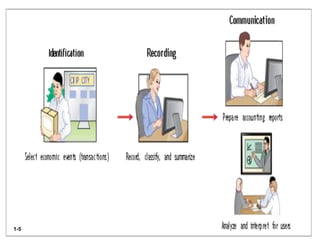
 Accounting is a systematic process of
identifying, recording, classifying,
verifying, summarizing, interpreting,
and communicating financial
information. It involves the collection
and organization of financial data to
help individuals and organizations
make informed decisions.
1-5
1-6
1. Financial Accounting: This focuses on the preparation of financial
statements for external users, such as investors, creditors, and
government agencies. It includes topics like recording transactions,
adjusting entries, and preparing financial statements (income
statement, balance sheet, statement of cash flows, and statement of
changes in equity).
2. Managerial Accounting: This branch of accounting is concerned
with providing information to internal users (managers) to help them
make decisions. It covers topics such as cost behavior, budgeting,
variance analysis, and performance evaluation.
3. Auditing: Auditing involves examining financial records to
determine if they are accurate, complete, and in compliance with
laws and regulations. It also includes an evaluation of internal
controls.
4. Tax Accounting: Tax accounting deals with the preparation and
filing of tax returns for individuals and businesses. It involves
understanding tax laws and regulations to minimize tax liabilities
legally.
1-7
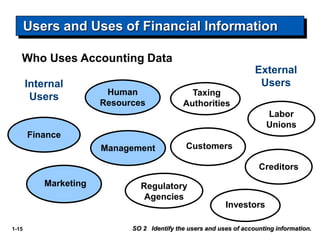
 Internal users of accounting information are managers
who plan, organize, and run the business. These include
marketing managers, production supervisors, finance
directors, and company officers.
 External users are individuals and organizations outside
a company who want financial information about the
company. The two most common types of exter- nal users
are investors and creditors. Investors (owners) use
accounting infor- mation to decide whether to buy, hold,
or sell ownership shares of a company. Creditors (such as
suppliers and bankers) use accounting information to
evalu- ate the risks of granting credit or lending money.
1-8
 Assumptions provide a foundation for the accounting
process. Two main assumptions are the monetary unit
assumption and the economic entity assumption.
 The monetary unit assumption requires that companies
include in the account- Ing records only transaction data
that can be expressed in money terms assumption enables
accounting to quantify (measure) economic events. The
monetary unit assumption is vital to applying the
historical cost principle.
 This assumption prevents the inclusion of some relevant
information in the accounting records. For example, the
health of a company’s owner, the quality of service, and
the morale of employees are not included
1-9
 An economic entity can be any organization or
unit in society.
 The economic entity assumption requires that
the activities of the entity be kept separate and
distinct from the activities of its owner and all
other economic entities.
1-10
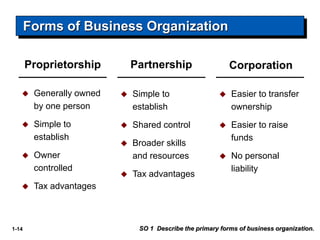
 PROPRIETORSHIP A business owned by one person
is generally a proprietor- ship.
The owner is often the manager/operator of the business.
Small service- type businesses (plumbing companies,
beauty salons, and auto repair shops).
The owner (proprietor) receives any profits, suffers any
losses, and is person- ally liable for all debts of the
business.
There is no legal distinction between the business as an
economic unit and the owner, but the accounting records
of the business activities are kept separate from the
personal records and activities of the owner.
1-11
 PARTNERSHIP A business owned by two or more persons
associated as partners is a partnership.
 In most respects a partnership is like a proprietorship except
that more than one owner is involved. Typically, a partnership
agreement (written or oral) sets forth such terms as initial
investment, duties of each partner, division of net income (or
net loss), and settlement to be made upon death or withdrawal
of a partner.
 Each partner generally has unlimited personal liability for the
debts of the partnership. Like a proprietorship, for accounting
purposes the partner- ship transactions must be kept separate
from the personal activities of the partners.
 Partnerships are often used to organize retail and service-type
busi- nesses, including professional practices (lawyers,
doctors, architects, and certi- fied public accountants).
1-12
 CORPORATION A business organized as a separate legal entity under
state corporation law and having ownership divided into transferable shares
of stock is a corporation.
 The holders of the shares (stockholders) enjoy limited liability; that is,
they are not personally liable for the debts of the corporate entity. Stock-
holders may transfer all or part of their ownership shares to other investors
at any time (i.e., sell their shares). Although the combined number of
proprietorships and partnerships in the United States is more than five
times the number of corporations, the revenue produced by corporations is
eight times greater. Most of the largest companies

for example Hormuud and Dahabshiil are corporations
1-13
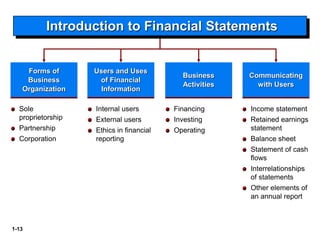
Internal users
External users
Ethics in financial
reporting
Forms of
Business
Organization
Users and Uses
of Financial
Information
Business
Activities
Communicating
with Users
Sole
proprietorship
Partnership
Corporation
Financing
Investing
Operating
Income statement
Retained earnings
statement
Balance sheet
Statement of cash
flows
Interrelationships
of statements
Other elements of
an annual report
Introduction to Financial Statements
1-14
Proprietorship Partnership Corporation
 Simple to
establish
 Shared control
 Broader skills
and resources
 Tax advantages
 Easier to transfer
ownership
 Easier to raise
funds
 No personal
liability
Forms of Business Organization
 Generally owned
by one person
 Simple to
establish
 Owner
controlled
 Tax advantages
SO 1 Describe the primary forms of business organization.
1-15
Management
Human
Resources
Taxing
Authorities
Labor
Unions
Regulatory
Agencies
Marketing
Finance
Investors
Creditors
Customers
Internal
Users
External
Users
Who Uses Accounting Data
Users and Uses of Financial Information
SO 2 Identify the users and uses of accounting information.
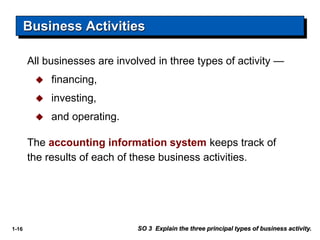
1-16
All businesses are involved in three types of activity —
 financing,
 investing,
 and operating.
Business Activities
SO 3 Explain the three principal types of business activity.
The accounting information system keeps track of
the results of each of these business activities.
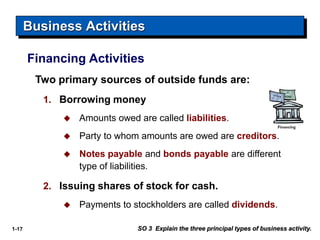
1-17
Two primary sources of outside funds are:
1. Borrowing money
 Amounts owed are called liabilities.
 Party to whom amounts are owed are creditors.
 Notes payable and bonds payable are different
type of liabilities.
2. Issuing shares of stock for cash.
 Payments to stockholders are called dividends.
Business Activities
SO 3 Explain the three principal types of business activity.
Financing Activities
1-18
Investing Activities
Purchase of resources a company needs to
operate.
 Computers, delivery trucks, furniture, buildings, etc.
 Resources owned by a business are called assets.
Business Activities
SO 3 Explain the three principal types of business activity.
1-19
Operating Activities
Once a business has the assets it needs,
it can begin its operations.
 Revenues - Amounts earned from the sale of products
(sales revenue, service revenue, and interest revenue).
 Inventory - Goods available for sale to customers.
 Accounts receivable - Right to receive money from a
customer,in the future, as the result of a sale.
Business Activities
SO 3 Explain the three principal types of business activity.
1-20
Operating Activities
 Expenses - cost of assets consumed or services used.
(cost of goods sold, selling, marketing, administrative,
interest, and income taxes expense).
 Liabilities arising from expenses include accounts
payable, interest payable, wages payable, sales taxes
payable, and income taxes payable.
 Net income – when revenues exceed expenses.
 Net loss – when expenses exceed revenues.
Business Activities
SO 3 Explain the three principal types of business activity.
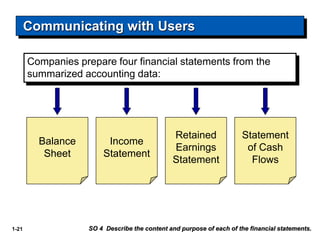
1-21
Companies prepare four financial statements from the
summarized accounting data:
Income
Statement
Balance
Sheet
Statement
of Cash
Flows
Retained
Earnings
Statement
Communicating with Users
SO 4 Describe the content and purpose of each of the financial statements.
1-22
 The two basic elements of a business are what it owns
and what it owes. Assets are the resources a business
owns. For example, Google has total assets of
approximately $93.8 billion. Liabilities and owner’s
equity are the rights or claims against these resources.
Thus, Google has $93.8 billion of claims against its $93.8
billion of assets. Claims of those to whom the company
owes money (cred- itors) are called liabilities. Claims of
owners are called owner’s equity. Google has liabilities of
$22.1 billion and owners’ equity of $71.7 billion.
 We can express the relationship of assets, liabilities, and
owner’s equity as an equation.
1-23
 This relationship is the basic accounting equation.
Assets must equal the sum of liabilities and owner’s
equity. Liabilities appear before owner’s equity in the
basic accounting equation because they are paid first if
a business is liquidated.
 The accounting equation applies to all economic
entities regardless of size, nature of business, or form
of business organization.

financial accounting Chapter one.pptx...

  • 1.
  • 2.
  • 3.
    1-3 1. Describe themeaning of accounting 2. Identify the users and uses of accounting information.. 3. Describe the primary forms of business organization 4. Explain the meaning of assets, liabilities, and stockholders’ equity, and state the basic accounting equation. 5. Describe the components that supplement the financial statements in an annual report. Study Objectives
  • 4.
    1-4  Accounting isa systematic process of identifying, recording, classifying, verifying, summarizing, interpreting, and communicating financial information. It involves the collection and organization of financial data to help individuals and organizations make informed decisions.
  • 5.
  • 6.
    1-6 1. Financial Accounting:This focuses on the preparation of financial statements for external users, such as investors, creditors, and government agencies. It includes topics like recording transactions, adjusting entries, and preparing financial statements (income statement, balance sheet, statement of cash flows, and statement of changes in equity). 2. Managerial Accounting: This branch of accounting is concerned with providing information to internal users (managers) to help them make decisions. It covers topics such as cost behavior, budgeting, variance analysis, and performance evaluation. 3. Auditing: Auditing involves examining financial records to determine if they are accurate, complete, and in compliance with laws and regulations. It also includes an evaluation of internal controls. 4. Tax Accounting: Tax accounting deals with the preparation and filing of tax returns for individuals and businesses. It involves understanding tax laws and regulations to minimize tax liabilities legally.
  • 7.
    1-7  Internal usersof accounting information are managers who plan, organize, and run the business. These include marketing managers, production supervisors, finance directors, and company officers.  External users are individuals and organizations outside a company who want financial information about the company. The two most common types of exter- nal users are investors and creditors. Investors (owners) use accounting infor- mation to decide whether to buy, hold, or sell ownership shares of a company. Creditors (such as suppliers and bankers) use accounting information to evalu- ate the risks of granting credit or lending money.
  • 8.
    1-8  Assumptions providea foundation for the accounting process. Two main assumptions are the monetary unit assumption and the economic entity assumption.  The monetary unit assumption requires that companies include in the account- Ing records only transaction data that can be expressed in money terms assumption enables accounting to quantify (measure) economic events. The monetary unit assumption is vital to applying the historical cost principle.  This assumption prevents the inclusion of some relevant information in the accounting records. For example, the health of a company’s owner, the quality of service, and the morale of employees are not included
  • 9.
    1-9  An economicentity can be any organization or unit in society.  The economic entity assumption requires that the activities of the entity be kept separate and distinct from the activities of its owner and all other economic entities.
  • 10.
    1-10  PROPRIETORSHIP Abusiness owned by one person is generally a proprietor- ship. The owner is often the manager/operator of the business. Small service- type businesses (plumbing companies, beauty salons, and auto repair shops). The owner (proprietor) receives any profits, suffers any losses, and is person- ally liable for all debts of the business. There is no legal distinction between the business as an economic unit and the owner, but the accounting records of the business activities are kept separate from the personal records and activities of the owner.
  • 11.
    1-11  PARTNERSHIP Abusiness owned by two or more persons associated as partners is a partnership.  In most respects a partnership is like a proprietorship except that more than one owner is involved. Typically, a partnership agreement (written or oral) sets forth such terms as initial investment, duties of each partner, division of net income (or net loss), and settlement to be made upon death or withdrawal of a partner.  Each partner generally has unlimited personal liability for the debts of the partnership. Like a proprietorship, for accounting purposes the partner- ship transactions must be kept separate from the personal activities of the partners.  Partnerships are often used to organize retail and service-type busi- nesses, including professional practices (lawyers, doctors, architects, and certi- fied public accountants).
  • 12.
    1-12  CORPORATION Abusiness organized as a separate legal entity under state corporation law and having ownership divided into transferable shares of stock is a corporation.  The holders of the shares (stockholders) enjoy limited liability; that is, they are not personally liable for the debts of the corporate entity. Stock- holders may transfer all or part of their ownership shares to other investors at any time (i.e., sell their shares). Although the combined number of proprietorships and partnerships in the United States is more than five times the number of corporations, the revenue produced by corporations is eight times greater. Most of the largest companies  for example Hormuud and Dahabshiil are corporations
  • 13.
    1-13 Internal users External users Ethicsin financial reporting Forms of Business Organization Users and Uses of Financial Information Business Activities Communicating with Users Sole proprietorship Partnership Corporation Financing Investing Operating Income statement Retained earnings statement Balance sheet Statement of cash flows Interrelationships of statements Other elements of an annual report Introduction to Financial Statements
  • 14.
    1-14 Proprietorship Partnership Corporation Simple to establish  Shared control  Broader skills and resources  Tax advantages  Easier to transfer ownership  Easier to raise funds  No personal liability Forms of Business Organization  Generally owned by one person  Simple to establish  Owner controlled  Tax advantages SO 1 Describe the primary forms of business organization.
  • 15.
  • 16.
    1-16 All businesses areinvolved in three types of activity —  financing,  investing,  and operating. Business Activities SO 3 Explain the three principal types of business activity. The accounting information system keeps track of the results of each of these business activities.
  • 17.
    1-17 Two primary sourcesof outside funds are: 1. Borrowing money  Amounts owed are called liabilities.  Party to whom amounts are owed are creditors.  Notes payable and bonds payable are different type of liabilities. 2. Issuing shares of stock for cash.  Payments to stockholders are called dividends. Business Activities SO 3 Explain the three principal types of business activity. Financing Activities
  • 18.
    1-18 Investing Activities Purchase ofresources a company needs to operate.  Computers, delivery trucks, furniture, buildings, etc.  Resources owned by a business are called assets. Business Activities SO 3 Explain the three principal types of business activity.
  • 19.
    1-19 Operating Activities Once abusiness has the assets it needs, it can begin its operations.  Revenues - Amounts earned from the sale of products (sales revenue, service revenue, and interest revenue).  Inventory - Goods available for sale to customers.  Accounts receivable - Right to receive money from a customer,in the future, as the result of a sale. Business Activities SO 3 Explain the three principal types of business activity.
  • 20.
    1-20 Operating Activities  Expenses- cost of assets consumed or services used. (cost of goods sold, selling, marketing, administrative, interest, and income taxes expense).  Liabilities arising from expenses include accounts payable, interest payable, wages payable, sales taxes payable, and income taxes payable.  Net income – when revenues exceed expenses.  Net loss – when expenses exceed revenues. Business Activities SO 3 Explain the three principal types of business activity.
  • 21.
    1-21 Companies prepare fourfinancial statements from the summarized accounting data: Income Statement Balance Sheet Statement of Cash Flows Retained Earnings Statement Communicating with Users SO 4 Describe the content and purpose of each of the financial statements.
  • 22.
    1-22  The twobasic elements of a business are what it owns and what it owes. Assets are the resources a business owns. For example, Google has total assets of approximately $93.8 billion. Liabilities and owner’s equity are the rights or claims against these resources. Thus, Google has $93.8 billion of claims against its $93.8 billion of assets. Claims of those to whom the company owes money (cred- itors) are called liabilities. Claims of owners are called owner’s equity. Google has liabilities of $22.1 billion and owners’ equity of $71.7 billion.  We can express the relationship of assets, liabilities, and owner’s equity as an equation.
  • 23.
    1-23  This relationshipis the basic accounting equation. Assets must equal the sum of liabilities and owner’s equity. Liabilities appear before owner’s equity in the basic accounting equation because they are paid first if a business is liquidated.  The accounting equation applies to all economic entities regardless of size, nature of business, or form of business organization.