P R E S E N T E D B Y
MUHAMMAD JAWAD IRFAN
& BASHAAR FAROOQ
Tax Structure of Pakistan
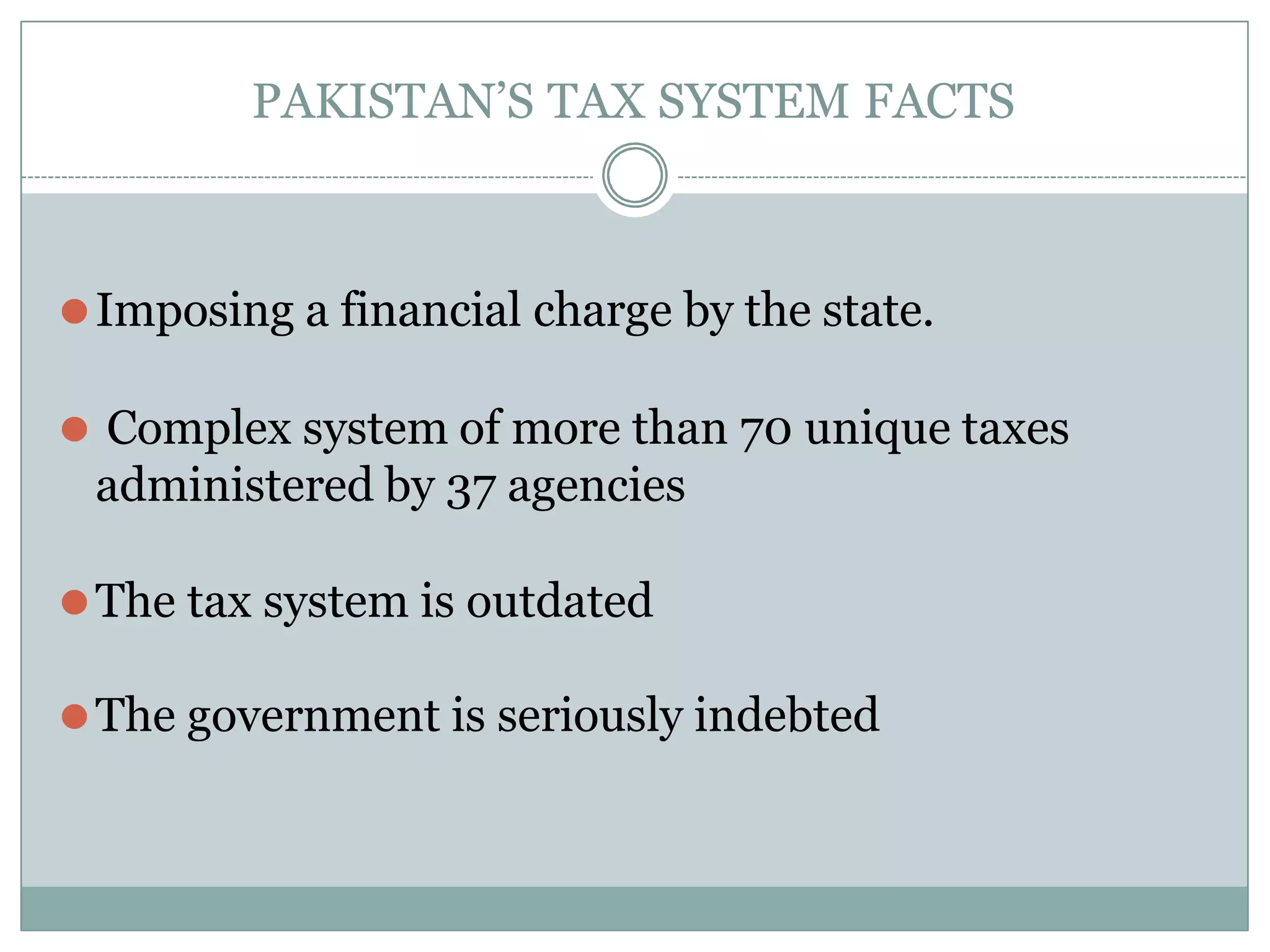
PAKISTAN’S TAX SYSTEM FACTS
⚫Imposing a financial charge by the state.
⚫ Complex system of more than 70 unique taxes
administered by 37 agencies
⚫The tax system is outdated
⚫The government is seriously indebted
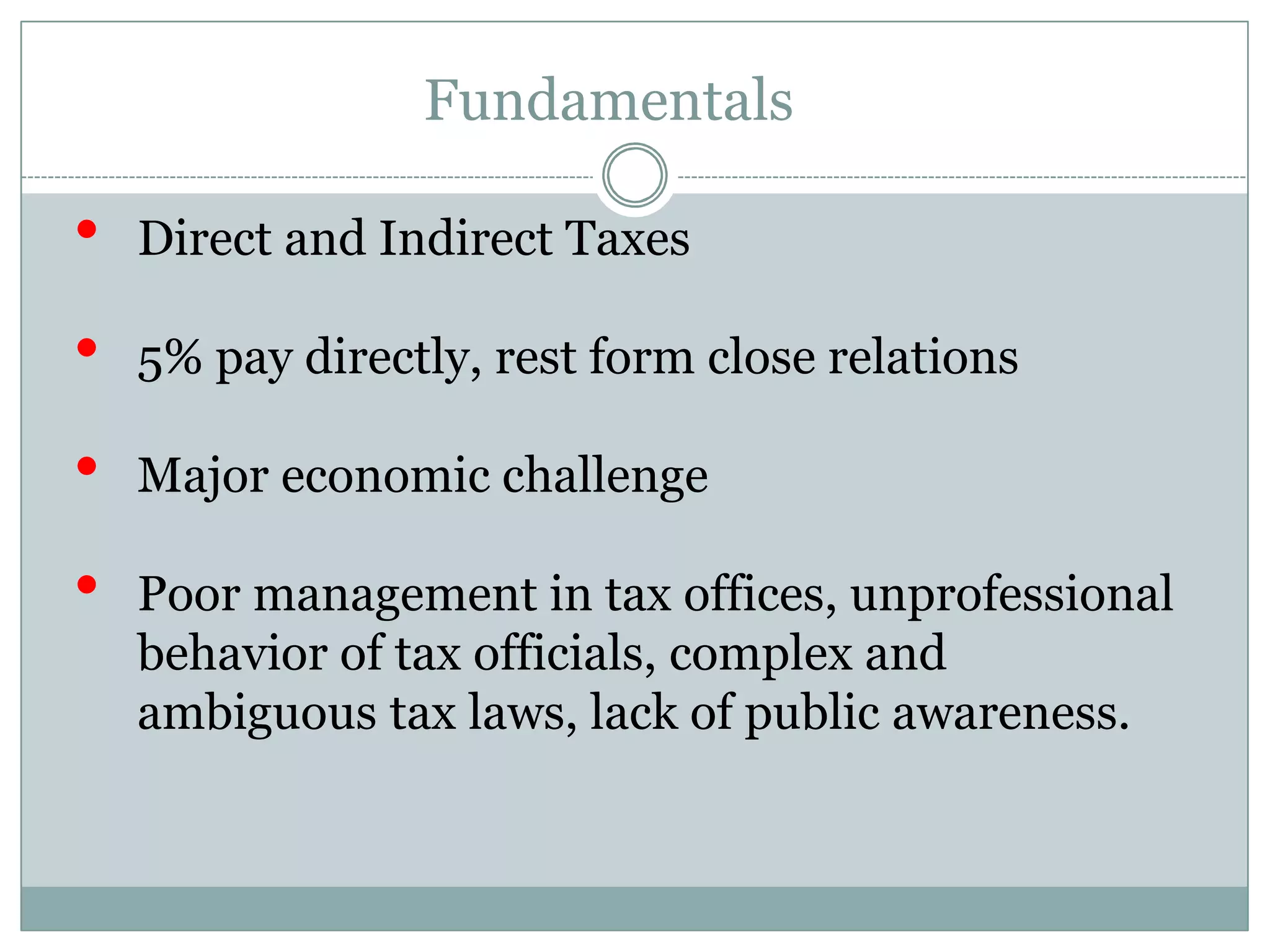
Fundamentals
• Direct and Indirect Taxes
• 5% pay directly, rest form close relations
• Major economic challenge
• Poor management in tax offices, unprofessional
behavior of tax officials, complex and
ambiguous tax laws, lack of public awareness.
Not only Public’s Fault
• Rising inflation
• 90% salaried
population
• Low salaries
• Less filers
• Deficit of
payments
• Financial aids
Tax Collection
• According to a survey by the Federal Board of Revenue
(FBR), Karachi is the highest tax-generating city.
• The tax collected from Karachi’s six major markets is
higher than the combined tax collected from Lahore,
Rawalpindi, Islamabad, and Faisalabad’s largest markets.
• the markets of Saddar, Tariq Road, Clifton, Golimar,
DHA collectively pay taxes of Rs30.87 billion.
• In contrast, Lahore’s four major markets paid Rs567
million in taxes, including Anarkali, Mall Road, Hafeez
Center, and Liberty Market.
• Islamabad’s major markets paid Rs1.93 billion in taxes.
Performance is low
• The important thing to consider here is that why the
businessmen of Liberty, Shah Alam, etc., which earn
millions of rupees every day, are reluctant to pay taxes?
• It is clear that the performance of tax collectors is much
worse and it needs to be improved.
• Comparing Pakistan’s tax system with that of
neighbouring India, 40 million Indians file income tax
returns (ITRs) every year.
• India has 6 times the population of Pakistan, then
Pakistan should have at least 6.2 million ITR filers, while
at present there are only 2.2 million
Avoidance
• India spends $70 billion annually on its people while
Pakistan spends $6 billion annually on the people.
• In terms of size, Pakistan should spend $ 12 billion a year
on its people.
• Similarly, by comparing to developed countries, it can be
seen that out of 330 million people in the United States,
142.3 million are filers.
Government performance
• Talking about the performance of the government, it can
be said that the existing dominated system of FBR has
failed to perform well in any area.
• That’s why tax reforms need to be introduced which will
increase the tax net through proper documentation while
reducing taxes on the formal sector.
• This will provide access to regular financing for the small
and medium enterprise (SME) sector, which is currently
only 5 per cent of the bank’s financing.
Conclusion
• Government should take notice of all of the departmental
issues and take the people into confidence.
• Government should take immediate and meaningful
steps to increase loans to the private sector through tax
incentives.
• Lending more to the private sector will also have a
multiplier effect on GDP growth.
• Implementing these reforms will enable Pakistan to
move on a new path towards a growing country which
can depend upon their taxes.
Taxation system in pakistan

Taxation system in pakistan

  • 3.
    P R ES E N T E D B Y MUHAMMAD JAWAD IRFAN & BASHAAR FAROOQ Tax Structure of Pakistan
  • 4.
    PAKISTAN’S TAX SYSTEMFACTS ⚫Imposing a financial charge by the state. ⚫ Complex system of more than 70 unique taxes administered by 37 agencies ⚫The tax system is outdated ⚫The government is seriously indebted
  • 6.
    Fundamentals • Direct andIndirect Taxes • 5% pay directly, rest form close relations • Major economic challenge • Poor management in tax offices, unprofessional behavior of tax officials, complex and ambiguous tax laws, lack of public awareness.
  • 7.
    Not only Public’sFault • Rising inflation • 90% salaried population • Low salaries • Less filers • Deficit of payments • Financial aids
  • 8.
    Tax Collection • Accordingto a survey by the Federal Board of Revenue (FBR), Karachi is the highest tax-generating city. • The tax collected from Karachi’s six major markets is higher than the combined tax collected from Lahore, Rawalpindi, Islamabad, and Faisalabad’s largest markets. • the markets of Saddar, Tariq Road, Clifton, Golimar, DHA collectively pay taxes of Rs30.87 billion. • In contrast, Lahore’s four major markets paid Rs567 million in taxes, including Anarkali, Mall Road, Hafeez Center, and Liberty Market. • Islamabad’s major markets paid Rs1.93 billion in taxes.
  • 9.
    Performance is low •The important thing to consider here is that why the businessmen of Liberty, Shah Alam, etc., which earn millions of rupees every day, are reluctant to pay taxes? • It is clear that the performance of tax collectors is much worse and it needs to be improved. • Comparing Pakistan’s tax system with that of neighbouring India, 40 million Indians file income tax returns (ITRs) every year. • India has 6 times the population of Pakistan, then Pakistan should have at least 6.2 million ITR filers, while at present there are only 2.2 million
  • 10.
    Avoidance • India spends$70 billion annually on its people while Pakistan spends $6 billion annually on the people. • In terms of size, Pakistan should spend $ 12 billion a year on its people. • Similarly, by comparing to developed countries, it can be seen that out of 330 million people in the United States, 142.3 million are filers.
  • 11.
    Government performance • Talkingabout the performance of the government, it can be said that the existing dominated system of FBR has failed to perform well in any area. • That’s why tax reforms need to be introduced which will increase the tax net through proper documentation while reducing taxes on the formal sector. • This will provide access to regular financing for the small and medium enterprise (SME) sector, which is currently only 5 per cent of the bank’s financing.
  • 12.
    Conclusion • Government shouldtake notice of all of the departmental issues and take the people into confidence. • Government should take immediate and meaningful steps to increase loans to the private sector through tax incentives. • Lending more to the private sector will also have a multiplier effect on GDP growth. • Implementing these reforms will enable Pakistan to move on a new path towards a growing country which can depend upon their taxes.