
Understanding Financials
Gener8! Business Ready in 8 Weeks
Financial Statements
• What are financial statements?
– Cash Flow Statement
– Income Statement (P&L)
– Balance Sheet
• Do you know what the statements
show?
• How do you use the statements to
start and manage your business?
Understanding Financials 2
Find An Accountant
• Seek an accountant to establish
accounting procedures
• Use software programs (such as
QuickBooks) available to do number
crunching
• Call San Antonio’s CPA Society for
reputable names of accounts who
understand your business type:
3Understanding Financials
Cash Flow Statements
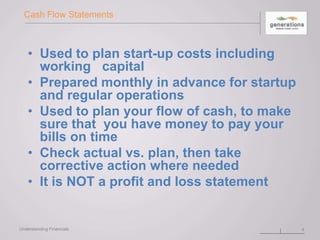
• Used to plan start-up costs including
working capital
• Prepared monthly in advance for startup
and regular operations
• Used to plan your flow of cash, to make
sure that you have money to pay your
bills on time
• Check actual vs. plan, then take
corrective action where needed
• It is NOT a profit and loss statement
4Understanding Financials
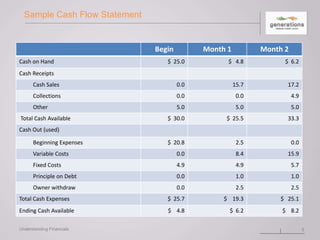
Sample Cash Flow Statement
5
Begin Month 1 Month 2
Cash on Hand $ 25.0 $ 4.8 $ 6.2
Cash Receipts
Cash Sales 0.0 15.7 17.2
Collections 0.0 0.0 4.9
Other 5.0 5.0 5.0
Total Cash Available $ 30.0 $ 25.5 33.3
Cash Out (used)
Beginning Expenses $ 20.8 2.5 0.0
Variable Costs 0.0 8.4 15.9
Fixed Costs 4.9 4.9 5.7
Principle on Debt 0.0 1.0 1.0
Owner withdraw 0.0 2.5 2.5
Total Cash Expenses $ 25.7 $ 19.3 $ 25.1
Ending Cash Available $ 4.8 $ 6.2 $ 8.2
Understanding Financials
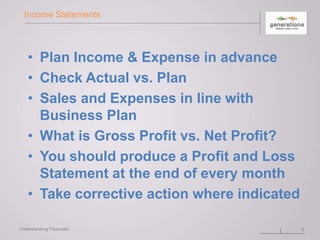
Income Statements
• Plan Income & Expense in advance
• Check Actual vs. Plan
• Sales and Expenses in line with
Business Plan
• What is Gross Profit vs. Net Profit?
• You should produce a Profit and Loss
Statement at the end of every month
• Take corrective action where indicated
6Understanding Financials
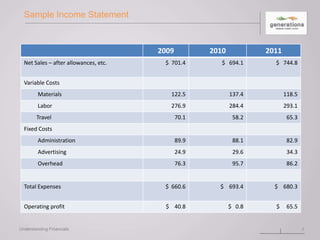
Sample Income Statement
7
2009 2010 2011
Net Sales – after allowances, etc. $ 701.4 $ 694.1 $ 744.8
Variable Costs
Materials 122.5 137.4 118.5
Labor 276.9 284.4 293.1
Travel 70.1 58.2 65.3
Fixed Costs
Administration 89.9 88.1 82.9
Advertising 24.9 29.6 34.3
Overhead 76.3 95.7 86.2
Total Expenses $ 660.6 $ 693.4 $ 680.3
Operating profit $ 40.8 $ 0.8 $ 65.5
Understanding Financials
Balance Sheets
• Assets = Liabilities + Capital
• Snapshot of the business. Tells the condition
of the business at a particular date.
• Periodic Balance Sheets give you a
continuing picture of the progress the
business is making. (Positive or Negative)
• How much you own. How much you owe.
• What are your Assets and Liabilities
• How much capital do you have in the
business.
• Produce at least quarterly.
8Understanding Financials
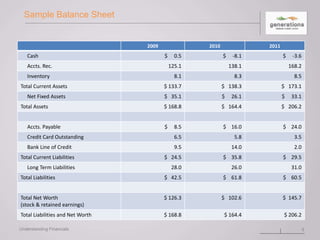
Sample Balance Sheet
9
2009 2010 2011
Cash $ 0.5 $ -8.1 $ -3.6
Accts. Rec. 125.1 138.1 168.2
Inventory 8.1 8.3 8.5
Total Current Assets $ 133.7 $ 138.3 $ 173.1
Net Fixed Assets $ 35.1 $ 26.1 $ 33.1
Total Assets $ 168.8 $ 164.4 $ 206.2
Accts. Payable $ 8.5 $ 16.0 $ 24.0
Credit Card Outstanding 6.5 5.8 3.5
Bank Line of Credit 9.5 14.0 2.0
Total Current Liabilities $ 24.5 $ 35.8 $ 29.5
Long Term Liabilities 28.0 26.0 31.0
Total Liabilities $ 42.5 $ 61.8 $ 60.5
Total Net Worth
(stock & retained earnings)
$ 126.3 $ 102.6 $ 145.7
Total Liabilities and Net Worth $ 168.8 $ 164.4 $ 206.2
Understanding Financials
How To Use Your Statements
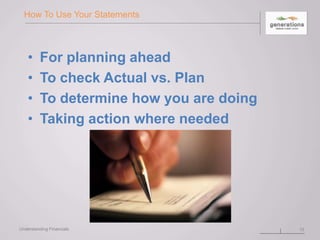
• For planning ahead
• To check Actual vs. Plan
• To determine how you are doing
• Taking action where needed
10Understanding Financials
Resources for QuickBooks & Accounting Software
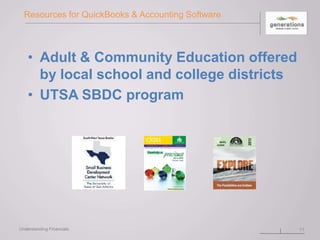
• Adult & Community Education offered
by local school and college districts
• UTSA SBDC program
11Understanding Financials
Get Connected & Learn More
Email us at: smallbiz@mygenfcu.org
Sign Up for our business classes
Connect with us via social where we talk personal and small
business tips to help you reach your money goals
www.genfcu.org

Understanding financials

  • 1.
  • 2.
    Financial Statements • Whatare financial statements? – Cash Flow Statement – Income Statement (P&L) – Balance Sheet • Do you know what the statements show? • How do you use the statements to start and manage your business? Understanding Financials 2
  • 3.
    Find An Accountant •Seek an accountant to establish accounting procedures • Use software programs (such as QuickBooks) available to do number crunching • Call San Antonio’s CPA Society for reputable names of accounts who understand your business type: 3Understanding Financials
  • 4.
    Cash Flow Statements •Used to plan start-up costs including working capital • Prepared monthly in advance for startup and regular operations • Used to plan your flow of cash, to make sure that you have money to pay your bills on time • Check actual vs. plan, then take corrective action where needed • It is NOT a profit and loss statement 4Understanding Financials
  • 5.
    Sample Cash FlowStatement 5 Begin Month 1 Month 2 Cash on Hand $ 25.0 $ 4.8 $ 6.2 Cash Receipts Cash Sales 0.0 15.7 17.2 Collections 0.0 0.0 4.9 Other 5.0 5.0 5.0 Total Cash Available $ 30.0 $ 25.5 33.3 Cash Out (used) Beginning Expenses $ 20.8 2.5 0.0 Variable Costs 0.0 8.4 15.9 Fixed Costs 4.9 4.9 5.7 Principle on Debt 0.0 1.0 1.0 Owner withdraw 0.0 2.5 2.5 Total Cash Expenses $ 25.7 $ 19.3 $ 25.1 Ending Cash Available $ 4.8 $ 6.2 $ 8.2 Understanding Financials
  • 6.
    Income Statements • PlanIncome & Expense in advance • Check Actual vs. Plan • Sales and Expenses in line with Business Plan • What is Gross Profit vs. Net Profit? • You should produce a Profit and Loss Statement at the end of every month • Take corrective action where indicated 6Understanding Financials
  • 7.
    Sample Income Statement 7 20092010 2011 Net Sales – after allowances, etc. $ 701.4 $ 694.1 $ 744.8 Variable Costs Materials 122.5 137.4 118.5 Labor 276.9 284.4 293.1 Travel 70.1 58.2 65.3 Fixed Costs Administration 89.9 88.1 82.9 Advertising 24.9 29.6 34.3 Overhead 76.3 95.7 86.2 Total Expenses $ 660.6 $ 693.4 $ 680.3 Operating profit $ 40.8 $ 0.8 $ 65.5 Understanding Financials
  • 8.
    Balance Sheets • Assets= Liabilities + Capital • Snapshot of the business. Tells the condition of the business at a particular date. • Periodic Balance Sheets give you a continuing picture of the progress the business is making. (Positive or Negative) • How much you own. How much you owe. • What are your Assets and Liabilities • How much capital do you have in the business. • Produce at least quarterly. 8Understanding Financials
  • 9.
    Sample Balance Sheet 9 20092010 2011 Cash $ 0.5 $ -8.1 $ -3.6 Accts. Rec. 125.1 138.1 168.2 Inventory 8.1 8.3 8.5 Total Current Assets $ 133.7 $ 138.3 $ 173.1 Net Fixed Assets $ 35.1 $ 26.1 $ 33.1 Total Assets $ 168.8 $ 164.4 $ 206.2 Accts. Payable $ 8.5 $ 16.0 $ 24.0 Credit Card Outstanding 6.5 5.8 3.5 Bank Line of Credit 9.5 14.0 2.0 Total Current Liabilities $ 24.5 $ 35.8 $ 29.5 Long Term Liabilities 28.0 26.0 31.0 Total Liabilities $ 42.5 $ 61.8 $ 60.5 Total Net Worth (stock & retained earnings) $ 126.3 $ 102.6 $ 145.7 Total Liabilities and Net Worth $ 168.8 $ 164.4 $ 206.2 Understanding Financials
  • 10.
    How To UseYour Statements • For planning ahead • To check Actual vs. Plan • To determine how you are doing • Taking action where needed 10Understanding Financials
  • 11.
    Resources for QuickBooks& Accounting Software • Adult & Community Education offered by local school and college districts • UTSA SBDC program 11Understanding Financials
  • 12.
    Get Connected &Learn More Email us at: smallbiz@mygenfcu.org Sign Up for our business classes Connect with us via social where we talk personal and small business tips to help you reach your money goals www.genfcu.org