Net Income indicator 1,305,162
Cash Flow indicator
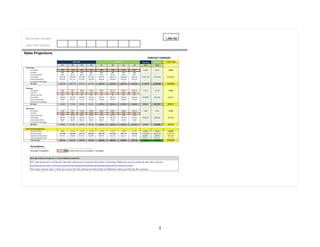
Sales Projections
Year One Year Two Year One Year Two 2-Year Total Year One Year Two
Q1 Q2 Q3 Q4 Q1 Q2 Q3 Q4 Total Total 1 2 3 4 5 6 7 8
Ticket Sales slope
Unit Volume 4800 5380 5784 6362 6998 7695 8466 9315 22,326 32,474 54,800 $668 $5,380 $5,784 $6,362 $6,998 $7,695 $8,466 $9,315 $8,647 7 1,235.29
Unit Price $65 $65 $65 $65 $65 $65 $65 $65 - - Q2 vs. Q1 Q3 vs. Q2 Q4 vs. Q3 Q1 vs. Q4 Q2 vs. Q1 Q3 vs. Q2 Q4 vs. Q3
Cost per Unit Sold $0.03 $0.03 $0.03 $0.03 $0.03 $0.03 $0.03 $0.03 - - 12% 8% 10% 10% 10% 10% 10%
Gross Sales $312,000 $349,700 $375,960 $413,530 $454,870 $500,175 $550,290 $605,475 $1,451,190 $2,110,810 $3,562,000 LINEST SLOPE L/S
(Cost of Goods Sold) $144.00 $161.40 $173.52 $190.86 $209.94 $230.85 $253.98 $279.45 Sales growing over time? 1 980.095238095238 1,235 1
(Commission Percentage) 15% 15% 15% 15% 15% 15% 15% 15% - - 94% overall rate
Net Sales $265,078 $297,108 $319,419 $351,338 $386,461 $424,953 $467,531 $514,416 $1,232,942 $1,793,360 $3,026,303 points for this dynamic (allocation) 25%
your growth points 25%
Beverages
Unit Volume 3120 3497 3759.6 4135.3 4548.7 5001.75 5502.9 6054.75 14,512 21,108 35,620 Perfectly Exponential L/S = 2
Unit Price $8 $8 $9 $9 $10 $10 $10 $10 - Perfectly Linear L/S = 1
Cost per Unit Sold $3 $3 $3 $3 $3 $3 $3 $3 - This Forecast L/S = 0.79
Gross Sales $24,960 $27,976 $33,836 $37,218 $45,487 $50,018 $55,029 $60,548 $123,990 $211,081 $335,071 As a proportion out of 100% 40%
(Cost of Goods Sold) $9,360 $10,491 $11,279 $12,406 $13,646 $15,005 $16,509 $18,164 points for this dynamic (allocation) 75%
(Commission Percentage) 0% 0% 0% 0% 0% 0% 0% 0% - - - your growth points 30%
Net Sales $15,600 $17,485 $22,558 $24,812 $31,841 $35,012 $38,520 $42,383 $80,454 $147,757 $228,211
YOUR TOTAL POINTS % 55%
Merchandise Total Points Possible 10
Unit Volume 1440 1614 1735.2 1908.6 2099.4 2308.5 2539.8 2794.5 6,698 9,742 16,440 Your Total Points 5
Unit Price $25 $25 $25 $25 $30 $30 $30 $35 - - -
Cost per Unit Sold $3.25 $3.25 $3.25 $3.25 $3.25 $3.25 $3.25 $3.25 - - -
Gross Sales $36,000 $40,350 $43,380 $47,715 $62,982 $69,255 $76,194 $97,808 $167,445 $306,239 $473,684
(Cost of Goods Sold) $4,680 $5,246 $5,639 $6,203 $6,823 $7,503 $8,254 $9,082
(Commission Percentage) 50% 50% 50% 50% 50% 50% 50% 50% - - -
Net Sales $15,660 $17,552 $18,870 $20,756 $28,079 $30,876 $33,970 $44,363 $72,839 $137,288 $210,127
Total: All Products/Services
Total Unit Volume 9,360 10,491 11,279 12,406 13,646 15,005 16,509 18,164 43,536 63,324 106,860
Total Gross Sales $372,960 $418,026 $453,176 $498,463 $563,339 $619,448 $681,513 $763,830 $1,742,625 $2,628,130 $4,370,755
(Total Cost of Goods Sold) $14,184 $15,898 $17,092 $18,800 $20,679 $22,739 $25,017 $27,526 $65,973 $95,961 $161,934
(Total Commissions Paid) $62,438 $69,983 $75,238 $82,757 $96,278 $105,868 $116,475 $135,142 $290,417 $453,764 $744,180
Total Net Sales $296,338 $332,145 $360,846 $396,906 $446,381 $490,841 $540,021 $601,162 $1,386,235 $2,078,405 $3,464,640
Assumptions:
Merchanside (locked) 30% of ticket buyers buy merchandise
Beverages (changeable) 65% of ticket buyers buy an average of 1 beverages
Beverage Industry Average for U.S. Bar & Nightclub (es
ti
mate)
65% order drinks most to all the time with males ordering more frequently than females. Surprisingly, Millennials order less frequently than older consumers
The average consumer order 2.3 drinks per occasion with males ordering more than females and Millennials ordering more than the older consumers.
FORECAST SUMMARY
1
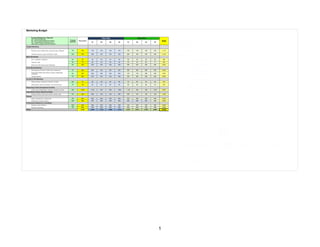
Marketing Budget
Purpose/Strategy Key: (Optional)
PB: Personal Branding
BA: Brand Awareness/Brand Building
SP: Product/Service Sampling, Trial
L&R: Brand Loyalty/Customer Rewards
Purpose
(optonal)
Pre-Launch
Year One Year Two
Total
Q1 Q2 Q3 Q4 Q1 Q2 Q3 Q4 Variance
108,888
Tangible Marketing Quartile (1st) 100
Brochures, flyers, Mobile signs, bus/metro signs, billboards PB 200 150 150 155 150 160 150 150 150 1,415 Quartile (3rd) 350 1,415
Samples, premiums, logo merchandise, "swag" L&R 300 300 350 350 400 280 300 400 450 3,130 Difference 250 3,130
Media Advertising
Print: newspaper, magazines BA 60 50 50 50 55 55 55 55 60 490 Dispersion 8% 490
Television, radio SP 70 60 50 50 50 50 50 50 0 430 430
Banner Ads, Paid Search Engine Marketing BA 200 200 200 300 350 350 200 200 200 2,200 Percent of 60% 14%
Social Media Marketing Point Multiplier
Paid Facebook promotions, Twitter ads, Linkedin ads SP 800 500 550 550 550 550 580 580 600 5,260 Dispersion Total Points 2.5 5,260
Social media contests, Deal-of-the-day: Groupon, Google Offers,
LivingSocial BA 350 500 350 350 200 100 150 250 300 2,550
Your Dispersion Points 2,550
Tweetups, Meetups SP 650 350 300 300 300 250 250 250 250 2,900 2,900
Guerilla & Viral Marketing Fewer than 6 types? FALSE
Sticker bombing, flyposting, Flashmobs, streetart BA 70 50 50 55 55 70 50 55 55 510 Point Multiplier 0% 510
Street teams, campus promotions, Crowd-sourced ads SP 100 90 80 80 80 90 80 85 75 760
Category Focus Total Points 2.5 760
Networking & Client Development Activities Your Focus Points Multiplier 46%
Launch party, Memberships, meetings, Entertaining Clients L&R 3,000 1,100 400 400 1,500 1,100 400 400 1,500 9,800 Your Focus Points 9,800
Trade Shows, Events, Street Promotions
Wrapped vehicles, food trucks, booths, exhibits, signs PB 200 250 100 100 250 250 100 100 100 1,250 Total Points / Component 1,250
Website
Design, development, programming PB 600 500 400 300 250 400 250 250 250 5,700
Maintenance, hosting, domains L&R 300 300 300 300 300 250 250 250 250 2,500 2,500
Professional Assistance & Consultants
Marketing, Public Relations L&R 600 450 450 300 300 320 400 430 355 3,605 3,605
Branding, Advertising PB 600 350 350 350 350 200 250 250 300 2,400
TOTAL 8,100 5,200 4,130 3,990 5,140 4,475 3,515 3,755 4,895 43,200 43,200
Categories of
Marketing
Utilized 14
Difference from Budget Amount
Percent of
Budget Spent Component Points
Your
Deduct Your Points
$0 100% 5 500% 500%
Budget Completed? TRUE 10 10
1
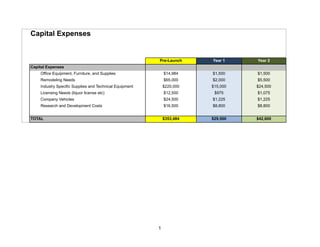
Capital Expenses
Pre-Launch Year 1 Year 2
Capital Expenses
Office Equipment, Furniture, and Supplies $14,984 $1,500 $1,500
Remodeling Needs $65,000 $2,000 $5,500
Industry Specific Supplies and Technical Equipment $220,000 $15,000 $24,500
Licensing Needs (liquor license etc) $12,500 $975 $1,075
Company Vehicles $24,500 $1,225 $1,225
Research and Development Costs $16,500 $8,800 $8,800
TOTAL $353,484 $29,500 $42,600
1
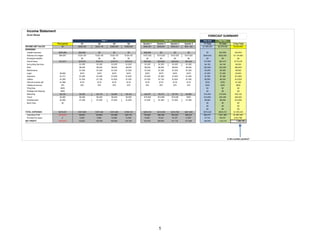
Income Statement
2Live Venue
Year 1 Year Two Year One Year Two
Pre-Launch Q1 Q2 Q3 Q4 Quarter 1 Quarter 2 Quarter 3 Quarter 4 Y1 Total Y2 Total 2-Year Total
INCOME (NET SALES) $0 $296,338 $332,145 $360,846 $396,906 $446,381 $490,841 $540,021 $601,162 $1,386,235 $2,078,405 $3,464,640
EXPENSES
Capital expenses $353,484 $29,500 $0 $0 $0 $42,600 $0 $0 $0 $0 $42,600 $42,600
Salaries and wages $84,067 $126,100 $126,100 $126,100 $126,100 $157,625 $157,625 $157,625 $157,625 $504,400 $630,500 $1,134,900
Employee benefits $0 $0 $0 $0 $0 $0 $0 $0 $0 $0 $0
Payroll taxes $12,610 $18,915 $18,915 $18,915 $18,915 $23,644 $23,644 $23,644 $23,644 $75,660 $94,575 $170,235
Accounting Services $1,025 $1,025 $1,025 $1,025 $1,025 $1,025 $1,025 $1,025 $4,100 $4,100 $8,200
Rent $8,000 $8,000 $8,000 $8,000 $8,000 $8,000 $8,000 $8,000 $32,000 $32,000 $64,000
Maintenance $1,000 $1,000 $1,000 $1,000 $1,000 $1,000 $1,000 $1,000 $4,000 $4,000 $8,000
Legal $9,000 $375 $375 $375 $375 $375 $375 $375 $375 $1,500 $1,500 $3,000
Insurance $1,217 $1,825 $1,825 $1,825 $1,825 $1,825 $1,825 $1,825 $1,825 $7,300 $7,300 $14,600
Utilities $1,000 $1,500 $1,700 $1,800 $1,500 $1,500 $1,700 $1,800 $1,500 $6,500 $6,500 $13,000
Internet & public wifi $1,995 $175 $175 $175 $175 $175 $175 $175 $175 $700 $700 $1,400
Telephone service $75 $75 $75 $75 $75 $75 $75 $75 $75 $300 $300 $600
Filing fees $450 $0 $0 $0
Postage and shipping $250 $0 $0 $0
Marketing $8,100 $5,200 $4,130 $3,990 $5,140 $4,475 $3,515 $3,755 $4,895 $18,460 $16,640 $35,100
Travel $2,500 $2,500 $2,500 $2,500 $2,500 $10,000 $10,000 $10,000 $300 $10,000 $30,300 $40,300
Entertainment $3,500 $1,500 $1,500 $1,500 $1,500 $1,500 $1,500 $1,500 $1,500 $6,000 $6,000 $12,000
Bank Fees $0 $0 $0 $0
$0 $0 $0
$0 $0 $0
TOTAL EXPENSES $478,247 $197,690 $167,320 $167,280 $168,130 $253,819 $210,459 $210,799 $201,939 $670,920 $834,415 $1,505,335
Operating Profit (478,247) 98,648 164,825 193,566 228,776 192,563 280,382 329,222 399,223 685,815 1,201,390 $1,887,205
Provision for taxes 0 5,426 9,065 10,646 12,583 10,591 15,421 18,107 21,957 37,720 66,076 $103,796
NET PROFIT (478,247) 93,222 155,760 182,920 216,193 181,972 264,961 311,115 377,266 169,848 1,135,314 1,305,162
Is this number posi
ti
ve?
FORECAST SUMMARY
1
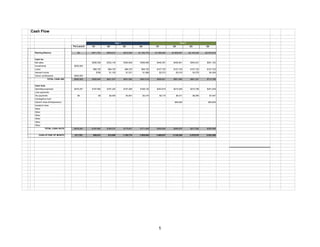
Cash Flow
Year 1 Year 2
Pre-Launch Q1 Q2 Q3 Q4 Q1 Q2 Q3 Q4
Starting Balance $0 $471,753 $659,912 $912,509 $1,192,770 $1,508,945 $1,809,637 $2,145,349 $2,579,578
Cash Ins
Net sales $296,338 $332,145 $360,846 $396,906 $446,381 $490,841 $540,021 $601,162
Investments $550,000
Loans $88,725 $88,725 $88,725 $88,725 $107,725 $107,725 $107,725 $107,725
Interest income $786 $1,100 $1,521 $1,988 $2,515 $3,016 $3,576 $4,299
Owner contributions $400,000
TOTAL CASH INS $950,000 $385,849 $421,970 $451,092 $487,619 $556,621 $601,582 $651,321 $713,186
Cash Outs
Operating expenses $478,247 $197,690 $167,320 $167,280 $168,130 $253,819 $210,459 $210,799 $201,939
Loan payments
Tax payments $0 $0 $2,052 $3,551 $3,315 $2,110 $5,411 $6,293 $7,457
Contingency fund
Owner's draw (Entrepreneur) $50,000 $50,000
Investor's draw
Other:
Other:
Other:
Other:
Other:
Other:
TOTAL CASH OUTS $478,247 $197,690 $169,372 $170,831 $171,445 $255,929 $265,870 $217,092 $259,396
CASH AT END OF MONTH 471,753 659,912 912,509 1,192,770 1,508,945 1,809,637 2,145,349 2,579,578 3,033,368
1
Capital Investment
aka "Shark Tank" Page
Investor Name Investment Amount ($) Equity Offered (%)
Private Investor $550,000 20%
Owner Name Contribution Amount ($) Equity Retained (%)
Owner $400,000 80%
TOTAL INVESTMENTS Total Capital Raised EQUITY OWNERSHIP
%
Outside Investors $550,000 20%
Owners $400,000 80%
TOTAL $950,000 100%
The Total Investment Amount (Capital) should be
the amount of the largest negative number on your
Cash Flow Statement (the amount of cash you need
to eliminate any and all negative cash balances
throughout the two years while your business is
breaking even.
Are you raising capital from an investor? If so, enter the amount you'll
need from them here. Then enter the percentage of your company
you're willing to give up in exchange.
If you choose to raise smaller amounts of capital with crowdfunding
donations, remember that the $ is donated and no equity % is given
away.
START HERE and decide how much of the total will come from your
own money. This sends a positive psychological signal to investors
that you believe in your idea. In addition, these sharks assume that
the more money you invested, the harder you will work to make the
business a success.
COME BACK LATER and enter the amount of equity you own, after
you've decided how much equity you'll be giving up to an investor.
This Capital Investment page SHOULD NOT BE COMPLETED UNTIL AFTER you have successfully achieved Goal #1 -
having already completed Sales Projections and spent your total Marketing Budget.
Now you're ready to achieve Goal #2 and finish this assignment.
Goal #2 is as follows: Ensure your new business will not run out of cash while you are trying to make it profitable.
Where do you go to monitor the cash position of your entertainment business and ensure that it will have
sufficient cash over the entire two-year forecast period? To the Cash Flow Statement! It's like a bank savings
account balance and you should treat it as such.
By the time you're done with your forecast, there cannot be even a single negative end-of-period balance on your
Cash Flow Statement.
How do you modify the Cash Flow Statement? Well, technically you won't change that. You'll be modifying this
page [Capital Investment], by entering a Shark-Tank-style venture pitch OFFER.
IT'S A TRIAL-AND-ERROR PROCESS, and you'll want to click back and forth from this Capital Investment page to
your Cash Flow Statement, and continue to make changes until you successfully reach Goal #2.
Notice that this page has a space for your (the owner/entrepreneur) up-front contribution to the venture - as
well as how much money you need from an investor.
One of the first questions routinely asked by a "Shark Tank" Investor is "How much money have you put into your
own business?"
Enter the amount you'll need from them in the "Contribution Amount" cell. Then enter the percentage of your
company you're willing to give up in exchange, and the remainder percentage leftover needs to be entered, so that
the Total under the "Equity Ownership" is equal to 100%.
On this page you will need to show an offer that includes both an Investment Amount as well as the Owner
Contribution, just like you would in a "Shark Tank" pitch.
The most important reasons you should develop a financial forecast for your startup is both to prove it to yourself
that you have a profitable ("viable") business model, and also To Discover, with a great deal of confidence, HOW
MUCH MONEY this business model needs / requires up-front, from an outside sourece, so that The Total
Investment Amounts from an Investor plus The Total Contribution from You (the owner/entrepreneur) will ADD
TOGETHER and TOTAL THE EXACT AMOUNT OF THE SHORTFALL on your Cash-Flow Statement.
In other words, the TOTAL CAPITAL RAISED on this page must be sufficiently large enough to completely eliminate
the shortfall you most likely had, at the moment you completed Goal #1. Once Goal #2 is reached, the business will
1
In other words, the TOTAL CAPITAL RAISED on this page must be sufficiently large enough to completely eliminate
the shortfall you most likely had, at the moment you completed Goal #1. Once Goal #2 is reached, the business will
be "Cash-Flow Positive" as evidenced by the bottom line of your Cash-Flow Statement.
2
Financial Forecasting Assignment Capital Investments Analysis
Investm Equity
OVERALL POINTS BY CATEGORY Your Score Possible Y O U R O F F Amount Offered
Marke
ti
ng 20 INVESTOR 550,000 20%
Sales Projec
ti
ons 15 20 OWNER 400,000 80%
Income Statement 20 20 Total Capital Invested 950,000 100%
Cash Flow Statement 18 20
Capital Investments 16 20 Implied Valuation (based on this offer)
2,750,000
Price-to-Sales
Ra
ti
o
Forecasted "Normal" Sales (Year 2)
2,078,405
= 1.3
Your Score / Total Possible 100
1
POINTS BY OBJECTIVE Your Score Possible
Goal #1: Pro
fi
table within two years 20 20
Goal #2: Cash
fl
ow posi
ti
ve 18 20
Sales projec
ti
ons calculated correctly 10 10
Realis
ti
c growth pa
tt
ern in sales 5 10
Marke
ti
ng budget was completed 10 10
Marke
ti
ng budget spent en
ti
rely 500% 5
Marke
ti
ng is targeted 5
All ownership shown 8 10
Reasonable capital raised/valua
ti
on 8 10
Your Score / Total Possible 100
Your Ticket Sales Forecast: Tickets Sold
Quarterly
Growth
1 4800
2 5380 12%
3 5784 8%
4 6362 10%
5 6998 10%
6 7695 10%
7 8466 10%
8 9315 10%
0
2500
5000
7500
10000
1 2 3 4 5 6 7 8
9,315
8,466
7,695
6,998
6,362
5,784
5,380
4,800
1
<h1><strong>Financial Forecas
ti
ng Assignment
</strong></h1>
Thanks for submi
tti
ng your forecast. This was a challenging assignment. Please review the following info regarding the grade you received and feel free to contact me with any ques
ti
ons!
<br>
<img src="h
tt
ps://assethub.fso.fullsail.edu/assethub/graph2icon_4b662179-8894-4f63-b670-04ee23e1c679.png" style="width: 226px;">
<br><br><table><tr><td><strong>
OVERALL POINTS BY CATEGORY
</td><td><strong>
Your Score
</td><td><strong>
Possible </b></strong></td>
<tr><td><b style="color:#0063a1">
Marke
ti
ng <td style="text-align: center;">
<td style="text-align: center;">
20 </td>
<tr><td><b style="color:#0063a1">
Sales Projec
ti
ons <td style="text-align: center;">
15 <td style="text-align: center;">
20 </td>
<tr><td><b style="color:#0063a1">
Income Statement <td style="text-align: center;">
20 <td style="text-align: center;">
20 </td>
<tr><td><b style="color:#0063a1">
Cash Flow Statement <td style="text-align: center;">
18 <td style="text-align: center;">
20 </td>
<tr><td><b style="color:#0063a1">
Capital Investments <td style="text-align: center;">
16 <td style="text-align: center;">
20 </td>
<tr><td> -------------------------------------------------------
<td style="text-align: center;">
---------- <td style="text-align: center;">
---------- </td>
<tr><td><strong><mark>
Your Score / Total Possible
<td style="text-align: center;"><strong><mark>
100 </td></strong></table>
<br><br>
<table><tr><td><strong>
POINTS BY OBJECTIVE
</td><td><strong>
Your Score
</td><td><strong>
Possible </b></strong></td>
<tr><td><b style="color:#0063a1">
Goal #1: Pro
fi
table within two years
<td style="text-align: center;">
20 <td style="text-align: center;">
20 </td>
<tr><td><b style="color:#0063a1">
Goal #2: Cash
fl
ow posi
ti
ve
<td style="text-align: center;">
18 <td style="text-align: center;">
20 </td>
<tr><td><b style="color:#0063a1">
Sales projec
ti
ons calculated correctly
<td style="text-align: center;">
10 <td style="text-align: center;">
10 </td>
<tr><td><b style="color:#0063a1">
Realis
ti
c growth pa
tt
ern in sales
<td style="text-align: center;">
5 <td style="text-align: center;">
10 </td>
<tr><td><b style="color:#0063a1">
Marke
ti
ng budget was completed
<td style="text-align: center;">
10 <td style="text-align: center;">
10 </td>
<tr><td><b style="color:#0063a1">
marke
ti
ng budget spent en
ti
rely
<td style="text-align: center;">
5 <td style="text-align: center;">
5 </td>
<tr><td><b style="color:#0063a1">
Marke
ti
ng is targeted <td style="text-align: center;">
<td style="text-align: center;">
5 </td>
<tr><td><b style="color:#0063a1">
All ownership shown <td style="text-align: center;">
8 <td style="text-align: center;">
10 </td>
<tr><td><b style="color:#0063a1">
Reasonable capital raised/valua
ti
on
<td style="text-align: center;">
8 <td style="text-align: center;">
10 </td>
<tr><td> -------------------------------------------------------
<td style="text-align: center;">
---------- <td style="text-align: center;">
---------- </td>
<tr><td><strong>
Your Score / Total Possible
<td style="text-align: center;"><strong>
100 </strong></td></b></table>
<div class="editor-embedded-media"><img src="https://fso-lms4-mortal-assets.s3.amazonaws.com/public/599/20178/7dec8ec0-6c85-4a65-9bf8-fb6b8241edea-7a92413e-4ebc-44ac-9822-b4144ba57630/inside-the-shark-tank-
fi
ght-that-caused-3-investors-to-storm-off-the-set.jpg" class="inline-media"></div><p><br></p>
<p>Notice how it's still mostly a straight line? This is because you need to increase the increase between each quarter. Let's say you start out with a 60% of capacity, and you chose 65% for
the second quarter. For the third quarter, don't increase this by another 5%, but increase the increase by say 8%. This would be 65% + 8% = 73% Then, for the fourth quarter, you'd want to
jump up by say, 12% to 85%, then you'd have room for a jump to 100%, and you could repeat the 100% a couple times until you get through the whole two years forecast period.&nbsp;</p>
<p>So the growth pattern I just described would be un upward-sloping CURVE. Since this is how many living things in our universe grow, it is a realistic pattern to use when forecasting the
sales of a new business, or believe it or not you could even use it to model the fees someone would earn from advertising on Youtube using a video that is expected to "go viral."</p>
<p><strong><span class="redactor__highlighted-text">Why does this really matter anyway? </span></strong><em>Great question</em>.. I'm glad you asked! We can find the answer to
this by combining these two growth patterns together and looking at the interference pattern (I mean the point of intersection between both curves and the zone before it and the zone
after it):&nbsp;</p>
<p>Sales Projections - although there is now a very clear upward trend in sales (growth over time), to be more realistic, you'd need to
increase the jump between quarterly percentage-of-capacity numbers. Your current growth pattern in sales is as follows:</p>
INSERT SCREENSHOT OF STUDENT'S SALES GROWTH CHART
div class="editor-rendered-content editor-embedded-media"><figure><img src="https://fso-lms4-mortal-assets.s3.amazonaws.com/
public/599/2022_7_20/a4d728c7-471c-4326-b685-a6f372957648/EXPONENTIALCURVEvsSTRAIGHTLINE.png" class="inline-media"
data-image="ansoa1m7x423"></figure></div>
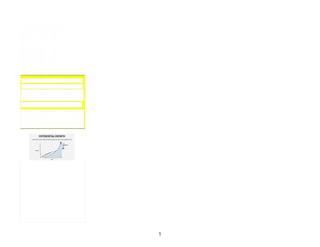
<p>If you simply use a straight line, and you were to superimpose a realistic upward sloping curve on top of your straight line, then you would notice ONE POINT&nbsp;where these shapes cross. This crossing creates
TWO ZONES , one in the beginning and one closer to the end. That's because the growth in sales of a startup business typically takes <em>a while longer </em>to seem / feel like it's increasing very much.&nbsp;</p>
<p><em>But later on during the forecast period</em>, <em>that same upward sloping curve </em>becomes <u>steep enough </u>that it crosses the straight line and after this second crossing, gets so amazingly steep
that it appears to almost go straight up to the Moon. During the later stage of startup, the actual growth in sales will exceed your original straight-line forecast.&nbsp;</p>
<p>The lesson is as follows:&nbsp;<u> to forecast a straight line growth in sales </u>is <em>to end up being WRONG about what will happen, <u>twice in a row</u>: first <strong>near the beginning</strong> and
second <strong>near the end</strong><strong>.</strong></em> During the first several forecast periods, it will seem as if actual results are underperforming expectations. <strong>Likewise, near the end of the forecast
period, the upward-sloping curve will greatly outperform a straight line forecast.&nbsp;&nbsp;</strong></p>
<p><strong>&nbsp;&nbsp;<br></strong></p>
<p><strong>Why is that point super important?&nbsp;</strong> Now, if you bring in an entrepreneurial mindset to a straight-line forecast, <strong>what happens could be life-changing</strong>.&nbsp;</p>
<p>&nbsp;</p>
<p>I first learned this insight from Ray Kurzweil, who now is in charge of all Artificial Intelligence projects at Google (Alphabet). Ray invented the first realistic keyboard sample of a real grand piano, and turned it into a
keyboard: the Kurzweil K2500. This was the first sampling keyboard I ever purchased and still own it today!&nbsp;</p>
<p><strong>&nbsp;</strong></p>
<p><strong>Now for the insight:</strong>&nbsp;<span class="redactor__highlighted-text">Most people become discouraged after experiencing&nbsp; several business quarters in a row that seem to be under-
performing your straight line forecast.</span> So what do they do? They tend to quit. <strong>But they quit too early, not understanding the nature of growth and how it is exponential. </strong>If they knew before
starting such a business that it will take longer than they think, <strong>but eventually they will see a business that grows far in excess of what they forecasted, this would hopefully be quite encouraging.&nbsp;</
strong>Such an insight might just be enough to prevent entrepreneurs from giving up too early.&nbsp;<strong>Every entrepreneur and investor should understand this insight. It might just keep them from walking away
and losing everything they worked so hard for.</strong></p>
<p><br></p>
<p></p>
1

Financial Forecasting

  • 1.
    Net Income indicator1,305,162 Cash Flow indicator Sales Projections Year One Year Two Year One Year Two 2-Year Total Year One Year Two Q1 Q2 Q3 Q4 Q1 Q2 Q3 Q4 Total Total 1 2 3 4 5 6 7 8 Ticket Sales slope Unit Volume 4800 5380 5784 6362 6998 7695 8466 9315 22,326 32,474 54,800 $668 $5,380 $5,784 $6,362 $6,998 $7,695 $8,466 $9,315 $8,647 7 1,235.29 Unit Price $65 $65 $65 $65 $65 $65 $65 $65 - - Q2 vs. Q1 Q3 vs. Q2 Q4 vs. Q3 Q1 vs. Q4 Q2 vs. Q1 Q3 vs. Q2 Q4 vs. Q3 Cost per Unit Sold $0.03 $0.03 $0.03 $0.03 $0.03 $0.03 $0.03 $0.03 - - 12% 8% 10% 10% 10% 10% 10% Gross Sales $312,000 $349,700 $375,960 $413,530 $454,870 $500,175 $550,290 $605,475 $1,451,190 $2,110,810 $3,562,000 LINEST SLOPE L/S (Cost of Goods Sold) $144.00 $161.40 $173.52 $190.86 $209.94 $230.85 $253.98 $279.45 Sales growing over time? 1 980.095238095238 1,235 1 (Commission Percentage) 15% 15% 15% 15% 15% 15% 15% 15% - - 94% overall rate Net Sales $265,078 $297,108 $319,419 $351,338 $386,461 $424,953 $467,531 $514,416 $1,232,942 $1,793,360 $3,026,303 points for this dynamic (allocation) 25% your growth points 25% Beverages Unit Volume 3120 3497 3759.6 4135.3 4548.7 5001.75 5502.9 6054.75 14,512 21,108 35,620 Perfectly Exponential L/S = 2 Unit Price $8 $8 $9 $9 $10 $10 $10 $10 - Perfectly Linear L/S = 1 Cost per Unit Sold $3 $3 $3 $3 $3 $3 $3 $3 - This Forecast L/S = 0.79 Gross Sales $24,960 $27,976 $33,836 $37,218 $45,487 $50,018 $55,029 $60,548 $123,990 $211,081 $335,071 As a proportion out of 100% 40% (Cost of Goods Sold) $9,360 $10,491 $11,279 $12,406 $13,646 $15,005 $16,509 $18,164 points for this dynamic (allocation) 75% (Commission Percentage) 0% 0% 0% 0% 0% 0% 0% 0% - - - your growth points 30% Net Sales $15,600 $17,485 $22,558 $24,812 $31,841 $35,012 $38,520 $42,383 $80,454 $147,757 $228,211 YOUR TOTAL POINTS % 55% Merchandise Total Points Possible 10 Unit Volume 1440 1614 1735.2 1908.6 2099.4 2308.5 2539.8 2794.5 6,698 9,742 16,440 Your Total Points 5 Unit Price $25 $25 $25 $25 $30 $30 $30 $35 - - - Cost per Unit Sold $3.25 $3.25 $3.25 $3.25 $3.25 $3.25 $3.25 $3.25 - - - Gross Sales $36,000 $40,350 $43,380 $47,715 $62,982 $69,255 $76,194 $97,808 $167,445 $306,239 $473,684 (Cost of Goods Sold) $4,680 $5,246 $5,639 $6,203 $6,823 $7,503 $8,254 $9,082 (Commission Percentage) 50% 50% 50% 50% 50% 50% 50% 50% - - - Net Sales $15,660 $17,552 $18,870 $20,756 $28,079 $30,876 $33,970 $44,363 $72,839 $137,288 $210,127 Total: All Products/Services Total Unit Volume 9,360 10,491 11,279 12,406 13,646 15,005 16,509 18,164 43,536 63,324 106,860 Total Gross Sales $372,960 $418,026 $453,176 $498,463 $563,339 $619,448 $681,513 $763,830 $1,742,625 $2,628,130 $4,370,755 (Total Cost of Goods Sold) $14,184 $15,898 $17,092 $18,800 $20,679 $22,739 $25,017 $27,526 $65,973 $95,961 $161,934 (Total Commissions Paid) $62,438 $69,983 $75,238 $82,757 $96,278 $105,868 $116,475 $135,142 $290,417 $453,764 $744,180 Total Net Sales $296,338 $332,145 $360,846 $396,906 $446,381 $490,841 $540,021 $601,162 $1,386,235 $2,078,405 $3,464,640 Assumptions: Merchanside (locked) 30% of ticket buyers buy merchandise Beverages (changeable) 65% of ticket buyers buy an average of 1 beverages Beverage Industry Average for U.S. Bar & Nightclub (es ti mate) 65% order drinks most to all the time with males ordering more frequently than females. Surprisingly, Millennials order less frequently than older consumers The average consumer order 2.3 drinks per occasion with males ordering more than females and Millennials ordering more than the older consumers. The average consumer order 2.3 drinks per occasion with males ordering more than females and Millennials ordering more than the older consumers. FORECAST SUMMARY 1
  • 2.
    Marketing Budget Purpose/Strategy Key:(Optional) PB: Personal Branding BA: Brand Awareness/Brand Building SP: Product/Service Sampling, Trial L&R: Brand Loyalty/Customer Rewards Purpose (optonal) Pre-Launch Year One Year Two Total Q1 Q2 Q3 Q4 Q1 Q2 Q3 Q4 Variance 108,888 Tangible Marketing Quartile (1st) 100 Brochures, flyers, Mobile signs, bus/metro signs, billboards PB 200 150 150 155 150 160 150 150 150 1,415 Quartile (3rd) 350 1,415 Samples, premiums, logo merchandise, "swag" L&R 300 300 350 350 400 280 300 400 450 3,130 Difference 250 3,130 Media Advertising Print: newspaper, magazines BA 60 50 50 50 55 55 55 55 60 490 Dispersion 8% 490 Television, radio SP 70 60 50 50 50 50 50 50 0 430 430 Banner Ads, Paid Search Engine Marketing BA 200 200 200 300 350 350 200 200 200 2,200 Percent of 60% 14% Social Media Marketing Point Multiplier Paid Facebook promotions, Twitter ads, Linkedin ads SP 800 500 550 550 550 550 580 580 600 5,260 Dispersion Total Points 2.5 5,260 Social media contests, Deal-of-the-day: Groupon, Google Offers, LivingSocial BA 350 500 350 350 200 100 150 250 300 2,550 Your Dispersion Points 2,550 Tweetups, Meetups SP 650 350 300 300 300 250 250 250 250 2,900 2,900 Guerilla & Viral Marketing Fewer than 6 types? FALSE Sticker bombing, flyposting, Flashmobs, streetart BA 70 50 50 55 55 70 50 55 55 510 Point Multiplier 0% 510 Street teams, campus promotions, Crowd-sourced ads SP 100 90 80 80 80 90 80 85 75 760 Category Focus Total Points 2.5 760 Networking & Client Development Activities Your Focus Points Multiplier 46% Launch party, Memberships, meetings, Entertaining Clients L&R 3,000 1,100 400 400 1,500 1,100 400 400 1,500 9,800 Your Focus Points 9,800 Trade Shows, Events, Street Promotions Wrapped vehicles, food trucks, booths, exhibits, signs PB 200 250 100 100 250 250 100 100 100 1,250 Total Points / Component 1,250 Website Design, development, programming PB 600 500 400 300 250 400 250 250 250 5,700 Maintenance, hosting, domains L&R 300 300 300 300 300 250 250 250 250 2,500 2,500 Professional Assistance & Consultants Marketing, Public Relations L&R 600 450 450 300 300 320 400 430 355 3,605 3,605 Branding, Advertising PB 600 350 350 350 350 200 250 250 300 2,400 TOTAL 8,100 5,200 4,130 3,990 5,140 4,475 3,515 3,755 4,895 43,200 43,200 Categories of Marketing Utilized 14 Difference from Budget Amount Percent of Budget Spent Component Points Your Deduct Your Points $0 100% 5 500% 500% Budget Completed? TRUE 10 10 1
  • 3.
    Capital Expenses Pre-Launch Year1 Year 2 Capital Expenses Office Equipment, Furniture, and Supplies $14,984 $1,500 $1,500 Remodeling Needs $65,000 $2,000 $5,500 Industry Specific Supplies and Technical Equipment $220,000 $15,000 $24,500 Licensing Needs (liquor license etc) $12,500 $975 $1,075 Company Vehicles $24,500 $1,225 $1,225 Research and Development Costs $16,500 $8,800 $8,800 TOTAL $353,484 $29,500 $42,600 1
  • 4.
    Income Statement 2Live Venue Year1 Year Two Year One Year Two Pre-Launch Q1 Q2 Q3 Q4 Quarter 1 Quarter 2 Quarter 3 Quarter 4 Y1 Total Y2 Total 2-Year Total INCOME (NET SALES) $0 $296,338 $332,145 $360,846 $396,906 $446,381 $490,841 $540,021 $601,162 $1,386,235 $2,078,405 $3,464,640 EXPENSES Capital expenses $353,484 $29,500 $0 $0 $0 $42,600 $0 $0 $0 $0 $42,600 $42,600 Salaries and wages $84,067 $126,100 $126,100 $126,100 $126,100 $157,625 $157,625 $157,625 $157,625 $504,400 $630,500 $1,134,900 Employee benefits $0 $0 $0 $0 $0 $0 $0 $0 $0 $0 $0 Payroll taxes $12,610 $18,915 $18,915 $18,915 $18,915 $23,644 $23,644 $23,644 $23,644 $75,660 $94,575 $170,235 Accounting Services $1,025 $1,025 $1,025 $1,025 $1,025 $1,025 $1,025 $1,025 $4,100 $4,100 $8,200 Rent $8,000 $8,000 $8,000 $8,000 $8,000 $8,000 $8,000 $8,000 $32,000 $32,000 $64,000 Maintenance $1,000 $1,000 $1,000 $1,000 $1,000 $1,000 $1,000 $1,000 $4,000 $4,000 $8,000 Legal $9,000 $375 $375 $375 $375 $375 $375 $375 $375 $1,500 $1,500 $3,000 Insurance $1,217 $1,825 $1,825 $1,825 $1,825 $1,825 $1,825 $1,825 $1,825 $7,300 $7,300 $14,600 Utilities $1,000 $1,500 $1,700 $1,800 $1,500 $1,500 $1,700 $1,800 $1,500 $6,500 $6,500 $13,000 Internet & public wifi $1,995 $175 $175 $175 $175 $175 $175 $175 $175 $700 $700 $1,400 Telephone service $75 $75 $75 $75 $75 $75 $75 $75 $75 $300 $300 $600 Filing fees $450 $0 $0 $0 Postage and shipping $250 $0 $0 $0 Marketing $8,100 $5,200 $4,130 $3,990 $5,140 $4,475 $3,515 $3,755 $4,895 $18,460 $16,640 $35,100 Travel $2,500 $2,500 $2,500 $2,500 $2,500 $10,000 $10,000 $10,000 $300 $10,000 $30,300 $40,300 Entertainment $3,500 $1,500 $1,500 $1,500 $1,500 $1,500 $1,500 $1,500 $1,500 $6,000 $6,000 $12,000 Bank Fees $0 $0 $0 $0 $0 $0 $0 $0 $0 $0 TOTAL EXPENSES $478,247 $197,690 $167,320 $167,280 $168,130 $253,819 $210,459 $210,799 $201,939 $670,920 $834,415 $1,505,335 Operating Profit (478,247) 98,648 164,825 193,566 228,776 192,563 280,382 329,222 399,223 685,815 1,201,390 $1,887,205 Provision for taxes 0 5,426 9,065 10,646 12,583 10,591 15,421 18,107 21,957 37,720 66,076 $103,796 NET PROFIT (478,247) 93,222 155,760 182,920 216,193 181,972 264,961 311,115 377,266 169,848 1,135,314 1,305,162 Is this number posi ti ve? FORECAST SUMMARY 1
  • 5.
    Cash Flow Year 1Year 2 Pre-Launch Q1 Q2 Q3 Q4 Q1 Q2 Q3 Q4 Starting Balance $0 $471,753 $659,912 $912,509 $1,192,770 $1,508,945 $1,809,637 $2,145,349 $2,579,578 Cash Ins Net sales $296,338 $332,145 $360,846 $396,906 $446,381 $490,841 $540,021 $601,162 Investments $550,000 Loans $88,725 $88,725 $88,725 $88,725 $107,725 $107,725 $107,725 $107,725 Interest income $786 $1,100 $1,521 $1,988 $2,515 $3,016 $3,576 $4,299 Owner contributions $400,000 TOTAL CASH INS $950,000 $385,849 $421,970 $451,092 $487,619 $556,621 $601,582 $651,321 $713,186 Cash Outs Operating expenses $478,247 $197,690 $167,320 $167,280 $168,130 $253,819 $210,459 $210,799 $201,939 Loan payments Tax payments $0 $0 $2,052 $3,551 $3,315 $2,110 $5,411 $6,293 $7,457 Contingency fund Owner's draw (Entrepreneur) $50,000 $50,000 Investor's draw Other: Other: Other: Other: Other: Other: TOTAL CASH OUTS $478,247 $197,690 $169,372 $170,831 $171,445 $255,929 $265,870 $217,092 $259,396 CASH AT END OF MONTH 471,753 659,912 912,509 1,192,770 1,508,945 1,809,637 2,145,349 2,579,578 3,033,368 1
  • 6.
    Capital Investment aka "SharkTank" Page Investor Name Investment Amount ($) Equity Offered (%) Private Investor $550,000 20% Owner Name Contribution Amount ($) Equity Retained (%) Owner $400,000 80% TOTAL INVESTMENTS Total Capital Raised EQUITY OWNERSHIP % Outside Investors $550,000 20% Owners $400,000 80% TOTAL $950,000 100% The Total Investment Amount (Capital) should be the amount of the largest negative number on your Cash Flow Statement (the amount of cash you need to eliminate any and all negative cash balances throughout the two years while your business is breaking even. Are you raising capital from an investor? If so, enter the amount you'll need from them here. Then enter the percentage of your company you're willing to give up in exchange. If you choose to raise smaller amounts of capital with crowdfunding donations, remember that the $ is donated and no equity % is given away. START HERE and decide how much of the total will come from your own money. This sends a positive psychological signal to investors that you believe in your idea. In addition, these sharks assume that the more money you invested, the harder you will work to make the business a success. COME BACK LATER and enter the amount of equity you own, after you've decided how much equity you'll be giving up to an investor. This Capital Investment page SHOULD NOT BE COMPLETED UNTIL AFTER you have successfully achieved Goal #1 - having already completed Sales Projections and spent your total Marketing Budget. Now you're ready to achieve Goal #2 and finish this assignment. Goal #2 is as follows: Ensure your new business will not run out of cash while you are trying to make it profitable. Where do you go to monitor the cash position of your entertainment business and ensure that it will have sufficient cash over the entire two-year forecast period? To the Cash Flow Statement! It's like a bank savings account balance and you should treat it as such. By the time you're done with your forecast, there cannot be even a single negative end-of-period balance on your Cash Flow Statement. How do you modify the Cash Flow Statement? Well, technically you won't change that. You'll be modifying this page [Capital Investment], by entering a Shark-Tank-style venture pitch OFFER. IT'S A TRIAL-AND-ERROR PROCESS, and you'll want to click back and forth from this Capital Investment page to your Cash Flow Statement, and continue to make changes until you successfully reach Goal #2. Notice that this page has a space for your (the owner/entrepreneur) up-front contribution to the venture - as well as how much money you need from an investor. One of the first questions routinely asked by a "Shark Tank" Investor is "How much money have you put into your own business?" Enter the amount you'll need from them in the "Contribution Amount" cell. Then enter the percentage of your company you're willing to give up in exchange, and the remainder percentage leftover needs to be entered, so that the Total under the "Equity Ownership" is equal to 100%. On this page you will need to show an offer that includes both an Investment Amount as well as the Owner Contribution, just like you would in a "Shark Tank" pitch. The most important reasons you should develop a financial forecast for your startup is both to prove it to yourself that you have a profitable ("viable") business model, and also To Discover, with a great deal of confidence, HOW MUCH MONEY this business model needs / requires up-front, from an outside sourece, so that The Total Investment Amounts from an Investor plus The Total Contribution from You (the owner/entrepreneur) will ADD TOGETHER and TOTAL THE EXACT AMOUNT OF THE SHORTFALL on your Cash-Flow Statement. In other words, the TOTAL CAPITAL RAISED on this page must be sufficiently large enough to completely eliminate the shortfall you most likely had, at the moment you completed Goal #1. Once Goal #2 is reached, the business will 1
  • 7.
    In other words,the TOTAL CAPITAL RAISED on this page must be sufficiently large enough to completely eliminate the shortfall you most likely had, at the moment you completed Goal #1. Once Goal #2 is reached, the business will be "Cash-Flow Positive" as evidenced by the bottom line of your Cash-Flow Statement. 2
  • 8.
    Financial Forecasting AssignmentCapital Investments Analysis Investm Equity OVERALL POINTS BY CATEGORY Your Score Possible Y O U R O F F Amount Offered Marke ti ng 20 INVESTOR 550,000 20% Sales Projec ti ons 15 20 OWNER 400,000 80% Income Statement 20 20 Total Capital Invested 950,000 100% Cash Flow Statement 18 20 Capital Investments 16 20 Implied Valuation (based on this offer) 2,750,000 Price-to-Sales Ra ti o Forecasted "Normal" Sales (Year 2) 2,078,405 = 1.3 Your Score / Total Possible 100 1 POINTS BY OBJECTIVE Your Score Possible Goal #1: Pro fi table within two years 20 20 Goal #2: Cash fl ow posi ti ve 18 20 Sales projec ti ons calculated correctly 10 10 Realis ti c growth pa tt ern in sales 5 10 Marke ti ng budget was completed 10 10 Marke ti ng budget spent en ti rely 500% 5 Marke ti ng is targeted 5 All ownership shown 8 10 Reasonable capital raised/valua ti on 8 10 Your Score / Total Possible 100 Your Ticket Sales Forecast: Tickets Sold Quarterly Growth 1 4800 2 5380 12% 3 5784 8% 4 6362 10% 5 6998 10% 6 7695 10% 7 8466 10% 8 9315 10% 0 2500 5000 7500 10000 1 2 3 4 5 6 7 8 9,315 8,466 7,695 6,998 6,362 5,784 5,380 4,800 1
  • 9.
    <h1><strong>Financial Forecas ti ng Assignment </strong></h1> Thanksfor submi tti ng your forecast. This was a challenging assignment. Please review the following info regarding the grade you received and feel free to contact me with any ques ti ons! <br> <img src="h tt ps://assethub.fso.fullsail.edu/assethub/graph2icon_4b662179-8894-4f63-b670-04ee23e1c679.png" style="width: 226px;"> <br><br><table><tr><td><strong> OVERALL POINTS BY CATEGORY </td><td><strong> Your Score </td><td><strong> Possible </b></strong></td> <tr><td><b style="color:#0063a1"> Marke ti ng <td style="text-align: center;"> <td style="text-align: center;"> 20 </td> <tr><td><b style="color:#0063a1"> Sales Projec ti ons <td style="text-align: center;"> 15 <td style="text-align: center;"> 20 </td> <tr><td><b style="color:#0063a1"> Income Statement <td style="text-align: center;"> 20 <td style="text-align: center;"> 20 </td> <tr><td><b style="color:#0063a1"> Cash Flow Statement <td style="text-align: center;"> 18 <td style="text-align: center;"> 20 </td> <tr><td><b style="color:#0063a1"> Capital Investments <td style="text-align: center;"> 16 <td style="text-align: center;"> 20 </td> <tr><td> ------------------------------------------------------- <td style="text-align: center;"> ---------- <td style="text-align: center;"> ---------- </td> <tr><td><strong><mark> Your Score / Total Possible <td style="text-align: center;"><strong><mark> <td style="text-align: center;"><strong><mark> 100 </td></strong></table> <br><br> <table><tr><td><strong> POINTS BY OBJECTIVE </td><td><strong> Your Score </td><td><strong> Possible </b></strong></td> <tr><td><b style="color:#0063a1"> Goal #1: Pro fi table within two years <td style="text-align: center;"> 20 <td style="text-align: center;"> 20 </td> <tr><td><b style="color:#0063a1"> Goal #2: Cash fl ow posi ti ve <td style="text-align: center;"> 18 <td style="text-align: center;"> 20 </td> <tr><td><b style="color:#0063a1"> Sales projec ti ons calculated correctly <td style="text-align: center;"> 10 <td style="text-align: center;"> 10 </td> <tr><td><b style="color:#0063a1"> Realis ti c growth pa tt ern in sales <td style="text-align: center;"> 5 <td style="text-align: center;"> 10 </td> <tr><td><b style="color:#0063a1"> Marke ti ng budget was completed <td style="text-align: center;"> 10 <td style="text-align: center;"> 10 </td> <tr><td><b style="color:#0063a1"> marke ti ng budget spent en ti rely <td style="text-align: center;"> 5 <td style="text-align: center;"> 5 </td> <tr><td><b style="color:#0063a1"> Marke ti ng is targeted <td style="text-align: center;"> <td style="text-align: center;"> 5 </td> <tr><td><b style="color:#0063a1"> All ownership shown <td style="text-align: center;"> 8 <td style="text-align: center;"> 10 </td> <tr><td><b style="color:#0063a1"> Reasonable capital raised/valua ti on <td style="text-align: center;"> 8 <td style="text-align: center;"> 10 </td> <tr><td> ------------------------------------------------------- <td style="text-align: center;"> ---------- <td style="text-align: center;"> ---------- </td> <tr><td><strong> Your Score / Total Possible <td style="text-align: center;"><strong> <td style="text-align: center;"><strong> 100 </strong></td></b></table> <div class="editor-embedded-media"><img src="https://fso-lms4-mortal-assets.s3.amazonaws.com/public/599/20178/7dec8ec0-6c85-4a65-9bf8-fb6b8241edea-7a92413e-4ebc-44ac-9822-b4144ba57630/inside-the-shark-tank- fi ght-that-caused-3-investors-to-storm-off-the-set.jpg" class="inline-media"></div><p><br></p> <p>Notice how it's still mostly a straight line? This is because you need to increase the increase between each quarter. Let's say you start out with a 60% of capacity, and you chose 65% for the second quarter. For the third quarter, don't increase this by another 5%, but increase the increase by say 8%. This would be 65% + 8% = 73% Then, for the fourth quarter, you'd want to jump up by say, 12% to 85%, then you'd have room for a jump to 100%, and you could repeat the 100% a couple times until you get through the whole two years forecast period.&nbsp;</p> <p>So the growth pattern I just described would be un upward-sloping CURVE. Since this is how many living things in our universe grow, it is a realistic pattern to use when forecasting the sales of a new business, or believe it or not you could even use it to model the fees someone would earn from advertising on Youtube using a video that is expected to "go viral."</p> <p><strong><span class="redactor__highlighted-text">Why does this really matter anyway? </span></strong><em>Great question</em>.. I'm glad you asked! We can find the answer to this by combining these two growth patterns together and looking at the interference pattern (I mean the point of intersection between both curves and the zone before it and the zone after it):&nbsp;</p> <p>Sales Projections - although there is now a very clear upward trend in sales (growth over time), to be more realistic, you'd need to increase the jump between quarterly percentage-of-capacity numbers. Your current growth pattern in sales is as follows:</p> INSERT SCREENSHOT OF STUDENT'S SALES GROWTH CHART div class="editor-rendered-content editor-embedded-media"><figure><img src="https://fso-lms4-mortal-assets.s3.amazonaws.com/ public/599/2022_7_20/a4d728c7-471c-4326-b685-a6f372957648/EXPONENTIALCURVEvsSTRAIGHTLINE.png" class="inline-media" data-image="ansoa1m7x423"></figure></div> <p>If you simply use a straight line, and you were to superimpose a realistic upward sloping curve on top of your straight line, then you would notice ONE POINT&nbsp;where these shapes cross. This crossing creates TWO ZONES , one in the beginning and one closer to the end. That's because the growth in sales of a startup business typically takes <em>a while longer </em>to seem / feel like it's increasing very much.&nbsp;</p> <p><em>But later on during the forecast period</em>, <em>that same upward sloping curve </em>becomes <u>steep enough </u>that it crosses the straight line and after this second crossing, gets so amazingly steep that it appears to almost go straight up to the Moon. During the later stage of startup, the actual growth in sales will exceed your original straight-line forecast.&nbsp;</p> <p>The lesson is as follows:&nbsp;<u> to forecast a straight line growth in sales </u>is <em>to end up being WRONG about what will happen, <u>twice in a row</u>: first <strong>near the beginning</strong> and second <strong>near the end</strong><strong>.</strong></em> During the first several forecast periods, it will seem as if actual results are underperforming expectations. <strong>Likewise, near the end of the forecast period, the upward-sloping curve will greatly outperform a straight line forecast.&nbsp;&nbsp;</strong></p> <p><strong>&nbsp;&nbsp;<br></strong></p> <p><strong>Why is that point super important?&nbsp;</strong> Now, if you bring in an entrepreneurial mindset to a straight-line forecast, <strong>what happens could be life-changing</strong>.&nbsp;</p> <p>&nbsp;</p> <p>I first learned this insight from Ray Kurzweil, who now is in charge of all Artificial Intelligence projects at Google (Alphabet). Ray invented the first realistic keyboard sample of a real grand piano, and turned it into a keyboard: the Kurzweil K2500. This was the first sampling keyboard I ever purchased and still own it today!&nbsp;</p> <p><strong>&nbsp;</strong></p> <p><strong>Now for the insight:</strong>&nbsp;<span class="redactor__highlighted-text">Most people become discouraged after experiencing&nbsp; several business quarters in a row that seem to be under- performing your straight line forecast.</span> So what do they do? They tend to quit. <strong>But they quit too early, not understanding the nature of growth and how it is exponential. </strong>If they knew before starting such a business that it will take longer than they think, <strong>but eventually they will see a business that grows far in excess of what they forecasted, this would hopefully be quite encouraging.&nbsp;</ strong>Such an insight might just be enough to prevent entrepreneurs from giving up too early.&nbsp;<strong>Every entrepreneur and investor should understand this insight. It might just keep them from walking away and losing everything they worked so hard for.</strong></p> <p><br></p> <p></p> 1