FMI
Lec#4-The Bond Market
Bonds
 A bond is a debt security, similar to an
I.O.U. When you purchase a bond,
you are lending money to a
government, municipality, corporation,
federal agency or other entity known
as an issuer.*
Types of Bonds
 Types of bonds we will examine
include long-term government bonds
(T-bonds), municipal bonds, and
corporate bonds.
Types of Bonds:
Sample Corporate Bond
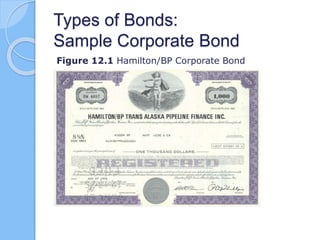
Figure 12.1 Hamilton/BP Corporate Bond
Treasury Notes and Bonds
 The Treasury issues notes and bonds
to finance its operations.
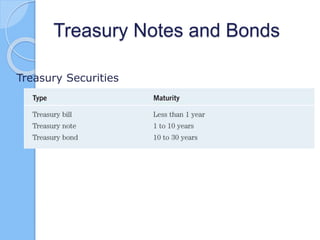
 The following table summarizes the
maturity differences among the
various Treasury securities.
Treasury Notes and Bonds
Treasury Securities
Treasury Bond Interest Rates
 No default risk since the Treasury can
print money to payoff the debt
 Very low interest rates, often
considered the risk-free rate (although
inflation risk is still present)
Treasury Bonds:
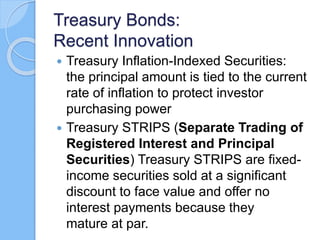
Recent Innovation
 Treasury Inflation-Indexed Securities:
the principal amount is tied to the current
rate of inflation to protect investor
purchasing power
 Treasury STRIPS (Separate Trading of
Registered Interest and Principal
Securities) Treasury STRIPS are fixed-
income securities sold at a significant
discount to face value and offer no
interest payments because they
mature at par.
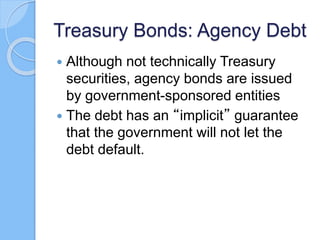
Treasury Bonds: Agency Debt
 Although not technically Treasury
securities, agency bonds are issued
by government-sponsored entities
 The debt has an “implicit” guarantee
that the government will not let the
debt default.
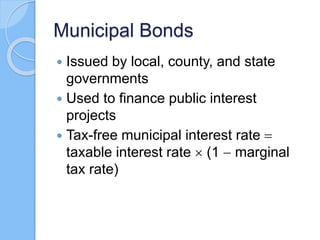
Municipal Bonds
 Issued by local, county, and state
governments
 Used to finance public interest
projects
 Tax-free municipal interest rate =
taxable interest rate  (1  marginal
tax rate)
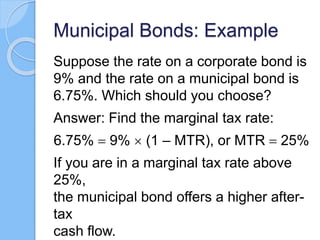
Municipal Bonds: Example
Suppose the rate on a corporate bond is
9% and the rate on a municipal bond is
6.75%. Which should you choose?
Answer: Find the marginal tax rate:
6.75% = 9%  (1 – MTR), or MTR = 25%
If you are in a marginal tax rate above
25%,
the municipal bond offers a higher after-
tax
cash flow.
Municipal Bonds: Example
Suppose the rate on a corporate bond is
5% and the rate on a municipal bond is
3.5%. Which should you choose? Your
marginal tax rate is 28%.
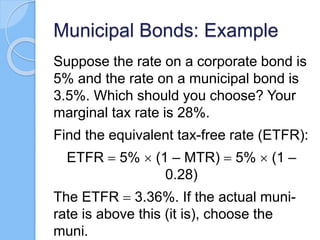
Municipal Bonds: Example
Suppose the rate on a corporate bond is
5% and the rate on a municipal bond is
3.5%. Which should you choose? Your
marginal tax rate is 28%.
Find the equivalent tax-free rate (ETFR):
ETFR = 5%  (1 – MTR) = 5%  (1 –
0.28)
The ETFR = 3.36%. If the actual muni-
rate is above this (it is), choose the
muni.
Corporate Bonds
 Typically have a face value of $1,000,
although some have a face value of
$5,000 or $10,000
 Pay interest semi-annually
Corporate Bonds
 Cannot be redeemed anytime the
issuer wishes, unless a specific clause
states this (call option).
 Degree of risk varies with each bond,
even from the same issuer. Following
suite, the required interest rate varies
with level of risk.
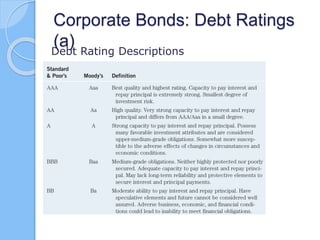
Corporate Bonds: Debt Ratings
(a)Debt Rating Descriptions
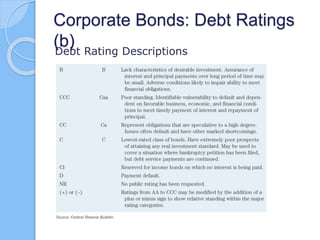
Corporate Bonds: Debt Ratings
(b)Debt Rating Descriptions
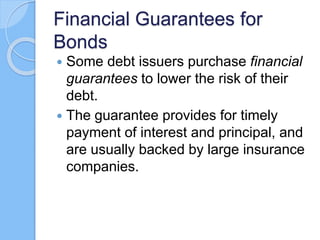
Financial Guarantees for
Bonds
 Some debt issuers purchase financial
guarantees to lower the risk of their
debt.
 The guarantee provides for timely
payment of interest and principal, and
are usually backed by large insurance
companies.
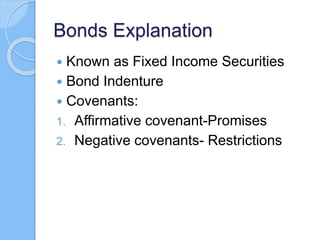
Bonds Explanation
 Known as Fixed Income Securities
 Bond Indenture
 Covenants:
1. Affirmative covenant-Promises
2. Negative covenants- Restrictions
Characteristics of bonds
 Par value
 Maturity
 Coupon rate
Coupon Rate Structures
 Zero coupon bond
 Accrual bond
 Deferred coupon bond
 Step up notes
 Floating rate securities
Retirement & Redemption
 Amortizing
 Non-amortizing
 Call provision
Finding the Value of Coupon
Bonds
 Bond pricing is, in theory, no different
than pricing any set of known cash
flows.
 Once the cash flows have been
identified, they should be discounted
to time zero at an appropriate discount
rate.
Finding the Value of Coupon
Bonds & YTM
Let’s use a simple example to illustrate
the bond pricing idea.
What is the price of two-year, 10%
coupon bond (semi-annual coupon
payments) with a face value of $1,000
and a required rate of 12%?
Investing in Bonds
 Bonds are the most popular
alternative to stocks for long-term
investing.
 Even though the bonds of a
corporation are less risky than its
equity, investors still have risk: price
risk and interest rate risk

Bonds

  • 1.
  • 2.
    Bonds  A bondis a debt security, similar to an I.O.U. When you purchase a bond, you are lending money to a government, municipality, corporation, federal agency or other entity known as an issuer.*
  • 3.
    Types of Bonds Types of bonds we will examine include long-term government bonds (T-bonds), municipal bonds, and corporate bonds.
  • 4.
    Types of Bonds: SampleCorporate Bond Figure 12.1 Hamilton/BP Corporate Bond
  • 5.
    Treasury Notes andBonds  The Treasury issues notes and bonds to finance its operations.  The following table summarizes the maturity differences among the various Treasury securities.
  • 6.
    Treasury Notes andBonds Treasury Securities
  • 7.
    Treasury Bond InterestRates  No default risk since the Treasury can print money to payoff the debt  Very low interest rates, often considered the risk-free rate (although inflation risk is still present)
  • 8.
    Treasury Bonds: Recent Innovation Treasury Inflation-Indexed Securities: the principal amount is tied to the current rate of inflation to protect investor purchasing power  Treasury STRIPS (Separate Trading of Registered Interest and Principal Securities) Treasury STRIPS are fixed- income securities sold at a significant discount to face value and offer no interest payments because they mature at par.
  • 9.
    Treasury Bonds: AgencyDebt  Although not technically Treasury securities, agency bonds are issued by government-sponsored entities  The debt has an “implicit” guarantee that the government will not let the debt default.
  • 10.
    Municipal Bonds  Issuedby local, county, and state governments  Used to finance public interest projects  Tax-free municipal interest rate = taxable interest rate  (1  marginal tax rate)
  • 11.
    Municipal Bonds: Example Supposethe rate on a corporate bond is 9% and the rate on a municipal bond is 6.75%. Which should you choose? Answer: Find the marginal tax rate: 6.75% = 9%  (1 – MTR), or MTR = 25% If you are in a marginal tax rate above 25%, the municipal bond offers a higher after- tax cash flow.
  • 12.
    Municipal Bonds: Example Supposethe rate on a corporate bond is 5% and the rate on a municipal bond is 3.5%. Which should you choose? Your marginal tax rate is 28%.
  • 13.
    Municipal Bonds: Example Supposethe rate on a corporate bond is 5% and the rate on a municipal bond is 3.5%. Which should you choose? Your marginal tax rate is 28%. Find the equivalent tax-free rate (ETFR): ETFR = 5%  (1 – MTR) = 5%  (1 – 0.28) The ETFR = 3.36%. If the actual muni- rate is above this (it is), choose the muni.
  • 14.
    Corporate Bonds  Typicallyhave a face value of $1,000, although some have a face value of $5,000 or $10,000  Pay interest semi-annually
  • 15.
    Corporate Bonds  Cannotbe redeemed anytime the issuer wishes, unless a specific clause states this (call option).  Degree of risk varies with each bond, even from the same issuer. Following suite, the required interest rate varies with level of risk.
  • 16.
    Corporate Bonds: DebtRatings (a)Debt Rating Descriptions
  • 17.
    Corporate Bonds: DebtRatings (b)Debt Rating Descriptions
  • 18.
    Financial Guarantees for Bonds Some debt issuers purchase financial guarantees to lower the risk of their debt.  The guarantee provides for timely payment of interest and principal, and are usually backed by large insurance companies.
  • 19.
    Bonds Explanation  Knownas Fixed Income Securities  Bond Indenture  Covenants: 1. Affirmative covenant-Promises 2. Negative covenants- Restrictions
  • 20.
    Characteristics of bonds Par value  Maturity  Coupon rate
  • 21.
    Coupon Rate Structures Zero coupon bond  Accrual bond  Deferred coupon bond  Step up notes  Floating rate securities
  • 22.
    Retirement & Redemption Amortizing  Non-amortizing  Call provision
  • 23.
    Finding the Valueof Coupon Bonds  Bond pricing is, in theory, no different than pricing any set of known cash flows.  Once the cash flows have been identified, they should be discounted to time zero at an appropriate discount rate.
  • 24.
    Finding the Valueof Coupon Bonds & YTM Let’s use a simple example to illustrate the bond pricing idea. What is the price of two-year, 10% coupon bond (semi-annual coupon payments) with a face value of $1,000 and a required rate of 12%?
  • 25.
    Investing in Bonds Bonds are the most popular alternative to stocks for long-term investing.  Even though the bonds of a corporation are less risky than its equity, investors still have risk: price risk and interest rate risk