1
FINANCIAL ANALYSES AND
PLANNING
CHAPTER 2
2
Contents:
 Financial Analysis
 The need for financial analysis
 Source of financial data
 Approaches to financial analysis and
interpretation
 Financial planning (forecasting)
 The planning process
 The importance of sales forecasting
 Techniques of determining external
financial requirements.
3
Financial Analysis
 As a manager, you may want to know the answers
for the following questions.
 when existing capacity will be expanded and enlarged?
 As an investor, how do you predict how well the securities of one
firm will perform relative to that of another?
 How can you tell whether one security is riskier than another?
 As a lender, how do decide the borrower will be able to pay
back as promised?
 All of these questions can be addressed through
financial analysis.
4
What is financial analysis?
 Financial analysis is the selection, evaluation,
and interpretation of financial data, along
with other pertinent information, to assist in
investment and financial decision-making.
 Financial analysis may be used internally to
evaluate issues such as employee performance,
the efficiency of operations, and credit
policies, and
 Financial analysis may be used externally to
evaluate potential investments and the credit-
worthiness of borrowers, among other things
5
The need for Financial Analysis
 Financial analysis is not an end in itself but is performed
for the purpose of providing information that is useful in
making the right decisions.
 Thus, financial statement analysis serves the following
purposes:
1. Measuring the profitability
 The main objective of a business is to earn a satisfactory return on
the funds invested in it.
– Financial analysis helps in ascertaining whether adequate profits are
being earned on the capital invested in the business or not.
– It also helps in knowing the capacity to pay the interest and dividend.
2. Indicating the trend of Achievements
 Financial statements of the previous years can be compared and the
trend regarding various expenses, purchases, sales, gross profits
and net profit etc. can be ascertained. Value of assets and liabilities
can be compared and the future prospects of the business can be
predicted.
6
3. Assessing the growth potential of the
business
 The trend and other analysis of the business
provide sufficient information indicating the
growth potential of the business.
4. Comparative position in relation to other
firms
 The purpose of financial statements analysis is to
help the management to make a comparative
study of the profitability of various firms engaged
in similar businesses. Such comparison also helps
the management to study the position of their
firm in respect of sales, expenses, profitability
and utilising capital, etc.
7
5. Assess overall financial strength
 The purpose of financial analysis is to assess the
financial strength of the business. Analysis also
helps in taking decisions, whether funds required
for the purchase of new machines and
equipments are provided from internal sources of
the business or not if yes, how much? And also, to
assess how much funds have been received from
external sources.
6. Assess solvency of the firm
 The different tools of an analysis tell us whether
the firm has sufficient funds to meet its short
term and long term liabilities or not.
8
Source of Financial data
 Financial data can be obtained from many
sources.
– The primary source is the data provided by the
company itself in its annual report and required
disclosures.
– The annual report includes the income statement,
the balance sheet, and the statement of cash flows,
as well as footnotes to these statements.
– Certain businesses are required by law to disclose
additional information.
9
 Besides information that companies are
required to disclose through financial
statements, other information is readily
available for financial analysis.
 Like, information such as the market prices of
securities of publicly-traded corporations can be
found in the financial press and the electronic
media daily.
 Similarly, information on stock price indices for
industries and for the market as a whole are
available in the financial press.
10
 Another source of information is economic
data, such as the Gross Domestic Product and
Consumer Price Index, which may be useful
in assessing the recent performance or future
prospects of a firm or industry.
 Suppose you are evaluating a firm that owns a chain of
retail outlets. What information do you need to judge the
firm's performance and financial condition?
 You need financial data, but it doesn't tell the whole
story.
 You also need information on consumer spending,
producer prices, consumer prices, and the competition.
This is economic data that is readily available from
government and private sources.
11
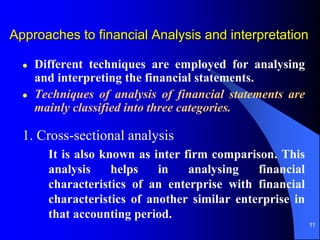
 Different techniques are employed for analysing
and interpreting the financial statements.
 Techniques of analysis of financial statements are
mainly classified into three categories.
1. Cross-sectional analysis
It is also known as inter firm comparison. This
analysis helps in analysing financial
characteristics of an enterprise with financial
characteristics of another similar enterprise in
that accounting period.
Approaches to financial Analysis and interpretation
12
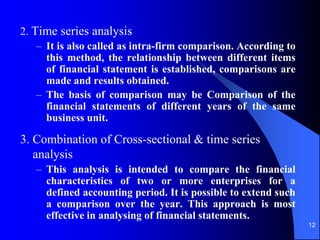
2. Time series analysis
– It is also called as intra-firm comparison. According to
this method, the relationship between different items
of financial statement is established, comparisons are
made and results obtained.
– The basis of comparison may be Comparison of the
financial statements of different years of the same
business unit.
3. Combination of Cross-sectional & time series
analysis
– This analysis is intended to compare the financial
characteristics of two or more enterprises for a
defined accounting period. It is possible to extend such
a comparison over the year. This approach is most
effective in analysing of financial statements.
13
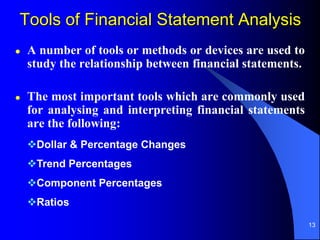
Dollar & Percentage Changes
Trend Percentages
Component Percentages
Ratios
 A number of tools or methods or devices are used to
study the relationship between financial statements.
 The most important tools which are commonly used
for analysing and interpreting financial statements
are the following:
Tools of Financial Statement Analysis
14
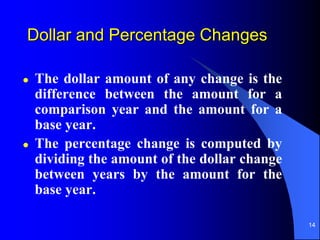
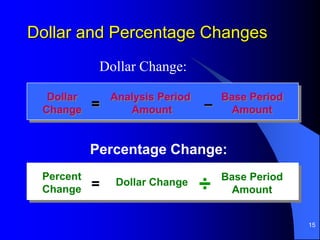
 The dollar amount of any change is the
difference between the amount for a
comparison year and the amount for a
base year.
 The percentage change is computed by
dividing the amount of the dollar change
between years by the amount for the
base year.
Dollar and Percentage Changes
15
Dollar Change:
Analysis Period
Amount
Base Period
Amount
Dollar
Change = –
Percentage Change:
Dollar Change
Base Period
Amount
Percent
Change = ÷
Dollar and Percentage Changes
16
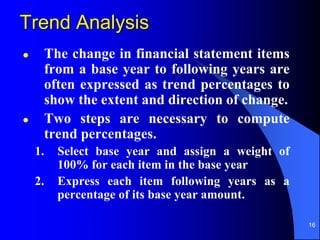
 The change in financial statement items
from a base year to following years are
often expressed as trend percentages to
show the extent and direction of change.
 Two steps are necessary to compute
trend percentages.
1. Select base year and assign a weight of
100% for each item in the base year
2. Express each item following years as a
percentage of its base year amount.
Trend Analysis
17
Ratio
 A ratio is a mathematical relation
between one quantity and another.
 A financial ratio is a comparison between
one bit of financial information and
another.
18
The use of Ratio
 Ratios are used to
 compare results over a period of time
 measure performance against other
organisations
 compare results with a target
 compare against industry averages
19
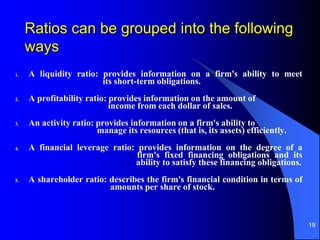
Ratios can be grouped into the following
ways
1. A liquidity ratio: provides information on a firm's ability to meet
its short-term obligations.
2. A profitability ratio: provides information on the amount of
income from each dollar of sales.
3. An activity ratio: provides information on a firm's ability to
manage its resources (that is, its assets) efficiently.
4. A financial leverage ratio: provides information on the degree of a
firm's fixed financing obligations and its
ability to satisfy these financing obligations.
5. A shareholder ratio: describes the firm's financial condition in terms of
amounts per share of stock.
20
Liquidity
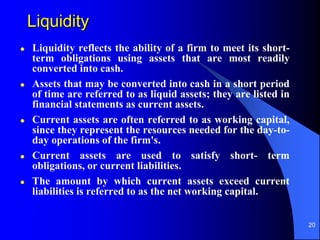
 Liquidity reflects the ability of a firm to meet its short-
term obligations using assets that are most readily
converted into cash.
 Assets that may be converted into cash in a short period
of time are referred to as liquid assets; they are listed in
financial statements as current assets.
 Current assets are often referred to as working capital,
since they represent the resources needed for the day-to-
day operations of the firm's.
 Current assets are used to satisfy short- term
obligations, or current liabilities.
 The amount by which current assets exceed current
liabilities is referred to as the net working capital.
21
Measures of liquidity
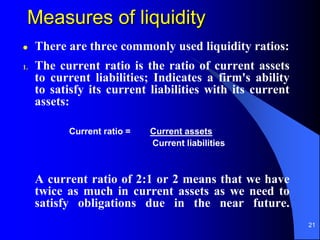
 There are three commonly used liquidity ratios:
1. The current ratio is the ratio of current assets
to current liabilities; Indicates a firm's ability
to satisfy its current liabilities with its current
assets:
A current ratio of 2:1 or 2 means that we have
twice as much in current assets as we need to
satisfy obligations due in the near future.
Current ratio = Current assets
Current liabilities
22
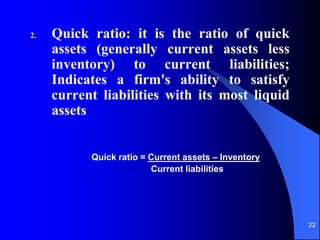
2. Quick ratio: it is the ratio of quick
assets (generally current assets less
inventory) to current liabilities;
Indicates a firm's ability to satisfy
current liabilities with its most liquid
assets
Quick ratio = Current assets – Inventory
Current liabilities
23
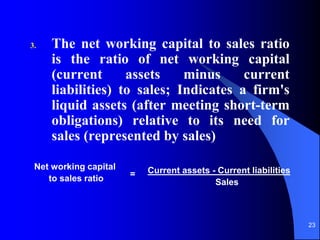
3. The net working capital to sales ratio
is the ratio of net working capital
(current assets minus current
liabilities) to sales; Indicates a firm's
liquid assets (after meeting short-term
obligations) relative to its need for
sales (represented by sales)
Current assets - Current liabilities
Sales
Net working capital
to sales ratio =
24
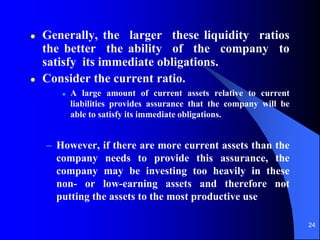
 Generally, the larger these liquidity ratios
the better the ability of the company to
satisfy its immediate obligations.
 Consider the current ratio.
 A large amount of current assets relative to current
liabilities provides assurance that the company will be
able to satisfy its immediate obligations.
– However, if there are more current assets than the
company needs to provide this assurance, the
company may be investing too heavily in these
non- or low-earning assets and therefore not
putting the assets to the most productive use
25
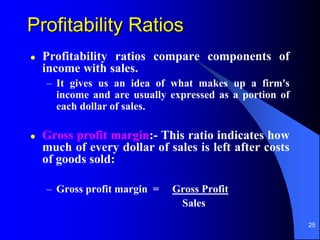
Profitability Ratios
 Profitability ratios compare components of
income with sales.
– It gives us an idea of what makes up a firm's
income and are usually expressed as a portion of
each dollar of sales.
 Gross profit margin:- This ratio indicates how
much of every dollar of sales is left after costs
of goods sold:
– Gross profit margin = Gross Profit
Sales
26
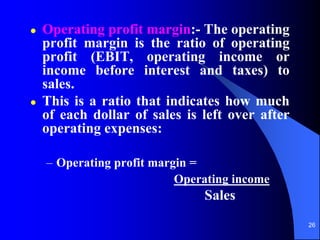
 Operating profit margin:- The operating
profit margin is the ratio of operating
profit (EBIT, operating income or
income before interest and taxes) to
sales.
 This is a ratio that indicates how much
of each dollar of sales is left over after
operating expenses:
– Operating profit margin =
Operating income
Sales
27
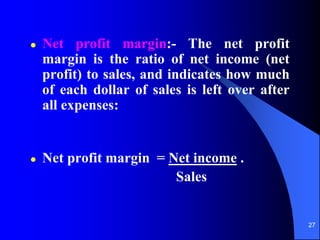
 Net profit margin:- The net profit
margin is the ratio of net income (net
profit) to sales, and indicates how much
of each dollar of sales is left over after
all expenses:
 Net profit margin = Net income .
Sales
28
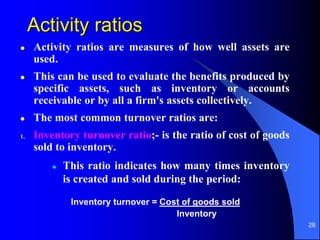
Activity ratios
 Activity ratios are measures of how well assets are
used.
 This can be used to evaluate the benefits produced by
specific assets, such as inventory or accounts
receivable or by all a firm's assets collectively.
 The most common turnover ratios are:
1. Inventory turnover ratio;- is the ratio of cost of goods
sold to inventory.
 This ratio indicates how many times inventory
is created and sold during the period:
Inventory turnover = Cost of goods sold
Inventory
29
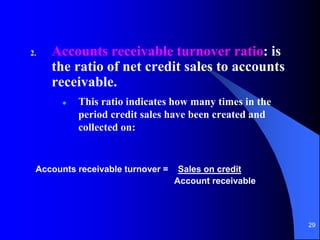
2. Accounts receivable turnover ratio: is
the ratio of net credit sales to accounts
receivable.
 This ratio indicates how many times in the
period credit sales have been created and
collected on:
Accounts receivable turnover = Sales on credit
Account receivable
30
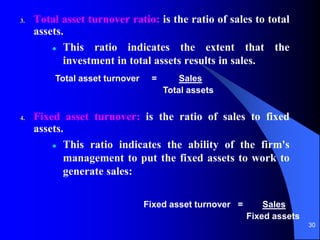
3. Total asset turnover ratio: is the ratio of sales to total
assets.
 This ratio indicates the extent that the
investment in total assets results in sales.
4. Fixed asset turnover: is the ratio of sales to fixed
assets.
 This ratio indicates the ability of the firm's
management to put the fixed assets to work to
generate sales:
Total asset turnover = Sales
Total assets
Fixed asset turnover = Sales
Fixed assets
31
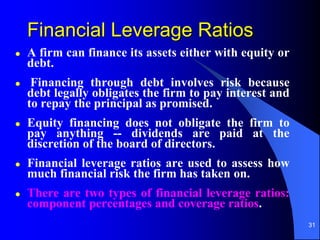
Financial Leverage Ratios
 A firm can finance its assets either with equity or
debt.
 Financing through debt involves risk because
debt legally obligates the firm to pay interest and
to repay the principal as promised.
 Equity financing does not obligate the firm to
pay anything -- dividends are paid at the
discretion of the board of directors.
 Financial leverage ratios are used to assess how
much financial risk the firm has taken on.
 There are two types of financial leverage ratios:
component percentages and coverage ratios.
32
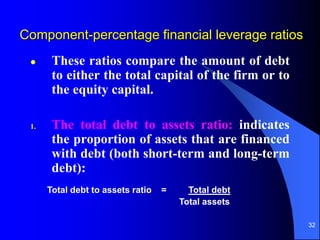
Component-percentage financial leverage ratios
 These ratios compare the amount of debt
to either the total capital of the firm or to
the equity capital.
1. The total debt to assets ratio: indicates
the proportion of assets that are financed
with debt (both short-term and long-term
debt):
Total debt to assets ratio = Total debt
Total assets
33
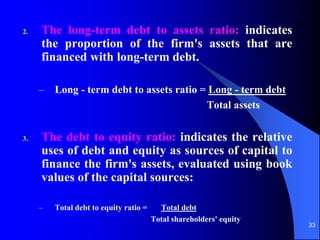
2. The long-term debt to assets ratio: indicates
the proportion of the firm's assets that are
financed with long-term debt.
– Long - term debt to assets ratio = Long - term debt
Total assets
3. The debt to equity ratio: indicates the relative
uses of debt and equity as sources of capital to
finance the firm's assets, evaluated using book
values of the capital sources:
– Total debt to equity ratio = Total debt
Total shareholders' equity
34
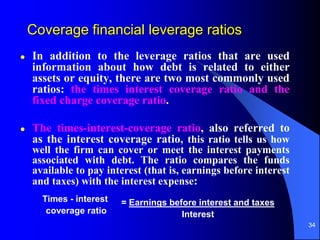
Coverage financial leverage ratios
 In addition to the leverage ratios that are used
information about how debt is related to either
assets or equity, there are two most commonly used
ratios: the times interest coverage ratio and the
fixed charge coverage ratio.
 The times-interest-coverage ratio, also referred to
as the interest coverage ratio, this ratio tells us how
well the firm can cover or meet the interest payments
associated with debt. The ratio compares the funds
available to pay interest (that is, earnings before interest
and taxes) with the interest expense:
Times - interest
coverage ratio
= Earnings before interest and taxes
Interest
35
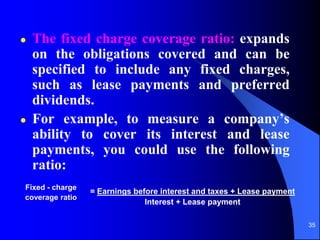
 The fixed charge coverage ratio: expands
on the obligations covered and can be
specified to include any fixed charges,
such as lease payments and preferred
dividends.
 For example, to measure a company’s
ability to cover its interest and lease
payments, you could use the following
ratio:
Fixed - charge
coverage ratio
= Earnings before interest and taxes + Lease payment
Interest + Lease payment
36
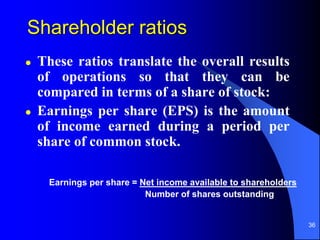
Shareholder ratios
 These ratios translate the overall results
of operations so that they can be
compared in terms of a share of stock:
 Earnings per share (EPS) is the amount
of income earned during a period per
share of common stock.
Earnings per share = Net income available to shareholders
Number of shares outstanding
37
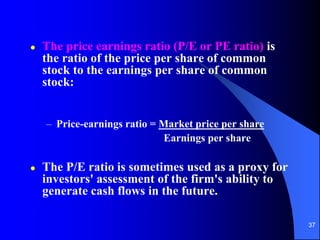
 The price earnings ratio (P/E or PE ratio) is
the ratio of the price per share of common
stock to the earnings per share of common
stock:
– Price-earnings ratio = Market price per share
Earnings per share
 The P/E ratio is sometimes used as a proxy for
investors' assessment of the firm's ability to
generate cash flows in the future.
38
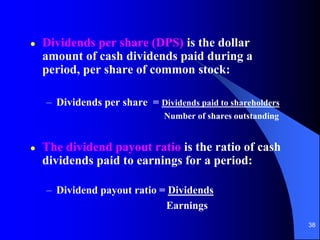
 Dividends per share (DPS) is the dollar
amount of cash dividends paid during a
period, per share of common stock:
– Dividends per share = Dividends paid to shareholders
Number of shares outstanding
 The dividend payout ratio is the ratio of cash
dividends paid to earnings for a period:
– Dividend payout ratio = Dividends
Earnings

Financial Analysis ch-2 (II).ppt

  • 1.
  • 2.
    2 Contents:  Financial Analysis The need for financial analysis  Source of financial data  Approaches to financial analysis and interpretation  Financial planning (forecasting)  The planning process  The importance of sales forecasting  Techniques of determining external financial requirements.
  • 3.
    3 Financial Analysis  Asa manager, you may want to know the answers for the following questions.  when existing capacity will be expanded and enlarged?  As an investor, how do you predict how well the securities of one firm will perform relative to that of another?  How can you tell whether one security is riskier than another?  As a lender, how do decide the borrower will be able to pay back as promised?  All of these questions can be addressed through financial analysis.
  • 4.
    4 What is financialanalysis?  Financial analysis is the selection, evaluation, and interpretation of financial data, along with other pertinent information, to assist in investment and financial decision-making.  Financial analysis may be used internally to evaluate issues such as employee performance, the efficiency of operations, and credit policies, and  Financial analysis may be used externally to evaluate potential investments and the credit- worthiness of borrowers, among other things
  • 5.
    5 The need forFinancial Analysis  Financial analysis is not an end in itself but is performed for the purpose of providing information that is useful in making the right decisions.  Thus, financial statement analysis serves the following purposes: 1. Measuring the profitability  The main objective of a business is to earn a satisfactory return on the funds invested in it. – Financial analysis helps in ascertaining whether adequate profits are being earned on the capital invested in the business or not. – It also helps in knowing the capacity to pay the interest and dividend. 2. Indicating the trend of Achievements  Financial statements of the previous years can be compared and the trend regarding various expenses, purchases, sales, gross profits and net profit etc. can be ascertained. Value of assets and liabilities can be compared and the future prospects of the business can be predicted.
  • 6.
    6 3. Assessing thegrowth potential of the business  The trend and other analysis of the business provide sufficient information indicating the growth potential of the business. 4. Comparative position in relation to other firms  The purpose of financial statements analysis is to help the management to make a comparative study of the profitability of various firms engaged in similar businesses. Such comparison also helps the management to study the position of their firm in respect of sales, expenses, profitability and utilising capital, etc.
  • 7.
    7 5. Assess overallfinancial strength  The purpose of financial analysis is to assess the financial strength of the business. Analysis also helps in taking decisions, whether funds required for the purchase of new machines and equipments are provided from internal sources of the business or not if yes, how much? And also, to assess how much funds have been received from external sources. 6. Assess solvency of the firm  The different tools of an analysis tell us whether the firm has sufficient funds to meet its short term and long term liabilities or not.
  • 8.
    8 Source of Financialdata  Financial data can be obtained from many sources. – The primary source is the data provided by the company itself in its annual report and required disclosures. – The annual report includes the income statement, the balance sheet, and the statement of cash flows, as well as footnotes to these statements. – Certain businesses are required by law to disclose additional information.
  • 9.
    9  Besides informationthat companies are required to disclose through financial statements, other information is readily available for financial analysis.  Like, information such as the market prices of securities of publicly-traded corporations can be found in the financial press and the electronic media daily.  Similarly, information on stock price indices for industries and for the market as a whole are available in the financial press.
  • 10.
    10  Another sourceof information is economic data, such as the Gross Domestic Product and Consumer Price Index, which may be useful in assessing the recent performance or future prospects of a firm or industry.  Suppose you are evaluating a firm that owns a chain of retail outlets. What information do you need to judge the firm's performance and financial condition?  You need financial data, but it doesn't tell the whole story.  You also need information on consumer spending, producer prices, consumer prices, and the competition. This is economic data that is readily available from government and private sources.
  • 11.
    11  Different techniquesare employed for analysing and interpreting the financial statements.  Techniques of analysis of financial statements are mainly classified into three categories. 1. Cross-sectional analysis It is also known as inter firm comparison. This analysis helps in analysing financial characteristics of an enterprise with financial characteristics of another similar enterprise in that accounting period. Approaches to financial Analysis and interpretation
  • 12.
    12 2. Time seriesanalysis – It is also called as intra-firm comparison. According to this method, the relationship between different items of financial statement is established, comparisons are made and results obtained. – The basis of comparison may be Comparison of the financial statements of different years of the same business unit. 3. Combination of Cross-sectional & time series analysis – This analysis is intended to compare the financial characteristics of two or more enterprises for a defined accounting period. It is possible to extend such a comparison over the year. This approach is most effective in analysing of financial statements.
  • 13.
    13 Dollar & PercentageChanges Trend Percentages Component Percentages Ratios  A number of tools or methods or devices are used to study the relationship between financial statements.  The most important tools which are commonly used for analysing and interpreting financial statements are the following: Tools of Financial Statement Analysis
  • 14.
    14  The dollaramount of any change is the difference between the amount for a comparison year and the amount for a base year.  The percentage change is computed by dividing the amount of the dollar change between years by the amount for the base year. Dollar and Percentage Changes
  • 15.
    15 Dollar Change: Analysis Period Amount BasePeriod Amount Dollar Change = – Percentage Change: Dollar Change Base Period Amount Percent Change = ÷ Dollar and Percentage Changes
  • 16.
    16  The changein financial statement items from a base year to following years are often expressed as trend percentages to show the extent and direction of change.  Two steps are necessary to compute trend percentages. 1. Select base year and assign a weight of 100% for each item in the base year 2. Express each item following years as a percentage of its base year amount. Trend Analysis
  • 17.
    17 Ratio  A ratiois a mathematical relation between one quantity and another.  A financial ratio is a comparison between one bit of financial information and another.
  • 18.
    18 The use ofRatio  Ratios are used to  compare results over a period of time  measure performance against other organisations  compare results with a target  compare against industry averages
  • 19.
    19 Ratios can begrouped into the following ways 1. A liquidity ratio: provides information on a firm's ability to meet its short-term obligations. 2. A profitability ratio: provides information on the amount of income from each dollar of sales. 3. An activity ratio: provides information on a firm's ability to manage its resources (that is, its assets) efficiently. 4. A financial leverage ratio: provides information on the degree of a firm's fixed financing obligations and its ability to satisfy these financing obligations. 5. A shareholder ratio: describes the firm's financial condition in terms of amounts per share of stock.
  • 20.
    20 Liquidity  Liquidity reflectsthe ability of a firm to meet its short- term obligations using assets that are most readily converted into cash.  Assets that may be converted into cash in a short period of time are referred to as liquid assets; they are listed in financial statements as current assets.  Current assets are often referred to as working capital, since they represent the resources needed for the day-to- day operations of the firm's.  Current assets are used to satisfy short- term obligations, or current liabilities.  The amount by which current assets exceed current liabilities is referred to as the net working capital.
  • 21.
    21 Measures of liquidity There are three commonly used liquidity ratios: 1. The current ratio is the ratio of current assets to current liabilities; Indicates a firm's ability to satisfy its current liabilities with its current assets: A current ratio of 2:1 or 2 means that we have twice as much in current assets as we need to satisfy obligations due in the near future. Current ratio = Current assets Current liabilities
  • 22.
    22 2. Quick ratio:it is the ratio of quick assets (generally current assets less inventory) to current liabilities; Indicates a firm's ability to satisfy current liabilities with its most liquid assets Quick ratio = Current assets – Inventory Current liabilities
  • 23.
    23 3. The networking capital to sales ratio is the ratio of net working capital (current assets minus current liabilities) to sales; Indicates a firm's liquid assets (after meeting short-term obligations) relative to its need for sales (represented by sales) Current assets - Current liabilities Sales Net working capital to sales ratio =
  • 24.
    24  Generally, thelarger these liquidity ratios the better the ability of the company to satisfy its immediate obligations.  Consider the current ratio.  A large amount of current assets relative to current liabilities provides assurance that the company will be able to satisfy its immediate obligations. – However, if there are more current assets than the company needs to provide this assurance, the company may be investing too heavily in these non- or low-earning assets and therefore not putting the assets to the most productive use
  • 25.
    25 Profitability Ratios  Profitabilityratios compare components of income with sales. – It gives us an idea of what makes up a firm's income and are usually expressed as a portion of each dollar of sales.  Gross profit margin:- This ratio indicates how much of every dollar of sales is left after costs of goods sold: – Gross profit margin = Gross Profit Sales
  • 26.
    26  Operating profitmargin:- The operating profit margin is the ratio of operating profit (EBIT, operating income or income before interest and taxes) to sales.  This is a ratio that indicates how much of each dollar of sales is left over after operating expenses: – Operating profit margin = Operating income Sales
  • 27.
    27  Net profitmargin:- The net profit margin is the ratio of net income (net profit) to sales, and indicates how much of each dollar of sales is left over after all expenses:  Net profit margin = Net income . Sales
  • 28.
    28 Activity ratios  Activityratios are measures of how well assets are used.  This can be used to evaluate the benefits produced by specific assets, such as inventory or accounts receivable or by all a firm's assets collectively.  The most common turnover ratios are: 1. Inventory turnover ratio;- is the ratio of cost of goods sold to inventory.  This ratio indicates how many times inventory is created and sold during the period: Inventory turnover = Cost of goods sold Inventory
  • 29.
    29 2. Accounts receivableturnover ratio: is the ratio of net credit sales to accounts receivable.  This ratio indicates how many times in the period credit sales have been created and collected on: Accounts receivable turnover = Sales on credit Account receivable
  • 30.
    30 3. Total assetturnover ratio: is the ratio of sales to total assets.  This ratio indicates the extent that the investment in total assets results in sales. 4. Fixed asset turnover: is the ratio of sales to fixed assets.  This ratio indicates the ability of the firm's management to put the fixed assets to work to generate sales: Total asset turnover = Sales Total assets Fixed asset turnover = Sales Fixed assets
  • 31.
    31 Financial Leverage Ratios A firm can finance its assets either with equity or debt.  Financing through debt involves risk because debt legally obligates the firm to pay interest and to repay the principal as promised.  Equity financing does not obligate the firm to pay anything -- dividends are paid at the discretion of the board of directors.  Financial leverage ratios are used to assess how much financial risk the firm has taken on.  There are two types of financial leverage ratios: component percentages and coverage ratios.
  • 32.
    32 Component-percentage financial leverageratios  These ratios compare the amount of debt to either the total capital of the firm or to the equity capital. 1. The total debt to assets ratio: indicates the proportion of assets that are financed with debt (both short-term and long-term debt): Total debt to assets ratio = Total debt Total assets
  • 33.
    33 2. The long-termdebt to assets ratio: indicates the proportion of the firm's assets that are financed with long-term debt. – Long - term debt to assets ratio = Long - term debt Total assets 3. The debt to equity ratio: indicates the relative uses of debt and equity as sources of capital to finance the firm's assets, evaluated using book values of the capital sources: – Total debt to equity ratio = Total debt Total shareholders' equity
  • 34.
    34 Coverage financial leverageratios  In addition to the leverage ratios that are used information about how debt is related to either assets or equity, there are two most commonly used ratios: the times interest coverage ratio and the fixed charge coverage ratio.  The times-interest-coverage ratio, also referred to as the interest coverage ratio, this ratio tells us how well the firm can cover or meet the interest payments associated with debt. The ratio compares the funds available to pay interest (that is, earnings before interest and taxes) with the interest expense: Times - interest coverage ratio = Earnings before interest and taxes Interest
  • 35.
    35  The fixedcharge coverage ratio: expands on the obligations covered and can be specified to include any fixed charges, such as lease payments and preferred dividends.  For example, to measure a company’s ability to cover its interest and lease payments, you could use the following ratio: Fixed - charge coverage ratio = Earnings before interest and taxes + Lease payment Interest + Lease payment
  • 36.
    36 Shareholder ratios  Theseratios translate the overall results of operations so that they can be compared in terms of a share of stock:  Earnings per share (EPS) is the amount of income earned during a period per share of common stock. Earnings per share = Net income available to shareholders Number of shares outstanding
  • 37.
    37  The priceearnings ratio (P/E or PE ratio) is the ratio of the price per share of common stock to the earnings per share of common stock: – Price-earnings ratio = Market price per share Earnings per share  The P/E ratio is sometimes used as a proxy for investors' assessment of the firm's ability to generate cash flows in the future.
  • 38.
    38  Dividends pershare (DPS) is the dollar amount of cash dividends paid during a period, per share of common stock: – Dividends per share = Dividends paid to shareholders Number of shares outstanding  The dividend payout ratio is the ratio of cash dividends paid to earnings for a period: – Dividend payout ratio = Dividends Earnings

Editor's Notes