FINANCIAL ACCOUNTING
AND
TAXATION
BUSINESS


Businesses are everywhere. They are the units that perform
most of the economic activity in our economy. Businesses exist
to generate a profit. The traditional definition of a business is an
entity that brings together time, effort and capital in order to
produce a profit.

Following are the characteristics of a business:
 Human Activity
 Financial Nature
 Profit Motive
 Continuously
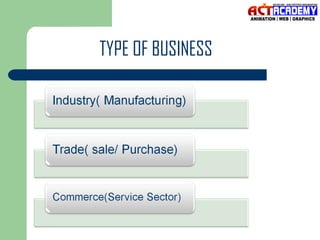
TYPE OF BUSINESS
WHAT IS ACCOUNTING
Up to 1974, accounting was done the same way that the Egyptians did it
3,000 years before. Accounting is the art of systematic recording,
reporting,

and analysis of financial

transactions of

a business.

The person in charge of accounting is known as an accountant.

WHAT IS BOOK KEEPING
Bookkeeping is the recording of financial transactions. Transactions include
sales, purchases, income, receipts and payments by an individual or
organization. Bookkeeping is usually performed by a bookkeeper.
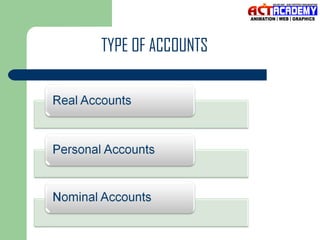
TYPE OF ACCOUNTS
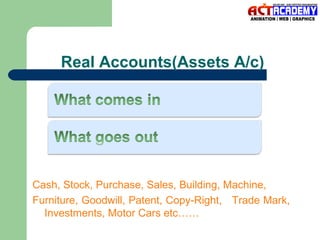
Real Accounts(Assets A/c)

Cash, Stock, Purchase, Sales, Building, Machine,
Furniture, Goodwill, Patent, Copy-Right, Trade Mark,
Investments, Motor Cars etc……
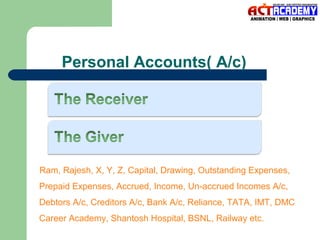
Personal Accounts( A/c)

Ram, Rajesh, X, Y, Z, Capital, Drawing, Outstanding Expenses,
Prepaid Expenses, Accrued, Income, Un-accrued Incomes A/c,
Debtors A/c, Creditors A/c, Bank A/c, Reliance, TATA, IMT, DMC
Career Academy, Shantosh Hospital, BSNL, Railway etc.
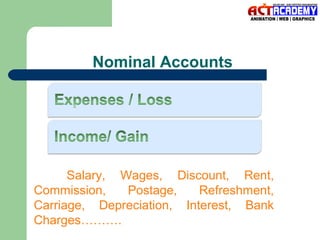
Nominal Accounts

Salary, Wages, Discount, Rent,
Commission,
Postage,
Refreshment,
Carriage, Depreciation, Interest, Bank
Charges……….
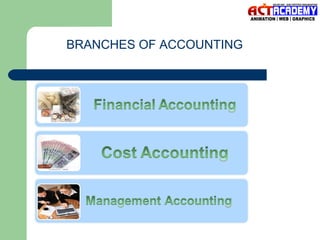
BRANCHES OF ACCOUNTING
Financial Accounting


It is the original form of accounting.



It is mainly confined to the preparation of financial
statements for the use of outsiders like creditors,
banks and financial institutions etc.



The chief purpose of financial accounting is to
calculate profit or loss made by the business during
the year and exhibit financial position of the business
as on a particular date.
Cost Accounting
 Function

of cost accounting is to ascertain
the cost of the product and to help the
management in the control of cost.
Management Accounting
 It

is accounting for management.
 Accounting
which provides necessary
information to the management for
discharging its functions.
 It is the reproduction of financial accounts in
such a way as will enable the management
to take decisions and to control various
business activities
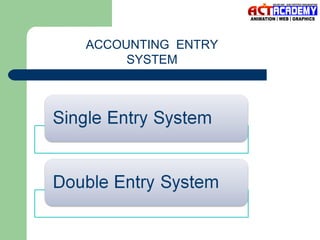
ACCOUNTING ENTRY
SYSTEM
Single Entry System
 It

means to record one side of entry.
 Suppose, we sell our furniture, we have not
to record furniture sale but we just record
total cash received from furniture. So, in
single entry accounting, we records cash,
account receivables,
Double Entry System
Invented by………………. “Lucas Pasioli”
of………………………… ‘Italy’
In …………………………’1494’
[ He said that every transaction have two sides……….. ]

Transactions:
Receiver……..…. Giver
Comes in………….….Goes Out
Expenses/ Losses …. Incomes/ Gains
Double Entry System


In this system, both cash and credit transactions are recognized.



The double entry system was first used in Genoa, Italy around the 13th
century and was further polished in Venice.



all transactions will have dual aspects (debit and credit) and that is why
it’s called Double Entry System.



The word Debit comes from the Latin word "debita" (Italian "debito“).



The word Credit comes from the Latin word "credo" (Italian "credito“).
What is Tally








Tally is used to store and maintain daily business transactions
like purchases, sales, receipts, payments, purchase returns,
sales returns, deposits and withdrawals etc.
popular FA software packages are Tally, Busy etc.
Tally is the number one financial accounting package in India
and is also used abroad.
With tally you could be the owner, the financial controller,
accountant, manager, auditor or anyone connected with
accounts. The fundamentals behind tally are simple enough for
learn accounting
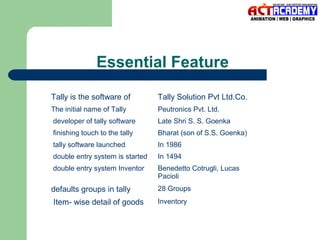
Essential Feature
Tally is the software of

Tally Solution Pvt Ltd.Co.

The initial name of Tally

Peutronics Pvt. Ltd.

developer of tally software

Late Shri S. S. Goenka

finishing touch to the tally

Bharat (son of S.S. Goenka)

tally software launched

In 1986

double entry system is started

In 1494

double entry system Inventor

Benedetto Cotrugli, Lucas
Pacioli

defaults groups in tally

28 Groups

Item- wise detail of goods

Inventory
GROUPS


Groups are collection of Ledgers of the same
nature. Account Groups are maintained to
determine the hierarchy of Ledger Accounts which is
helpful in determining and presenting meaningful and
compliant reports.



Choosing a correct group for a ledger account help
in viewing the financial position in a better way
otherwise the financial statements will not give a true
and correct picture.
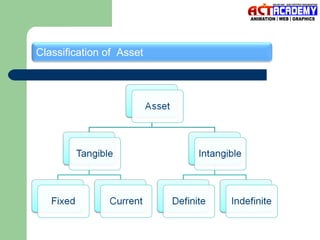
Classification of Asset
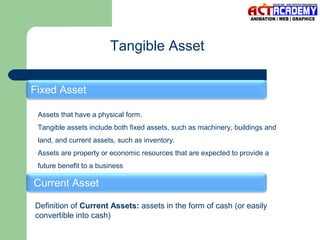
Tangible Asset
Fixed Asset
Assets that have a physical form.
Tangible assets include both fixed assets, such as machinery, buildings and
land, and current assets, such as inventory.
Assets are property or economic resources that are expected to provide a
future benefit to a business

Current Asset
Definition of Current Assets: assets in the form of cash (or easily
convertible into cash)
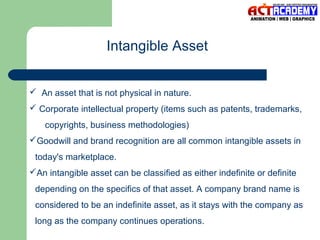
Intangible Asset
 An asset that is not physical in nature.
 Corporate intellectual property (items such as patents, trademarks,
copyrights, business methodologies)
Goodwill and brand recognition are all common intangible assets in
today's marketplace.
An intangible asset can be classified as either indefinite or definite
depending on the specifics of that asset. A company brand name is
considered to be an indefinite asset, as it stays with the company as
long as the company continues operations.
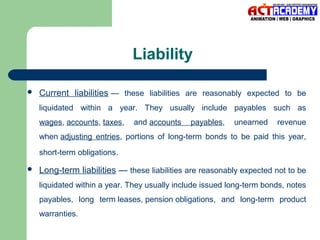
Liability


Current liabilities — these liabilities are reasonably expected to be
liquidated within a year. They usually include payables such as
wages, accounts, taxes,

and accounts

payables,

unearned

revenue

when adjusting entries, portions of long-term bonds to be paid this year,
short-term obligations.


Long-term liabilities — these liabilities are reasonably expected not to be
liquidated within a year. They usually include issued long-term bonds, notes
payables, long term leases, pension obligations, and long-term product
warranties.
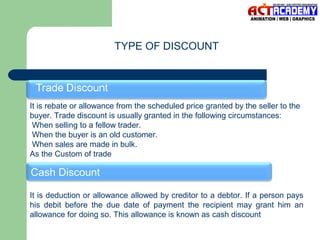
TYPE OF DISCOUNT

It is rebate or allowance from the scheduled price granted by the seller to the
buyer. Trade discount is usually granted in the following circumstances:
When selling to a fellow trader.
When the buyer is an old customer.
When sales are made in bulk.
As the Custom of trade

Cash Discount
It is deduction or allowance allowed by creditor to a debtor. If a person pays
his debit before the due date of payment the recipient may grant him an
allowance for doing so. This allowance is known as cash discount
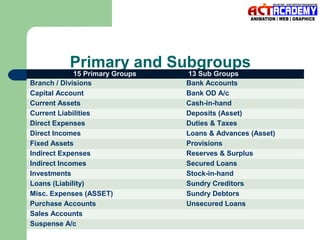
Primary and Subgroups

15 Primary Groups
Branch / Divisions
Capital Account
Current Assets
Current Liabilities
Direct Expenses
Direct Incomes
Fixed Assets
Indirect Expenses
Indirect Incomes
Investments
Loans (Liability)
Misc. Expenses (ASSET)
Purchase Accounts
Sales Accounts
Suspense A/c

13 Sub Groups
Bank Accounts
Bank OD A/c
Cash-in-hand
Deposits (Asset)
Duties & Taxes
Loans & Advances (Asset)
Provisions
Reserves & Surplus
Secured Loans
Stock-in-hand
Sundry Creditors
Sundry Debtors
Unsecured Loans
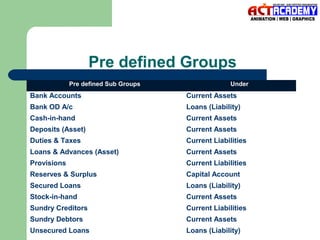
Pre defined Groups
Pre defined Sub Groups

Under

Bank Accounts

Current Assets

Bank OD A/c

Loans (Liability)

Cash-in-hand

Current Assets

Deposits (Asset)

Current Assets

Duties & Taxes

Current Liabilities

Loans & Advances (Asset)

Current Assets

Provisions

Current Liabilities

Reserves & Surplus

Capital Account

Secured Loans

Loans (Liability)

Stock-in-hand

Current Assets

Sundry Creditors

Current Liabilities

Sundry Debtors

Current Assets

Unsecured Loans

Loans (Liability)
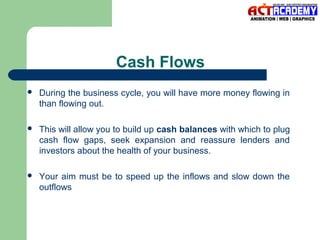
Cash Flows


During the business cycle, you will have more money flowing in
than flowing out.



This will allow you to build up cash balances with which to plug
cash flow gaps, seek expansion and reassure lenders and
investors about the health of your business.



Your aim must be to speed up the inflows and slow down the
outflows
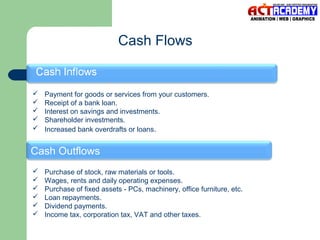
Cash Flows







Payment for goods or services from your customers.
Receipt of a bank loan.
Interest on savings and investments.
Shareholder investments.
Increased bank overdrafts or loans.

Cash Outflows







Purchase of stock, raw materials or tools.
Wages, rents and daily operating expenses.
Purchase of fixed assets - PCs, machinery, office furniture, etc.
Loan repayments.
Dividend payments.
Income tax, corporation tax, VAT and other taxes.
OVERSTATED

Overstated is that amount which is more than correct
amount in the account.
It is error of commission and it can rectify by passing
rectify entry. For instance, if outstanding wages are
wrongly written Rs. 12000 but actual outstanding
wages are Rs. 10,000, then Rs. 2000 is overstated and
its bad effect will be on wages account because wage
account will also overstated with Rs. 2000 and our
profit will reduce with Rs. 2000. So, to rectify to
overstated error is must.
What is Tax


A fee charged by a government on a product, income, or
activity.



If tax is levied directly on personal or corporate income, then it
is a direct tax.



If tax is levied on the price of a good or service, then it is called
an indirect tax.



The purpose of taxation is to finance government expenditure.
One of the most important uses of taxes is to finance public
goods and services, such as street lighting and street cleaning.
Taxes in Tally


Value Added Tax



Tax Deducted at Source



Service tax



Tax Collected at Source



Central sales tax



Fringe benefit Tax



Excise tax
Value Added Tax


Value added tax is a consumption tax.



This is a simple method of multiple taxes on an individual product.



VAT system levies tax on every level of value addition to the product or
goods.



This is the new system being implemented from April 1, 2005.



VAT is calculated based on Input & Output variation.



Input tax is paid on purchases.



Output tax is paid on sales.



Input credit is the excess amount of input tax over output tax
VAT rates


There are three main rates for Input and Output Vat
tax.



0% for Agriculture products.



1% for Jewellery



4% for Pharma, Computers, Soaps etc.



12.5% for Cement, Automobile
Tax Deducted at Source


Tax deducted at source (TDS) is one of the modes of
collecting income tax.



The buyer (deductor) deducts the tax from the payment made
to the seller (deductee) and remits the tax to the Income Tax
Department within the stipulated time.



The buyer makes payments (such as salary, rent, Interest on
securities, dividends, insurance, commission, Professional
fees, commission on brokerage, commission on lottery tickets,
etc) to the seller.
TDS Deduction Chart
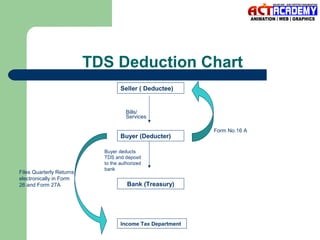
Seller ( Deductee)

Bills/
Services

Buyer (Deducter)

Files Quarterly Returns
electronically in Form
26 and Form 27A

Buyer deducts
TDS and deposit
to the authorized
bank

Bank (Treasury)

Income Tax Department

Form No.16 A
Electronic TDS (E-TDS)


E-TDS return is a TDS return prepared in form No.24, 26 or 27 in
electronic media as per prescribed data structure in either a floppy or a
CD ROM.



The floppy or CD ROM prepared should be accompanied by a signed
verification in Form No.27A. As per Section 206 of Income Tax Act all
corporate and government deductors are compulsorily required to file
their TDS return on electronic media.
Service Tax


Service tax is indirect tax on services provided. Service tax is
paid by buyer of services to seller of services, who in turn,
deposits the tax with the government.



Some Service Tax categories are- Advertising Agency, Cable
operators, Maintenance and Repair service, Courier , Life
insurance Services, Telephone services, Banking and Financial
Services.
Credit Adjustment in Service Tax


The Service Tax paid by you on input services to your business
can be adjusted to the Service Tax payable by you. This is
called 'adjustment of Service Tax Credit.



If your input service (purchase) can be directly related to the
output service (sale) then you can use 100% credit adjustment
on the service tax payable.



If the input service is not solely used for the output service, then
20% credit adjustment is applicable.
What is ERP



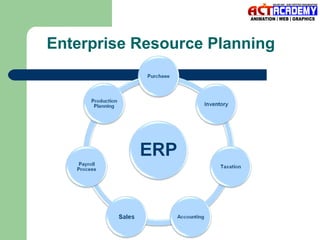
ERP is an abbreviation for Enterprise Resource Planning.
It is principally an integration of business management
practices and modern technology.



The term ERP originally referred to the way a large
organization planned to use its organizational wide resources.



It is a company-wide computer software system used to
manage

and

coordinate all

the

resources,

information,

and functions of a business from shared data stores.
Enterprise Resource Planning
Tax Collected at Source


TCS is Tax Collected at source by the seller on sale of some
specified goods .



Goods are defined under section 206C of the Income Tax Act,
1961 .



Some specific goods under TCS are Tendu leaves, Timber
obtained under a forest lease, Scrap, etc.

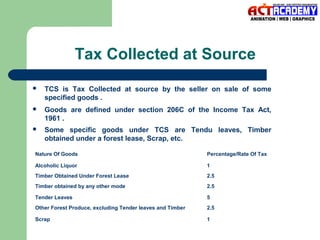
Nature Of Goods

Percentage/Rate Of Tax

Alcoholic Liquor

1

Timber Obtained Under Forest Lease

2.5

Timber obtained by any other mode

2.5

Tender Leaves

5

Other Forest Produce, excluding Tender leaves and Timber

2.5

Scrap

1
Exemption


A buyer who purchases specified goods for
manufacturing, processing or production of
goods/article or thing and not for trading, no tax
would be deducted. In such cases the buyer would
declare it in Form 27C to the seller.



The seller in turn would deliver one copy of Form
27C
collected
from
buyer
to
Chief
Commissioner/Commissioner of Income tax.
Central Sales Tax


This is the system being implemented from 1956.



Central state tax (CST) is Sales Tax arising from Inter-state sales
(when goods sold move from one state to another).



In case of any Inter state sales between two registered dealers, a
prescribed CST declaration Form must be issued to buyers/sellers.



Every dealer who effects inter-state sale is required to register with
State sales tax authorities who are empowered to grant registration
under CST Act. Application should be in form ‘A’. Security has to be
furnished. Certificate of registration will be in form ‘B’.
Forms Under CST


Form C, E-I/E-II, F, G, H, I and J have been
prescribed to avail concessional rate of CST.



Form C and E-I/E-II and F are required to be
collected and submitted on quarterly basis.



In case of forms H, I and J, no time limit has been
prescribed.



F form is to be obtained on monthly basis
CST (C Form)



A Form issued by the sales tax department to the registered
sales tax payer.



If Person buys any good from another registered sales tax
payer and issues a C form to him. Than that other sales tax
payer will not charge sales tax from him and sales tax will be
collected and deposited by the c form issuer and deposited in
the treasury of the govt.



If C form is lost, indemnity bond in form G is to be given and
then duplicate C form can be issued.
Fringe Benefit Tax


Fringe benefit tax (FBT) is a tax on benefits that
employees receive as a result of their employment,
including those benefits provided through someone
other than an employer.



Fringe benefits (perks) include most benefits given to
employees in addition to their salary or wages.
Category of FBT










Entertainment
Festival celebrations
Gifts
Use of club facilities
Employee welfare
Use of health club, sports and similar facilities
Sales promotion, including publicity
Use of telephone
Scholarship to the children of the employees.
Excise Tax


An excise or excise tax (sometimes called a duty of excise or a
special tax).



It is commonly understood to refer to an inland tax on the sale, or
production for sale, of specific goods within a country.



Excises are distinguished from customs duties.



An excise is considered an indirect tax, meaning that the producer
or seller who pays the tax to the government is expected to try to
recover or shift the tax by raising the price paid by the buyer.
Payroll Processing


Having access to employees pay, bonus, and other
special income records can be crucial for managers.



Businesses may even consider choosing a payroll
service systems that offers financial advise and one
that can analyze payroll records.

l
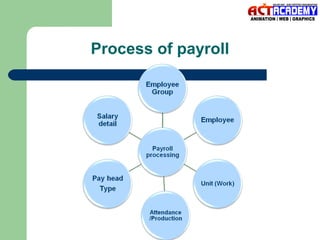
Process of payroll

Accounting ppt

  • 1.
  • 2.
    BUSINESS  Businesses are everywhere.They are the units that perform most of the economic activity in our economy. Businesses exist to generate a profit. The traditional definition of a business is an entity that brings together time, effort and capital in order to produce a profit. Following are the characteristics of a business:  Human Activity  Financial Nature  Profit Motive  Continuously
  • 3.
  • 4.
    WHAT IS ACCOUNTING Upto 1974, accounting was done the same way that the Egyptians did it 3,000 years before. Accounting is the art of systematic recording, reporting, and analysis of financial transactions of a business. The person in charge of accounting is known as an accountant. WHAT IS BOOK KEEPING Bookkeeping is the recording of financial transactions. Transactions include sales, purchases, income, receipts and payments by an individual or organization. Bookkeeping is usually performed by a bookkeeper.
  • 5.
  • 6.
    Real Accounts(Assets A/c) Cash,Stock, Purchase, Sales, Building, Machine, Furniture, Goodwill, Patent, Copy-Right, Trade Mark, Investments, Motor Cars etc……
  • 7.
    Personal Accounts( A/c) Ram,Rajesh, X, Y, Z, Capital, Drawing, Outstanding Expenses, Prepaid Expenses, Accrued, Income, Un-accrued Incomes A/c, Debtors A/c, Creditors A/c, Bank A/c, Reliance, TATA, IMT, DMC Career Academy, Shantosh Hospital, BSNL, Railway etc.
  • 8.
    Nominal Accounts Salary, Wages,Discount, Rent, Commission, Postage, Refreshment, Carriage, Depreciation, Interest, Bank Charges……….
  • 9.
  • 10.
    Financial Accounting  It isthe original form of accounting.  It is mainly confined to the preparation of financial statements for the use of outsiders like creditors, banks and financial institutions etc.  The chief purpose of financial accounting is to calculate profit or loss made by the business during the year and exhibit financial position of the business as on a particular date.
  • 11.
    Cost Accounting  Function ofcost accounting is to ascertain the cost of the product and to help the management in the control of cost.
  • 12.
    Management Accounting  It isaccounting for management.  Accounting which provides necessary information to the management for discharging its functions.  It is the reproduction of financial accounts in such a way as will enable the management to take decisions and to control various business activities
  • 13.
  • 14.
    Single Entry System It means to record one side of entry.  Suppose, we sell our furniture, we have not to record furniture sale but we just record total cash received from furniture. So, in single entry accounting, we records cash, account receivables,
  • 15.
    Double Entry System Inventedby………………. “Lucas Pasioli” of………………………… ‘Italy’ In …………………………’1494’ [ He said that every transaction have two sides……….. ] Transactions: Receiver……..…. Giver Comes in………….….Goes Out Expenses/ Losses …. Incomes/ Gains
  • 16.
    Double Entry System  Inthis system, both cash and credit transactions are recognized.  The double entry system was first used in Genoa, Italy around the 13th century and was further polished in Venice.  all transactions will have dual aspects (debit and credit) and that is why it’s called Double Entry System.  The word Debit comes from the Latin word "debita" (Italian "debito“).  The word Credit comes from the Latin word "credo" (Italian "credito“).
  • 17.
    What is Tally     Tallyis used to store and maintain daily business transactions like purchases, sales, receipts, payments, purchase returns, sales returns, deposits and withdrawals etc. popular FA software packages are Tally, Busy etc. Tally is the number one financial accounting package in India and is also used abroad. With tally you could be the owner, the financial controller, accountant, manager, auditor or anyone connected with accounts. The fundamentals behind tally are simple enough for learn accounting
  • 18.
    Essential Feature Tally isthe software of Tally Solution Pvt Ltd.Co. The initial name of Tally Peutronics Pvt. Ltd. developer of tally software Late Shri S. S. Goenka finishing touch to the tally Bharat (son of S.S. Goenka) tally software launched In 1986 double entry system is started In 1494 double entry system Inventor Benedetto Cotrugli, Lucas Pacioli defaults groups in tally 28 Groups Item- wise detail of goods Inventory
  • 19.
    GROUPS  Groups are collectionof Ledgers of the same nature. Account Groups are maintained to determine the hierarchy of Ledger Accounts which is helpful in determining and presenting meaningful and compliant reports.  Choosing a correct group for a ledger account help in viewing the financial position in a better way otherwise the financial statements will not give a true and correct picture.
  • 20.
  • 21.
    Tangible Asset Fixed Asset Assetsthat have a physical form. Tangible assets include both fixed assets, such as machinery, buildings and land, and current assets, such as inventory. Assets are property or economic resources that are expected to provide a future benefit to a business Current Asset Definition of Current Assets: assets in the form of cash (or easily convertible into cash)
  • 22.
    Intangible Asset  Anasset that is not physical in nature.  Corporate intellectual property (items such as patents, trademarks, copyrights, business methodologies) Goodwill and brand recognition are all common intangible assets in today's marketplace. An intangible asset can be classified as either indefinite or definite depending on the specifics of that asset. A company brand name is considered to be an indefinite asset, as it stays with the company as long as the company continues operations.
  • 23.
    Liability  Current liabilities —these liabilities are reasonably expected to be liquidated within a year. They usually include payables such as wages, accounts, taxes, and accounts payables, unearned revenue when adjusting entries, portions of long-term bonds to be paid this year, short-term obligations.  Long-term liabilities — these liabilities are reasonably expected not to be liquidated within a year. They usually include issued long-term bonds, notes payables, long term leases, pension obligations, and long-term product warranties.
  • 24.
    TYPE OF DISCOUNT Itis rebate or allowance from the scheduled price granted by the seller to the buyer. Trade discount is usually granted in the following circumstances: When selling to a fellow trader. When the buyer is an old customer. When sales are made in bulk. As the Custom of trade Cash Discount It is deduction or allowance allowed by creditor to a debtor. If a person pays his debit before the due date of payment the recipient may grant him an allowance for doing so. This allowance is known as cash discount
  • 25.
    Primary and Subgroups 15Primary Groups Branch / Divisions Capital Account Current Assets Current Liabilities Direct Expenses Direct Incomes Fixed Assets Indirect Expenses Indirect Incomes Investments Loans (Liability) Misc. Expenses (ASSET) Purchase Accounts Sales Accounts Suspense A/c 13 Sub Groups Bank Accounts Bank OD A/c Cash-in-hand Deposits (Asset) Duties & Taxes Loans & Advances (Asset) Provisions Reserves & Surplus Secured Loans Stock-in-hand Sundry Creditors Sundry Debtors Unsecured Loans
  • 26.
    Pre defined Groups Predefined Sub Groups Under Bank Accounts Current Assets Bank OD A/c Loans (Liability) Cash-in-hand Current Assets Deposits (Asset) Current Assets Duties & Taxes Current Liabilities Loans & Advances (Asset) Current Assets Provisions Current Liabilities Reserves & Surplus Capital Account Secured Loans Loans (Liability) Stock-in-hand Current Assets Sundry Creditors Current Liabilities Sundry Debtors Current Assets Unsecured Loans Loans (Liability)
  • 27.
    Cash Flows  During thebusiness cycle, you will have more money flowing in than flowing out.  This will allow you to build up cash balances with which to plug cash flow gaps, seek expansion and reassure lenders and investors about the health of your business.  Your aim must be to speed up the inflows and slow down the outflows
  • 28.
    Cash Flows      Payment forgoods or services from your customers. Receipt of a bank loan. Interest on savings and investments. Shareholder investments. Increased bank overdrafts or loans. Cash Outflows       Purchase of stock, raw materials or tools. Wages, rents and daily operating expenses. Purchase of fixed assets - PCs, machinery, office furniture, etc. Loan repayments. Dividend payments. Income tax, corporation tax, VAT and other taxes.
  • 29.
    OVERSTATED Overstated is thatamount which is more than correct amount in the account. It is error of commission and it can rectify by passing rectify entry. For instance, if outstanding wages are wrongly written Rs. 12000 but actual outstanding wages are Rs. 10,000, then Rs. 2000 is overstated and its bad effect will be on wages account because wage account will also overstated with Rs. 2000 and our profit will reduce with Rs. 2000. So, to rectify to overstated error is must.
  • 30.
    What is Tax  Afee charged by a government on a product, income, or activity.  If tax is levied directly on personal or corporate income, then it is a direct tax.  If tax is levied on the price of a good or service, then it is called an indirect tax.  The purpose of taxation is to finance government expenditure. One of the most important uses of taxes is to finance public goods and services, such as street lighting and street cleaning.
  • 31.
    Taxes in Tally  ValueAdded Tax  Tax Deducted at Source  Service tax  Tax Collected at Source  Central sales tax  Fringe benefit Tax  Excise tax
  • 32.
    Value Added Tax  Valueadded tax is a consumption tax.  This is a simple method of multiple taxes on an individual product.  VAT system levies tax on every level of value addition to the product or goods.  This is the new system being implemented from April 1, 2005.  VAT is calculated based on Input & Output variation.  Input tax is paid on purchases.  Output tax is paid on sales.  Input credit is the excess amount of input tax over output tax
  • 33.
    VAT rates  There arethree main rates for Input and Output Vat tax.  0% for Agriculture products.  1% for Jewellery  4% for Pharma, Computers, Soaps etc.  12.5% for Cement, Automobile
  • 34.
    Tax Deducted atSource  Tax deducted at source (TDS) is one of the modes of collecting income tax.  The buyer (deductor) deducts the tax from the payment made to the seller (deductee) and remits the tax to the Income Tax Department within the stipulated time.  The buyer makes payments (such as salary, rent, Interest on securities, dividends, insurance, commission, Professional fees, commission on brokerage, commission on lottery tickets, etc) to the seller.
  • 35.
    TDS Deduction Chart Seller( Deductee) Bills/ Services Buyer (Deducter) Files Quarterly Returns electronically in Form 26 and Form 27A Buyer deducts TDS and deposit to the authorized bank Bank (Treasury) Income Tax Department Form No.16 A
  • 36.
    Electronic TDS (E-TDS)  E-TDSreturn is a TDS return prepared in form No.24, 26 or 27 in electronic media as per prescribed data structure in either a floppy or a CD ROM.  The floppy or CD ROM prepared should be accompanied by a signed verification in Form No.27A. As per Section 206 of Income Tax Act all corporate and government deductors are compulsorily required to file their TDS return on electronic media.
  • 37.
    Service Tax  Service taxis indirect tax on services provided. Service tax is paid by buyer of services to seller of services, who in turn, deposits the tax with the government.  Some Service Tax categories are- Advertising Agency, Cable operators, Maintenance and Repair service, Courier , Life insurance Services, Telephone services, Banking and Financial Services.
  • 38.
    Credit Adjustment inService Tax  The Service Tax paid by you on input services to your business can be adjusted to the Service Tax payable by you. This is called 'adjustment of Service Tax Credit.  If your input service (purchase) can be directly related to the output service (sale) then you can use 100% credit adjustment on the service tax payable.  If the input service is not solely used for the output service, then 20% credit adjustment is applicable.
  • 39.
    What is ERP   ERPis an abbreviation for Enterprise Resource Planning. It is principally an integration of business management practices and modern technology.  The term ERP originally referred to the way a large organization planned to use its organizational wide resources.  It is a company-wide computer software system used to manage and coordinate all the resources, information, and functions of a business from shared data stores.
  • 40.
  • 41.
    Tax Collected atSource  TCS is Tax Collected at source by the seller on sale of some specified goods .  Goods are defined under section 206C of the Income Tax Act, 1961 .  Some specific goods under TCS are Tendu leaves, Timber obtained under a forest lease, Scrap, etc. Nature Of Goods Percentage/Rate Of Tax Alcoholic Liquor 1 Timber Obtained Under Forest Lease 2.5 Timber obtained by any other mode 2.5 Tender Leaves 5 Other Forest Produce, excluding Tender leaves and Timber 2.5 Scrap 1
  • 42.
    Exemption  A buyer whopurchases specified goods for manufacturing, processing or production of goods/article or thing and not for trading, no tax would be deducted. In such cases the buyer would declare it in Form 27C to the seller.  The seller in turn would deliver one copy of Form 27C collected from buyer to Chief Commissioner/Commissioner of Income tax.
  • 43.
    Central Sales Tax  Thisis the system being implemented from 1956.  Central state tax (CST) is Sales Tax arising from Inter-state sales (when goods sold move from one state to another).  In case of any Inter state sales between two registered dealers, a prescribed CST declaration Form must be issued to buyers/sellers.  Every dealer who effects inter-state sale is required to register with State sales tax authorities who are empowered to grant registration under CST Act. Application should be in form ‘A’. Security has to be furnished. Certificate of registration will be in form ‘B’.
  • 44.
    Forms Under CST  FormC, E-I/E-II, F, G, H, I and J have been prescribed to avail concessional rate of CST.  Form C and E-I/E-II and F are required to be collected and submitted on quarterly basis.  In case of forms H, I and J, no time limit has been prescribed.  F form is to be obtained on monthly basis
  • 45.
    CST (C Form)  AForm issued by the sales tax department to the registered sales tax payer.  If Person buys any good from another registered sales tax payer and issues a C form to him. Than that other sales tax payer will not charge sales tax from him and sales tax will be collected and deposited by the c form issuer and deposited in the treasury of the govt.  If C form is lost, indemnity bond in form G is to be given and then duplicate C form can be issued.
  • 46.
    Fringe Benefit Tax  Fringebenefit tax (FBT) is a tax on benefits that employees receive as a result of their employment, including those benefits provided through someone other than an employer.  Fringe benefits (perks) include most benefits given to employees in addition to their salary or wages.
  • 47.
    Category of FBT          Entertainment Festivalcelebrations Gifts Use of club facilities Employee welfare Use of health club, sports and similar facilities Sales promotion, including publicity Use of telephone Scholarship to the children of the employees.
  • 48.
    Excise Tax  An exciseor excise tax (sometimes called a duty of excise or a special tax).  It is commonly understood to refer to an inland tax on the sale, or production for sale, of specific goods within a country.  Excises are distinguished from customs duties.  An excise is considered an indirect tax, meaning that the producer or seller who pays the tax to the government is expected to try to recover or shift the tax by raising the price paid by the buyer.
  • 49.
    Payroll Processing  Having accessto employees pay, bonus, and other special income records can be crucial for managers.  Businesses may even consider choosing a payroll service systems that offers financial advise and one that can analyze payroll records. l
  • 50.