by
Gary Allen & Dona Do
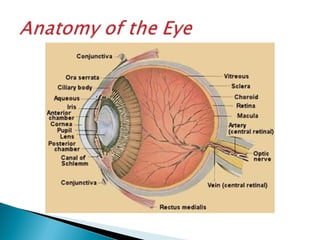
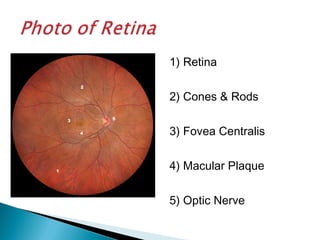
1) Retina
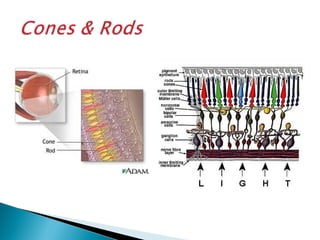
2) Cones & Rods
3) Fovea Centralis
4) Macular Plaque
5) Optic Nerve
 What is it?
 Who gets it?
 Why would you want
it?
 What are the risks?
 What are the
benefits?
 How expensive is it?
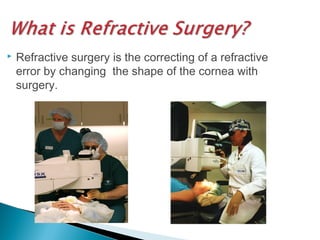
 Refractive surgery is the correcting of a refractive
error by changing the shape of the cornea with
surgery.
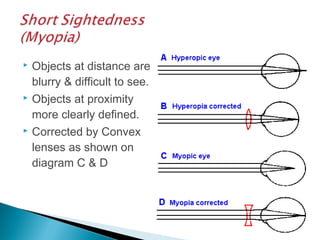
 Objects at distance are
blurry & difficult to see.
 Objects at proximity
more clearly defined.
 Corrected by Convex
lenses as shown on
diagram C & D
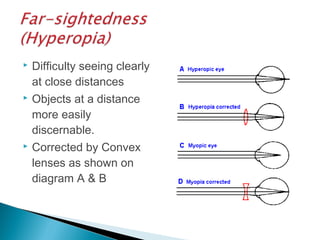
 Difficulty seeing clearly
at close distances
 Objects at a distance
more easily
discernable.
 Corrected by Convex
lenses as shown on
diagram A & B
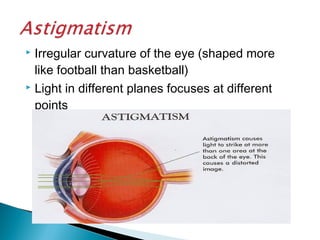
 Irregular curvature of the eye (shaped more
like football than basketball)
 Light in different planes focuses at different
points
 Flattening the cornea decreases myopia
 Increasing the steepness of the cornea decreases
Hyperopia
 Making the cornea more spherical decreases
Astigmatism
 All of these are correctable to some greater or
lesser degree through refractive surgeries
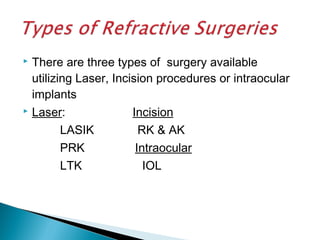
 There are three types of surgery available
utilizing Laser, Incision procedures or intraocular
implants
 Laser: Incision
LASIK RK & AK
PRK Intraocular
LTK IOL
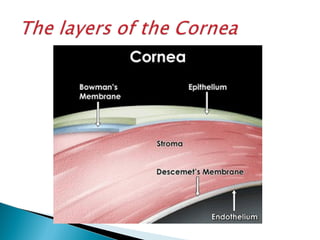
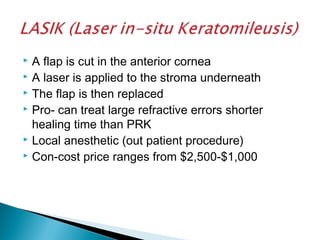
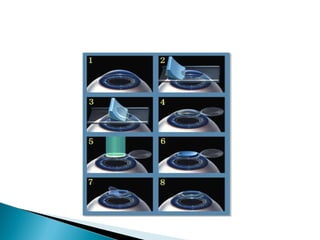
 A flap is cut in the anterior cornea
 A laser is applied to the stroma underneath
 The flap is then replaced
 Pro- can treat large refractive errors shorter
healing time than PRK
 Local anesthetic (out patient procedure)
 Con-cost price ranges from $2,500-$1,000
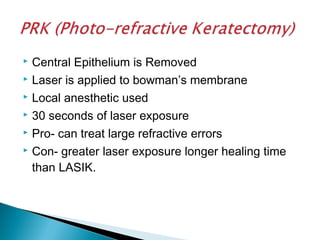
 Central Epithelium is Removed
 Laser is applied to bowman’s membrane
 Local anesthetic used
 30 seconds of laser exposure
 Pro- can treat large refractive errors
 Con- greater laser exposure longer healing time
than LASIK.
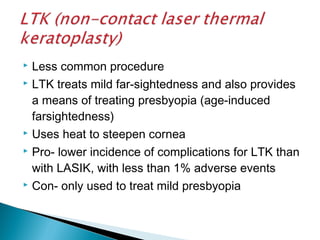
 Less common procedure
 LTK treats mild far-sightedness and also provides
a means of treating presbyopia (age-induced
farsightedness)
 Uses heat to steepen cornea
 Pro- lower incidence of complications for LTK than
with LASIK, with less than 1% adverse events
 Con- only used to treat mild presbyopia
 RK= Radial keratotomy for myopia
 AK= Astigmatic keratotomy for astigmatism
 Incisions in cornea heal causing reshaping of eye
 Pro-can be done in poorer countries
 Con- higher risk of complications, less effective,
obsolete
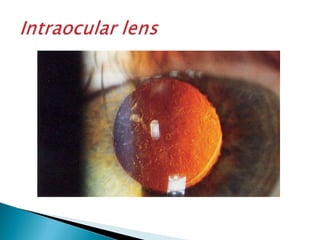
 Phakic Intraocular lenses
 Implanted into eye without removing the
natural lens
 Refractive lens-ectomy
 Natural lens is removed from eye and replaced
with intraocular lens
 PRO- for high myopia and cataracts
 Con- cost upwards of $1500 per eye.
1) Must have had no
vision changes for
at least two years
2) No underlying
corneal abnormalities
3) No use of contact
lenses prior to surgery
 Some anti-inflammatory
medications are required
 Possibility of infection
based on procedure
 Sunglasses outside are
recommended for the first
two weeks
 Eye rubbing can cause
damage
 Some problems with glare
can be noticed
 Vision can be improved to
20/20 or greater but there is
no guarantee of perfect
vision.
 Over time the corneal
shape can gradually
change requiring the need
of glasses for reading this
usually happens to
candidates over 40-50
years of age.
 What is it?
 Who gets it?
 Why would you want it?
 What are the risks?
 What are the benefits?
 How expensive is it?
 The evolution in correction
of vision
 Any one who fits criteria &
wants better vision
 Very small 0.1-0.9% have
some form of complications
 Benefits include improved
vision to greater or lesser
degree.
 Prices Range $1000-$2500
per eye

Final version lasik ppt

  • 1.
  • 4.
    1) Retina 2) Cones& Rods 3) Fovea Centralis 4) Macular Plaque 5) Optic Nerve
  • 7.
     What isit?  Who gets it?  Why would you want it?  What are the risks?  What are the benefits?  How expensive is it?
  • 8.
     Refractive surgeryis the correcting of a refractive error by changing the shape of the cornea with surgery.
  • 10.
     Objects atdistance are blurry & difficult to see.  Objects at proximity more clearly defined.  Corrected by Convex lenses as shown on diagram C & D
  • 11.
     Difficulty seeingclearly at close distances  Objects at a distance more easily discernable.  Corrected by Convex lenses as shown on diagram A & B
  • 12.
     Irregular curvatureof the eye (shaped more like football than basketball)  Light in different planes focuses at different points
  • 13.
     Flattening thecornea decreases myopia  Increasing the steepness of the cornea decreases Hyperopia  Making the cornea more spherical decreases Astigmatism  All of these are correctable to some greater or lesser degree through refractive surgeries
  • 14.
     There arethree types of surgery available utilizing Laser, Incision procedures or intraocular implants  Laser: Incision LASIK RK & AK PRK Intraocular LTK IOL
  • 16.
     A flapis cut in the anterior cornea  A laser is applied to the stroma underneath  The flap is then replaced  Pro- can treat large refractive errors shorter healing time than PRK  Local anesthetic (out patient procedure)  Con-cost price ranges from $2,500-$1,000
  • 17.
     Central Epitheliumis Removed  Laser is applied to bowman’s membrane  Local anesthetic used  30 seconds of laser exposure  Pro- can treat large refractive errors  Con- greater laser exposure longer healing time than LASIK.
  • 18.
     Less commonprocedure  LTK treats mild far-sightedness and also provides a means of treating presbyopia (age-induced farsightedness)  Uses heat to steepen cornea  Pro- lower incidence of complications for LTK than with LASIK, with less than 1% adverse events  Con- only used to treat mild presbyopia
  • 20.
     RK= Radialkeratotomy for myopia  AK= Astigmatic keratotomy for astigmatism  Incisions in cornea heal causing reshaping of eye  Pro-can be done in poorer countries  Con- higher risk of complications, less effective, obsolete
  • 21.
     Phakic Intraocularlenses  Implanted into eye without removing the natural lens  Refractive lens-ectomy  Natural lens is removed from eye and replaced with intraocular lens  PRO- for high myopia and cataracts  Con- cost upwards of $1500 per eye.
  • 23.
    1) Must havehad no vision changes for at least two years 2) No underlying corneal abnormalities 3) No use of contact lenses prior to surgery
  • 24.
     Some anti-inflammatory medicationsare required  Possibility of infection based on procedure  Sunglasses outside are recommended for the first two weeks  Eye rubbing can cause damage  Some problems with glare can be noticed  Vision can be improved to 20/20 or greater but there is no guarantee of perfect vision.  Over time the corneal shape can gradually change requiring the need of glasses for reading this usually happens to candidates over 40-50 years of age.
  • 25.
     What isit?  Who gets it?  Why would you want it?  What are the risks?  What are the benefits?  How expensive is it?  The evolution in correction of vision  Any one who fits criteria & wants better vision  Very small 0.1-0.9% have some form of complications  Benefits include improved vision to greater or lesser degree.  Prices Range $1000-$2500 per eye