MEXICO
KNOW YOUR COMMUNITY
KNOW YOUR WORLD
A PROGRAM OF GLOBAL TIES AKRON
INSERT COUNTRY FLAG HERE
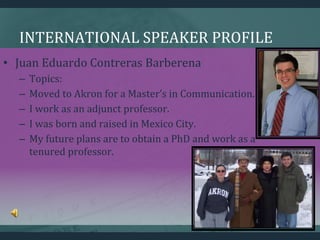
INTERNATIONAL SPEAKER PROFILE
• Juan Eduardo Contreras Barberena
– Topics:
– Moved to Akron for a Master’s in Communication.
– I work as an adjunct professor.
– I was born and raised in Mexico City.
– My future plans are to obtain a PhD and work as a
tenured professor.
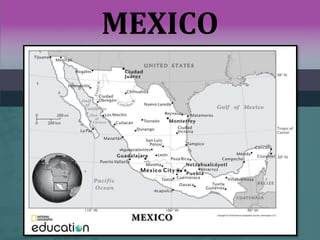
MEXICO
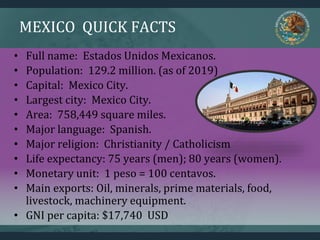
MEXICO QUICK FACTS
• Full name: Estados Unidos Mexicanos.
• Population: 129.2 million. (as of 2019)
• Capital: Mexico City.
• Largest city: Mexico City.
• Area: 758,449 square miles.
• Major language: Spanish.
• Major religion: Christianity / Catholicism
• Life expectancy: 75 years (men); 80 years (women).
• Monetary unit: 1 peso = 100 centavos.
• Main exports: Oil, minerals, prime materials, food,
livestock, machinery equipment.
• GNI per capita: $17,740 USD
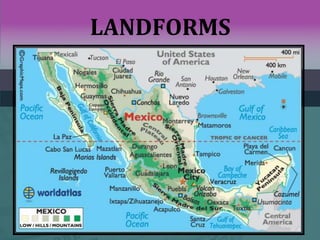
LANDFORMS
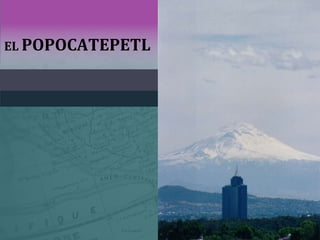
EL POPOCATEPETL
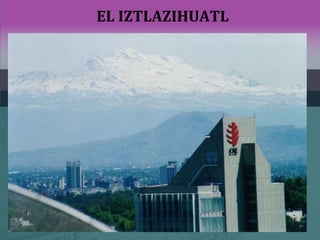
EL IZTLAZIHUATL
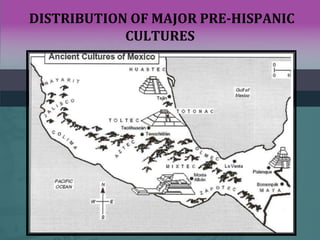
DISTRIBUTION OF MAJOR PRE-HISPANIC
CULTURES
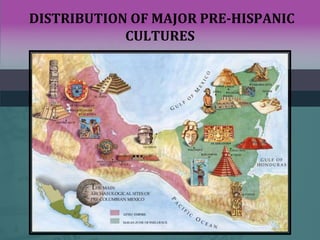
DISTRIBUTION OF MAJOR PRE-HISPANIC
CULTURES
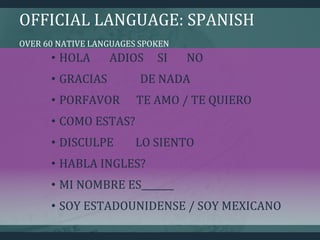
OFFICIAL LANGUAGE: SPANISH
OVER 60 NATIVE LANGUAGES SPOKEN
• HOLA ADIOS SI NO
• GRACIAS DE NADA
• PORFAVOR TE AMO / TE QUIERO
• COMO ESTAS?
• DISCULPE LO SIENTO
• HABLA INGLES?
• MI NOMBRE ES_______
• SOY ESTADOUNIDENSE / SOY MEXICANO
MEXICO
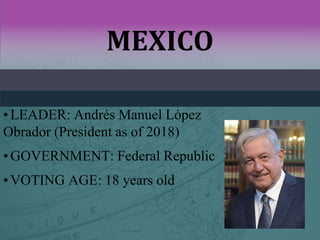
•LEADER: Andrés Manuel López
Obrador (President as of 2018)
•GOVERNMENT: Federal Republic
•VOTING AGE: 18 years old
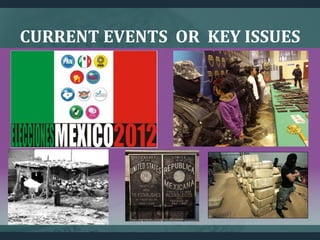
CURRENT EVENTS OR KEY ISSUES
ECONOMICS
⦿Known for: Oil, agriculture, and mined metals
(mainly silver), manufacturing.
⦿Imports: Machinery products for all industries,
including agriculture, manufacturing,
transportation, and transportation. Bootlegged
products.
⦿Exports: Oil, manufactured goods, silver, fruits and
vegetables, coffee, cotton. Bootlegged products.
⦿State of the economy: Many industries are still in
development. There is substantial debt, and a high
percentage of underground economy (non-tax
payers).
EVERYDAY-ECONOMICS
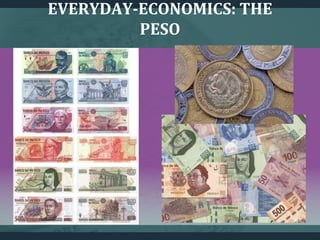
• Currency: Mexican Pesos (1 Peso =$ 0.052)
• Public and private banks. Credits and loans are
available.
• Jobs: People start working depending on their
economic bracket. The extremely poor start as
children, the poor start as pre-teens, the middle
class as teenagers, and the rich start in college
years.
• Students and money: middle and high class kids
get an allowance; it varies for the poor because
their work earnings are all meant to help the
household.
EVERYDAY-ECONOMICS: THE
PESO
RELIGION(S)
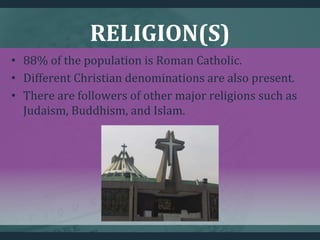
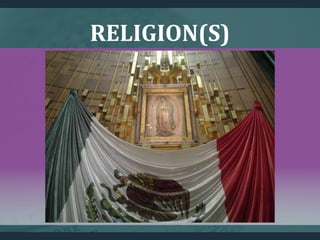
• 88% of the population is Roman Catholic.
• Different Christian denominations are also present.
• There are followers of other major religions such as
Judaism, Buddhism, and Islam.
RELIGION(S)
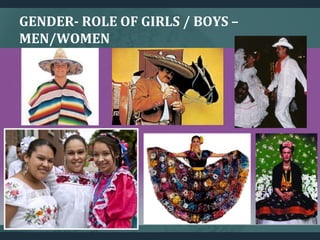
GENDER- ROLE OF GIRLS / BOYS –
MEN/WOMEN
• Growing up: Emphasis is given to school and
family life. Recreation activities vary between
cities and small towns. After school programs are
rare.
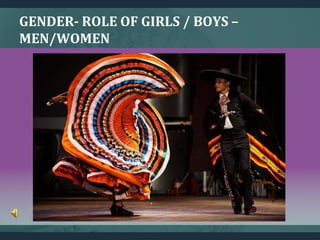
• Dress: Typical dress varies from region to region.
In urban areas, typical dress is saved for Mexican
holidays.
• Gender rites: Quinceañera.
GENDER- ROLE OF GIRLS / BOYS –
MEN/WOMEN
GENDER- ROLE OF GIRLS / BOYS –
MEN/WOMEN
GENDER- ROLE OF GIRLS / BOYS –
MEN/WOMEN
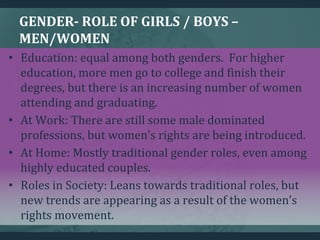
• Education: equal among both genders. For higher
education, more men go to college and finish their
degrees, but there is an increasing number of women
attending and graduating.
• At Work: There are still some male dominated
professions, but women’s rights are being introduced.
• At Home: Mostly traditional gender roles, even among
highly educated couples.
• Roles in Society: Leans towards traditional roles, but
new trends are appearing as a result of the women’s
rights movement.
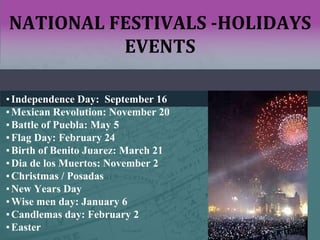
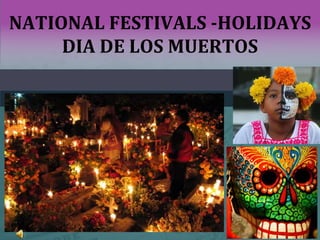
NATIONAL FESTIVALS -HOLIDAYS
EVENTS
▪Independence Day: September 16
▪Mexican Revolution: November 20
▪Battle of Puebla: May 5
▪Flag Day: February 24
▪Birth of Benito Juarez: March 21
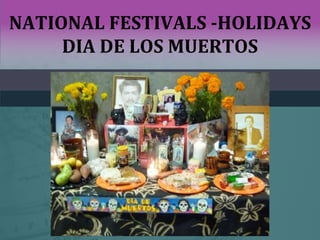
▪Dia de los Muertos: November 2
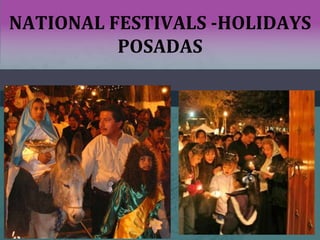
▪Christmas / Posadas
▪New Years Day
▪Wise men day: January 6
▪Candlemas day: February 2
▪Easter
NATIONAL FESTIVALS -HOLIDAYS
POSADAS
NATIONAL FESTIVALS -HOLIDAYS
DIA DE LOS MUERTOS
NATIONAL FESTIVALS -HOLIDAYS
DIA DE LOS MUERTOS
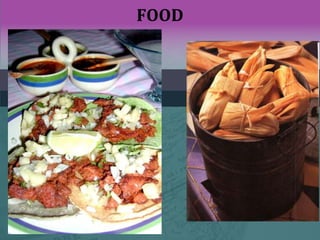
FOOD
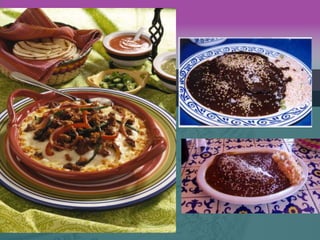
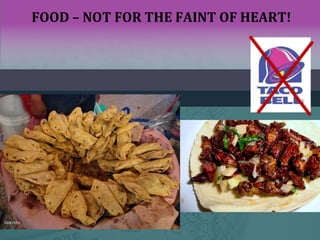
FOOD – NOT FOR THE FAINT OF HEART!
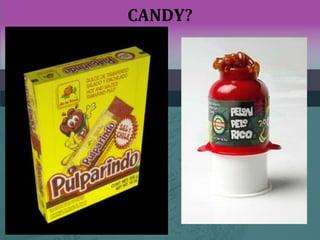
CANDY?
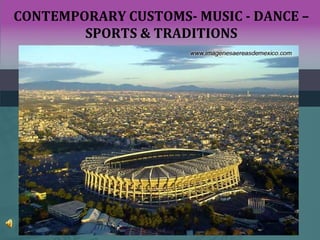
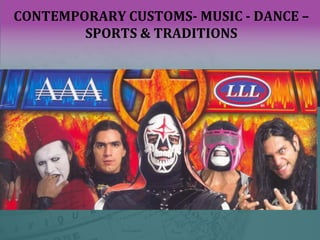
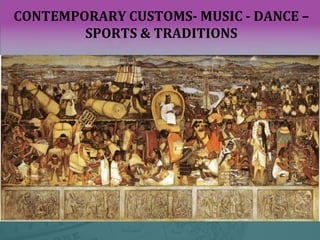
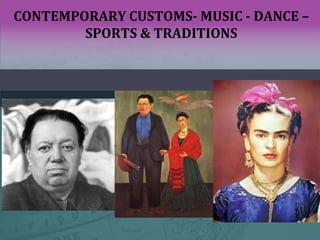
CONTEMPORARY CUSTOMS- MUSIC - DANCE –
SPORTS & TRADITIONS
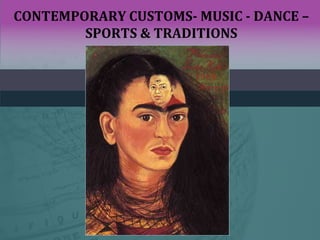
CONTEMPORARY CUSTOMS- MUSIC - DANCE –
SPORTS & TRADITIONS
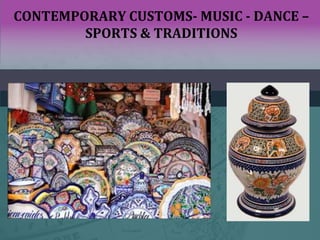
CONTEMPORARY CUSTOMS- MUSIC - DANCE –
SPORTS & TRADITIONS
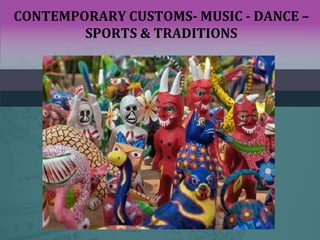
CONTEMPORARY CUSTOMS- MUSIC - DANCE –
SPORTS & TRADITIONS
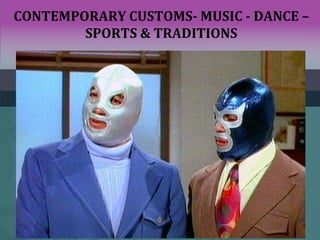
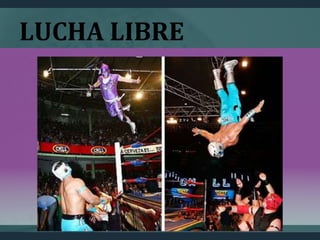
LUCHA LIBRE
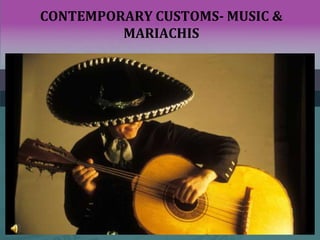
CONTEMPORARY CUSTOMS- MUSIC &
MARIACHIS
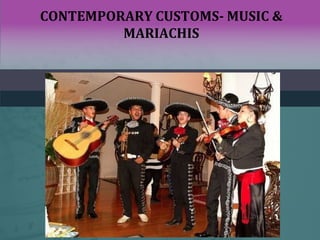
CONTEMPORARY CUSTOMS- MUSIC &
MARIACHIS
CONTEMPORARY CUSTOMS- MUSIC - DANCE –
SPORTS & TRADITIONS
CONTEMPORARY CUSTOMS- MUSIC - DANCE –
SPORTS & TRADITIONS
CONTEMPORARY CUSTOMS- MUSIC - DANCE –
SPORTS & TRADITIONS
CONTEMPORARY CUSTOMS- MUSIC - DANCE –
SPORTS & TRADITIONS
CONTEMPORARY CUSTOMS- MUSIC - DANCE –
SPORTS & TRADITIONS
CONTEMPORARY CUSTOMS- MUSIC - DANCE –
SPORTS & TRADITIONS
CONTEMPORARY CUSTOMS- MUSIC - DANCE –
SPORTS & TRADITIONS
CONTEMPORARY CUSTOMS- MUSIC - DANCE –
SPORTS & TRADITIONS
CONTEMPORARY CUSTOMS- MUSIC - DANCE –
SPORTS & TRADITIONS
CONTEMPORARY CUSTOMS- MUSIC - DANCE –
SPORTS & TRADITIONS
CONTEMPORARY CUSTOMS- MUSIC - DANCE –
SPORTS & TRADITIONS
CONTEMPORARY CUSTOMS- MUSIC - DANCE –
SPORTS & TRADITIONS
CONTEMPORARY CUSTOMS- MUSIC - DANCE –
SPORTS & TRADITIONS
CONTEMPORARY CUSTOMS- MUSIC - DANCE –
SPORTS & TRADITIONS
CONTEMPORARY CUSTOMS- MUSIC - DANCE –
SPORTS & TRADITIONS
CONTEMPORARY CUSTOMS- MUSIC - DANCE –
SPORTS & TRADITIONS
CONTEMPORARY CUSTOMS- MUSIC - DANCE –
SPORTS & TRADITIONS
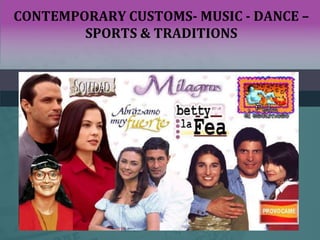
• American pop culture is closely followed in terms
of music, movies, television shows, and video games.
• Cell phones and social media (facebook and twitter
in particular) are extremely popular.
EVERYDAY LIVING
• Typical day schedule:
– Meal times are different: Largest meal is at 2-3pm, small
dinners at 8-9pm.
– In small towns, businesses will close from 2-4pm for
‘lunch’ and a short nap known as siesta, then people
return to work until around 8pm.
• A School Day/Week: The school experience for an
11-12 year old in Mexico is similar to the U.S.;
however, there are hardly any extracurricular
activities throughout the school year.
– Uniforms are widely used in many schools.
EVERYDAY LIVING
• English as a second language is commonly taught
in urban schools from an early age. Most private
schools are now bi-lingual (most English, some
French).
• Extracurricular Activities: Some sports have after-
school sports programs, but competitions and
tournaments between schools are sporadic.
Cheerleading programs are almost non-existant.
EVERYDAY LIVING
• Family Life: Families are extremely important.
Many times, children are somewhat involved in
household chores, but not as much as in the U.S.
• Extended family is considered extremely
important. Mexicans will go out of their way to
assist extensive family.
• Grandparents move in with their children when
they cannot take care of themselves. Retirement
homes and communities are rare and are destined
to those who have no family left.
EVERYDAY LIVING
• Acquisition of pets is common, with people mostly
choosing dogs and cats.
• Mexico is known for creating fairs in the center of
small towns. In urban areas, each municipality
within a city creates several fairs per year. Fairs
are family oriented events.
• Parks are common in large cities, though they can
be dangerous.
• In smaller cities and towns, parks are rare. People
use the main plaza at the center of each town as a
place for gathering.
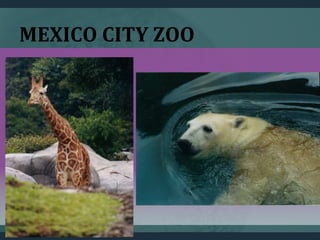
MEXICO CITY ZOO
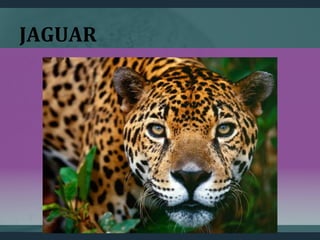
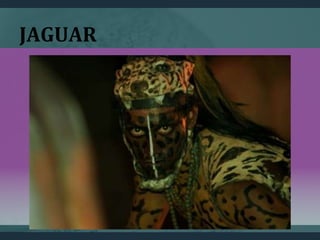
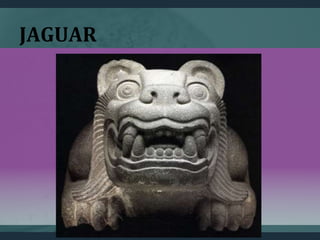
JAGUAR
JAGUAR
JAGUAR
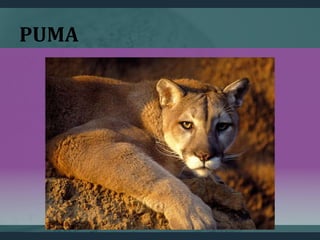
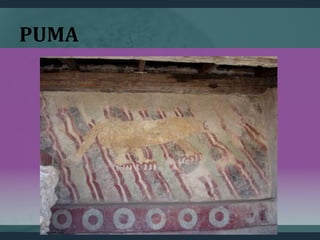
PUMA
PUMA
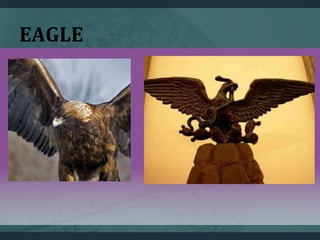
EAGLE
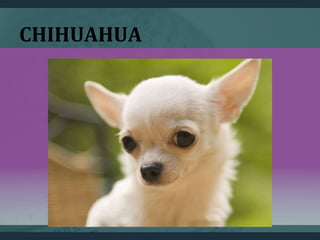
CHIHUAHUA
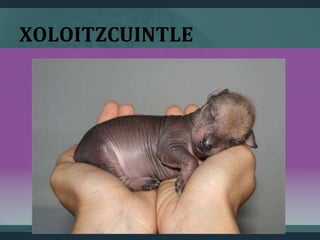
XOLOITZCUINTLE
XOLOITZCUINTLE
XOLOITZCUINTLE
SIMILARITIES-DIFFERENCES
• Can you notice similarities between Mexico and
the U.S.?
• What do you find most surprising? What do you
find interesting?
• The importance of appreciating cultural diversity
in the U.S.
LINKS
• Tourism: www.visitmexico.com
• History & Anthropology:
www.mna.inah.gob.mx/
inah.gob.mx/
• News Media:
www.excelsior.com.mx
www.eluniversal.com.mx
www2.esmas.com/usa/
Explore Mexico juan -kyckyw 2019

Explore Mexico juan -kyckyw 2019

  • 1.
    MEXICO KNOW YOUR COMMUNITY KNOWYOUR WORLD A PROGRAM OF GLOBAL TIES AKRON INSERT COUNTRY FLAG HERE
  • 2.
    INTERNATIONAL SPEAKER PROFILE •Juan Eduardo Contreras Barberena – Topics: – Moved to Akron for a Master’s in Communication. – I work as an adjunct professor. – I was born and raised in Mexico City. – My future plans are to obtain a PhD and work as a tenured professor.
  • 3.
  • 4.
    MEXICO QUICK FACTS •Full name: Estados Unidos Mexicanos. • Population: 129.2 million. (as of 2019) • Capital: Mexico City. • Largest city: Mexico City. • Area: 758,449 square miles. • Major language: Spanish. • Major religion: Christianity / Catholicism • Life expectancy: 75 years (men); 80 years (women). • Monetary unit: 1 peso = 100 centavos. • Main exports: Oil, minerals, prime materials, food, livestock, machinery equipment. • GNI per capita: $17,740 USD
  • 5.
  • 6.
  • 7.
  • 8.
    DISTRIBUTION OF MAJORPRE-HISPANIC CULTURES
  • 9.
    DISTRIBUTION OF MAJORPRE-HISPANIC CULTURES
  • 10.
    OFFICIAL LANGUAGE: SPANISH OVER60 NATIVE LANGUAGES SPOKEN • HOLA ADIOS SI NO • GRACIAS DE NADA • PORFAVOR TE AMO / TE QUIERO • COMO ESTAS? • DISCULPE LO SIENTO • HABLA INGLES? • MI NOMBRE ES_______ • SOY ESTADOUNIDENSE / SOY MEXICANO
  • 11.
    MEXICO •LEADER: Andrés ManuelLópez Obrador (President as of 2018) •GOVERNMENT: Federal Republic •VOTING AGE: 18 years old
  • 12.
  • 13.
    ECONOMICS ⦿Known for: Oil,agriculture, and mined metals (mainly silver), manufacturing. ⦿Imports: Machinery products for all industries, including agriculture, manufacturing, transportation, and transportation. Bootlegged products. ⦿Exports: Oil, manufactured goods, silver, fruits and vegetables, coffee, cotton. Bootlegged products. ⦿State of the economy: Many industries are still in development. There is substantial debt, and a high percentage of underground economy (non-tax payers).
  • 14.
    EVERYDAY-ECONOMICS • Currency: MexicanPesos (1 Peso =$ 0.052) • Public and private banks. Credits and loans are available. • Jobs: People start working depending on their economic bracket. The extremely poor start as children, the poor start as pre-teens, the middle class as teenagers, and the rich start in college years. • Students and money: middle and high class kids get an allowance; it varies for the poor because their work earnings are all meant to help the household.
  • 15.
  • 16.
    RELIGION(S) • 88% ofthe population is Roman Catholic. • Different Christian denominations are also present. • There are followers of other major religions such as Judaism, Buddhism, and Islam.
  • 17.
  • 18.
    GENDER- ROLE OFGIRLS / BOYS – MEN/WOMEN • Growing up: Emphasis is given to school and family life. Recreation activities vary between cities and small towns. After school programs are rare. • Dress: Typical dress varies from region to region. In urban areas, typical dress is saved for Mexican holidays. • Gender rites: Quinceañera.
  • 19.
    GENDER- ROLE OFGIRLS / BOYS – MEN/WOMEN
  • 20.
    GENDER- ROLE OFGIRLS / BOYS – MEN/WOMEN
  • 21.
    GENDER- ROLE OFGIRLS / BOYS – MEN/WOMEN • Education: equal among both genders. For higher education, more men go to college and finish their degrees, but there is an increasing number of women attending and graduating. • At Work: There are still some male dominated professions, but women’s rights are being introduced. • At Home: Mostly traditional gender roles, even among highly educated couples. • Roles in Society: Leans towards traditional roles, but new trends are appearing as a result of the women’s rights movement.
  • 22.
    NATIONAL FESTIVALS -HOLIDAYS EVENTS ▪IndependenceDay: September 16 ▪Mexican Revolution: November 20 ▪Battle of Puebla: May 5 ▪Flag Day: February 24 ▪Birth of Benito Juarez: March 21 ▪Dia de los Muertos: November 2 ▪Christmas / Posadas ▪New Years Day ▪Wise men day: January 6 ▪Candlemas day: February 2 ▪Easter
  • 23.
  • 24.
  • 25.
  • 26.
  • 28.
    FOOD – NOTFOR THE FAINT OF HEART!
  • 29.
  • 30.
    CONTEMPORARY CUSTOMS- MUSIC- DANCE – SPORTS & TRADITIONS
  • 31.
    CONTEMPORARY CUSTOMS- MUSIC- DANCE – SPORTS & TRADITIONS
  • 32.
    CONTEMPORARY CUSTOMS- MUSIC- DANCE – SPORTS & TRADITIONS
  • 33.
    CONTEMPORARY CUSTOMS- MUSIC- DANCE – SPORTS & TRADITIONS
  • 34.
  • 35.
  • 36.
  • 37.
    CONTEMPORARY CUSTOMS- MUSIC- DANCE – SPORTS & TRADITIONS
  • 38.
    CONTEMPORARY CUSTOMS- MUSIC- DANCE – SPORTS & TRADITIONS
  • 39.
    CONTEMPORARY CUSTOMS- MUSIC- DANCE – SPORTS & TRADITIONS
  • 40.
    CONTEMPORARY CUSTOMS- MUSIC- DANCE – SPORTS & TRADITIONS
  • 41.
    CONTEMPORARY CUSTOMS- MUSIC- DANCE – SPORTS & TRADITIONS
  • 42.
    CONTEMPORARY CUSTOMS- MUSIC- DANCE – SPORTS & TRADITIONS
  • 43.
    CONTEMPORARY CUSTOMS- MUSIC- DANCE – SPORTS & TRADITIONS
  • 44.
    CONTEMPORARY CUSTOMS- MUSIC- DANCE – SPORTS & TRADITIONS
  • 45.
    CONTEMPORARY CUSTOMS- MUSIC- DANCE – SPORTS & TRADITIONS
  • 46.
    CONTEMPORARY CUSTOMS- MUSIC- DANCE – SPORTS & TRADITIONS
  • 47.
    CONTEMPORARY CUSTOMS- MUSIC- DANCE – SPORTS & TRADITIONS
  • 48.
    CONTEMPORARY CUSTOMS- MUSIC- DANCE – SPORTS & TRADITIONS
  • 49.
    CONTEMPORARY CUSTOMS- MUSIC- DANCE – SPORTS & TRADITIONS
  • 50.
    CONTEMPORARY CUSTOMS- MUSIC- DANCE – SPORTS & TRADITIONS
  • 51.
    CONTEMPORARY CUSTOMS- MUSIC- DANCE – SPORTS & TRADITIONS
  • 52.
    CONTEMPORARY CUSTOMS- MUSIC- DANCE – SPORTS & TRADITIONS
  • 53.
    CONTEMPORARY CUSTOMS- MUSIC- DANCE – SPORTS & TRADITIONS • American pop culture is closely followed in terms of music, movies, television shows, and video games. • Cell phones and social media (facebook and twitter in particular) are extremely popular.
  • 54.
    EVERYDAY LIVING • Typicalday schedule: – Meal times are different: Largest meal is at 2-3pm, small dinners at 8-9pm. – In small towns, businesses will close from 2-4pm for ‘lunch’ and a short nap known as siesta, then people return to work until around 8pm. • A School Day/Week: The school experience for an 11-12 year old in Mexico is similar to the U.S.; however, there are hardly any extracurricular activities throughout the school year. – Uniforms are widely used in many schools.
  • 55.
    EVERYDAY LIVING • Englishas a second language is commonly taught in urban schools from an early age. Most private schools are now bi-lingual (most English, some French). • Extracurricular Activities: Some sports have after- school sports programs, but competitions and tournaments between schools are sporadic. Cheerleading programs are almost non-existant.
  • 56.
    EVERYDAY LIVING • FamilyLife: Families are extremely important. Many times, children are somewhat involved in household chores, but not as much as in the U.S. • Extended family is considered extremely important. Mexicans will go out of their way to assist extensive family. • Grandparents move in with their children when they cannot take care of themselves. Retirement homes and communities are rare and are destined to those who have no family left.
  • 57.
    EVERYDAY LIVING • Acquisitionof pets is common, with people mostly choosing dogs and cats. • Mexico is known for creating fairs in the center of small towns. In urban areas, each municipality within a city creates several fairs per year. Fairs are family oriented events. • Parks are common in large cities, though they can be dangerous. • In smaller cities and towns, parks are rare. People use the main plaza at the center of each town as a place for gathering.
  • 58.
  • 59.
  • 60.
  • 61.
  • 62.
  • 63.
  • 64.
  • 65.
  • 66.
  • 67.
  • 68.
  • 69.
    SIMILARITIES-DIFFERENCES • Can younotice similarities between Mexico and the U.S.? • What do you find most surprising? What do you find interesting? • The importance of appreciating cultural diversity in the U.S.
  • 70.
    LINKS • Tourism: www.visitmexico.com •History & Anthropology: www.mna.inah.gob.mx/ inah.gob.mx/ • News Media: www.excelsior.com.mx www.eluniversal.com.mx www2.esmas.com/usa/