Learner Centered
Community of Praxis
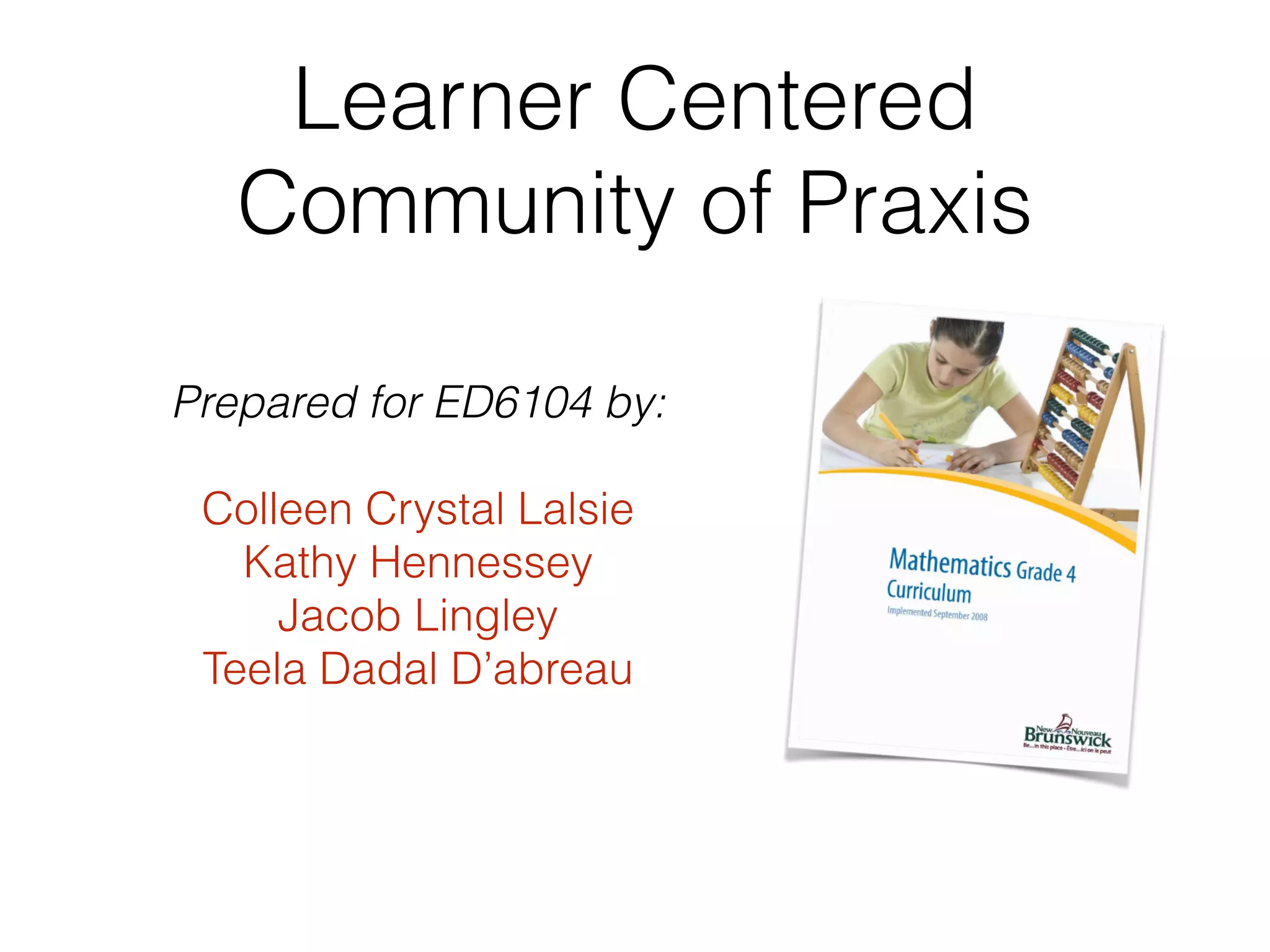
Prepared for ED6104 by:
Colleen Crystal Lalsie
Kathy Hennessey
Jacob Lingley
Teela Dadal D’abreau
Understanding Learners
within Grade 4
New Brunswick Mathematics
Colleen Lalsie
Understanding Learners
• Active Participants
• Meaningful Learning
• Treated Equally
• Learners are Humans
Types of Ideologies
• Scholar Academic Ideology
• Academic Discipline
• Learners are lacking something
• The child’s mind
• Evaluation
Types of Ideologies
• Social Efficiency Ideology
• Curriculum development seen from an industrial
point of view.
• The ‘potential adult’
• Behaviours are shaped
• Evaluation
Types of Ideologies
• Learner Centered Ideology
• Active Participants
• Stimulating Environment
• Developmental Stages
• Evaluation
Types of Ideologies
• Social Recontsruction Ideology
• ‘Social Beings’
• Meaning Makers
• Active Agents
• Evaluation
New Brunswick Grade 4
Mathematics Curriculum
• Active and Constructive Process
• Prior Knowledge and Experiences
• Meaningful Learning
• Conducive Learning Environment
• Assessment and Feedback
Analysis of the Curriculum from
the Point of View of the Learner
Kathy Hennessey
Background and Rational
Goal of the Curriculum
Fosters the development of mathematically literate students who can
extend and apply their learning and who are effective participants in
society.
The word student is mentioned 810 times in the curriculum document.
The Intent
Clearly communicate high expectations for students in mathematics
education.
Background and Rational
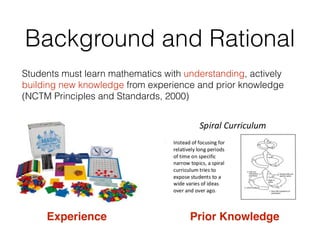
Students must learn mathematics with understanding, actively
building new knowledge from experience and prior knowledge
(NCTM Principles and Standards, 2000)
Experience Prior Knowledge
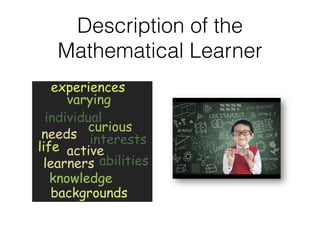
Description of the
Mathematical Learner
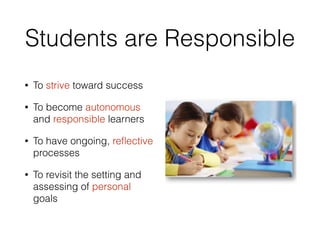
Students are Responsible
• To strive toward success
• To become autonomous
and responsible learners
• To have ongoing, reflective
processes
• To revisit the setting and
assessing of personal
goals
Beliefs about Student
Mathematical Learning
• mathematics learning is an active and constructive process.
• learning is most likely to occur when placed in meaningful
contexts and in an environment that supports exploration, risk
taking, and critical thinking and that nurtures positive attitudes
and sustained effort
• learning is most effective when standards of expectation are
made clear with on-going assessment and feedback.
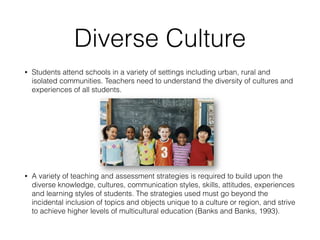
Diverse Culture
• Students attend schools in a variety of settings including urban, rural and
isolated communities. Teachers need to understand the diversity of cultures and
experiences of all students.
• A variety of teaching and assessment strategies is required to build upon the
diverse knowledge, cultures, communication styles, skills, attitudes, experiences
and learning styles of students. The strategies used must go beyond the
incidental inclusion of topics and objects unique to a culture or region, and strive
to achieve higher levels of multicultural education (Banks and Banks, 1993).
Adapting to All Needs of
Learners
• The reality of individual
student differences must
not be ignored when
making instructional
decisions.
• Teachers must
understand and design
instruction to
accommodate differences
in student learning styles
and must also reflect in
assessment strategies.
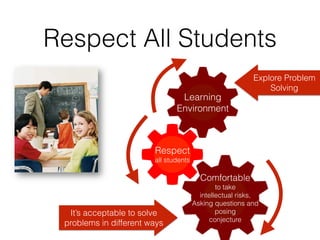
Respect All Students
Explore Problem
Solving
It’s acceptable to solve
problems in different ways
Learning
Environment
Comfortable
to take
intellectual risks,
Asking questions and
posing
conjecture
Respect
all students
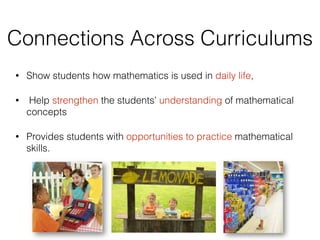
Connections Across Curriculums
• Show students how mathematics is used in daily life,
• Help strengthen the students’ understanding of mathematical
concepts
• Provides students with opportunities to practice mathematical
skills.
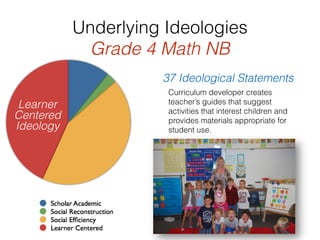
Underlying Ideologies
Grade 4 Math NB
Learner
Centered
Ideology
37 Ideological Statements
Curriculum developer creates
teacher’s guides that suggest
activities that interest children and
provides materials appropriate for
student use.
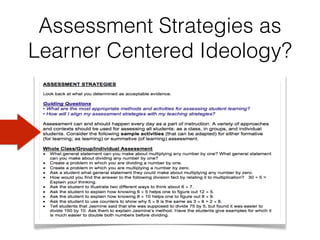
Assessment Strategies as
Learner Centered Ideology?
Questions?
Curriculum Critique
Teela Dadal D’abreau & Jacob Lingley
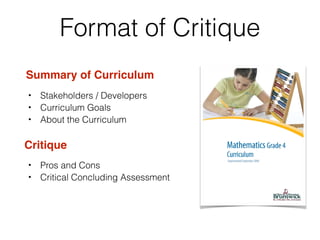
Format of Critique
Summary of Curriculum
• Stakeholders / Developers
• Curriculum Goals
• About the Curriculum
• Pros and Cons
• Critical Concluding Assessment
Critique
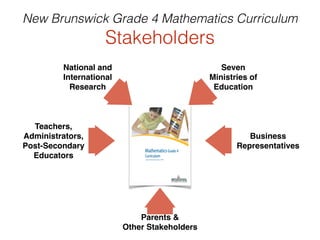
New Brunswick Grade 4 Mathematics Curriculum
Stakeholders
National and
International
Research
Seven
Ministries of
Education
Business
Representatives
Teachers,
Administrators,
Post-Secondary
Educators
Parents &
Other Stakeholders
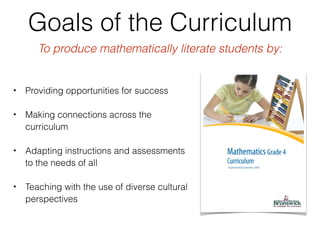
Goals of the Curriculum
To produce mathematically literate students by:
• Providing opportunities for success
• Making connections across the
curriculum
• Adapting instructions and assessments
to the needs of all
• Teaching with the use of diverse cultural
perspectives
About the Curriculum
Emphasis on Teaching Strategies that include:
Communication
Making Connections
Reasoning Skills
Mental Math and Estimation Skills
Problem Solving Skills
Use of Technology
Visualization
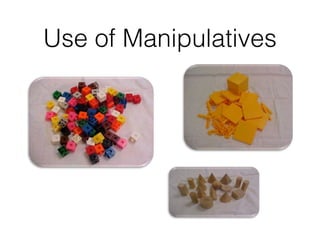
Use of Manipulatives
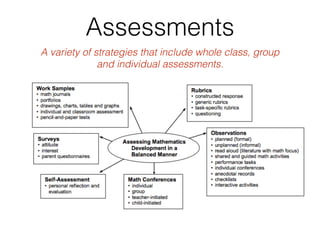
Assessments
A variety of strategies that include whole class, group
and individual assessments.
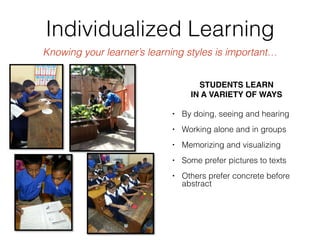
Individualized Learning
Knowing your learner’s learning styles is important…
STUDENTS LEARN
IN A VARIETY OF WAYS
• By doing, seeing and hearing
• Working alone and in groups
• Memorizing and visualizing
• Some prefer pictures to texts
• Others prefer concrete before
abstract
What Leaner Centered Teaching
and Learning Looks Like
• Engages students
• Teaches students skills such as problem
solving ,analyzing etc.
• Teaches students to reflect on what they are learning
• Gives students control over how they learn (by giving
them opportunities to choose gies etc) assessment
strategies
• encourages collaboration
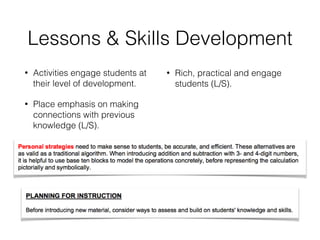
Lessons & Skills Development
• Activities engage students at
their level of development.
• Place emphasis on making
connections with previous
knowledge (L/S).
• Rich, practical and engage
students (L/S).
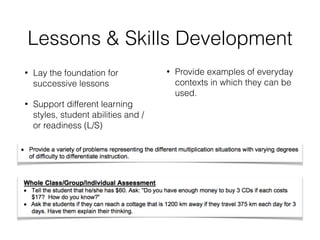
Lessons & Skills Development
• Lay the foundation for
successive lessons
• Support different learning
styles, student abilities and /
or readiness (L/S)
• Provide examples of everyday
contexts in which they can be
used.
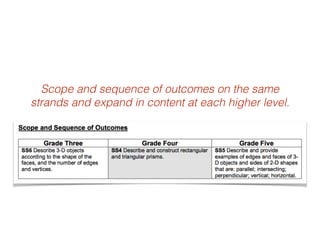
Scope and sequence of outcomes on the same
strands and expand in content at each higher level.
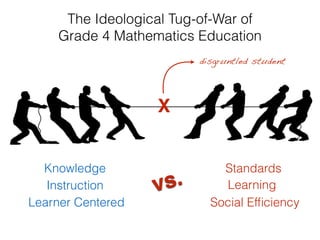
The Ideological Tug-of-War of
Grade 4 Mathematics Education
Knowledge Standards
Instruction Learning
Learner Centered Social Efficiency
X
disgruntled student
vs.
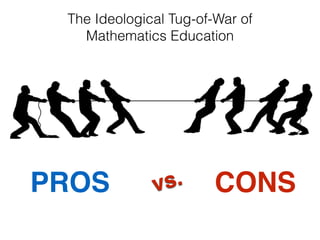
PROS CONS
The Ideological Tug-of-War of
Mathematics Education
vs.
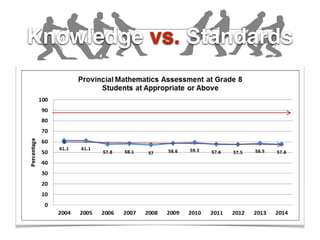
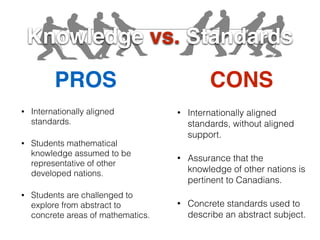
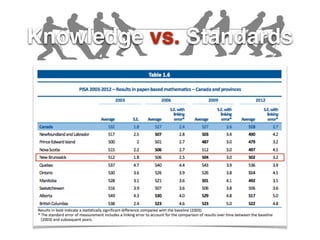
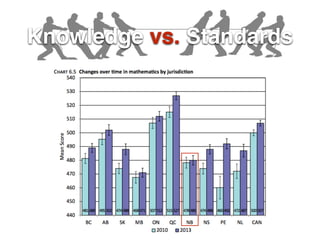
Knowledge vs. Standards
PROS CONS
• Internationally aligned
standards.
• Students mathematical
knowledge assumed to be
representative of other
developed nations.
• Students are challenged to
explore from abstract to
concrete areas of mathematics.
• Internationally aligned
standards, without aligned
support.
• Assurance that the
knowledge of other nations is
pertinent to Canadians.
• Concrete standards used to
describe an abstract subject.
Knowledge vs. Standards
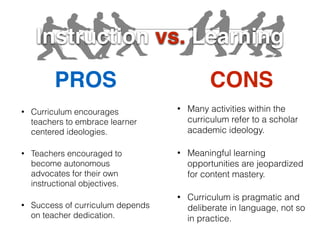
Instruction vs. Learning
PROS CONS
• Curriculum encourages
teachers to embrace learner
centered ideologies.
• Teachers encouraged to
become autonomous
advocates for their own
instructional objectives.
• Success of curriculum depends
on teacher dedication.
• Many activities within the
curriculum refer to a scholar
academic ideology.
• Meaningful learning
opportunities are jeopardized
for content mastery.
• Curriculum is pragmatic and
deliberate in language, not so
in practice.
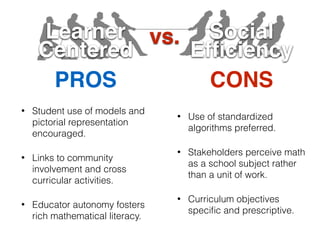
PROS CONS
• Student use of models and
pictorial representation
encouraged.
• Links to community
involvement and cross
curricular activities.
• Educator autonomy fosters
rich mathematical literacy.
• Use of standardized
algorithms preferred.
• Stakeholders perceive math
as a school subject rather
than a unit of work.
• Curriculum objectives
specific and prescriptive.
Learner
Centered
Social
Efficiency
vs.
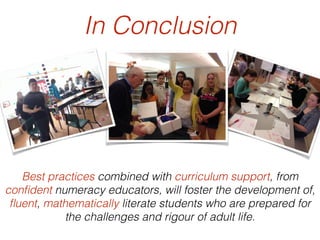
In Conclusion
Best practices combined with curriculum support, from
confident numeracy educators, will foster the development of,
fluent, mathematically literate students who are prepared for
the challenges and rigour of adult life.

Final Presentation ED6104

  • 1.
    Learner Centered Community ofPraxis Prepared for ED6104 by: Colleen Crystal Lalsie Kathy Hennessey Jacob Lingley Teela Dadal D’abreau
  • 2.
    Understanding Learners within Grade4 New Brunswick Mathematics Colleen Lalsie
  • 3.
    Understanding Learners • ActiveParticipants • Meaningful Learning • Treated Equally • Learners are Humans
  • 4.
    Types of Ideologies •Scholar Academic Ideology • Academic Discipline • Learners are lacking something • The child’s mind • Evaluation
  • 5.
    Types of Ideologies •Social Efficiency Ideology • Curriculum development seen from an industrial point of view. • The ‘potential adult’ • Behaviours are shaped • Evaluation
  • 6.
    Types of Ideologies •Learner Centered Ideology • Active Participants • Stimulating Environment • Developmental Stages • Evaluation
  • 7.
    Types of Ideologies •Social Recontsruction Ideology • ‘Social Beings’ • Meaning Makers • Active Agents • Evaluation
  • 8.
    New Brunswick Grade4 Mathematics Curriculum • Active and Constructive Process • Prior Knowledge and Experiences • Meaningful Learning • Conducive Learning Environment • Assessment and Feedback
  • 9.
    Analysis of theCurriculum from the Point of View of the Learner Kathy Hennessey
  • 10.
    Background and Rational Goalof the Curriculum Fosters the development of mathematically literate students who can extend and apply their learning and who are effective participants in society. The word student is mentioned 810 times in the curriculum document. The Intent Clearly communicate high expectations for students in mathematics education.
  • 11.
    Background and Rational Studentsmust learn mathematics with understanding, actively building new knowledge from experience and prior knowledge (NCTM Principles and Standards, 2000) Experience Prior Knowledge
  • 12.
  • 13.
    Students are Responsible •To strive toward success • To become autonomous and responsible learners • To have ongoing, reflective processes • To revisit the setting and assessing of personal goals
  • 14.
    Beliefs about Student MathematicalLearning • mathematics learning is an active and constructive process. • learning is most likely to occur when placed in meaningful contexts and in an environment that supports exploration, risk taking, and critical thinking and that nurtures positive attitudes and sustained effort • learning is most effective when standards of expectation are made clear with on-going assessment and feedback.
  • 15.
    Diverse Culture • Studentsattend schools in a variety of settings including urban, rural and isolated communities. Teachers need to understand the diversity of cultures and experiences of all students. • A variety of teaching and assessment strategies is required to build upon the diverse knowledge, cultures, communication styles, skills, attitudes, experiences and learning styles of students. The strategies used must go beyond the incidental inclusion of topics and objects unique to a culture or region, and strive to achieve higher levels of multicultural education (Banks and Banks, 1993).
  • 16.
    Adapting to AllNeeds of Learners • The reality of individual student differences must not be ignored when making instructional decisions. • Teachers must understand and design instruction to accommodate differences in student learning styles and must also reflect in assessment strategies.
  • 17.
    Respect All Students ExploreProblem Solving It’s acceptable to solve problems in different ways Learning Environment Comfortable to take intellectual risks, Asking questions and posing conjecture Respect all students
  • 18.
    Connections Across Curriculums •Show students how mathematics is used in daily life, • Help strengthen the students’ understanding of mathematical concepts • Provides students with opportunities to practice mathematical skills.
  • 19.
    Underlying Ideologies Grade 4Math NB Learner Centered Ideology 37 Ideological Statements Curriculum developer creates teacher’s guides that suggest activities that interest children and provides materials appropriate for student use.
  • 20.
  • 21.
  • 22.
    Curriculum Critique Teela DadalD’abreau & Jacob Lingley
  • 23.
    Format of Critique Summaryof Curriculum • Stakeholders / Developers • Curriculum Goals • About the Curriculum • Pros and Cons • Critical Concluding Assessment Critique
  • 24.
    New Brunswick Grade4 Mathematics Curriculum Stakeholders National and International Research Seven Ministries of Education Business Representatives Teachers, Administrators, Post-Secondary Educators Parents & Other Stakeholders
  • 25.
    Goals of theCurriculum To produce mathematically literate students by: • Providing opportunities for success • Making connections across the curriculum • Adapting instructions and assessments to the needs of all • Teaching with the use of diverse cultural perspectives
  • 26.
    About the Curriculum Emphasison Teaching Strategies that include: Communication Making Connections Reasoning Skills Mental Math and Estimation Skills Problem Solving Skills Use of Technology Visualization
  • 27.
  • 28.
    Assessments A variety ofstrategies that include whole class, group and individual assessments.
  • 29.
    Individualized Learning Knowing yourlearner’s learning styles is important… STUDENTS LEARN IN A VARIETY OF WAYS • By doing, seeing and hearing • Working alone and in groups • Memorizing and visualizing • Some prefer pictures to texts • Others prefer concrete before abstract
  • 30.
    What Leaner CenteredTeaching and Learning Looks Like • Engages students • Teaches students skills such as problem solving ,analyzing etc. • Teaches students to reflect on what they are learning • Gives students control over how they learn (by giving them opportunities to choose gies etc) assessment strategies • encourages collaboration
  • 31.
    Lessons & SkillsDevelopment • Activities engage students at their level of development. • Place emphasis on making connections with previous knowledge (L/S). • Rich, practical and engage students (L/S).
  • 32.
    Lessons & SkillsDevelopment • Lay the foundation for successive lessons • Support different learning styles, student abilities and / or readiness (L/S) • Provide examples of everyday contexts in which they can be used.
  • 33.
    Scope and sequenceof outcomes on the same strands and expand in content at each higher level.
  • 34.
    The Ideological Tug-of-Warof Grade 4 Mathematics Education Knowledge Standards Instruction Learning Learner Centered Social Efficiency X disgruntled student vs.
  • 35.
    PROS CONS The IdeologicalTug-of-War of Mathematics Education vs.
  • 36.
    Knowledge vs. Standards PROSCONS • Internationally aligned standards. • Students mathematical knowledge assumed to be representative of other developed nations. • Students are challenged to explore from abstract to concrete areas of mathematics. • Internationally aligned standards, without aligned support. • Assurance that the knowledge of other nations is pertinent to Canadians. • Concrete standards used to describe an abstract subject.
  • 37.
  • 38.
  • 39.
  • 40.
    Instruction vs. Learning PROSCONS • Curriculum encourages teachers to embrace learner centered ideologies. • Teachers encouraged to become autonomous advocates for their own instructional objectives. • Success of curriculum depends on teacher dedication. • Many activities within the curriculum refer to a scholar academic ideology. • Meaningful learning opportunities are jeopardized for content mastery. • Curriculum is pragmatic and deliberate in language, not so in practice.
  • 41.
    PROS CONS • Studentuse of models and pictorial representation encouraged. • Links to community involvement and cross curricular activities. • Educator autonomy fosters rich mathematical literacy. • Use of standardized algorithms preferred. • Stakeholders perceive math as a school subject rather than a unit of work. • Curriculum objectives specific and prescriptive. Learner Centered Social Efficiency vs.
  • 42.
    In Conclusion Best practicescombined with curriculum support, from confident numeracy educators, will foster the development of, fluent, mathematically literate students who are prepared for the challenges and rigour of adult life.