INTASC Standards
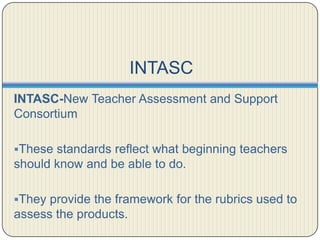
INTASCINTASC-New Teacher Assessment and Support ConsortiumThese standards reflect what beginning teachers should know and be able to do.
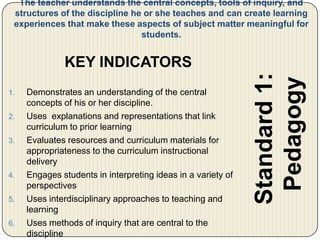
They provide the framework for the rubrics used to assess the products.The teacher understands the central concepts, tools of inquiry, and structures of the discipline he or she teaches and can create learning experiences that make these aspects of subject matter meaningful for students.Standard 1: PedagogyKEY INDICATORSDemonstrates an understanding of the central concepts of his or her discipline.Uses  explanations and representations that link curriculum to prior learningEvaluates resources and curriculum materials for appropriateness to the curriculum instructional deliveryEngages students in interpreting ideas in a variety of perspectivesUses interdisciplinary approaches to teaching and  learningUses methods of inquiry that are central to the discipline
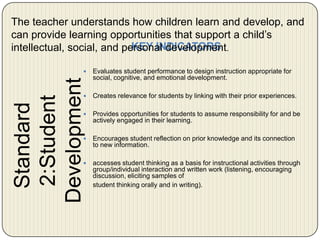
.     The teacher understands how children learn and develop, and can provide learning opportunities that support a child’s intellectual, social, and personal development.KEY INDICATORSEvaluates student performance to design instruction appropriate for social, cognitive, and emotional development.Creates relevance for students by linking with their prior experiences.Provides opportunities for students to assume responsibility for and be actively engaged in their learning.Encourages student reflection on prior knowledge and its connection to new information.accesses student thinking as a basis for instructional activities through group/individual interaction and written work (listening, encouraging discussion, eliciting samples of 	student thinking orally and in writing). Standard 2:Student Development
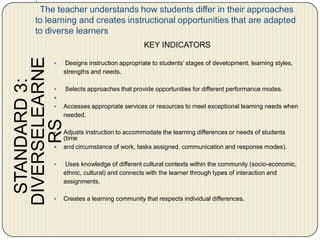
.  The teacher understands how students differ in their approaches to learning and creates instructional opportunities that are adapted to diverse learners  KEY INDICATORS  Designs instruction appropriate to students’ stages of development, learning styles,	strengths and needs. Selects approaches that provide opportunities for different performance modes. Accesses appropriate services or resources to meet exceptional learning needs when 	needed. Adjusts instruction to accommodate the learning differences or needs of students (time and circumstance of work, tasks assigned, communication and response modes). Uses knowledge of different cultural contexts within the community (socio-economic, 	ethnic, cultural) and connects with the learner through types of interaction and 	assignments. Creates a learning community that respects individual differences.  STANDARD 3: DIVERSELEARNERS 
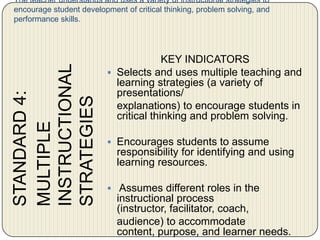
The teacher understands and uses a variety of instructional strategies to encourage student development of critical thinking, problem solving, and performance skills.	STANDARD 4:	MULTIPLE 	INSTRUCTIONAL 	STRATEGIESKEY INDICATORS Selects and uses multiple teaching and learning strategies (a variety of presentations/	explanations) to encourage students in critical thinking and problem solving. Encourages students to assume responsibility for identifying and using learning resources.
 Assumes different roles in the instructional process (instructor, facilitator, coach,	audience) to accommodate content, purpose, and learner needs. 
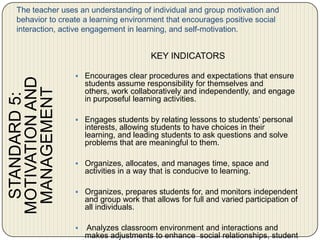
The teacher uses an understanding of individual and group motivation and behavior to create a learning environment that encourages positive social interaction, active engagement in learning, and self-motivation. KEY INDICATORS Encourages clear procedures and expectations that ensure students assume responsibility for themselves and others, work collaboratively and independently, and engage in purposeful learning activities.
Engages students by relating lessons to students’ personal interests, allowing students to have choices in their learning, and leading students to ask questions and solve problems that are meaningful to them. Organizes, allocates, and manages time, space and activities in a way that is conducive to learning.
Organizes, prepares students for, and monitors independent and group work that allows for full and varied participation of all individuals.
 Analyzes classroom environment and interactions and makes adjustments to enhance  social relationships, student motivation/engagement and productive work.STANDARD 5: MOTIVATION AND MANAGEMENT 
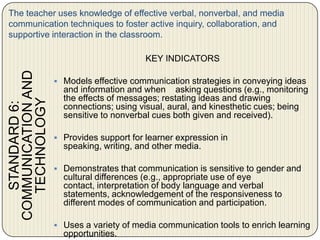
The teacher uses knowledge of effective verbal, nonverbal, and media communication techniques to foster active inquiry, collaboration, and supportive interaction in the classroom.KEY INDICATORSModels effective communication strategies in conveying ideas and information and when    asking questions (e.g., monitoring the effects of messages; restating ideas and drawing connections; using visual, aural, and kinesthetic cues; being sensitive to nonverbal cues both given and received).

Intasc Standards presentation

  • 1.
  • 2.
    INTASCINTASC-New Teacher Assessmentand Support ConsortiumThese standards reflect what beginning teachers should know and be able to do.
  • 3.
    They provide theframework for the rubrics used to assess the products.The teacher understands the central concepts, tools of inquiry, and structures of the discipline he or she teaches and can create learning experiences that make these aspects of subject matter meaningful for students.Standard 1: PedagogyKEY INDICATORSDemonstrates an understanding of the central concepts of his or her discipline.Uses explanations and representations that link curriculum to prior learningEvaluates resources and curriculum materials for appropriateness to the curriculum instructional deliveryEngages students in interpreting ideas in a variety of perspectivesUses interdisciplinary approaches to teaching and learningUses methods of inquiry that are central to the discipline
  • 4.
    .     The teacher understandshow children learn and develop, and can provide learning opportunities that support a child’s intellectual, social, and personal development.KEY INDICATORSEvaluates student performance to design instruction appropriate for social, cognitive, and emotional development.Creates relevance for students by linking with their prior experiences.Provides opportunities for students to assume responsibility for and be actively engaged in their learning.Encourages student reflection on prior knowledge and its connection to new information.accesses student thinking as a basis for instructional activities through group/individual interaction and written work (listening, encouraging discussion, eliciting samples of student thinking orally and in writing). Standard 2:Student Development
  • 5.
    .  The teacherunderstands how students differ in their approaches to learning and creates instructional opportunities that are adapted to diverse learners  KEY INDICATORS  Designs instruction appropriate to students’ stages of development, learning styles, strengths and needs. Selects approaches that provide opportunities for different performance modes. Accesses appropriate services or resources to meet exceptional learning needs when needed. Adjusts instruction to accommodate the learning differences or needs of students (time and circumstance of work, tasks assigned, communication and response modes). Uses knowledge of different cultural contexts within the community (socio-economic, ethnic, cultural) and connects with the learner through types of interaction and assignments. Creates a learning community that respects individual differences.  STANDARD 3: DIVERSELEARNERS 
  • 6.
    The teacher understandsand uses a variety of instructional strategies to encourage student development of critical thinking, problem solving, and performance skills. STANDARD 4: MULTIPLE INSTRUCTIONAL STRATEGIESKEY INDICATORS Selects and uses multiple teaching and learning strategies (a variety of presentations/ explanations) to encourage students in critical thinking and problem solving. Encourages students to assume responsibility for identifying and using learning resources.
  • 7.
    Assumes differentroles in the instructional process (instructor, facilitator, coach, audience) to accommodate content, purpose, and learner needs. 
  • 8.
    The teacher usesan understanding of individual and group motivation and behavior to create a learning environment that encourages positive social interaction, active engagement in learning, and self-motivation. KEY INDICATORS Encourages clear procedures and expectations that ensure students assume responsibility for themselves and others, work collaboratively and independently, and engage in purposeful learning activities.
  • 9.
    Engages students byrelating lessons to students’ personal interests, allowing students to have choices in their learning, and leading students to ask questions and solve problems that are meaningful to them. Organizes, allocates, and manages time, space and activities in a way that is conducive to learning.
  • 10.
    Organizes, prepares studentsfor, and monitors independent and group work that allows for full and varied participation of all individuals.
  • 11.
    Analyzes classroomenvironment and interactions and makes adjustments to enhance social relationships, student motivation/engagement and productive work.STANDARD 5: MOTIVATION AND MANAGEMENT 
  • 12.
    The teacher usesknowledge of effective verbal, nonverbal, and media communication techniques to foster active inquiry, collaboration, and supportive interaction in the classroom.KEY INDICATORSModels effective communication strategies in conveying ideas and information and when asking questions (e.g., monitoring the effects of messages; restating ideas and drawing connections; using visual, aural, and kinesthetic cues; being sensitive to nonverbal cues both given and received).