Perception
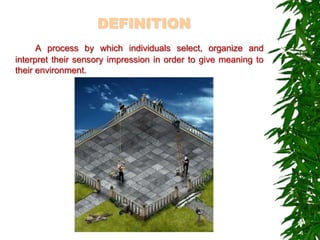
DEFINITION
A process by which individuals select, organize and
interpret their sensory impression in order to give meaning to
their environment.
 Receive and
make sense
 Filter
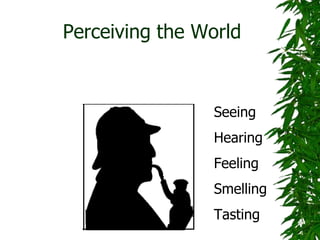
Perceiving the World
Seeing
Hearing
Feeling
Smelling
Tasting
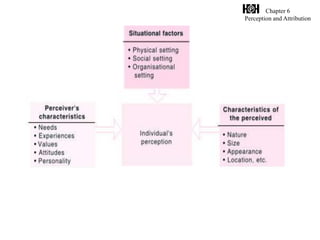
Chapter 6
Perception and Attribution
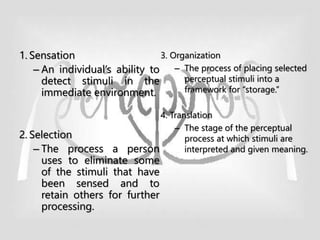
1. Sensation
– An individual’s ability to
detect stimuli in the
immediate environment.
2. Selection
– The process a person
uses to eliminate some
of the stimuli that have
been sensed and to
retain others for further
processing.
3. Organization
– The process of placing selected
perceptual stimuli into a
framework for “storage.”
4. Translation
– The stage of the perceptual
process at which stimuli are
interpreted and given meaning.
Chapter 6
Perception and Attribution
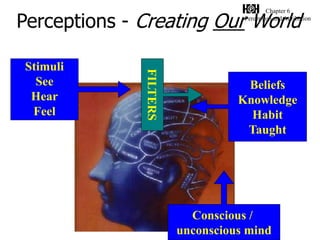
Perceptions - Creating Our World
Stimuli
See
Hear
Feel
Conscious /
unconscious mind
Beliefs
Knowledge
Habit
Taught
FILTERS
Chapter 6
Perception and Attribution
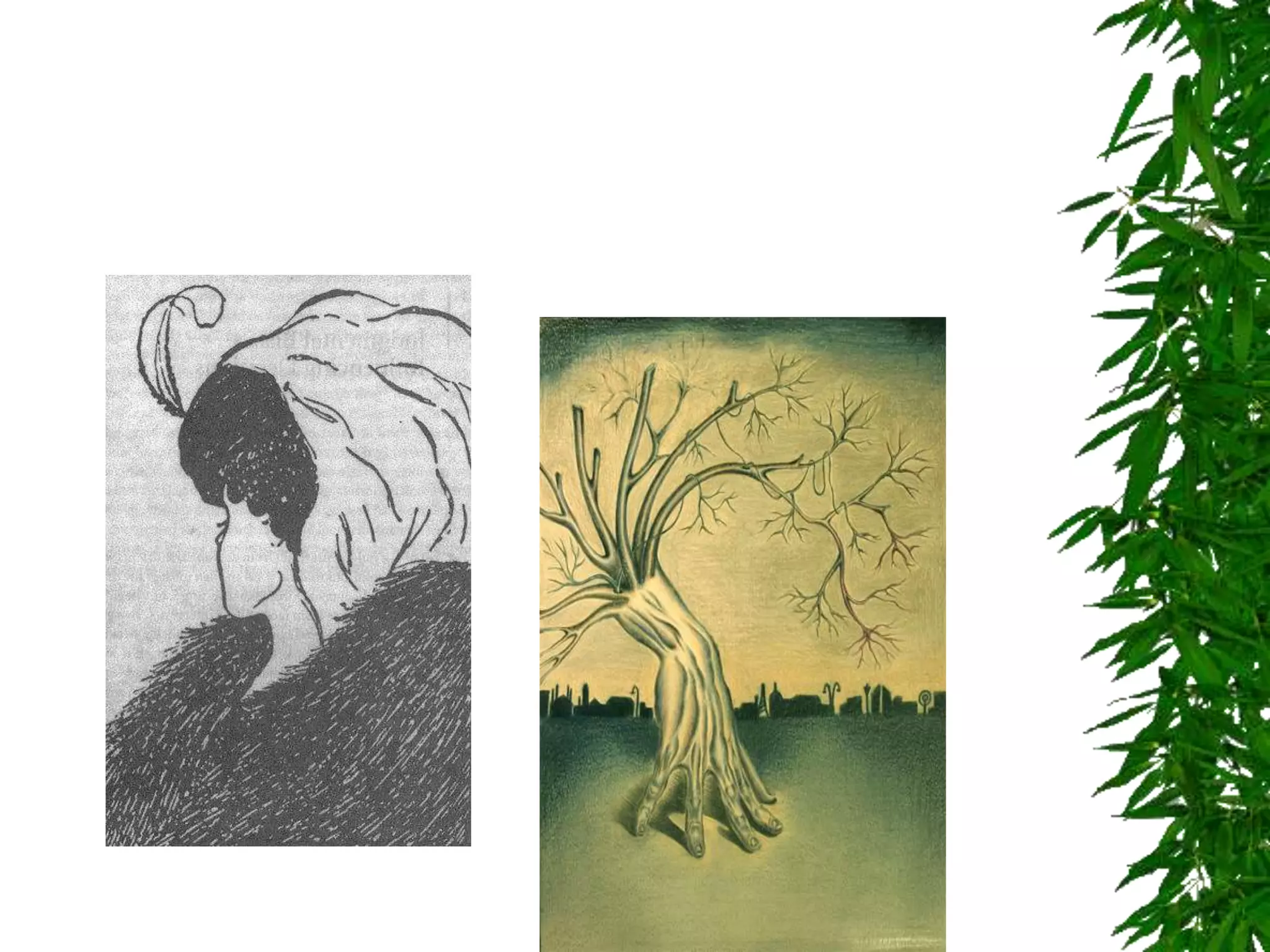
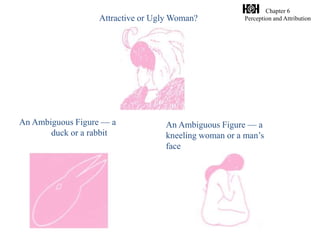
Attractive or Ugly Woman?
An Ambiguous Figure — a
duck or a rabbit
An Ambiguous Figure — a
kneeling woman or a man’s
face
Chapter 6
Perception and Attribution
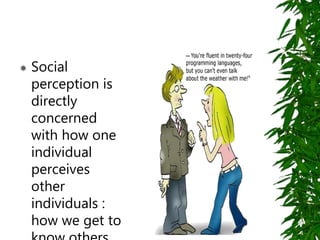
 Social
perception is
directly
concerned
with how one
individual
perceives
other
individuals :
how we get to
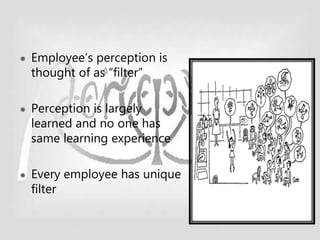
 Employee’s perception is
thought of as “filter”
 Perception is largely
learned and no one has
same learning experience
 Every employee has unique
filter
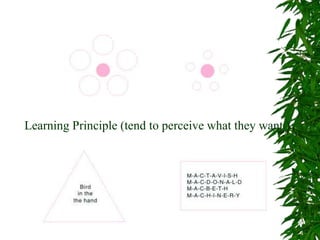
Learning Principle (tend to perceive what they want )
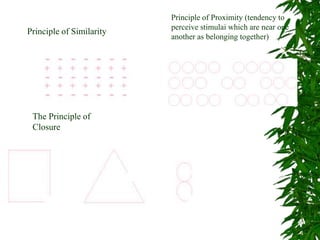
Principle of Similarity
Principle of Proximity (tendency to
perceive stimulai which are near one
another as belonging together)
The Principle of
Closure
 Selective Perception
People selectively interpret what they see on
the basis of their interests, background,
experience and attitude.
16
OBJECT vs BACKGROUND
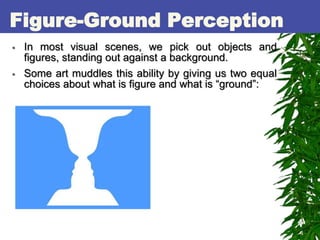
Figure-Ground Perception
 In most visual scenes, we pick out objects and
figures, standing out against a background.
 Some art muddles this ability by giving us two equal
choices about what is figure and what is “ground”:
 Culture
 Gender
 Age
 Education
 Language
 Political Viewpoint
 Socio-economic
 Halo Effect
When we draw a general impression about an
individual on the basis of a single characteristic, such
as intelligence, sociability or appearance.
20
 Projection
Attributing one’s own characteristics to other people.
e.g. If you want challenge and responsibility, you assume …... Or, you
are honest and trustworthy , ……
21
 Stereotyping
Judging someone on the basis of one’s perception of the
group to which that person belongs.
Common Stereotypes may be based on-
Nationality
Occupation
Age
Physical Attributes
Education
Social Status
Gender
22
Attribution:
 Individual assigns causes to the
behaviour
Attribution Theory:
 Fritz Heider and H. H. Kelly
 Observe behaviour and then attribute causes
 Behaviour is caused internally ( by forces within the
person e.g., ability) or externally ( by the forces in
the person’s environment; e.g., task)
25
FACTORS OF THE ATTRIBUTION
THEORY
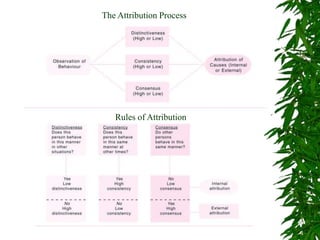
 Distinctiveness
 Consensus
 Consistency
Distinctiveness
It is the degree to which a person behaves similarly
in different situations
26
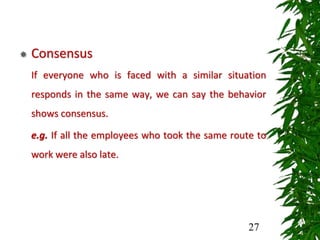
 Consensus
If everyone who is faced with a similar situation
responds in the same way, we can say the behavior
shows consensus.
e.g. If all the employees who took the same route to
work were also late.
27
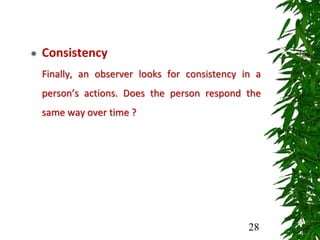
 Consistency
Finally, an observer looks for consistency in a
person’s actions. Does the person respond the
same way over time ?
28
The Attribution Process
Rules of Attribution
Perception and OB
 Helps understand the difference between perceived
world and real world
 Plays decisive role in employee hiring
 Key role in performance appraisal
 Helps determine loyalty of employees
 Treating employees under Theory Y
 Key role in impression management

final Perception.ppt

  • 4.
  • 5.
    DEFINITION A process bywhich individuals select, organize and interpret their sensory impression in order to give meaning to their environment.
  • 6.
     Receive and makesense  Filter
  • 7.
  • 8.
    Chapter 6 Perception andAttribution 1. Sensation – An individual’s ability to detect stimuli in the immediate environment. 2. Selection – The process a person uses to eliminate some of the stimuli that have been sensed and to retain others for further processing. 3. Organization – The process of placing selected perceptual stimuli into a framework for “storage.” 4. Translation – The stage of the perceptual process at which stimuli are interpreted and given meaning.
  • 9.
    Chapter 6 Perception andAttribution Perceptions - Creating Our World Stimuli See Hear Feel Conscious / unconscious mind Beliefs Knowledge Habit Taught FILTERS
  • 10.
    Chapter 6 Perception andAttribution Attractive or Ugly Woman? An Ambiguous Figure — a duck or a rabbit An Ambiguous Figure — a kneeling woman or a man’s face
  • 11.
  • 12.
     Social perception is directly concerned withhow one individual perceives other individuals : how we get to
  • 13.
     Employee’s perceptionis thought of as “filter”  Perception is largely learned and no one has same learning experience  Every employee has unique filter
  • 14.
    Learning Principle (tendto perceive what they want )
  • 15.
    Principle of Similarity Principleof Proximity (tendency to perceive stimulai which are near one another as belonging together) The Principle of Closure
  • 16.
     Selective Perception Peopleselectively interpret what they see on the basis of their interests, background, experience and attitude. 16
  • 17.
  • 18.
    Figure-Ground Perception  Inmost visual scenes, we pick out objects and figures, standing out against a background.  Some art muddles this ability by giving us two equal choices about what is figure and what is “ground”:
  • 19.
     Culture  Gender Age  Education  Language  Political Viewpoint  Socio-economic
  • 20.
     Halo Effect Whenwe draw a general impression about an individual on the basis of a single characteristic, such as intelligence, sociability or appearance. 20
  • 21.
     Projection Attributing one’sown characteristics to other people. e.g. If you want challenge and responsibility, you assume …... Or, you are honest and trustworthy , …… 21
  • 22.
     Stereotyping Judging someoneon the basis of one’s perception of the group to which that person belongs. Common Stereotypes may be based on- Nationality Occupation Age Physical Attributes Education Social Status Gender 22
  • 23.
    Attribution:  Individual assignscauses to the behaviour
  • 24.
    Attribution Theory:  FritzHeider and H. H. Kelly  Observe behaviour and then attribute causes  Behaviour is caused internally ( by forces within the person e.g., ability) or externally ( by the forces in the person’s environment; e.g., task)
  • 25.
    25 FACTORS OF THEATTRIBUTION THEORY  Distinctiveness  Consensus  Consistency
  • 26.
    Distinctiveness It is thedegree to which a person behaves similarly in different situations 26
  • 27.
     Consensus If everyonewho is faced with a similar situation responds in the same way, we can say the behavior shows consensus. e.g. If all the employees who took the same route to work were also late. 27
  • 28.
     Consistency Finally, anobserver looks for consistency in a person’s actions. Does the person respond the same way over time ? 28
  • 29.
  • 30.
    Perception and OB Helps understand the difference between perceived world and real world  Plays decisive role in employee hiring  Key role in performance appraisal  Helps determine loyalty of employees  Treating employees under Theory Y  Key role in impression management