Ken Weinberg, Director of Water Resources
Dave Chamberlain, Principal Engineer
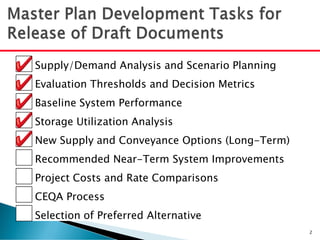
Supply/Demand Analysis and Scenario Planning
Evaluation Thresholds and Decision Metrics
Baseline System Performance
Storage Utilization Analysis
New Supply and Conveyance Options (Long-Term)
Recommended Near-Term System Improvements
Project Costs and Rate Comparisons
CEQA Process
Selection of Preferred Alternative
2
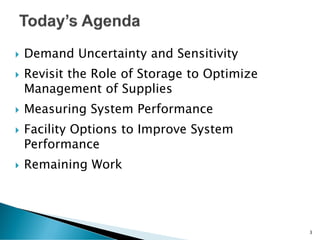
 Demand Uncertainty and Sensitivity
 Revisit the Role of Storage to Optimize
Management of Supplies
 Measuring System Performance
 Facility Options to Improve System
Performance
 Remaining Work
3
 2010 UWMP Implementation and Supply
Reliability
◦ No Supply/Demand Gaps for Normal Weather
 Dependent on member agencies achieving conservation
and local supply targets
◦ Supply/demand gaps occur in dry years
 Multi-year dry weather with MWD allocation of imported
supplies
 Compounded with lower levels of local supply
development
 Continued uncertainty in imported water availability
4
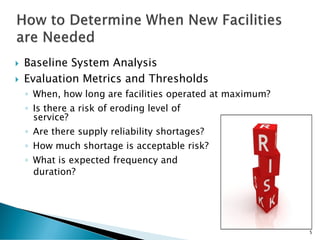
 Baseline System Analysis
 Evaluation Metrics and Thresholds
◦ When, how long are facilities operated at maximum?
◦ Is there a risk of eroding level of
service?
◦ Are there supply reliability shortages?
◦ How much shortage is acceptable risk?
◦ What is expected frequency and
duration?
5
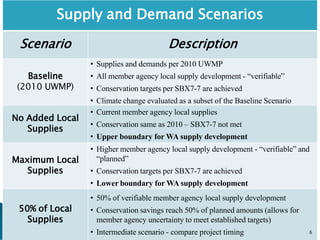
Supply and Demand Scenarios
Scenario Description
Baseline
(2010 UWMP)
• Supplies and demands per 2010 UWMP
• All member agency local supply development - “verifiable”
• Conservation targets per SBX7-7 are achieved

• Climate change evaluated as a subset of the Baseline Scenario
No Added Local
Supplies
• Current member agency local supplies
• Conservation same as 2010 – SBX7-7 not met
• Upper boundary for WA supply development
Maximum Local
Supplies
• Higher member agency local supply development - “verifiable” and
“planned”
• Conservation targets per SBX7-7 are achieved
• Lower boundary for WA supply development
50% of Local
Supplies
• 50% of verifiable member agency local supply development
• Conservation savings reach 50% of planned amounts (allows for
member agency uncertainty to meet established targets)
• Intermediate scenario - compare project timing 6
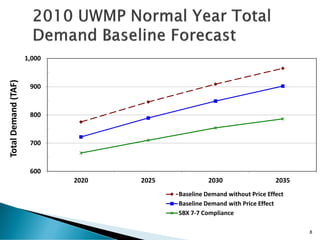
8
600
700
800
900
1,000
2020 2025 2030 2035
TotalDemand(TAF)
Baseline Demand without Price Effect
Baseline Demand with Price Effect
SBX 7-7 Compliance
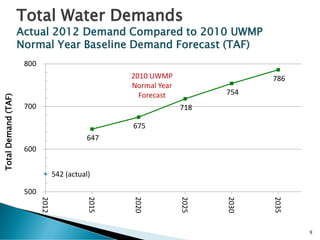
542 (actual)
647
675
718
754
786
500
600
700
800
2012
2015
2020
2025
2030
2035
TotalDemand(TAF)
Total Water Demands
Actual 2012 Demand Compared to 2010 UWMP
Normal Year Baseline Demand Forecast (TAF)
2010 UWMP
Normal Year
Forecast
9
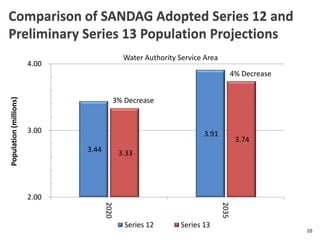
3.44
3.91
3.33
3.74
2.00
3.00
4.00
2020
2035
Population(millions)
Series 12 Series 13
Comparison of SANDAG Adopted Series 12 and
Preliminary Series 13 Population Projections
Water Authority Service Area
3% Decrease
4% Decrease
10
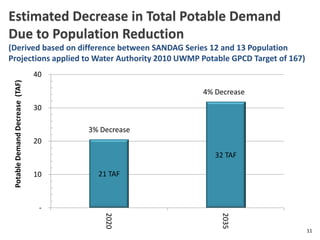
21 TAF
32 TAF
-
10
20
30
40
2020
2035
PotableDemandDecrease(TAF)
4% Decrease
Estimated Decrease in Total Potable Demand
Due to Population Reduction
(Derived based on difference between SANDAG Series 12 and 13 Population
Projections applied to Water Authority 2010 UWMP Potable GPCD Target of 167)
3% Decrease
11
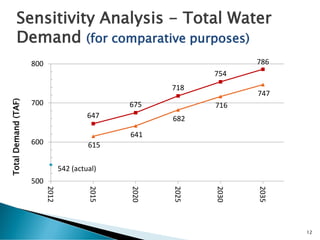
542 (actual)
647
675
718
754
786
615
641
682
716
747
500
600
700
800
2012
2015
2020
2025
2030
2035
TotalDemand(TAF)
Sensitivity Analysis - Total Water
Demand (for comparative purposes)
12
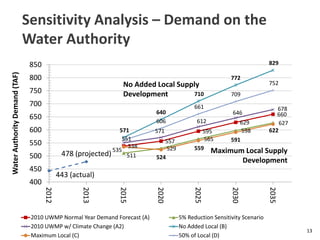
443 (actual)
478 (projected)
538
557
595
629
660
511
529
565
598
627
551
571
612
646
678
571
640
710
772
829
535
524
559
591
622
606
661
709
752
400
450
500
550
600
650
700
750
800
850
2012
2013
2015
2020
2025
2030
2035
WaterAuthorityDemand(TAF)
2010 UWMP Normal Year Demand Forecast (A) 5% Reduction Sensitivity Scenario
2010 UWMP w/ Climate Change (A2) No Added Local (B)
Maximum Local (C) 50% of Local (D)
Sensitivity Analysis – Demand on the
Water Authority
No Added Local Supply
Development
Maximum Local Supply
Development
13
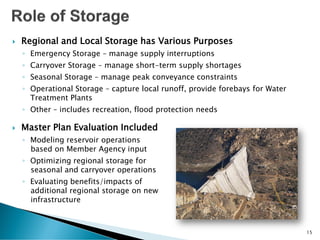
 Regional and Local Storage has Various Purposes
◦ Emergency Storage – manage supply interruptions
◦ Carryover Storage – manage short-term supply shortages
◦ Seasonal Storage – manage peak conveyance constraints
◦ Operational Storage – capture local runoff, provide forebays for Water
Treatment Plants
◦ Other – includes recreation, flood protection needs
 Master Plan Evaluation Included
◦ Modeling reservoir operations
based on Member Agency input
◦ Optimizing regional storage for
seasonal and carryover operations
◦ Evaluating benefits/impacts of
additional regional storage on new
infrastructure
15
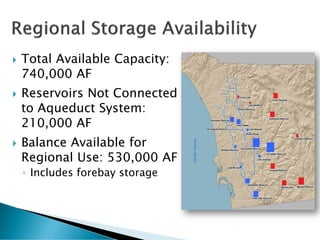
 Total Available Capacity:
740,000 AF
 Reservoirs Not Connected
to Aqueduct System:
210,000 AF
 Balance Available for
Regional Use: 530,000 AF
◦ Includes forebay storage
16
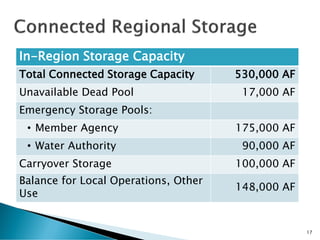
17
In-Region Storage Capacity
Total Connected Storage Capacity 530,000 AF
Unavailable Dead Pool 17,000 AF
Emergency Storage Pools:
• Member Agency 175,000 AF
• Water Authority 90,000 AF
Carryover Storage 100,000 AF
Balance for Local Operations, Other
Use
148,000 AF
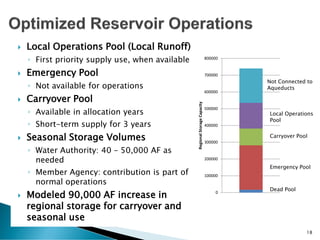
 Local Operations Pool (Local Runoff)
◦ First priority supply use, when available
 Emergency Pool
◦ Not available for operations
 Carryover Pool
◦ Available in allocation years
◦ Short-term supply for 3 years
 Seasonal Storage Volumes
◦ Water Authority: 40 – 50,000 AF as
needed
◦ Member Agency: contribution is part of
normal operations
 Modeled 90,000 AF increase in
regional storage for carryover and
seasonal use
0
100000
200000
300000
400000
500000
600000
700000
800000
RegionalStorageCapacity
18
Dead Pool
Emergency Pool
Carryover Pool
Local Operations
Pool
Not Connected to
Aqueducts
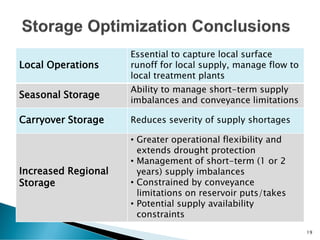
19
Local Operations
Essential to capture local surface
runoff for local supply, manage flow to
local treatment plants
Seasonal Storage
Ability to manage short-term supply
imbalances and conveyance limitations
Carryover Storage Reduces severity of supply shortages
Increased Regional
Storage
• Greater operational flexibility and
extends drought protection
• Management of short-term (1 or 2
years) supply imbalances
• Constrained by conveyance
limitations on reservoir puts/takes
• Potential supply availability
constraints
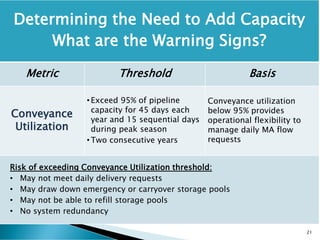
Determining the Need to Add Capacity
What are the Warning Signs?
Metric Threshold Basis
Conveyance
Utilization
• Exceed 95% of pipeline
capacity for 45 days each
year and 15 sequential days
during peak season
• Two consecutive years
Conveyance utilization
below 95% provides
operational flexibility to
manage daily MA flow
requests
Risk of exceeding Conveyance Utilization threshold:
• May not meet daily delivery requests
• May draw down emergency or carryover storage pools
• May not be able to refill storage pools
• No system redundancy
21
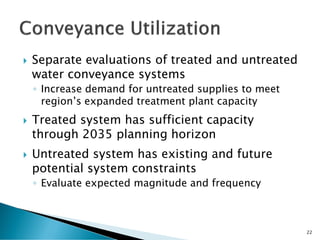
 Separate evaluations of treated and untreated
water conveyance systems
◦ Increase demand for untreated supplies to meet
region’s expanded treatment plant capacity
 Treated system has sufficient capacity
through 2035 planning horizon
 Untreated system has existing and future
potential system constraints
◦ Evaluate expected magnitude and frequency
22
Miramar
Otay
Perdue
Levy
Alvarado
Twin Oaks Valley
100 MGD
Escondido/Vista ID
Poway
Badger
Olivenhain
Weese
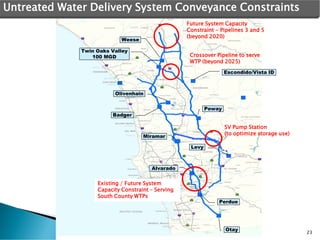
Untreated Water Delivery System Conveyance Constraints
23
Future System Capacity
Constraint - Pipelines 3 and 5
(beyond 2020)
Existing / Future System
Capacity Constraint – Serving
South County WTPs
Crossover Pipeline to serve
WTP (beyond 2025)
SV Pump Station
(to optimize storage use)
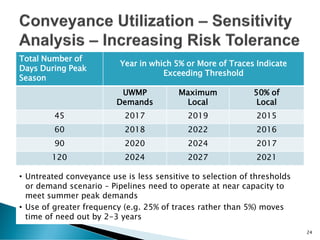
Total Number of
Days During Peak
Season
Year in which 5% or More of Traces Indicate
Exceeding Threshold
UWMP
Demands
Maximum
Local
50% of
Local
45 2017 2019 2015
60 2018 2022 2016
90 2020 2024 2017
120 2024 2027 2021
24
• Untreated conveyance use is less sensitive to selection of thresholds
or demand scenario – Pipelines need to operate at near capacity to
meet summer peak demands
• Use of greater frequency (e.g. 25% of traces rather than 5%) moves
time of need out by 2-3 years
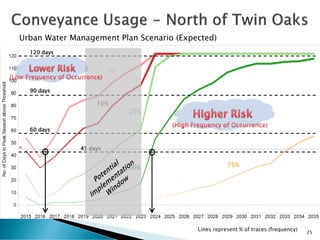
25
5%
25%
10%
Lines represent % of traces (frequency)
Urban Water Management Plan Scenario (Expected)
45 days
60 days
90 days
120 days
50% 75%
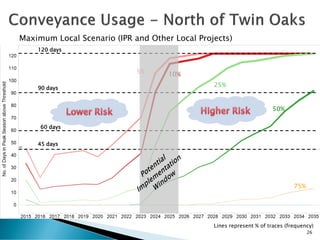
26
5%
25%
10%
Lines represent % of traces (frequency)
Maximum Local Scenario (IPR and Other Local Projects)
45 days
60 days
90 days
120 days
50%
75%
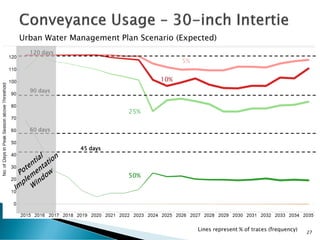
27
5%
25%
10%
Lines represent % of traces (frequency)
Urban Water Management Plan Scenario (Expected)
45 days
60 days
90 days
120 days
50%
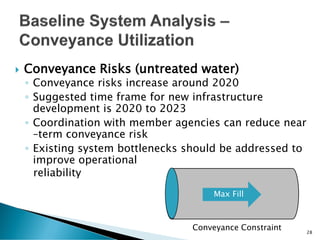
 Conveyance Risks (untreated water)
◦ Conveyance risks increase around 2020
◦ Suggested time frame for new infrastructure
development is 2020 to 2023
◦ Coordination with member agencies can reduce near
–term conveyance risk
◦ Existing system bottlenecks should be addressed to
improve operational
reliability
Conveyance Constraint 28
Max Fill
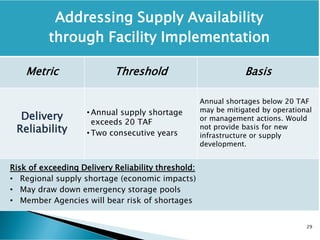
Addressing Supply Availability
through Facility Implementation
Metric Threshold Basis
Delivery
Reliability
• Annual supply shortage
exceeds 20 TAF
• Two consecutive years
Annual shortages below 20 TAF
may be mitigated by operational
or management actions. Would
not provide basis for new
infrastructure or supply
development.
Risk of exceeding Delivery Reliability threshold:
• Regional supply shortage (economic impacts)
• May draw down emergency storage pools
• Member Agencies will bear risk of shortages
29
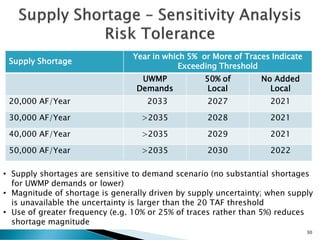
Supply Shortage
Year in which 5% or More of Traces Indicate
Exceeding Threshold
UWMP
Demands
50% of
Local
No Added
Local
20,000 AF/Year 2033 2027 2021
30,000 AF/Year >2035 2028 2021
40,000 AF/Year >2035 2029 2021
50,000 AF/Year >2035 2030 2022
30
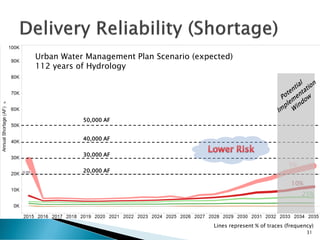
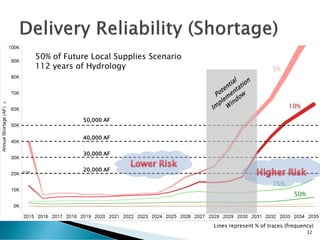
• Supply shortages are sensitive to demand scenario (no substantial shortages
for UWMP demands or lower)
• Magnitude of shortage is generally driven by supply uncertainty; when supply
is unavailable the uncertainty is larger than the 20 TAF threshold
• Use of greater frequency (e.g. 10% or 25% of traces rather than 5%) reduces
shortage magnitude
31
5%
25%
10%
Lines represent % of traces (frequency)
Urban Water Management Plan Scenario (expected)
112 years of Hydrology
20,000 AF
30,000 AF
40,000 AF
50,000 AF
32
5%
25%
10%
Lines represent % of traces (frequency)
50%
50% of Future Local Supplies Scenario
112 years of Hydrology
20,000 AF
30,000 AF
40,000 AF
50,000 AF
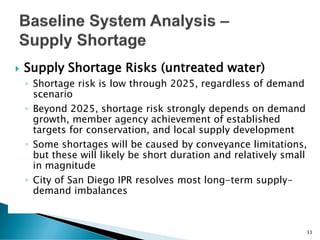
 Supply Shortage Risks (untreated water)
◦ Shortage risk is low through 2025, regardless of demand
scenario
◦ Beyond 2025, shortage risk strongly depends on demand
growth, member agency achievement of established
targets for conservation, and local supply development
◦ Some shortages will be caused by conveyance limitations,
but these will likely be short duration and relatively small
in magnitude
◦ City of San Diego IPR resolves most long-term supply-
demand imbalances
33
Miramar
Otay
Perdue
Levy
Alvarado
Twin Oaks Valley
100 MGD
Escondido/Vista ID
Poway
Badger
Olivenhain
Weese
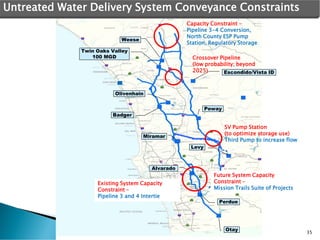
Untreated Water Delivery System Conveyance Constraints
35
Capacity Constraint -
Pipeline 3-4 Conversion,
North County ESP Pump
Station, Regulatory Storage
Existing System Capacity
Constraint –
Pipeline 3 and 4 Intertie
Crossover Pipeline
(low probability; beyond
2025)
SV Pump Station
(to optimize storage use)
Third Pump to increase flow
Future System Capacity
Constraint –
Mission Trails Suite of Projects
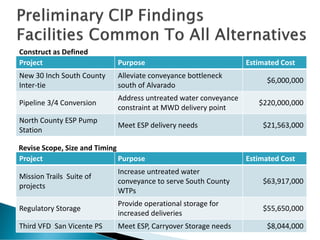
Project Purpose Estimated Cost
New 30 Inch South County
Inter-tie
Alleviate conveyance bottleneck
south of Alvarado
$6,000,000
Pipeline 3/4 Conversion
Address untreated water conveyance
constraint at MWD delivery point
$220,000,000
North County ESP Pump
Station
Meet ESP delivery needs $21,563,000
Construct as Defined
Project Purpose Estimated Cost
Mission Trails Suite of
projects
Increase untreated water
conveyance to serve South County
WTPs
$63,917,000
Regulatory Storage
Provide operational storage for
increased deliveries
$55,650,000
Third VFD San Vicente PS Meet ESP, Carryover Storage needs $8,044,000
Revise Scope, Size and Timing
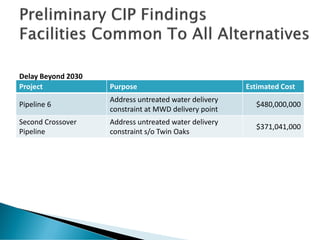
Project Purpose Estimated Cost
Pipeline 6
Address untreated water delivery
constraint at MWD delivery point
$480,000,000
Second Crossover
Pipeline
Address untreated water delivery
constraint s/o Twin Oaks
$371,041,000
Delay Beyond 2030
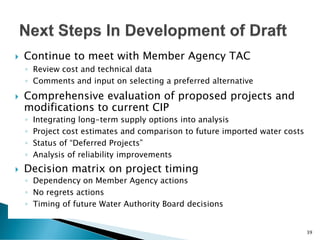
 Continue to meet with Member Agency TAC
◦ Review cost and technical data
◦ Comments and input on selecting a preferred alternative
 Comprehensive evaluation of proposed projects and
modifications to current CIP
◦ Integrating long-term supply options into analysis
◦ Project cost estimates and comparison to future imported water costs
◦ Status of “Deferred Projects”
◦ Analysis of reliability improvements
 Decision matrix on project timing
◦ Dependency on Member Agency actions
◦ No regrets actions
◦ Timing of future Water Authority Board decisions
39
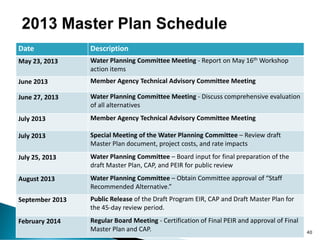
Date Description
May 23, 2013 Water Planning Committee Meeting - Report on May 16th Workshop
action items
June 2013 Member Agency Technical Advisory Committee Meeting
June 27, 2013 Water Planning Committee Meeting - Discuss comprehensive evaluation
of all alternatives
July 2013 Member Agency Technical Advisory Committee Meeting
July 2013 Special Meeting of the Water Planning Committee – Review draft
Master Plan document, project costs, and rate impacts
July 25, 2013 Water Planning Committee – Board input for final preparation of the
draft Master Plan, CAP, and PEIR for public review
August 2013 Water Planning Committee – Obtain Committee approval of “Staff
Recommended Alternative.”
September 2013 Public Release of the Draft Program EIR, CAP and Draft Master Plan for
the 45-day review period.
February 2014 Regular Board Meeting - Certification of Final PEIR and approval of Final
Master Plan and CAP. 40
Final   master plan - wp workshop 5-16-13

Final master plan - wp workshop 5-16-13

  • 1.
    Ken Weinberg, Directorof Water Resources Dave Chamberlain, Principal Engineer
  • 2.
    Supply/Demand Analysis andScenario Planning Evaluation Thresholds and Decision Metrics Baseline System Performance Storage Utilization Analysis New Supply and Conveyance Options (Long-Term) Recommended Near-Term System Improvements Project Costs and Rate Comparisons CEQA Process Selection of Preferred Alternative 2
  • 3.
     Demand Uncertaintyand Sensitivity  Revisit the Role of Storage to Optimize Management of Supplies  Measuring System Performance  Facility Options to Improve System Performance  Remaining Work 3
  • 4.
     2010 UWMPImplementation and Supply Reliability ◦ No Supply/Demand Gaps for Normal Weather  Dependent on member agencies achieving conservation and local supply targets ◦ Supply/demand gaps occur in dry years  Multi-year dry weather with MWD allocation of imported supplies  Compounded with lower levels of local supply development  Continued uncertainty in imported water availability 4
  • 5.
     Baseline SystemAnalysis  Evaluation Metrics and Thresholds ◦ When, how long are facilities operated at maximum? ◦ Is there a risk of eroding level of service? ◦ Are there supply reliability shortages? ◦ How much shortage is acceptable risk? ◦ What is expected frequency and duration? 5
  • 6.
    Supply and DemandScenarios Scenario Description Baseline (2010 UWMP) • Supplies and demands per 2010 UWMP • All member agency local supply development - “verifiable” • Conservation targets per SBX7-7 are achieved • Climate change evaluated as a subset of the Baseline Scenario No Added Local Supplies • Current member agency local supplies • Conservation same as 2010 – SBX7-7 not met • Upper boundary for WA supply development Maximum Local Supplies • Higher member agency local supply development - “verifiable” and “planned” • Conservation targets per SBX7-7 are achieved • Lower boundary for WA supply development 50% of Local Supplies • 50% of verifiable member agency local supply development • Conservation savings reach 50% of planned amounts (allows for member agency uncertainty to meet established targets) • Intermediate scenario - compare project timing 6
  • 8.
    8 600 700 800 900 1,000 2020 2025 20302035 TotalDemand(TAF) Baseline Demand without Price Effect Baseline Demand with Price Effect SBX 7-7 Compliance
  • 9.
    542 (actual) 647 675 718 754 786 500 600 700 800 2012 2015 2020 2025 2030 2035 TotalDemand(TAF) Total WaterDemands Actual 2012 Demand Compared to 2010 UWMP Normal Year Baseline Demand Forecast (TAF) 2010 UWMP Normal Year Forecast 9
  • 10.
    3.44 3.91 3.33 3.74 2.00 3.00 4.00 2020 2035 Population(millions) Series 12 Series13 Comparison of SANDAG Adopted Series 12 and Preliminary Series 13 Population Projections Water Authority Service Area 3% Decrease 4% Decrease 10
  • 11.
    21 TAF 32 TAF - 10 20 30 40 2020 2035 PotableDemandDecrease(TAF) 4%Decrease Estimated Decrease in Total Potable Demand Due to Population Reduction (Derived based on difference between SANDAG Series 12 and 13 Population Projections applied to Water Authority 2010 UWMP Potable GPCD Target of 167) 3% Decrease 11
  • 12.
  • 13.
    443 (actual) 478 (projected) 538 557 595 629 660 511 529 565 598 627 551 571 612 646 678 571 640 710 772 829 535 524 559 591 622 606 661 709 752 400 450 500 550 600 650 700 750 800 850 2012 2013 2015 2020 2025 2030 2035 WaterAuthorityDemand(TAF) 2010UWMP Normal Year Demand Forecast (A) 5% Reduction Sensitivity Scenario 2010 UWMP w/ Climate Change (A2) No Added Local (B) Maximum Local (C) 50% of Local (D) Sensitivity Analysis – Demand on the Water Authority No Added Local Supply Development Maximum Local Supply Development 13
  • 15.
     Regional andLocal Storage has Various Purposes ◦ Emergency Storage – manage supply interruptions ◦ Carryover Storage – manage short-term supply shortages ◦ Seasonal Storage – manage peak conveyance constraints ◦ Operational Storage – capture local runoff, provide forebays for Water Treatment Plants ◦ Other – includes recreation, flood protection needs  Master Plan Evaluation Included ◦ Modeling reservoir operations based on Member Agency input ◦ Optimizing regional storage for seasonal and carryover operations ◦ Evaluating benefits/impacts of additional regional storage on new infrastructure 15
  • 16.
     Total AvailableCapacity: 740,000 AF  Reservoirs Not Connected to Aqueduct System: 210,000 AF  Balance Available for Regional Use: 530,000 AF ◦ Includes forebay storage 16
  • 17.
    17 In-Region Storage Capacity TotalConnected Storage Capacity 530,000 AF Unavailable Dead Pool 17,000 AF Emergency Storage Pools: • Member Agency 175,000 AF • Water Authority 90,000 AF Carryover Storage 100,000 AF Balance for Local Operations, Other Use 148,000 AF
  • 18.
     Local OperationsPool (Local Runoff) ◦ First priority supply use, when available  Emergency Pool ◦ Not available for operations  Carryover Pool ◦ Available in allocation years ◦ Short-term supply for 3 years  Seasonal Storage Volumes ◦ Water Authority: 40 – 50,000 AF as needed ◦ Member Agency: contribution is part of normal operations  Modeled 90,000 AF increase in regional storage for carryover and seasonal use 0 100000 200000 300000 400000 500000 600000 700000 800000 RegionalStorageCapacity 18 Dead Pool Emergency Pool Carryover Pool Local Operations Pool Not Connected to Aqueducts
  • 19.
    19 Local Operations Essential tocapture local surface runoff for local supply, manage flow to local treatment plants Seasonal Storage Ability to manage short-term supply imbalances and conveyance limitations Carryover Storage Reduces severity of supply shortages Increased Regional Storage • Greater operational flexibility and extends drought protection • Management of short-term (1 or 2 years) supply imbalances • Constrained by conveyance limitations on reservoir puts/takes • Potential supply availability constraints
  • 21.
    Determining the Needto Add Capacity What are the Warning Signs? Metric Threshold Basis Conveyance Utilization • Exceed 95% of pipeline capacity for 45 days each year and 15 sequential days during peak season • Two consecutive years Conveyance utilization below 95% provides operational flexibility to manage daily MA flow requests Risk of exceeding Conveyance Utilization threshold: • May not meet daily delivery requests • May draw down emergency or carryover storage pools • May not be able to refill storage pools • No system redundancy 21
  • 22.
     Separate evaluationsof treated and untreated water conveyance systems ◦ Increase demand for untreated supplies to meet region’s expanded treatment plant capacity  Treated system has sufficient capacity through 2035 planning horizon  Untreated system has existing and future potential system constraints ◦ Evaluate expected magnitude and frequency 22
  • 23.
    Miramar Otay Perdue Levy Alvarado Twin Oaks Valley 100MGD Escondido/Vista ID Poway Badger Olivenhain Weese Untreated Water Delivery System Conveyance Constraints 23 Future System Capacity Constraint - Pipelines 3 and 5 (beyond 2020) Existing / Future System Capacity Constraint – Serving South County WTPs Crossover Pipeline to serve WTP (beyond 2025) SV Pump Station (to optimize storage use)
  • 24.
    Total Number of DaysDuring Peak Season Year in which 5% or More of Traces Indicate Exceeding Threshold UWMP Demands Maximum Local 50% of Local 45 2017 2019 2015 60 2018 2022 2016 90 2020 2024 2017 120 2024 2027 2021 24 • Untreated conveyance use is less sensitive to selection of thresholds or demand scenario – Pipelines need to operate at near capacity to meet summer peak demands • Use of greater frequency (e.g. 25% of traces rather than 5%) moves time of need out by 2-3 years
  • 25.
    25 5% 25% 10% Lines represent %of traces (frequency) Urban Water Management Plan Scenario (Expected) 45 days 60 days 90 days 120 days 50% 75%
  • 26.
    26 5% 25% 10% Lines represent %of traces (frequency) Maximum Local Scenario (IPR and Other Local Projects) 45 days 60 days 90 days 120 days 50% 75%
  • 27.
    27 5% 25% 10% Lines represent %of traces (frequency) Urban Water Management Plan Scenario (Expected) 45 days 60 days 90 days 120 days 50%
  • 28.
     Conveyance Risks(untreated water) ◦ Conveyance risks increase around 2020 ◦ Suggested time frame for new infrastructure development is 2020 to 2023 ◦ Coordination with member agencies can reduce near –term conveyance risk ◦ Existing system bottlenecks should be addressed to improve operational reliability Conveyance Constraint 28 Max Fill
  • 29.
    Addressing Supply Availability throughFacility Implementation Metric Threshold Basis Delivery Reliability • Annual supply shortage exceeds 20 TAF • Two consecutive years Annual shortages below 20 TAF may be mitigated by operational or management actions. Would not provide basis for new infrastructure or supply development. Risk of exceeding Delivery Reliability threshold: • Regional supply shortage (economic impacts) • May draw down emergency storage pools • Member Agencies will bear risk of shortages 29
  • 30.
    Supply Shortage Year inwhich 5% or More of Traces Indicate Exceeding Threshold UWMP Demands 50% of Local No Added Local 20,000 AF/Year 2033 2027 2021 30,000 AF/Year >2035 2028 2021 40,000 AF/Year >2035 2029 2021 50,000 AF/Year >2035 2030 2022 30 • Supply shortages are sensitive to demand scenario (no substantial shortages for UWMP demands or lower) • Magnitude of shortage is generally driven by supply uncertainty; when supply is unavailable the uncertainty is larger than the 20 TAF threshold • Use of greater frequency (e.g. 10% or 25% of traces rather than 5%) reduces shortage magnitude
  • 31.
    31 5% 25% 10% Lines represent %of traces (frequency) Urban Water Management Plan Scenario (expected) 112 years of Hydrology 20,000 AF 30,000 AF 40,000 AF 50,000 AF
  • 32.
    32 5% 25% 10% Lines represent %of traces (frequency) 50% 50% of Future Local Supplies Scenario 112 years of Hydrology 20,000 AF 30,000 AF 40,000 AF 50,000 AF
  • 33.
     Supply ShortageRisks (untreated water) ◦ Shortage risk is low through 2025, regardless of demand scenario ◦ Beyond 2025, shortage risk strongly depends on demand growth, member agency achievement of established targets for conservation, and local supply development ◦ Some shortages will be caused by conveyance limitations, but these will likely be short duration and relatively small in magnitude ◦ City of San Diego IPR resolves most long-term supply- demand imbalances 33
  • 35.
    Miramar Otay Perdue Levy Alvarado Twin Oaks Valley 100MGD Escondido/Vista ID Poway Badger Olivenhain Weese Untreated Water Delivery System Conveyance Constraints 35 Capacity Constraint - Pipeline 3-4 Conversion, North County ESP Pump Station, Regulatory Storage Existing System Capacity Constraint – Pipeline 3 and 4 Intertie Crossover Pipeline (low probability; beyond 2025) SV Pump Station (to optimize storage use) Third Pump to increase flow Future System Capacity Constraint – Mission Trails Suite of Projects
  • 36.
    Project Purpose EstimatedCost New 30 Inch South County Inter-tie Alleviate conveyance bottleneck south of Alvarado $6,000,000 Pipeline 3/4 Conversion Address untreated water conveyance constraint at MWD delivery point $220,000,000 North County ESP Pump Station Meet ESP delivery needs $21,563,000 Construct as Defined Project Purpose Estimated Cost Mission Trails Suite of projects Increase untreated water conveyance to serve South County WTPs $63,917,000 Regulatory Storage Provide operational storage for increased deliveries $55,650,000 Third VFD San Vicente PS Meet ESP, Carryover Storage needs $8,044,000 Revise Scope, Size and Timing
  • 37.
    Project Purpose EstimatedCost Pipeline 6 Address untreated water delivery constraint at MWD delivery point $480,000,000 Second Crossover Pipeline Address untreated water delivery constraint s/o Twin Oaks $371,041,000 Delay Beyond 2030
  • 39.
     Continue tomeet with Member Agency TAC ◦ Review cost and technical data ◦ Comments and input on selecting a preferred alternative  Comprehensive evaluation of proposed projects and modifications to current CIP ◦ Integrating long-term supply options into analysis ◦ Project cost estimates and comparison to future imported water costs ◦ Status of “Deferred Projects” ◦ Analysis of reliability improvements  Decision matrix on project timing ◦ Dependency on Member Agency actions ◦ No regrets actions ◦ Timing of future Water Authority Board decisions 39
  • 40.
    Date Description May 23,2013 Water Planning Committee Meeting - Report on May 16th Workshop action items June 2013 Member Agency Technical Advisory Committee Meeting June 27, 2013 Water Planning Committee Meeting - Discuss comprehensive evaluation of all alternatives July 2013 Member Agency Technical Advisory Committee Meeting July 2013 Special Meeting of the Water Planning Committee – Review draft Master Plan document, project costs, and rate impacts July 25, 2013 Water Planning Committee – Board input for final preparation of the draft Master Plan, CAP, and PEIR for public review August 2013 Water Planning Committee – Obtain Committee approval of “Staff Recommended Alternative.” September 2013 Public Release of the Draft Program EIR, CAP and Draft Master Plan for the 45-day review period. February 2014 Regular Board Meeting - Certification of Final PEIR and approval of Final Master Plan and CAP. 40