From Drought
 Response to Center
       Stage:

Water Conservation Finds
 It’s Home in Integrated
    Resources Planning
Central Texas Water
Conservation Symposium                Richard Harris
February 26, 2013        Water Conservation Manager
Presentation Outline


• EBMUD Facts and Figures


• California’s Water Challenges

• EBMUD’s Water Supply Management Program

• EBMUD’s Water Conservation Master Plan

 Implementation Strategies
EBMUD Facts and Figures
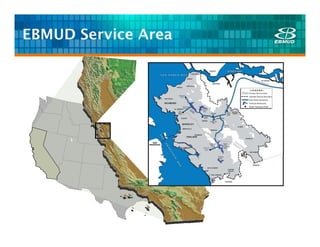
EBMUD Service Area
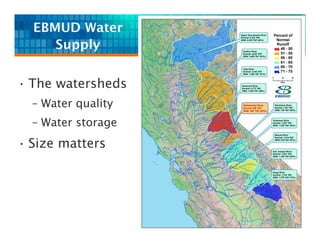
EBMUD Water
     Supply


• The watersheds
  – Water quality
  – Water storage
• Size matters
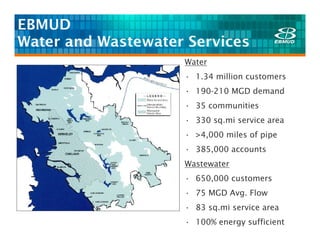
EBMUD
Water and Wastewater Services
                    Water
                    • 1.34 million customers
                    • 190-210 MGD demand
                    • 35 communities
                    • 330 sq.mi service area
                    • >4,000 miles of pipe
                    • 385,000 accounts
                    Wastewater
                    • 650,000 customers
                    • 75 MGD Avg. Flow
                    • 83 sq.mi service area
                    • 100% energy sufficient
California’s Water Challenges
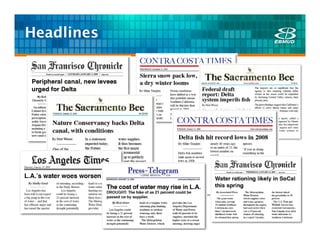
Headlines
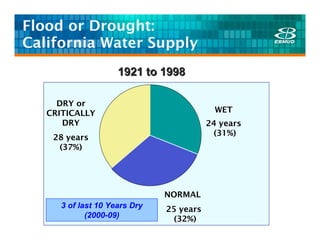
Flood or Drought:
California Water Supply
                    1921 to 1998

     DRY or
   CRITICALLY                             WET
      DRY                                24 years
                                          (31%)
    28 years
     (37%)


                              NORMAL
     3 of last 10 Years Dry   25 years
            (2000-09)           (32%)
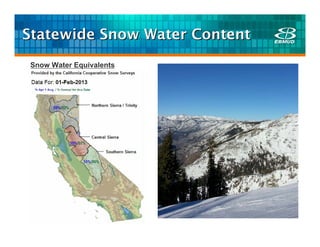
Statewide Snow Water Content
Snow Water Equivalents
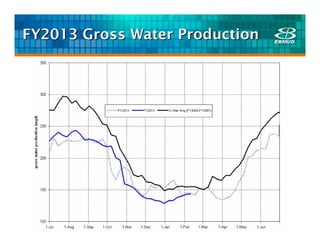
FY2013 Gross Water Production
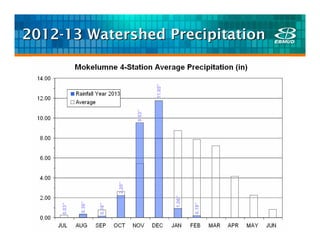
0.03”


0.36”


0.16”


          2.20”


                  9.53”


                          11.85”


  1.06”


0.18”
                                   2012-13 Watershed Precipitation
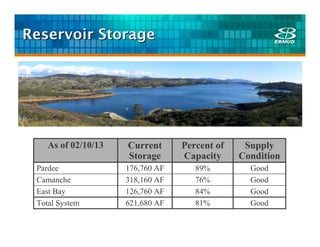
Reservoir Storage


    As of 02/10/13   Current      Percent of    Supply
                     Storage      Capacity     Condition
 Pardee              176,760 AF      89%         Good
 Camanche            318,160 AF      76%         Good
 East Bay            126,760 AF      84%         Good
 Total System        621,680 AF      81%         Good
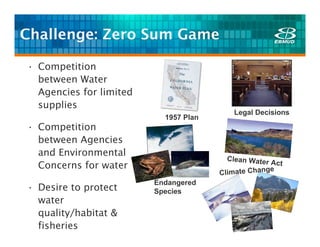
Challenge: Zero Sum Game

• Competition
  between Water
  Agencies for limited
  supplies
                                           Legal Decisions
                           1957 Plan
• Competition
  between Agencies
  and Environmental
                                         Clean Water
  Concerns for water                                 Ac t
                                                     e
                                       Climate Chang
                         Endangered
• Desire to protect      Species
  water
  quality/habitat &
  fisheries
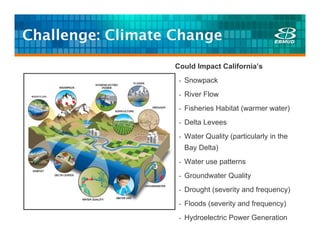
Challenge: Climate Change
                   Could Impact California’s
                    - Snowpack
                    - River Flow
                    - Fisheries Habitat (warmer water)
                    - Delta Levees
                    - Water Quality (particularly in the
                     Bay Delta)
                    - Water use patterns
                    - Groundwater Quality
                    - Drought (severity and frequency)
                    - Floods (severity and frequency)
                    - Hydroelectric Power Generation
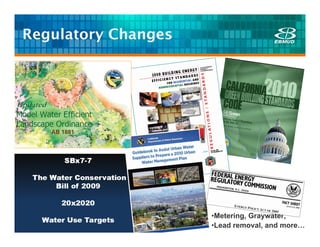
Regulatory Changes


                     •Metering, Graywater,
                     •Lead removal, and more…
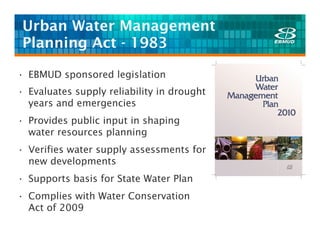
Urban Water Management
 Planning Act - 1983

• EBMUD sponsored legislation
• Evaluates supply reliability in drought
  years and emergencies
• Provides public input in shaping
  water resources planning
• Verifies water supply assessments for
  new developments
• Supports basis for State Water Plan
• Complies with Water Conservation
  Act of 2009
EBMUD Water Supply
Management Program
  (WSMP) To 2040
WSMP 2040 Purpose/Objectives

• Water supply reliability to the year 2040
• Account for accomplishments and changes
  since the last WSMP (1993), including:
   - New facilities and programs
   - New regulatory and resource requirements
   - Climate change
• Find optimum balance between customer
  rationing, conservation, recycling and
  supplemental supply
• Maintain environmental stewardship
WSMP 2040 Planning Objectives
• Operations, Engineering, Legal & Institutional
   - Provide water supply reliability
   - Utilize water right entitlements
   - Promote regional solutions
• Economic
   - Minimize customer cost
   - Minimize drought impact
   - Maximize positive impact to local economy
• Public Health, Safety and Community
   -   Ensure high water quality
   -   Minimize adverse sociocultural impacts
   -   Minimize risks to public health & safety
   -   Maximize security of infrastructure & water supply
• Environmental
   -   Preserve & protect the environment for future generations
   -   Preserve & protect biological resources
   -   Minimize carbon footprint
   -   Promote recreational opportunities
WSMP 2040 Solution
Provides Flexibility for the Future


• Future demand growth will be met through:

   - Aggressive water conservation

   - Maximum feasible recycled water

   - 10% water rationing objective in dry years

• Additional diverse supplemental supplies will
  allow reduction in water rationing from >25%
WSMP 2040 - Preferred Portfolio


 • Robust plan: needed in light of future
   uncertainty (e.g., Global Climate Change)


 • Multiple, parallel project components


 • Diverse & flexible strategy


 • Environmentally sound
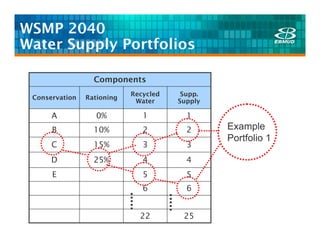
WSMP 2040
Water Supply Portfolios

                  Components
                            Recycled    Supp.
 Conservation   Rationing
                             Water     Supply

      A            0%          1         1
      B           10%          2         2      Example
                                                Portfolio 1
      C           15%          3         3
      D           25%          4         4
      E                        5         5
                               6         6


                              22        25
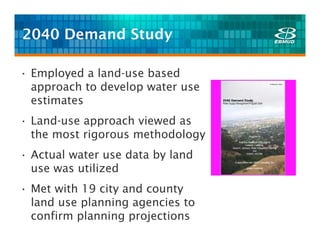
2040 Demand Study

• Employed a land-use based
  approach to develop water use
  estimates
• Land-use approach viewed as
  the most rigorous methodology
• Actual water use data by land
  use was utilized
• Met with 19 city and county
  land use planning agencies to
  confirm planning projections
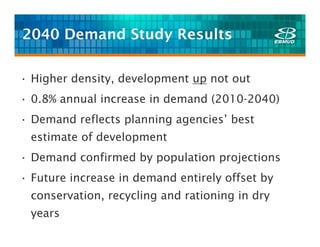
2040 Demand Study Results

• Higher density, development up not out
• 0.8% annual increase in demand (2010-2040)
• Demand reflects planning agencies’ best
 estimate of development
• Demand confirmed by population projections
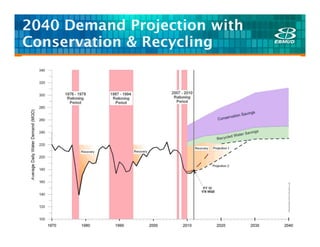
• Future increase in demand entirely offset by
 conservation, recycling and rationing in dry
 years
2040 Demand Projection with
Conservation & Recycling
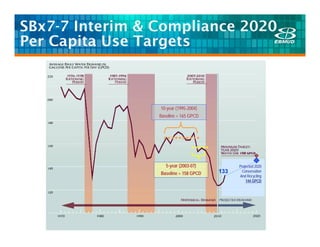
SBx7-7 Interim & Compliance 2020
Per Capita Use Targets


                 10-year (1995-2004)
                 Baseline = 165 GPCD


                    5-year (2003-07)         Projected 2020
                                       133    Conservation
                 Baseline = 158 GPCD
                                             And Recycling
                                                 144 GPCD
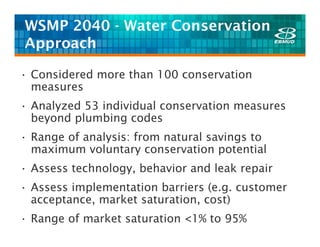
WSMP 2040 - Water Conservation
Approach

• Considered more than 100 conservation
  measures
• Analyzed 53 individual conservation measures
  beyond plumbing codes
• Range of analysis: from natural savings to
  maximum voluntary conservation potential
• Assess technology, behavior and leak repair
• Assess implementation barriers (e.g. customer
  acceptance, market saturation, cost)
• Range of market saturation <1% to 95%
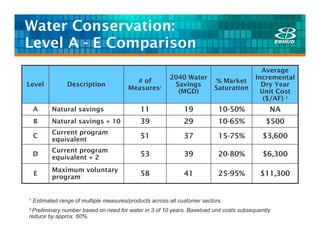
Water Conservation:
Level A - E Comparison
                                                                                          Average
                                                         2040 Water                     Incremental
                                           # of                             % Market
Level            Description                              Savings                         Dry Year
                                         Measures1                         Saturation
                                                           (MGD)                          Unit Cost
                                                                                           ($/AF) 2
    A      Natural savings                    11               19           10-50%          NA
    B      Natural savings + 10               39               29           10-65%         $500
           Current program
    C
           equivalent
                                              51               37           15-75%        $3,600
           Current program
    D
           equivalent + 2                     53               39           20-80%        $6,300

           Maximum voluntary
    E
           program                            58               41           25-95%       $11,300


1   Estimated range of multiple measures/products across all customer sectors.
2 Preliminary
            number based on need for water in 3 of 10 years. Baseload unit costs subsequently
reduce by approx. 60%.
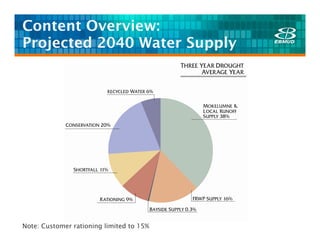
Content Overview:
Projected 2040 Water Supply


Note: Customer rationing limited to 15%
2011 Water Conservation
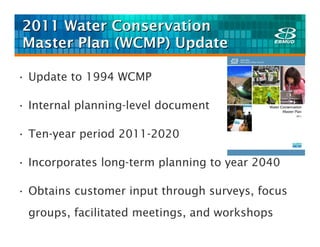
Master Plan (WCMP) Update

• Update to 1994 WCMP

• Internal planning-level document

• Ten-year period 2011-2020

• Incorporates long-term planning to year 2040

• Obtains customer input through surveys, focus
 groups, facilitated meetings, and workshops
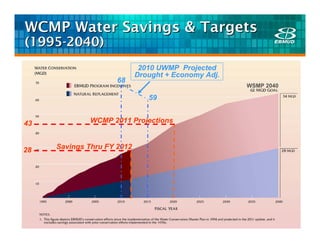
WCMP Water Savings & Targets
(1995-2040)
                             2010 UWMP Projected
                            Drought + Economy Adj.
                     68
                                                     WSMP 2040

                               59


43           WCMP 2011 Projections


28   Savings Thru FY 2012
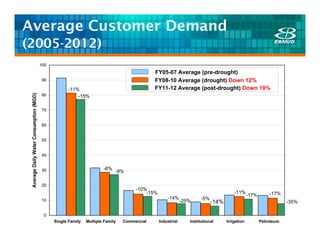
Average Customer Demand
(2005-2012)

                                    FY05-07 Average (pre-drought)
                                    FY08-10 Average (drought) Down 12%
      -11%                          FY11-12 Average (post-drought) Down 19%
          -15%


                 -6%
                       -9%


                             -10%
                                 -15%                              -11%          -17%
                                                                          -17%
                                        -14%          -5%
                                               -25%         -14%                        -35%
Water Conservation (Market)
Trends

• Indoor residential conservation becoming saturated
• Focus toward outdoor and supply-side savings
• Maintaining savings through behavior-related services
• Innovative incentives thru loans, on-bill financing
• Standards for advanced metering infrastructure
• Nexus with energy, wastewater, and solid waste
• Enhanced web-based services (self-help tools, videos)
• Professional landscaper & plumber certification
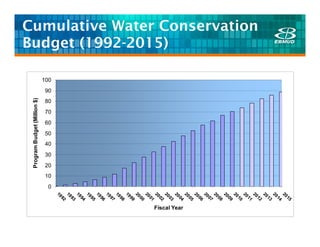
Cumulative Water Conservation
Budget (1992-2015)

                              100
                               90
 Program Budget (Million $)


                               80
                               70
                               60
                               50
                               40
                               30
                               20
                               10
                                0
                                    19 19 19 19 19 19 19 19 20 20 20 20 20 20 20 20 20 20 20 20 20 20 20 20
                                      92 93 94 95 96 97 98 99 00 01 02 03 04 05 06 07 08 09 10 11 12 13 14 15

                                                                  Fiscal Year
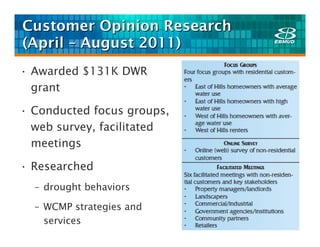
Customer Opinion Research
(April – August 2011)
• Awarded $131K DWR
  grant

• Conducted focus groups,
  web survey, facilitated
  meetings

• Researched
  – drought behaviors

  – WCMP strategies and
    services
Customer Opinion Research
Findings
• General perception that low water price limits
  conservation-related financial savings
• Function, price and water savings are important
  purchasing considerations
• Outdoor landscape is an extension of living space,
  aesthetics and usability
• Few customer know how much water they use;
  measured in dollars, not gallons
• Ability for landlords to individually meter, bill for
  usage could provide conservation incentive
• Many expressed interest in metering technology, real
  time access, water budgets
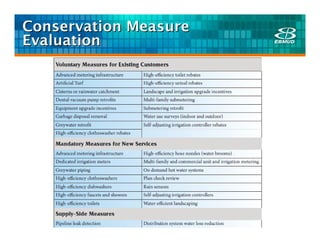
Conservation Measure
Evaluation
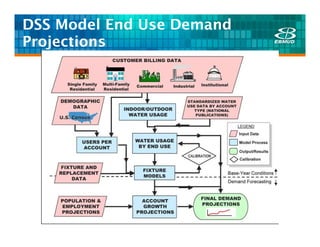
DSS Model End Use Demand
Projections
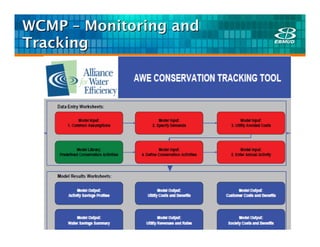
WCMP – Monitoring and
Tracking
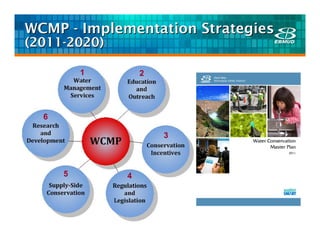
WCMP - Implementation Strategies
(2011-2020)

          1       2


  6

                      3


      5       4
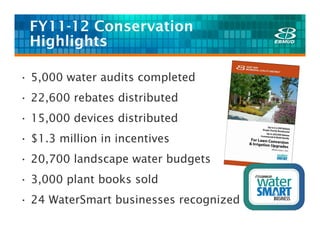
FY11-12 Conservation
 Highlights

• 5,000 water audits completed
• 22,600 rebates distributed
• 15,000 devices distributed
• $1.3 million in incentives
• 20,700 landscape water budgets
• 3,000 plant books sold
• 24 WaterSmart businesses recognized
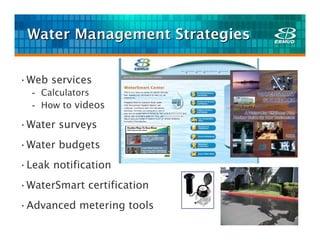
Water Management Strategies


•Web services
  - Calculators
  - How to videos

•Water surveys
•Water budgets
•Leak notification
•WaterSmart certification
•Advanced metering tools
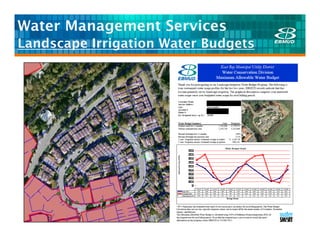
Water Management Services
Landscape Irrigation Water Budgets
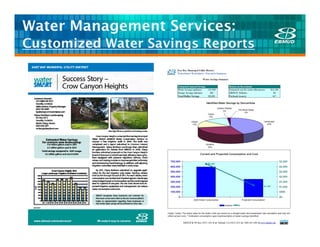
Water Management Services:
Customized Water Savings Reports
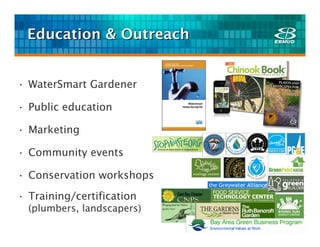
Education & Outreach


• WaterSmart Gardener

• Public education

• Marketing

• Community events

• Conservation workshops
• Training/certification
  (plumbers, landscapers)
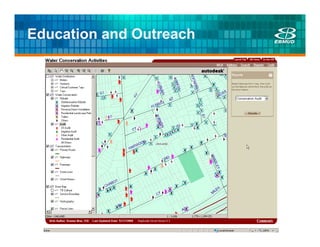
Education and Outreach
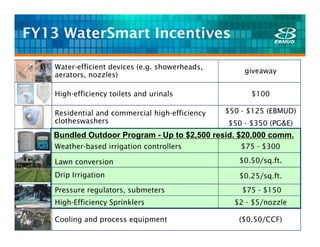
FY13 WaterSmart Incentives

    Water-efficient devices (e.g. showerheads,
                                                     giveaway
    aerators, nozzles)

    High-efficiency toilets and urinals                $100

    Residential and commercial high-efficiency   $50 - $125 (EBMUD)
    clotheswashers                               $50 - $350 (PG&E)
   Bundled Outdoor Program - Up to $2,500 resid. $20,000 comm.
    Weather-based irrigation controllers             $75 - $300

    Lawn conversion                                 $0.50/sq.ft.
    Drip Irrigation                                 $0.25/sq.ft.
    Pressure regulators, submeters                   $75 - $150
    High-Efficiency Sprinklers                     $2 - $5/nozzle

    Cooling and process equipment                   ($0.50/CCF)
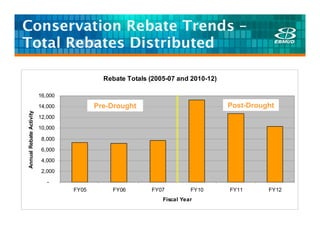
Conservation Rebate Trends –
Total Rebates Distributed

                                           Rebate Totals (2005-07 and 2010-12)

                         16,000
                         14,000          Pre-Drought                             Post-Drought
Annual Rebate Activity


                         12,000
                         10,000

                          8,000
                          6,000
                          4,000

                          2,000
                            -
                                  FY05       FY06        FY07          FY10      FY11      FY12
                                                             Fiscal Year
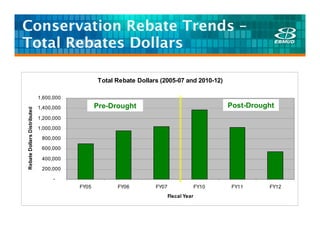
Conservation Rebate Trends –
Total Rebates Dollars

                                                Total Rebate Dollars (2005-07 and 2010-12)

                             1,600,000

                             1,400,000          Pre-Drought                                    Post-Drought
Rebate Dollars Distributed


                             1,200,000
                             1,000,000
                              800,000

                              600,000

                              400,000
                              200,000

                                   -
                                         FY05         FY06         FY07                 FY10   FY11      FY12
                                                                          Fiscal Year
Conservation Rebate Trends –
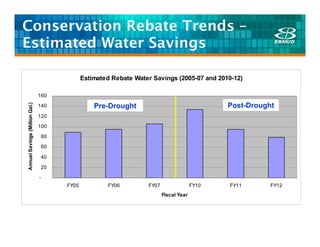
Estimated Water Savings

                                                Estimated Rebate Water Savings (2005-07 and 2010-12)

                                160
Annual Savings (Million Gal.)


                                140                 Pre-Drought                                  Post-Drought
                                120

                                100

                                    80

                                    60

                                    40

                                    20

                                -
                                         FY05           FY06         FY07                 FY10   FY11       FY12
                                                                            Fiscal Year
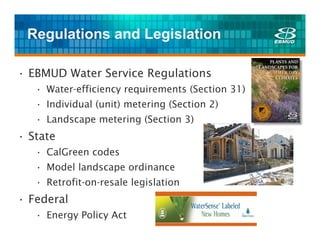
Regulations and Legislation

• EBMUD Water Service Regulations
   • Water-efficiency requirements (Section 31)
   • Individual (unit) metering (Section 2)
   • Landscape metering (Section 3)
• State
   • CalGreen codes
   • Model landscape ordinance
   • Retrofit-on-resale legislation
• Federal
   • Energy Policy Act
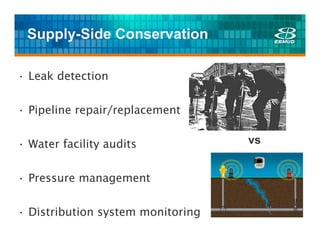
Supply-Side Conservation

• Leak detection


• Pipeline repair/replacement


• Water facility audits            vs


• Pressure management


• Distribution system monitoring
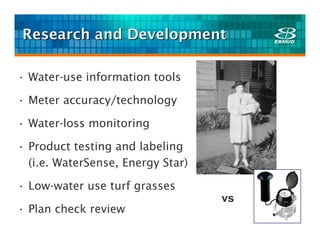
Research and Development

• Water-use information tools

• Meter accuracy/technology

• Water-loss monitoring

• Product testing and labeling
  (i.e. WaterSense, Energy Star)

• Low-water use turf grasses
                                   vs
• Plan check review
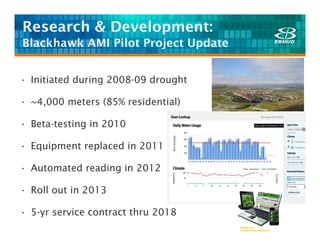
Research & Development:
Blackhawk AMI Pilot Project Update


• Initiated during 2008-09 drought

• ~4,000 meters (85% residential)

• Beta-testing in 2010

• Equipment replaced in 2011

• Automated reading in 2012

• Roll out in 2013

• 5-yr service contract thru 2018
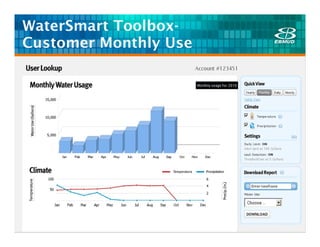
WaterSmart Toolbox-
Customer Monthly Use
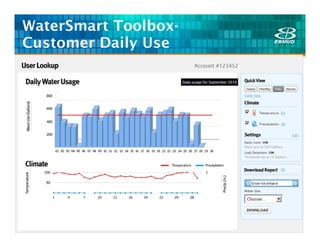
WaterSmart Toolbox-
Customer Daily Use
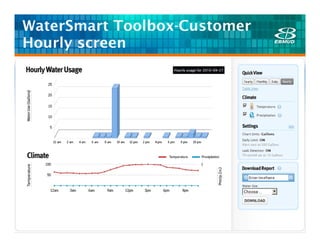
WaterSmart Toolbox-Customer
Hourly screen
Research & Development:
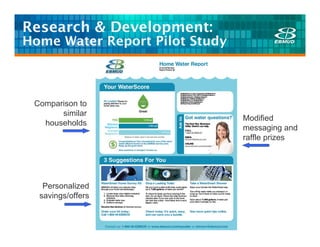
Home Water Report Pilot Study


 Comparison to
       similar
                                Modified
   households
                                messaging and
                                raffle prizes


   Personalized
  savings/offers
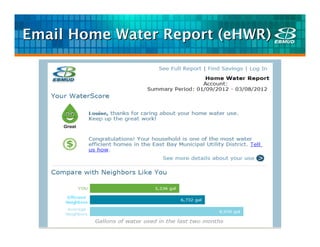
Email Home Water Report (eHWR)
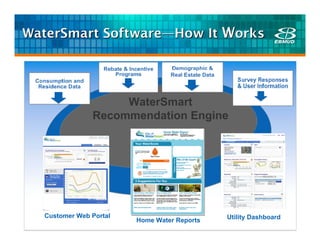
WaterSmart Software—How It Works


                    WaterSmart
               Recommendation Engine


  Customer Web Portal                        Utility Dashboard
                        Home Water Reports
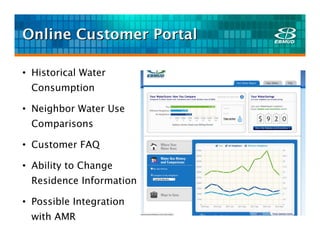
Online Customer Portal

• Historical Water
 Consumption

• Neighbor Water Use
 Comparisons

• Customer FAQ

• Ability to Change
 Residence Information

• Possible Integration
 with AMR
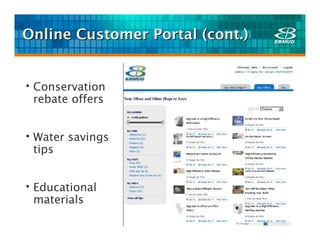
Online Customer Portal (cont.)


•Conservation
 rebate offers


•Water savings
 tips


•Educational
 materials
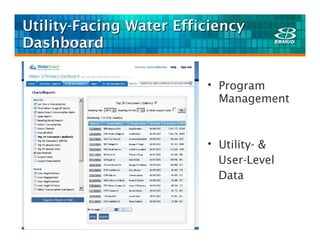
Utility-Facing Water Efficiency
Dashboard

                         • Program
                           Management


                         • Utility- &
                           User-Level
                           Data
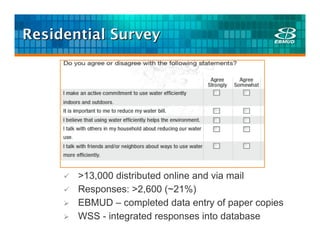
Residential Survey


       >13,000 distributed online and via mail
       Responses: >2,600 (~21%)
       EBMUD – completed data entry of paper copies
       WSS - integrated responses into database
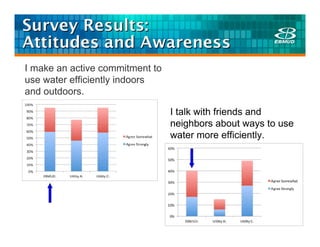
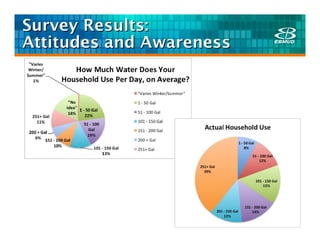
Survey Results:
Attitudes and Awareness
I make an active commitment to
use water efficiently indoors
and outdoors.

                                 I talk with friends and
                                 neighbors about ways to use
                                 water more efficiently.
Survey Results:
Attitudes and Awareness
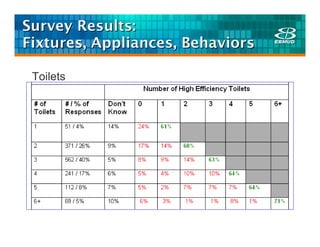
Survey Results:
Fixtures, Appliances, Behaviors

 Toilets
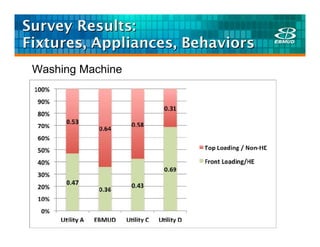
Survey Results:
Fixtures, Appliances, Behaviors
 Washing Machine
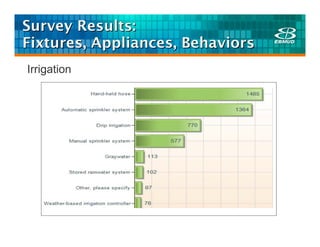
Survey Results:
Fixtures, Appliances, Behaviors
Irrigation
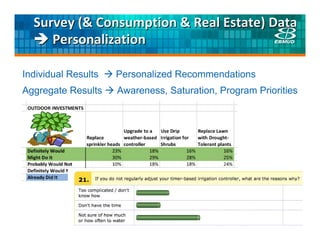
Survey (& Consumption & Real Estate) Data 
     Personalization

Individual Results   Personalized Recommendations
Aggregate Results    Awareness, Saturation, Program Priorities
Lessons and Results:
Happy Customers, Taking Action

•Overall customers happy, liked neighborhood comparison
•4.6% of customers have called or gone online
•Increased request for conservation services (3 audits/day)
•Power of social norms - water use comparison v. $ on bill
•Effective prompt/nudge for people who were complacent
•Graphics v. text-heavy bill – simple communication
•Some people pay close attention – pull out old bills
•Targeting 2% annual water savings overall
•Early results of 4-5%
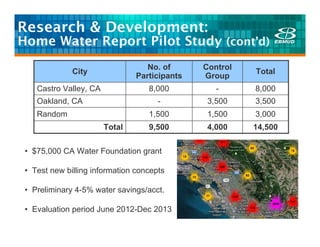
Research & Development:
Home Water Report Pilot Study (cont’d)
                                   No. of      Control
              City                                       Total
                                Participants   Group
    Castro Valley, CA              8,000          -      8,000
    Oakland, CA                       -         3,500    3,500
    Random                         1,500        1,500    3,000
                        Total      9,500        4,000    14,500

 • $75,000 CA Water Foundation grant

 • Test new billing information concepts

 • Preliminary 4-5% water savings/acct.

 • Evaluation period June 2012-Dec 2013
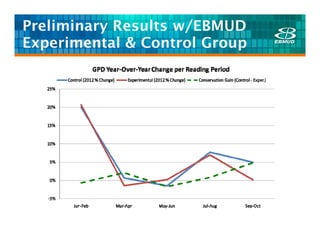
Preliminary Results w/EBMUD
Experimental & Control Group
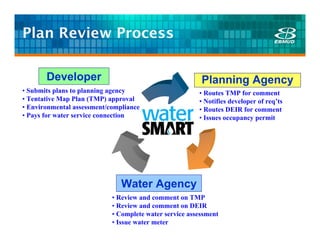
Plan Review Process

       Developer                                         Planning Agency
• Submits plans to planning agency                      • Routes TMP for comment
• Tentative Map Plan (TMP) approval                     • Notifies developer of req’ts
• Environmental assessment/compliance                   • Routes DEIR for comment
• Pays for water service connection                     • Issues occupancy permit


                               Water Agency
                            • Review and comment on TMP
                            • Review and comment on DEIR
                            • Complete water service assessment
                            • Issue water meter
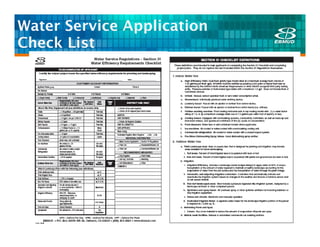
Water Service Application
Check List
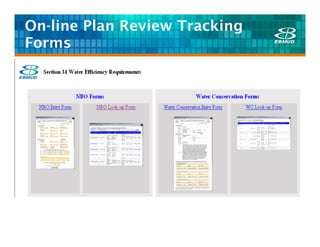
On-line Plan Review Tracking
Forms
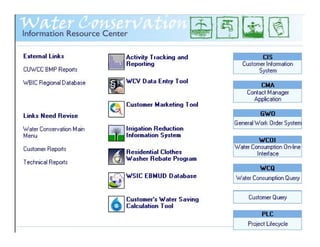
Water Management Strategies
Questions

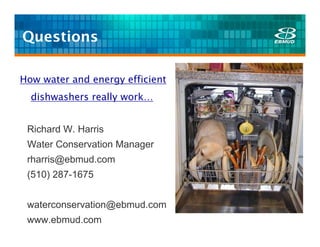
How water and energy efficient
  dishwashers really work…


 Richard W. Harris
 Water Conservation Manager
 rharris@ebmud.com
 (510) 287-1675


 waterconservation@ebmud.com
 www.ebmud.com

From Drought Response to Center Stage

  • 1.
    From Drought Responseto Center Stage: Water Conservation Finds It’s Home in Integrated Resources Planning Central Texas Water Conservation Symposium Richard Harris February 26, 2013 Water Conservation Manager
  • 2.
    Presentation Outline • EBMUDFacts and Figures • California’s Water Challenges • EBMUD’s Water Supply Management Program • EBMUD’s Water Conservation Master Plan Implementation Strategies
  • 3.
  • 4.
  • 5.
    EBMUD Water Supply • The watersheds – Water quality – Water storage • Size matters
  • 6.
    EBMUD Water and WastewaterServices Water • 1.34 million customers • 190-210 MGD demand • 35 communities • 330 sq.mi service area • >4,000 miles of pipe • 385,000 accounts Wastewater • 650,000 customers • 75 MGD Avg. Flow • 83 sq.mi service area • 100% energy sufficient
  • 7.
  • 8.
  • 10.
    Flood or Drought: CaliforniaWater Supply 1921 to 1998 DRY or CRITICALLY WET DRY 24 years (31%) 28 years (37%) NORMAL 3 of last 10 Years Dry 25 years (2000-09) (32%)
  • 11.
    Statewide Snow WaterContent Snow Water Equivalents
  • 12.
  • 13.
    0.03” 0.36” 0.16” 2.20” 9.53” 11.85” 1.06” 0.18” 2012-13 Watershed Precipitation
  • 14.
    Reservoir Storage As of 02/10/13 Current Percent of Supply Storage Capacity Condition Pardee 176,760 AF 89% Good Camanche 318,160 AF 76% Good East Bay 126,760 AF 84% Good Total System 621,680 AF 81% Good
  • 15.
    Challenge: Zero SumGame • Competition between Water Agencies for limited supplies Legal Decisions 1957 Plan • Competition between Agencies and Environmental Clean Water Concerns for water Ac t e Climate Chang Endangered • Desire to protect Species water quality/habitat & fisheries
  • 16.
    Challenge: Climate Change Could Impact California’s - Snowpack - River Flow - Fisheries Habitat (warmer water) - Delta Levees - Water Quality (particularly in the Bay Delta) - Water use patterns - Groundwater Quality - Drought (severity and frequency) - Floods (severity and frequency) - Hydroelectric Power Generation
  • 17.
    Regulatory Changes •Metering, Graywater, •Lead removal, and more…
  • 18.
    Urban Water Management Planning Act - 1983 • EBMUD sponsored legislation • Evaluates supply reliability in drought years and emergencies • Provides public input in shaping water resources planning • Verifies water supply assessments for new developments • Supports basis for State Water Plan • Complies with Water Conservation Act of 2009
  • 19.
    EBMUD Water Supply ManagementProgram (WSMP) To 2040
  • 20.
    WSMP 2040 Purpose/Objectives •Water supply reliability to the year 2040 • Account for accomplishments and changes since the last WSMP (1993), including: - New facilities and programs - New regulatory and resource requirements - Climate change • Find optimum balance between customer rationing, conservation, recycling and supplemental supply • Maintain environmental stewardship
  • 21.
    WSMP 2040 PlanningObjectives • Operations, Engineering, Legal & Institutional - Provide water supply reliability - Utilize water right entitlements - Promote regional solutions • Economic - Minimize customer cost - Minimize drought impact - Maximize positive impact to local economy • Public Health, Safety and Community - Ensure high water quality - Minimize adverse sociocultural impacts - Minimize risks to public health & safety - Maximize security of infrastructure & water supply • Environmental - Preserve & protect the environment for future generations - Preserve & protect biological resources - Minimize carbon footprint - Promote recreational opportunities
  • 22.
    WSMP 2040 Solution ProvidesFlexibility for the Future • Future demand growth will be met through: - Aggressive water conservation - Maximum feasible recycled water - 10% water rationing objective in dry years • Additional diverse supplemental supplies will allow reduction in water rationing from >25%
  • 23.
    WSMP 2040 -Preferred Portfolio • Robust plan: needed in light of future uncertainty (e.g., Global Climate Change) • Multiple, parallel project components • Diverse & flexible strategy • Environmentally sound
  • 24.
    WSMP 2040 Water SupplyPortfolios Components Recycled Supp. Conservation Rationing Water Supply A 0% 1 1 B 10% 2 2 Example Portfolio 1 C 15% 3 3 D 25% 4 4 E 5 5 6 6 22 25
  • 25.
    2040 Demand Study •Employed a land-use based approach to develop water use estimates • Land-use approach viewed as the most rigorous methodology • Actual water use data by land use was utilized • Met with 19 city and county land use planning agencies to confirm planning projections
  • 26.
    2040 Demand StudyResults • Higher density, development up not out • 0.8% annual increase in demand (2010-2040) • Demand reflects planning agencies’ best estimate of development • Demand confirmed by population projections • Future increase in demand entirely offset by conservation, recycling and rationing in dry years
  • 27.
    2040 Demand Projectionwith Conservation & Recycling
  • 28.
    SBx7-7 Interim &Compliance 2020 Per Capita Use Targets 10-year (1995-2004) Baseline = 165 GPCD 5-year (2003-07) Projected 2020 133 Conservation Baseline = 158 GPCD And Recycling 144 GPCD
  • 29.
    WSMP 2040 -Water Conservation Approach • Considered more than 100 conservation measures • Analyzed 53 individual conservation measures beyond plumbing codes • Range of analysis: from natural savings to maximum voluntary conservation potential • Assess technology, behavior and leak repair • Assess implementation barriers (e.g. customer acceptance, market saturation, cost) • Range of market saturation <1% to 95%
  • 30.
    Water Conservation: Level A- E Comparison Average 2040 Water Incremental # of % Market Level Description Savings Dry Year Measures1 Saturation (MGD) Unit Cost ($/AF) 2 A Natural savings 11 19 10-50% NA B Natural savings + 10 39 29 10-65% $500 Current program C equivalent 51 37 15-75% $3,600 Current program D equivalent + 2 53 39 20-80% $6,300 Maximum voluntary E program 58 41 25-95% $11,300 1 Estimated range of multiple measures/products across all customer sectors. 2 Preliminary number based on need for water in 3 of 10 years. Baseload unit costs subsequently reduce by approx. 60%.
  • 31.
    Content Overview: Projected 2040Water Supply Note: Customer rationing limited to 15%
  • 32.
    2011 Water Conservation MasterPlan (WCMP) Update • Update to 1994 WCMP • Internal planning-level document • Ten-year period 2011-2020 • Incorporates long-term planning to year 2040 • Obtains customer input through surveys, focus groups, facilitated meetings, and workshops
  • 33.
    WCMP Water Savings& Targets (1995-2040) 2010 UWMP Projected Drought + Economy Adj. 68 WSMP 2040 59 43 WCMP 2011 Projections 28 Savings Thru FY 2012
  • 34.
    Average Customer Demand (2005-2012) FY05-07 Average (pre-drought) FY08-10 Average (drought) Down 12% -11% FY11-12 Average (post-drought) Down 19% -15% -6% -9% -10% -15% -11% -17% -17% -14% -5% -25% -14% -35%
  • 35.
    Water Conservation (Market) Trends •Indoor residential conservation becoming saturated • Focus toward outdoor and supply-side savings • Maintaining savings through behavior-related services • Innovative incentives thru loans, on-bill financing • Standards for advanced metering infrastructure • Nexus with energy, wastewater, and solid waste • Enhanced web-based services (self-help tools, videos) • Professional landscaper & plumber certification
  • 36.
    Cumulative Water Conservation Budget(1992-2015) 100 90 Program Budget (Million $) 80 70 60 50 40 30 20 10 0 19 19 19 19 19 19 19 19 20 20 20 20 20 20 20 20 20 20 20 20 20 20 20 20 92 93 94 95 96 97 98 99 00 01 02 03 04 05 06 07 08 09 10 11 12 13 14 15 Fiscal Year
  • 37.
    Customer Opinion Research (April– August 2011) • Awarded $131K DWR grant • Conducted focus groups, web survey, facilitated meetings • Researched – drought behaviors – WCMP strategies and services
  • 38.
    Customer Opinion Research Findings •General perception that low water price limits conservation-related financial savings • Function, price and water savings are important purchasing considerations • Outdoor landscape is an extension of living space, aesthetics and usability • Few customer know how much water they use; measured in dollars, not gallons • Ability for landlords to individually meter, bill for usage could provide conservation incentive • Many expressed interest in metering technology, real time access, water budgets
  • 39.
  • 40.
    DSS Model EndUse Demand Projections
  • 41.
    WCMP – Monitoringand Tracking
  • 42.
    WCMP - ImplementationStrategies (2011-2020) 1 2 6 3 5 4
  • 43.
    FY11-12 Conservation Highlights •5,000 water audits completed • 22,600 rebates distributed • 15,000 devices distributed • $1.3 million in incentives • 20,700 landscape water budgets • 3,000 plant books sold • 24 WaterSmart businesses recognized
  • 44.
    Water Management Strategies •Webservices - Calculators - How to videos •Water surveys •Water budgets •Leak notification •WaterSmart certification •Advanced metering tools
  • 45.
    Water Management Services LandscapeIrrigation Water Budgets
  • 46.
  • 47.
    Education & Outreach •WaterSmart Gardener • Public education • Marketing • Community events • Conservation workshops • Training/certification (plumbers, landscapers)
  • 48.
  • 49.
    FY13 WaterSmart Incentives Water-efficient devices (e.g. showerheads, giveaway aerators, nozzles) High-efficiency toilets and urinals $100 Residential and commercial high-efficiency $50 - $125 (EBMUD) clotheswashers $50 - $350 (PG&E) Bundled Outdoor Program - Up to $2,500 resid. $20,000 comm. Weather-based irrigation controllers $75 - $300 Lawn conversion $0.50/sq.ft. Drip Irrigation $0.25/sq.ft. Pressure regulators, submeters $75 - $150 High-Efficiency Sprinklers $2 - $5/nozzle Cooling and process equipment ($0.50/CCF)
  • 50.
    Conservation Rebate Trends– Total Rebates Distributed Rebate Totals (2005-07 and 2010-12) 16,000 14,000 Pre-Drought Post-Drought Annual Rebate Activity 12,000 10,000 8,000 6,000 4,000 2,000 - FY05 FY06 FY07 FY10 FY11 FY12 Fiscal Year
  • 51.
    Conservation Rebate Trends– Total Rebates Dollars Total Rebate Dollars (2005-07 and 2010-12) 1,600,000 1,400,000 Pre-Drought Post-Drought Rebate Dollars Distributed 1,200,000 1,000,000 800,000 600,000 400,000 200,000 - FY05 FY06 FY07 FY10 FY11 FY12 Fiscal Year
  • 52.
    Conservation Rebate Trends– Estimated Water Savings Estimated Rebate Water Savings (2005-07 and 2010-12) 160 Annual Savings (Million Gal.) 140 Pre-Drought Post-Drought 120 100 80 60 40 20 - FY05 FY06 FY07 FY10 FY11 FY12 Fiscal Year
  • 53.
    Regulations and Legislation •EBMUD Water Service Regulations • Water-efficiency requirements (Section 31) • Individual (unit) metering (Section 2) • Landscape metering (Section 3) • State • CalGreen codes • Model landscape ordinance • Retrofit-on-resale legislation • Federal • Energy Policy Act
  • 54.
    Supply-Side Conservation • Leakdetection • Pipeline repair/replacement • Water facility audits vs • Pressure management • Distribution system monitoring
  • 55.
    Research and Development •Water-use information tools • Meter accuracy/technology • Water-loss monitoring • Product testing and labeling (i.e. WaterSense, Energy Star) • Low-water use turf grasses vs • Plan check review
  • 56.
    Research & Development: BlackhawkAMI Pilot Project Update • Initiated during 2008-09 drought • ~4,000 meters (85% residential) • Beta-testing in 2010 • Equipment replaced in 2011 • Automated reading in 2012 • Roll out in 2013 • 5-yr service contract thru 2018
  • 57.
  • 58.
  • 59.
  • 60.
    Research & Development: HomeWater Report Pilot Study Comparison to similar Modified households messaging and raffle prizes Personalized savings/offers
  • 61.
    Email Home WaterReport (eHWR)
  • 62.
    WaterSmart Software—How ItWorks WaterSmart Recommendation Engine Customer Web Portal Utility Dashboard Home Water Reports
  • 63.
    Online Customer Portal •Historical Water Consumption • Neighbor Water Use Comparisons • Customer FAQ • Ability to Change Residence Information • Possible Integration with AMR
  • 64.
    Online Customer Portal(cont.) •Conservation rebate offers •Water savings tips •Educational materials
  • 65.
    Utility-Facing Water Efficiency Dashboard • Program Management • Utility- & User-Level Data
  • 66.
    Residential Survey >13,000 distributed online and via mail Responses: >2,600 (~21%) EBMUD – completed data entry of paper copies WSS - integrated responses into database
  • 67.
    Survey Results: Attitudes andAwareness I make an active commitment to use water efficiently indoors and outdoors. I talk with friends and neighbors about ways to use water more efficiently.
  • 68.
  • 69.
  • 70.
    Survey Results: Fixtures, Appliances,Behaviors Washing Machine
  • 71.
  • 72.
    Survey (& Consumption & Real Estate) Data  Personalization Individual Results Personalized Recommendations Aggregate Results Awareness, Saturation, Program Priorities
  • 73.
    Lessons and Results: HappyCustomers, Taking Action •Overall customers happy, liked neighborhood comparison •4.6% of customers have called or gone online •Increased request for conservation services (3 audits/day) •Power of social norms - water use comparison v. $ on bill •Effective prompt/nudge for people who were complacent •Graphics v. text-heavy bill – simple communication •Some people pay close attention – pull out old bills •Targeting 2% annual water savings overall •Early results of 4-5%
  • 74.
    Research & Development: HomeWater Report Pilot Study (cont’d) No. of Control City Total Participants Group Castro Valley, CA 8,000 - 8,000 Oakland, CA - 3,500 3,500 Random 1,500 1,500 3,000 Total 9,500 4,000 14,500 • $75,000 CA Water Foundation grant • Test new billing information concepts • Preliminary 4-5% water savings/acct. • Evaluation period June 2012-Dec 2013
  • 75.
  • 76.
    Plan Review Process Developer Planning Agency • Submits plans to planning agency • Routes TMP for comment • Tentative Map Plan (TMP) approval • Notifies developer of req’ts • Environmental assessment/compliance • Routes DEIR for comment • Pays for water service connection • Issues occupancy permit Water Agency • Review and comment on TMP • Review and comment on DEIR • Complete water service assessment • Issue water meter
  • 77.
  • 78.
    On-line Plan ReviewTracking Forms
  • 79.
  • 80.
    Questions How water andenergy efficient dishwashers really work… Richard W. Harris Water Conservation Manager rharris@ebmud.com (510) 287-1675 waterconservation@ebmud.com www.ebmud.com