Strategic Alliance Proposal
between Mahindra Aerospace
and Airbus Military
Why Defence?
FDI Regulations
• Currently, FDI in defense stands at 26%
• Proposals have been made to further ease it to 49%
• Government has shown interest in increasing FDI inflows in defense which is currently
low (less than 0.01% of total FDI inflows)
• Higher investment may be considered in state of the art technology
Relaxation in Defense Offset Policy (DOP)
• Foreign vendors can offset credits by transfer of technology
• Indigenization limit lowered to 30%
Contract for purchasing transport aircraft by IAF
•
•
•
•

Why
Defence?

Contract worth Rs 11,897 crore to replace AVROS by 56 new transport aircrafts
Emphasis on developing private players in aircraft manufacturing
Private players encouraged to form JV’s with foreign players
Previous backlogs of PSU in delivering previous orders

External
Environment

Business
Case

Partner
Selection

Alliance
Negotiation

Alliance
Management

Termination
The Global Shift in Defence Power (1
of 2)
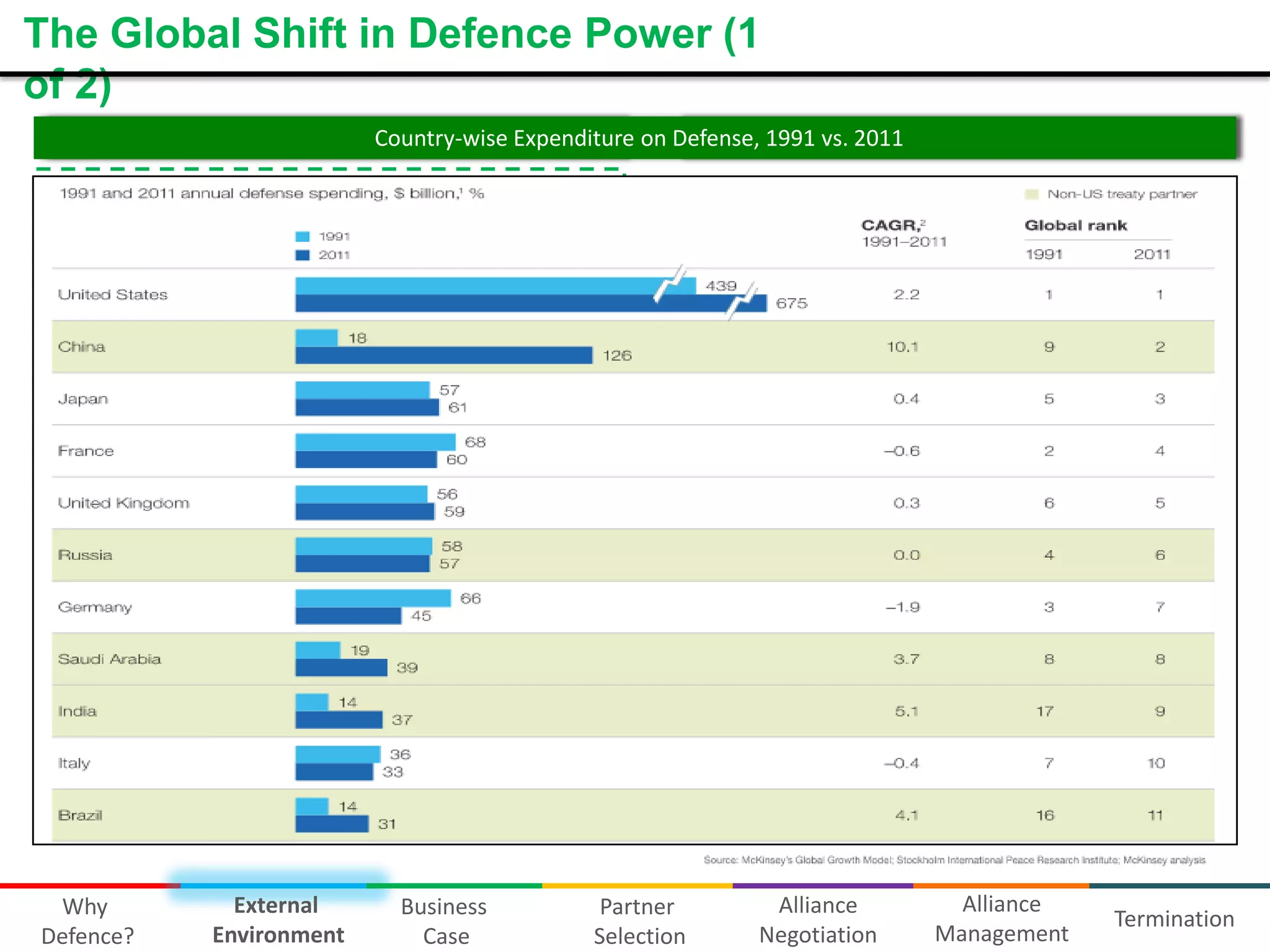
The Strategic Landscape Reshaped, 1991 -Expenditure on Defense, Long Term Growth in Military Spending
Country-wise 2012
1991 vs. 2011





The past 20 years saw dramatic changes on the
battlefield and the beginnings of an equally dramatic
shift in economic power
The world’s attention shifted to the Greater Middle
East
Innovations in defence technology and operations
have marked these past two decades of conflict
Developing countries are emerging as true
competitors to the developed economies with regard
to their innovation and technical prowess, R&D
expenses, etc.

Why
Defence?

External
Environment

Business
Case

Partner
Selection

Alliance
Negotiation

Alliance
Management

Termination
The Global Shift in Defence Power (2
of 2)
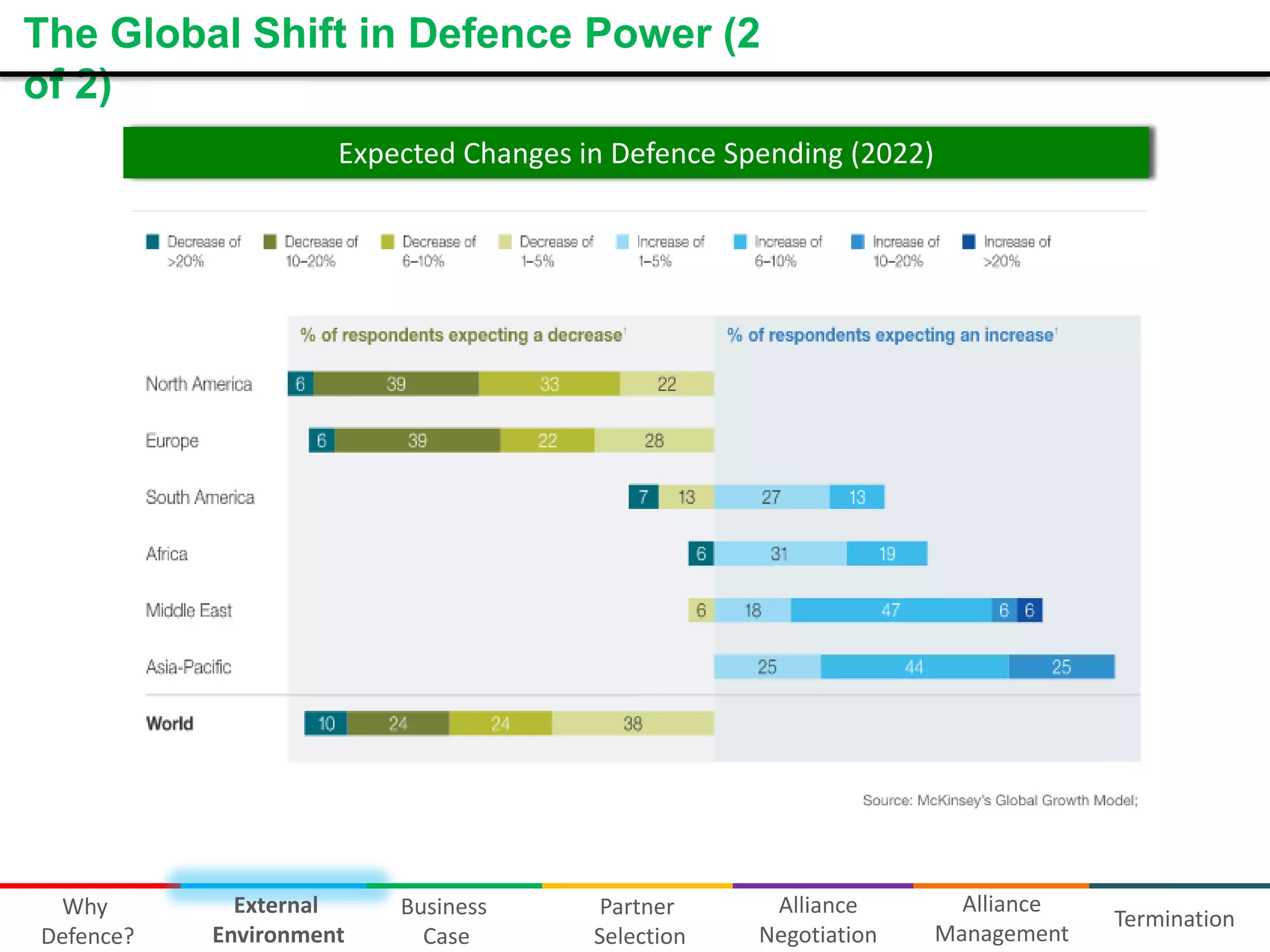
Global Defense Spending shifting away from the US
Expected Changes in Defence Spending (2022)

Why
Defence?

External
Environment

Business
Case

Partner
Selection

Alliance
Negotiation

Alliance
Management

Termination
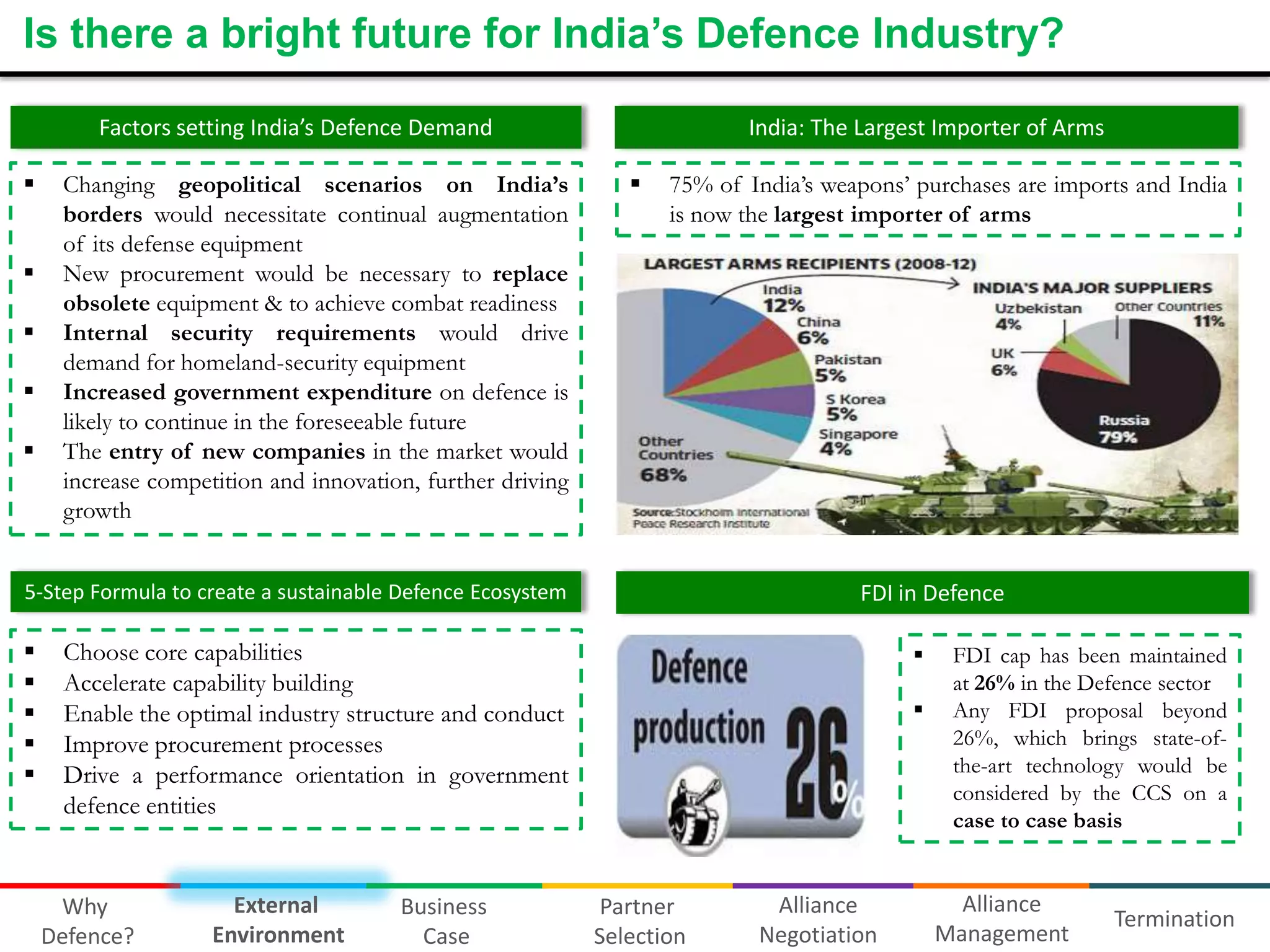
Is there a bright future for India’s Defence Industry?
Factors setting India’s Defence Demand







Changing geopolitical scenarios on India’s
borders would necessitate continual augmentation
of its defense equipment
New procurement would be necessary to replace
obsolete equipment & to achieve combat readiness
Internal security requirements would drive
demand for homeland-security equipment
Increased government expenditure on defence is
likely to continue in the foreseeable future
The entry of new companies in the market would
increase competition and innovation, further driving
growth

India: The Largest Importer of Arms



75% of India’s weapons’ purchases are imports and India
is now the largest importer of arms

5-Step Formula to create a sustainable Defence Ecosystem







FDI in Defence

Choose core capabilities
Accelerate capability building
Enable the optimal industry structure and conduct
Improve procurement processes
Drive a performance orientation in government
defence entities

Why
Defence?

External
Environment

Business
Case




Partner
Selection

Alliance
Negotiation

FDI cap has been maintained
at 26% in the Defence sector
Any FDI proposal beyond
26%, which brings state-ofthe-art technology would be
considered by the CCS on a
case to case basis

Alliance
Management

Termination
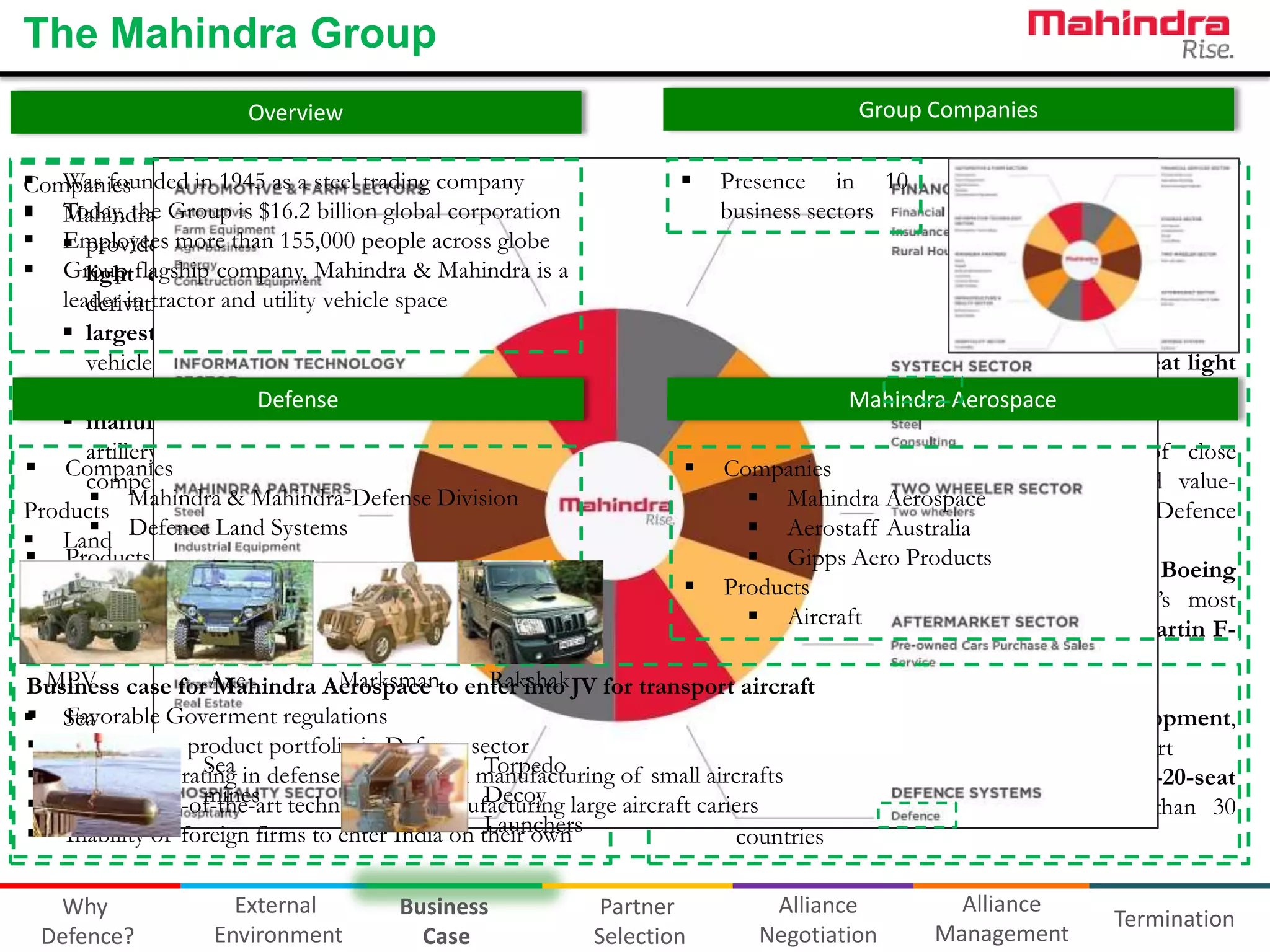
The Mahindra Group
Group Companies

Overview

 Presence in 10
Companies
business sectors
 Mahindra Aerospace
 Vision is to become a globally recognized
manufacturer of aircraft and a tier 1 supplier of
components and assemblies
 In partnership with the National Aerospace
Laboratories, already developing a new 5-seat light
utility aircraft
Mahindra Aerospace
 Aerostaff Australia
 one of the world’s premier suppliers of close
 Companies
tolerance high-precision sheet metal and value Mahindra Aerospace
added products to Aerospace and Defence
 Aerostaff Australia
customers
 Gipps Aero Products
 directly supply the assembly lines of the Boeing
 Products
737, Gulfstream G150, and the world’s most
 Aircraft
advanced fighter aircraft, the Lockheed-Martin F35 Joint Strike Fighter
MPV case for Axe
Marksmanto enter into JV for transport aircraft Products
Rakshak
Business
Mahindra Aerospace
 Gipps Aero
 Favorable Goverment regulations
 Sea
 handles all aspects of aircraft development,
 Diversify its product portfolio in Defense sector
production, marketing and after-sales support
Sea
Torpedo
 Already operating in defense sector and in manufacturing of small aircrafts
 develops and manufactures a family of 2-20-seat
mines technology to manufacturing large aircraft cariers
Decoy
 Aquire state-of-the-art
utility aircraft which is sold in more than 30
Launchers
 Inability of foreign firms to enter India on their own
countries
 Was founded in 1945 as a steel trading company
Companies
 Today, the& Mahindra-Defense Division
Mahindra Group is $16.2 billion global corporation
  provide total than 155,000 people entire globe of
Employees more solutions for the across range
 Group flagship company, Mahindra vehicles andis their
light combat and armoured & Mahindra a
leader in tractor and utility vehicle space
derivatives for defence and security forces
 largest private-sector supplier of bullet-proof
vehicles in the country
 Defence Land Systems
Defense
 manufacture world-class military vehicles, select
artillery systems, and other land system weapons at
 Companies
competitively low costs
 Mahindra & Mahindra-Defense Division
Products
 Defence Land Systems
 Land
 Products
 Land
 Sea

Why
Defence?

External
Environment

Business
Case

Partner
Selection

Alliance
Negotiation

Alliance
Management

Termination
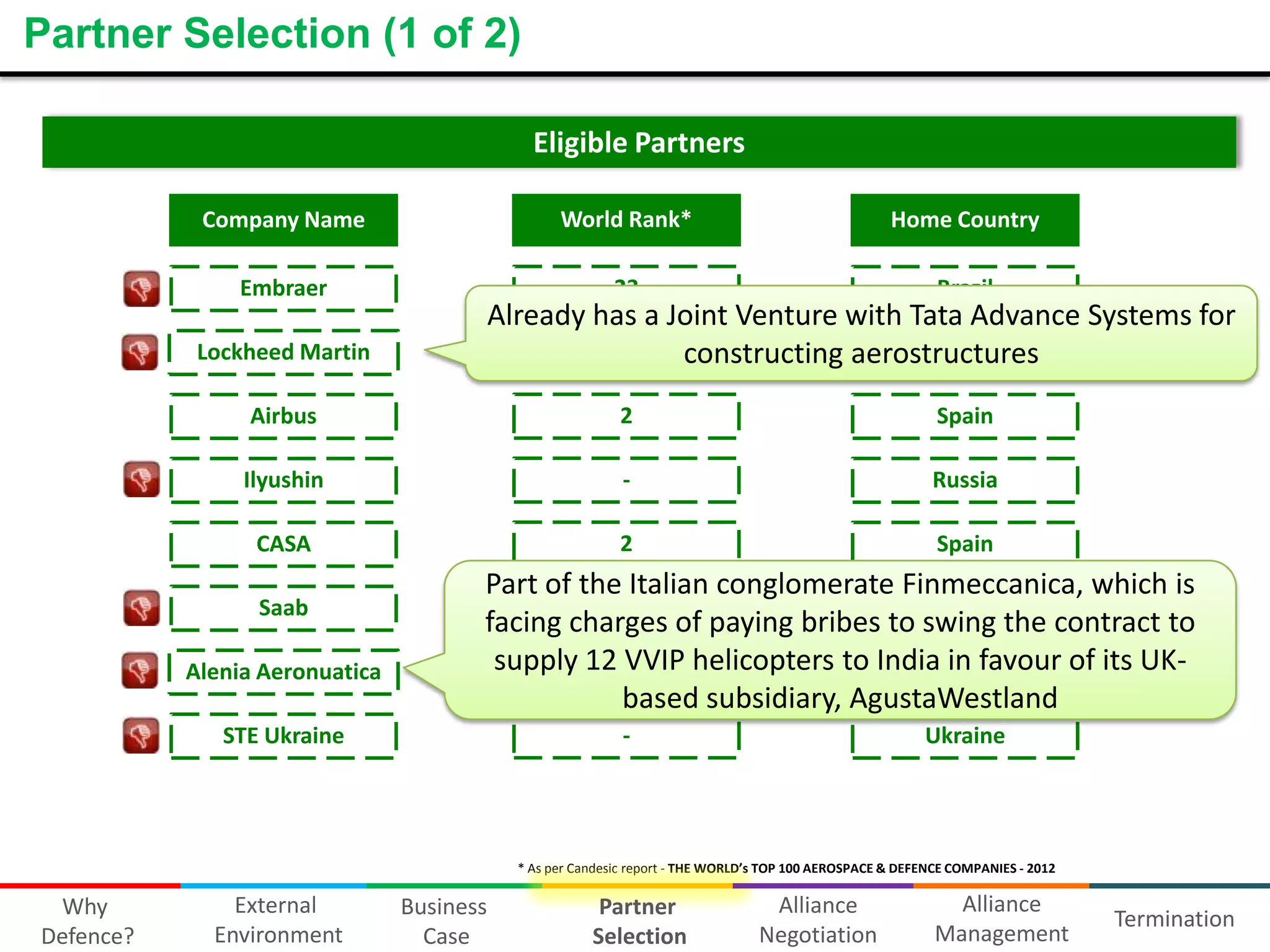
Partner Selection (1 of 2)
Eligible Partners
Company Name

World Rank*

Home Country

Embraer

23

Brazil

Airbus

2

Spain

Ilyushin

-

Russia

CASA

2

Spain

Already has a Joint Venture with Tata Advance Systems for
3
USA
constructing aerostructures

Lockheed Martin

Saab
Alenia Aeronuatica

Part of the Italian conglomerate Finmeccanica, which is
39
Sweden
facing charges of paying bribes to swing the contract to
supply 12 9
VVIP helicopters to India Italy
in favour of its UKbased subsidiary, AgustaWestland
-

STE Ukraine

Ukraine

* As per Candesic report - THE WORLD’s TOP 100 AEROSPACE & DEFENCE COMPANIES - 2012

Why
Defence?

External
Environment

Business
Case

Partner
Selection

Alliance
Negotiation

Alliance
Management

Termination
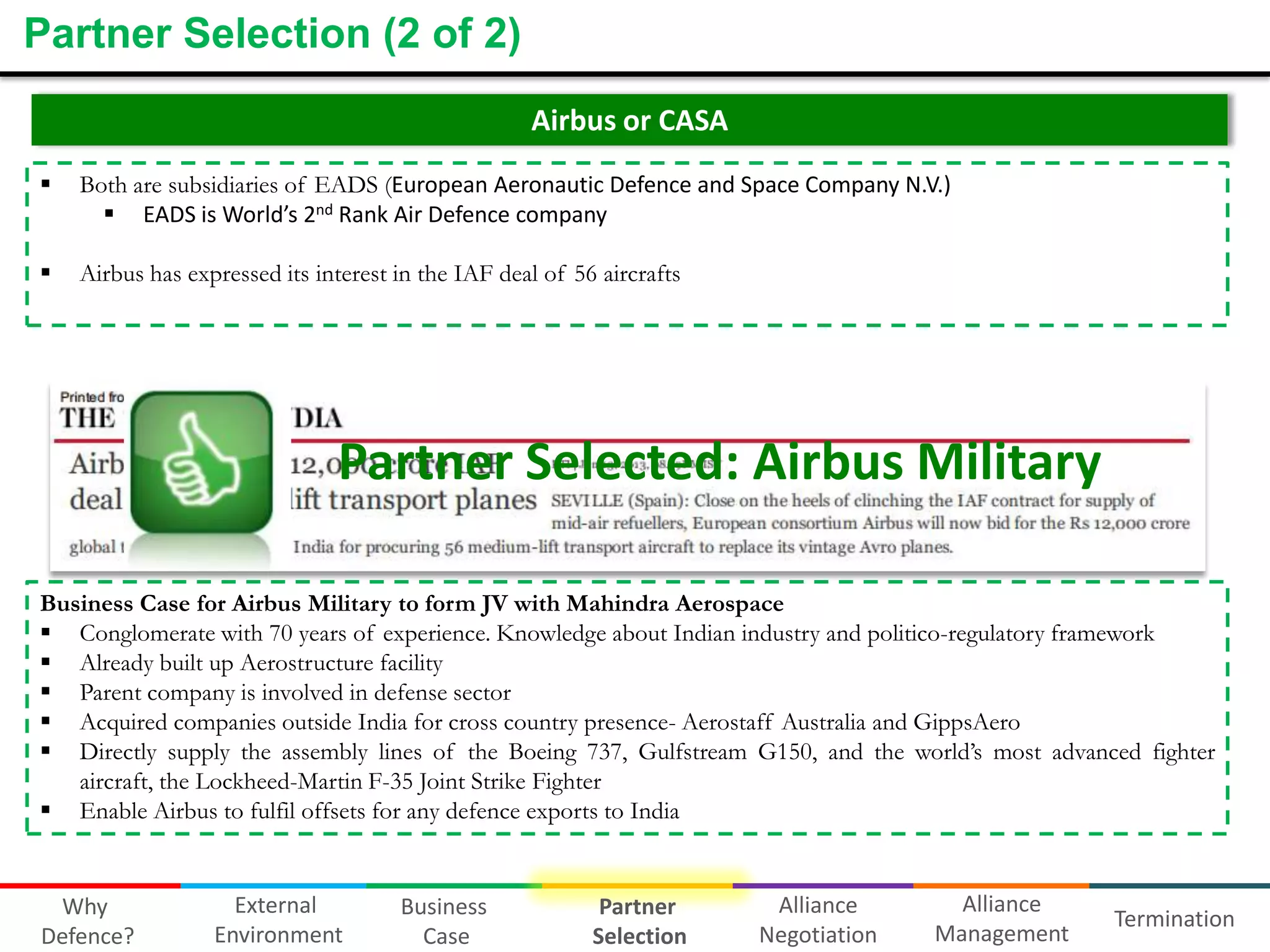
Partner Selection (2 of 2)
Airbus or CASA


Both are subsidiaries of EADS (European Aeronautic Defence and Space Company N.V.)
 EADS is World’s 2nd Rank Air Defence company



Airbus has expressed its interest in the IAF deal of 56 aircrafts

Partner Selected: Airbus Military
Business Case for Airbus Military to form JV with Mahindra Aerospace
 Conglomerate with 70 years of experience. Knowledge about Indian industry and politico-regulatory framework
 Already built up Aerostructure facility
 Parent company is involved in defense sector
 Acquired companies outside India for cross country presence- Aerostaff Australia and GippsAero
 Directly supply the assembly lines of the Boeing 737, Gulfstream G150, and the world’s most advanced fighter
aircraft, the Lockheed-Martin F-35 Joint Strike Fighter
 Enable Airbus to fulfil offsets for any defence exports to India

Why
Defence?

External
Environment

Business
Case

Partner
Selection

Alliance
Negotiation

Alliance
Management

Termination
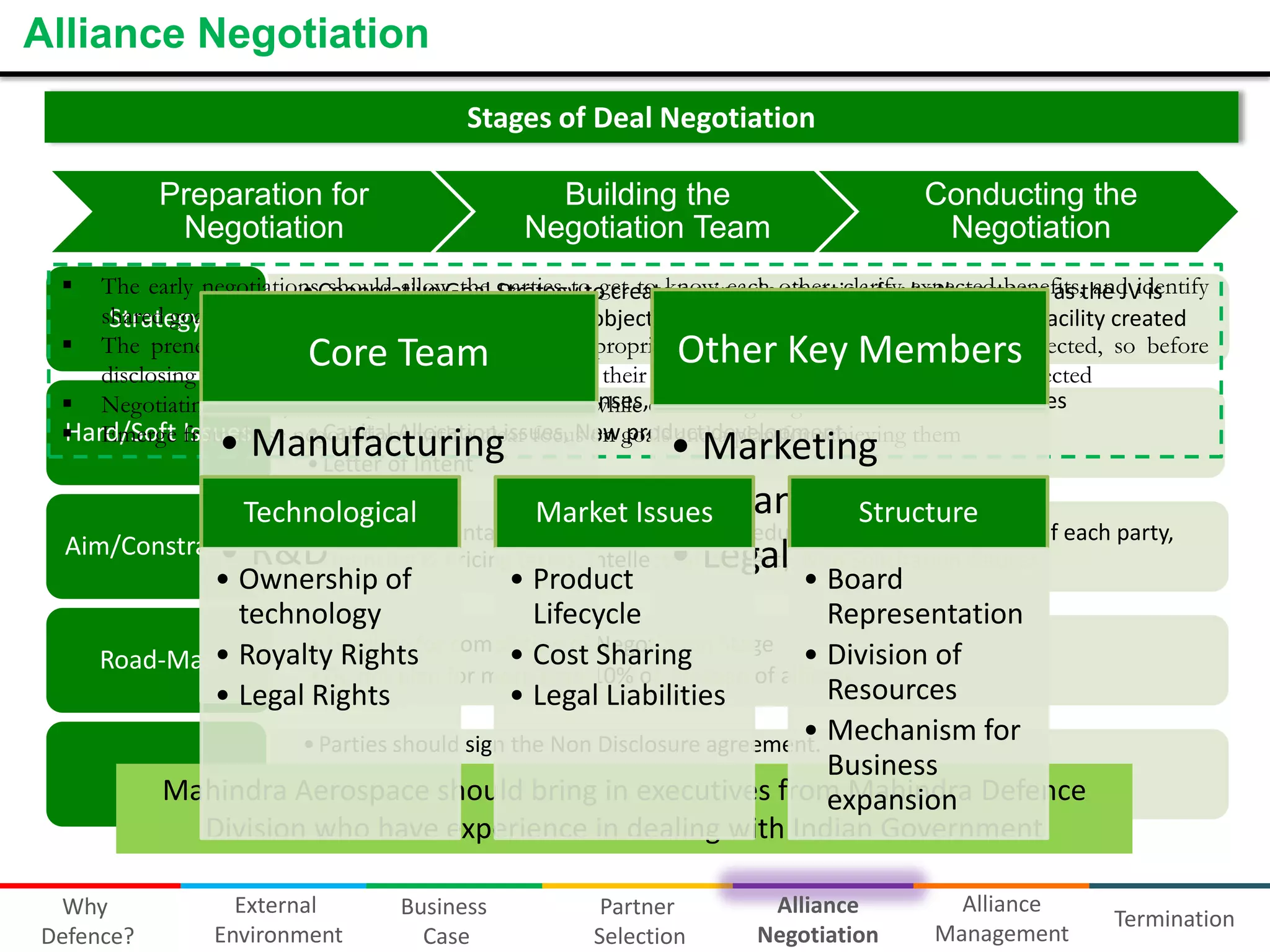
Alliance Negotiation
Stages of Deal Negotiation
Preparation for
Preparation for
Negotiation
Negotiation

Building the
Building the
Negotiation Team
Negotiation Team

Conducting the
Conducting the
Negotiation
Negotiation



The early negotiationsCooperative Goal Strategy to create a win-win other, clarify expected benefits,the JV is
• should allow the parties to get to know each situation for both partners as and identify
shared goals and objectives with the long-term objective and its is not just a manufacturing facility created
formed
Strategy
 The prenegotiation stage should cost synergies proprietary knowledge that needs to be protected, so before
to tap into have identified
disclosing proprietary data, managers should ensure their competitive advantage is adequately protected
• the partner should be used while Scope of License Territories and Royalties
 Negotiating History of Granting of Technology Licenses,conducting Negotiations
• Capital Allocation issues, New product a plan for achieving them
Hard/Soft Issues
 Emerge from these negotiations with a clear focus on goals anddevelopment
• Letter of Intent

Core Team

Other Key Members

• Manufacturing
• Marketing
• Technological
Technology
• Finance Structure
Market Issues
• Term Sheet containing Time Frame and Schedules, Obligations & Rights of each party,
Aim/ConstraintsR&D
•
Financing & Pricing terms, Intellectual Legal Non Solicitation clauses
• Property,
• Ownership of
• Product
• Board
technology
Lifecycle
Representation
• Timeline for completion of Negotiation Stage
• Cost Sharing
• Division of
Road-Map• Royalty Rights
• Do not plan for more than 10% of lifespan of alliance
Resources
• Legal Rights
• Legal Liabilities
•
• Parties should sign the Non Disclosure agreement. Mechanism for
Business
Trust
• This will build trust against any chances of Technology leakages as well help in
Mahindra Aerospace Due Diligence of in executives from Mahindra Defence
performing should bring each other’s capabilityexpansion
Division who have experience in dealing with Indian Government

Why
Defence?

External
Environment

Business
Case

Partner
Selection

Alliance
Negotiation

Alliance
Management

Termination
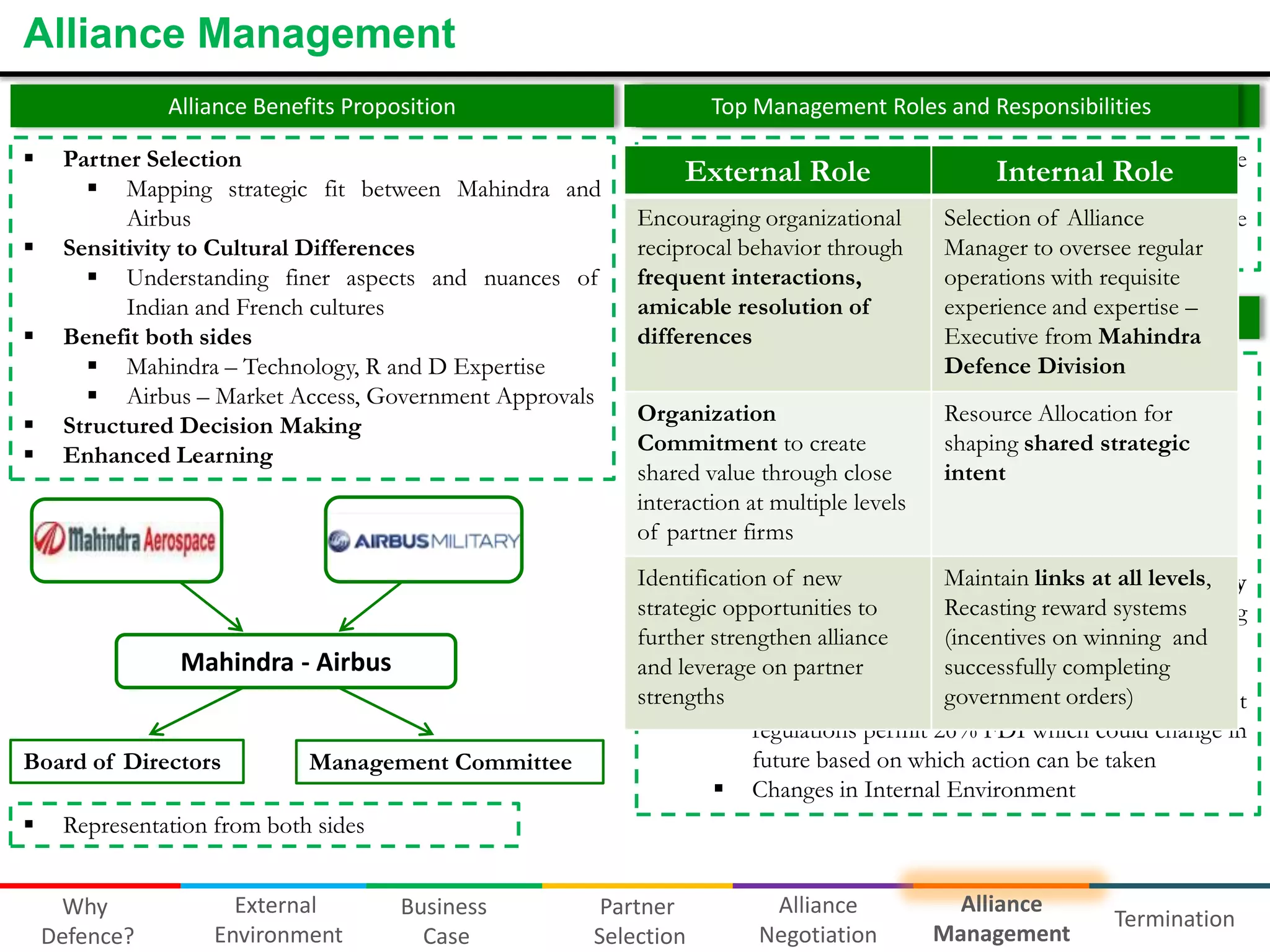
Alliance Management
Alliance Benefits Proposition






Partner Selection
 Mapping strategic fit between Mahindra and
Airbus
Sensitivity to Cultural Differences
 Understanding finer aspects and nuances of
Indian and French cultures
Benefit both sides
 Mahindra – Technology, R and D Expertise
 Airbus – Market Access, Government Approvals
Structured Decision Making
Enhanced Learning

Mahindra - Airbus
Board of Directors


Top Management Roles and Selection
Alliance Manager Responsibilities

Management Committee



Executives
Mahindra Defence Division who
External from Government before can beRole have
Role
Internal employed
dealt with Indian

Encouraging organizational
Selection of Alliance
 Identify mid level managers who would serve as interface
reciprocal behavior through operational leveloversee regular
Manager to management
between top level and
frequent interactions,
operations with requisite
amicable resolution of
experience
Alliance Manager Roleand expertise –
differences
Executive from Mahindra
Defence Division
 Establish congenial working atmosphere
 Trust
Organization building exercises, Personal Relationships
Resource Allocation for
 Bridge cultural differences (Indo-French)
Commitment to create
shaping shared strategic
 Monitor Partner Contribution
shared value through close
intent
 at multipleAllocation
Resource levels
interaction
 Corrective Action
of partner firms
 Regulate Information Flows
Identification of new sector Maintain links at all extremely
 Defence
associated with levels,
strategic opportunities toinformation, careful systems
Recasting reward monitoring
sensitive
further strengthen alliance leakage
required to avoid (incentives on winning and
and leverage on Strategic Viability, Flexibility
successfully completing
 Reassess partner
strengths Changes in External Environment – Ex: Current
government orders)

regulations permit 26% FDI which could change in
future based on which action can be taken
 Changes in Internal Environment

Representation from both sides
Why
Defence?

External
Environment

Business
Case

Partner
Selection

Alliance
Negotiation

Alliance
Management

Termination
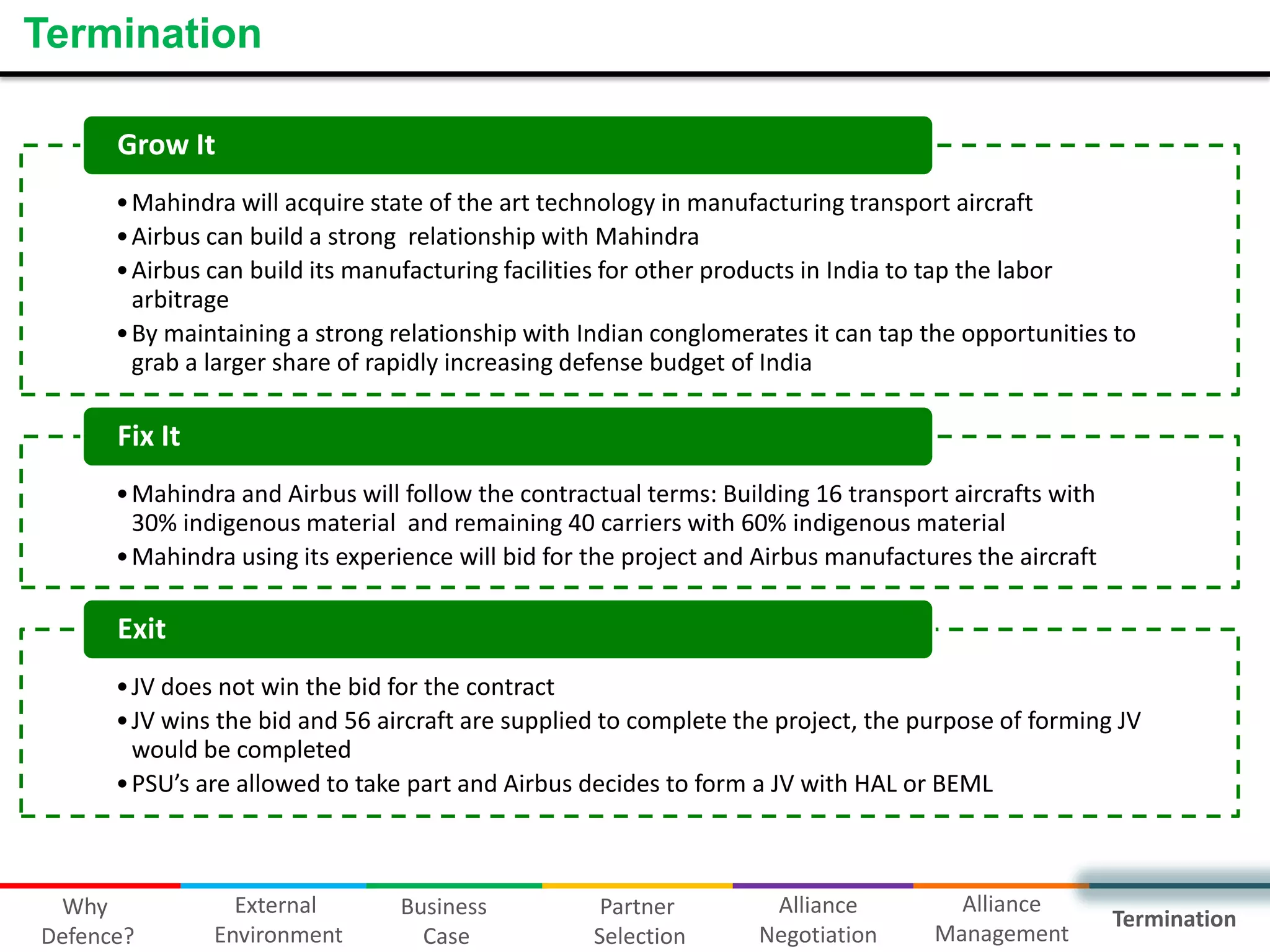
Termination
Grow It
• Mahindra will acquire state of the art technology in manufacturing transport aircraft
• Airbus can build a strong relationship with Mahindra
• Airbus can build its manufacturing facilities for other products in India to tap the labor
arbitrage
• By maintaining a strong relationship with Indian conglomerates it can tap the opportunities to
grab a larger share of rapidly increasing defense budget of India

Fix It
• Mahindra and Airbus will follow the contractual terms: Building 16 transport aircrafts with
30% indigenous material and remaining 40 carriers with 60% indigenous material
• Mahindra using its experience will bid for the project and Airbus manufactures the aircraft

Exit
• JV does not win the bid for the contract
• JV wins the bid and 56 aircraft are supplied to complete the project, the purpose of forming JV
would be completed
• PSU’s are allowed to take part and Airbus decides to form a JV with HAL or BEML

Why
Defence?

External
Environment

Business
Case

Partner
Selection

Alliance
Negotiation

Alliance
Management

Termination
Strategic Alliance Proposal
between Mahindra Aerospace
and Airbus Military

Strategic Alliance Proposal between Mahindra Aerospace and Airbus Military

  • 1.
    Strategic Alliance Proposal betweenMahindra Aerospace and Airbus Military
  • 2.
    Why Defence? FDI Regulations •Currently, FDI in defense stands at 26% • Proposals have been made to further ease it to 49% • Government has shown interest in increasing FDI inflows in defense which is currently low (less than 0.01% of total FDI inflows) • Higher investment may be considered in state of the art technology Relaxation in Defense Offset Policy (DOP) • Foreign vendors can offset credits by transfer of technology • Indigenization limit lowered to 30% Contract for purchasing transport aircraft by IAF • • • • Why Defence? Contract worth Rs 11,897 crore to replace AVROS by 56 new transport aircrafts Emphasis on developing private players in aircraft manufacturing Private players encouraged to form JV’s with foreign players Previous backlogs of PSU in delivering previous orders External Environment Business Case Partner Selection Alliance Negotiation Alliance Management Termination
  • 3.
    The Global Shiftin Defence Power (1 of 2) The Strategic Landscape Reshaped, 1991 -Expenditure on Defense, Long Term Growth in Military Spending Country-wise 2012 1991 vs. 2011     The past 20 years saw dramatic changes on the battlefield and the beginnings of an equally dramatic shift in economic power The world’s attention shifted to the Greater Middle East Innovations in defence technology and operations have marked these past two decades of conflict Developing countries are emerging as true competitors to the developed economies with regard to their innovation and technical prowess, R&D expenses, etc. Why Defence? External Environment Business Case Partner Selection Alliance Negotiation Alliance Management Termination
  • 4.
    The Global Shiftin Defence Power (2 of 2) Global Defense Spending shifting away from the US Expected Changes in Defence Spending (2022) Why Defence? External Environment Business Case Partner Selection Alliance Negotiation Alliance Management Termination
  • 5.
    Is there abright future for India’s Defence Industry? Factors setting India’s Defence Demand      Changing geopolitical scenarios on India’s borders would necessitate continual augmentation of its defense equipment New procurement would be necessary to replace obsolete equipment & to achieve combat readiness Internal security requirements would drive demand for homeland-security equipment Increased government expenditure on defence is likely to continue in the foreseeable future The entry of new companies in the market would increase competition and innovation, further driving growth India: The Largest Importer of Arms  75% of India’s weapons’ purchases are imports and India is now the largest importer of arms 5-Step Formula to create a sustainable Defence Ecosystem      FDI in Defence Choose core capabilities Accelerate capability building Enable the optimal industry structure and conduct Improve procurement processes Drive a performance orientation in government defence entities Why Defence? External Environment Business Case   Partner Selection Alliance Negotiation FDI cap has been maintained at 26% in the Defence sector Any FDI proposal beyond 26%, which brings state-ofthe-art technology would be considered by the CCS on a case to case basis Alliance Management Termination
  • 6.
    The Mahindra Group GroupCompanies Overview  Presence in 10 Companies business sectors  Mahindra Aerospace  Vision is to become a globally recognized manufacturer of aircraft and a tier 1 supplier of components and assemblies  In partnership with the National Aerospace Laboratories, already developing a new 5-seat light utility aircraft Mahindra Aerospace  Aerostaff Australia  one of the world’s premier suppliers of close  Companies tolerance high-precision sheet metal and value Mahindra Aerospace added products to Aerospace and Defence  Aerostaff Australia customers  Gipps Aero Products  directly supply the assembly lines of the Boeing  Products 737, Gulfstream G150, and the world’s most  Aircraft advanced fighter aircraft, the Lockheed-Martin F35 Joint Strike Fighter MPV case for Axe Marksmanto enter into JV for transport aircraft Products Rakshak Business Mahindra Aerospace  Gipps Aero  Favorable Goverment regulations  Sea  handles all aspects of aircraft development,  Diversify its product portfolio in Defense sector production, marketing and after-sales support Sea Torpedo  Already operating in defense sector and in manufacturing of small aircrafts  develops and manufactures a family of 2-20-seat mines technology to manufacturing large aircraft cariers Decoy  Aquire state-of-the-art utility aircraft which is sold in more than 30 Launchers  Inability of foreign firms to enter India on their own countries  Was founded in 1945 as a steel trading company Companies  Today, the& Mahindra-Defense Division Mahindra Group is $16.2 billion global corporation   provide total than 155,000 people entire globe of Employees more solutions for the across range  Group flagship company, Mahindra vehicles andis their light combat and armoured & Mahindra a leader in tractor and utility vehicle space derivatives for defence and security forces  largest private-sector supplier of bullet-proof vehicles in the country  Defence Land Systems Defense  manufacture world-class military vehicles, select artillery systems, and other land system weapons at  Companies competitively low costs  Mahindra & Mahindra-Defense Division Products  Defence Land Systems  Land  Products  Land  Sea Why Defence? External Environment Business Case Partner Selection Alliance Negotiation Alliance Management Termination
  • 7.
    Partner Selection (1of 2) Eligible Partners Company Name World Rank* Home Country Embraer 23 Brazil Airbus 2 Spain Ilyushin - Russia CASA 2 Spain Already has a Joint Venture with Tata Advance Systems for 3 USA constructing aerostructures Lockheed Martin Saab Alenia Aeronuatica Part of the Italian conglomerate Finmeccanica, which is 39 Sweden facing charges of paying bribes to swing the contract to supply 12 9 VVIP helicopters to India Italy in favour of its UKbased subsidiary, AgustaWestland - STE Ukraine Ukraine * As per Candesic report - THE WORLD’s TOP 100 AEROSPACE & DEFENCE COMPANIES - 2012 Why Defence? External Environment Business Case Partner Selection Alliance Negotiation Alliance Management Termination
  • 8.
    Partner Selection (2of 2) Airbus or CASA  Both are subsidiaries of EADS (European Aeronautic Defence and Space Company N.V.)  EADS is World’s 2nd Rank Air Defence company  Airbus has expressed its interest in the IAF deal of 56 aircrafts Partner Selected: Airbus Military Business Case for Airbus Military to form JV with Mahindra Aerospace  Conglomerate with 70 years of experience. Knowledge about Indian industry and politico-regulatory framework  Already built up Aerostructure facility  Parent company is involved in defense sector  Acquired companies outside India for cross country presence- Aerostaff Australia and GippsAero  Directly supply the assembly lines of the Boeing 737, Gulfstream G150, and the world’s most advanced fighter aircraft, the Lockheed-Martin F-35 Joint Strike Fighter  Enable Airbus to fulfil offsets for any defence exports to India Why Defence? External Environment Business Case Partner Selection Alliance Negotiation Alliance Management Termination
  • 9.
    Alliance Negotiation Stages ofDeal Negotiation Preparation for Preparation for Negotiation Negotiation Building the Building the Negotiation Team Negotiation Team Conducting the Conducting the Negotiation Negotiation  The early negotiationsCooperative Goal Strategy to create a win-win other, clarify expected benefits,the JV is • should allow the parties to get to know each situation for both partners as and identify shared goals and objectives with the long-term objective and its is not just a manufacturing facility created formed Strategy  The prenegotiation stage should cost synergies proprietary knowledge that needs to be protected, so before to tap into have identified disclosing proprietary data, managers should ensure their competitive advantage is adequately protected • the partner should be used while Scope of License Territories and Royalties  Negotiating History of Granting of Technology Licenses,conducting Negotiations • Capital Allocation issues, New product a plan for achieving them Hard/Soft Issues  Emerge from these negotiations with a clear focus on goals anddevelopment • Letter of Intent Core Team Other Key Members • Manufacturing • Marketing • Technological Technology • Finance Structure Market Issues • Term Sheet containing Time Frame and Schedules, Obligations & Rights of each party, Aim/ConstraintsR&D • Financing & Pricing terms, Intellectual Legal Non Solicitation clauses • Property, • Ownership of • Product • Board technology Lifecycle Representation • Timeline for completion of Negotiation Stage • Cost Sharing • Division of Road-Map• Royalty Rights • Do not plan for more than 10% of lifespan of alliance Resources • Legal Rights • Legal Liabilities • • Parties should sign the Non Disclosure agreement. Mechanism for Business Trust • This will build trust against any chances of Technology leakages as well help in Mahindra Aerospace Due Diligence of in executives from Mahindra Defence performing should bring each other’s capabilityexpansion Division who have experience in dealing with Indian Government Why Defence? External Environment Business Case Partner Selection Alliance Negotiation Alliance Management Termination
  • 10.
    Alliance Management Alliance BenefitsProposition      Partner Selection  Mapping strategic fit between Mahindra and Airbus Sensitivity to Cultural Differences  Understanding finer aspects and nuances of Indian and French cultures Benefit both sides  Mahindra – Technology, R and D Expertise  Airbus – Market Access, Government Approvals Structured Decision Making Enhanced Learning Mahindra - Airbus Board of Directors  Top Management Roles and Selection Alliance Manager Responsibilities Management Committee  Executives Mahindra Defence Division who External from Government before can beRole have Role Internal employed dealt with Indian Encouraging organizational Selection of Alliance  Identify mid level managers who would serve as interface reciprocal behavior through operational leveloversee regular Manager to management between top level and frequent interactions, operations with requisite amicable resolution of experience Alliance Manager Roleand expertise – differences Executive from Mahindra Defence Division  Establish congenial working atmosphere  Trust Organization building exercises, Personal Relationships Resource Allocation for  Bridge cultural differences (Indo-French) Commitment to create shaping shared strategic  Monitor Partner Contribution shared value through close intent  at multipleAllocation Resource levels interaction  Corrective Action of partner firms  Regulate Information Flows Identification of new sector Maintain links at all extremely  Defence associated with levels, strategic opportunities toinformation, careful systems Recasting reward monitoring sensitive further strengthen alliance leakage required to avoid (incentives on winning and and leverage on Strategic Viability, Flexibility successfully completing  Reassess partner strengths Changes in External Environment – Ex: Current government orders)  regulations permit 26% FDI which could change in future based on which action can be taken  Changes in Internal Environment Representation from both sides Why Defence? External Environment Business Case Partner Selection Alliance Negotiation Alliance Management Termination
  • 11.
    Termination Grow It • Mahindrawill acquire state of the art technology in manufacturing transport aircraft • Airbus can build a strong relationship with Mahindra • Airbus can build its manufacturing facilities for other products in India to tap the labor arbitrage • By maintaining a strong relationship with Indian conglomerates it can tap the opportunities to grab a larger share of rapidly increasing defense budget of India Fix It • Mahindra and Airbus will follow the contractual terms: Building 16 transport aircrafts with 30% indigenous material and remaining 40 carriers with 60% indigenous material • Mahindra using its experience will bid for the project and Airbus manufactures the aircraft Exit • JV does not win the bid for the contract • JV wins the bid and 56 aircraft are supplied to complete the project, the purpose of forming JV would be completed • PSU’s are allowed to take part and Airbus decides to form a JV with HAL or BEML Why Defence? External Environment Business Case Partner Selection Alliance Negotiation Alliance Management Termination
  • 12.
    Strategic Alliance Proposal betweenMahindra Aerospace and Airbus Military