HIV Prevention


Centers for Disease Control and Prevention
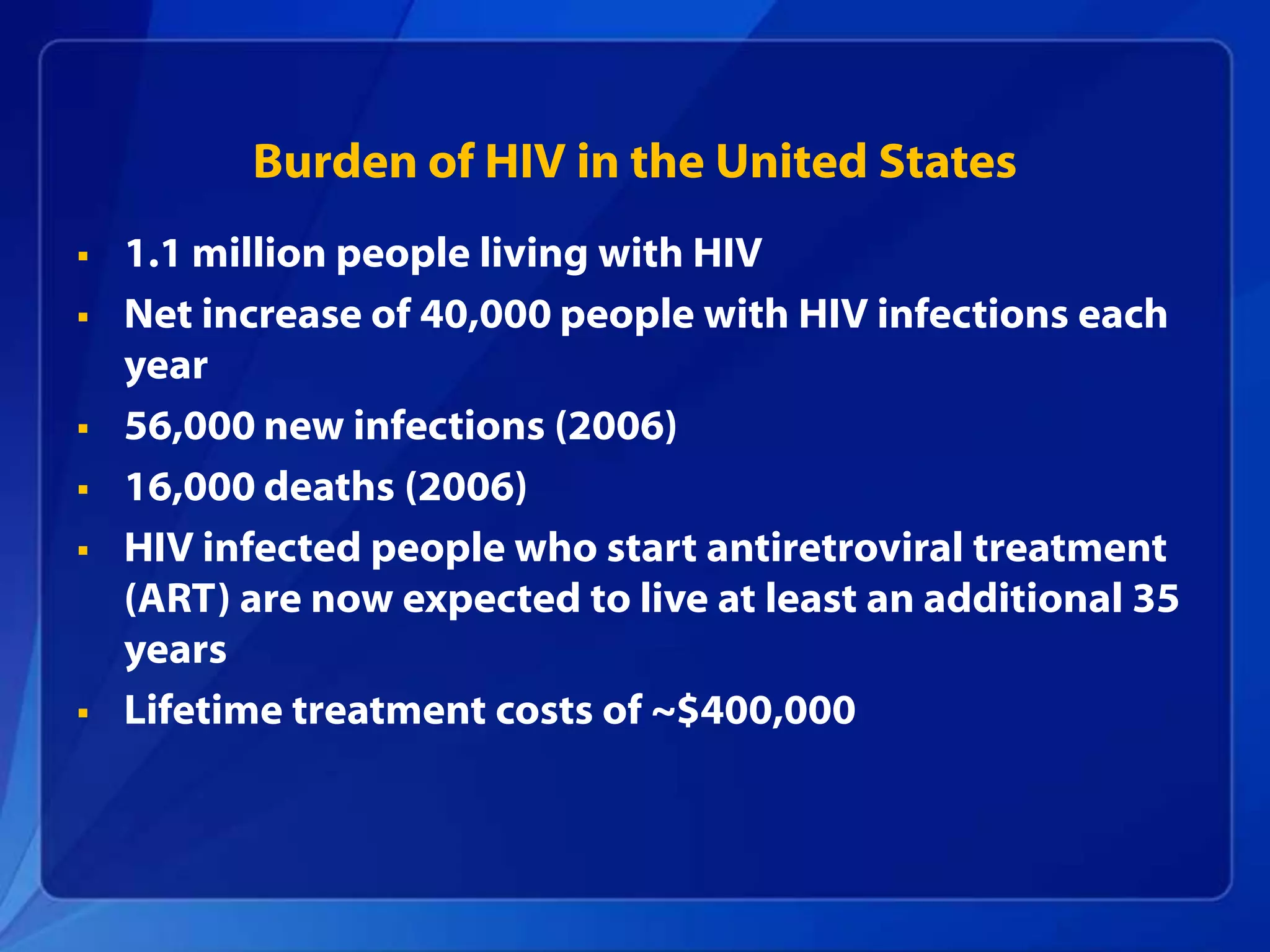
Burden of HIV in the United States
   1.1 million people living with HIV
   Net increase of 40,000 people with HIV infections each
    year
   56,000 new infections (2006)
   16,000 deaths (2006)
   HIV infected people who start antiretroviral treatment
    (ART) are now expected to live at least an additional 35
    years
   Lifetime treatment costs of ~$400,000
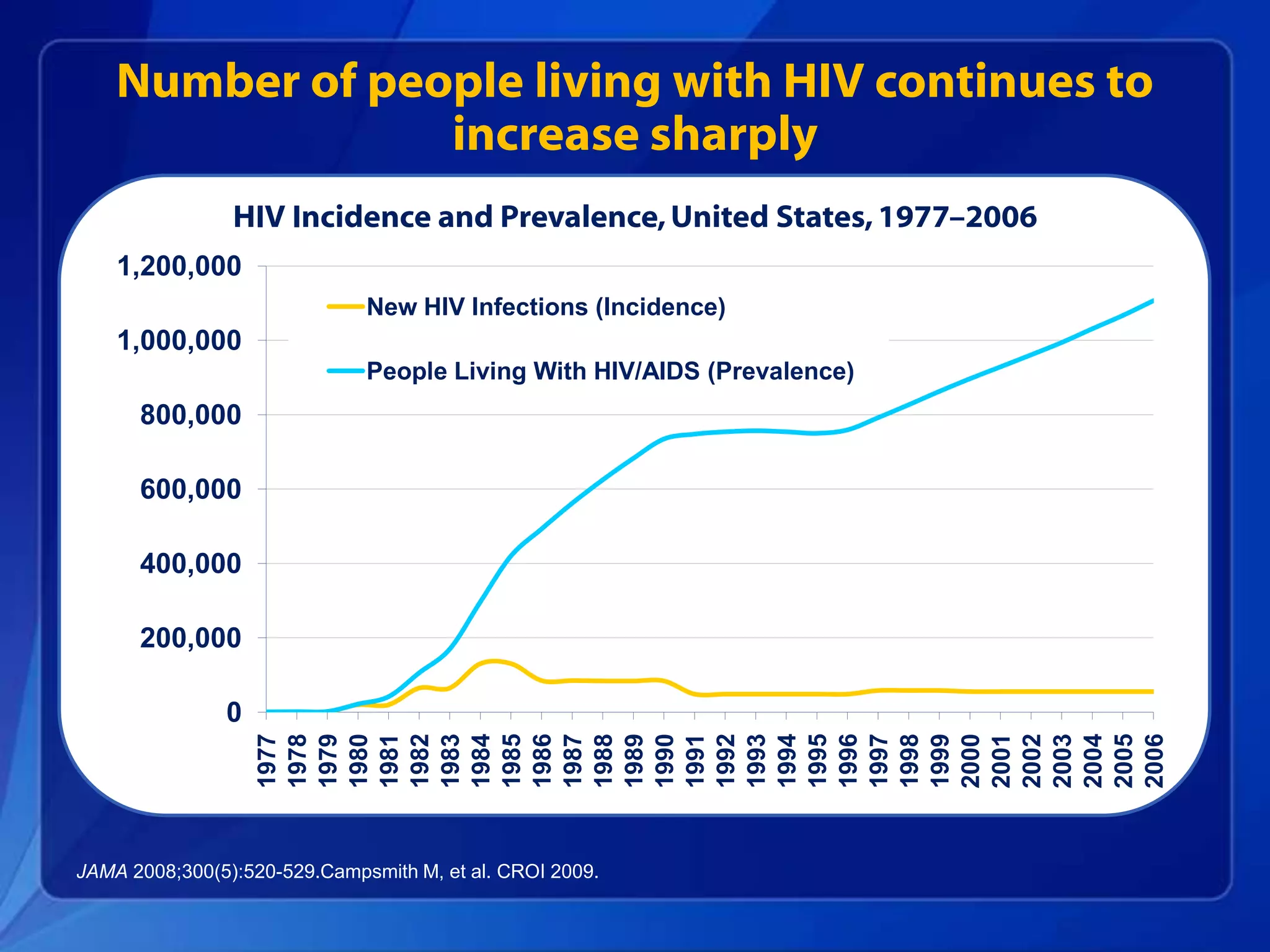
Number of people living with HIV continues to
                 increase sharply
                HIV Incidence and Prevalence, United States, 1977–2006
    1,200,000
                              New HIV Infections (Incidence)
    1,000,000
                              People Living With HIV/AIDS (Prevalence)
      800,000

      600,000

      400,000

      200,000

               0
                   1977
                   1978
                   1979
                   1980
                   1981
                   1982
                   1983
                   1984
                   1985
                   1986
                   1987
                   1988
                   1989
                   1990
                   1991
                   1992
                   1993
                   1994
                   1995
                   1996
                   1997
                   1998
                   1999
                   2000
                   2001
                   2002
                   2003
                   2004
                   2005
                   2006
JAMA 2008;300(5):520-529.Campsmith M, et al. CROI 2009.
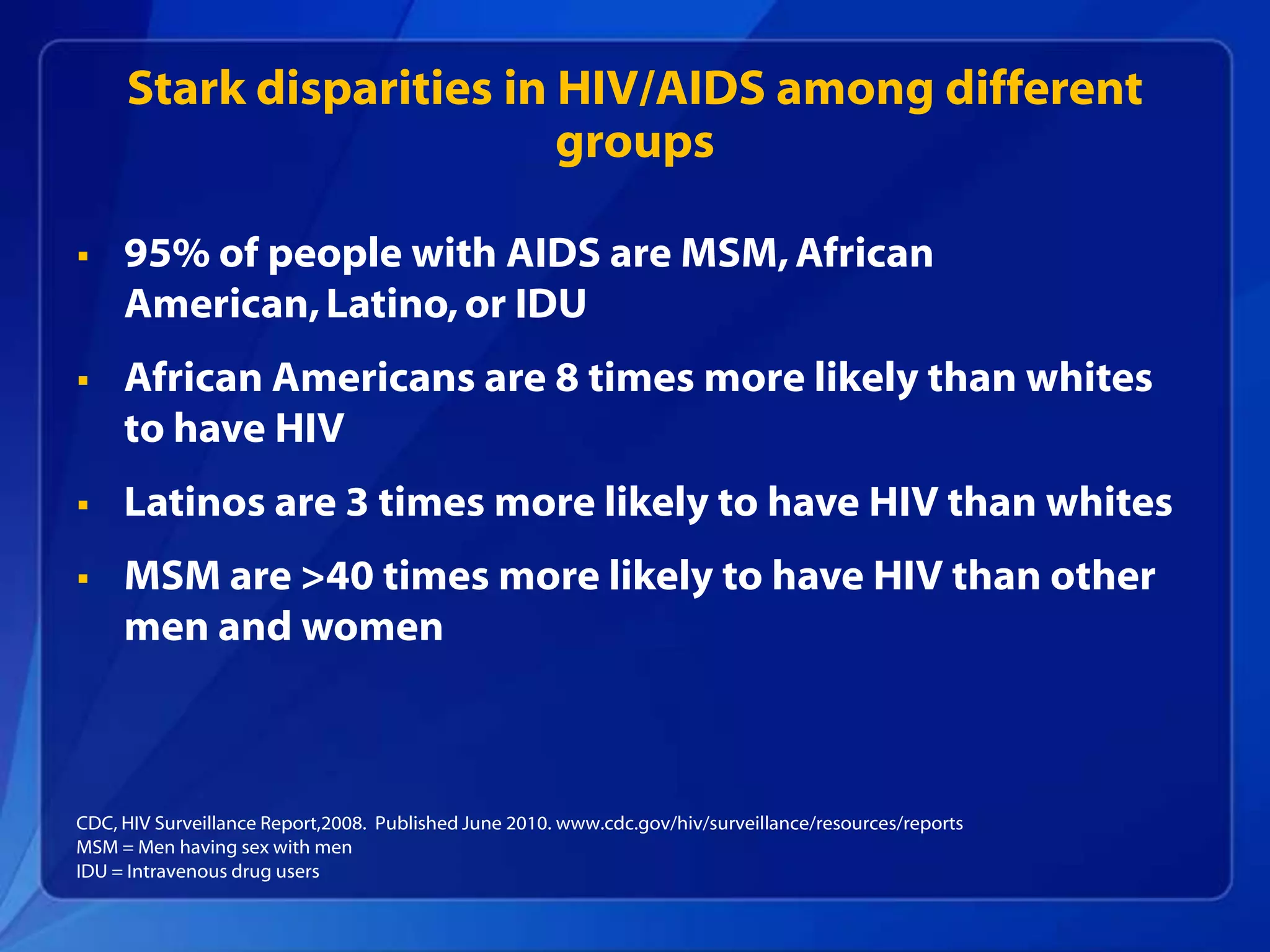
Stark disparities in HIV/AIDS among different
                          groups

    95% of people with AIDS are MSM, African
     American, Latino, or IDU
    African Americans are 8 times more likely than whites
     to have HIV
    Latinos are 3 times more likely to have HIV than whites
    MSM are >40 times more likely to have HIV than other
     men and women


CDC, HIV Surveillance Report,2008. Published June 2010. www.cdc.gov/hiv/surveillance/resources/reports
MSM = Men having sex with men
IDU = Intravenous drug users
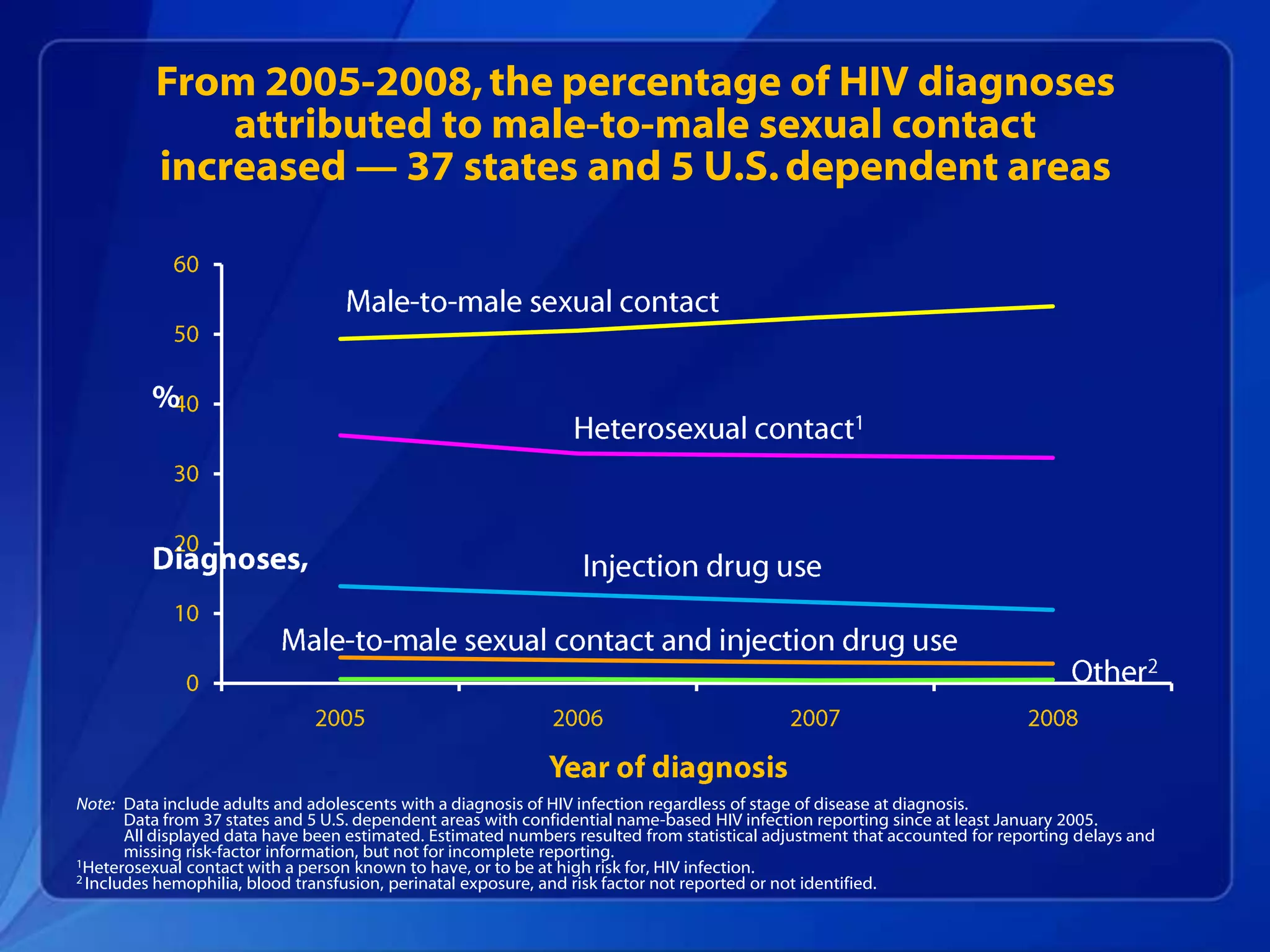
From 2005-2008, the percentage of HIV diagnoses
              attributed to male-to-male sexual contact
          increased — 37 states and 5 U.S. dependent areas


Note: Data include adults and adolescents with a diagnosis of HIV infection regardless of stage of disease at diagnosis.
       Data from 37 states and 5 U.S. dependent areas with confidential name-based HIV infection reporting since at least January 2005.
       All displayed data have been estimated. Estimated numbers resulted from statistical adjustment that accounted for reporting delays and
       missing risk-factor information, but not for incomplete reporting.
1Heterosexual contact with a person known to have, or to be at high risk for, HIV infection.
2 Includes hemophilia, blood transfusion, perinatal exposure, and risk factor not reported or not identified.
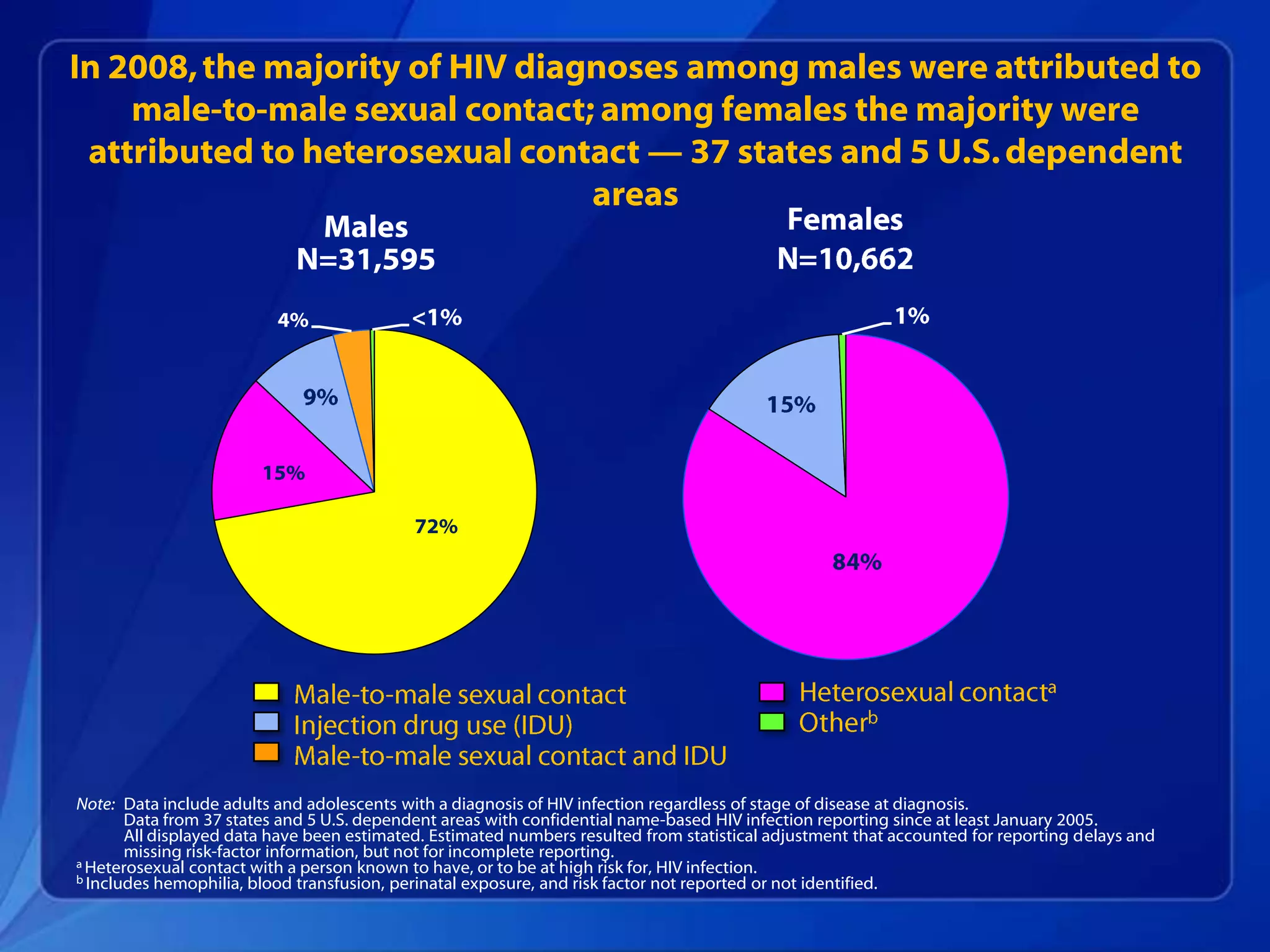
In 2008, the majority of HIV diagnoses among males were attributed to
    male-to-male sexual contact; among females the majority were
 attributed to heterosexual contact — 37 states and 5 U.S. dependent
                                 areas
                             Males
                            N=31,595
                          4%


                        15%

                                            72%


Note: Data include adults and adolescents with a diagnosis of HIV infection regardless of stage of disease at diagnosis.
       Data from 37 states and 5 U.S. dependent areas with confidential name-based HIV infection reporting since at least January 2005.
       All displayed data have been estimated. Estimated numbers resulted from statistical adjustment that accounted for reporting delays and
       missing risk-factor information, but not for incomplete reporting.
a Heterosexual contact with a person known to have, or to be at high risk for, HIV infection.
b Includes hemophilia, blood transfusion, perinatal exposure, and risk factor not reported or not identified.
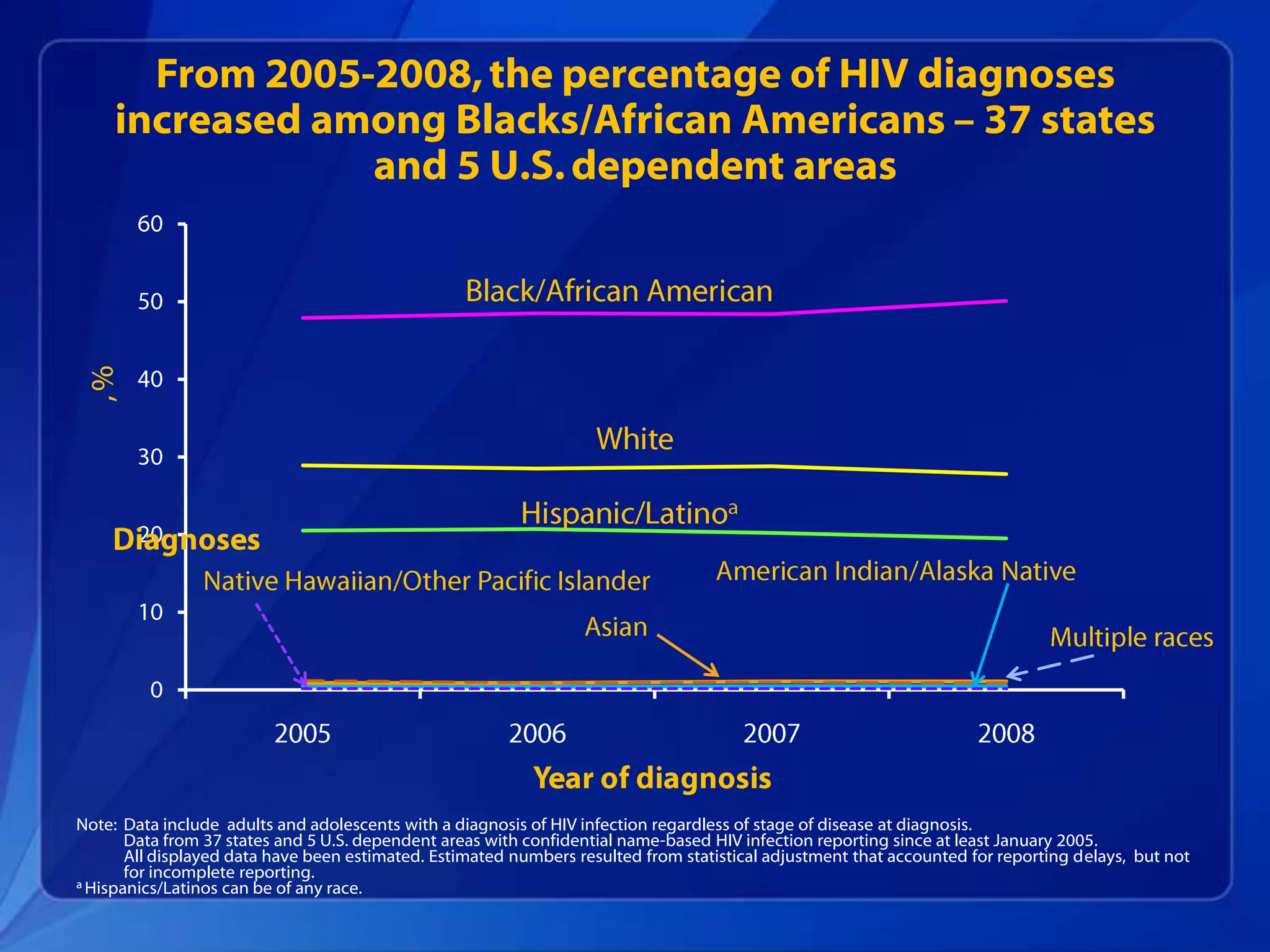
From 2005-2008, the percentage of HIV diagnoses
     increased among Blacks/African Americans – 37 states
                 and 5 U.S. dependent areas
 ,%


Note: Data include adults and adolescents with a diagnosis of HIV infection regardless of stage of disease at diagnosis.
       Data from 37 states and 5 U.S. dependent areas with confidential name-based HIV infection reporting since at least January 2005.
       All displayed data have been estimated. Estimated numbers resulted from statistical adjustment that accounted for reporting delays, but not
       for incomplete reporting.
a Hispanics/Latinos can be of any race.
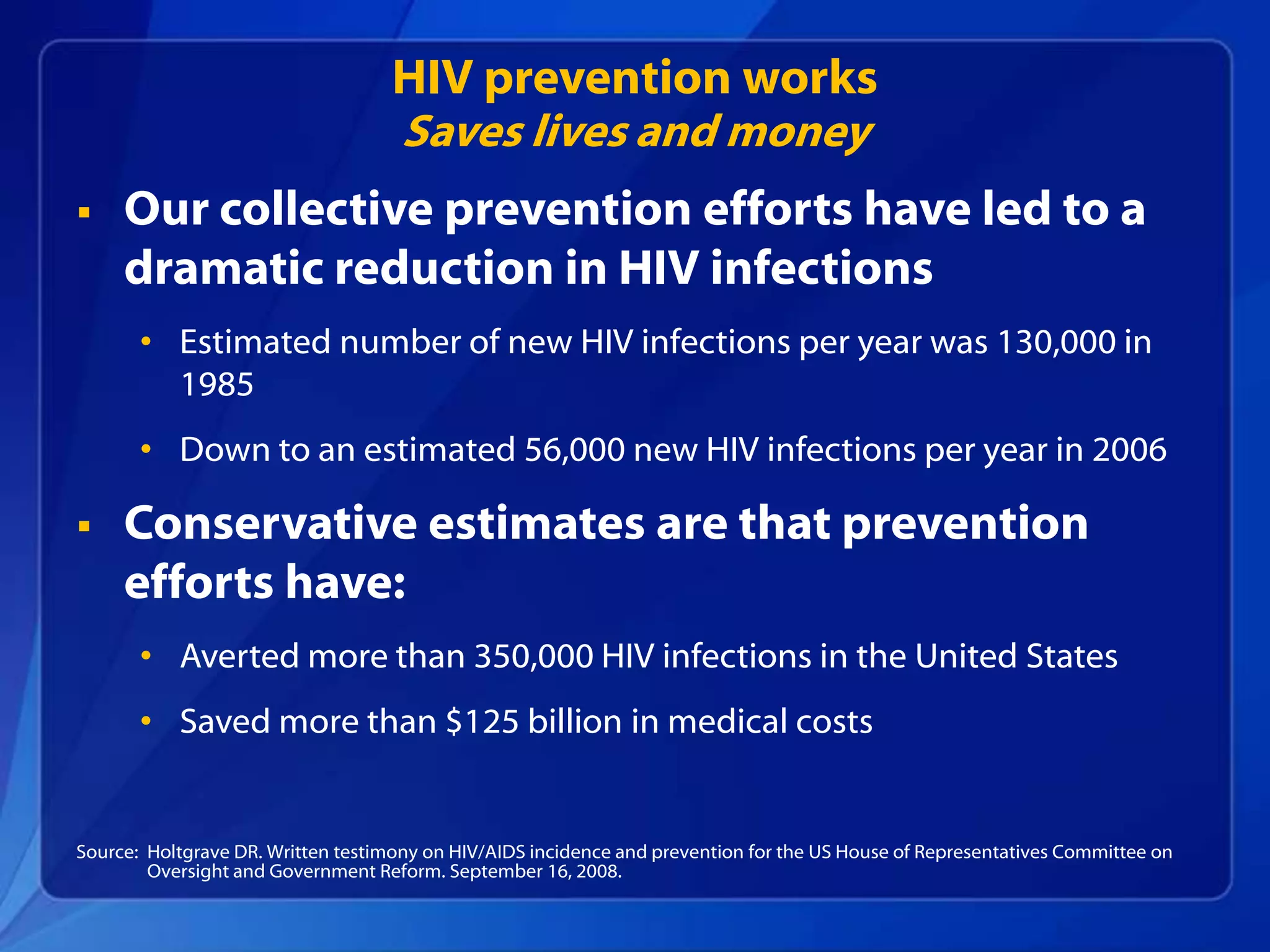
HIV prevention works
                                   Saves lives and money
    Our collective prevention efforts have led to a
     dramatic reduction in HIV infections
       • Estimated number of new HIV infections per year was 130,000 in
         1985
       • Down to an estimated 56,000 new HIV infections per year in 2006

    Conservative estimates are that prevention
     efforts have:
       • Averted more than 350,000 HIV infections in the United States
       • Saved more than $125 billion in medical costs


Source: Holtgrave DR. Written testimony on HIV/AIDS incidence and prevention for the US House of Representatives Committee on
        Oversight and Government Reform. September 16, 2008.
Key HIV prevention strategies
Promote:
   Abstinence (or delaying sex)
   Fewer sexual partners (ideally, monogamous
    relationship with an uninfected partner)
   Consistent and correct use of condoms
    (male/female)
   Not sharing syringes for injection drug use
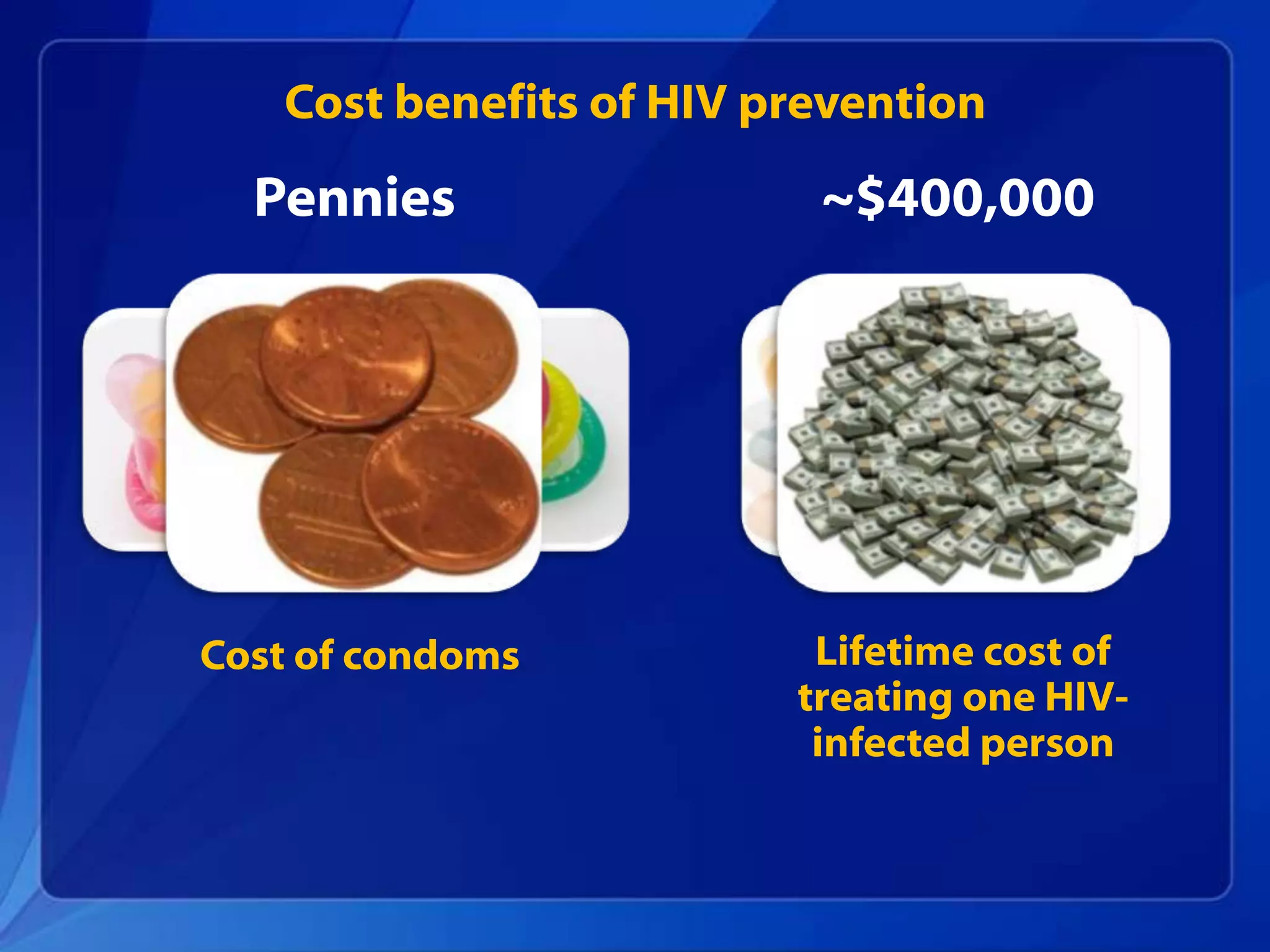
Cost benefits of HIV prevention
  Pennies                 ~$400,000


Cost of condoms           Lifetime cost of
                         treating one HIV-
                          infected person
Other HIV prevention strategies

   Antiretroviral drugs (ARVs):
    • To prevent perinatal
      transmission
    • To reduce infectiousness
    • To prevent new infections (as
      Pre-Exposure Prophylaxis
      [PrEP])
   Male circumcision
    • To reduce risk of HIV infection
      through penile-vaginal sex
Pre-Exposure Prophylaxis (PrEP)

      Potential users: HIV-uninfected persons at high
       risk of becoming infected
         • High risk may include sexual partner who has HIV, multiple
           partners, frequent STDs, or other evidence of high risk
         • Recent trial demonstrates the safety and efficacy of PrEP for MSM
           at high risk

      Cost-effectiveness depends on:
         •   HIV incidence in target groups
         •   Cost of medication and services
         •   Ability to maintain or increase existing risk reduction behavior
         •   Adherence to medication
         •   $34,000-$320,000 per QALY saved

Source: Paltiel et al. CID 2009:48(6):806-816 Smith, et al. MMWR 2011:60(03);65-68
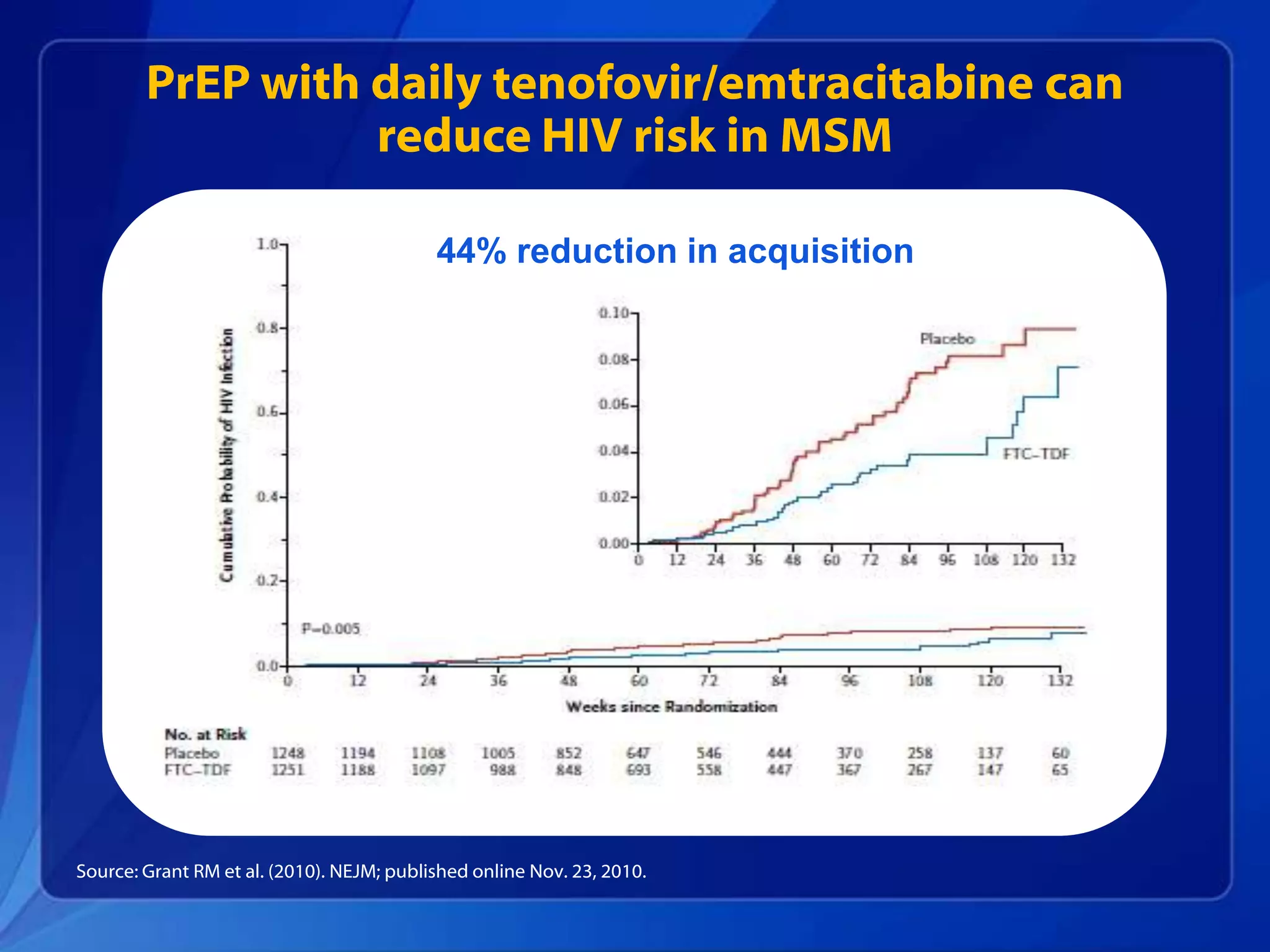
PrEP with daily tenofovir/emtracitabine can
                  reduce HIV risk in MSM

                                           44% reduction in acquisition


Source: Grant RM et al. (2010). NEJM; published online Nov. 23, 2010.
Policy, Systems, and Environmental Change
       Integrating Prevention and Healthcare
Policy development and support
   Guidelines and recommendations (testing, prevention
    with positives, ART)
   Quality measures: Development and uptake
   Reimbursement coding guidance
Policy, Systems, and Environmental Change
        Integrating Prevention and Healthcare
New programs and models
   Expanded Testing Initiative: 30 jurisdictions covering
    >90% of epidemic
    • Over 2.6 million HIV tests conducted; 27,000 HIV infections
      diagnosed

   Enhanced HIV Prevention Planning: 12 urban areas
    covering 44% of epidemic
    • Integrating HIV prevention, care, treatment services across health
      care system and community
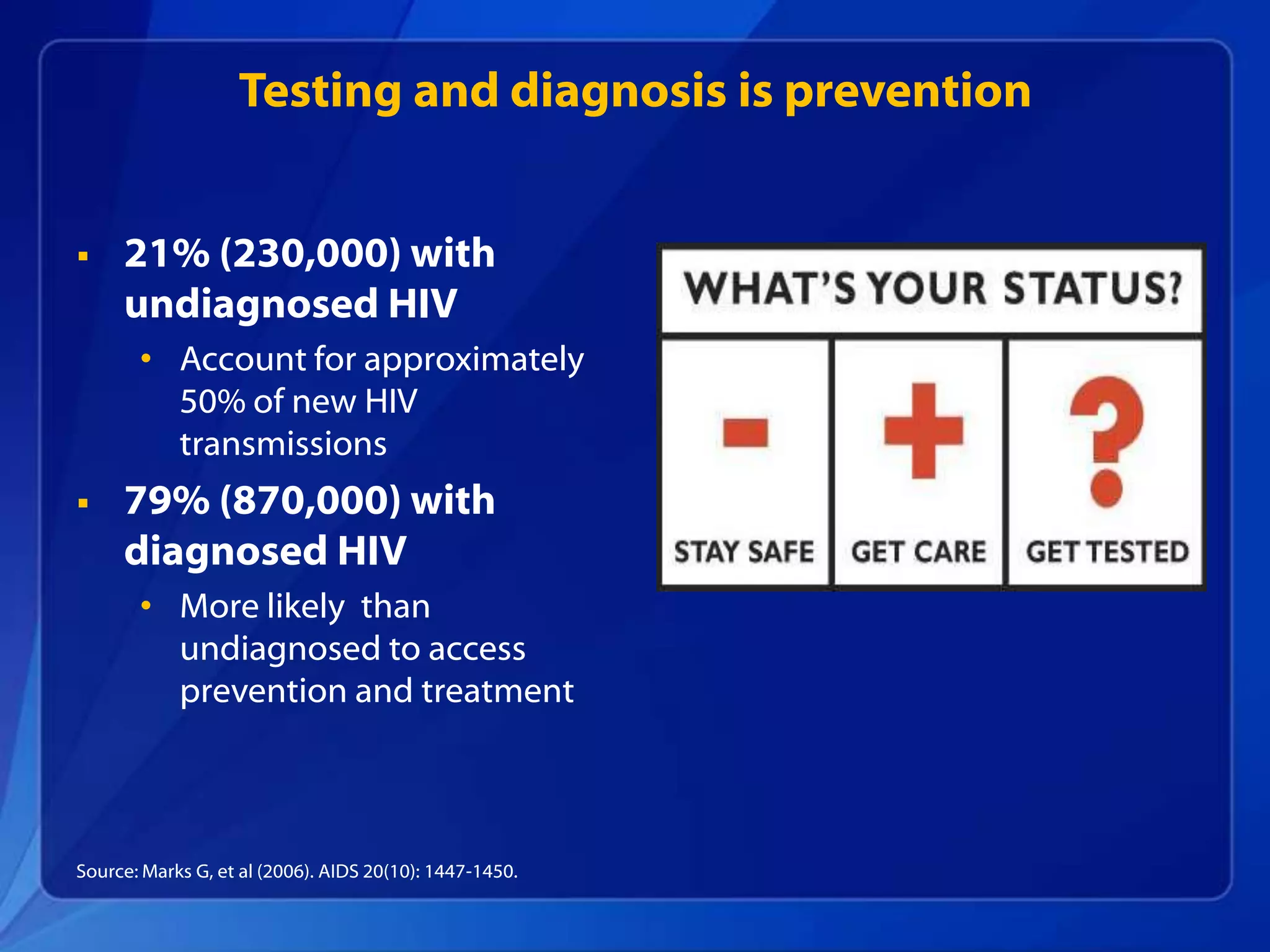
Testing and diagnosis is prevention


    21% (230,000) with
     undiagnosed HIV
       • Account for approximately
         50% of new HIV
         transmissions
    79% (870,000) with
     diagnosed HIV
       • More likely than
         undiagnosed to access
         prevention and treatment


Source: Marks G, et al (2006). AIDS 20(10): 1447-1450.
HIV testing is a prevention strategy
    CDC’s 2006 HIV Testing Recommendations for Health
     Care Settings
       • Promote routine screening of patients age 13-64


               Routine, opt-out screening in clinical settings
                   costs $2,000-$6,000 per HIV diagnosis
                                  confirmed


Source: Campsmith M et al. (2010). JAIDS 53:619--24.
Key approaches and program considerations in
                  HIV prevention
   HIV testing and linkage to care
   Prevention with positives
   Policy and structural interventions
   Targeted interventions
   Surveillance, monitoring, and evaluation
   Evidence-based planning
   Health equity
   Health reform
   Program collaboration and service integration
Focusing resources
   Burden of disease
    • Geographic distribution
    • Groups disproportionately affected by HIV (MSM, African
      Americans, Latinos, injection drug users)
   HIV prevention services
    • For people living with HIV
    • For people at high risk for HIV infection
   Monitoring the epidemic, sharing, and using
    information
   Discovering and operationalizing new interventions
Maximizing impact
   Target programs to people and geographic areas most
    at risk for transmission or acquisition
   Focus on interventions with evidence for large effect
    size
   Choose feasible efforts with potential for large-scale
    implementation
―The United States will become a place where new HIV
infections are rare and when they do occur, every
person, regardless of age, gender, race/ethnicity, sexual
orientation, gender identity or socio-economic
circumstance, will have unfettered access to high
quality, life-extending care, free from stigma and
discrimination.‖
               —Vision of the National HIV/AIDS Strategy

HIV Winnable Battle presentation

  • 1.
    HIV Prevention Centers forDisease Control and Prevention
  • 2.
    Burden of HIVin the United States  1.1 million people living with HIV  Net increase of 40,000 people with HIV infections each year  56,000 new infections (2006)  16,000 deaths (2006)  HIV infected people who start antiretroviral treatment (ART) are now expected to live at least an additional 35 years  Lifetime treatment costs of ~$400,000
  • 3.
    Number of peopleliving with HIV continues to increase sharply HIV Incidence and Prevalence, United States, 1977–2006 1,200,000 New HIV Infections (Incidence) 1,000,000 People Living With HIV/AIDS (Prevalence) 800,000 600,000 400,000 200,000 0 1977 1978 1979 1980 1981 1982 1983 1984 1985 1986 1987 1988 1989 1990 1991 1992 1993 1994 1995 1996 1997 1998 1999 2000 2001 2002 2003 2004 2005 2006 JAMA 2008;300(5):520-529.Campsmith M, et al. CROI 2009.
  • 4.
    Stark disparities inHIV/AIDS among different groups  95% of people with AIDS are MSM, African American, Latino, or IDU  African Americans are 8 times more likely than whites to have HIV  Latinos are 3 times more likely to have HIV than whites  MSM are >40 times more likely to have HIV than other men and women CDC, HIV Surveillance Report,2008. Published June 2010. www.cdc.gov/hiv/surveillance/resources/reports MSM = Men having sex with men IDU = Intravenous drug users
  • 5.
    From 2005-2008, thepercentage of HIV diagnoses attributed to male-to-male sexual contact increased — 37 states and 5 U.S. dependent areas Note: Data include adults and adolescents with a diagnosis of HIV infection regardless of stage of disease at diagnosis. Data from 37 states and 5 U.S. dependent areas with confidential name-based HIV infection reporting since at least January 2005. All displayed data have been estimated. Estimated numbers resulted from statistical adjustment that accounted for reporting delays and missing risk-factor information, but not for incomplete reporting. 1Heterosexual contact with a person known to have, or to be at high risk for, HIV infection. 2 Includes hemophilia, blood transfusion, perinatal exposure, and risk factor not reported or not identified.
  • 6.
    In 2008, themajority of HIV diagnoses among males were attributed to male-to-male sexual contact; among females the majority were attributed to heterosexual contact — 37 states and 5 U.S. dependent areas Males N=31,595 4% 15% 72% Note: Data include adults and adolescents with a diagnosis of HIV infection regardless of stage of disease at diagnosis. Data from 37 states and 5 U.S. dependent areas with confidential name-based HIV infection reporting since at least January 2005. All displayed data have been estimated. Estimated numbers resulted from statistical adjustment that accounted for reporting delays and missing risk-factor information, but not for incomplete reporting. a Heterosexual contact with a person known to have, or to be at high risk for, HIV infection. b Includes hemophilia, blood transfusion, perinatal exposure, and risk factor not reported or not identified.
  • 7.
    From 2005-2008, thepercentage of HIV diagnoses increased among Blacks/African Americans – 37 states and 5 U.S. dependent areas ,% Note: Data include adults and adolescents with a diagnosis of HIV infection regardless of stage of disease at diagnosis. Data from 37 states and 5 U.S. dependent areas with confidential name-based HIV infection reporting since at least January 2005. All displayed data have been estimated. Estimated numbers resulted from statistical adjustment that accounted for reporting delays, but not for incomplete reporting. a Hispanics/Latinos can be of any race.
  • 8.
    HIV prevention works Saves lives and money  Our collective prevention efforts have led to a dramatic reduction in HIV infections • Estimated number of new HIV infections per year was 130,000 in 1985 • Down to an estimated 56,000 new HIV infections per year in 2006  Conservative estimates are that prevention efforts have: • Averted more than 350,000 HIV infections in the United States • Saved more than $125 billion in medical costs Source: Holtgrave DR. Written testimony on HIV/AIDS incidence and prevention for the US House of Representatives Committee on Oversight and Government Reform. September 16, 2008.
  • 9.
    Key HIV preventionstrategies Promote:  Abstinence (or delaying sex)  Fewer sexual partners (ideally, monogamous relationship with an uninfected partner)  Consistent and correct use of condoms (male/female)  Not sharing syringes for injection drug use
  • 10.
    Cost benefits ofHIV prevention Pennies ~$400,000 Cost of condoms Lifetime cost of treating one HIV- infected person
  • 11.
    Other HIV preventionstrategies  Antiretroviral drugs (ARVs): • To prevent perinatal transmission • To reduce infectiousness • To prevent new infections (as Pre-Exposure Prophylaxis [PrEP])  Male circumcision • To reduce risk of HIV infection through penile-vaginal sex
  • 12.
    Pre-Exposure Prophylaxis (PrEP)  Potential users: HIV-uninfected persons at high risk of becoming infected • High risk may include sexual partner who has HIV, multiple partners, frequent STDs, or other evidence of high risk • Recent trial demonstrates the safety and efficacy of PrEP for MSM at high risk  Cost-effectiveness depends on: • HIV incidence in target groups • Cost of medication and services • Ability to maintain or increase existing risk reduction behavior • Adherence to medication • $34,000-$320,000 per QALY saved Source: Paltiel et al. CID 2009:48(6):806-816 Smith, et al. MMWR 2011:60(03);65-68
  • 13.
    PrEP with dailytenofovir/emtracitabine can reduce HIV risk in MSM 44% reduction in acquisition Source: Grant RM et al. (2010). NEJM; published online Nov. 23, 2010.
  • 14.
    Policy, Systems, andEnvironmental Change Integrating Prevention and Healthcare Policy development and support  Guidelines and recommendations (testing, prevention with positives, ART)  Quality measures: Development and uptake  Reimbursement coding guidance
  • 15.
    Policy, Systems, andEnvironmental Change Integrating Prevention and Healthcare New programs and models  Expanded Testing Initiative: 30 jurisdictions covering >90% of epidemic • Over 2.6 million HIV tests conducted; 27,000 HIV infections diagnosed  Enhanced HIV Prevention Planning: 12 urban areas covering 44% of epidemic • Integrating HIV prevention, care, treatment services across health care system and community
  • 16.
    Testing and diagnosisis prevention  21% (230,000) with undiagnosed HIV • Account for approximately 50% of new HIV transmissions  79% (870,000) with diagnosed HIV • More likely than undiagnosed to access prevention and treatment Source: Marks G, et al (2006). AIDS 20(10): 1447-1450.
  • 17.
    HIV testing isa prevention strategy  CDC’s 2006 HIV Testing Recommendations for Health Care Settings • Promote routine screening of patients age 13-64 Routine, opt-out screening in clinical settings costs $2,000-$6,000 per HIV diagnosis confirmed Source: Campsmith M et al. (2010). JAIDS 53:619--24.
  • 18.
    Key approaches andprogram considerations in HIV prevention  HIV testing and linkage to care  Prevention with positives  Policy and structural interventions  Targeted interventions  Surveillance, monitoring, and evaluation  Evidence-based planning  Health equity  Health reform  Program collaboration and service integration
  • 19.
    Focusing resources  Burden of disease • Geographic distribution • Groups disproportionately affected by HIV (MSM, African Americans, Latinos, injection drug users)  HIV prevention services • For people living with HIV • For people at high risk for HIV infection  Monitoring the epidemic, sharing, and using information  Discovering and operationalizing new interventions
  • 20.
    Maximizing impact  Target programs to people and geographic areas most at risk for transmission or acquisition  Focus on interventions with evidence for large effect size  Choose feasible efforts with potential for large-scale implementation
  • 21.
    ―The United Stateswill become a place where new HIV infections are rare and when they do occur, every person, regardless of age, gender, race/ethnicity, sexual orientation, gender identity or socio-economic circumstance, will have unfettered access to high quality, life-extending care, free from stigma and discrimination.‖ —Vision of the National HIV/AIDS Strategy

Editor's Notes

  • #4 Chart description: HIV incidence and prevalence in the United States, 1977-2006. The number of people living with HIV/AIDS (prevalence) in 1977 was 600. In 1978, it was 1,200. In 1979, it was 1,800. In 1980, it was 22,000. In 1981, it was 42,000. In 1982, it was 106,000. In 1983, it was 170,000. In 1984, 297,000. In 1985, it was 420,000. In 1986, it was 493,000. In 1987, it was 562,000. In 1988, it was 625,000. In 1989, it was 683,000. In 1990, it was 735,000. In 1991, it was 748,000. In 1992, it was 754,000. In 1993, it was 757,000. In 1994, it was 754,000. In 1995, it was 750,000. In 1996, it was 759,000. In 1997, it was 792,000. In 1998, it was 827,000. In 1999, it was 863,000. In 2000, it was 897,000. In 2001, it was 929,000. In 2002, it was 961,000. In 2003, it was 994,000. In 2004, it was 1,031,000. In 2005, it was 1,067,000. In 2006, it was 1,107,000. The number of new HIV infections (incidence) in 1977 was 600. In 1978, it was 600. In 1979, it was 600. In 1980, it was 20,000. In 1981, it was 20,000. In 1982, it was 64,900. In 1983, it was 64,900. In 1984, 130,400. In 1985, it was 130,400. In 1986, it was 84,800. In 1987, it was 84,800. In 1988, it was 84,800. In 1989, it was 84,200. In 1990, it was 84,200. In 1991, it was 48,700. In 1992, it was 48,700. In 1993, it was 48,700. In 1994, it was 48,800. In 1995, it was 48,800. In 1996, it was 48,800. In 1997, it was 58,400. In 1998, it was 58,400. In 1999, it was 58,400. In 2000, it was 55,300. In 2001, it was 55,300. In 2002, it was 55,300. In 2003, it was 55,400. In 2004, it was 55,400. In 2005, it was 55,400. In 2006, it was 55,400.
  • #6 Diagnoses of HIV Infection among Adults and Adolescents, by Transmission Category, 2005–2008—37 States and 5 U.S. Dependent AreasThis slide presents the distribution of diagnoses of HIV infection among adults and adolescents diagnosed from 2005 through 2008, by transmission category, for 37 states and 5 U.S. dependent areas with confidential name-based HIV infection reporting since at least January 2005. The percentage of diagnoses of HIV infection among adults and adolescents exposed through male-to-male sexual contact increased from 50% in 2005 to 54% in 2008. The percentage of diagnoses of HIV infection among adults and adolescents exposed through heterosexual contact remained stable during this time. The percentage of diagnoses among adults and adolescents exposed through injection drug use and through male-to-male sexual contact and injection drug use decreased from 2005 through 2008. The remaining diagnoses of HIV infection were those attributed to hemophilia or the receipt of blood or blood products, and those in persons without an identified risk factor. The following 37 states have had laws or regulations requiring confidential name-based HIV infection reporting since at least January 2005: Alabama, Alaska, Arizona, Arkansas, Colorado, Connecticut, Florida, Georgia, Idaho, Indiana, Iowa, Kansas, Kentucky, Louisiana, Michigan, Minnesota, Mississippi, Missouri, Nebraska, Nevada, New Hampshire, New Jersey, New Mexico, New York, North Carolina, North Dakota, Ohio, Oklahoma, South Carolina, South Dakota, Tennessee, Texas, Utah, Virginia, West Virginia, Wisconsin, and Wyoming. The 5 U.S. dependent areas include American Samoa, Guam, the Northern Mariana Islands, Puerto Rico and the U.S. Virgin Islands.Data include persons with a diagnosis of HIV infection regardless of stage of disease at diagnosis. All displayed data have been estimated. Estimated numbers resulted from statistical adjustment that accounted for reporting delays and missing risk-factor information, but not for incomplete reporting. Heterosexual contact is with a person known to have or to be at high risk for HIV infection. Note. Data include persons with a diagnosis of HIV infection regardless of stage of disease at diagnosis. Data from 37 states and 5 U.S. dependent areas with confidential name-based HIV infection reporting since at least January 2005. All displayed data have been estimated. Estimated numbers resulted from statistical adjustment that accounted for reporting delays and missing risk-factor information, but not for incomplete reporting. a Heterosexual contact with a person known to have, or to be at high risk for, HIV infection. b Includes hemophilia, blood transfusion, perinatal exposure, and risk factor not reported or not identified.
  • #7 Chart description:Diagnoses of HIV Infection among Adults and Adolescents, by Sex and Transmission Category, 2008—37 States and 5 U.S. Dependent AreasIn 2008, among male adults and adolescents diagnosed with HIV infection in the 37 states and 5 U.S. dependent areas with confidential name-based HIV infection reporting since at least January 2005, 72% were attributed to male-to-male sexual contact and 9% were attributed to injection drug use. Approximately 15% of cases were attributed to heterosexual contact and 4% attributed to male-to-male sexual contact and injection drug use. Most (84%) of the diagnoses of HIV infection among female adults and adolescents were attributed to heterosexual contact, and 15% were attributed to injection drug use.  The following 37 states have had laws or regulations requiring confidential name-based HIV infection reporting since at least January 2005: Alabama, Alaska, Arizona, Arkansas, Colorado, Connecticut, Florida, Georgia, Idaho, Indiana, Iowa, Kansas, Kentucky, Louisiana, Michigan, Minnesota, Mississippi, Missouri, Nebraska, Nevada, New Hampshire, New Jersey, New Mexico, New York, North Carolina, North Dakota, Ohio, Oklahoma, South Carolina, South Dakota, Tennessee, Texas, Utah, Virginia, West Virginia, Wisconsin, and Wyoming. The 5 U.S. dependent areas include American Samoa, Guam, the Northern Mariana Islands, Puerto Rico and the U.S. Virgin Islands.Data include persons with a diagnosis of HIV infection regardless of stage of disease at diagnosis. All displayed data have been estimated. Estimated numbers resulted from statistical adjustment that accounted for reporting delays and missing risk-factor information, but not for incomplete reporting. Heterosexual contact is with a person known to have or to be at high risk for HIV infection.Note. Data include persons with a diagnosis of HIV infection regardless of stage of disease at diagnosis. Data from 37 states and 5 U.S. dependent areas with confidential name-based HIV infection reporting since at least January 2005. All displayed data have been estimated. Estimated numbers resulted from statistical adjustment that accounted for reporting delays and missing risk-factor information, but not for incomplete reporting. a Heterosexual contact with a person known to have, or to be at high risk for, HIV infection. b Includes hemophilia, blood transfusion, perinatal exposure, and risk factor not reported or not identified.
  • #8 Chart description: Diagnoses of HIV Infection among Adults and Adolescents, by Race/Ethnicity, 2005–2008—37 States and 5 U.S. Dependent Areas From 2005-2008, blacks/African Americans constituted the largest percentage of diagnoses of HIV infection each year. In 2008, of adults and adolescents diagnosed with HIV infection in 37 states and 5 U.S. dependent areas with confidential name-based HIV infection reporting since at least January 2005, 50% were black/African American, 28% were white, 20% were Hispanic/Latino, 1% were Asian, 1% were of multiple races, and less than 1% each were American Indian/Alaska Native and Native Hawaiian/other Pacific Islander.  The following 37 states have had laws or regulations requiring confidential name-based HIV infection reporting since at least January 2005: Alabama, Alaska, Arizona, Arkansas, Colorado, Connecticut, Florida, Georgia, Idaho, Indiana, Iowa, Kansas, Kentucky, Louisiana, Michigan, Minnesota, Mississippi, Missouri, Nebraska, Nevada, New Hampshire, New Jersey, New Mexico, New York, North Carolina, North Dakota, Ohio, Oklahoma, South Carolina, South Dakota, Tennessee, Texas, Utah, Virginia, West Virginia, Wisconsin, and Wyoming. The 5 U.S. dependent areas include American Samoa, Guam, the Northern Mariana Islands, Puerto Rico and the U.S. Virgin Islands.Data include persons with a diagnosis of HIV infection regardless of stage of disease at diagnosis. All displayed data have been estimated. Estimated numbers resulted from statistical adjustment that accounted for reporting delays, but not for incomplete reporting.  Hispanics/Latinos can be of any race. Note. Data include persons with a diagnosis of HIV infection regardless of stage of disease at diagnosis. Data from 37 states and 5 U.S. dependent areas with confidential name-based HIV infection reporting since at least January 2005. All displayed data have been estimated. Estimated numbers resulted from statistical adjustment that accounted for reporting delays, but not for incomplete reporting. a Hispanics/Latinos can be of any race.
  • #14 The chart shows a 44% reduction in acquisition for men who have sex with men (MSM) with the use of Pre-Exposure Prophylaxis with daily tenofovir/emtracitabine use